What's inside
- Key Takeaways
- Quick Picks
- How We Chose These Picks
- How Does Frost-Free Operation Actually Work?
- The Line-Up Compared: Size, Defrost Wording and Placement
- Frost-Free Versus Manual Defrost: Which Suits Your Life?
- How Should You Load a Frost-Free Upright?
- Which Frost-Free Buying Mistakes Should You Avoid?
- What Happens Inside During an Automatic Defrost Cycle?
- Frost-Free in Second Homes, Rentals and Shared Houses
- A Light-Touch Care Calendar for a Cabinet That Defrosts Itself
- Choosing Your Size on the 11-to-21 Ladder
- The Convertible Year: One Cabinet, Four Seasons
- What a Year of Neglect Does to a Manual Cabinet
- Final Recommendation
- Frequently Asked Questions
- Related Guides
As an Amazon Associate I earn from qualifying purchases. This post may contain affiliate links at no extra cost to you.
**cottageverdict.com is reader-supported. When you buy through links on our site, we may earn an affiliate commission.**
Where to buy: each model in this guide to the best frost-free freezers is linked to its Amazon listing from the Quick Picks table and from its review heading, where you can check price on Amazon and confirm the current finish, shelving and door configuration before ordering.
Frost is a freezer’s slow tax. It creeps across walls and shelves a fraction at a time, stealing capacity, insulating the cold surfaces the cabinet depends on, and eventually demanding a full empty-out, a day of melting and a floor of towels. The best frost-free freezers refuse that bargain: their defrost systems clear the build-up automatically, in small cycles you never schedule, so the cabinet you buy is the cabinet you still have in year three. This guide compares six verified upright models whose own listings state frost-free or auto-defrost operation — three BLACK+DECKER convertibles that say Frost Free, an ICEVIVAL that describes frost-free cooling, and two Kenmore convertibles that say Auto Defrost. Those phrases are quoted from the listings and never extended: a manual-defrost model is not frostless, is never called frostless here, and no model in this guide is credited with a defrost system its listing does not claim.
The six picks share more than a defrost philosophy. Every one is a convertible upright that can run as a refrigerator or a freezer, and they span 11 to 21 cubic feet — the sizes where a household’s main frozen store actually lives. That combination, convertible plus frost-free, is the modern upright formula: one tall cabinet that adapts to the season and never asks for a defrosting weekend. If your current freezer’s interior resembles a glacier with shelves, this is the category that ends the archaeology.
Key Takeaways
- All six linked models state their defrost method in their own listings: Frost Free on the three BLACK+DECKER models, frost-free cooling on the ICEVIVAL, and Auto Defrost on the two Kenmore models.
- Every pick is a convertible freezer-refrigerator as listed, so each cabinet can change roles between frozen storage and fresh overflow.
- Capacities run from 11 to 21 cubic feet, covering second freezers and full family stores alike.
- Glass shelves appear across the BLACK+DECKER line as listed, while the Kenmore models state four shelves each.
- Garage Ready wording appears on the BLACK+DECKER 17, the ICEVIVAL 11 and both Kenmore models as listed — placement flexibility alongside the frost-free design.
- ENERGY STAR rating is stated on all three BLACK+DECKER listings and is claimed for no other model here, because no other listing states it.
Quick Picks
| Pick | Badge | Why it is here |
|---|---|---|
| BLACK+DECKER BUC1400XW 14 Cu Ft Convertible Freezer | Family-size frost-free | Fourteen cubic feet of frost-free, convertible storage with glass shelves and an ENERGY STAR rating as listed. |
| BLACK+DECKER BUC1100XW 11 Cu Ft Convertible Freezer | Compact line member | The 11 cubic foot entry to the same frost-free convertible line, with a reversible door as listed. |
| BLACK+DECKER BUC1700XS 17 Cu Ft Convertible Freezer | Garage-ready large | Seventeen cubic feet, frost-free and garage ready as listed, for households storing beyond the kitchen. |
| ICEVIVAL 11 Cu Ft Upright Freezer | Digital-control alternative | Frost-free cooling with digital control and four-in-one convertible modes in a garage-ready design. |
| Kenmore 14 Cu Ft Upright Freezer | Auto-defrost classic | A 14 cubic foot convertible with auto defrost, four shelves and garage-ready wording as listed. |
| Kenmore 21 Cu Ft Upright Freezer | Largest capacity | Twenty-one cubic feet of auto-defrost convertible storage for the biggest household stores. |
How We Chose These Picks
The entry ticket to this guide was a sentence, not a feature category: the model’s own listing had to state frost-free or auto-defrost operation. That rule excluded every manual-defrost upright we encountered, including good ones, because a guide to frostless freezers that quietly includes a manual-defrost model teaches its readers to stop trusting the label. It also shaped the language of every review below — each pick’s defrost description is its listing’s description, whether that is the capitalised Frost Free of the BLACK+DECKER line, the frost-free cooling of the ICEVIVAL, or the Auto Defrost of the Kenmore pair.
Beyond the ticket, we looked for the pattern of the modern upright: convertible operation, because a cabinet that can become a refrigerator answers more of a household’s year; a capacity ladder, because frost-free matters at 11 cubic feet and at 21 for entirely different households; and placement honesty, noting Garage Ready wording exactly where listings state it. The result is two brand families with different accents — BLACK+DECKER’s glass-shelved, ENERGY STAR rated line, Kenmore’s larger four-shelf convertibles — plus the ICEVIVAL as the digital-control alternative at the compact end.
One more discipline deserves stating. Frost-free is sometimes used loosely in shopping conversation to mean any freezer that has not yet grown frost, the way a new car is briefly scratch-free. That is not what it means here, and it is not what these listings mean: it names a system that actively manages frost so the owner never performs a manual defrost. Readers comparing against the bulk-storage end of the freezer world will find the contrast drawn sharply in our guide to Best 20 Cu Ft Chest Freezers, where the big chests follow a different, manual tradition of cold storage and are honest about it.
How Does Frost-Free Operation Actually Work?
A frost-free cabinet fights frost with rhythm rather than heroics. Inside, a fan circulates cold air over the food instead of letting it settle from static cold walls, which evens the temperature and dries the air’s habit of depositing ice wherever it lands. Periodically, on a cycle the owner never schedules, a heating element briefly warms the evaporator coils — the one place frost is allowed to gather — and melts the accumulation away as water that drains and evaporates. The food barely notices these short cycles; the owner notices only that the walls stay clear, the shelves stay usable and the capacity printed on the box remains the capacity in the kitchen.
Auto defrost, the Kenmore listings’ phrase, describes the same family of behaviour from the owner’s side of the door: defrosting happens automatically, without the empty-out ritual. Different makers name their systems differently, tune their cycles differently and arrange their fans and drains differently, which is why this guide quotes each listing’s own words instead of translating them all into one claim. What unites the six models is the outcome promised in their listings — no manual defrosting — and what divides them is everything else: size, shelving, controls and placement.
The trade-offs of the design are real and worth naming. A fan-circulated cabinet moves air across food constantly, so packaging discipline matters: wrap well and seal tightly, because moving cold air draws moisture from exposed surfaces over long storage. Frost-free systems also carry more components than a static manual cabinet, which is the price of the convenience. Against those costs stands the central fact that manual defrosting, in real households, happens rarely and late — after frost has already taxed capacity and efficiency for months. A system that defrosts itself on schedule beats a chore that waits for motivation.

BLACK+DECKER BUC1400XW 14 Cu Ft Convertible Freezer — Family-size frost-free
Fourteen cubic feet is the size at which an upright becomes a family’s main frozen store, and the BUC1400XW is this guide’s reference point for that class: a white convertible freezer-refrigerator with glass shelves, an ENERGY STAR rating as listed, and Frost Free stated in its title. Glass shelves suit a family store well — they contain spills on one level instead of letting them rain through wire onto the food below, they wipe clean in seconds, and they make the cabinet’s contents read clearly under the interior light, which shortens every rummage.
The convertible design earns its place across the year. In freezer mode it is the household’s bulk anchor: batch cooking, market gluts and the holiday bird all live here. Switched to refrigerator mode — a planned change, with the cabinet emptied and re-planned — it becomes party overflow, a drinks cabinet, or fresh storage during a kitchen renovation. Frost-free operation in both modes means neither role ever inherits a glacier from the other, and the ENERGY STAR rating as listed speaks to the efficiency of a cabinet that will run every hour of every day in one mode or the other.
Place it where a main store belongs: against the kitchen or utility wall it will serve daily, level, with room for the door to open fully so shelves can be loaded without choreography. Families upgrading from a manual-defrost upright will feel the difference in the first month — not in any single dramatic moment, but in the absence of one: the defrost weekend that never gets scheduled because it never needs to be.
- Capacity as listed: 14 cu ft
- Modes as listed: convertible freezer refrigerator
- Defrost as listed: Frost Free
- Efficiency as listed: ENERGY STAR rated
- Shelving as listed: glass shelves
- Finish as listed: white
- Where to buy: the BLACK+DECKER BUC1400XW listing on Amazon — check price on Amazon
Strengths
- The complete modern formula — frost-free, convertible, glass shelves — at the classic family size.
- ENERGY STAR rating stated in the listing for an always-on appliance.
- Glass shelving contains spills and makes contents easy to survey.
Trade-offs
- No garage-ready wording appears in this listing, unlike its 17 cu ft sibling.
- Convertible changes still require an empty-and-replan day each time.
- Fan-circulated frost-free storage rewards well-sealed packaging on long-stored items.
Best for: families wanting one frost-free upright as their main frozen store, with fridge conversion in reserve.
Not suited for: garage placement shoppers who need the garage-ready description stated — the 17 cu ft model carries it.

BLACK+DECKER BUC1100XW 11 Cu Ft Convertible Freezer — Compact line member
The BUC1100XW brings the same formula down a size: 11 cubic feet, convertible freezer-refrigerator operation, glass shelves, a reversible door, an ENERGY STAR rating and Frost Free, all as listed, in white. Eleven cubic feet is the second-freezer size — the cabinet that stands beside the fridge-freezer and takes everything it cannot: the batch cooking, the market offers, the ice-cream economy of a household with children. In frost-free form it asks nothing of its owners but loading and unloading, which is exactly what a second freezer should ask.
The reversible door is a small feature with outsized placement value. Second freezers live in leftover spaces — the end of a utility run, a wide hallway, the corner by the back door — and those spaces have opinions about which way a door should swing. A door that can be rehung to match the room removes the commonest reason a compact upright ends up in the wrong place, worked around for years. Pair that with the glass shelves and the cabinet behaves like a piece of kitchen furniture rather than a utility box wherever it lands.
Choose this size honestly. A household of two or three, or a larger household whose fridge-freezer still carries the daily load, will find 11 cubic feet generous. A bulk-buying family of six will fill it by autumn and start negotiating with the kitchen freezer again — for them, the 14 and 17 cubic foot models in this guide exist. Within its class, the BUC1100XW is the complete package: the line’s frost-free convertible design, its efficiency rating, and its most flexible door, at the line’s most placeable size.
- Capacity as listed: 11 cu ft
- Modes as listed: convertible freezer refrigerator
- Defrost as listed: Frost Free
- Efficiency as listed: ENERGY STAR rated
- Shelving as listed: glass shelves
- Door as listed: reversible
- Finish as listed: white
- Where to buy: the BLACK+DECKER BUC1100XW listing on Amazon — check price on Amazon
Strengths
- Full frost-free convertible specification at a second-freezer size.
- Reversible door fits awkward leftover spaces without compromise.
- ENERGY STAR rating stated, suiting an always-on overflow role.
Trade-offs
- Eleven cubic feet is a ceiling bulk buyers will meet quickly.
- No garage-ready wording in this listing; check placement guidance on the product page for outbuildings.
- White finish only as listed, which may not match every kitchen’s scheme.
Best for: couples and small families adding a frost-free second freezer in a space with opinions about door swing.
A poor fit for: large households needing their main frozen store in a single cabinet.

BLACK+DECKER BUC1700XS 17 Cu Ft Convertible Freezer — Garage-ready large
The largest BLACK+DECKER in the line adds the placement freedom its siblings lack: 17 cubic feet, convertible operation, glass shelves, an ENERGY STAR rating, Frost Free and a Garage Ready description, all as listed. Seventeen cubic feet is serious household storage — a season of garden produce, a quarter’s batch cooking, a hunter’s or market-buyer’s reserve — and the garage-ready wording means that volume does not have to displace 17 cubic feet of kitchen to exist. It can stand in the garage or utility space where big cabinets belong, and work there through the room’s wider temperature swings as the maker describes.
Frost-free matters more, not less, in a garage cabinet. A kitchen freezer gets glanced at daily; a garage freezer may go unopened for a week and unexamined for a month, which is precisely how a manual-defrost cabinet quietly becomes an ice sculpture between visits. An automatic system keeps the interior honest without an audience. The convertible mode plays well out there too: the same cabinet can hold the holiday frozen store in December and switch to drinks and party refrigeration for a summer gathering, earning its floor space in both halves of the year.
The discipline this size demands is loading sense. Seventeen cubic feet invites the household to freeze ambitiously, and frost-free air circulation rewards those who package tightly and label honestly. Keep a simple map of what lives on which shelf, rotate new stock behind old, and the big cabinet stays a store rather than becoming a very cold cupboard of mysteries. For households whose volume has outgrown the kitchen, this is the guide’s natural flagship.
- Capacity as listed: 17 cu ft
- Modes as listed: convertible freezer refrigerator
- Defrost as listed: Frost Free
- Efficiency as listed: ENERGY STAR rated
- Shelving as listed: glass shelves
- Placement as listed: Garage Ready
- Where to buy: the BLACK+DECKER BUC1700XS listing on Amazon — check price on Amazon
Strengths
- The line’s largest capacity with its full frost-free, convertible specification.
- Garage Ready description frees the big cabinet from kitchen floor space.
- ENERGY STAR rating stated for a large always-on appliance.
Trade-offs
- A 17 cu ft cabinet needs a measured delivery route and a permanent position.
- Garage placement still requires a level, dry, sensibly powered spot.
- Its capacity tempts over-buying; a labelling system is not optional at this size.
Best for: high-volume households that want frost-free bulk storage outside the kitchen.
Not the right match for: small households whose real need is an 11 cu ft overflow cabinet.

ICEVIVAL 11 Cu Ft Upright Freezer — Digital-control alternative
The ICEVIVAL approaches the same 11 cubic foot brief from the control side: its listing describes a garage-ready stand-up freezer with four-in-one convertible modes, frost-free cooling and digital control, addressed to kitchen and basement storage. Digital control changes the owner’s relationship with the cabinet — a set temperature you can read and repeat, rather than a dial position you estimate — and for households that like their appliances explicit, that clarity is the reason to choose this model over a mechanically controlled rival of the same size.
The four-in-one convertible description suggests a cabinet designed to change jobs across the year, in the same spirit as the other convertibles here but with its modes presented as a headline feature. Combined with the garage-ready design as listed, the ICEVIVAL reads as the flexible modern option: kitchen, basement or garage, freezer or fridge modes, all supervised by a digital panel. Frost-free cooling, in the listing’s own phrase, completes the picture — the defrosting happens as part of the system’s normal operation.
At 11 cubic feet it competes directly with the BLACK+DECKER BUC1100XW, and the choice between them is a genuine fork: the BLACK+DECKER offers glass shelves, a reversible door and an ENERGY STAR rating as listed; the ICEVIVAL offers digital control, garage-ready wording and its four-mode conversion. Households that will place the cabinet in a basement or garage and value a readable control panel should lean ICEVIVAL; households placing it in the kitchen and valuing the stated efficiency rating should lean the other way. Either way, the frost-free promise that defines this guide is present in the listing’s own words.
- Capacity as listed: 11 cu ft
- Modes as listed: 4-in-1 convertible modes
- Defrost as listed: frost-free cooling
- Control as listed: digital control
- Placement as listed: Garage Ready design; kitchen and basement storage
- Where to buy: the ICEVIVAL 11 Cu Ft listing on Amazon — check price on Amazon
Strengths
- Digital control gives a readable, repeatable set point.
- Garage-ready design suits basement and garage placements as listed.
- Four-in-one convertible modes headline its flexibility across the year.
Trade-offs
- No ENERGY STAR claim appears in this listing, unlike the BLACK+DECKER line.
- Shelving material is not described in the listing provided; confirm on the product page.
- Digital panels are one more interface for households that prefer a simple dial.
Best for: buyers who want digital control and garage-ready placement at the 11 cubic foot size.
Poorly suited to: shoppers who rank a stated efficiency rating above control features.

Kenmore 14 Cu Ft Upright Freezer — Auto-defrost classic
Kenmore’s entry speaks a slightly different dialect: where the BLACK+DECKER line says Frost Free, this listing says Auto Defrost, and the guide keeps the distinction because the makers chose it. The stated package is a 14.0 cubic foot convertible refrigerator-freezer in white with four shelves, Garage Ready wording, meat storage among its named uses, and placement addressed to homes, apartments, cottages and basements. Four shelves across 14 cubic feet means tall, roomy levels — a configuration that suits households freezing joints, trays and boxed goods as much as small packages.
The cottage and basement addresses in the listing are worth taking seriously. A frost-free — in Kenmore’s words, auto-defrost — cabinet is the right freezer for a place you do not live in full-time: it manages its own frost between visits, so a cottage freezer opened after a month away presents food, not ice sculpture. The same logic serves basement storage in a main home, where the cabinet is visited weekly rather than daily. Meat storage being named in the listing aligns with the tall-shelf layout; this is a cabinet shaped for substantial items held properly cold and easy to survey.
Against the same-size BLACK+DECKER, the Kenmore trades glass shelves and a stated efficiency rating for garage-ready wording and its four-shelf layout. Households placing the freezer in the kitchen and counting running costs will lean one way; households placing it in a basement, garage or cottage will lean the other. Both are 14 cubic foot convertibles with automatic defrosting in their makers’ own words — the fork is about placement and shelving, and it is a fair one.
- Capacity as listed: 14.0 cu ft
- Modes as listed: convertible refrigerator/freezer
- Defrost as listed: Auto Defrost
- Shelving as listed: 4 shelves
- Placement as listed: Garage Ready; home, apartment, cottage, basement
- Finish as listed: white
- Where to buy: the Kenmore 14 Cu Ft listing on Amazon — check price on Amazon
Strengths
- Auto defrost plus garage-ready wording suits cottages and basements between visits.
- Four tall shelves handle joints, trays and boxes comfortably.
- Convertible operation gives the cabinet a refrigerator second role.
Trade-offs
- No efficiency rating is stated in this listing.
- Four shelves is coarse division for households freezing many small items.
- Shelf material is not specified in the listing provided.
Best for: households needing an auto-defrost store for a basement, garage or second home.
A weak match for: kitchen placements where a stated efficiency rating is the priority.
Kenmore 21 Cu Ft Upright Freezer — Largest capacity
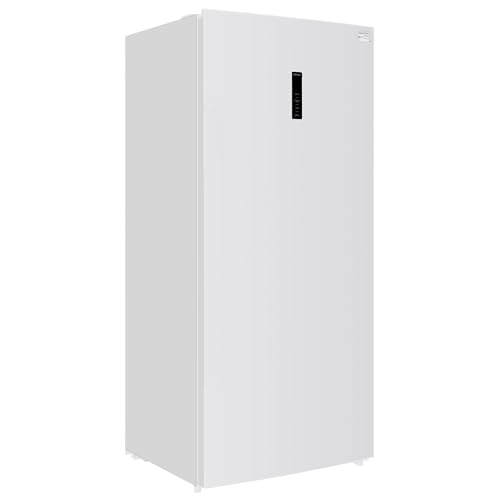
The biggest cabinet in the guide closes the ladder: 21.0 cubic feet of convertible, auto-defrost storage in white, with four shelves, Garage Ready wording, meat storage named, and an address list that runs from homes and apartments to cottages, basements and dorms. Twenty-one cubic feet is the territory of serious household provisioning — the family that buys in bulk, cooks in batches, gardens at scale or hunts — and at that scale automatic defrosting stops being a convenience and becomes a structural necessity, because manually defrosting 21 cubic feet means rehousing a small shop’s worth of food for a day.
Four shelves in 21 cubic feet are four very tall levels, and the loading strategy should match: dedicate levels by family of food, keep the heaviest items low, and use your own crates or boxes within a level to create the finer order the shelf count does not. The garage-ready description, as listed, keeps placement options open for a cabinet that will rarely fit a kitchen’s spare wall; basements and garages with level floors and sensible power are its natural homes. In refrigerator mode, the same volume becomes event-scale fresh storage — the kind of capacity that makes hosting a wedding weekend at home conceivable.
Buy this size with your eyes open about the commitment: the delivery route must accept it, the position must be permanent, and the household’s actual freezing volume must justify cooling 21 cubic feet every hour of the year. For the households that clear those bars, the Kenmore 21 is the guide’s capacity champion with its frost managed automatically — the largest store here, asking the least routine labour of any cabinet its size.
- Capacity as listed: 21.0 cu ft
- Modes as listed: convertible refrigerator/freezer
- Defrost as listed: Auto Defrost
- Shelving as listed: 4 shelves
- Placement as listed: Garage Ready; home, apartment, cottage, basement, dorm
- Finish as listed: white
- Where to buy: the Kenmore 21 Cu Ft listing on Amazon — check price on Amazon
Strengths
- The largest capacity in this guide with automatic defrosting as listed.
- Garage-ready wording supports basement and garage placement at full scale.
- Convertible volume doubles as event-scale refrigerator space.
Trade-offs
- Four shelves across 21 cu ft needs your own crates for fine organisation.
- Size demands a planned route, a permanent position and real volume to fill it.
- No efficiency rating is stated in the listing provided.
Best for: bulk-provisioning households that need the largest frost-managed store in this roundup.
Weakest fit: any home whose delivery route, floor space or actual volume cannot justify 21 cubic feet.
The Line-Up Compared: Size, Defrost Wording and Placement
| Model | Capacity | Defrost in listing’s words | Shelving as listed | Placement note as listed |
|---|---|---|---|---|
| BLACK+DECKER BUC1400XW | 14 cu ft | Frost Free | Glass shelves | ENERGY STAR rated |
| BLACK+DECKER BUC1100XW | 11 cu ft | Frost Free | Glass shelves | Reversible door; ENERGY STAR rated |
| BLACK+DECKER BUC1700XS | 17 cu ft | Frost Free | Glass shelves | Garage Ready; ENERGY STAR rated |
| ICEVIVAL | 11 cu ft | Frost-free cooling | Not stated in listing provided | Garage Ready design; digital control |
| Kenmore 14 | 14.0 cu ft | Auto Defrost | 4 shelves | Garage Ready |
| Kenmore 21 | 21.0 cu ft | Auto Defrost | 4 shelves | Garage Ready |
Frost-Free Versus Manual Defrost: Which Suits Your Life?
The honest comparison begins by admitting manual defrost has virtues: simpler machinery, a still and humid cold that some long-term storers prefer for loosely wrapped items, and — in the chest format especially — a talent for holding temperature through a power cut under a heavy lid. If you freeze whole animals, store for a year at a time and genuinely perform the defrost ritual twice a year without resentment, a manual cabinet can serve you well. The six models in this guide are not an argument that manual freezers are bad; they are an argument about what most households actually do.
What most households do is postpone. The defrost waits for a free weekend, a cool day, a time when the freezer is emptier — and in the waiting months, frost taxes the cabinet daily: capacity shrinks, the compressor works around insulation it did not ask for, and packages freeze into the landscape. Frost-free design simply removes the negotiation. The cabinet defrosts itself in small, scheduled moments, and the owner’s whole maintenance duty shrinks to seals, surfaces and sense. For uprights especially — tall cabinets whose every shelf is on display — that is the difference between an appliance that ages gracefully and one that slowly becomes a chore with a door.
There is an energy conversation here too, and it should be held honestly. This guide claims efficiency ratings only where listings state them — the BLACK+DECKER line carries ENERGY STAR wording — and makes no comparative promises for the others. Readers planning a wider kitchen refit alongside the freezer will find the same measure-first, claim-only-what-is-stated approach in our guide to Best Small Gas Wall Ovens, a category where honest scarcity matters just as much as it does here. The frost-free premium, where it exists, buys back the efficiency that unmanaged frost would have stolen anyway; the arithmetic favours the automatic cabinet in any household honest about its defrosting habits.
How Should You Load a Frost-Free Upright?
Air is the working fluid of a frost-free cabinet, so load for circulation. Leave small gaps between packages, keep the fan’s outlets unblocked by tall stacks, and resist the satisfying but costly urge to pack the cabinet into a solid block. Flat-frozen bags and boxes file efficiently and let air thread between them; loose round items waste the corners they roll into. A cabinet loaded at roughly three-quarters of its visual fullness freezes new additions faster and holds its temperature more evenly than one loaded to the seals.
Packaging is the second half of the craft. Moving cold air is dry air in effect, and exposed food surfaces surrender moisture to it over weeks — the familiar freezer-burn pattern. Wrap tightly, squeeze air from bags, seal containers properly, and treat packaging as part of the appliance rather than an afterthought. Label with contents and date, because a frost-free cabinet’s clarity makes a strict rotation easy to keep: new stock behind, old stock forward, a shelf-by-shelf glance whenever you add a shop. The system takes minutes and returns them every time you find exactly what you wanted with the door open for seconds, not minutes.
Temperature steadiness follows from habit. Set the control — dial or digital, as your model provides — to the setting your storage practice requires, then leave it alone; every adjustment restarts the cabinet’s settling. Open the door with a list in your head. Keep the seals clean and the door closing fully under its own weight. None of this is frost-free-specific so much as freezer-literate, but frost-free cabinets reward it most visibly, because their interiors stay clear enough for you to see your own system working.
Which Frost-Free Buying Mistakes Should You Avoid?
The first is believing the phrase wherever it floats. Frost-free is a system, not a mood, and it belongs only to models whose listings claim it — the discipline this guide has applied to every pick. A manual-defrost freezer bought under a frostless impression will announce the misunderstanding within a season. The second mistake is buying convertible and never planning the conversion: switching modes means emptying the cabinet and rehousing its contents, so households should know, before purchase, where 14 cubic feet of frozen food goes on conversion day — or accept that the cabinet will live its life in one mode, which is fine, but should be a decision rather than a surprise.
Third, shoppers ignore the kitchen’s wider plan. A frost-free upright often arrives during a broader refit, and its door swing, its finish and its running costs belong in the same reckoning as everything else — the way our guide to Best Energy-Saving Dishwashers insists on judging each appliance by its stated ratings within the whole kitchen’s energy budget rather than in isolation. Fourth, buyers fill a big frost-free cabinet with unwrapped, unlabelled food and blame the technology for the resulting freezer burn, when the true fault was packaging. Fifth, they forget the delivery route: 21 cubic feet of Kenmore does not turn corners by wishing. Measure first, and let the building eliminate what it cannot accept.
What Happens Inside During an Automatic Defrost Cycle?
Owners sometimes worry about the cycle they cannot see, so it is worth walking through it slowly. Several times in a typical day — the exact rhythm is the maker’s tuning, not a figure these listings print — the cabinet pauses its cooling, a heater warms the evaporator coil where frost has been encouraged to gather, and the thin accumulation melts, drains away through a channel and evaporates. The cabinet’s interior temperature rises only slightly and briefly, because the food’s own frozen mass is a reservoir of cold far larger than the cycle’s warmth. Then cooling resumes, the fan redistributes the cold, and the cabinet continues its day with clean coils.
Two practical consequences follow. First, the drain path is part of the appliance’s health: keep the cabinet level so meltwater travels where it was designed to go, and never block interior vents or drain areas with packaging pressed hard against the walls. Second, the faint sounds a frost-free cabinet makes — fan hum, occasional clicks and gurgles around a cycle — are the sounds of the system working, not failing. Households upgrading from a silent manual cabinet sometimes mistake this new soundscape for a fault in the first week. It is the opposite: it is the defrosting you no longer have to do, audible.
The cycle also explains why frost-free cabinets reward being kept reasonably full. A well-filled cabinet’s frozen mass smooths every small temperature ripple the cycles create, while a nearly empty cabinet has little thermal ballast. This is not a plea to buy food you do not need; it is the physics behind the old advice to fill spare space with bottles of water in a lightly used freezer. Ballast, good packaging and unblocked vents — the unglamorous trio that lets the automatic system do its best work.
Frost-Free in Second Homes, Rentals and Shared Houses
Some placements make the frost-free case overwhelming, and the Kenmore listings gesture at them with their cottage and dorm addresses. A second home visited monthly cannot be manually defrosted on any sane schedule; between visits, a manual cabinet’s frost simply compounds. An auto-defrost cabinet, by contrast, maintains itself in your absence, so arrival day begins with cooking rather than chipping. The same logic serves landlords furnishing rentals: a frost-free upright removes the single most neglected chore in tenant appliance care, protecting both the appliance and the deposit conversation at the end of the tenancy.
Shared houses make a different argument — the argument from diffusion of responsibility. In a house of five adults, the manual defrost belongs to everyone and therefore to no one, and the freezer’s interior records the negotiation. A frost-free cabinet dissolves the argument entirely; nobody’s chore, nobody’s grievance. University-area landlords and housemates alike have learned this, which is why the convertible frost-free format has become the default recommendation for any freezer whose users did not choose each other.
There is a budgeting corollary, stated qualitatively as this guide states all money matters. An automatic cabinet generally costs more to buy than a manual one of similar size, and returns the difference slowly in avoided spoilage, avoided defrost weekends and a longer useful life for the cabinet itself. For a primary home with a diligent owner, the sums can be argued either way. For a cottage, a rental or a shared house — anywhere the defrost would realistically never happen — the argument is not close, and frost-free is simply the correct specification.
A Light-Touch Care Calendar for a Cabinet That Defrosts Itself
Frost-free ownership is not maintenance-free ownership; it is maintenance reduced to the small and the regular. Weekly, wipe the door seals and check that the door closes fully without being pressed — a seal held ajar by a stray package will frost the cabinet’s edges and tax the system in exactly the place it cannot help itself. Keep the area in front of the door clear enough that it is never left resting against a box or a broom handle. These are thirty-second habits, and they protect the automatic system’s one vulnerability: it assumes the door is doing its job.
Monthly, look inside with an editor’s eye. Consolidate half-empty shelves, move the oldest stock forward, evict anything unlabelled while it can still be identified by memory, and confirm that no packaging has migrated against the fan outlets or the back wall. Check that the cabinet still stands level, especially in garages and basements where floors and stored clutter conspire to nudge appliances. A monthly five minutes is the entire price of keeping a frost-free store legible, and it doubles as your inventory.
Seasonally, clean properly. Frost-free cabinets still accumulate crumbs, spills and the odd escaped pea in their corners; a wipe-down with the shelves emptied one at a time — the food held in insulated bags for the few minutes involved — keeps the interior as clean as the frost-free promise keeps it clear. Inspect the seals for splits while you work, and note the cabinet’s general sounds so that a future change in its voice registers with you. Owners who keep this calendar rarely meet a freezer emergency, because their cabinet’s small problems surface during a scheduled five minutes rather than during a holiday weekend.
Keep the exterior in the same light routine. Dust the top and the accessible rear grille area as the maker’s guidance allows, since a cabinet that breathes dusty air works harder to move heat out of itself, and wipe the door front where hands actually land. In garages, sweep the cabinet’s immediate floor patch when you sweep the bay; grit under a door’s swing arc is a small, stupid cause of seal damage. None of this asks for products, tools or expertise — only for the freezer to be included in the house’s ordinary rounds, as a citizen rather than an afterthought.
Choosing Your Size on the 11-to-21 Ladder
Work backwards from the shop you actually do. A fortnightly market shop for a couple, plus batch cooking, lives comfortably in 11 cubic feet — the BUC1100XW or the ICEVIVAL, chosen by whether a reversible door and stated efficiency or digital control and garage-ready design matter more to your placement. A family shop with a garden behind it wants the 14 cubic foot class, where the BLACK+DECKER’s glass shelves and rating face the Kenmore’s tall shelves and garage-ready wording. Bulk households — the preserving, hunting, whole-animal households — should skip a size rather than squeeze: the 17 and 21 cubic foot models exist because a cabinet bought one size small is a daily irritation, while a cabinet bought one size large is merely a little extra air.
Then let the building vote. Measure the intended position, the door swing and the route from the street, and eliminate any size the house refuses. A surprising number of buyers fall in love with 21 cubic feet and house it, resentfully, in the one place it fits rather than the place it serves. The ladder in this guide is deliberately fine-grained — 11, 14, 17, 21 — so that the right answer can be the size that fits both the food and the floor plan. Choose that size, and the frost-free system will do the rest of the work for years without asking you for a single weekend.
The Convertible Year: One Cabinet, Four Seasons
Every pick in this guide converts, and the households that benefit most plan the conversions around the calendar rather than around crises. Spring and summer suit refrigerator mode for many: drinks, salads, barbecue prep and party overflow all want chilled space, while the preserving season has not yet begun. A cabinet standing in the garage as a fridge through the warm months earns its footprint daily, and its frost-free system keeps the interior fresh through constant opening in a way a tired second-hand fridge never quite manages.
Autumn flips the logic. Gardens, markets and bulk buying all peak together, and the cabinet returns to freezer duty for the preserving months, filled in dated order and drawn down through winter. The conversion day itself is the ritual that makes it work: empty completely, clean the interior while it is accessible, let the cabinet settle into its new mode, and load with the new season’s system rather than the old one’s leftovers. Two such days a year is a fair price for an appliance that is always the one the season needs.
Households that never convert should still value the option honestly — as insurance. A main fridge failure turns a convertible freezer into emergency fresh storage within hours; a new hobby, a growing family or a change in shopping habits can repurpose the cabinet without a purchase. Optionality is why the convertible frost-free upright has become the default modern format, and why every model in this guide, from 11 to 21 cubic feet, shares the design. You are not buying two appliances; you are buying one appliance that cannot be wrong-footed by the year.
What a Year of Neglect Does to a Manual Cabinet
Picture the manual-defrost upright in the January of its life: clear walls, full capacity, a proud owner. By March, a rind of frost lines the top shelf where warm air from every opening rises and deposits its moisture. By June, the rind is a landscape; packages at the back have frozen into it, the door needs a firmer push against the growing ice near the seal, and the stated capacity has quietly become a fiction — a fifth of the cabinet is now weather. The compressor, working through insulation it was never meant to cool through, runs longer for the same result.
By September the household is negotiating with itself. The defrost needs a free day, a cool day, an empty-ish freezer and a volunteer, and those four stars align rarely. Food quality suffers in the small print: packages frosted into the landscape are hard to rotate, so the oldest stock is the least accessible, and the freezer’s inventory becomes theoretical. By December the cabinet is a New Year’s resolution with a power cord. This is not a caricature of bad ownership; it is the ordinary biography of a manual cabinet in a busy house, and it is the entire reason the six listings in this guide lead with their defrost systems.
The frost-free alternative’s biography is boring, which is the point. January’s cabinet is December’s cabinet: same clear walls, same capacity, same shelves doing their quiet work. Nothing about it makes a story, because the drama was designed out — melted away in small unattended cycles while the household got on with everything else it would rather do than defrost a freezer.
Final Recommendation
For most households, the BLACK+DECKER BUC1400XW is the centre of this guide: frost-free, convertible, glass-shelved and efficiency-rated as listed, at the size a family’s main store wants to be. Drop to the BUC1100XW for a second freezer with a reversible door, or step up to the BUC1700XS when the store must live in the garage at 17 cubic feet. Choose the ICEVIVAL if digital control and garage-ready design at 11 cubic feet match your placement, and choose the Kenmore pair — 14 for cottages and basements, 21 for the largest provisioning — when tall shelves and auto defrost in a big convertible suit your life. Every model here earns its place the same way: its own listing promises that frost will never again be your weekend problem, and that is a promise your future self, towels staying in the cupboard where they belong, will thank you for believing carefully and buying once.
Frequently Asked Questions
Does frost-free mean the same as auto defrost?
They describe the same owner experience — no manual defrosting — in different makers’ words. The BLACK+DECKER listings in this guide say Frost Free, the ICEVIVAL describes frost-free cooling, and the Kenmore listings say Auto Defrost. This guide quotes each maker’s own phrase rather than merging them, because the underlying systems are tuned differently even though the promise to the owner is the same: the cabinet manages its own frost.
Will a frost-free freezer dry out my food?
Frost-free cabinets circulate air with a fan, and moving cold air draws moisture from exposed surfaces over long storage. The defence is packaging: wrap tightly, expel air from bags and seal containers well, and food keeps its quality for the storage periods your own guidance recommends. Loosely wrapped items stored for months are the classic casualty, and they are a packaging failure more than an appliance failure.
Can I switch a convertible model between fridge and freezer often?
You can, but plan it as an event rather than a whim. Switching modes means emptying the cabinet completely, letting it settle into its new role and reloading with appropriate stock. Households that convert seasonally — freezer for the preserving months, refrigerator for the party months — get real value from the feature. Households that imagine flipping weekly usually discover the emptying step and settle, happily, into one primary mode.
Which of these belong in a garage?
The listings name garage-ready design on the BLACK+DECKER BUC1700XS, the ICEVIVAL 11 and both Kenmore models. Garage placement still needs a level floor, sensible power and protection from weather extremes beyond the maker’s description, so confirm the placement guidance for your exact model on its product page. The two smaller BLACK+DECKER models carry no garage-ready wording in their listings and are reviewed here as indoor cabinets.
Does frost-free cost more to run than manual defrost?
This guide makes no comparative running-cost promises, because the listings do not support them. What can be said: the three BLACK+DECKER models carry an ENERGY STAR rating as listed, and a manual-defrost cabinet’s economy quietly erodes as frost builds between defrosts. Judge efficiency model by model from stated ratings, and keep whichever you buy loaded and sealed with the discipline described in this guide.
Can a frost-free upright live in a cold utility room or basement?
Several picks here are addressed to exactly those rooms — the Kenmore listings name basements and cottages, and the ICEVIVAL names basement storage — and frost-free operation suits rooms you visit weekly rather than daily, because the cabinet maintains itself between visits. Keep the room dry, the floor level and the door’s swing clear, and confirm any placement specifics for your model on its product page, since a listing’s address list is an intention rather than a building survey.
Do frost-free freezers need any defrosting at all, ever?
Under normal use, no manual defrost is part of the routine — that is the system’s purpose as the listings describe it. Exceptional circumstances can still call for common sense: a door left ajar for a weekend can frost any cabinet’s edges, and the remedy then is to empty, let the ice melt with the door open and the power off, dry the interior and restart, following the maker’s guidance. Such events are accidents, not maintenance, and in a household that keeps its seals clean and its door closing fully, they should never occur.
How do I know a freezer is truly frost-free before I buy?
Read the listing for the maker’s own defrost claim — Frost Free, frost-free cooling, Auto Defrost or an equivalent explicit statement — and treat silence as a no. Marketing photographs of a clear interior prove nothing, since every freezer is clear on its first day. Every pick in this guide was admitted only because its listing makes the claim in words, and your own shortlist deserves the same test.
Related Guides
Households comparing frost-free uprights against fridge-freezer formats will find our guide to Best Affordable Side-by-Side Refrigerators a useful companion, since a side-by-side’s freezer column follows the same frost-free philosophy in a combined appliance. Read together, they clarify whether your cold storage belongs in one combined unit or in dedicated cabinets.


