What's inside
- Key Takeaways
- Quick Picks
- How We Chose These Picks
- What Does 20 Cubic Feet Actually Hold?
- Three Sizes, Three Honest Answers
- How Do You Organise Twenty Cubic Feet So Nothing Gets Lost?
- Defrosting a Big Chest Without Losing a Weekend
- Which Sizing Mistakes Do Big-Chest Buyers Regret Most?
- The Provisioning Year: How a 20-Class Chest Earns Its Floor
- Chest or Upright at This Scale?
- Delivery Day for a Furniture-Scale Cabinet
- The Full-Cabinet Principle and Running Sense
- Bins, Baskets and the Hardware of Order
- When Twenty Is Not Enough — and When It Is Already Too Much
- Power Cuts at Provisioning Scale
- Final Recommendation
- Frequently Asked Questions
- Related Guides
As an Amazon Associate I earn from qualifying purchases. This post may contain affiliate links at no extra cost to you.
**cottageverdict.com is reader-supported. When you buy through links on our site, we may earn an affiliate commission.**
Where to buy: the three linked models in this guide are sold through their Amazon listings, linked from the Quick Picks table and from each review heading, where you can check price on Amazon and confirm current dimensions and configuration before ordering. The remaining three slots are covered in prose, for reasons the reviews themselves explain.
Twenty cubic feet is where a chest freezer stops being an appliance and becomes a room decision. The best 20 cu ft chest freezers serve households that provision in earnest — whole animals, a garden’s full harvest, a year’s batch cooking — and they reward buyers who read capacities literally. So let this guide be literal from its first page: exactly one linked model here is a true 20 cubic foot machine, the KoolMore SCF-20C, whose listing states that capacity and little else. Beside it stand two honest neighbours that are never presented as 20 cubic foot models: a Hamilton Beach 30 cubic foot chest, framed throughout as the oversize step-up, and a Hamilton Beach 14 cubic foot chest, framed as the step-down. Three further slots are covered in prose, examining the wider 20-class as it is sold through appliance retail, because that is where much of this size category actually lives.
This guide is also deliberately distinct from coverage of the 15 cubic foot class. Fifteen is the large-family size; twenty and above is provisioning scale, where the questions change from what fits to how a household organises, rotates and defrosts a genuinely big cold store. If your life involves a side of beef, a hunting season, a market garden or a kitchen that feeds a crowd monthly, you are reading the right guide. If it involves a weekly family shop and good intentions, the honest advice is to size down — and the step-down pick below exists to make that choice respectable.
Key Takeaways
- Only one linked model is exactly 20 cu ft: the KoolMore SCF-20C, whose listing states its capacity, model name and colour and very little more.
- The Hamilton Beach 30 cu ft chest is the step-up for households outgrowing the 20 class; the Hamilton Beach 14 cu ft chest is the step-down for households honest about smaller needs.
- Neither Hamilton Beach is a 20 cu ft model, and this guide never presents them as such — capacity claims come only from the listings.
- Three prose slots cover the wider 20-class sold through appliance retailers, where much of this category is bought in person rather than from marketplace listings.
- At this scale, organisation and defrost planning matter as much as capacity: drains, lid design and your own bin system decide daily life with the freezer.
- Measure the room, the route and the lid clearance before anything else — a 20-class chest is furniture-scale, and the 30 cu ft step-up is 79 inches wide as listed.
Quick Picks
| Pick | Badge | Why it is here |
|---|---|---|
| KoolMore SCF-20C Chest Freezer | The true 20 | The only verified listing at exactly 20 cu ft in this guide — the genuine article for the title’s promise. |
| Hamilton Beach 30 Cu Ft Chest Freezer | The step-up | Thirty cubic feet with a double door lid and defrost drain as listed, for provisioning beyond the 20 class. |
| Hamilton Beach 14 Cu Ft Chest Freezer | The step-down | Fourteen cubic feet with a flat back and front drain as listed, for households sizing honestly downward. |
| The 20-class at appliance retailers | Covered in prose | The mainstream way this size is bought — in showrooms, with delivery and haul-away arranged in person. |
| Split-lid large chests at retail | Covered in prose | The two-lid organisation pattern for very wide cabinets, discussed at class level. |
| Commercial-leaning large chests | Covered in prose | The heavy-duty end of big chest storage sold through equipment channels, discussed at class level. |
How We Chose These Picks
We began by verifying the number in the title. Marketplace listings at exactly 20 cubic feet turned out to be scarce — scarcer than the search results for this topic pretend, since many results borrow the number loosely for models above and below it. Rather than pad the guide with near-misses dressed as exact matches, we built it honestly: one verified exact-20 listing as the anchor pick, the nearest verified neighbours above and below it labelled plainly as step-up and step-down, and prose coverage of the retail class where most 20-class buying actually happens. A reader who finishes this guide will know precisely which cabinets are 20 cubic feet and which are not, which is the least a guide with the number in its title owes them.
The two Hamilton Beach models earned their places on stated facts, not on their capacities’ proximity to twenty. The 30 cubic foot model lists a double door lid, an adjustable thermostat, an easy defrost drain and a garage-ready description, with full dimensions printed — a completely specified big chest. The 14 cubic foot model lists a space-saving flat back, a front drain and a garage-ready description — the practical details a step-down buyer actually needs. Both are described in this guide only in the terms their listings use.
Readers who find themselves drawn to the upright format at this scale — tall cabinets rather than wide chests — will find the natural companion coverage in our guide to Best Garage-Ready Upright Freezers, where the big-store problem is solved vertically instead of horizontally. The two formats divide households cleanly: chests for maximum unobstructed volume and whole-item storage, uprights for shelved visibility, and this guide makes no attempt to pretend one answer fits both instincts.
What Does 20 Cubic Feet Actually Hold?
Translate the number into a household’s year. Twenty cubic feet is the class that absorbs a whole animal’s worth of butchered, wrapped portions with room left for the garden; that holds a preserving season’s output in one address instead of three; that lets a big family buy a month of proteins when prices smile and ignore the meat counter for weeks afterwards. It is, deliberately, more freezer than a weekly shop requires — the class exists for provisioning rhythms measured in seasons, and its owners think in harvests, hunts and bulk runs rather than in baskets.
The step from the 15 class to the 20 class is larger in life than in arithmetic. At fifteen, a chest is still a big box in the corner; at twenty, it is a piece of infrastructure with a footprint that organises the room around it, a lid whose opening arc must be planned, and an inventory large enough to need a system rather than a memory. That is why this guide spends as much time on organisation, rotation and defrosting as on the cabinets themselves. Capacity is the headline; logistics is the article.
It is also why the step-down pick matters. A household whose honest volume is a fortnight’s family shop will pay — in floor space, in cooled empty air, in food lost to the depths — for every cubic foot it does not use. The 14 cubic foot Hamilton Beach is not a consolation prize in this guide; it is the correct answer for a large class of readers, presented without apology next to its bigger relatives.
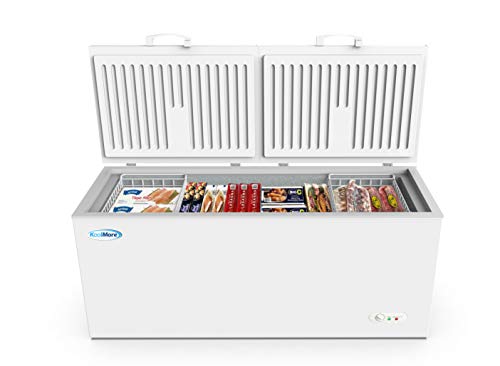
KoolMore SCF-20C Chest Freezer — The true 20
Here is the whole verified listing, and its brevity is itself information: KoolMore SCF-20C Chest Freezer, 20 cu. Ft, White. That is the model name, the exact capacity this guide exists to cover, and the colour — no thermostat poetry, no feature list, no claims to grade. In a category where rivals borrow numbers, the SCF-20C’s plain statement of exactly 20 cubic feet is the reason it anchors this guide. KoolMore sells into food-service and serious home provisioning, and the SCF naming follows the maker’s commercial chest-freezer line conventions; beyond that, this review refuses to invent a specification the listing does not provide.
What can a buyer responsibly do with a sparse listing? Treat the product page as the specification sheet: confirm dimensions, thermostat arrangement, basket provision, lid design and drain details there before ordering, and weigh the answers against the Hamilton Beach models below, whose listings state those practicalities openly. A big chest’s daily life is decided by exactly those unglamorous details — how it defrosts, how it drains, how its interior is divided — and a buyer who confirms them is buying wisely regardless of brand.
Why choose it, then? Because it is the genuine article at the exact size: a true 20 cubic foot chest from a maker whose business includes commercial cold storage, for the household that has measured its provisioning and landed on twenty as the honest number. If your research keeps returning you to this capacity and you want the cabinet that simply is what the title promises, the SCF-20C is the pick — bought with eyes open, specifications confirmed on the page, and a bin system ready to organise the space the day it arrives.
- Capacity as listed: 20 cu ft
- Model as listed: SCF-20C
- Finish as listed: white
- Note: the listing states no further features; confirm dimensions, thermostat, baskets and drain on the product page
- Where to buy: the KoolMore SCF-20C listing on Amazon — check price on Amazon
Strengths
- The only verified exactly-20 cu ft listing in this guide — the title’s promise kept literally.
- A maker with commercial cold-storage lines behind the model name.
- Clean, unhyped listing that states its capacity and nothing it cannot support.
Trade-offs
- The listing’s sparseness means key practical details must be confirmed on the product page.
- No basket, drain or lid features can be credited from the listing provided.
- Buyers who want every feature stated up front may prefer the Hamilton Beach listings’ openness.
Best for: provisioning households that have settled on exactly 20 cu ft and want the genuine model at that size.
Not suited for: buyers unwilling to confirm practical specifications on the product page before ordering.

Hamilton Beach 30 Cu Ft Chest Freezer — The step-up
Let the framing be unmistakable: this is a 30 cubic foot freezer, half again the size this guide is named for, included because a real class of readers will measure their provisioning, look at the true-20 pick, and correctly conclude they need more. The listing is the most complete of the three linked models: 30 cubic feet in white, garage ready, with stated dimensions of 29 inches deep by 79 inches wide by 38 inches high, an adjustable thermostat, an easy defrost drain, and a double door lid, addressed to storage, hunting and large families.
Every stated feature answers a big-chest problem. The double door lid means a 79-inch cabinet does not demand one vast lid be lifted for every retrieval — open the half you need, keep the other half’s cold undisturbed. The easy defrost drain acknowledges that defrosting 30 cubic feet produces real meltwater and gives it a planned exit. The adjustable thermostat puts deliberate control in the owner’s hands, and the garage-ready description places the whole operation where 79 inches of freezer belongs: out of the kitchen, in the space a household actually has for infrastructure.
The cautions scale with the cabinet. Seventy-nine inches wide is a wall, and the delivery route, the door frames and the final position must all be surveyed before ordering, not negotiated on the day. An inventory system stops being optional: at 30 cubic feet, unlabelled food is lost food with extra steps. But for the hunting household, the market gardener, the family that provisions quarterly — for the reader who found 20 cubic feet a good idea and then did the maths on their own year — this is the honest step up, specified in the open and sized without apology.
- Capacity as listed: 30 cu ft — a step-up, not a 20 cu ft model
- Dimensions as listed: 29″D x 79″W x 38″H
- Lid as listed: double door lid
- Thermostat as listed: adjustable
- Defrost as listed: easy defrost drain
- Placement as listed: Garage Ready
- Settings named in listing: storage, hunting, large family
- Where to buy: the Hamilton Beach 30 Cu Ft listing on Amazon — check price on Amazon
Strengths
- The most completely specified listing of the three linked models.
- Double door lid and defrost drain directly answer big-chest daily problems.
- Garage-ready description suits the outbuilding placement its size demands.
Trade-offs
- It is not a 20 cu ft freezer; households set on that size should not drift upward by default.
- Seventy-nine inches of width must be surveyed against route and room before ordering.
- Capacity this large punishes any household without a labelling and rotation system.
Best for: hunting, gardening and large-family households whose provisioning honestly exceeds the 20 class.
A poor fit for: anyone whose room, route or real volume says twenty was already generous.

Hamilton Beach 14 Cu Ft Chest Freezer — The step-down
Equally unmistakable in the other direction: this is a 14 cubic foot freezer, six feet of capacity below the class in the title, included because honest sizing cuts both ways. Its listing describes a white chest for families with a space-saving flat back, a front drain and a garage-ready description. The flat back is the detail to notice — a chest designed to sit flush against a wall, reclaiming the wedge of wasted space that rounded-back cabinets leave, which in a garage or utility room can be the difference between fitting beside the workbench and blocking it.
Fourteen cubic feet remains a great deal of freezer: a large family’s monthly provisioning, a keen cook’s batch archive, a smallholder’s first serious store. What it is not is provisioning-at-scale, and the household that buys it instead of a 20 has usually done the better maths — matching the cabinet to the food they demonstrably freeze rather than to an imagined harvest. The front drain keeps the defrost ritual civilised, the garage-ready description keeps placement flexible, and the whole cabinet asks less of the room, the route and the electricity of daily life than its bigger relatives.
Choose the step-down proudly if your audit says fourteen. The failure mode this guide exists to prevent is not buying small; it is buying a number — twenty, because the search said twenty — without ever counting your own bags, boxes and birds. Readers whose audit lands between classes should remember that a chest’s usable truth is set by organisation as much as by volume: a well-binned 14 can outperform a chaotic 20 in everything except raw capacity, and it will do so in a smaller corner of the garage.
- Capacity as listed: 14 cu ft — a step-down, not a 20 cu ft model
- Back as listed: space-saving flat back
- Defrost as listed: front drain
- Placement as listed: Garage Ready
- Finish as listed: white
- Where to buy: the Hamilton Beach 14 Cu Ft listing on Amazon — check price on Amazon
Strengths
- Flat back sits flush to the wall and reclaims wasted floor space.
- Front drain and garage-ready description keep ownership practical.
- The honest size for large families whose volume never reaches provisioning scale.
Trade-offs
- It is not a 20 cu ft freezer and will not absorb a whole-animal provisioning rhythm.
- Thermostat details are not elaborated in the listing provided.
- Households that later scale up will replace rather than supplement it.
Best for: large families and keen cooks whose audited volume fits fourteen cubic feet with room to spare.
Not the right match for: provisioning households whose seasons genuinely fill twenty cubic feet and beyond.
The 20-Class at Appliance Retailers
Walk into an appliance showroom and the 20 class is simply there: row upon row of big white chests from the industry’s mainstream makers, sold with delivery, installation positioning and haul-away of the old cabinet arranged in one conversation. That channel is where most 20 cubic foot freezers are actually bought, and this slot covers it in prose because no verified marketplace listing for the mainstream showroom models sits in this guide’s pool. The class-level facts are stable enough to shop by: expect a hinged single lid at this size, a manual defrost rhythm with a drain, interior provision that ranges from a single basket to a small set of dividers depending on the line, and capacity stated on the maker’s plate rather than in marketing copy.
Shop the channel with this guide’s discipline in your pocket. Read the capacity off the specification, not the banner. Ask how the cabinet defrosts and where the meltwater goes. Lift the lid and judge its weight and its stay-open behaviour, because you will lift it a thousand times. Ask what the delivery crew will and will not do — which door they will take it through, whether they position and level it, whether the old cabinet leaves with them. A showroom that answers those questions precisely is selling the same honesty this guide has tried to practise; one that steers you back to the headline number is telling you something about itself.
Best for: buyers who want hands on the lid, delivery arranged in person and a local door to knock on afterwards.
Poorly suited to: shoppers who prefer a verified online listing and a delivery slot booked from the sofa.
Split-Lid Large Chests at Retail
At the wide end of the chest world, a design pattern recurs that the Hamilton Beach 30 in this guide also follows as listed: the lid divides into two doors, so a very wide cabinet can be opened in halves. The pattern deserves its own prose slot because it changes how a big chest is used daily. Open the left half for the proteins, and the right half’s cold stays pooled and undisturbed; stage a whole preserving day on one side while the other side holds the long-term store. In retail showrooms this pattern appears across the largest domestic chests, usually alongside the plainest of interiors — one vast space per side, waiting for the owner’s own bins to give it order.
Judge a split-lid cabinet by its centre seal and its hinges, the two places the design can fail. The meeting of the two lids must close cleanly along its whole length, every time, without being pressed into place; a cabinet that needs persuasion when new will need force within a year. Hinges should hold each lid open unassisted at working height, because a lid that must be held is a hand you no longer have for the box you came for. Test both in the showroom with the seriousness you would give a car door — it is the part of the freezer you will touch most.
Best for: households buying at the wide end who open the freezer in sections and want the cold kept where it belongs.
A weak match for: buyers of the true-20 size who neither need nor can house a cabinet wide enough to split its lid.
Commercial-Leaning Large Chests Through Equipment Channels
Beyond the domestic showroom sits a third channel for big chests: the restaurant-equipment and food-service suppliers, where large chests are sold as working stockrooms for cafés, caterers, farm shops and institutions. The KoolMore name in this guide’s anchor pick comes from that world, and the class at large is characterised by plain exteriors, capacious unadorned interiors and an expectation that the buyer is a professional who will organise the space to their own system. Domestic buyers with genuinely commercial volumes — the farm shop, the community kitchen, the caterer working from a home base — often find their honest 20-class cabinet here rather than in either marketplace listings or high-street showrooms.
The channel’s discipline is specification by document rather than by advertisement: ask for the dimension sheet, the electrical requirements and the warranty terms in writing, and expect the conversation to be about those documents. Delivery is freight, positioning is your problem unless negotiated, and aftercare runs through trade counters rather than a retail returns desk. None of that is a warning; it is a description of a professional channel that rewards professional questions. Households whose provisioning truly resembles a small business’s stock will feel at home in it, and the SCF-20C’s sparse, document-like listing will suddenly read as fluency rather than omission.
Best for: farm shops, caterers and community kitchens whose frozen volume behaves like a business’s stock.
Weakest fit: domestic buyers who want retail delivery, positioning and returns as part of the purchase.
Three Sizes, Three Honest Answers
| Model or class | Capacity stated | Relationship to 20 cu ft | Details stated in its listing or channel |
|---|---|---|---|
| KoolMore SCF-20C | 20 cu ft | The exact size | White; further details to confirm on product page |
| Hamilton Beach 30 | 30 cu ft | Step-up | Double door lid, adjustable thermostat, defrost drain, Garage Ready, 79 in wide |
| Hamilton Beach 14 | 14 cu ft | Step-down | Flat back, front drain, Garage Ready |
| 20-class at appliance retail | 20 class | The exact size, in showrooms | Sold with delivery and haul-away arranged in person |
| Split-lid large chests | Largest domestic class | Above the 20 class | Two-part lids for sectional opening |
| Commercial-leaning chests | 20 class and above | Exact and above, by document | Sold through equipment channels to a specification sheet |
How Do You Organise Twenty Cubic Feet So Nothing Gets Lost?
With bins, a map and a rule. Twenty cubic feet of open chest is a volume in which food goes to be forgotten unless the household imposes geography: one bin per family of food, each bin labelled, the bins arranged in a fixed order that every user learns. Proteins in one zone, vegetables in another, prepared meals in a third, bread and baking in a fourth, with the current month’s working stock riding on top and the deep reserve below. A simple written map taped inside the lid — zone by zone, in the order the eye travels — turns a two-minute excavation into a ten-second retrieval, and keeps the lid open for a fraction of the time, which the food and the electricity both appreciate.
Rotation is the second system: new stock goes to the bottom or the back of its bin, old stock rises to the top, and nothing enters the freezer without a label carrying its contents and its month. At provisioning scale, add a paper inventory on the lid’s outside — a running list, struck through as items leave — because a 20-class store is genuinely too large to hold in memory. The households that thrive with big chests treat them like small warehouses, with a warehouse’s light bureaucracy. The households that fail with them treat them like big kitchen drawers, and excavate.
The same planning mindset governs the rest of a provisioning household’s equipment, which is why readers speccing a whole utility room often pair this guide with our colleagues’ work on Best Mid-Range Wall Ovens — the ovens that will cook what the freezer stores deserve the same measure-first, buy-once discipline. A freezer this size is a decade-scale purchase; its organisation system, set up in the first week, is what the decade actually feels like.
Defrosting a Big Chest Without Losing a Weekend
Chest freezers of this class traditionally ask for a manual defrost, and the two Hamilton Beach listings acknowledge the ritual with drains — an easy defrost drain on the 30, a front drain on the 14. Treat the defrost as a seasonal operation with a plan rather than an emergency with towels. Choose a cold day when the store is at its lowest, move the contents into insulated bags and boxes in the coolest room you have, switch off, lid open, and let the ice release in its own time, helping it with bowls of hot water rested inside on a board if your maker’s guidance allows. Never lever ice with a knife or screwdriver near the cabinet walls; the lining you puncture is the freezer you replace.
The drain earns its keep at the melt stage: position a shallow tray or a hose route before the water arrives, not after, and mop the interior dry before restarting. Let the empty cabinet return to full cold before reloading, then reload in the organised order — reserve at the bottom, working stock on top — so the defrost doubles as the season’s great rotation audit. Done this way, twice a year at most for most households, the ritual takes a morning and returns a cabinet at full stated capacity, with every item in it known by name. The KoolMore’s drain and defrost particulars, unstated in its listing, should be confirmed on its product page so the same plan can be built around facts rather than hopes.
Which Sizing Mistakes Do Big-Chest Buyers Regret Most?
The first is buying the number in the search box rather than the volume in their lives — the error this guide’s structure exists to correct. Audit before you shop: count a season’s worth of your actual frozen goods, honestly, and let that count nominate the class. The second mistake is measuring the cabinet and forgetting the route: a 79-inch-wide step-up that cannot pass the garage’s side door is a lawn ornament. Measure the route with the same care as the room, including the lid’s opening arc against shelves, pipes and the ceiling’s low points.
Third, buyers place a big chest wherever it first fits and discover the placement’s flaws weekly — the lid that meets a shelf, the corner that pools damp, the spot so far from the kitchen that the freezer becomes a place food goes rather than a store anyone uses. Fourth, they skip the inventory system for the first month, meaning to start it later, and later never comes; the bins and the lid map must arrive with the freezer, not after it. Fifth, they overlook the supporting cast — the vacuum sealer, the labels, the spare bins — the small equipment that a provisioning household uses weekly, much as our guide to Best Large-Capacity Dishwashers reminds big households that capacity appliances earn their keep only when the routine around them is designed at the same scale. A 20-class freezer is a system purchase disguised as an appliance purchase, and it rewards being bought as one.
The Provisioning Year: How a 20-Class Chest Earns Its Floor
Spring opens the account gently: the last of winter’s stores drawn down, the first garden surplus — asparagus, peas, soft fruit — frozen flat and filed in a single bin. This is the season to audit the cabinet honestly, eating the oldest items into the menu and noting which of last year’s enthusiasms nobody actually cooked. A 20-class chest forgives a generous harvest, but it cannot forgive a dishonest inventory; the spring clean is what keeps the big store a store rather than a very cold archive of good intentions.
Summer is the high-turnover season: barbecue cuts, ice cream, drinks-party ice and the soft-fruit glut all cycle through the top layer while the deep reserve rests below. The working-stock-on-top discipline matters most now, because the lid opens often and every opening should be short. Autumn is the surge the cabinet was bought for — preserving, bulk buying, the hunting season’s first returns — and it arrives in waves that a smaller freezer would force into the kitchen cabinet and the neighbours’ goodwill. Winter is the drawing-down: the season the whole system exists to serve, when the household eats from its own store for weeks and the written inventory on the lid becomes the menu’s first draft.
Seen across the year, the case for the class is rhythm, not size. Each season asks the freezer for a different virtue — audit space, turnover speed, surge capacity, deep reserve — and twenty cubic feet is the size at which one cabinet can supply all four without negotiation. Households whose year has no surge, no harvest and no bulk rhythm are not failing some test by choosing the step-down; they are simply living a different year, and their freezer should match it.
Chest or Upright at This Scale?
The question deserves a direct answer because the 20 class is where the two formats genuinely compete. A chest offers one unobstructed volume: whole joints, large birds, trays and awkward shapes all fit without negotiating with a shelf, and the cold stays pooled in the cabinet when the lid opens, which suits a store opened briefly and purposefully. Its costs are retrieval — you reach down into it — and the organisational burden this guide has described at length. An upright offers the opposite trade: shelved visibility and eye-level access, at the price of fixed shelf geometry that refuses the largest items and a door that spills its cold at every opening.
Provisioning households have historically chosen chests, and the reasons are practical rather than sentimental. Butchery arrives in shapes that shelves dislike. Harvests arrive in volumes that door bins cannot help with. And a chest’s simplicity — one space, one lid, a drain — suits a cabinet that may live in an outbuilding and be visited with a list rather than browsed. Households whose frozen life is portioned, packaged and daily, by contrast, often serve themselves better with the upright format at similar capacity, accepting the shelf geometry in exchange for visibility. Neither answer is the sophisticated one; the sophisticated move is matching the format to the shape of your own frozen goods, which you can audit in an afternoon with a notebook and last season’s receipts.
Some households, honestly assessed, need both: the chest as the deep reserve in the outbuilding, an upright as the working store near the kitchen. If that is your audit’s conclusion, sequence the purchases — the chest first if provisioning is the pain, the upright first if daily retrieval is — and let the second cabinet be bought with a season’s experience of the first behind it.
Delivery Day for a Furniture-Scale Cabinet
A 20-class chest arrives like furniture, not like a parcel, and the day deserves a furniture mover’s planning. Walk the route from the vehicle to the final position with a tape measure, checking every door frame, turn and threshold against the cabinet’s stated dimensions — the Hamilton Beach 30 prints its full measurements in its listing, and every model here deserves the same verification on its product page before the order is placed. Clear the route of everything movable, decide where the packaging mountain will go, and confirm with the seller or carrier exactly what the delivery includes: kerbside, threshold, or positioned in the room.
Once the cabinet stands in place, the discipline is patience. Level it, leave its clearances, and let it run empty until it is thoroughly cold before the first food crosses the lid — loading a warm cabinet with a season’s provisioning asks the refrigeration to do its hardest work at its weakest moment. Load in the organised order from the first bin: reserve deep, working stock high, map drawn, inventory started. The households that treat delivery day as the system’s birthday, rather than as a race to fill a box, are the ones still praising their own foresight when the first harvest lands.
Keep the paperwork with the same care: the specification documents, the warranty terms and a note of the delivery condition, photographed if anything looks amiss. A decade-scale appliance deserves a file, and the file is what turns a future question — a part, a claim, a resale — from an excavation into a lookup.
The Full-Cabinet Principle and Running Sense
A chest freezer’s economy follows a principle owners learn in the first year: a full cabinet is a steadier cabinet. Frozen food is thermal ballast — a mass of cold that shrugs off door openings and brief interruptions far better than the same volume of air. This is the practical argument for sizing honestly in both directions. The household that buys twenty and fills eight owns a cabinet whose contents wobble with every opening and whose empty volume is cooled for nothing; the household that buys fourteen and fills thirteen owns a stable, efficient store. Ballast can be borrowed — containers of water frozen into spare corners during lean months — but the honest fix is the audit this guide keeps recommending.
Beyond ballast, running sense is placement and habit. A level cabinet with a clean-sealing lid, kept out of the direct blast of heaters and the dampest corner of the building, asks less of its refrigeration than a neglected one. Lids opened with a list in hand, and closed without being dropped, keep the cold where it was made. None of this requires a specification from a listing; it is the owner’s half of the bargain, and at 20 cubic feet the owner’s half is worth more than any single feature a maker could print — because the cabinet is big enough for small habits to compound, in either direction, across a decade of seasons.
Bins, Baskets and the Hardware of Order
The cabinet provides the cold; the order is hardware you supply. The provisioning household’s basic kit is unglamorous: a set of sturdy open bins or crates sized to the chest’s interior, chosen so they tile the floor of the cabinet without wasted wedges; labels that survive cold and damp, plus the marker that lives with them; a vacuum sealer or a disciplined wrapping routine for portions; and the lid map and inventory list described earlier. Buy the bins before the freezer arrives if you can, because the first load sets the geography, and geography improvised under the pressure of a thawing harvest never quite gets redrawn.
Size the bins to the lift, not to the cabinet. A bin of frozen meat that one person cannot lift safely out of a deep chest is a bin that will be excavated in place, defeating its purpose; two smaller bins per zone beat one heroic one. Leave one bin as the staging bin — the place new arrivals sit while they freeze fully, before being filed into their long-term zones — and one small basket riding on top for the week’s working items, so the daily retrieval never disturbs the deep order. Colour-coding helps households with several users: a colour per food family, repeated on the lid map, lets anyone fetch the right bin on a shouted instruction from the kitchen.
Review the hardware seasonally, when you defrost. Bins crack, labels fade, the map drifts from the territory. An hour spent re-inking the map, replacing the tired bin and re-filing the strays is the cheapest capacity you will ever buy, because a 20-class cabinet’s real capacity is not its cubic feet — it is the volume you can actually find things in, and that volume is made of bins, labels and habits rather than of steel and refrigerant.
When Twenty Is Not Enough — and When It Is Already Too Much
Twenty is not enough when the audit keeps overflowing it in fact rather than in imagination: the household that processes more than one animal a year, the market garden whose autumn genuinely fills the cabinet by October, the community kitchen storing for events. Those readers should step up to the Hamilton Beach 30 in this guide without treating it as indulgence — it is the size their documented year requires — or consider two cabinets run as a system, a working chest and a reserve, which adds resilience alongside volume. What they should not do is pack a 20 to the lid and call the overflow a system; a chest filled past its organised capacity loses the retrieval that justified it.
Twenty is already too much when the audit says so and pride says otherwise. The signs are plain in hindsight: a cabinet a third full in its best month, food discovered a year late, a defrost postponed because the store was too chaotic to face. The step-down to fourteen — or the frank choice of the 15 class covered elsewhere — is not a lesser purchase; it is the same discipline applied in the other direction, and it returns floor space, calm and a store the household actually commands. The readers this guide most respects are the ones who let their own counted bags and boxes, rather than a search box, choose the number.
Between those poles sits the true-20 household, and it is a real and numerous class: the big family that provisions monthly and preserves seasonally, the hunter with one animal a year, the gardener with a serious plot. For them the SCF-20C’s plain promise — exactly this much cold room, honestly stated — is the whole point, and this guide’s structure, with its labelled neighbours above and below, exists to make sure they land on it deliberately rather than by approximation.
Power Cuts at Provisioning Scale
A big chest is, among other things, an insurance policy that must itself be insured. The good news is structural: a full chest, lid down and unopened, is the most patient cold store in the house, its mass of frozen food holding the interior far longer than a half-empty upright survives. The discipline during an outage is therefore simple and strict — keep the lid closed, resist every checking instinct, and let the ballast do its work. Every peek is paid for in the only currency the cabinet has left.
Preparation is the other half. Keep the cabinet well filled in the seasons when outages threaten, keep the inventory current so that any aftermath is assessed from a list, and know in advance where dry ice or a neighbour’s spare capacity could be had if an outage stretches beyond patience. Households in outage-prone areas sometimes keep a simple thermometer routine for the cabinet, checked on the weekly rounds, so that a silent failure is discovered in days rather than at the next harvest. When power returns, let the cabinet recover fully before resuming normal openings, and judge any doubtful items by official food-safety guidance rather than by hope — a provisioning household’s store is worth too much to gamble on a sniff.
None of this is a reason to fear the format; it is a reason the format suits serious households. The chest’s patience under failure is one of its oldest virtues, and the households that provision at this scale have always planned around it — the plan simply deserves to be written down, like the inventory and the lid map, where the whole household can follow it.
Final Recommendation
If your audit says twenty, buy the true twenty: the KoolMore SCF-20C, its sparse listing confirmed detail by detail on the product page, is the genuine article at the exact capacity this guide promises. If your audit says more — the hunting season, the market garden, the quarterly provision run — step up knowingly to the Hamilton Beach 30, whose double lid and defrost drain are specified for exactly that life. If your audit says less, step down without a flicker of embarrassment to the Hamilton Beach 14 and enjoy a cabinet sized to your real year. And if you prefer to buy with your hands on the lid, take this guide’s questions into an appliance showroom or an equipment supplier and let the prose classes above be your checklist. The right chest is the one whose number matches your life — and a household that provisions at this scale, in a cabinet it can organise and a size it actually fills, will open that lid a thousand times a year and find, every single time, exactly the dinner it went looking for.
Frequently Asked Questions
Is the KoolMore SCF-20C really the only true 20 cu ft pick here?
Yes, among the verified listings in this guide’s pool. Its listing states 20 cu. Ft plainly. The Hamilton Beach models beside it are 30 and 14 cubic feet respectively and are framed throughout as a step-up and a step-down, never as 20 cu ft models. The remaining slots cover the wider 20-class as sold through appliance retail and equipment channels, discussed in prose at class level.
How is a 20 cu ft chest different from a 15 cu ft one in daily life?
Scale changes the job. A 15 cu ft chest is a large family’s store; a 20 cu ft chest is provisioning infrastructure that absorbs whole-animal, harvest-scale volumes. At twenty, the footprint organises the room, the inventory needs bins, a map and a written list rather than memory, and defrosting becomes a planned seasonal operation. Buyers who do not provision at that rhythm usually find the smaller class the better servant.
Where should a freezer this size live?
Where its lid can open fully, its floor is level and dry, and its distance from the kitchen still allows daily use — most often a garage or utility room, which is why garage-ready descriptions appear on both Hamilton Beach listings here. Survey the delivery route as carefully as the final position, and leave the maker’s ventilation clearances rather than wedging the cabinet between stored clutter.
How often will a big chest need defrosting?
That depends on climate, opening habits and the individual model, and no figure is promised here. The practical signs are visible: when frost build-up begins to steal meaningful space or the lid’s seal meets ice, the season has come. Both Hamilton Beach models provide drains as listed to make the operation manageable; the KoolMore’s arrangements should be confirmed on its product page so your plan rests on its actual design.
Can a chest this big hold a whole animal’s worth of meat?
That is precisely the provisioning rhythm the 20 class exists for, and the 30 cu ft step-up extends it further. The practical arts matter as much as the volume: have the meat wrapped and labelled in portions at butchering, freeze it in organised bins by cut, and keep the written inventory on the lid. Capacity holds the animal; the system is what lets you find the right joint in February.
Do I need a dedicated electrical circuit for a big chest?
That depends on the model and on what the building’s circuits already carry, and no listing here settles it — so treat it as a question for the product page’s stated requirements and, where the run is doubtful, for an electrician’s brief visit before delivery rather than after a tripped breaker. A provisioning freezer is the one appliance whose power should never be an improvisation, because its contents represent a season of the household’s work.
How long does a cabinet of this size typically stay in service?
No lifespan figure is stated in these listings, and none is promised here. What can be said is that big chests are among the simplest cold appliances a household owns — one space, one lid, a drain — and that their service lives are governed mostly by placement, seal care and the defrost discipline described in this guide. Buyers should read the warranty terms of the exact model they choose, keep the paperwork, and treat the purchase as the decade-scale decision its size declares it to be.
Should I buy in a showroom instead of online?
Both routes are legitimate, and this guide covers both: verified listings for the KoolMore and the two Hamilton Beach models, and prose guidance for the showroom and equipment channels where much of the 20 class is sold. In a showroom, test the lid’s weight and hinges, read the capacity from the specification plate, and pin down exactly what delivery includes. Online, confirm every practical detail on the product page before ordering. The discipline is the same in both worlds.
Related Guides
Readers building a complete large-scale cold-storage plan may pair this guide with our coverage of Best 36-Inch Column Refrigerators, the tall fresh-storage counterparts to a big chest’s frozen store. Together they describe a provisioning household’s full cold wall: fresh capacity standing upright, frozen capacity lying in wait, and every season’s food accounted for.


