What's inside
- Key Takeaways
- Quick Picks
- How We Chose These Picks
- How Do the Six Freezers Compare at a Glance?
- What Actually Fits Inside 5 Cubic Feet?
- Chest or Upright at This Size: Which Suits Your Back and Your Habits?
- Where Does a Small Freezer Belong Inside a Home?
- How Cold Should a 5 Cu Ft Freezer Run, and How Do You Verify It?
- How Do You Defrost and Clean a Small Chest Freezer?
- When Should You Step Down to 3.5, and When Should You Step Up to 7?
- How Do You Keep a Small Freezer Organised Enough to Trust?
- What Does a 5 Cu Ft Freezer Cost to Run?
- How Long Does a Small Chest Freezer Keep Food Safe Without Power?
- How Should You Pack Food Differently in a Small Chest?
- Who Gets the Most From a 5 Cu Ft Freezer?
- How Do the Seasons Change How You Use a Small Freezer?
- How Do You Buy a Small Freezer Second-Hand Without Regrets?
- What Should You Check in the First Week of Ownership?
- What Mistakes Do 5 Cu Ft Freezer Buyers Make Most Often?
- Final Recommendation
- How Does a Small Freezer Help a Household Waste Less Food?
- How Do You Move a Small Chest Freezer to a New Home?
- Frequently Asked Questions
- Related Guides
As an Amazon Associate I earn from qualifying purchases. This post may contain affiliate links at no extra cost to you.
cottageverdict.com is reader-supported. When you buy through links on our site, we may earn an affiliate commission.
Where to buy: the six freezers in this guide are all sold on Amazon, with each pick linked to its listing so you can confirm the exact capacity, colour and footprint. Read the labels in this round-up carefully — the class is 5.0 cubic feet, but two picks are upright models and one is a smaller step-down, and each is flagged as such.
The best chest freezers 5 cu feet wide are the introverts of the cold-storage world: small enough for a utility corner, a basement nook or a modest garage bay, yet large enough to change how a household shops. Five cubic feet holds a respectable meat order, a month of batch cooking or a garden’s worth of blanched vegetables without demanding the wall space of the big garage cabinets. It is the size people buy when the kitchen freezer has become a daily negotiation.
Honesty about the class matters here. The first three picks are true 5.0 cubic foot chest freezers. The fourth, from Igloo, delivers 5.0 cubic feet in an upright body rather than a chest, which some buyers will prefer and others should skip on purpose. The fifth is a Midea at 3.5 cubic feet, included and labelled as a step-down for tighter spaces. The sixth is another Igloo upright, also 3.5 cubic feet. Every badge and spec box below states the real format, so the comparison stays fair.
Key Takeaways
- The true class size is 5.0 cu ft; the Frigidaire, TABU and Ultra Quiet picks are genuine 5.0 cubic foot chests.
- Igloo’s 5.0 cu ft model is an upright, not a chest — shelving and a front door instead of a deep well.
- The Midea 3.5 cu ft is a deliberate step-down for smaller spaces, and the second Igloo is a 3.5 cu ft upright.
- At this size, one removable basket and a tidy loading system matter more than headline features.
- Garage-ready language appears on the Frigidaire; other picks suit indoor or mild-climate spots unless the listing says otherwise.
- A small freezer kept full beats a large one kept empty for both running cost and outage endurance.
Quick Picks
| Pick | Badge | Why it earns its place |
|---|---|---|
| FRIGIDAIRE 5.0 Cu Ft Chest Freezer Garage-Ready Black | Best True 5.0 Chest | A genuine 5.0 cubic foot chest in black, positioned as garage-ready, with an adjustable thermostat. |
| TABU 5.0 Cu Ft Chest Freezer Black | Best Compact Deep Freeze | Another true 5.0 cubic foot chest with a seven-level adjustable thermostat for finer control. |
| Ultra Quiet 5.0 Cu Ft Chest Freezer | Best for Quiet Rooms | A 5.0 cubic foot chest sold on quiet running and fast freezing, with mechanical temperature control. |
| Igloo 5.0 Cu Ft Upright Deep Freezer | Upright Alternative — 5.0 Cu Ft | The same class capacity in an upright body with a quick freezing system, for buyers who hate digging. |
| Midea 3.5 Cu Ft Chest Freezer Convertible | Step-Down Pick — 3.5 Cu Ft | A smaller convertible chest with an LED light and removable basket, for spaces a 5.0 cannot fit. |
| Igloo 3.5 Cu Ft Upright Deep Freezer | Small Upright — 3.5 Cu Ft | A compact upright with a quick freezing system for dorms, offices and small households. |
How We Chose These Picks
The class definition came first, and we held it firmly: a guide to 5 cubic foot chest freezers should lead with true 5.0 cubic foot chests, which is why the Frigidaire, TABU and Ultra Quiet models open the list. Each states 5.0 cubic feet in its listing, each is a top-opening chest, and each covers a different buying temperament — garage-ready brand name, fine-grained thermostat control, and quiet running for indoor rooms.
The remaining three places went to honest alternatives, labelled rather than disguised. Igloo’s 5.0 cubic foot upright serves the many buyers who search this class but privately dread a deep well; the Midea 3.5 convertible is the step-down for spaces that fail the tape test; the smaller Igloo upright suits single-person and office freezing. Every model was confirmed against the live catalogue entry for this site before receiving a link, and capacities and formats quoted here come from those listings.
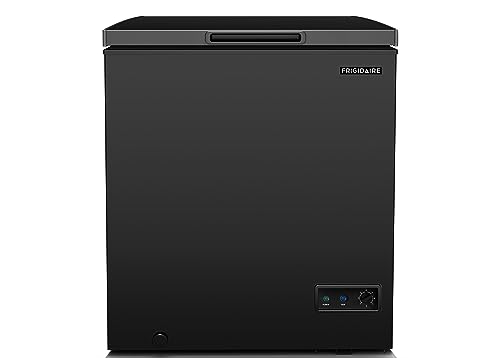
FRIGIDAIRE 5.0 Cu Ft Chest Freezer Garage-Ready Black — Best True 5.0 Chest
Frigidaire’s 5.0 cubic foot chest is the reference pick of this class: a true chest format, a stated 5.0 cubic foot capacity, and garage-ready positioning that its smaller rivals mostly do not claim. The black cabinet suits a garage or basement better than white, shrugging off the dust film that outbuildings deposit on everything. An adjustable thermostat keeps control simple, and the listing’s removable basket reference in this family of models points to the expected top-layer storage for small items.
At five cubic feet, loading strategy is the whole game. Freeze flat, file packs upright, keep the basket for the loose and the lovely — berries, butter, the good ice cream — and this chest behaves like a much larger appliance. Buyers placing it in a garage should still give it shade and clearance, because garage-ready is a tolerance rating, not an invitation to bake the cabinet beside a sunlit door. For a first separate freezer, this is the pick against which the rest of the page should be measured.
- Capacity: 5.0 cu ft chest — true class size
- Positioning: garage-ready
- Finish: black
- Control: adjustable thermostat
Strengths
- Genuine 5.0 cubic foot chest from an established refrigeration brand
- Garage-ready billing suits unheated spaces
- Black finish hides outbuilding dust and scuffs
Trade-offs
- No convertible fridge mode for holiday overflow
- Single small basket leaves deep organisation to you
- Dial control still wants a thermometer to set precisely
Best for: a first garage or basement freezer at the true class size. Not suited for: buyers wanting shelves instead of a deep well.
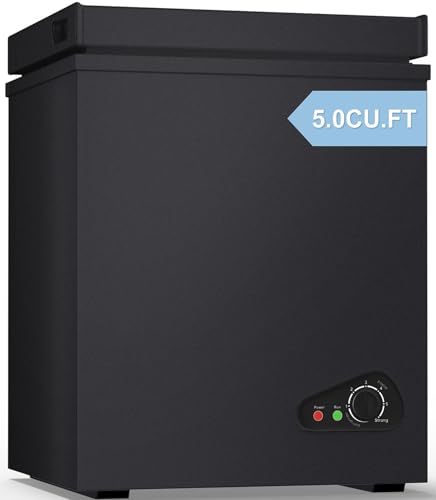
TABU 5.0 Cu Ft Chest Freezer Black — Best Compact Deep Freeze
TABU’s black chest matches the class capacity exactly and adds one detail worth noticing: a seven-level adjustable thermostat. Finer steps on the dial sound minor until you are balancing two tenants in one cabinet — ice cream that should stay scoopable and meat that should stay rock hard — and find the middle setting on a coarse dial satisfies neither. Seven levels give you room to land the temperature where a thermometer says it belongs, then leave it there.
The top-opening, compact deep freezer format is otherwise classic chest practice, and the black finish repeats the garage-friendly logic of the Frigidaire. TABU is a lesser-known name than the lead pick, so weigh the listing’s warranty and support details with open eyes before ordering. For buyers comfortable with that trade, this is a sensibly specified 5.0 cubic foot chest that does not ask you to pay for a badge on the lid.
- Capacity: 5.0 cu ft chest — true class size
- Control: 7-level adjustable thermostat
- Finish: black
- Format: compact top-opening deep freezer
Strengths
- Seven thermostat levels allow finer temperature landing
- Exact class capacity in a compact footprint
- Black cabinet suits garage and utility room alike
Trade-offs
- Newer brand with a thinner track record
- No garage-ready claim highlighted in the listing
- Interior accessories are minimal at this size
Best for: value-focused buyers who still want exact 5.0 capacity. Not suited for: anyone who prioritises the longest-established brand support.
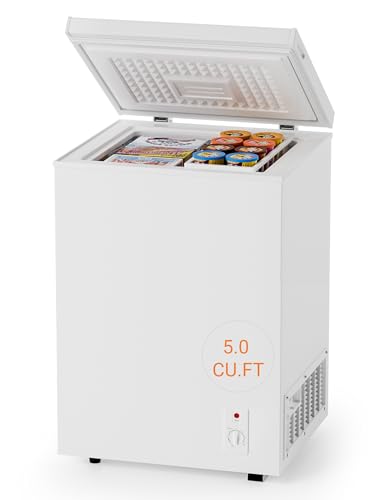
Ultra Quiet 5.0 Cu Ft Chest Freezer — Best for Quiet Rooms
Plenty of 5 cubic foot freezers will never see a garage; they will live in a flat’s utility cupboard, a studio’s kitchen corner or a home office that doubles as storage. This model is sold directly at that life, leading with ultra-quiet running and fast freezing in a 5.0 cubic foot chest. Mechanical temperature control keeps the interface to a dial, which suits a set-it-once appliance, and the listing’s low daily energy figure signals the efficiency intent behind the design.
Quiet claims deserve a calm reading. Any compressor freezer hums and clicks as it cycles; a model engineered and marketed for low noise simply does those things more discreetly, which matters when the cabinet shares air with a bedroom or a desk. Place it on a level, solid floor — a hollow or uneven surface amplifies vibration in any freezer — and this becomes the pick for renters and small-space households whose freezer must be a polite neighbour.
- Capacity: 5.0 cu ft chest — true class size
- Design focus: ultra-quiet running, fast freeze
- Control: mechanical temperature control
- Format: compact chest freezer
Strengths
- Quiet positioning suits flats, studios and offices
- True 5.0 cubic foot capacity despite the compact pitch
- Fast-freeze intent helps with batch cooking days
Trade-offs
- Generic naming means checking warranty details carefully
- Mechanical dial offers less precision than multi-level controls
- Not positioned for harsh garage temperature swings
Best for: indoor small-space living where noise carries. Not suited for: unheated garages in extreme climates.

Igloo 5.0 Cu Ft Upright Deep Freezer — Upright Alternative — 5.0 Cu Ft
Label first, because it changes everything about how this pick should be judged: despite appearing in a chest freezer guide, this Igloo is an upright deep freezer. The capacity matches the class at 5.0 cubic feet, but the storage stands behind a front door on shelves rather than in a top-opening well. For buyers with a bad back, a hatred of digging, or a habit of freezing many small labelled items, that format is not a compromise — it is the point.
The listing highlights a quick freezing system and an adjustable thermostat, both welcome in an upright, where cold air escapes at every opening and recovery speed matters. Accept the upright trades knowingly: door openings spill cold, the footprint is taller rather than wider, and outage endurance trails a chest of equal size. If your household grazes the freezer daily and values finding things at eye level, those trades are fairly made. If you wanted a chest, buy the Frigidaire or TABU above and let this Igloo serve the upright faithful.
- Capacity: 5.0 cu ft — upright format, not a chest
- System: quick freezing system
- Control: adjustable thermostat
- Format: front-door upright deep freezer
Strengths
- Shelved storage ends the deep-dig problem entirely
- Class-matching capacity in a taller, narrower footprint
- Quick freezing helps recovery after loading
Trade-offs
- Not a chest, whatever the search results implied
- Door openings lose more cold than a top lid
- Shorter safe window during a power cut than a chest
Best for: buyers who want 5.0 capacity with upright convenience. Not suited for: anyone specifically shopping for a chest freezer.

Midea 3.5 Cu Ft Chest Freezer Convertible — Step-Down Pick — 3.5 Cu Ft
This Midea is the step-down pick, and the label is deliberate: at 3.5 cubic feet it sits below the class this guide is named for. It earns its place because a meaningful share of shoppers measuring for a 5.0 discover the space will not allow it, and the honest alternative is a smaller chest that fits rather than a larger one that blocks a doorway. What softens the compromise is the feature set, carried down from its 7 cubic foot sibling: convertible fridge and freezer modes, an interior LED light and a removable basket.
Convertibility at 3.5 cubic feet is arguably more useful than at larger sizes, because a small household’s overflow needs swing wildly — freezer for the batch-cooking month, fridge for the party week. The light, rare at this size, makes a deep little well genuinely usable. Buy it with clear eyes about volume: this is a supplementary freezer for a couple or a small kitchen’s overflow, not a bulk store. Within that role, it is one of the most capable small chests listed anywhere in this guide’s family.
- Capacity: 3.5 cu ft chest — step-down below class size
- Modes: convertible fridge and freezer
- Interior: LED light, removable basket
- Control: adjustable temperature
Strengths
- Convertible modes multiply a small cabinet’s usefulness
- Interior light is uncommon at this capacity
- Fits spaces that fail the 5.0 tape test
Trade-offs
- Below the 5.0 class size this guide is named for
- Bulk meat orders will outgrow it quickly
- Basket space is small, so organisation stays manual
Best for: couples and tight spaces needing a flexible small chest. Not suited for: shoppers who truly need the full 5.0 cubic feet.

Igloo 3.5 Cu Ft Upright Deep Freezer — Small Upright — 3.5 Cu Ft
The second Igloo closes the list as the small upright option: 3.5 cubic feet behind a front door, with the same quick freezing system and adjustable thermostat as its larger sibling. This is the freezer for a dorm-adjacent flat, a small office kitchen, a single person’s batch-cooking habit or a drinks-and-ice reserve that needs to stay properly frozen rather than merely cold. Shelves at this scale hold the small, numerous items — portions, tubs, bags of ice — that a chest well turns into an excavation project.
Judge it as a convenience appliance and it succeeds; judge it as bulk storage and it was never entered in that contest. The upright format’s cold-spill at every opening matters less when the loads are small and the visits brief. Place it where the door can open fully, keep the seal clean, and this little Igloo will do the modest, useful job its size promises without pretending to be the 5.0 chest you may have come here seeking.
- Capacity: 3.5 cu ft — upright format, below class size
- System: quick freezing system
- Control: adjustable thermostat
- Format: compact front-door upright
Strengths
- Shelved access suits small, numerous frozen items
- Compact upright footprint fits flats and offices
- Quick freezing system aids recovery after loading
Trade-offs
- Neither a chest nor the 5.0 class capacity
- Limited room for bulky or awkward shapes
- Upright cold loss at every door opening
Best for: singles, offices and small supplementary freezing with shelves. Not suited for: bulk storage or chest freezer purists.
How Do the Six Freezers Compare at a Glance?
| Model | Capacity | Format | Standout trait |
|---|---|---|---|
| FRIGIDAIRE 5.0 Cu Ft Chest Freezer Garage-Ready Black | 5.0 cu ft | Chest | Garage-ready true class pick |
| TABU 5.0 Cu Ft Chest Freezer Black | 5.0 cu ft | Chest | Seven-level thermostat |
| Ultra Quiet 5.0 Cu Ft Chest Freezer | 5.0 cu ft | Chest | Quiet running for indoor rooms |
| Igloo 5.0 Cu Ft Upright Deep Freezer | 5.0 cu ft | Upright | Shelved alternative at class capacity |
| Midea 3.5 Cu Ft Chest Freezer Convertible | 3.5 cu ft | Chest | Convertible step-down with light |
| Igloo 3.5 Cu Ft Upright Deep Freezer | 3.5 cu ft | Upright | Compact shelved freezing |
What Actually Fits Inside 5 Cubic Feet?
Capacity numbers stay abstract until they are translated into groceries. A 5 cubic foot chest, loaded with reasonable discipline, holds in the region of a hundred-plus pounds of well-packed food — think a modest meat order of mixed cuts, a month of batch-cooked dinners for a couple, or a summer garden’s blanched output with room for bread and butter. The translation that matters is shape: flat packs and square containers stack to the walls, while round tubs and loose odd shapes can waste a third of a small cabinet before you notice.
Small freezers punish vague loading faster than big ones. In a 21 cubic foot chest, a badly packed corner is an inefficiency; in a 5 cubic foot chest it is tonight’s dinner refusing to fit. Work in layers with intent: the bottom for the long-storage archive, the middle for rotating staples, the basket and the very top for this week’s items. Freeze soups and sauces flat in bags, portion proteins individually, and keep a running sense of what lives at the bottom, because at this size a forgotten layer is a meaningful percentage of your whole reserve.
If the audit of your habits suggests you will fill 5 cubic feet within a month and keep it full, the size is right. If the audit suggests a whole-animal purchase or a market garden, be honest and step up a class instead of planning to play Tetris with a turkey.
Chest or Upright at This Size: Which Suits Your Back and Your Habits?
This guide contains both formats deliberately, because at 5 cubic feet the argument is genuinely balanced. A chest offers the better cold physics: the cold pool stays put when the lid lifts, the well swallows awkward shapes, and a power cut gives you a longer safe window. An upright offers the better ergonomics: everything at eye level, no leaning into a cold well, no archaeology at the bottom layer. Neither advantage is imaginary, and households choose wrong mostly by pretending one of them is.
Consider who loads the freezer and how often. A tall household cooking in weekend batches will thrive with a chest and a basket system. A household with a shorter cook, a stiff back, or a freezer visited three times a day for small items will be happier behind the Igloo’s front door. Consider also what gets frozen: many small labelled portions read like a shelving problem, while bulky joints and whole birds read like a well problem. Let the food and the body vote; the capacity number is the same either way at the top of this list.
One more factor deserves honesty: children and pets. A chest lid at waist height is harder for a small child to browse than an upright door at their eye level, while an upright’s door seal is easier for a determined toddler to test. Neither format is a toy, and the household’s supervision habits matter more than the hinge direction.
Where Does a Small Freezer Belong Inside a Home?
The 5 cubic foot class earns its keep by fitting where bigger cabinets cannot: the end of a utility room, a basement corner near the stairs, a wide hallway cupboard, even a spare bedroom that doubles as storage. Indoor placement brings conditions a garage never offers — stable temperature, dry air, proximity to the kitchen — and asks for two things in return: ventilation clearance and a floor that will not amplify the compressor’s hum into a household soundtrack.
Keep the cabinet off thick carpet where possible, since a soft surface tilts the machine, muffles its feet and traps warmth beneath it. A hard, level floor with the manual’s clearance at the back and sides lets any of these picks run as quietly as designed — a point that matters most for the Ultra Quiet model, whose whole purpose evaporates if it stands rocking gently on an uneven board. Keep the spot out of the direct path of a radiator or a sun-drenched window, and within honest carrying distance of the kitchen, because a freezer that is annoying to reach becomes a freezer that is rarely used well.
Renters should check the lease and the circuit. A small chest draws modest power, but older wiring shared with a kettle and a microwave can still object at the wrong moment, and a landlord’s permission is cheaper than a dispute. A drip tray under an indoor freezer is cheap insurance for the floor beneath, particularly on wood.
How Cold Should a 5 Cu Ft Freezer Run, and How Do You Verify It?
The target does not change with size: zero degrees Fahrenheit at the food, cold enough to keep everything safely frozen and ice cream firm, verified with a thermometer rather than inferred from a dial. Small cabinets actually make verification easier, because a thermometer placed in the middle of the load reads a temperature that represents most of the cabinet, without the stratification a giant chest can develop between its floor and its lid.
Set the dial to the middle of its range, give the loaded freezer a full day, then read the thermometer at the same hour on two consecutive days. Adjust one step at a time, waiting between changes, because small cabinets respond quickly and overshooting wastes energy while making some foods brittle. The TABU’s seven levels reward this patience with a finer landing; the mechanical dials on the other picks ask for the same method with slightly broader steps.
Recheck when the seasons turn or the room changes. A utility cupboard that shares a wall with a boiler, or a basement that floods with summer humidity, can shift what a given dial position delivers. The thermometer costs little, lives in the freezer permanently and converts every future worry — a strange noise, a warm day, a long door opening — into a number you can act on.
How Do You Defrost and Clean a Small Chest Freezer?
Small chests defrost quickly, which is one of their quiet virtues. At 5 cubic feet, the whole job — food into a cool box, lid open, warm water bowls rotated through the well, walls wiped dry — fits inside a morning. Schedule it when stocks run low, ideally before a planned big shop, and never attack the frost with a knife or a metal scraper: the refrigerant lines behind those walls are as vulnerable in a small cabinet as in a giant one, and a puncture ends the appliance rather than the chore.
Cleaning goes further than defrosting. Wash the interior with a mild solution, rinse and dry it fully before restarting, because any moisture left behind becomes the first frost of the new cycle. Wipe the lid seal’s folds, where crumbs and mould gather, and check the seal’s grip with a sheet of paper at several points. Restart the empty cabinet, let it reach temperature, then reload with your layers restored and anything dubious finally discarded.
Frequency depends on habit. A chest opened briefly twice a day in a dry room may need defrosting once a year; one opened constantly in a humid basement may ask twice. Frost thickness is the honest signal — once it starts stealing visible space or lifting the basket, the job is due.
When Should You Step Down to 3.5, and When Should You Step Up to 7?
The step-down case is usually written by the tape measure. If the only honest home for a freezer is a cupboard, a narrow utility wall or the end of a small kitchen, the Midea 3.5 convertible will serve daily while a 5.0 serves as an obstacle. Singles and couples who freeze portions rather than bulk also live comfortably at 3.5, especially with the Midea’s fridge mode covering the party weeks when cold drinks matter more than frozen peas. A smaller cabinet kept full is a better appliance than a larger one kept echoing.
The step-up case is written by volume that already exists. A household receiving a farm share, splitting a beef order with relatives, or preserving a serious garden will fill 5 cubic feet in a single delivery and spend the year annoyed. For them the 7 cubic foot class — the size that opens our garage guide’s family — is the honest purchase, and the extra footprint is the price of not renting overflow space from every relative with a basement. Notice that both decisions start from evidence: the space you have, the food you actually freeze. Guessing in either direction produces the two classic regrets, the blocked doorway and the overflowing lid.
If you are genuinely between sizes, consider the household’s trajectory rather than its snapshot. A growing family, a new allotment or a budding baking habit argues one step up; a household simplifying toward smaller shops argues one step down. Freezers live a long time, so buy for the household of the next several years, not the next several weeks.
How Do You Keep a Small Freezer Organised Enough to Trust?
At this scale, organisation is a five-minute habit rather than a system. Keep one basket zone sacred for the current week, label everything with contents and month, and freeze in the portions you cook. The most useful tool is a short list on the door or the phone: what went in, roughly when, and what has been there longest. Small freezers hide less than big ones, but they hide it more completely — a single forgotten layer at the bottom of a 5 cubic foot well is a fifth of your storage pretending not to exist.
Colour or category bags help households with several cooks. Proteins in one colour, vegetables in another, ready meals in a third, and anyone can load or retrieve without a briefing. Rotate on shopping day: new items go under or behind, older items rise. When something reaches the point where nobody can identify it with confidence, let it go; the discipline of discarding one mystery pack protects the credibility of everything else in the cabinet.
Finally, match the freezer’s contents to a loose meal rhythm. A household that knows Thursday is soup night and Sunday is roast night freezes with intent, and intent is what separates a reserve from a residue. The freezer then works as a pantry with a plan, which is when a small cabinet starts feeling surprisingly large.
What Does a 5 Cu Ft Freezer Cost to Run?
Small chest freezers sit at the frugal end of home appliances. The design helps — cold air pooled under a lid, thick insulation, a modest compressor — and the size helps more, because there is simply less cabinet to keep cold. The Ultra Quiet pick in this guide even leads with a low daily energy figure in its listing, a reminder that at this scale the engineering intent is efficiency. Your real bill still follows your habits: a full cabinet cycles more gently than an empty one, a clean seal keeps the cold in, and a sensible verified temperature avoids paying for unnecessary degrees.
Placement writes the rest of the bill. An indoor cabinet in a temperate room works less than one in a hot garage; a cabinet with its back clearance open sheds heat freely, while one smothered by stored boxes runs longer to do the same job. None of the picks in this guide should surprise a household budget when sited sensibly, and the savings they enable — bulk prices taken, leftovers kept, waste avoided — typically outweigh the running cost by a wide margin for households that use the space with intent.
Compare that with the cost of the alternative most households actually live: a crammed kitchen freezer compartment that frosts its contents, loses meals to freezer burn and forces premium-price top-up shopping. The little chest in the corner is rarely the expensive option once the whole picture is priced.
How Long Does a Small Chest Freezer Keep Food Safe Without Power?
A full 5 cubic foot chest, left unopened, commonly protects its contents for the better part of a day and often longer in a cool room, because the frozen mass is doing the work and the lid design keeps what cold there is pooled inside. The figure shrinks quickly with a half-empty cabinet or a curious household lifting the lid every hour to assess the situation. Treat an outage as a reason to leave the freezer strictly alone, plan meals around the fridge and the store cupboard, and let the chest’s insulation earn its keep undisturbed.
Preparation separates calm households from frantic ones. Keep the cabinet honestly full in ordinary times — a few filled water containers can occupy spare space and add thermal mass — and keep the thermometer inside where it lives permanently. When power returns, read the thermometer before judging anything by smell or guesswork. Food still carrying ice crystals, or holding at refrigerator temperatures, can usually be cooked promptly with confidence; food that sat warm for hours should be discarded however much it cost, because a small freezer’s contents are replaceable in a way a hospital visit is not.
The upright picks in this guide deserve a specific note here. A front door loses its cold faster in daily use and offers less outage endurance than a chest of equal capacity, which is one more reason the format labels in this round-up matter. Buy the upright for access, by all means — but know which insurance policy you are trading away.
How Should You Pack Food Differently in a Small Chest?
Small cabinets reward flatness above all virtues. Freeze liquids in bags laid on a tray until solid, then file them upright like envelopes; portion proteins thin so they stack and thaw quickly; choose square or rectangular tubs that meet the cabinet’s corners instead of round ones that gift the gaps to frost. Every cubic inch in a 5 cubic foot well is working capital, and packaging is how you stop paying rent on air.
Double-wrap anything destined for a long stay, squeeze air from bags before sealing, and cool cooked food fully before it enters, so one warm dish does not tax the whole cabinet. Keep a thin layer of order at the top — the basket or a single flat crate — for the items in current rotation, and resist the temptation to balance loose packages on top of the filed layers, where they will migrate, freeze into a landslide and bury the system you built.
Labels at this scale can be simple: contents and month, in marker, on the side that faces up when filed. The household that labels reliably wastes almost nothing from a small freezer, because nothing stays in it long enough to become a stranger.
Who Gets the Most From a 5 Cu Ft Freezer?
Batch cooks top the list. A Sunday of soups, sauces and casseroles becomes a fortnight of dinners when a small chest stands ready, and the flat-pack discipline this size teaches is exactly the discipline batch cooking needs. New parents freezing portions and milk, gardeners with a single raised bed’s surplus, and anglers or hunters with occasional rather than industrial catches all find 5 cubic feet matched to the shape of their lives.
Renters and flat-dwellers form the second great constituency, because this class fits through doors, up stairs and into corners that bigger cabinets cannot attempt, and it moves house without a specialist crew. Elderly households benefit too, provided the format is chosen with the body in mind: a chest asks for reaching and lifting, so a shorter user may honestly be better served by the Igloo upright at the same capacity, where every shelf presents itself at a civilised height.
The household that gets the least from this size is the one trying to use it as a warehouse. Bulk clubs, whole animals and market gardens will defeat 5 cubic feet in a single delivery, and no organisation system survives being asked to hold twice its design volume. Those buyers should step up a class with a clear conscience, as the earlier section of this guide sets out.
How Do the Seasons Change How You Use a Small Freezer?
Summer fills it with the garden and the market: berries frozen on trays then bagged, beans blanched in batches, herbs in oil, and always a reserve of ice for drinks and injuries alike. Summer is also when an indoor cabinet earns its placement, because a temperate room spares it the garage’s heat burden, and when the thermometer deserves a weekly glance rather than a seasonal one.
Autumn turns the cabinet toward preservation proper — the apple glut, the last tomatoes cooked into sauce, the game and the bulk meat order before winter. Winter makes the freezer a larder, drawn on steadily for soups and roasts, while spring is the audit season: stocks fall, the oldest packages get promoted into meals, and the cabinet is emptied enough for its defrost before the cycle begins again. Households that let the freezer breathe with that rhythm rarely face the archaeological dig that gives chest freezers their undeserved reputation.
The convertible Midea adds a seasonal trick of its own. In fridge mode it absorbs the drinks and platters of a summer party or a winter holiday, then returns to freezing when the calendar calms. Owners of the fixed-format picks achieve the same flexibility only with discipline, emptying the chest toward the party week rather than converting it.
How Do You Buy a Small Freezer Second-Hand Without Regrets?
The used market is full of small chests, and some are bargains — but a freezer is an appliance whose faults hide until it is loaded and warm in your home. If you shop second-hand, insist on seeing the cabinet running and cold, with frost patterns even and the compressor cycling off as well as on. A machine that runs constantly in a cool room is confessing to a tired seal, low refrigerant or a failing thermostat, whatever the seller believes. Check the seal’s grip at every corner, look for rust at the base, and smell the interior: a cabinet that smells stale when empty will perfume everything you store in it.
Ask why it is being sold, and favour the boring answers — a house move, an upgrade, an estate clearance — over a vague shrug. Factor in collection honestly: even a 5 cubic foot chest is an awkward two-person carry, and a bargain that requires a van, a stair climb and a day of your life may cost more than a new cabinet delivered to the door with a warranty. The picks in this guide exist partly because new small freezers carry guarantees that a used one cannot, and for an appliance trusted with a season of food, that guarantee has real value.
If you do buy used, deep-clean and run it empty for a day before food enters, verify its temperature with your own thermometer across a full cycle, and load it gradually over the first week. Trust, in freezers, should always be verified at zero degrees.
What Should You Check in the First Week of Ownership?
Week one is calibration week. Confirm the cabinet sits level and silent in its spot, that the lid or door seals evenly, and that the temperature you set is the temperature the food experiences, using the thermometer method described earlier. Note where frost first forms; a light, even film is normal, while a thick ridge along one edge of the lid can betray a seal gap worth raising while the warranty conversation is still easy.
Load in stages rather than all at once, letting each layer freeze before the next arrives, and build your zones and labels from the first package rather than promising to retrofit them. By the end of the week you should know three things: the dial position that holds your target, the sound the machine makes when it is happy, and exactly what is inside. Every later year of ownership is just those three facts, maintained.
What Mistakes Do 5 Cu Ft Freezer Buyers Make Most Often?
The signature mistake of this class is format confusion: ordering an upright while picturing a chest, or the reverse, because search results mix the two freely. This guide labels its Igloo picks as uprights in the badge, the spec box and the review text, and buyers should demand the same clarity anywhere they shop. The second mistake is capacity drift — settling for 3.5 cubic feet while needing 5, or forcing a 5.0 into a space measured optimistically — both cured by an honest audit and a careful tape.
Running mistakes follow. Owners trust the dial without a thermometer, cram the cabinet so tightly that air cannot move, or let frost quietly annex a quarter of a small interior that had no space to spare. A small freezer forgives none of these as gracefully as a big one, precisely because its margins are smaller. The good news is that the same smallness makes every fix quick: a morning’s defrost, a five-minute reorganisation, one thermometer, and the cabinet is back to being the most reliable corner of the kitchen.
Final Recommendation
Buy the FRIGIDAIRE 5.0 Cu Ft Chest Freezer Garage-Ready Black if you want the true class pick with garage tolerance, the TABU 5.0 Cu Ft Chest Freezer Black if finer thermostat steps appeal, or the Ultra Quiet 5.0 Cu Ft Chest Freezer if the cabinet will live within earshot of daily life. Choose the Igloo upright knowingly if shelves matter more than chest physics, and take the Midea step-down when the tape measure, not the appetite, is in charge.
A small freezer succeeds by being full, labelled and cold in a way you have verified yourself. Give any of these six that modest discipline and five cubic feet will quietly feed a household far beyond what the number suggests. It will not announce itself at dinner parties or dominate the room it stands in; it will simply be there on the ordinary evenings, holding a soup you made when you had energy, a loaf you bought when it was cheap and berries from a summer that already feels distant. That quiet reliability, bought at the size your home can actually hold, is the whole argument for this class — and it is enough.
How Does a Small Freezer Help a Household Waste Less Food?
Most household food waste is a timing failure: the extra portion, the half bag of spinach, the bread bought for guests who cancelled. A small chest freezer converts those timing failures into future meals, provided the food is frozen while it is still good. The habit to build is freezing on the day of surplus rather than the day of regret — portion the extra stew the night it is cooked, freeze the spare loaf sliced, blanch the vegetables the morning they are picked.
The freezer also disciplines shopping in the other direction. When the reserve is visible and labelled, households stop buying duplicates of food they already own, and the weekly shop shrinks to what the plan actually needs. Over a year, a 5 cubic foot cabinet that is used this way routinely saves more than it cost to buy and run, and it does so while feeding the household better, because a stocked freezer makes a home-cooked meal the easiest option on a tired evening rather than the hardest.
How Do You Move a Small Chest Freezer to a New Home?
Defrost it fully a day before the move, dry the interior and secure the lid with tape or a strap so it cannot swing during carrying. Keep the cabinet upright in the vehicle if at all possible; if it must travel on its side, note which side and let it stand upright for several hours — many makers suggest the same length of time it spent sideways, up to a full day — before switching it on, so compressor oil returns to where it belongs.
Carry it with two people and a clear route, protecting the corners that carry the seal line, and never lift by the lid. At the new home, repeat the first-week ritual from earlier in this guide: level, seal check, empty run, thermometer verification, staged loading. A freezer that survives a move with that care loses nothing but its frost, and the household gains a rare chance to audit every package it owns.
Frequently Asked Questions
Is 5 cubic feet big enough for a family?
For a couple or a small family using it as overflow beside a kitchen freezer, comfortably yes — and for many such households it quietly becomes the main freezer within a year, because its size matches the way they actually shop and cook far better than the cramped compartment above the fridge ever did. It holds a modest meat order, batch cooking and seasonal produce with room to spare when packed flat. A large family freezing bulk orders as its main store should look at the 7 to 10 cubic foot class instead.
Why are upright freezers in a chest freezer guide?
Because buyers searching this class meet both formats in every set of results, and two of the confirmed picks for this round-up are Igloo uprights that serve real households well. They are labelled as uprights everywhere they appear here, with their real capacities, so you can choose the format deliberately rather than discovering it at the door.
Can a 5 cu ft chest freezer go in a garage?
The Frigidaire pick is positioned as garage-ready, which makes it the natural choice for an unheated space, a cold basement or a utility outbuilding that follows the weather rather than the thermostat on the wall inside the house. The other chests suit indoor or mild conditions unless their listings state a wider tolerance, so place them accordingly and verify the interior temperature across a hot and a cold week.
How is the 3.5 cu ft Midea different from the 5.0 picks?
It is smaller — a step-down, not a class member — but it adds convertible fridge and freezer modes and an interior light that the larger chests here mostly lack, which makes it the most flexible cabinet on this page even though it will never be the largest. Choose it when space is the binding constraint or when the fridge mode solves a real seasonal problem for your household.
Where should the thermometer live inside the freezer?
Place it in the middle of the load, surrounded by food rather than resting against a wall or floating in the air space near the lid, because the food’s temperature is the number that matters. Read it at a consistent time of day, and after any event that worries you — a long loading session, a hot spell, a power flicker — before deciding anything is wrong.
Can I put a small freezer on carpet?
It is better avoided. Carpet tilts the cabinet, traps warmth underneath and can suffer if the freezer ever leaks during a defrost. A hard, level surface, or a suitable rigid board that spreads the weight and restores level, gives the compressor an easier life and the seal an even close. If carpet is genuinely the only option, check level again after a week, once the feet have settled into the pile.
Do small chest freezers need defrosting?
Yes, most are manual defrost, but at this size the job is quick: an hour or two with the lid open and warm water bowls, no sharp tools, and the interior wiped dry before restarting. Watch frost thickness rather than the calendar and defrost when it starts stealing visible space. Many owners tie the chore to a season change or to the week before a large shop, so the cabinet restarts empty, clean and ready to be filled deliberately rather than gradually buried again.
Related Guides
Readers sizing up cold storage may also find our guides to Best Single Serve Coffee Machines for the counter above the freezer’s corner, Best Compact Upright Vacuums for the utility room it shares, and Best Ductless Under Cabinet Range Hoods for the kitchen it supports genuinely useful companions for a household setting its storage in order.


