What's inside
- Key Takeaways
- Quick Picks
- What Did a Portable Have to Prove to Make This List?
- Side by Side: The Six Boxes on the Facts Their Listings State
- How Many Quarts Does a Trip Actually Eat?
- What Does Battery Protection Actually Protect?
- Fridge, Freezer, or Both at Once?
- How Should You Pack a Compressor Box for the Road?
- Where Do People Misjudge Portable Fridges?
- What About Care, Cleaning, and the Off-Season?
- What Powers the Box When the Engine Sleeps?
- How Do Tilt, Vibration, and Rough Roads Treat a Compressor?
- Why Does the Temperature Display Disagree With Your Thermometer?
- Can a Portable Fridge Earn Its Keep in Winter?
- Compressor or Thermoelectric — Why the Cheaper Box Disappoints?
- Which Vehicle Spaces Swallow Which Sizes?
- What Should the First Trip Teach You?
- How Long Should a Good Portable Last, and What Kills It Early?
- A Note on Noise, Sleep, and Campground Manners
- Final Recommendation
- Frequently Asked Questions
- Related Guides
As an Amazon Associate I earn from qualifying purchases. This post may contain affiliate links at no extra cost to you.
cottageverdict.com is reader-supported. When you buy through links on our site, we may earn an affiliate commission.
Every unit in this guide is sold on Amazon, and each pick below links to its own listing there, so once you know your size and your power setup you can check price on Amazon for the exact model. Portable cold is a planning purchase: the right box bought once ends years of melted ice and warm drinks.
The best portable fridge freezers are compressor boxes that ride in a vehicle, run on 12-volt power, and hold a set temperature the way a kitchen refrigerator does — except they travel. That single fact separates this class from everything else in the freezer world. A portable fridge freezer is not a smaller household freezer and it is not a cooler with better marketing; it is a real refrigeration circuit in a rugged shell, sized in quarts rather than cubic feet, built to shrug off vibration, tilt, and the heat radiating off a parked car in July. The six verified picks in this guide span 10 to 59 quarts, and between them they cover the solo driver’s lunch box, the family road-trip chest, and the big dual-zone unit that can freeze ice cream at the far end of a gravel road.
Why do people pay compressor money when a foam cooler costs almost nothing? Because ice is a recurring tax. It melts into water that soaks labels off bottles and turns sandwich bread into sponge, it takes up a third of the box’s volume doing its job, and it quits entirely somewhere around day two of a three-day trip. A compressor portable removes the tax. Food goes in dry, stays at the temperature you dialed, and comes out on day four exactly as it went in. For campers, truck drivers, boaters, market vendors, and anyone who has ever driven home from a distant grocery store in summer traffic, that reliability is the entire product.
A word about honesty in this class, because listings here love adjectives. This guide quotes temperature ranges, zone layouts, and power inputs only where a pick’s own listing title states them. Three of the six picks state a range reaching down to minus 4 degrees Fahrenheit; one states minus 8 at the cold end. Where a listing is silent about its range, the pick is described by what it does state — its modes, its battery protection, its power options — and you should treat that silence as a question to ask the listing, not a number to assume.
Key Takeaways
- The verified field runs from 10 to 59 quarts: the small end is a personal car box, the big end is a wheeled family chest, and the honest middle for two travelers sits near 32 to 34 quarts.
- Stated temperature ranges differ by pick: the BougeRV claims the coldest floor at minus 8 degrees Fahrenheit, while the VEVOR, Feelfunn, and EUHOMY each state a range from minus 4 to 68 degrees.
- Only one pick in the field is a true dual-zone unit — the BODEGA 53QT, which says so in its title — so fridge-and-freezer-at-once shoppers should start there rather than assume every large box splits.
- Every pick runs on vehicle DC power, and most also accept household AC through an adapter, which makes them double as spare fridge space at home during outages and parties.
- Battery protection appears in the titles of the Megiu, BODEGA, and EUHOMY picks; it is the feature that decides whether the box can run overnight without stranding your vehicle.
- App control shows up on the VEVOR, Feelfunn, and BODEGA listings — convenient, but the physical panel on the box remains the control that matters when your phone is dead.
Quick Picks
| Pick | Badge | Why it earned its place |
|---|---|---|
| VEVOR 10 QT 12V Portable Fridge Freezer | The solo driver’s box | Ten quarts, app control, and a stated minus 4 to 68 degree range in the smallest footprint here — a personal cold box, not a family chest. |
| BougeRV 23 Quart 12V Portable Freezer (Gray) | Coldest stated floor | Its title claims minus 8 degrees at the cold end and a 15-minute cool-down to 32 degrees — the freezer-leaning pick of the small class. |
| Megiu 32Qt Portable Fridge Freezer | The balanced middle | Thirty-two quarts with MAX and ECO modes and three-level battery protection — the size most couples actually finish a trip thanking. |
| Feelfunn 34QT Portable Refrigerator Freezer | Quiet running, app aboard | A stated 32 dB noise figure, app control, and a minus 4 to 68 degree range aimed at truck cabs and vans where people sleep nearby. |
| BODEGA 53QT Dual Zone Portable Refrigerator | The only true dual zone | Two independently controlled zones on wheels, with app control — fridge on one side, freezer on the other, in one rolling box. |
| EUHOMY 59QT 12V Portable Refrigerator | The big single chamber | Fifty-nine quarts of one undivided space with a stated minus 4 to 68 degree range — bulk cold for groups, boats, and long hauls. |
What Did a Portable Have to Prove to Make This List?
Three tests, applied without exceptions. First, it had to be a genuine compressor refrigerator-freezer — a unit that makes its own cold — rather than a thermoelectric cooler that merely chills below ambient and gives up on a hot day. Second, it had to run on vehicle power as its native diet, because a portable that needs a wall socket is a small fridge with handles, not a travel appliance. Third, its capacity had to be stated in its own listing, in quarts, so that the size ladder in this guide — 10, 23, 32, 34, 53, 59 — is a ladder of facts rather than estimates.
We also read each title for what it refused to say. A pick that states no temperature range was not assigned one. A pick that never uses the words dual zone was not described as having two zones, however wide its lid looks in photographs. That discipline matters more in this class than in most, because portable buyers shop from specifications: the difference between a box that freezes and a box that merely refrigerates is the difference between ice cream at the campsite and soup. Readers who need cold that never touches a vehicle at all — the cabin and homestead end of the spectrum — will find that separate world mapped in Best Freezers for Off-Grid Living, where propane and solar take over from the cigarette lighter.

VEVOR 10 QT 12V Portable Fridge Freezer — The solo driver’s box
Ten quarts is a deliberate smallness, and the VEVOR wears it well. This is the box for one person’s working day: lunch, drinks, medication that must stay cool, a driver’s cab that doubles as an office. Its listing states a temperature range from minus 4 to 68 degrees Fahrenheit, which means the smallest pick in this guide is a genuine freezer on paper — capable of holding ice cream hard or keeping a day’s catch frozen on the ride home — as well as a fridge for the sandwich run. App control is stated, letting the driver adjust the box from the phone without reaching behind the seat.
Power flexibility is the other half of its pitch: the title states 12/24V DC and 110-220V AC, so the same box that rides to the job site can sit in a dorm room, a workshop, or a hotel room without adapters beyond what the listing describes. What it will not do is feed a family. Ten quarts disappears fast once a second person’s food joins the load, and buyers should read that limit as the product’s honesty rather than its flaw: it is a personal appliance, priced and sized like one, and within that brief it is the most completely specified small box here.
- Capacity: 10 QT as stated in the listing
- Stated temperature range: -4℉ to 68℉
- Power: 12/24V DC and 110-220V AC as stated in the listing
- Controls: APP control as stated in the listing
- Cooling: compressor cooling
- Where to buy: the VEVOR 10 QT listing on Amazon — check price on Amazon
Strengths
- A real freezer-capable range in the smallest body in the field.
- Dual power diets, vehicle and household, both stated in the title.
- App control at a size where rivals usually offer a dial and a prayer.
Trade-offs
- Ten quarts is one person’s box; couples will outgrow it in a single trip.
- No battery-protection claim appears in its title, so overnight vehicle runs need your own vigilance.
- Its small chamber means full-size bottles stand only if the interior geometry allows — check the listing’s dimensions.
Best for: solo drivers, couriers, and commuters who want one person’s food held at an exact temperature all day.
Think twice if: you regularly carry food for two or more — move up the ladder before you buy, not after.
BougeRV 23 Quart 12V Portable Freezer (Gray) — Coldest stated floor
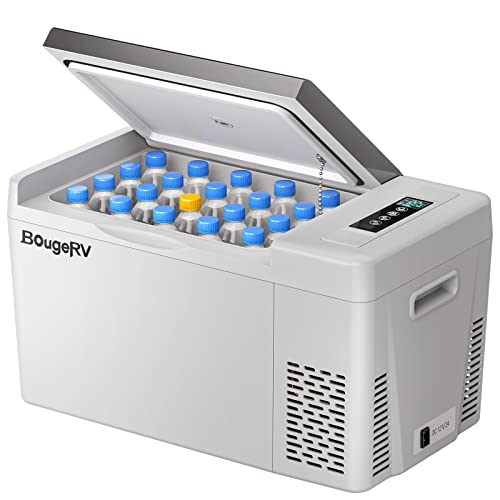
BougeRV’s 23-quart box makes the boldest cold claim in this guide: its title states a range from minus 8 to 50 degrees Fahrenheit, the lowest floor of any pick here, and pairs it with a speed claim — a fast 15-minute cool down to 32 degrees. Read together, those two figures describe a freezer-first appliance. The 50-degree ceiling tells the same story from the other end: this box is tuned for the cold half of the dial, for frozen goods, ice, and drinks held properly chilled, rather than for produce that wants a gentle 60 degrees.
The listing also states the practical virtues plainly: no ice needed, usable as fridge or freezer, powered by 12/24V DC or 110V AC. Twenty-three quarts is the classic two-person weekend size — a couple’s worth of food and drink for two days, or one person’s for four — and the gray finish of this listing is the one verified here; the same model exists in black, and it is the same model, not a second pick. For anglers freezing a catch, hunters moving game, or anyone whose cargo must arrive frozen rather than merely cold, this is the small box with its priorities in the right order.
- Capacity: 23 Quart as the listing states
- Stated temperature range: -8℉ to 50℉
- Cool-down claim: fast 15-minute cool to 32°F per the listing
- Power: 12/24V DC and 110V AC as listed
- Modes: use as fridge or freezer; no ice needed
- Finish: gray (this listing)
- Where to buy: BougeRV’s 23 Quart listing on Amazon is where to check the price on Amazon
Strengths
- The coldest stated temperature floor in the field, at minus 8 degrees.
- A stated rapid cool-down figure, useful when loading warm groceries on a hot day.
- The two-person weekend size that most buyers actually need.
Trade-offs
- The 50-degree ceiling makes it a cold specialist; delicate produce storage is not its brief.
- No app control or battery-protection level is claimed in the title.
- Single zone: fridge or freezer for the whole box, never both at once.
Made for: campers and anglers whose loads must stay genuinely frozen, in a box two people can carry loaded.
A poor match for: shoppers who want one box to chill wine gently and freeze meat simultaneously.

Megiu 32Qt Portable Fridge Freezer — The balanced middle
The Megiu’s title is a study in what this class values once size is settled: compressor cooling, no ice needed, use as fridge or freezer, MAX and ECO modes, three-level battery protection, and power options spanning 12V, 24V, and 110V. Notably, it states no temperature range, and this guide will not invent one for it. What the stated features describe is a box engineered around the vehicle’s electrical reality: MAX mode for pulling a warm load down quickly, ECO mode for sipping power on a long parked stretch, and a three-level battery guard that cuts the box off before it can drink the starter battery dry.
Thirty-two quarts is where portable sizing gets serious without getting silly. It swallows a long weekend for two with room for the return-trip farmers-market haul, yet one person can still move it without planning the lift like a furniture job. For the buyer who camps from the car, tailgates, or runs a small catering sideline from a hatchback, the Megiu’s specification reads like a checklist written by someone who has actually flattened a car battery with a cheaper box — because that is precisely the failure its battery protection exists to prevent.
- Capacity: 32Qt as its title states
- Cooling: compressor cooling; no ice needed
- Modes: MAX and ECO modes per the title
- Battery care: 3-level battery protection as titled
- Power: 12V/24V/110V from the listing
- Temperature range: not stated in the listing title — confirm on the listing page
- Where to buy: find the Megiu 32Qt listing on Amazon and check price on Amazon there
Strengths
- Three-level battery protection, the feature that protects the vehicle as well as the food.
- MAX and ECO modes acknowledge the two real phases of a trip: pull-down and endurance.
- The most trip-friendly size in the field for two travelers.
Trade-offs
- No temperature range is stated in the title, so freezer-depth shoppers must verify on the listing.
- No app control is claimed.
- Single chamber: one temperature governs everything inside.
Choose it if: your trips are long, your stops are longer, and your car battery’s survival is non-negotiable.
Less happy in: the hands of a buyer who needs a guaranteed deep-freeze figure printed before purchase.

Feelfunn 34QT Portable Refrigerator Freezer — Quiet running, app aboard
Feelfunn’s 34-quart box is the only pick here whose title talks about sound: quiet 32 dB, it states, which is a library whisper and a deliberate promise to the van-life and truck-cab crowd who sleep within arm’s reach of their refrigerator. A compressor cycling through the night can saw through light sleep; a box engineered to stay near 32 dB is engineered for bedrooms on wheels. Around that quiet core, the listing assembles the modern kit: app control, a stated fast cooling in 15 minutes, and a temperature range from minus 4 to 68 degrees Fahrenheit — the widest honest span in the field, matched only by the VEVOR and EUHOMY.
Its power statement is equally complete: 12/24V DC and 110-240V AC, which covers vehicles on two continents and any wall socket the trip ends at. Thirty-four quarts sits one step above the Megiu — the size for a small family or a couple who pack like one — and the combination of silence, span, and app control makes this the pick most clearly designed for people who live with their portable rather than merely travel with it. If the box will hum beside your pillow in a converted van for months at a time, its priorities are your priorities.
- Capacity: 34QT as printed in its title
- Stated temperature range: -4℉ to 68℉
- Noise: quiet 32dB the listing states it
- Cool-down claim: fast cooling in 15 minutes as the title has it
- Controls: APP control per its listing title
- Power: 12/24V DC and 110-240V AC as given in the listing
- Where to buy: the Feelfunn 34QT listing on Amazon — check price on Amazon before your next departure
Strengths
- A stated noise figure aimed at people who sleep beside the box.
- Full minus 4 to 68 degree span, freezer to cool-storage in one chamber.
- App control plus the broadest AC input range in the field.
Trade-offs
- No battery-protection levels are spelled out in the title.
- Thirty-four loaded quarts is a two-hand carry for most people.
- Its quiet brief suits travelers better than, say, a noisy job-site crew cab where silence earns nothing.
Suits best: van lifers, truck-cab sleepers, and light sleepers of every vehicle.
Not the one for: buyers who want two zones — no single-chamber box can be, however quiet it runs.

BODEGA 53QT Dual Zone Portable Refrigerator — The only true dual zone
Every large portable gets asked the same question — can it be a fridge and a freezer at the same time? — and in this field only the BODEGA’s title answers yes. Dual zone is stated outright, and it changes what the box is: not one cold space you compromise on, but two climates sharing a shell, so the ice cream stays brick-hard while the salad stays unfrozen a partition away. At 53 quarts it is a family-sized appliance, and BODEGA clearly knows it, because the title also states wheels — the honest admission that a loaded 53-quart box is rolled, not carried.
The rest of its stated kit serves the rolling-family brief: app control for adjusting zones from the driver’s seat, ECO and MAX modes for the endurance-versus-speed decision, battery protection for parked running, and power acceptance from 12V vehicle DC through 100-240V household AC. Its title states no temperature range for either zone, so this guide claims none; the dual-zone architecture is the verified fact, and zone-by-zone figures are a listing-page check. For the family that camps a week at a time, or the boater provisioning for days offshore, this is the pick that ends the two-box era.
- Capacity: 53QT as the listing states
- Zones: dual zone per the listing
- Mobility: wheels as listed
- Controls: APP control as its title states
- Modes: ECO and MAX modes; battery protection per the title
- Power: 12V and 100-240V as titled
- Where to buy: shop the BODEGA 53QT listing on Amazon to check price on Amazon
Strengths
- The field’s only stated dual-zone layout — fridge and freezer simultaneously.
- Wheels acknowledge its loaded weight honestly.
- App control earns its keep when two zones need managing from up front.
Trade-offs
- No per-zone temperature range is stated in the title.
- Its footprint claims real cargo space; small cars need not apply.
- Two zones mean two temperatures to manage — simplicity seekers should look down the ladder.
The right cargo for: families and groups who refuse to choose between frozen and merely chilled.
Skip it if: you travel solo — you would be rolling 43 quarts of empty air behind you.

EUHOMY 59QT 12V Portable Refrigerator — The big single chamber
Where the BODEGA splits its space, the EUHOMY keeps faith with one big room. Fifty-nine quarts in a single chamber is a different philosophy: no partition dictating what fits where, so a whole brisket, a weekend’s worth of drink cases, or a fishing party’s catch all find a home without Tetris. Its title states the full working span — minus 4 to 68 degrees Fahrenheit — which means the whole chamber can run as a freezer or as a fridge, and it backs the claim with the endurance kit: ECO and MAX modes, three-level battery protection, and a low-noise note for cab and campsite manners.
Power acceptance spans 12V vehicle and 100-240V household current, so the big box moonlights naturally: overflow freezer in the garage during hunting season, party fridge on the patio, then back into the truck bed for the next run. Buyers should be clear-eyed about the single-zone bargain — at 59 quarts you are committing the entire cold fleet to one temperature per trip. Households that plan menus in one climate at a time will find that no hardship at all, and they get the largest stated capacity in this guide for their loyalty.
- Capacity: 59QT from the listing
- Stated temperature range: -4℉ to 68℉
- Modes: ECO and MAX modes as printed in its title
- Battery care: 3-level battery protection the listing states it
- Power: 12V and 100-240V as the title has it
- Character: low noise per its listing title
- Where to buy: the EUHOMY 59QT listing on Amazon — check price on Amazon for the current listing
Strengths
- The largest capacity in the field with a full stated freezer-to-fridge span.
- One undivided chamber swallows awkward loads that partitions reject.
- Three-level battery protection guards long parked runs.
Trade-offs
- Single zone at maximum size: one temperature must serve everything aboard.
- No wheels are mentioned in its title; plan the loaded carry accordingly.
- Its bulk dominates small trunks and back seats.
Pick it when: the load is large, uniform in its cold needs, and headed somewhere far from a store.
A weaker fit for: mixed loads needing two climates — that is the BODEGA’s whole reason to exist.
Side by Side: The Six Boxes on the Facts Their Listings State
| Pick | Capacity | Stated range | Zones | Notable stated kit |
|---|---|---|---|---|
| VEVOR 10 QT | 10 QT | -4℉ to 68℉ | Single | App control; DC and AC power |
| BougeRV 23 Quart | 23 Quart | -8℉ to 50℉ | Single | 15-minute cool to 32°F claim |
| Megiu 32Qt | 32Qt | Not stated in title | Single | MAX/ECO; 3-level battery protection |
| Feelfunn 34QT | 34QT | -4℉ to 68℉ | Single | 32dB quiet claim; app control |
| BODEGA 53QT | 53QT | Not stated in title | Dual | Wheels; app control; ECO/MAX |
| EUHOMY 59QT | 59QT | -4℉ to 68℉ | Single | ECO/MAX; 3-level battery protection |
How Many Quarts Does a Trip Actually Eat?
Quarts are an awkward unit until you translate them into meals. Think of roughly a quart per person per day for drinks alone, then add the food: a weekend for two, eating simply, lands near 20 quarts once ice-free packing lets you use the whole chamber — which is why the 23-quart class exists. Stretch the trip to four days or the party to four people and you are shopping at 32 to 34 quarts. A week off the pavement, a family of five, or a boat provisioning for a long weekend pushes past 50, into BODEGA and EUHOMY territory. The solo sizes below 20 quarts are not failed family boxes; they are correctly sized for the one-person loads they serve, and buying bigger than your real pattern means hauling air and draining your battery to cool it.
One more translation helps at the store end of the decision: quarts to cans is the comparison listings love, but quarts to grocery bags is the one your life uses. A standard paper grocery bag holds roughly 16 quarts of loosely packed food, so the 32-to-34-quart pair swallows about two bags — a serious weekly shop for a small household — while the 59-quart EUHOMY takes three and a half, and the 10-quart VEVOR takes a little over half of one. Buyers provisioning a cabin weekend or a tournament team’s drinks cooler can plan directly from that arithmetic, and it explains why the middle sizes dominate driveways: two grocery bags is, empirically, what a trip looks like.
Also weigh the loaded lift. A quart of food and drink weighs roughly two pounds, so a full 59-quart box can outweigh a checked suitcase by a wide margin. Wheels, stated on the BODEGA, stop being a luxury at that scale. If your route from kitchen to car involves stairs, let that fact vote early: two trips with a 32-quart box beat one heroic heave with a 59-quart box and a tweaked back at the trailhead.
What Does Battery Protection Actually Protect?
Your ability to leave. A compressor box sips power compared with most vehicle accessories, but parked overnight — engine off, alternator silent — it sips from the same battery that must crank the engine at dawn. Battery protection watches the battery’s voltage and cuts the box off at a threshold you choose: a high setting guards a starting battery jealously, a low setting lets a dedicated auxiliary battery work deeper. The three-level versions stated on the Megiu and EUHOMY picks give you that choice in steps. Travelers comparing cabins and cottages rather than campsites may also care how a kitchen handles its own powerless hours; the discipline rhymes with the thinking behind Best Integrated Dishwashers in one respect only — both reward buyers who plan the installation before admiring the appliance.
The practical routine is simple. Run the box on its highest protection level whenever it shares the starting battery. Drop a level only when a house battery or a running engine backs the load. And pre-chill everything at home on AC power the night before departure, so the compressor starts the trip holding temperature instead of fighting for it — the single easiest range-extender a portable owner has.
Fridge, Freezer, or Both at Once?
Single-zone boxes ask you to pick one climate per trip, and most trips honestly have one. The freezer runs — ice, game, ice cream, frozen bait — want the coldest settings and forgive nothing. The fridge runs — produce, dairy, leftovers, drinks — want the gentle middle. Mixed loads are where the compromise bites: set for the fridge and the ice cream slumps; set for the freezer and the lettuce freezes into green glass. If your real travel pattern mixes the two weekly, the dual-zone BODEGA is not an upgrade but a correction. If your loads are uniform, a single-zone box at the right size is simpler, lighter on power, and one less climate to manage.
How Should You Pack a Compressor Box for the Road?
Pack it like a refrigerator, not a cooler. Cold air falls and spills every time the lid opens, so load in order of use — tonight’s dinner on top, day three’s supplies at the bottom — and open it with a plan, not a browsing session. Keep a small gap around the interior walls so air can circulate; a box packed to airtight stillness develops warm pockets that no compressor setting can fix. Freeze water bottles at home and lay them along the top: they are not ice for cooling, since the compressor does that work, but thermal ballast that steadies the temperature through lid openings and power gaps. Group drinks in one corner so the most frequent opening reaches them without touring the whole chamber.
Placement in the vehicle matters as much as packing. The compressor needs to breathe, so keep its vents clear of luggage, and shade the box from direct sun through glass — a windshield can turn a cargo area into an oven that forces any refrigerator to run constantly. Secure it against sliding; a 40-pound box in a hard stop is a projectile with a power cord. These habits, more than any feature list, decide whether the temperature on the display is the temperature your food experiences.
Where Do People Misjudge Portable Fridges?
The first misjudgment is buying by the photograph’s cargo — a box shown holding forty cans holds forty cans and nothing else, so read quarts, not cans. The second is assuming dual zone from size; in this verified field exactly one pick states it. The third is ignoring the power cord’s world: cigarette sockets vary, some switch off with the ignition, and a box that stops at every fuel stop still beats ice but loses to a box wired to constant power. The fourth is treating the app as the appliance — apps get abandoned, phones break, and the box must be fully governable from its own panel, which every pick here is. The fifth, and the one that ends trips, is skipping battery protection on a starting battery because the first night went fine.
What About Care, Cleaning, and the Off-Season?
Compressor boxes ask for little: a wiped interior, a dried seal, and storage with the lid cracked so the chamber airs instead of mildewing. Defrost when frost builds — a freezer-run box will frost like any freezer — by emptying it, letting the ice release on its own, and never prying with a knife near the cold plate. Keep the vents dusted, especially in trucks and boats where the box lives in grit. Owners who also keep a tidy kitchen will recognize the same philosophy that governs interior materials there — the readers of Best Dishwashers With No Plastic Inside and the owners of these boxes share a preference for surfaces that clean honestly and do not hold smells. Run the box for an hour every month or two in storage; compressors, like engines, age better exercised than abandoned.
What Powers the Box When the Engine Sleeps?
The cigarette socket is only the first chapter of portable power. Serious travelers graduate quickly to a house battery — a second battery, isolated from the starter, whose whole job is feeding camp loads — and at that point a portable fridge stops being a guest in the vehicle’s electrical system and becomes a resident. The wiring discipline is unglamorous and decisive: thick enough cable for the run, a fuse near the battery, and sockets rated for continuous duty rather than the flimsy accessory outlets that heat up and drop voltage. Voltage drop is the silent saboteur of this entire class; a compressor fed through thin wire sees low voltage, works harder, and may trip its own battery protection even on a healthy battery. Every pick in this guide accepts a range of DC and AC inputs as its title states, but the quality of what arrives at the plug is your installation’s doing, not the box’s.
Solar enters the picture for stays longer than a weekend. A modest panel on a roof rack or propped at camp, feeding the house battery through a charge controller, can balance a fridge’s daily appetite indefinitely in fair weather — which is why the portable class and the solar class overlap so heavily in the van and overland worlds. Portable power stations offer the shortcut version of the same architecture: battery, controller, and outlets in one handle-carried box, charged from the wall before departure or from the vehicle en route. Whichever architecture you choose, the arithmetic is the same — know your box’s appetite in the mode you actually run, size the battery for the longest parked stretch you plan, and keep the starter battery out of the equation entirely whenever the trip allows it.
How Do Tilt, Vibration, and Rough Roads Treat a Compressor?
Household refrigeration assumes a level floor and a quiet life; portable compressors are built for the opposite. The units in this class are designed to keep cooling on grades and over washboard roads that would horrify a kitchen fridge, which is why they serve in trucks, boats, and off-road rigs where level is a rumor. That said, design tolerance is not an invitation to abuse. A box that rides strapped down, vents clear, on a surface that does not cook it from below will outlast one that slides around a truck bed baking in direct sun. Boat owners should mind the additional arithmetic of heel and spray; truck owners, the heat that pools in a sealed canopy at noon.
Vibration deserves a word of its own, because it is the wear item nobody photographs. Fasteners loosen, plugs fret in their sockets, and a box that chatters against a metal bed for a thousand miles ages faster than its compressor hours suggest. A rubber mat beneath the box, a strap that holds without crushing, and a plug checked at fuel stops are the whole maintenance liturgy — cheap, quick, and the difference between a five-year appliance and a two-season disappointment. The picks here are sold for exactly this life; their titles speak of trucks, RVs, vans, and camping because the manufacturers know where the boxes will actually live.
Why Does the Temperature Display Disagree With Your Thermometer?
Sooner or later every owner drops a thermometer into the box, finds a number a few degrees off the display, and wonders which one is lying. Usually neither is. The display reports the temperature at the box’s own sensor, typically near the cooling plate; your thermometer reports the air where you hung it, and a portable’s interior is a landscape of microclimates — coldest at the plate, warmest at the lid, shifting every time the compressor cycles or the lid opens. Food safety lives in the warmest spot, so measure there, near the top of the load, and set the box a couple of degrees colder than your target if the top of the chamber runs warm.
Load shape matters too. A chamber full of cold, dense food holds its temperature with metronome steadiness, while a nearly empty box swings with every cycle — another reason the frozen water bottles recommended earlier earn their space as ballast. Give a newly loaded box several hours before judging its honesty; warm food is a heat debt the compressor repays slowly, and the display during repayment tells you about the debt, not about the box’s character. Judged at equilibrium, in the spot that matters, these appliances hold their set points with a fidelity that would shame many a kitchen refrigerator.
Can a Portable Fridge Earn Its Keep in Winter?
Owners in cold climates discover a second season for these boxes. When the garage sits below freezing for weeks, a household fridge’s freezer compartment can drift with the room — but a portable set to a precise temperature holds its line in a cold workshop, protecting the frozen goods that overfloweth from the house during hunting season and the holidays. Run in reverse logic, the same box protects cold-sensitive cargo in a freezing vehicle: set to a gentle refrigerator temperature, it keeps drinks, produce, and certain supplies above the ambient freeze on a winter job site, warming being simply refrigeration against a colder world. The stated spans in this field — up to 68 degrees on three picks — exist partly for this reason: a box that can hold 50 or 60 degrees on command is a cellar as well as a freezer.
Winter also forgives power sins that summer punishes. A compressor in a 30-degree truck bed barely works to hold freezing, so battery endurance stretches and the overnight anxiety of July evaporates. If your travels lean toward ice fishing, ski trips, and winter work, the portable’s value proposition quietly doubles — and the purchase that looked like a summer luxury in June reads, by January, like the most versatile cold appliance you own.
Compressor or Thermoelectric — Why the Cheaper Box Disappoints?
Every portable buyer meets the thermoelectric cooler first, because it costs a fraction of a compressor box and promises cold without ice. Its promise has a ceiling written into its physics: it cools a fixed distance below the surrounding air, so on a mild spring day it feels miraculous and on a 100-degree afternoon in a parked car it holds food at temperatures no one should eat. It cannot freeze, it cannot hold a set point, and its one moving part — a small fan — lulls buyers into thinking the technology is simpler in a good way. Simpler, here, means incapable. The compressor boxes in this guide exist because travelers kept learning that lesson at the cost of a load of groceries.
The compressor’s advantages compound on long trips. It reaches its temperature and rests; the thermoelectric runs constantly and still loses ground whenever the sun hits the vehicle. It sips from the battery in cycles; the thermoelectric drinks steadily. And at the end of the day it can hand you ice — actually frozen water, made en route — which remains the small miracle that converts skeptics. If your use is a two-hour picnic in gentle weather, the cheap box is honestly fine. The moment a trip involves a hot vehicle, a second day, or anything that must stay frozen, the compressor stops being the expensive option and becomes the only option, and every pick in this guide is that kind of machine.
Which Vehicle Spaces Swallow Which Sizes?
Measure the space before the box, because portables live in geometry. The 10-quart VEVOR belongs to the footwell-and-console world: behind a seat, on a transmission hump, in the cab of a work truck where its owner actually reaches it. The 23-quart class rides in trunks and rear footwells of sedans and crossovers, sliding out for loading like a drawer of cold. The low-30s boxes — Megiu, Feelfunn — are hatchback and SUV cargo-area residents, tall enough to stand bottles in, sized to leave room for the rest of the camp. The 53 and 59-quart pair are truck-bed, van, and boat appliances; in a small car they do not fit so much as move in.
Height is the dimension buyers forget. A box that fits the cargo floor may still foul the sloped hatch glass above it, and a lid that cannot open fully inside the vehicle turns every loading into a drag-it-out ceremony. Check the listing’s dimensions against your space with the hatch closed and the seats where you keep them, and leave clearance at the vents — a box suffocated by luggage works twice as hard for the same cold. Tie-down points matter in beds and boats; a box that can be strapped is a box that arrives. These are dull paragraphs, deliberately: in this class, the glamorous specifications are all about temperature, but the purchases that get returned are the ones that failed geometry.
What Should the First Trip Teach You?
Treat the maiden voyage as an instrument check. Note how long the box takes to pull a warm load down — the BougeRV and Feelfunn both state 15-minute cool-down claims aimed at exactly this curiosity, though full loads take longer than the headline test. Watch the battery gauge if you run parked, and learn how many hours your setup truly has rather than the number you hoped for. Check the top of the load with a thermometer at journey’s end and compare it with the display, so later trips inherit a calibration instead of a surprise. And notice your own habits: how often you opened the lid, what you buried that you needed, which corner became the drinks corner by natural law.
Owners who run that first trip attentively rarely have a bad second one. The box reveals its rhythm — when it cycles, how it likes to be packed, where its cold pools — and the vehicle reveals its own: which socket stays live, where the sun pools at noon, how much room the vents really need. That mutual knowledge, not any single specification, is what people are actually buying in this class: cold that behaves predictably, hundreds of miles from the kitchen that spoiled them.
How Long Should a Good Portable Last, and What Kills It Early?
A compressor is among the most durable mechanisms in any home — the same basic machine runs kitchen refrigerators for decades — and a well-kept portable should measure its life in years of trips, not seasons. What shortens that life is rarely the refrigeration circuit itself. It is the supporting cast: fans choked with dust and pet hair, seals torn by being slammed on cargo, cords frayed where they exit a bouncing vehicle, vents blocked until the compressor cooks in its own exhaust. Nearly all of that is owner-preventable with the dull liturgy already described — dust the vents, mind the cord, store it dry with the lid ajar, and strap it so it rides rather than rattles.
Heat is the other slow killer, and it works through arithmetic rather than damage. A box that spends its summers fighting a 130-degree cargo area runs more hours per trip than one shaded and ventilated, and compressor life is ultimately counted in run hours. Shade cloth, a cracked window where security allows, and parking with the cargo area out of the sun are longevity measures disguised as comfort measures. Buyers who treat the box as an appliance — with a home spot, a cleaning rhythm, and a respectful ride — routinely get the long service the technology promises. Buyers who treat it as a cooler with a plug get cooler-grade lifespans, and the difference between those two owners is larger than the difference between any two picks in this guide.
There is also a resale truth worth knowing: named compressors in popular sizes hold their value because the used market understands exactly what they are. The 23-to-34-quart heartland sizes move fastest secondhand, since they fit the widest range of vehicles and trips. Buying the right size once, from a listing whose specifications you verified, is therefore cheaper in every direction — no return freight, no replacement purchase, no discount taken on a hasty resale of the wrong box.
A Note on Noise, Sleep, and Campground Manners
Sound is the specification travelers underrate until the first night. A compressor box makes two noises: the low hum of the compressor itself and the whisper of its fan, punctuated by the soft click of cycles starting and stopping. In a moving vehicle both vanish under road noise. Parked, in the silence of a tent or a sleeper cab, they become the loudest thing in your world — which is why the Feelfunn’s stated 32 dB figure is aimed at a real pain rather than a spec-sheet contest. Placement helps any box: a mat beneath it kills the drumming that turns a cargo floor into a sounding board, and a few inches of air around the cabinet keep fan noise from reflecting straight back at the sleeper. If your nights are light and your box will share them, let the noise line in a listing carry real weight in your decision; it is the one specification you will hear in the dark, every night, for the life of the appliance.
Final Recommendation
Start with the load, not the listings. One person’s daily cold belongs in the VEVOR 10 QT. Two travelers freezing seriously belong in the BougeRV 23 Quart; two travelers traveling long belong in the Megiu 32Qt, whose battery protection is the wisest money in the middle of this field. Sleep beside your box and the Feelfunn 34QT’s quiet brief wins. Carry two climates or one enormous one — BODEGA 53QT for the split, EUHOMY 59QT for the single vast chamber. Buy the size your real trips demand, wire it to power that respects your starter battery, and the melted-ice era of your traveling life ends the day the box arrives — which, for anyone who has ever poured cooler water over a ruined picnic at a rest stop, is worth more than every feature in this guide combined.
Frequently Asked Questions
Can a portable fridge freezer really freeze, or is it just a strong cooler?
A compressor unit genuinely freezes. In this field, the BougeRV states a floor of minus 8 degrees Fahrenheit and three other picks state minus 4, both well below the freezing point of water and cold enough for ice cream, frozen meat, and ice. Thermoelectric coolers are the ones that merely chill below ambient; none of the six picks here is that lesser technology.
Will one of these boxes kill my car battery overnight?
It can if you let it, which is why battery protection matters. Picks whose titles state three-level battery protection — the Megiu and the EUHOMY among them — cut the box off before the battery falls below a threshold you select. On a shared starting battery, use the most protective level, and pre-chill the load at home so the compressor idles rather than labors through the night.
What size should a family of four buy for week-long camping?
Shop at the top of this ladder. A week for four people is a 50-plus-quart problem: the BODEGA 53QT if the menu mixes fridge and freezer goods, the EUHOMY 59QT if everything aboard shares one climate. Below that size, a family spends the trip rationing space instead of enjoying it.
Do I need the app control, honestly?
No — and every pick here remains fully usable from its own panel. App control earns its place in specific moments: adjusting the box from the driver’s seat, checking temperature without opening the lid at a rest stop, changing a zone while the box sits in a hot cargo area. Treat it as a convenience layered on a complete appliance, never as the appliance itself.
Can these boxes run at home as a spare fridge or freezer?
Yes, and most owners end up using them that way. The picks’ titles state household AC acceptance — 110V, 110-220V, 110-240V, or 100-240V depending on the model — so the same box that travels can hold overflow groceries, party drinks, or a holiday turkey’s supporting cast in the garage. It is a second refrigerator that happens to have a vehicle habit.
Related Guides
When the traveling ends and the load moves indoors, the home end of frozen storage has its own ladder of sizes and formats, mapped in Best 20 Cu Ft Chest Freezers — the stationary counterpart to everything the portable class does on wheels and 12 volts.


