What's inside
- Key Takeaways
- Quick Picks
- What Did We Require Before Calling a Dishwasher “Integrated”?
- Panel-Ready Versus Fully Integrated: Which Disappearance Do You Want?
- What Should You Ask Your Cabinetmaker Before Ordering?
- How Does an Integrated Machine Change Daily Use?
- What Goes Wrong With Panelled Installations?
- Mistakes That Undo an Integrated Kitchen
- The Six, Compared on What Their Listings Actually State
- Which Panel Materials Behave Well on a Dishwasher Door?
- How Do You Live With a Machine You Cannot See?
- Does Integration Cost You Efficiency or Capacity?
- How Should You Brief a Kitchen Designer About the Dishwasher?
- The Handle Question, and Other Small Decisions That Are Not Small
- What Does Integration Mean for Resale, Landlords and Letting?
- Why Did the Dishwasher Learn to Disappear?
- How Do You Service a Machine That Is Part of the Furniture?
- What Should You Budget Beyond the Machine Itself?
- Final Recommendation
- Frequently Asked Questions
- Related Guides
As an Amazon Associate I earn from qualifying purchases. This post may contain affiliate links at no extra cost to you.
cottageverdict.com is reader-supported. When you buy through links on our site, we may earn an affiliate commission.
Where to buy: each machine below is sold through Amazon, and every pick section closes with the precise listing name to search for, where you can check price on Amazon and read the panel specifications before you commit your cabinetmaker to a door. With integrated machines the panel is half the purchase, so read the maker’s panel weight and dimension limits before anyone cuts timber.
The best integrated dishwashers are bought by people who have looked at a beautiful kitchen and asked an impolite question: where is the dishwasher? The answer, in a fully integrated design, is that it is standing behind a door panel that matches the cabinetry exactly, its controls hidden along the top edge of the door, betraying itself only by a handle — sometimes not even that. This is not vanity. In open-plan homes the kitchen is the living room, and a wall of stainless appliance fronts reads very differently from a calm run of painted or timber cabinetry. Integration is how the hardest-working machine in the house learns discretion.
Vocabulary matters here, because the market abuses it. A top-control dishwasher with a stainless door is not integrated; it is merely tidy. In this guide, “integrated” is claimed only where the manufacturer’s own listing title claims it: panel-ready machines built to accept a custom cabinet door (the KoolMore, the Bosch SHV, the Forno, the ZLINE) and fully integrated machines whose controls disappear entirely behind the door line (the Monogram and the Bosch SHP, both in stainless). Every one of the six linked picks states its integration claim in its title. Where a title gives a decibel figure, we quote it; where it gives place settings, we quote those; where it is silent, we stay silent and let the machine’s design brief speak instead.
Key Takeaways
- All six linked picks state their integration in the listing title — four are panel-ready for a custom cabinet door, and two are fully integrated stainless designs with concealed controls.
- The two Bosch picks are different answers, not duplicates: the SHV takes your cabinet panel, while the SHP wears its own stainless front with the controls hidden.
- Stated noise runs from 39 dBA (the Monogram) through the low-to-mid forties — integration and quiet engineering travel together in this class.
- A panel-ready purchase is two purchases: the machine, and a panel built to the maker’s weight and size limits by someone who has done it before.
- Third-rack loading appears in this class (the ZLINE states one), but capacity claims otherwise stay modest — read the stated place settings, not the photography.
Quick Picks
| Machine | Badge | Why it earns its place |
|---|---|---|
| KoolMore KM-DW2445-PR Panel-Ready Dishwasher | Panel-ready value anchor | Fourteen stated place settings, a stated 45 dB and both UL and Energy Star named — the panel-ready brief at its most complete on paper. |
| Bosch SHV78DM3N Panel-Ready Dishwasher | The cabinetmaker’s Bosch | Bosch’s panel-ready fully integrated line at a stated 42 dBA, with smart features for those who want them. |
| Forno Rivestito Panel-Ready Dishwasher | Italian-styled panel route | Panel-ready with a stated 45 dB, a stainless steel interior and Energy Star named in the listing. |
| Monogram ZDT985SPNSS Fully Integrated Dishwasher | The quiet flagship | The lowest stated noise in this guide at 39 dBA, in a fully integrated stainless design from GE’s luxury arm. |
| ZLINE Monument DWMT-24 Panel-Ready Dishwasher | Third-rack panel option | Custom panel ready with a stated third rack, stainless tub and 45 dBa — the loader’s choice among panel machines. |
| Bosch SHP78DM5N Fully Integrated Dishwasher | Stainless, fully hidden controls | Fully integrated in stainless at a stated 42 dBA for kitchens that want the metal but not the control strip. |
What Did We Require Before Calling a Dishwasher “Integrated”?
The first requirement was honesty of vocabulary, enforced mechanically: the listing title itself had to carry the claim. Panel-ready, fully integrated, custom panel ready — if the manufacturer’s own title did not say it, the machine did not enter this list, however hidden its controls might look in photographs. That rule quietly excludes a shelf of handsome top-control machines that marketing departments describe as integrated-adjacent. They are fine dishwashers; they are simply not this guide’s subject, and readers planning a panelled kitchen deserve a list that never makes them discover the difference after delivery.
The second requirement was that the integration be structural, not cosmetic. A panel-ready machine ships without a finished front because its door is engineered — in hinge balance, in mounting points, in the control layout along the door’s top edge — to carry the weight of your cabinetry. A fully integrated stainless machine achieves the same disappearance by recessing its controls entirely. Both approaches cost engineering that a sticker badge cannot fake. Third, we read for the supporting facts a panelled installation actually needs: stated place settings where given, stated decibels where given, certifications where given, and we treated the two Bosch lines as the distinct products they are — one built for your panel, one built to be seen in stainless with its controls tucked away. Readers comparing brand families across guides will notice our brand study of Best GE Dishwashers takes the same title-first approach to the Monogram’s parent stable.

KoolMore KM-DW2445-PR Panel-Ready Dishwasher — Panel-ready value anchor
KoolMore’s KM-DW2445-PR is the completeness pick: the listing title manages to state nearly everything a panelled buyer asks first. It is a 24-inch panel-ready machine with fourteen place settings, a stated 45 dB operating level, a stainless-steel build, and both UL and Energy Star credentials named outright. In a class where several famous names publish titles that say almost nothing, that density of stated fact is itself a recommendation — it suggests a maker who expects to be compared on specifications rather than on showroom lighting.
For households comparing across brands, KoolMore’s presence in this class is itself a sign of the format’s maturity: panel-ready engineering is no longer a luxury-only craft, and a maker can now state the full panel-ready package — capacity, noise, credentials — in a single listing title and expect to be judged on it. That transparency is the standard this guide would set for the whole class if it could.
The fourteen stated settings put it squarely in family territory, and the panel-ready format means the machine’s daily presence in the kitchen is whatever your cabinetmaker makes of it: an exact match to painted Shaker doors, a slab of the same walnut as the island, or a deliberately contrasting panel that turns the dishwasher into the one honest seam in the run. At a stated 45 dB it sits in the comfortable middle of this guide’s noise range — quiet enough for open-plan evenings, without claiming the flagship hush of the Monogram. For a renovator who wants the integrated look with the paperwork in order — certifications named, capacity named, noise named — this is the straightforward shortlist-topper, the machine against which the prettier stories below have to justify themselves.
- Format: 24-inch panel-ready, as titled
- Capacity: 14 place settings, as titled
- Noise: 45 dB, as titled
- Build: stainless steel, as titled
- Credentials: UL and Energy Star Certified, as titled
- Model: KM-DW2445-PR
- Where to buy: the KoolMore KM-DW2445-PR Panel-Ready Dishwasher listing on Amazon — check price on Amazon
Strengths
- The most completely stated specification of any pick in this guide.
- Fourteen settings cover genuine family loads behind the panel.
- Both major credentials are named in the title itself.
Trade-offs
- 45 dB is good, not class-leading, for very open plans.
- The panel itself is your cabinetmaker’s cost and problem.
- No third rack is stated for cutlery-heavy households.
Best for: a panelled renovation that wants the integrated look with every key figure stated up front.
Not suited for: buyers chasing the absolute quietest machine regardless of paperwork.

Bosch SHV78DM3N Panel-Ready Dishwasher — The cabinetmaker’s Bosch
The SHV78DM3N is Bosch’s panel-ready answer in its higher series: the listing states 42 dBA, panel-ready construction, fully integrated built-in format and smart features. Cabinetmakers like this machine for reasons that never appear in advertisements — Bosch publishes disciplined panel specifications, the door hardware tolerates real timber weight gracefully, and the top-edge controls stay reachable and legible under a panelled door. When a kitchen designer specifies “the Bosch panel one” without finishing the sentence, this is the family they mean.
At a stated 42 dBA it undercuts the KoolMore and Forno on noise while asking you to trust the brand’s broader documentation for the capacity and interior details its title leaves unstated — we note that silence rather than filling it from sibling models, because Bosch’s series ladder is a maze even for dealers. The smart designation in the title will divide readers: those who want cycle notifications and remote diagnostics get them; those who regard a dishwasher as an appliance that should outlive its app ecosystem can simply never connect it, and lose nothing about the wash. Either way, the machine’s core proposition is the panelled Bosch experience — quiet, exact, and invisible in the room until the moment it is opened.
- Format: panel-ready, fully integrated built-in, as titled
- Noise: 42 dBA, as titled
- Features: smart designation, as titled
- Maker’s line: the panel-ready branch of Bosch’s higher series
- Where to buy: the Bosch SHV78DM3N Panel-Ready Dishwasher listing on Amazon — check price on Amazon
Strengths
- Stated 42 dBA beats most of this list on paper.
- Panel engineering from the maker designers specify most.
- Smart features present for those who want them, ignorable for those who do not.
Trade-offs
- The title states no place settings — capacity must be confirmed on the listing.
- Panel specifications must be followed exactly; improvisation voids the magic.
- Smart features add nothing if your household will never connect them.
Ideal when: your cabinetmaker asks which panel-ready machine they would rather hang a door on.
A weak match when: you want every figure, including capacity, stated in the listing title itself.

Forno Rivestito Panel-Ready Dishwasher — Italian-styled panel route
Forno’s Rivestito brings the panel-ready format from an Italian-styled maker whose ranges and refrigeration trade on a professional-kitchen look. Its listing states the essentials cleanly: 24-inch panel-ready format, a quiet 45 dB, a stainless steel interior and Energy Star standing. The stainless interior is worth pausing on — in a panelled machine the outside is your cabinetry, so the inside is the maker’s entire visible craft, and a steel tub is the right place for that craft to show. It resists staining, holds heat kindly for drying, and reads as quality every time the door opens, which in an integrated kitchen is the only time the machine reads as anything at all.
The Rivestito’s proposition is stylistic coherence for kitchens built around Forno’s other appliances, and specification adequacy for everyone else: nothing in its stated package leads the class, and nothing embarrasses it. The stated 45 dB matches the KoolMore; the Energy Star standing matches; the panel takes your cabinetry like the rest. Choose it when the kitchen’s design language is already speaking Italian, or when its particular balance of stated facts lands at the right moment in a remodel’s budget. It is the connoisseur’s panel pick rather than the spreadsheet’s, and this guide respects both temperaments.
- Format: 24-inch panel ready, as titled
- Noise: 45 dB (stated as “Quiet 45 dB”)
- Interior: stainless steel, as titled
- Certification: Energy Star, as titled
- Where to buy: the Forno Rivestito Panel-Ready Dishwasher listing on Amazon — check price on Amazon
Strengths
- Stainless interior stated — the visible craft of a panelled machine.
- Pairs visually and stylistically with a Forno-led appliance suite.
- Energy Star standing is named in the title.
Trade-offs
- No capacity figure is stated in the title.
- Noise matches rather than beats the mid-pack.
- The brand’s service footprint is thinner than the giants’.
Choose it if: your kitchen is being built around an Italian-styled suite and the panel must keep the secret.
Pass on it if: you need stated place settings before you will shortlist a machine.
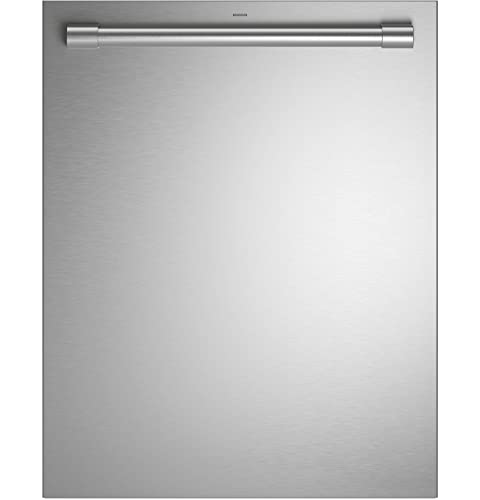
Monogram ZDT985SPNSS Fully Integrated Dishwasher — The quiet flagship
Monogram is GE’s luxury arm, and the ZDT985SPNSS is this guide’s flagship by the only number that cannot be argued with: the listing states 39 dBA, the lowest noise figure among all six picks. Thirty-nine decibels is library-corridor territory — a machine you can run through a dinner party in the same room without a single guest raising their voice. It achieves its integration differently from the panel-ready four: this is a fully integrated stainless design, its controls concealed, its front a single composed metal face that sits flush and quiet in a stainless-led kitchen. Buyers who want disappearance without commissioning a panel should study it closely, because it is the proof that “integrated” and “panel-ready” are cousins, not synonyms.
It is worth saying plainly who should not buy it, because flagship machines attract aspirational purchases that end in mismatch. If your kitchen’s design is a timber panelled run, this machine’s stainless face will read as an interruption no matter how quiet it runs. If your household’s loads are small and your room is a closed kitchen, its hush is engineering you will rarely be in the room to appreciate. The Monogram rewards a specific life — open-plan, stainless-led, lived in one room — and rewards it completely.
The smart designation in its title suits its tier — at flagship level, connected diagnostics and status are expected furniture — and the Monogram badge carries the service expectations of a luxury line, which matters in a machine engineered this tightly. What the title does not state, we do not claim: capacity and interior details live on the listing for your confirmation. What the title does state is the thing money cannot retrofit later — the 39 dBA. Noise is born in the pump, the insulation and the tub engineering; no cabinetmaker can add it afterwards. If your kitchen is one room with your life, this is the pick the rest of the list is measured against.
- Format: fully integrated, stainless, as titled
- Noise: 39 dBA, as titled — the lowest stated here
- Features: smart designation, as titled
- Model: ZDT985SPNSS
- Where to buy: look for the Monogram ZDT985SPNSS Fully Integrated Dishwasher listing on Amazon — check price on Amazon
Strengths
- A stated 39 dBA leads this entire guide on quiet.
- Fully integrated stainless front — no panel commission required.
- Luxury-line backing and smart features at the tier that expects them.
Trade-offs
- It wears stainless; it will not take your cabinet panel.
- Capacity is not stated in the title.
- Flagship positioning means flagship expectations on budget.
The right kitchen: an open-plan space where the dishwasher runs while life happens around it.
Look elsewhere when: the whole point of your renovation is a timber panel with no metal showing.

ZLINE Monument DWMT-24 Panel-Ready Dishwasher — Third-rack panel option
ZLINE’s Monument-series DWMT-24 is the panel-ready pick for people who load first and admire cabinetry second. Its listing states the combination loaders care about: custom panel ready, a stainless steel tub, a third rack, top touch controls and 45 dBa. The third rack is the differentiator in a panelled field that mostly competes on silence — a shallow upper tray that swallows cutlery, utensils and the long awkward tools that otherwise colonise the main racks, freeing the lower tub for the pans and platters that justify a full-size machine. Households that cook with many utensils feel a third rack every single day; it is the least glamorous and most used feature in modern dishwashing.
The “custom panel ready” phrasing in the title is the honest core of the machine: ZLINE builds the Monument line for kitchens with a designed look — the brand’s whole identity leans into statement kitchens — and the panel is where your design statement happens. The stated stainless tub keeps the interior honest, the top touch controls keep the panelled front clean, and the stated 45 dBa keeps it mid-pack on noise. If your household’s loading pattern is utensil-heavy and your kitchen’s design is panel-led, this is the intersection pick: the machine that respects both the cabinetmaker and the cook.
- Format: custom panel ready, 24-inch class, as titled
- Racking: 3rd rack stated in the title
- Controls: top touch control, as titled
- Tub: stainless steel, as titled
- Noise: 45 dBa, as titled
- Model: DWMT-24, Monument Series
- Where to buy: the ZLINE Monument DWMT-24 Panel-Ready Dishwasher listing on Amazon — check price on Amazon
Strengths
- The only panel-ready pick here stating a third rack.
- Stainless tub stated alongside the panel-ready format.
- Top touch controls keep the panelled face completely clean.
Trade-offs
- 45 dBa matches the mid-pack rather than the quiet leaders.
- No place-setting figure is stated in the title.
- Third-rack loading is a habit some households never adopt.
Suits best: utensil-heavy cooks inside a panel-led designer kitchen.
Not suited for: buyers whose first priority is the lowest stated decibels.

Bosch SHP78DM5N Fully Integrated Dishwasher — Stainless, fully hidden controls
The SHP78DM5N is the other Bosch, and keeping the two straight is this guide’s small act of public service. Where the SHV above is panel-ready — naked without your cabinetry — the SHP is fully integrated in stainless: a finished metal front whose controls vanish into the door’s top edge, giving the integrated kitchen the Bosch wash at a stated 42 dBA without commissioning a panel. Kitchens already committed to stainless, or renters of high-end fitted kitchens whose landlords chose the metal look, are its natural home. The smart designation appears in its title as it does in its sibling’s, with the same divide: connect it if you value the notifications, ignore it if you do not.
Side by side, the siblings frame the integrated decision perfectly. Same stated quiet. Same maker’s engineering culture. The choice is purely architectural: does your kitchen’s design ask the dishwasher to wear the cabinetry (SHV) or to wear stainless with its controls hidden (SHP)? Neither answer is more “integrated” than the other; both conceal the machine’s working face from the room. What the SHP saves you is the panel itself — its cost, its lead time, its weight calculations — and what it asks in return is that stainless be a front you are happy to see. In a kitchen of stainless ranges and refrigerators, that is no sacrifice at all.
- Format: fully integrated built-in, stainless, as titled
- Noise: 42 dBA, as titled
- Features: smart designation, as titled
- Distinction: finished stainless front — not a panel-ready model
- Where to buy: the Bosch SHP78DM5N Fully Integrated Dishwasher listing on Amazon — check price on Amazon
Strengths
- Integrated discretion without commissioning a cabinet panel.
- Stated 42 dBA matches its panel-ready sibling.
- Bosch engineering and documentation depth.
Trade-offs
- It cannot take a custom panel later — the front is final.
- Capacity is not stated in the title.
- Stainless shows fingerprints in a way a panel never will.
Worth it when: your kitchen already speaks stainless and you want the controls gone, not the metal.
Frustrating when: the renovation plan calls for an unbroken run of cabinet doors.
Panel-Ready Versus Fully Integrated: Which Disappearance Do You Want?
The panel-ready route — KoolMore, Bosch SHV, Forno, ZLINE — makes the dishwasher a piece of furniture. Its success depends on three numbers your cabinetmaker must respect: the panel’s dimensions, its weight range, and its thickness, all published by the maker and all unforgiving. A panel that is too heavy strains hinges and changes the door’s balance; too thick, and it fouls the neighbouring doors at full swing. Commission the panel from the same shop that built the kitchen run, hand them the maker’s specification sheet before they cut, and insist the handle — if the design uses one — is mounted through the panel into the machine’s door exactly as the template directs. Done well, guests open the wrong door twice before they find the dishwasher, which owners of panelled kitchens count as the highest praise.
The fully integrated stainless route — Monogram, Bosch SHP — makes the dishwasher a piece of sculpture instead: present, composed, but silent about its controls. It suits kitchens where the appliance suite is a deliberate material, and it forgives more, because there is no panel to commission, align or keep in finish-matching repair for twenty years. Its trade-off is permanence of look: the stainless front is the front forever. Neither route hides the machine’s interior, its racks or its work; both hide only the interface. Choose by asking which your kitchen will still love in a decade — the unbroken cabinetry run, or the calm metal face — because the wash inside either is a decision the listings above have already made well.
What Should You Ask Your Cabinetmaker Before Ordering?
Ask first whether they have hung dishwasher panels before, and listen for specifics rather than confidence. Ask who supplies the panel — the kitchen maker, a separate joiner, or the appliance dealer’s panel service — and who owns the problem if the panel and the machine disagree by three millimetres. Ask how the design handles the handle: many panelled kitchens use a handle matched to the cabinet run, some use an edge-pull routed into the panel’s top, and the choice changes the panel’s construction. Ask about the kick plate, the strip beneath the door that must move with the machine’s door swing or sit recessed behind it; a kick plate fitted like ordinary cabinetry will be kicked by the door it hides.
Then ask the question that protects the whole project: what is the maker’s stated panel weight limit for the exact model you are ordering, and does the planned panel — in your chosen material, at your chosen thickness — sit comfortably inside it? Timber species differ wildly in density; a panel in solid oak is not a panel in painted MDF. The machines in this guide publish their limits; the time to compare them is before the timber is ordered, not after. Finally, agree who levels the machine and who makes the final door-gap adjustments, because a panelled dishwasher is aligned twice — once as an appliance, once as furniture — and each trade assumes the other did the second.
How Does an Integrated Machine Change Daily Use?
The honest daily difference is the control strip’s address. With controls along the door’s top edge, you set the cycle with the door ajar, close it, and the room hears nothing and sees nothing — no countdown glow, no status light unless the design projects one onto the floor. Some owners find the invisibility serene; some find themselves opening the door mid-cycle to check, which the machine tolerates and the dishes forgive. Households with children discover a genuine benefit: there are no buttons at toddler height, because there are no visible buttons at all. Households with guests discover the comic cost: visitors cannot find the dishwasher, and will stack plates beside the sink of a kitchen that contains a perfectly empty machine.
None of this changes the wash. What changes is the kitchen’s emotional register — one fewer appliance face, one calmer room — and that is precisely what the premium buys. Buyers who move between homes for work sometimes take the opposite format for flexibility, which is why our guide to the Best Mobile Dishwashers exists as this guide’s philosophical opposite: wheels and a faucet hose instead of panels and permanence. Both are correct answers; they are answers to different lives.
What Goes Wrong With Panelled Installations?
The failures are consistent enough to list from memory. Panels arrive built to the kitchen’s door dimensions rather than the machine maker’s panel drawing — close, beautiful, and wrong. Hinges complain within a year because the panel’s weight was guessed. The door, perfectly aligned in the workshop, rubs in the house because the floor falls away and nobody re-levelled after the flooring went down. And the classic: the panel is fitted before the machine’s first test cycle, so the leak that a ten-minute empty run would have announced instead announces itself through a swollen timber panel. Every one of these is a sequencing failure, not a product failure, and every one is preventable by the order of operations in the next section.
Order of operations, then, as the careful installers practise it. Set and level the machine. Plumb and wire it. Run it empty, then run it loaded, with the front still bare. Only when the machine has proven itself does the panel go on, followed by alignment, gap-checking against its neighbours through the door’s full swing, and a final loaded cycle with the panel fitted — because the panel’s weight is part of the door’s behaviour and deserves a test of its own. Readers who treat this sequence as fussiness have not priced a replacement panel in matched, aged timber.
Mistakes That Undo an Integrated Kitchen
First, buying the machine before the kitchen design is final — the panel-ready versus stainless decision is a design decision, and reversing it mid-remodel wastes both money and goodwill. Second, treating the two Bosch lines as interchangeable because their names differ by one letter; SHV and SHP are different products answering different briefs, and ordering the wrong one is an expensive reading error. Third, forgetting the floor: a machine levelled on subfloor and then trapped by new flooring cannot be removed for service without a fight, so leave the service clearance the maker specifies. Fourth, matching a panel’s finish from a photograph rather than a physical sample under the kitchen’s own light.
Fifth, and most quietly damaging: neglecting the interior because the exterior disappeared. An integrated machine still has a filter that wants a monthly rinse, seals that want a wipe, and racks that reward the loading discipline every dishwasher rewards. The invisibility is cosmetic; the maintenance is not. Owners who keep the small rituals find their panelled machine outlasts the kitchen’s fashion cycle, which is the entire point of a design meant to be timeless. And a note for the feature-led: integration now travels with connected extras across price tiers, a theme our roundup of the Best Multifunctional Microwaves explores in the neighbouring appliance — worth reading before you decide how much connectivity your kitchen actually wants.
The Six, Compared on What Their Listings Actually State
| Machine | Integration route | Stated noise | Other stated facts |
|---|---|---|---|
| KoolMore KM-DW2445-PR | Panel-ready | 45 dB | 14 place settings, stainless steel, UL and Energy Star |
| Bosch SHV78DM3N | Panel-ready, fully integrated | 42 dBA | Smart designation |
| Forno Rivestito | Panel-ready | 45 dB | Stainless steel interior, Energy Star |
| Monogram ZDT985SPNSS | Fully integrated stainless | 39 dBA | Smart designation |
| ZLINE Monument DWMT-24 | Custom panel ready | 45 dBa | 3rd rack, top touch control, stainless tub |
| Bosch SHP78DM5N | Fully integrated stainless | 42 dBA | Smart designation |
Which Panel Materials Behave Well on a Dishwasher Door?
A dishwasher panel lives a harder life than any other door in the kitchen. It is opened daily, often with wet hands; it breathes the machine’s warm, damp exhale every cycle; and its bottom edge sits in the splash zone of a working sink’s neighbourhood. Painted MDF, the default of Shaker kitchens, behaves well if the paint system seals every edge — the panel’s underside edge is where moisture tests the finish first, and a panel painted beautifully on its face and raw on its bottom edge will swell there within a few years. Solid timber is heavier, which brings the maker’s weight limit into the conversation, and it moves with the seasons; a wide solid panel needs construction that allows that movement, which is a cabinetmaker’s conversation, not an appliance dealer’s.
Veneered panels on a stable core are the quiet professionals’ choice: real timber’s face, a fraction of the movement, predictable weight. High-pressure laminates and modern matte finishes shrug off the damp entirely and suit handleless designs where fingerprints are the enemy. Whatever the material, specify the panel’s finish on all six sides, ask for the maker’s weight figure to be checked against the finished panel rather than the raw board, and keep a small pot of the touch-up paint — a panelled kitchen’s only visible repair risk is a chipped panel edge with no matching paint in the house. The machines above will outlast several fashions in panel colour; choose a material you can refinish, and the integration outlives the trend that inspired it.
How Do You Live With a Machine You Cannot See?
New owners of integrated machines go through a predictable fortnight. In week one they open the door mid-cycle out of pure uncertainty, startle at the steam, and apologise to the dishes. By week three they have learned the machine’s sounds the way sailors learn a ship’s — the fill’s hush, the wash’s rhythm, the drain’s businesslike gurgle — and the invisibility turns from novelty into the kitchen’s calmest feature. Households adapt their signalling: a magnet on the panel that flips between “running” and “clean, please empty” is the classic low-technology solution, and it survives because it works for guests, children and cleaners alike, none of whom should need a manual to coexist with your dishwasher.
There is one adaptation worth planning rather than discovering: the unload. A front-control machine announces its finished state to the room; an integrated one tells only the person who opens it. Families solve this with rhythm — the machine runs overnight, the first person down empties it — or with the smart notifications the Bosch pair and the Monogram offer. Either way, the deeper truth of integrated ownership is that the machine leaves the room’s conversation entirely, and what remains is the oldest kitchen pleasure: a clean, calm space where the work has invisibly been done.
Does Integration Cost You Efficiency or Capacity?
Newcomers sometimes assume the panel is bought with compromises elsewhere — a shallower tub, a thirstier cycle. The stated facts in this guide say otherwise. The KoolMore’s fourteen stated place settings match what mainstream full-size machines offer; the Forno states Energy Star standing and the KoolMore states it too, alongside UL. Integration is a door-and-controls architecture, not a wash-system downgrade: the tub behind a panel is the same class of tub that sits behind a stainless door in the maker’s mainstream line. Where the class genuinely differs is in the engineering budget’s direction — toward silence, toward door hardware that carries weight, toward controls that work from the top edge — and away from the front-facing theatre of displays and chrome.
There is one efficiency angle unique to panelled machines, and it is thermal and acoustic rather than electrical: a timber panel adds a layer of insulation to the door, marginally softening sound and heat loss. We would never choose a machine for it, but owners of panelled kitchens consistently report the door feels substantial and the cycle sounds distant, and the panel is part of that sensation. The honest summary is that integration costs money and planning, not performance — which is why the format dominates designed kitchens. The compromise, if the word applies at all, is that your beautiful machine’s beauty is borrowed from your cabinetry, and keeping the two in finish-matching health for twenty years is a small, real obligation the stainless route never imposes.
How Should You Brief a Kitchen Designer About the Dishwasher?
Bring the machine into the design conversation at the first meeting, not the fifth. Designers plan cabinet runs in modules, and a dishwasher — panelled or not — is a fixed 24-inch module with plumbing loyalties: it wants to stand beside the sink, on the correct side for the household’s dominant hand, with the cutlery drawer and the cupboard for daily dishes inside one pivot of the person unloading. Say which of this guide’s two routes you intend before the elevations are drawn, because a panelled machine affects the cabinet order itself — the panel is a cabinet component, ordered with the doors, finished with the doors, and delivered with the doors. A machine chosen after the cabinet order is a machine whose panel will be a special, a delay and a small heartbreak of finish-matching.
Bring also your noise reality. If the kitchen opens to the living space, tell the designer the machine will run during evenings, and let that fact push the shortlist toward the stated low-forties and the Monogram’s 39 dBA rather than toward a prettier story. Bring your loading reality too: the third rack on the ZLINE is a sentence about how your household cooks, and designers who hear it will plan the utensil drawer differently. And bring the service question — how the machine comes out in year seven without dismantling the island — because the designer who has an answer is the designer who has fitted integrated machines before. The appliance is the easy part of this purchase; the integration is the craft, and craft begins with a brief that treats the dishwasher as architecture from day one.
The Handle Question, and Other Small Decisions That Are Not Small
Every panelled kitchen eventually argues about the dishwasher’s handle, because it is the one place the machine’s furniture disguise can slip. Match the cabinet run’s handle exactly — same bar, same finish, same mounting centres — and the disguise is total. Omit the handle for a push-to-open or edge-pull design and the run goes handleless and modern, at the cost of wet hands hunting for the pull’s edge. Put a deliberately different, appliance-grade handle on the panel and the kitchen gains a small honesty: this door works for a living. All three are defensible; the indefensible option is deciding at installation, with the fitter waiting and the sample handles in a bag. Decide on paper, with the panel drawing, alongside the hinge and weight questions.
The same principle governs the other small decisions. The kick plate’s finish — matched to cabinetry, or shadow-black and recessed — changes whether the eye reads the run as furniture to the floor. The reveal, the slim gap between the panel and its neighbours, must match the kitchen’s other reveals or the dishwasher announces itself by geometry. Even the choice of whether the panel’s grain runs with the run or book-matches the island is a decision the timber order needs early. Integration is a hundred such small fidelities; the machines in this guide do their half by arriving square, balanced and honestly specified, and the kitchen does its half in these details.
What Does Integration Mean for Resale, Landlords and Letting?
Estate agents will tell you a panelled kitchen photographs like a magazine and lets like a dream, and they are right — with a caveat that matters to landlords. A tenant cannot be expected to divine a hidden dishwasher, and a panelled machine in a rental needs its instructions laminated and its existence pointed out at move-in, or it will sit unused while dishes are washed in the sink it was bought to replace. In high-end rentals the format is standard and expected; in mid-market rentals the stainless fully integrated route — the Monogram’s and Bosch SHP’s territory — often splits the difference: designed looks, a front a tenant recognises as an appliance, controls they can find.
For sellers, the integrated machine’s value is that it never dates the kitchen the way a fashionable appliance finish does. A black-stainless suite timestamps a renovation to a two-year window; a panelled dishwasher is timestamped only by the cabinetry, which is the renovation’s main investment anyway. Keep the machine’s documentation with the house paperwork — model, panel specification, the cabinetmaker’s name — because the next owner’s first service call will need all three, and a house that hands over its secrets gracefully is a house that was clearly cared for. That, in the end, is what integration signals: not wealth, but care taken where nobody was expected to look.
Why Did the Dishwasher Learn to Disappear?
The integrated format is a European idea that crossed the Atlantic with the open-plan house. In the compact, design-led kitchens of northern Europe, the appliance-as-furniture habit formed early: rooms were small, cooking and living shared air, and a calm cabinetry run was worth engineering for. American kitchens, larger and historically separated from living space, treated the dishwasher as a proud appliance with a face worth showing — until the walls came down. Once the kitchen became the room where the household also reads, works, entertains and watches children do homework, the appliance wall started to look like a control room, and one by one the machines learned discretion. The refrigerator went first in designed kitchens; the dishwasher, cheaper and simpler to panel, followed fastest.
Understanding that history helps a buyer read this guide’s list correctly. The six machines here are not six attempts at novelty; they are the mature end of a forty-year design migration, which is why their stated differences are so unglamorous — a decibel here, a third rack there, a certification named or not. The format questions are settled; what remains is execution. That is also why the guide insists on stated facts over stories: in a mature class, the honest spec sheet is the marketing, and the makers who publish complete ones, as KoolMore does on this list, are telling you how they expect to be judged.
How Do You Service a Machine That Is Part of the Furniture?
Sooner or later every dishwasher needs a pump, a valve or a seal, and the integrated owner’s fear is that service means dismantling the kitchen. In practice, a well-fitted integrated machine slides out exactly as a standard one does — the panel travels with the door, the machine’s feet and brackets release as designed, and the cabinetry is never touched. The qualifier is “well-fitted”: the service disasters belong to installations where flooring was laid tight against the machine’s feet, where the panel was glued rather than fixed to its drawing, or where the water and waste connections were left too short to let the machine come forward. Every one of those is an installation choice, which is why this guide keeps returning to sequence and clearance.
Help your future self in three cheap ways. Photograph the connections and the levelling before the panel goes on. Record the model and serial numbers somewhere that is not behind the machine. And leave the maker’s installation manual in the drawer nearest the sink rather than in a box in the attic — the engineer who arrives in year six will bless you for it. Service, planned this way, is a morning’s mild inconvenience. The furniture stays furniture; the machine gets its hour of being an appliance again; and the kitchen’s long calm resumes by lunch.
What Should You Budget Beyond the Machine Itself?
An integrated purchase carries honest extras that a front-control purchase does not, and planning them is the difference between a smooth project and a resentful one. On the panel-ready route there is the panel: materials, the cabinetmaker’s time, the handle if the design uses one, and finishing on all faces. There is the fitting itself, which takes longer than a standard installation because alignment is furniture work, and there may be an electrician’s visit if the kitchen’s circuits are being renewed anyway. None of these costs is hidden by anyone honest — they are simply itemised across three trades instead of one invoice, which is why integrated kitchens feel more expensive in the planning than they prove in the living.
On the stainless route the extras shrink to delivery and fitting, which is the SHP’s and the Monogram’s quiet practical argument. Set against the whole life of the kitchen, though, the panel route’s extras buy the thing owners actually describe years later — not the machine, but the room’s calm. Budget the extras openly, choose the route whose costs you understand, and neither path will ambush you. The only genuinely bad budget is the one that discovers the panel after the machine has been ordered.
Final Recommendation
Decide the architecture first and the brand second. If the kitchen’s design calls for cabinetry without interruption, shortlist the panel-ready four: the KoolMore for its completely stated specification, the Bosch SHV for its stated quiet and its cabinetmaker following, the ZLINE when a third rack shapes your loading life, and the Forno when the suite around it speaks its language. If stainless is the kitchen’s material and the panel commission is a cost you would rather not carry, the Bosch SHP and the Monogram divide the decision by ambition — and the Monogram’s stated 39 dBA makes it the machine for rooms where the dishwasher shares air with conversation. Whichever disappearance you choose, choose it on the stated facts, fit it in the right order, and the quietest compliment your kitchen will ever receive is a guest asking where the dishwasher is.
Frequently Asked Questions
Can any top-control dishwasher be fitted with a cabinet panel?
No. A panel-ready machine is engineered for the panel — its hinges, door balance and mounting points are designed around the panel’s weight. Bolting cabinetry to a machine never built for it strains the door and voids the design’s assumptions. If a panel is the goal, buy a machine whose title says panel-ready.
What does the panel itself typically require?
A panel built to the maker’s published dimensions, thickness and weight limits, usually by the kitchen’s own cabinetmaker so the finish matches, plus a handle arrangement the design specifies. The machine’s documentation carries a panel drawing; that drawing, not the neighbouring door, is the authority.
Is 39 dBA noticeably quieter than 45 dB?
Yes — decibels are logarithmic, so the Monogram’s stated figure represents a clearly audible step down from the mid-forties machines, roughly the difference between a machine you can place and one you must plan around in an open-plan room. All six picks sit in the civilised range; the flagship simply sits deepest in it.
Do fully integrated stainless models hide their controls completely?
Yes — that is the definition this guide uses. The Bosch SHP and the Monogram carry their controls along the door’s top edge, invisible when the door is closed, which is what separates a fully integrated machine from a front-control one wearing a tidy face.
Can I change my mind later and add a panel to the stainless models?
Not properly. The stainless fully integrated picks are finished products, not panel-ready chassis. If there is any real chance the kitchen will go panelled later, buy a panel-ready machine now and run it with a temporary panel; the reverse journey does not exist.
How long should an integrated dishwasher last?
As long as any quality dishwasher — the integration architecture does not shorten the wash system’s life. The panel, if anything, is the longer-lived half of the purchase, since cabinetry routinely outlasts appliances; when the machine is eventually replaced, a panel-ready successor can often wear the same panel, provided its maker’s panel drawing still matches. Keep the panel specification with the house documents for exactly that day.
Are smart features worth it on an integrated machine?
They solve the one genuine annoyance of hidden controls — not knowing the cycle’s state without opening the door — by moving status to a phone. If that annoyance would be yours, the stated smart designations on the Bosch pair and the Monogram are functional, not decorative. If you never check, they cost you nothing by existing.
Related Guides
Integration pairs naturally with the interior question, because a machine hidden behind cabinetry is opened a dozen times a day and its tub is the part you actually live with. Our guide to the Best Dishwashers With Stainless Steel Tubs takes the interior material apart in depth and makes a fine second read before you finalise any pick above.


