What's inside
- Key Takeaways
- Quick Picks
- What Qualified a Machine as Genuinely Mobile for This Guide?
- The Lineup, Briefly
- How Does a Portable Actually Connect, Step by Step?
- Which Kitchens Should Not Buy the Rolling Format at All?
- What Mistakes Do First-Time Portable Owners Make?
- How Loud Is a Machine That Stands in the Room With You?
- Does a Portable Use More Water or Energy Than a Built-In?
- Loading a Rolling Machine Well: What Changes and What Does Not
- The Portable as a Strategy: Before the Remodel, Between Homes, at the Cabin
- What Should You Check in the First Week of Ownership?
- Older Homes, Real Floors: The Portable’s Natural Habitat Examined
- Three Widths, Three Floor Plans: Choosing by the Room, Not the Rack
- Whose Machine Is It Anyway? Portables, Landlords and the Long Rental
- Maintenance a Rolling Machine Needs That a Built-In Does Not
- Final Recommendation
- Frequently Asked Questions
- Related Guides
As an Amazon Associate I earn from qualifying purchases. This post may contain affiliate links at no extra cost to you.
cottageverdict.com is reader-supported. When you buy through links on our site, we may earn an affiliate commission.
Each linked machine below is sold on Amazon and points to its own listing, so you can check price on Amazon and confirm the format details before ordering. The prose slots carry no links; they cover the adapter discipline, a neighbouring format, and the practicalities of living with a machine that rolls.
The best mobile dishwashers are full-size dishwashers that roll. That sentence does more work than it looks: mobile, in this guide, means a floor-standing portable — a real dishwasher on casters, with a finished cabinet, that wheels to the sink, couples to the faucet, washes a family’s dishes, and wheels away again. It does not mean the countertop tank machines that sit beside the sink and hold a few place settings; those are a different and legitimate format, covered elsewhere on this site, and they appear here only as a prose contrast. Renters who cannot alter plumbing, owners of older homes whose kitchens predate dishwasher cutouts, and anyone whose kitchen layout is a promise they intend to keep only until the remodel — those are this guide’s readers, and the rolling format is their machine.
Three verified models carry the format here: two from SPT, the portable-dishwasher specialist whose initials long-time appliance shoppers will recognise, in 18-inch and 24-inch widths, and a Hamilton Beach on wheels at 19 inches wide with a stated eight place settings. Around them, three prose slots handle the knowledge that decides whether a portable succeeds in a real kitchen: how the faucet coupling works and what discipline it demands, how the countertop tank class differs and when it is actually the right answer, and what rolling, storing and parking a full-size appliance means in daily life. Read the slots as seriously as the picks — with portables, the machine is only half the purchase; the routine is the other half.
Key Takeaways
- Mobile here means floor-standing, hose-connected and rolling — full dishwasher capacity that parks against a wall, never the countertop tank format.
- The three linked picks span the format’s real widths: an 18-inch SPT, a 19-inch Hamilton Beach with a stated 8 place settings, and a 24-inch SPT with a stated 10 place settings and six wash programs.
- The faucet coupling is the format’s whole discipline: the machine visits the sink rather than living under it, and the adapter routine takes under a minute once learned.
- Countertop tank machines are a different class, excluded from the picks and discussed honestly in a prose slot — they suit singles and RVs, not family dish loads.
- Storage is the hidden specification: a portable needs a parking place with a few square feet of floor, and kitchens without one should not buy the format.
Quick Picks
| Pick | Badge | Why it earned its place |
|---|---|---|
| SPT SD-9263SSC 18-Inch Portable Dishwasher | Narrow roller | The 18-inch portable from the format’s specialist maker, with Energy Star standing stated in its title — the slim route to a real rolling machine. |
| Hamilton Beach Portable Dishwasher With Wheels (White) | Stated capacity | Wheels in the title and a stated 8 place settings at 19 inches wide — the mid-size option from a household name. |
| SPT SD-6513WA 24-Inch Portable Dishwasher | Full-size roller | The complete built-in alternative on wheels: 24 inches wide, a stated 10 place settings, six wash programs and a stainless steel tub. |
| Faucet-Adapter Discipline | Routine slot | How the quick coupling works, which faucets refuse it, and the two-minute habits that make portable life painless. |
| The Countertop Tank Class, as Contrast | Contrast slot | A different format for different households — defined, respected, and kept out of the mobile picks where it does not belong. |
| Rolling, Parking and Storing a Full-Size Machine | Practicalities slot | Floor plans, thresholds, hose storage and the parking question every portable buyer must answer first. |
What Qualified a Machine as Genuinely Mobile for This Guide?
Three tests. The machine had to stand on the floor as a finished cabinet — top, sides and front presentable from every angle, because a portable is furniture in a way a built-in never has to be. It had to connect by hose to a faucet rather than by permanent plumbing, since that temporary connection is the entire point of the class. And it had to offer real dishwasher capacity — racks, spray arms and a stated or standard place-setting scale — because a machine that washes four settings is a countertop appliance wearing a costume. All three linked picks pass plainly. The many countertop listings that use the word portable in their marketing failed the third test and were reassigned to the contrast slot, where they are treated fairly and at length.
Width received special attention, because portable widths are the format’s quiet chaos: the verified titles here state 18, 19 and 24 inches, three genuinely different footprints for three genuinely different kitchens, and this guide quotes each width only as its title gives it. A renter measuring a galley kitchen should trust those title figures and then measure the parking spot twice — a portable spends most of its life parked, and a machine that fits at the sink but not in its parking place is a machine that lives in the middle of the kitchen, resented daily.
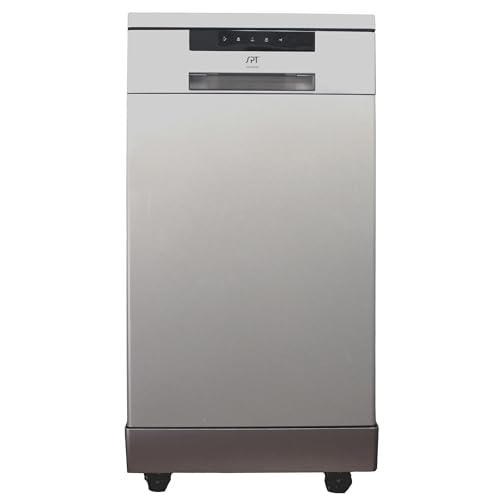
SPT SD-9263SSC 18-Inch Portable Dishwasher — Narrow roller
SPT — Sunpentown to an older generation of appliance buyers — has made portable dishwashers a speciality for long enough that its model numbers are practically the format’s vocabulary. The SD-9263SSC is the narrow entry: an 18-inch portable whose title states Energy Star standing and a stainless steel finish. Eighteen inches is the width of the slimline built-in class, and in a portable it buys the format’s most important practical gift — the machine parks in places a 24-inch unit cannot, in the gap beside a fridge, at the end of a run of cabinets, in a wide doorway’s alcove. Kitchens that fail the parking test at 24 inches often pass it at 18, and that difference decides more portable purchases than any wash feature.
The title is otherwise restrained — no place-setting figure, no program count — and this guide respects the restraint by not inventing either. What can be said from the format itself: an 18-inch portable carries the slimline rack layout, which suits couples and small households whose loads are daily rather than monumental, and whose alternative was a built-in they are not permitted to install. Energy Star standing, stated outright, matters more in a rental than buyers expect, because the tenant pays the utilities on a machine the landlord did not choose; efficiency is the one specification whose benefit arrives monthly, in writing. For the renter in a small kitchen with a standard faucet, this is the guide’s natural first look.
- Format: 18-inch floor-standing portable, hose-connected
- Certification: ENERGY STAR, stated in the title
- Finish: stainless steel, per title
- Capacity: not stated in the title
- Maker: SPT (Sunpentown), the portable specialist
- Where to buy: the SPT SD-9263SSC 18-Inch Portable Dishwasher listing on Amazon — check price on Amazon
Strengths
- The narrowest verified footprint here — the portable most likely to find a parking place in a small kitchen.
- Energy Star standing is stated, which matters when the tenant pays the power and water bills.
- A specialist maker’s model, in a format where specialism shows in the coupling and cabinet details.
Trade-offs
- Slimline racks ask large households to run more frequent, smaller loads.
- No capacity or program figures are stated in the title to compare against its rivals.
- Stainless finishes show fingerprints, and a portable’s front is touched constantly.
Best for: renters and small households whose kitchens can park 18 inches but not 24. Skip it if: your loads are family-sized and nightly — the 24-inch SPT below exists for you.
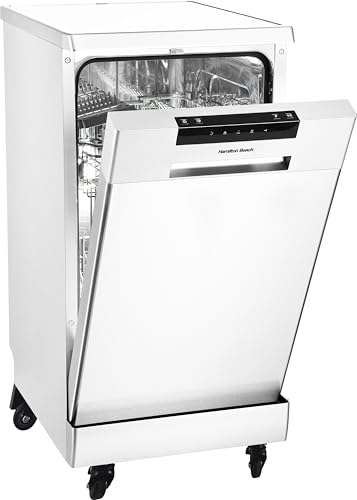
Hamilton Beach Portable Dishwasher With Wheels (White) — Stated capacity
Hamilton Beach puts the format’s defining word in its title — wheels — and follows it with the two facts a portable buyer most needs: 19 inches wide and a stated capacity of 8 place settings. Nineteen inches is an interesting width, an inch broader than the slimline standard, and in practice it places this machine between the two SPT picks: meaningfully narrower than a full-size portable, a touch more cabinet than the 18-inch class. Eight place settings is the honest arithmetic of that footprint — a couple’s full day of dishes plus cooking ware, or a small family’s dinner load without the serving pieces.
The white finish suits the kitchens portables usually serve: rentals and older homes whose other appliances are white and whose owners value a machine that disappears politely against the wall it parks against. Brand familiarity is this pick’s quiet asset. Hamilton Beach is a countertop-appliance name rather than a dishwasher specialist, and some buyers will count that against it; others will count the company’s long retail presence and parts visibility as reassurance, particularly in a class where the purchase is often a household’s first dishwasher of any kind. The title states no energy certification and no program count, and this guide leaves both unstated — the machine’s case is its footprint, its stated capacity and its wheels, and for the mid-size kitchen that case is complete.
- Format: portable on wheels, 19 inches wide as titled
- Capacity: 8 place settings, stated in the title
- Finish: white
- Energy certification: not stated in the title
- Programs: not stated in the title
- Where to buy: the Hamilton Beach Portable Dishwasher With Wheels listing on Amazon — check price on Amazon
Strengths
- The only mid-width option here, for kitchens that find 18 inches cramped and 24 inches impossible.
- A stated place-setting count — the buyer knows the appetite before ordering.
- Wheels are named in the title itself; the mobility claim is the product’s headline, not a footnote.
Trade-offs
- No Energy Star claim is stated, so efficiency comparisons rest on the listing rather than the title.
- Eight settings is a ceiling family households will meet on entertaining days.
- White shows kitchen grime more readily than stainless in a hard-working rental.
Ideal for: couples and small families in white-appliance kitchens who measured 19 inches of parking space and found it waiting. Not the one if: you need double-digit place settings or a stated efficiency certification.
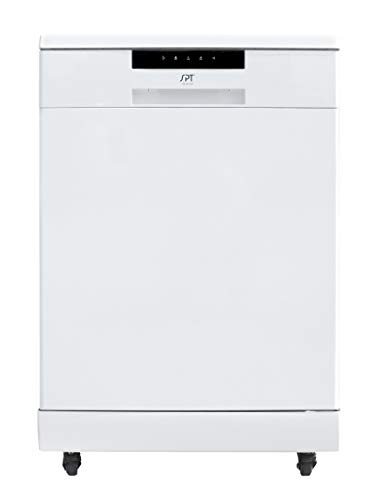
SPT SD-6513WA 24-Inch Portable Dishwasher — Full-size roller
The SD-6513WA is what happens when the portable format stops apologising: a full 24-inch machine on wheels whose title states Energy Star standing, six wash programs, 10 place settings and a stainless steel tub, in a white cabinet. Read that specification against any entry-level built-in and the point lands — this is not a compromise appliance but a built-in’s peer that happens to park against a wall and visit the sink on a hose. Households whose only obstacle is the absence of a dishwasher cutout or the landlord’s permission should start here, because nothing in the stated specification asks them to accept a lesser wash for their mobility.
The stainless steel tub deserves emphasis, since tub material is the specification portable buyers least expect to be offered: it brings the heat tolerance and stain resistance that make heavy cycles routine, in a machine class where plastic tubs are common. Six wash programs give the load-matching range a family actually uses, from the scorched-pan evening to the glassware morning after a party. Ten place settings in a 24-inch portable is slightly fewer than some built-ins claim — the cabinet and hose hardware take their tax — and this guide states the figure as titled rather than rounding it into a story. In white, the machine reads as classic rental-kitchen furniture, which in its natural habitat is camouflage of the most useful kind.
- Format: 24-inch floor-standing portable, hose-connected
- Tub: stainless steel, stated in the title
- Capacity: 10 place settings, as titled
- Programs: 6 wash programs
- Certification: ENERGY STAR, per title
- Finish: white
- Where to buy: the SPT SD-6513WA 24-Inch Portable Dishwasher listing on Amazon — check price on Amazon
Strengths
- A stated stainless steel tub — the built-in market’s premium cavity, in a machine that rolls.
- Six programs and double-digit place settings make it a genuine family machine, not a stopgap.
- Energy Star standing stated in the title, valuable to whoever pays the utility bills.
Trade-offs
- The largest parking footprint here — a full 24 inches of floor must be found and kept clear.
- Ten stated settings trail the most generous built-in claims; the cabinet takes its share.
- A full-size portable is a substantial object to wheel across thresholds and rugs.
Choose it if: your household needs a real family dishwasher and only the installation is impossible. A weak match for: studios and galleys where 24 inches of parking simply does not exist.
Faucet-Adapter Discipline — Routine slot
Every portable in this guide drinks from the kitchen faucet through a quick-connect coupling, and the routine around that coupling is the format’s entire learning curve. The faucet’s aerator comes off, an adapter goes on in its place — typically supplied or specified by the dishwasher’s maker — and the machine’s hose snaps onto the adapter when washing and off again when the sink is needed. A pressure-release habit matters: the hose holds pressure after the cycle, and the coupling’s release button should be pressed before disconnecting, unless the operator enjoys a brief fountain. The drain hose rests in the sink, secured so its first surge does not walk it onto the counter.
Two compatibility warnings belong in this slot. Pull-down and pull-out spray faucets — the kind whose head detaches on a hose — generally cannot accept a portable’s coupling, and neither can some designer faucets with concealed aerators; the standard threaded spout is the portable’s friend. Renters should also confirm the water pressure story is ordinary and keep the landlord conversation simple: a portable makes no permanent modification beyond an aerator swap that reverses in a minute. Master those small disciplines and the format’s promise holds — the machine visits the sink, the sink returns to being a sink, and nobody’s plumbing was harmed in the making of clean dishes. Households that later graduate to a built-in with hygiene cycles will find the routine’s care familiar from Best Sanitizing Dishwashers, where the discipline is thermal rather than mechanical but the principle — the feature works when the routine is followed — is the same.
Strengths
- No plumber, no cutout, no permanent alteration — the renter’s whole case in one routine.
- The coupling takes under a minute once the adapter lives on the faucet.
- The routine reverses completely when the household moves out.
Trade-offs
- The sink is occupied for the cycle’s duration — batch your hand-washing accordingly.
- Spray-head faucets are generally incompatible, which vetoes some kitchens outright.
- Forgetting the pressure release earns the operator a splash, once, memorably.
Best for: every portable owner — this routine is the price of the format and it is a small one. Not suited for: kitchens with spray-head faucets and no willingness to swap the faucet.
The Countertop Tank Class, as Contrast — Contrast slot
Now the neighbours, treated fairly. Countertop tank dishwashers are compact boxes that sit beside the sink, hold their own water in a built-in tank or sip it through a short hose, and wash a handful of place settings at a time. They are genuinely good machines for a single person’s studio, a dorm-adjacent kitchen, an office kitchenette, or a recreational vehicle — contexts where the dish load is small, the counter space exists, and a rolling full-size machine would be absurd. This site maintains a dedicated guide for the format in its RV coverage, because the RV is where the tank class shines brightest.
They are not mobile dishwashers in this guide’s sense, and the distinction is capacity and cabinet, not snobbery. A tank machine washes a fraction of a family dinner; a rolling portable washes the dinner, the serving dishes and the roasting pan, then parks in the corner. Marketing that blurs the two under one word — portable — sets buyers up for the classic disappointment of a machine that cannot swallow Sunday lunch. If your household is small and your counter is free, buy the tank class with this guide’s blessing and its RV guide’s guidance. If your household cooks for four, the three picks above are your format, and no countertop box will be talked into substituting.
Strengths
- The tank class needs no parking floor space and no faucet routine beyond a short hose or a filled tank.
- It suits genuinely small loads that would waste a full-size machine’s water and time.
- It travels — between rentals, to the RV, to the cabin — in a way no rolling cabinet can.
Trade-offs
- Capacity is a fraction of a family load; big dinners mean multiple cycles or the sink.
- Counter space is its own rent, and many kitchens have none to spare.
- It cannot take the large pans and serving ware that the rolling format swallows whole.
Best for: singles, studios, offices and RVs with small, frequent loads. Not suited for: families — and it is not a pick here, however the word portable is stretched.
Rolling, Parking and Storing a Full-Size Machine — Practicalities slot
The portable’s day has three locations: parked, travelling, and working. Parked is where it spends twenty-two hours of it, so choose the parking place first and measure it honestly — width for the cabinet, depth for the door swing when loading at rest, and a little grace for the hose that stores on the machine’s back or side. Travelling is the short journey to the sink, and its obstacles are the ones floor plans hide: thresholds between rooms, rug edges, the slight slope of an old floor that turns a loaded machine into a slow decision. Working, the machine stands at the sink with its hoses coupled, and the kitchen reorganises around it for an hour — a reason to run it after the meal’s cooking is done rather than during.
Households that plan for all three locations love the format; households that plan only for the working hour grow to resent the other twenty-three. The owners who thrive with portables tend to give the machine a parking place with the same permanence as a fridge’s — not borrowed from the breakfast nook’s chair space, not negotiated nightly. Treat the portable as furniture that occasionally washes dishes, buy the width your parking place dictates from the three picks above, and the format repays you with a decade of unmodified-kitchen dishwashing. Readers planning a whole off-grid or backup appliance strategy around a rolling kitchen will recognise the same plan-for-the-whole-day thinking in Best Backup Freezers, where an appliance’s value is likewise measured across the hours it is not actively running.
Strengths
- Planning parking first converts the format’s only real risk into a solved problem before purchase.
- A permanent parking place makes the machine feel like an appliance rather than an obstacle.
- The three-location view predicts satisfaction better than any specification.
Trade-offs
- Some kitchens honestly fail the parking test, and no pick in this guide can fix that.
- Thresholds and rugs tax the travelling step in older homes.
- The working hour reorganises the sink area, which busy cooks must schedule around.
Read it if: prospective buyers before they order — this slot is the pre-purchase checklist in prose form. Not suited for: no one, though kitchen-measurers will get the most from it.
The Lineup, Briefly
| Slot | Kind | Width, as titled | Stated capacity and notes |
|---|---|---|---|
| SPT SD-9263SSC | Linked | 18 inches | Capacity not stated; Energy Star; stainless finish |
| Hamilton Beach With Wheels | Linked | 19 inches | 8 place settings; white |
| SPT SD-6513WA | Linked | 24 inches | 10 place settings; 6 programs; stainless tub; Energy Star |
| Faucet-Adapter Discipline | Prose | Applies to all three picks | Quick-connect routine; spray faucets generally incompatible |
| Countertop Tank Class | Prose | Countertop format | Different class; covered by this site’s RV guide |
| Rolling and Parking | Prose | Measure the parking place | Parked, travelling, working — plan all three |
How Does a Portable Actually Connect, Step by Step?
Wheel the machine to the sink and brake or settle it level. Unscrew the faucet aerator if the adapter is not already fitted, and fit the adapter in its place — a once-only step that most owners leave permanently installed. Snap the inlet hose’s quick coupling onto the adapter until it clicks. Rest the drain hose in the sink basin, weighted or hooked so it stays. Turn the faucet fully to hot and open it; the machine controls its own intake from there. Load, select the program, and start. When the cycle ends, close the faucet, press the coupling’s pressure-release, disconnect, coil the hoses to their storage on the cabinet, and wheel the machine home to its parking place. The full routine, practised, is shorter than the paragraph that describes it.
Two refinements separate contented owners from frustrated ones. First, run the tap until the water is hot before coupling, so the machine’s first fill is hot rather than the cold slug that sat in the pipe — wash performance improves noticeably for the cost of ten seconds. Second, keep the adapter’s washer healthy; a perished washer is the source of nearly every portable leak story, and it costs pennies. The format’s plumbing is humble, and humble plumbing rewards humble maintenance.
Which Kitchens Should Not Buy the Rolling Format at All?
Honesty requires the negative space. A kitchen with a pull-down spray faucet and no appetite for changing it should not buy a portable; the coupling is the machine’s lifeline and improvisation there ends in leaks. A kitchen with genuinely no parking square — where the only floor is the walkway — will experience the machine as a permanent roadblock, and its owner should choose the countertop class or wait for the remodel. A household that entertains constantly and runs the sink continuously through an evening will feel the occupied sink as a real cost, cycle after cycle. And a buyer whose landlord forbids even an aerator swap — rare, but real — has no route to the format at all.
For everyone else, the format’s compromises are the mild, schedulable kind. It is also worth naming the household for whom a portable is not a compromise at all but the best machine outright: the long-term renter in a good apartment with a bad kitchen clause, who will run a portable for a decade and take it to the next home. Built-ins are abandoned at every move; the rolling machine emigrates with its owner, and over two or three homes that portability compounds into the cheapest dishwashing the household will ever buy. Kitchen planners weighing a permanent alternative in the same breath — a wall of built-ins with combination cooking — will find the contrast drawn in Best Combo Wall Ovens, where the appliances commit to the house in exactly the way a portable refuses to.
What Mistakes Do First-Time Portable Owners Make?
The first is measuring the sink position and forgetting the parking position, covered at length above because it is the format’s defining error. The second is coupling to a cold tap and judging the machine’s wash by the lukewarm result; run the hot water to temperature first. The third is leaving the faucet open and the coupling pressurised for hours after the cycle — the routine is couple, wash, release, uncouple, and the release step is the one that protects the hose. The fourth is overloading a slimline machine as though it were a 24-inch, then blaming the spray arms for the physics of a rack packed past its geometry.
The fifth mistake is subtler: treating the portable as temporary in the owner’s mind long after it has become permanent in the kitchen. The machine that is “just until the remodel” gets no parking place, no adapter left fitted, no routine — and delivers a daily drip of friction that owners blame on the format. The households that decide, consciously, that the portable is the dishwasher — with a home, a routine and a maintained washer — report the opposite experience, and the difference costs nothing but the decision itself.
How Loud Is a Machine That Stands in the Room With You?
None of the three verified titles states a decibel figure, so this guide assigns none — but the question deserves a structural answer. A built-in hides inside cabinetry that muffles it; a portable stands in the open, wearing its own finished cabinet as its only insulation, so the same wash sounds more present. Owners schedule around this the way they schedule around the occupied sink: run the machine after dinner while the household is in another room, or during the day’s empty hours, and the question dissolves. The delay-start habits discussed elsewhere in this batch transfer perfectly. What a portable owner should not do is expect showroom silence from a cabinet on casters; the format trades acoustic invisibility for mobility, openly, and the trade is stated here so no reader discovers it at 9 p.m. on the first evening.
One practical consolation: the parked position and the working position need not be acoustically identical choices. A machine that parks in the kitchen can work at the kitchen sink while the household occupies rooms a doorway or two away, and in the older homes that are the format’s habitat, doors are real and walls are thick. Owners in flats and shared houses add a courtesy rule — no cycles during a neighbour’s known sleeping hours — and report that the format coexists with thin walls far better than its reputation suggests, provided the rule is kept. Sound, like parking, turns out to be a planning problem rather than a specification, and planning is the portable owner’s native skill by the end of the first month.
Does a Portable Use More Water or Energy Than a Built-In?
The honest answer is that the wash itself is comparable — the same fill volumes, the same heating task — and the differences live at the margins of the format. A portable draws its water from the faucet at whatever temperature arrives, which is why the run-the-tap-first habit in the connection section matters: a machine that begins with hot water spends less of its own energy reaching wash temperature. Both SPT picks state Energy Star standing in their titles, which certifies the machine’s efficiency under the standard test regardless of its cabinet style, and for the tenant paying the bills that certification is the format’s efficiency argument in one line. The Hamilton Beach title makes no such claim, and this guide leaves its efficiency as a question for the listing rather than an assumption.
Against hand-washing, any of the three wins the usual comparison: a sink-based wash of a full day’s dishes, run under a conscientious tap, typically uses more water than a machine load, and the machine heats only what it uses. The portable’s real resource cost is not water or power but time and sink access — the hour the faucet is spoken for. Households that batch their lives around that hour, running the machine during dinner or after it, find the cost trivial. Households that need the sink continuously will feel it nightly, and no efficiency figure compensates them; the format decision is a lifestyle decision wearing an appliance’s clothes.
Loading a Rolling Machine Well: What Changes and What Does Not
The racks obey the same rules as any dishwasher’s — plates angled to the spray, bowls nested without sealing each other, nothing tall blocking an arm’s rotation, the spin test before the door closes. What changes is the sequence around the loading. A built-in loads in place; a portable often loads where it parks, is wheeled to the sink, and only then coupled — which means the load rides a short journey, and items stacked optimistically can shift in transit. Load a portable as though it will be moved, because it will: heavy items low and centred, glasses seated firmly, nothing perched. The reward is a machine that can be filled after lunch at its parking place and run after dinner without a second thought.
The other difference is psychological, and owners name it often: the portable gets loaded more promptly. A machine standing visibly in the kitchen invites dishes to go straight into it, where a built-in under a counter can let the counter accumulate. Rental kitchens with portables often stay tidier than the same kitchens did with a sink-only routine, not because the machine washes better but because it is present — a piece of furniture that asks, all day, to be fed. It is an odd virtue to list in a buying guide, but it is a real one, and it belongs to the format rather than to any of the three picks.
The Portable as a Strategy: Before the Remodel, Between Homes, at the Cabin
Three ownership stories recur for this format, and each maps to a pick. The pre-remodel household buys time: the kitchen will be rebuilt in two years, the cutout does not exist yet, and a portable bridges the gap — then, after the remodel, the machine retires to a utility room, a rental unit the family owns, or a second home, because a finished cabinet on wheels always finds a second job. The between-homes renter buys continuity: one machine, several kitchens, no installations abandoned to landlords. The cabin and second-home owner buys simplicity: a machine that needs no winterised plumbing connections beyond a faucet, that can be drained and left, and that serves a household whose dish loads arrive in holiday-sized bursts.
The 24-inch SPT SD-6513WA suits the first story best — it is the machine least likely to feel like a bridge to anything. The 18-inch SD-9263SSC suits the second and third, where parking and storage space are the binding constraints and its stated efficiency keeps a small home’s bills small. The Hamilton Beach, with its stated eight settings, suits the household that has counted its dishes and knows its number. Notice that none of these stories requires the machine to be anyone’s dream dishwasher. The format’s dignity is that it solves the actual problem — dishes, tonight, in this kitchen, under these rules — and solves it for years.
What Should You Check in the First Week of Ownership?
Four small things, all cheap. First, the adapter washer: run two cycles and inspect the coupling dry-eyed for weeping, because a washer that seals on day one and day seven will seal for years. Second, the drain hose’s behaviour at full surge — watch the first drain and confirm the hose stays where you put it in the basin, adjusting its rest until it does. Third, the parking route: wheel the loaded machine to the sink and back once in daylight, noting thresholds and rug edges, so the nightly journey is choreography rather than improvisation. Fourth, the hot-water habit: time how long your tap takes to run hot, because that number is now part of your wash routine, and knowing it turns the pre-rinse of the pipes from a guess into a count.
Owners who run this first-week checklist almost never appear in the format’s complaint threads. The complaints that do recur — leaks, wandering hoses, machines that live in walkways — are nearly all first-week discoveries that went undiscovered until they became grievances. A portable rewards a small amount of early attention with years of unremarkable service, which is the highest praise any appliance in this batch of guides, built-in or rolling, ever honestly earns.
Older Homes, Real Floors: The Portable’s Natural Habitat Examined
The portable’s heartland is the older home — the farmhouse whose cabinets are solid and shallow, the pre-war apartment whose kitchen was designed around a stove and an icebox, the cottage whose plumbing is a negotiated settlement. These kitchens share three traits that bear on the format. Their floors are rarely level, which matters to a machine on casters: a portable parked on a slope will try to live at the slope’s bottom, and a level parking place — or a simple chock habit — is part of the installation nobody mentions. Their doorways are narrower than modern plans assume, so the travelling route deserves a tape measure as much as the parking place does. And their electrical circuits are often shared and modest, which counsels running the dishwasher when the kettle and the microwave are not also drawing on the same circuit — a scheduling habit, not a barrier.
None of this is a warning against the format; it is the format’s biography. Portable dishwashers were perfected for exactly these houses, in the decades when most kitchens had no dishwasher opening, and the three picks here are the current heirs of that long refinement. A household in a Victorian terrace or a 1920s bungalow is not settling when it buys a rolling machine — it is buying the appliance its house was, in a sense, designed to receive. The new-build kitchen with its waiting cutout is the special case in history, not the farmhouse.
Three Widths, Three Floor Plans: Choosing by the Room, Not the Rack
Because the picks differ most honestly in width, the choice between them can be made from the floor plan alone. Walk the parking place with a tape. If the honest space is a slot — the end of a counter run, the side of a tall fridge — the 18-inch SPT is the machine that fits the slot and the household adjusts its loading rhythm to slimline racks, running most days. If the space is a nook that once held a highchair or a bin station, the Hamilton Beach’s 19 inches and stated eight settings fill it precisely, and its white cabinet disappears against rental walls. If the space is a genuine bay — a removed table’s footprint, a wide utility corner — the 24-inch SPT takes it and gives back a family machine with a steel tub, and the household never thinks about capacity again.
The failure mode to avoid is choosing by aspiration: buying the 24-inch for the cook you hope to become, then parking it in a walkway for the cook you are. Floor plans do not care about aspirations, and a portable is the one appliance whose dimensions confront its owner several times a day. Measure the room, respect the room, and the machine will feel chosen rather than endured — the difference, repeated nightly, between the format’s fans and its complainers.
Whose Machine Is It Anyway? Portables, Landlords and the Long Rental
A word for the reader whose kitchen belongs to someone else. The portable is the only dishwasher that is unambiguously the tenant’s property and the tenant’s to remove, and that clarity has practical consequences. There is no permission to seek beyond, at most, a courtesy note — the aerator swap is reversible and non-destructive — and no investment abandoned when the lease ends. Compare the alternative sometimes floated in rental forums, offering to fund a built-in for the landlord: the tenant pays, the landlord keeps the machine and the improved kitchen, and the arrangement pleases everyone except the person who bought a dishwasher for a house they do not own. The portable inverts every term of that deal, which is why experienced long-term renters so often arrive at the format after one expensive lesson in generosity.
The same clarity helps at the other end of the market. A landlord reading this guide — they exist, and they furnish kitchens — should note that a tenant with a portable is a tenant whose dish problem is solved without a single modification to the property, and that permitting the aerator adapter graciously is the cheapest goodwill in the rental business. And the homeowner between houses, living in a rental for a year with the good kitchen waiting in storage, finds in the portable the one appliance that serves the interim address and then joins the household’s permanent fleet at the cabin or the utility sink. Formats have constituencies; this one’s constituency is everyone whose kitchen is real but not final.
Maintenance a Rolling Machine Needs That a Built-In Does Not
The format adds three small duties to the standard dishwasher list, and none of them is burdensome. The casters and the floor beneath them collect the kitchen’s grit; a monthly sweep under the parked machine keeps the wheels rolling truly and the parking place from becoming a crumb archive. The hoses live a harder life than a built-in’s hidden plumbing — coupled, pressurised, released, coiled — and deserve an annual look for stiffness or cracking at the coupling ends, where the flexing concentrates. The adapter washer, already praised in these pages, is a consumable: replacing it at the first sign of weeping costs almost nothing and prevents the format’s only characteristic failure.
Against those three duties, set one the portable escapes: access. Every part of a rolling machine can be reached by wheeling it into the middle of the room — no kick plate to remove, no cabinet to extract it from, no service visit that begins with demolition. Filters, hoses and couplings are all inspectable by the owner in daylight. For the renter who cannot authorise repairs to the property but can maintain their own appliance completely, that accessibility is not a footnote; it is the format keeping its founding promise, that the machine belongs to you in every sense that matters, including the sense that lets you look after it yourself.
Final Recommendation
Most rolling-format households should take the SPT SD-6513WA: a stated stainless tub, six programs, ten place settings and Energy Star standing make it a built-in’s peer that happens to park against a wall, and it asks no apology from a family of four. Where the parking place measures 18 inches, the SD-9263SSC is the same specialist idea in the slim cabinet, with efficiency stated for the bill-payer. Between them, the Hamilton Beach serves the 19-inch kitchen and the buyer who wants the capacity in writing — eight place settings, on wheels, in white. Whichever rolls through your door, fit the adapter, learn the release button, and give the machine a parking place with a name. The best mobile dishwasher is not the one that washes best in a laboratory; it is the one still being wheeled happily to the sink in its fifth year, by an owner who understood that mobility is a routine you keep, not a feature you buy once.
Frequently Asked Questions
Will a portable dishwasher work with my faucet?
If your faucet ends in a standard threaded spout, almost certainly yes, via the adapter that replaces the aerator. Pull-down and pull-out spray faucets generally cannot accept the coupling, and some designer faucets conceal their threads entirely. Check your faucet type before ordering — it is the one compatibility question the format cannot negotiate.
Do portable dishwashers wash as well as built-ins?
The wash system is the same technology — pumps, spray arms, heaters — in a finished cabinet. The 24-inch SPT in this guide states a stainless steel tub and six programs, a specification indistinguishable from an entry built-in’s. Differences live in capacity and installation, not in cleaning principle, and loading discipline matters more than format.
Can a renter install one without risking the deposit?
That is the format’s purpose. The only modification is swapping the faucet aerator for an adapter, which reverses in a minute with no trace. No plumbing is cut, no cabinet altered. Keep the original aerator in a labelled bag in a drawer, and the kitchen returns to its exact original state on moving day.
Where do the hoses go when the machine is parked?
Portable cabinets are designed with hose storage on the back or side of the unit, and the power cord stows with them. Coiled and parked, the machine presents as a plain cabinet. Owners who leave hoses trailing have usually skipped the thirty seconds of stowing; the design intends tidiness and rewards it.
Is an 18-inch portable big enough for a family?
For a family that runs it daily, often yes; for a family that cooks large and washes once, no. Slimline racks hold a day of dishes for three or four people when loaded promptly, but serving ware and big pans queue for a second cycle. The Hamilton Beach states 8 place settings and the 24-inch SPT states 10 — match the stated capacity to your household’s real evening, not its quietest one.
Why are countertop dishwashers not in the picks?
Because they are a different format: tank-fed, counter-sited, and sized for a few place settings. This guide defines mobile as the floor-standing rolling format with full racks, and the countertop class is covered fairly in the contrast slot above and in depth in this site’s RV dishwasher coverage. Buyers who actually need the small format deserve a guide written for it, not a consolation mention in this one.
Can I convert a portable into a built-in later?
Some portable models are designed with conversion in mind and some are not, and none of the three verified titles here promises a conversion kit — so this guide’s answer is to buy the portable as a portable. If a remodel is certain and near, the honest routes are to wait, or to buy the portable knowing its second life will be a utility room or a resale, not a cutout. Households do convert machines, but a purchase justified by an unstated possibility is a purchase made on a hope the listing never offered.
Does the machine need to be level, and how do I know?
Yes — a dishwasher drains and seals correctly when it sits level, and a rolling machine on an old floor can sit visibly off. A phone’s level app laid on the cabinet top tells the story in seconds. Shim or reposition the parking place rather than the machine’s feet if the floor is the culprit, and re-check after the first week, because a loaded machine settles differently from an empty one.
How long do the hoses and coupling last?
Years, with the annual inspection described in this guide and a washer replaced when it begins to weep. The coupling ends work hardest, so flex cracks appear there first if they appear at all. Owners who coil the hoses loosely rather than kinking them, and who release pressure before disconnecting rather than forcing the coupling, routinely report the original hose set outliving their tenancy — the parts are simple, and simple parts age slowly when they are not abused.
Can a portable run while I am out of the house?
Opinions divide, and this guide sides with caution: the coupling is a temporary plumbing connection, and temporary connections deserve supervision. Run the machine while someone is home — during dinner, during the evening — rather than on a timer in an empty house. The routine takes an hour of presence, which most households can find, and the small discipline removes the format’s only scenario that ever produces a serious water story.
Related Guides
The rolling format’s closest cousin in spirit is the machine built for vehicles and small spaces, gathered in Best Dishwashers for RVs — where the countertop tank class discussed above receives its full, fair hearing alongside compact built-ins. Readers whose kitchens can accept a permanent installation after all may prefer to start from this site’s built-in coverage instead.


