What's inside
- Key Takeaways
- Quick Picks
- How Do You Compare Machines When One Maker Is the Class?
- Four Configurations, One Range: The Comparison
- How Do You Load a Drawer Differently From a Tub?
- Where Does a Dish Drawer Belong in the Kitchen Plan?
- Errors Drawer Buyers Make in the First Month
- A Day in a Two-Drawer Household
- Looking After Drawers: The Small Print of the Format
- Drawers and the Accessible Kitchen, Revisited Properly
- A Short History of the Drawer Idea
- Two Singles in Two Places: The Split Installation
- The Premium Question, Answered Qualitatively
- Sound, Steam and the Open Drawer
- Measure Your Tallest Items: The Five-Minute Ritual
- Drawers in Holiday Homes and Second Kitchens
- What Guests Think, and Why It Matters Less Than You Fear
- The Resale Conversation
- Dosing for a Life of Half Loads
- Final Recommendation
- Frequently Asked Questions
- Related Guides
As an Amazon Associate I earn from qualifying purchases. This post may contain affiliate links at no extra cost to you.
cottageverdict.com is reader-supported. When you buy through links on our site, we may earn an affiliate commission.
Where to buy: the four Fisher & Paykel models below are sold through Amazon, and each detailed section ends with the listing name to look for, where you can check price on Amazon and confirm the configuration before ordering. Drawer machines are bought by configuration — single, double, tall, integrated — so confirm the exact model code against your cabinet plan twice.
The best dish drawer dishwashers ask a question no other format asks: why does a dishwasher have a door at all? A conventional machine makes you bend to a tub at ankle height and load it like a oven in reverse. The dish drawer abolishes the door and the bending together — the machine opens like a kitchen drawer, at bench height, and you load it the way you load a cutlery drawer, standing upright, looking down into the work. For cooks with bad backs, for kitchens designed around an island, for households that run many small loads instead of few large ones, the format is not a novelty. It is a rethink of the appliance’s basic geometry, and once a household has lived with drawers, doors feel like a historical accident.
Honesty about the class comes first, because it shapes everything else in this guide: the built-in dish-drawer class is, in practice, one maker’s line. Fisher & Paykel invented the format, kept faith with it across decades, and remains effectively its sole serious manufacturer at built-in scale — a second listing of the same model under another code is the same machine, never a rival. So this is a guide within a single range: four verified Fisher & Paykel configurations — single, tall single, double, and integrated double — distinguished by the decisions that actually divide them, plus two prose slots on drawer ergonomics as a class and on the drawer-style alternatives that exist outside the built-in mainstream. If you want drawers, this is the shelf. There is, honestly, no other.
Key Takeaways
- The built-in dish-drawer class is effectively one maker’s line — Fisher & Paykel — and this guide says so plainly rather than padding the list with door machines in disguise.
- The format’s real divide is configuration: a single drawer for small households, a tall single for big items, a double for independent half-loads, an integrated double for panelled kitchens.
- The double drawer’s two independent halves are the format’s killer feature — a small load washed now, a large load later, in the same cabinet bay.
- Ergonomics is the purchase: loading at bench height, without bending to a floor-level tub, is why owners convert and rarely convert back.
- Capacity per drawer is smaller than a full tub’s; the format rewards households that wash little and often over households that batch.
Quick Picks
| Configuration | Badge | Why it earns its place |
|---|---|---|
| Fisher & Paykel DD24SAX9 Single DishDrawer | The original single | The format in its purest form — one full-console drawer in stainless for small households and second stations. |
| Fisher & Paykel DD24DV2T9 Double DishDrawer | The independent double | Two large independent half-load drawers in the Series 9 Contemporary line — the format’s most flexible configuration. |
| Fisher & Paykel DD24SCTX9 Tall Single DishDrawer | The tall single | A single drawer with extra height for the large plates and tall items a standard drawer refuses. |
| Fisher & Paykel DD24DI9 Integrated Double DishDrawer | The panelled double | The double-drawer layout in Series 9 Integrated form, built to disappear behind your cabinetry. |
| Drawer-format ergonomics | The case for the format | Bench-height loading, island installations and the little-and-often rhythm — the class argument, in prose. |
| Drawer-style alternatives beyond the line | The honest elsewhere | What exists outside Fisher & Paykel’s built-in range, and what it can and cannot do — in prose. |
How Do You Compare Machines When One Maker Is the Class?
By configuration and by fit, because within a single maker’s range the engineering culture is a constant and the variables are architectural. The questions that divide these four picks are the ones a buyer can actually answer: How many drawers does your household’s rhythm want — one that runs nightly, or two that run independently? What is the tallest thing you wash weekly, and does it demand the tall drawer? Should the machine wear stainless like an appliance or disappear behind a panel like furniture? And where will it stand — in the main run, in an island, at a second station — because drawers, uniquely, can be split and sited with a freedom doors never allow. Answer those four and the range reads itself; the “best” model is the one whose configuration matches the answers, which is why this guide spends its energy on the configurations rather than on inventing rivalries.
Our verification discipline stays the site’s own: each linked pick is a distinct model in the maker’s line, identified by its model code, with its format stated in its listing title. Where titles state a fact — the double’s two independent half-load drawers, the tall single’s extra height implied by its name and line, the integrated model’s panel-ready purpose — we use it; where a title is terse, we describe the configuration’s role in the range rather than borrowing specifications across models. Fisher & Paykel’s codes reward literacy, by the way: DD for DishDrawer, the number for width class, and the letters for configuration — learn the grammar once and the whole range becomes legible. Households whose cooking produces serious pan loads should also weigh the tub world’s answer in our guide to the Best Dishwashers for Pots, because the drawer-versus-tub decision is partly a cookware decision.
Fisher & Paykel DD24SAX9 Single DishDrawer — The original single
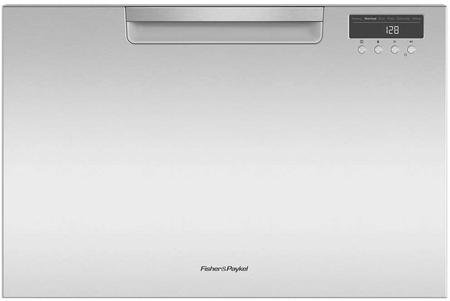
The DD24SAX9 is the format’s founding argument in its simplest form: one drawer, full console controls, a stainless front, in the standard 24-inch bay. Everything the dish drawer believes is present without elaboration — open the drawer at bench height, load standing upright, close it with a hip. For the household of one or two that cooks daily and washes daily, a single drawer is not the small option; it is the correctly sized one, run nightly at an honest fill instead of a full-size tub run guiltily at a third. The full console layout keeps the controls on the drawer’s face, visible and simple, which suits the second-station roles this configuration so often fills: the butler’s pantry, the studio kitchen, the main kitchen of a small household that has thought carefully about its actual dish output.
Owners of the single drawer develop a particular tidiness worth describing, because the configuration teaches it: with one drawer, the kitchen’s reset is a single, completable act. There is no second cavity harbouring a forgotten load, no backlog with a door on it. The drawer is washed, emptied, and done — a closed loop that small households describe with the satisfaction usually reserved for a made bed. In the economy of domestic attention, a loop that closes is worth more than capacity that yawns.
Its limits are the format’s limits in miniature. One drawer means one load at a time — there is no second half quietly handling the glasses while the pans wash — and the drawer’s depth sets a ceiling on the tallest items, which is precisely the problem the tall single below exists to solve. Judge the DD24SAX9 as the purist’s pick: the configuration for households whose loads are small, whose rhythm is daily, and whose backs have opinions. In that life it is not a compromise version of a dishwasher. It is the dishwasher, finally the shape of the task.
- Configuration: single drawer, 24-inch class, as titled
- Controls: full console, as titled
- Finish: stainless steel, as titled
- Model: DD24SAX9
- Where to buy: the Fisher & Paykel DD24SAX9 Single DishDrawer listing on Amazon — check price on Amazon
Strengths
- The format’s ergonomic argument in its purest form.
- Correctly sized for the daily small-load rhythm.
- Suits second stations and small households alike.
Trade-offs
- One load at a time — no independent second half.
- Drawer depth caps the tallest items.
- Entertaining loads will queue behind each other.
Best for: one- and two-person households and second stations with daily small loads.
Not suited for: entertainers who wash in waves after dinner parties.

Fisher & Paykel DD24DV2T9 Double DishDrawer — The independent double
The DD24DV2T9 is the configuration the format’s evangelists describe first, and its listing title carries the reason in plain words: two large independent half-load drawers. Independence is the whole idea. The top drawer can be running the breakfast things while the bottom drawer is still collecting lunch; a delicate load of glasses can take one drawer on a gentle program while the other’s pans take a sterner one; a household of two can run a half-load without the theatre of a full tub. In the Series 9 Contemporary line, in a professional tall stainless presentation, this is the double drawer as the maker intends it at its most complete — the machine that converts sceptics, because its flexibility is not a feature list but a daily experience of never waiting for the dishwasher to be “worth running.”
There is a subtler dividend to independence that owners mention after the first month: the drawers develop personalities. One becomes the glass-and-breakfast drawer, run on its gentle program as a matter of routine; the other becomes the pans-and-plates drawer, run hotter and later. The household stops thinking of “the dishwasher” as a single appliance with a single setting and starts thinking of it as two small specialists — which is, in miniature, how professional kitchens have always organised washing. Specialisation sounds like a luxury. In practice it is simply what happens when a machine finally matches the shape of the work.
The double also reframes capacity honestly. Two half-load drawers do not equal one giant tub for the single biggest load of the year — the roasting-day mountain still arrives in waves — but across a normal week, the independent halves wash more real life, sooner, than a single large cavity washed in batches. Households that entertain in courses rather than in banquets feel this immediately. So do households whose members keep different hours: the early riser’s drawer and the night owl’s drawer coexist without negotiation. If the single drawer is the format’s purest form, the double is its most useful one, and for most full-kitchen installations it is the configuration we would start the conversation with.
- Configuration: double drawer, as titled
- Drawers: two large independent half-load drawers, as titled
- Line: Series 9 Contemporary, as titled
- Presentation: professional tall, stainless steel, as titled
- Model: DD24DV2T9
- Where to buy: the Fisher & Paykel DD24DV2T9 Double DishDrawer listing on Amazon — check price on Amazon
Strengths
- Independent drawers wash different loads on different programs.
- Half-loads become honourable — no waiting for a full tub.
- Series 9 Contemporary execution in tall stainless.
Trade-offs
- Two halves do not merge for the year’s single biggest load.
- The format’s premium is real and should be admitted.
- Drawer depth still governs the tallest items per load.
Ideal when: your household’s loads arrive in streams, not batches.
A weak match when: one enormous weekly wash is your household’s whole pattern.

Fisher & Paykel DD24SCTX9 Tall Single DishDrawer — The tall single
The DD24SCTX9 answers the single drawer’s one structural objection: height. In the Contemporary line, this is the tall single — a lone drawer given extra vertical room, so the large dinner plates, tall glasses and serving pieces that a standard drawer makes you angle, soak or hand-wash can ride upright like civilised cargo. The buyer it serves is specific and numerous: the small household that cooks properly. Two people, real plates, a platter habit, wine glasses with stems — the loads are few but the items are full-sized, and a standard drawer’s depth turns every load into a negotiation. The tall single ends the negotiation while keeping the single drawer’s virtues: one honest load, run nightly, at bench height.
It is also the configuration that makes the strongest second-drawer sense in split installations — a tall single sited by the prep zone for the cook’s tools and boards, while everyday washing happens elsewhere — because its height swallows the prep world’s awkward shapes. Judge it against its siblings by your tallest weekly item, measured rather than imagined: if that item stands upright in your current machine with room to spare, the standard single may serve; if it has ever met the sink in defeat, the tall drawer is the one your kitchen has been describing. In a format defined by geometry, this pick is geometry’s answer to the big plate.
- Configuration: tall single drawer, as titled
- Line: Contemporary, as titled
- Brief: extra drawer height for large plates and tall items
- Model: DD24SCTX9
- Where to buy: the Fisher & Paykel DD24SCTX9 Tall Single DishDrawer listing on Amazon — check price on Amazon
Strengths
- Extra height ends the big-plate negotiation.
- Keeps the single drawer’s nightly rhythm.
- Excellent as a prep-zone second drawer.
Trade-offs
- Still one load at a time.
- The extra height is wasted on households of small plates.
- Costs a configuration decision the standard single avoids.
Choose it if: your small household cooks with full-size plates and platters.
Pass on it if: your tallest weekly item is a mug.

Fisher & Paykel DD24DI9 Integrated Double DishDrawer — The panelled double
The DD24DI9 takes the double drawer’s flexibility and gives it the integrated treatment: a Series 9 Integrated double, built to wear your cabinetry’s panels so that two working drawers hide inside what reads as a pair of ordinary kitchen drawers. Of all the disappearing acts in this batch of guides, this is the most complete — a panelled door machine still announces a door’s proportions, but a panelled drawer pair is indistinguishable from the drawers beside it, and guests will open it looking for cutlery for the rest of your friendship. Beneath the disguise sits the double’s whole argument: independent halves, half-loads without guilt, the little-and-often rhythm, now in a kitchen whose design refuses to show an appliance face.
The integrated route carries the integrated obligations, which our panelled guides elsewhere describe in full: panels built to the maker’s specification, weight respected, installation sequenced so the machine proves itself before the cabinetry goes on. Buyers already committed to a panelled kitchen lose nothing by reading those obligations as part of this pick’s price of admission. What they gain is the only machine in this batch that satisfies both of the modern kitchen’s competing desires at once — the drawer’s ergonomics and the panel’s invisibility. For the designed kitchen that cooks, it is the natural flagship of the range, and the configuration against which the others are the simpler answers.
- Configuration: integrated double drawer, as titled
- Line: Series 9, as titled
- Format: built for custom cabinetry panels
- Model: DD24DI9
- Where to buy: look for the Fisher & Paykel DD24DI9 Integrated Double DishDrawer listing on Amazon — check price on Amazon
Strengths
- The double’s flexibility behind a fully panelled front.
- Indistinguishable from ordinary kitchen drawers when closed.
- Series 9 execution throughout.
Trade-offs
- Panels are your cabinetmaker’s cost and craft.
- Guests will hunt for cutlery in it forever.
- The integrated obligations apply in full.
The right kitchen: a panelled, designed kitchen that still cooks daily.
Look elsewhere when: you want the machine’s face visible and its controls public.
Drawer-Format Ergonomics — The case for the format
This prose slot makes the class argument the four picks assume: the drawer is an ergonomic idea before it is an appliance. Loading a conventional dishwasher is the kitchen’s most repeated deep bend, performed with wet, fragile cargo, twice a day for decades. The drawer moves that act to bench height and turns it into the motion of loading a drawer — a motion the body already trusts. Owners with back trouble describe the change in the vocabulary of relief; owners without it describe it in the vocabulary of obviousness, which may be the stronger endorsement. The format also redistributes the machine in space: drawers can sit in an island facing the prep zone, under a bench in a scullery, or split across two stations in a large kitchen, because a drawer needs no door swing and no kneeling room.
The ergonomic case has a rhythm attached. Drawers reward little-and-often washing — the load run at its natural size, the machine emptied in a minute, the kitchen reset continuously rather than in a nightly ceremony. Households formed by the batch rhythm of big tubs sometimes find the transition strange for a fortnight; households formed by it rarely return. If your kitchen life is streams rather than batches, and your body has begun voting on appliance design, the format is not an eccentricity. It is the mainstream arriving late to a good idea. The neighbouring appliance world has its own version of this conversion story — cooks who moved the microwave to drawer height tell it too, a thread our roundup of the Best Microhood Microwaves touches from the ventilation side.
Strengths
- Bench-height loading ends the daily deep bend.
- No door swing — islands and tight galleys open up.
- Split and second-station siting is uniquely flexible.
Trade-offs
- Per-load capacity is smaller than a full tub’s.
- The little-and-often rhythm must be learned by batch households.
- The format’s choice is one maker’s range.
Worth it when: your back, your island or your rhythm votes for drawers.
Frustrating when: your household’s whole pattern is one giant weekly wash.
Drawer-Style Alternatives Beyond the Line — The honest elsewhere
The final slot owes you the landscape outside Fisher & Paykel, described at class level and without varnish. At built-in scale, there is no rival range to tour: other makers have experimented at the format’s edges over the years, but the sustained, supported, cabinet-bay dish drawer is the one line this guide lists. What exists elsewhere are adjacent answers — countertop machines that borrow the drawer’s small-load spirit without its installation, conventional machines with top drawers of cutlery trays that borrow its vocabulary, and the second-hand market in earlier generations of the same Fisher & Paykel line, where the format’s long history means used drawers circulate with real parts support behind them.
Judge any alternative by the format’s founding tests: does it open at bench height, does it install as furniture, does its maker support it as a line rather than an experiment? An alternative that passes those tests deserves a look on its merits; one that merely wears the word “drawer” in its marketing deserves the scepticism this guide has practised throughout. The class’s concentration is, in the end, a strange kind of reassurance: the format survived because one maker engineered it properly and stood behind it for decades. Buying into that line is buying into the format’s entire accumulated knowledge — and households planning the wider kitchen around it, cold storage included, will find the road-trip end of the appliance world mapped in our guide to the Best Portable Fridge Freezers.
Strengths
- Names the landscape honestly instead of inventing rivals.
- The used market in the same line carries real parts support.
- Adjacent formats serve renters the built-in cannot.
Trade-offs
- No second built-in range means no cross-brand price tension.
- Adjacent formats borrow the spirit, not the installation.
- Used drawers carry used-machine homework.
Suits best: as a reality check before committing to the format.
Not suited for: readers hoping for a rival range that does not exist.
Four Configurations, One Range: The Comparison
| Model | Configuration | Front | The decision it answers |
|---|---|---|---|
| DD24SAX9 | Single drawer | Stainless, full console | Small household, daily rhythm |
| DD24DV2T9 | Double drawer | Stainless, Series 9 Contemporary | Independent half-loads |
| DD24SCTX9 | Tall single drawer | Contemporary | Big plates, small household |
| DD24DI9 | Integrated double drawer | Your cabinetry panels | Panelled kitchen, full flexibility |
| Drawer ergonomics (prose) | The format itself | — | Bench-height loading |
| Alternatives (prose) | Adjacent classes | — | Life outside the built-in line |
How Do You Load a Drawer Differently From a Tub?
Loading a drawer is a top-down act, and it changes the cook’s relationship with the load. You see the whole cargo at once, from above, like a tray being arranged rather than a cupboard being filled — which makes the classic loading errors harder to commit and easier to spot. Tall items announce themselves immediately against the drawer’s rim; nothing hides at the back because there is no back, only a far edge you can reach. Plates stand in their racks with their faces to the spray, glasses settle into their rows, and the whole arrangement can be surveyed in one glance before the drawer slides home. Owners consistently describe loading as faster — not because the drawer is bigger, but because the geometry shows its work.
The disciplines that remain are the format’s own. Respect the drawer’s height line absolutely: an item that stands proud will meet the drawer’s top and the cycle’s spray in ways that end in chips. Keep the heaviest items distributed so the drawer slides true rather than listing. And learn the half-load habit the double drawer invites — a drawer run at its natural fill, on the program its cargo deserves, is the format’s whole economy. The tub household’s skill was packing; the drawer household’s skill is timing. Both are learnable in a fortnight, and the second, most owners report, is the one that feels like living in the future.
Where Does a Dish Drawer Belong in the Kitchen Plan?
Almost anywhere a drawer can go, which is the planning revolution in a sentence. The conventional dishwasher is chained to the sink’s plumbing and the door’s swing; the drawer still wants the plumbing, but it asks nothing for a swing and nothing for kneeling space, so the island becomes a washing station, the scullery bench becomes a second front, and the main run can host two drawers in two places instead of one machine in one place. Large kitchens exploit this shamelessly: a drawer by the prep sink for boards and knives, a double by the main sink for everything else. Small kitchens exploit it differently: one drawer, exactly where the cook stands, instead of a door machine that blocks the galley when open.
Plan the heights with the household’s bodies in mind. A drawer bank can sit higher than a door machine’s tub ever could, because there is no door to fold down into the room — the top drawer of a double can ride at a height that makes loading it a genuinely upright act. Plan also the drawer’s neighbours: the cutlery drawer it will be mistaken for, the bin drawer that shares its rhythm, the bench above it that will collect the unloading. A dish drawer is planned like furniture because it is furniture — the only piece in the kitchen that also washes.
Errors Drawer Buyers Make in the First Month
The first is measuring the kitchen’s loads by the old tub’s calendar — buying a single drawer for a batch household, or a double for a nightly single, because the configuration was chosen by the showroom’s charm rather than the household’s week. The second is ignoring the tallest item: drawers forgive much, but not geometry, and the platter that meets the sink in defeat should have been measured in the shop. The third is panel procrastination on the integrated model — ordering the machine before the cabinetmaker has the panel specification, and discovering the two trades’ calendars do not forgive each other.
Fourth, new drawer owners overload the top of the load, stacking light items where the drawer’s closure will meet them; the drawer teaches its rim discipline quickly, but the first chipped rim of a good glass is a tuition fee nobody needs to pay. Fifth, households forget that two independent drawers are two machines for maintenance purposes — two filters in the double’s case, two interiors to keep aired — and the little-and-often rhythm that makes drawers joyful also makes their small, regular care non-negotiable. None of these errors survives a careful first month. All of them are cheaper read here than learned at the sink.
A Day in a Two-Drawer Household
Narrate the format’s case as a day, because that is where it wins. At seven, the top drawer takes the breakfast things — two bowls, mugs, the porridge pan — and runs its short program while the household showers; by eight it is emptied into the cupboards it stands beside, a ninety-second act performed upright with coffee in the other hand. Through the day the bottom drawer collects lunch and prep debris in the open, used as a hiding place for dirty things that a door machine would demand a bend and a ceremony to receive. At six the cook loads the prep boards and knives into the top drawer as they finish; at eight, after dinner, the bottom drawer takes the meal’s whole aftermath and runs overnight. Nothing waited. Nothing batched. The sink stayed empty all day, which regular guests notice before they notice the machine.
Contrast the door household’s day, which is perfectly fine and entirely different: a slow accumulation, a nightly Tetris, a morning unload performed bent over a steamed cavity. Neither day is a failure. But households that have lived the first rarely volunteer for the second, and that revealed preference — across decades of the format’s existence — is the strongest evidence this guide can offer. Appliances are usually replaced like for like. Drawer households replace drawers with drawers, at a rate the industry’s other formats should find thought-provoking.
Looking After Drawers: The Small Print of the Format
Drawer care follows the format’s logic: everything is doubled or nothing is. A double drawer has two interiors to keep aired, and the household habit that matters most is leaving a resting drawer slightly ajar after unloading rather than sealed damp — the same freshness discipline as any machine, performed twice and therefore worth making automatic. Filters live in each drawer’s base and want the same monthly rinse as any dishwasher’s; because each drawer runs smaller loads more often, its filter’s calendar is the household’s calendar, not the machine’s size. Wipe the drawer’s rim and the cabinetry edge it seals against, since that seal line is the format’s hardest-working surface.
The drawer’s runners and latches reward a light touch and punish the slam that a door tolerates; teach the household to close a drawer the way they would close a good kitchen drawer, because that is what it is. Keep the detergent dosing matched to half-load reality — a double drawer’s half loads want half measures of enthusiasm with the powder, or residue will film the glasses. None of this is burdensome. It is simply the format’s own catechism, and households that learn it in the first month find the drawers ageing like furniture: gracefully, and in daily use.
Drawers and the Accessible Kitchen, Revisited Properly
This batch’s front-control guide discussed accessibility in terms of controls; the drawer format makes the stronger claim in terms of the whole act. A seated user can load a drawer from the front at a height that can be planned into the cabinetry — no door folding down into the wheelchair’s foot space, no tub floor at ankle depth, no reaching across a wet cavity. The drawer pulls toward the user like the rest of the kitchen’s drawers, and its cargo is surveyed from above, where a seated user’s sightline actually works. Kitchen designers who specialise in accessible homes reach for this format early and often, and the reason is not novelty; it is that the drawer is the only dishwasher whose basic motion is the same motion as every other storage act in the room.
Planning notes follow from that. Set the primary drawer’s height from the primary user’s seated reach, not from convention. Put the everyday dishes in the cupboards that the same reach serves, so the unload is a pivot rather than a journey. And if the household mixes seated and standing users, the double configuration performs a quiet kindness: one drawer at each user’s best height, each running independently. Accessibility is rarely one feature; here it is a configuration, chosen on paper, lived in daily.
A Short History of the Drawer Idea
The dish drawer arrived in the late twentieth century from a New Zealand maker willing to ask why a dishwasher was shaped like an oven. Fisher & Paykel’s answer — that it should be shaped like the furniture around it — sounds obvious in retrospect and was anything but: it required rethinking the tub as a drawer box, the seal as a lid that inflates into place, and the whole service model around a machine installed like cabinetry. The format survived its novelty years, accumulated generations — the Series designations in this guide’s picks are its current chapter — and settled into its constituency: design-led kitchens, accessibility-led kitchens, and households whose rhythm is streams rather than batches.
That no rival built a competing range at scale is usually read as the format’s weakness; owners tend to read it as the opposite. The line’s continuity means its parts, its installers’ knowledge and its design grammar have compounded for decades, uninterrupted by a competitor’s incompatible take. Buying the format is buying into that continuity — a single maker’s long attention to a single good idea. In an industry of annual reinventions, there are worse foundations for a fifteen-year appliance.
Two Singles in Two Places: The Split Installation
The configuration this guide’s table cannot show deserves its own section, because only this format allows it: two single drawers installed in different parts of the kitchen. A single by the prep zone takes the cook’s boards, knives and mixing bowls at the moment of creation; a single by the table end takes the meal’s plates and glasses at the moment of clearing. Large kitchens with two sinks have always dreamed this dream; door machines could never split, because a door machine is one cavity in one bay, while a drawer is a module that goes where a drawer fits. The DD24SAX9’s simplicity makes it the natural module for such schemes, and the tall single offers the same trick with height where the prep zone lives.
Split installations multiply the planning questions — two sets of services, two filters on the household’s calendar — and divide the capacity questions helpfully: each station is sized to its stream, and neither is oversized for its job. For the serious cook’s kitchen, the split is the format’s most persuasive luxury, more persuasive than any finish: the dishwasher stops being a place and becomes a property of the room, present wherever dishes are made dirty. Households planning a kitchen from scratch should at least price the idea before dismissing it; it can only be built at the cabinet stage, and it is the one configuration in this guide that cannot be retrofitted later.
The Premium Question, Answered Qualitatively
Drawer machines ask a premium over door machines of comparable ambition, and a buying guide should say what the premium purchases rather than merely noting it. It purchases the mechanism — drawer hardware, lid sealing, duplicated systems in the double — and the engineering of a format one maker sustains. It purchases the ergonomics this guide has described at length, which owners experience as a daily physical fact rather than a specification. And it purchases siting freedom, whose value is set by the kitchen: in a kitchen where the drawer unlocks an island station or an accessible layout, the premium buys something no door machine sells at any price; in a kitchen where a door machine would serve identically, the premium buys preference, and preference should be admitted as the reason.
That admission framework is the honest way to decide. Name what the premium buys in your kitchen, in your sentences, before you spend it. If the sentences are about backs, islands, rhythms and panels, the premium has a case no spreadsheet can argue with. If the sentences are about novelty, expect the novelty to fade by the second month, leaving a good dishwasher and a quiet question. The format rewards the households that wanted what it actually is. It has been doing so, for one maker’s long line of drawers, for decades.
Sound, Steam and the Open Drawer
Two physical notes complete the format’s portrait. A drawer opens upward into the room’s air, so the steam of a finished cycle rises toward the user rather than rolling across the floor from a dropped door — a small difference that anyone who has opened a hot door machine in a small kitchen will appreciate, and one more reason to let a finished drawer rest a few minutes before unloading, as every format prefers. And a drawer’s sound is the sound of a machine at bench height, nearer the ear than a tub’s; households sensitive to noise should read each model’s own listing for its published figure rather than assume the format is inherently hushed or inherently loud, because within the range the engineering, not the geometry, decides.
Neither note is a warning. They are the kind of physical truth a buyer deserves before a format change, because a dishwasher is not a photograph but a daily physical event — heat, sound, steam, weight — lived at arm’s length for fifteen years. The drawer’s event is, on the testimony of its owners, the gentlest in the category. But it is a different event, and this guide’s whole method is to let you choose it knowingly.
Measure Your Tallest Items: The Five-Minute Ritual
Before any drawer configuration is chosen, this guide prescribes a ritual that costs five minutes and prevents the format’s commonest regret. Gather the five tallest or widest things your kitchen washes weekly — the dinner plates, the pasta pot’s lid, the tall vase, the stemmed glasses, the serving platter that hosts every roast — and measure them, actually measure them, with the number written down. That list is your kitchen’s geometry made honest. Read against it, the range divides itself: the standard drawers take a known cargo, the tall single exists for the list that overflows them, and the household that discovers its platter defeats every drawer has learned, cheaply and in advance, that its format is a door machine with a tall tub — a fine answer this guide is happy to have prevented a mistake to reach.
Bring the list to the listing, too. Drawer interior heights are published in the maker’s documentation, and five minutes of comparison between your numbers and theirs is the whole due diligence of the format. Every other dishwasher decision in this batch of guides is a matter of taste, tier or rhythm; this one is a matter of millimetres, and millimetres do not negotiate. Measure first, and the drawer you choose will fit the life you actually cook.
Drawers in Holiday Homes and Second Kitchens
The second home is a natural drawer habitat, for reasons the format’s fans enumerate with feeling. Visits are short, loads are social and irregular, and the machine sits idle between stays — a life of streams and pauses rather than daily batches. A single drawer handles a weekend’s rhythm without the guilt of a cavernous tub; a double absorbs the Saturday dinner party’s waves while Sunday’s breakfast collects calmly in the other half. The bench-height load matters doubly in a house whose cooks are on holiday and whose backs have opinions about it. And the drawer’s furniture nature suits rooms that are living spaces first — the open-plan cabin, the studio annexe — where a door machine’s open cavity colonises the floor.
The idle intervals argue for the format’s simple disciplines performed religiously: drawers left ajar between stays, a hot empty cycle on arrival, filters checked at the season’s start. A machine that wakes well is a machine that was put to sleep properly, in this format as in every other. Holiday households that keep those three habits find the drawer the least demanding appliance in the house — which, in a house kept for pleasure, is the highest available praise.
What Guests Think, and Why It Matters Less Than You Fear
Every drawer household tells the same two guest stories. In the first, a visitor hunts for the dishwasher, opens the integrated double looking for cutlery, and is delighted; in the second, a visitor loads the drawer wrong once — a tall glass laid where it will meet the lid — is corrected kindly, and never errs again. The format’s learning curve for strangers is measured in one load, because the drawer explains itself the way all drawers do: pull, see, arrange. Compare the hidden-control door machine, whose guests stand before it in genuine puzzlement, and the drawer emerges as the more hospitable format, its novelty notwithstanding.
Hosts who entertain weekly should nonetheless weigh the one real guest factor: capacity choreography. A dinner party’s load arrives at a double drawer in two waves rather than one grand packing, and the host who plans for the waves — first drawer running before dessert is served — finds the evening smoother than the door machine’s single midnight ceremony. The format rewards the host who thinks in courses. Most good hosts already do.
The Resale Conversation
Sellers occasionally worry that a one-maker format will puzzle buyers, and the evidence of designed kitchens runs the other way: a Fisher & Paykel drawer installation reads, in a listing, as a deliberate, premium kitchen decision, the kind that signals a house renovated by people who thought. The format is known — decades of presence have seen to that — and its constituency includes exactly the buyers who pay for kitchens with ideas in them. Keep the documentation with the house papers, as this batch’s guides advise for every panelled or configured appliance, and the drawers will present themselves to the next household as what they are: the kitchen’s best thought, still washing.
Dosing for a Life of Half Loads
The drawer’s rhythm changes the chemistry habits a household brings from the tub world, and the change is worth stating plainly because it decides results. A half load washed with a full load’s detergent dose is over-soaped: residue films the glasses, foam confuses the machine’s senses, and the owner blames the format for a dosing error. Powder or gel, dosed to the load in front of you, is the drawer household’s friend; pre-dosed tablets sized for full tubs are its quiet saboteur. Match the dose to the drawer, keep rinse aid filled — small loads sheet water less forgivingly — and the format’s results match its ergonomics for polish.
The same logic governs loading density. A drawer run at its natural fill cleans beautifully; a drawer crammed past its rim line in a fit of optimism cleans like any overpacked machine, which is to say partially and with complaints. The double drawer’s independence exists precisely to make the honest fill easy — start the second drawer rather than forcing the first. Households that internalise that single gesture have understood the format entire: two right-sized loads beat one heroic one, in cleanliness, in drying, and in the small daily pleasure of a machine that always seems ready.
Final Recommendation
Choose by configuration, in the order of your household’s truths. If your loads are small and nightly, the DD24SAX9 single is the format in its purest, most honest size. If your plates are large and your household small, the tall single DD24SCTX9 was drawn for you. If your kitchen’s life arrives in streams — different hours, different loads, no patience for waiting — the DD24DV2T9 double is the most useful dishwasher in this entire batch of guides, full stop. And if the kitchen is panelled and designed, the DD24DI9 gives that kitchen drawers that wash, hidden in plain sight. One maker built this class and stands behind it; within its range, the right configuration is not a compromise between rivals but a description of your own household — and a drawer, chosen to match the life that loads it, will make every door in every other kitchen feel like a question nobody answered.
Frequently Asked Questions
Is Fisher & Paykel really the only dish drawer maker?
At built-in, cabinet-bay scale, effectively yes — the format is their invention and their sustained line, which is why this guide compares configurations within the range instead of inventing a cross-brand contest. Adjacent formats exist, and the prose section above describes them honestly, but the supported built-in drawer class is one maker’s shelf.
Does a double drawer hold as much as a normal dishwasher?
Across a week of real loads, comparably — but not in a single load. Two independent half-load drawers cannot merge for the year’s largest wash, so banquet-style households should count their biggest recurring load, not their average one, before choosing configuration.
Are dish drawers gentler on backs, really?
The geometry is not marketing: loading happens at bench height, standing upright, looking down into the drawer, instead of bending to a floor-level tub. Owners with back trouble are the format’s most loyal constituency for exactly that reason, and the absence of a fold-down door also frees the floor space in front of the machine.
Can dish drawers be installed in an island?
Yes — that is one of the format’s signature installations, since a drawer needs no door swing and no kneeling clearance. The island needs the same water, waste and power services as any dishwasher position, planned into the island’s construction, and the result is a washing station where the cook actually stands.
What does “integrated” mean on the DD24DI9?
It is built to accept your cabinetry’s panels, so the two drawers read as ordinary kitchen drawers when closed. The panels are made to the maker’s specification by your cabinetmaker, with the weight and fitting obligations that every panelled appliance carries — the guide’s integrated sections describe them in full.
Can I install a single drawer now and add another later?
Often yes, and it is one of the format’s quiet strategic advantages: a single drawer installed in a standard bay can gain a sibling when the kitchen or the household grows, provided the cabinetry plan left the second bay honest. Discuss the ambition with your cabinetmaker at the first installation, so the plumbing and the carcass anticipate the second drawer rather than resenting it.
Do drawers use more water from running small loads?
Small loads run on half-load programs are the format’s design case, not its abuse — a drawer washing its natural fill is an efficient machine. The waste case is the opposite habit in any format: running near-empty cycles impatiently. Match the drawer to the load’s size, as the double’s independent halves invite, and the ledger stays honest.
Related Guides
Drawer owners tend to care about the tall and awkward end of the dish world, since the format’s one geometry question is height. Our guide to the Best Dishwashers for Tall Glasses explores that dimension across conventional machines too, and pairs well with the tall single drawer’s thinking above.


