What's inside
- Key Takeaways
- Quick Picks
- How Did We Choose These Drawer Machines and Their Alternatives?
- How Do the Six Compare — Drawers and Alternatives Side by Side?
- How Does Washing in Two Drawers Change a Household’s Rhythm?
- What Are the Ergonomics of Loading a Drawer Versus a Door?
- Which Loads Suit Drawers Best — and Which Still Suit a Door?
- How Should You Plan a Kitchen Around Drawer Dishwashers?
- What Do the Countertop Alternatives Teach About the Drawer Decision?
- How Do You Load Two Drawers for a Dinner Party?
- What Maintenance Do Drawer Machines Need?
- How Much Does the Drawer Format Cost to Own Over Time?
- How Do Drawers Handle the Items Other Dishwashers Struggle With?
- What Is It Like to Unload and Live With Drawers for a Year?
- Drawer, Third Rack or Conventional Door — How Should a Renovator Decide?
- How Quiet Is a Kitchen With Two Small Wash Systems?
- What Should You Check Before Replacing a Door Machine With Drawers?
- Why Did the Drawer Format Come From the Other Side of the World?
- What Mistakes Do Buyers Make With Drawer Dishwashers?
- Final Recommendation
- Frequently Asked Questions
- Related Guides
As an Amazon Associate I earn from qualifying purchases. This post may contain affiliate links at no extra cost to you.
cottageverdict.com is reader-supported. When you buy through links on our site, we may earn an affiliate commission.
Where to buy: the machines below are sold through Amazon, and their names in the Quick Picks table, the detailed reviews and the comparison table link to their listings so you can check price on Amazon and verify dimensions before ordering. The best 2-drawer dishwashers start from a simple observation about how households actually wash: not in one enormous load at the end of the day, but in a shifting stream of breakfast bowls, lunch pans and dinner plates that never quite synchronise.
A double drawer dishwasher answers that stream with two independent washing drawers stacked in a standard 24-inch cabinet space. Each drawer is a complete dishwasher in miniature — its own spray, its own cycle, its own load — so a small load can run in one drawer while the other collects the day, or both can run together on different programmes after a dinner party. Fisher & Paykel invented this format with its DishDrawer line, and four of the six picks here are theirs, spanning the double and single drawer range.
Honesty about the other two picks matters, and this guide states it up front: the COMFEE’ and EdgeStar models in this roundup are countertop dishwashers, not drawer machines at all. They earn their places as budget alternatives for kitchens that cannot install a drawer unit — rented counters, temporary homes, spaces without a cabinet to surrender — and each of their reviews says plainly what they are and what they cannot do. Nobody should finish this article believing a countertop box is a drawer.
What follows therefore works on two levels: a buyer’s guide to the genuine drawer machines, judged on drawer independence, load flexibility and ergonomics, and a clear-eyed account of the countertop escape route for kitchens where drawers are impossible. Read the level that matches your kitchen, and the right machine usually identifies itself.
Key Takeaways
- A true double drawer machine runs two loads independently — different cycles, different times, one cabinet space.
- Fisher & Paykel’s DishDrawer range defines the format; the four drawer picks here are all from that line.
- Two of this guide’s picks are countertop machines, included openly as budget alternatives — they are not drawer dishwashers.
- Drawer loading happens at bench height with the rack fully exposed, which changes the ergonomics of every load.
- Single drawers suit small households and can pair with a second drawer later in some kitchen plans.
- Drawer machines need the standard 24-inch width but reward it with half-load efficiency no door machine matches.
Quick Picks
| Pick | Badge | Why it earns its place |
|---|---|---|
| Fisher & Paykel Double DishDrawer DD24DAX9 | Best All-Round Double Drawer | Fisher & Paykel DD24DAX9 double DishDrawer — the format’s reference design in a contemporary finish |
| Fisher & Paykel Double DishDrawer Series 9 DD24DV2T9 | Best Premium Double Drawer | Series 9 DD24DV2T9 pairs two large independent drawers with a tall, professional stainless presentation |
| Fisher & Paykel Single DishDrawer DD24SAX9 | Best Single Drawer Start | DD24SAX9 single DishDrawer for small households that wash in a steady, modest stream |
| Fisher & Paykel Tall Single DishDrawer DD24SCTX9 | Best Tall Single Drawer | DD24SCTX9 tall single drawer swallows larger plates and platters a standard drawer refuses |
| COMFEE’ Countertop Dishwasher Energy Star Portable | Budget Alternative — Countertop, Not a Drawer | COMFEE’ countertop with 6 place settings and 8 programmes for kitchens that cannot install drawers |
| EdgeStar DWP63 Countertop Dishwasher | Budget Alternative — Countertop, Not a Drawer | EdgeStar DWP63 countertop, 6 place settings, for renters who need washing without any installation |
How Did We Choose These Drawer Machines and Their Alternatives?
The first criterion was definitional: a pick could only be presented as a drawer dishwasher if it actually is one. Four Fisher & Paykel DishDrawer models qualify — two doubles and two singles — and they form the spine of this guide. The two countertop machines were admitted under a different label, as alternatives, because search results for this category mix the formats and buyers deserve a guide that separates them instead of exploiting the confusion.
Within the drawer range we judged independence above all. The entire point of two drawers is that they need not agree: a delicate load above, a roasting pan below, started at different times on different cycles. Models whose drawers genuinely operate independently — the Series 9 listing states it outright — embody the format; that independence, plus drawer size and tub height, drove the ordering of the four.
Ergonomics came third, because drawers change the body’s relationship with the machine. Loading a drawer means standing at a bench and placing items downward into a fully visible rack, with no door to fold and no lower rack at ankle height. For households with back trouble, for keen cooks who load constantly, and for kitchens where an open dishwasher door blocks the only walkway, that difference is not a luxury — it is the reason for the category’s existence.
Finally, we considered the honest alternatives. A countertop machine costs a fraction of a drawer installation and asks nothing of the cabinetry, so for renters and temporary kitchens the comparison is real. We included the two strongest countertop names from the pool under explicit alternative badges, with their limitations stated in their reviews rather than buried in footnotes.

Fisher & Paykel Double DishDrawer DD24DAX9 — Best All-Round Double Drawer
The DD24DAX9 is the DishDrawer in its reference form: two drawers in a 24-inch-wide built-in cabinet, from the N Series 7 contemporary line, in the configuration that made the format famous. For most households asking the two-drawer question, this is the machine the question is about — a full replacement for a conventional dishwasher that happens to think in halves, from the maker that has refined the idea longer than anyone.
The daily magic is mundane and total. Breakfast things go in the top drawer and run while the day is young; the bottom drawer spends the day collecting, then runs after dinner with the pans. Neither load waits for the other to fill, neither is washed at the wrong intensity, and the household’s dish flow stops having a bottleneck. After a large meal, both drawers run together and the kitchen resets in one cycle’s time, which is the dinner-party dividend the format promises and this model delivers.
Choose it as the balanced centre of the range: contemporary styling that sits quietly in modern cabinetry, the double-drawer flexibility in full, and none of the price escalation of the flagship line. Households that want the format’s essence without its ornaments will find this the easiest machine in the guide to justify, and the hardest to outgrow.
- Format: double DishDrawer, 24-inch built-in
- Series: N Series 7 Contemporary, per the listing
- Drawers: two, for independent half loads
- Maker: Fisher & Paykel, originator of the format
- Best role: full-time family dishwasher, rethought
- Installation: standard dishwasher cavity and services
Strengths
- The format’s reference design from its inventor
- Two-drawer rhythm eliminates load bottlenecks
- Contemporary finish suits modern cabinetry
Trade-offs
- Each drawer holds less than a full-size door machine’s single load
- Premium over a conventional dishwasher of similar capacity
- Very large items must be planned across drawers
Best for: families whose dishes arrive in a stream rather than a single daily mountain.
Not suited for: households that regularly wash oversized trays and stockpots in one load.

Fisher & Paykel Double DishDrawer Series 9 DD24DV2T9 — Best Premium Double Drawer
The Series 9 DD24DV2T9 is the flagship expression of the drawer idea, and its listing makes the two claims that matter most: two large independent half-load drawers, in a tall, professional stainless steel presentation. Independence is the operative word — each drawer runs its own programme on its own schedule — and ‘large’ is the reassurance, because the standing criticism of drawer machines is cavity size, and this model answers it with the most generous drawers in the range.
Series 9 is Fisher & Paykel’s professional tier, and the machine presents accordingly: a substantial stainless frontage designed to sit beside the brand’s professional cooking appliances and hold its own visually. In a kitchen built around a serious range cooker, a standard dishwasher door can look like an apology; this machine looks like part of the brigade. That presence is part of what the premium buys, and in design-led kitchens it is a legitimate part.
Functionally, the tall drawers widen the load envelope — larger plates, taller items, the serving pieces that standard drawers refuse — while the independent operation keeps the half-load economy that justifies the format. Buy it if the kitchen is a long-term project and the dishwasher is expected to match the ambition of everything around it; the DAX9 above covers the same logic at a gentler position, but this is the drawer machine with nothing held back.
- Format: double DishDrawer, built-in
- Series: Series 9 Contemporary, professional tier
- Drawers: two large independent half-load drawers
- Presentation: tall, professional stainless steel
- Maker: Fisher & Paykel
- Best role: flagship kitchens with serious cooking kit
Strengths
- Largest, fully independent drawers in this guide
- Professional stainless presence beside premium ranges
- Tall drawers accept bigger plates and serving pieces
Trade-offs
- Flagship pricing within the drawer category
- Stainless frontage needs regular wiping in bright kitchens
- Capacity still splits across two drawers by design
Best for: design-led kitchens wanting the drawer format at full flagship specification.
Not suited for: buyers who need one cavernous single load more than two flexible ones.
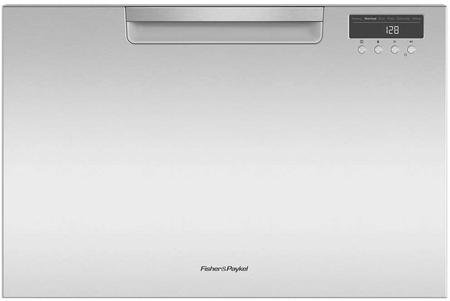
Fisher & Paykel Single DishDrawer DD24SAX9 — Best Single Drawer Start
The DD24SAX9 reduces the DishDrawer idea to its essence: one drawer, 24 inches wide, full console controls, stainless steel. It exists for the households the double drawer overshoots — couples, singles, small flats with a dishwasher cavity, holiday homes — where the daily load is a modest stream and a single drawer run frequently beats a cavernous machine run reluctantly. In such homes this is not the small option; it is the correctly sized one.
A single drawer also opens a kitchen-planning possibility the doubles cannot: pairing. One drawer at bench height beside the sink for the daily stream, with the cabinet space below given to storage, a bin system or a second drawer added later if life expands. Several of the most practical small kitchens are built on exactly this asymmetry, and the SAX9 is the component that makes it possible with genuine drawer ergonomics.
Judge it on its own terms and it is complete: a real dishwasher’s wash system, the loading posture that defines the format, and a footprint in the plan — half a standard cavity’s height — that returns the rest of the cabinet to the household. Buyers who later discover they need more can graduate to the doubles with their eyes open; buyers who size honestly the first time may never need to.
- Format: single DishDrawer, 24 inches wide
- Controls: full console, per the listing
- Finish: stainless steel
- Maker: Fisher & Paykel
- Best role: small households, paired installations
- Installation: half-height dishwasher cavity
Strengths
- Drawer ergonomics at the format’s simplest scale
- Frees half the cavity for storage or a future drawer
- Right-sized for couples and small households
Trade-offs
- One drawer means one load at a time
- Large households will outgrow it quickly
- Per-drawer price is higher than a basic door machine
Best for: couples and small households washing modest daily loads.
Not suited for: families who need two loads running simultaneously.

Fisher & Paykel Tall Single DishDrawer DD24SCTX9 — Best Tall Single Drawer
The DD24SCTX9 takes the single drawer and stretches it upward. The ‘Tall’ in its name is a capacity argument: a deeper drawer cavity that accepts larger dinner plates, taller platters and the serving ware that standard drawers — and standard single drawers — turn away. For households whose tableware runs large, this is the difference between a drawer machine that handles the real crockery and one that handles everything except the crockery.
That extra height suits a particular kind of cooking household: the entertainers with oversized plates, the families whose Sunday roast produces a platter that defines the load, the owners of statement serving bowls that no ordinary rack welcomes. One tall drawer, loaded at bench height with the whole rack visible, takes these pieces without the crouching rearrangement a door machine demands at ankle level.
It remains a single drawer, with a single load’s throughput, and households should buy it for geometry rather than volume. If your problem is that things do not fit, the SCTX9 is the answer in this guide; if your problem is that things do not stop coming, the doubles above are. Knowing which problem you have is the entire art of choosing within this range.
- Format: tall single DishDrawer
- Series: Contemporary, per the listing
- Cavity: deeper drawer for larger plates and platters
- Maker: Fisher & Paykel
- Best role: households with oversized tableware
- Installation: taller single-drawer cavity
Strengths
- Tall cavity accepts plates standard drawers refuse
- Bench-height loading for heavy serving pieces
- Single-drawer simplicity with grown-up geometry
Trade-offs
- One load at a time, like any single drawer
- Height helps geometry, not total throughput
- Premium for a single-drawer machine
Best for: hosts whose large plates and platters defeat standard racks.
Not suited for: high-volume households needing parallel loads.
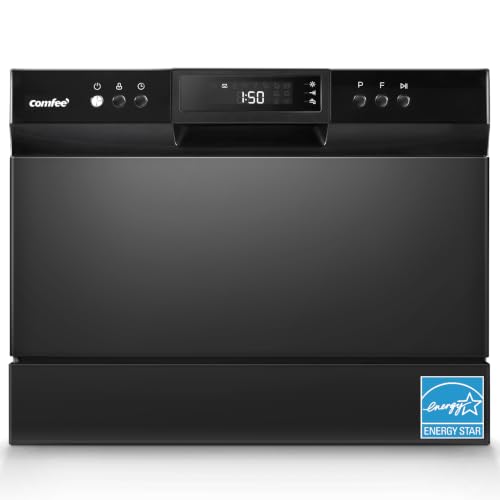
COMFEE’ Countertop Dishwasher Energy Star Portable — Budget Alternative — Countertop, Not a Drawer
This pick requires the guide’s clearest label: the COMFEE’ countertop dishwasher is not a drawer dishwasher, has no drawers, and does not pretend otherwise in its own listing. It is a portable countertop machine — Energy Star rated, 6 place settings, eight washing programmes including Speed, Baby-Care, ECO and Glass, in black — included here because many readers who search for drawer machines are really searching for an escape from hand-washing in a kitchen that cannot be altered, and this is the honest budget version of that escape.
What it does, it does respectably. It sits on the counter, connects simply, and washes a small household’s daily load with a programme list longer than some built-ins offer; the Baby-Care programme in particular serves young families in flats where a built-in installation is a landlord’s decision rather than theirs. Dorms, RVs and rental apartments are its stated habitats, and in those habitats it is not a compromise — it is the only category of machine allowed through the door.
What it cannot do is behave like the drawers above it. There is no bench-height drawer loading, no half-load independence, no cabinet integration; it occupies counter space permanently and holds six settings rather than a family day’s full production. Buy it with both eyes open, as a countertop appliance solving a countertop problem, and it will satisfy. Buy it believing the word ‘drawer’ applies, and no machine could survive the misunderstanding.
- Format: countertop portable — NOT a drawer machine
- Capacity: 6 place settings as listed
- Programmes: eight, including Speed, Baby-Care, ECO and Glass
- Energy: Energy Star rated per the listing
- Finish: black
- Habitats: dorms, RVs and rental apartments
Strengths
- No installation or cabinet required at all
- Eight programmes including a baby-care cycle
- A fraction of a drawer installation’s commitment
Trade-offs
- It is not a drawer dishwasher in any respect
- Occupies counter space permanently
- Six settings suit small loads only
Best for: renters and small-space households who cannot install any built-in machine.
Not suited for: anyone actually shopping for drawers — the four Fisher & Paykel picks above are your list.

EdgeStar DWP63 Countertop Dishwasher — Budget Alternative — Countertop, Not a Drawer
The second alternative carries the same honest label: the EdgeStar DWP63 is a countertop dishwasher — 21 and five-eighths inches wide, 6 place settings, in white — and not a drawer machine. EdgeStar appears twice in this corner of our coverage because compact appliances are its trade; the DWP63 is its countertop answer, for kitchens where the counter is available and the cabinets are not negotiable.
The countertop case, made plainly, is immediacy. The machine arrives, sits down, connects to the tap arrangement its instructions describe, and washes tonight’s dishes tonight. For a renter mid-tenancy, a household awaiting a kitchen renovation, or anyone whose drawer ambitions are real but whose current kitchen forbids them, that immediacy has genuine value — the months or years before the dream kitchen are also lived at a sink, and they count.
Its limits mirror the COMFEE”s: six settings, counter space surrendered, no drawer ergonomics, no integration. Between the two alternatives, the choice is presentational and practical — the EdgeStar’s white finish and compact-appliance pedigree against the COMFEE”s longer programme list and black cabinet. Either serves as a bridge; neither should be mistaken for the destination, and this guide’s badges keep that distinction visible on purpose.
- Format: countertop — NOT a drawer machine
- Width: 21-5/8 inches as listed
- Capacity: 6 place settings
- Finish: white
- Maker: EdgeStar, compact-appliance specialist
- Best role: bridge appliance in unalterable kitchens
Strengths
- Washing tonight, with no installation project
- Compact specialist’s countertop design
- Suits renters and renovation interludes
Trade-offs
- Not a drawer dishwasher — included as an alternative only
- Counter footprint is permanently occupied
- Capacity limited to six place settings
Best for: households needing real dishwashing in a kitchen they cannot change.
Not suited for: buyers fitting out a permanent kitchen — choose a true drawer above.
How Do the Six Compare — Drawers and Alternatives Side by Side?
| Pick | Badge | True format | Capacity note |
|---|---|---|---|
| Fisher & Paykel Double DishDrawer DD24DAX9 | Best All-Round Double Drawer | Double drawer, built-in | Two independent half loads |
| Fisher & Paykel Double DishDrawer Series 9 DD24DV2T9 | Best Premium Double Drawer | Double drawer, built-in | Two large independent drawers |
| Fisher & Paykel Single DishDrawer DD24SAX9 | Best Single Drawer Start | Single drawer, built-in | One drawer, half-height cavity |
| Fisher & Paykel Tall Single DishDrawer DD24SCTX9 | Best Tall Single Drawer | Single tall drawer, built-in | Deeper cavity for large plates |
| COMFEE’ Countertop Dishwasher Energy Star Portable | Budget Alternative — Countertop, Not a Drawer | Countertop portable | 6 place settings, 8 programmes |
| EdgeStar DWP63 Countertop Dishwasher | Budget Alternative — Countertop, Not a Drawer | Countertop portable | 6 place settings, 21-5/8 in. wide |
How Does Washing in Two Drawers Change a Household’s Rhythm?
The conventional dishwasher imposes a rhythm of accumulation: dishes wait, the machine fills, a load runs, and anything generated mid-cycle joins the queue for tomorrow. Two drawers dissolve that rhythm into flow. A drawer is small enough to justify running half full without guilt, so loads turn over when they are ready rather than when they are complete, and the sink — the true measure of a kitchen’s peace — stays empty as a matter of routine.
The independence compounds the effect. A drawer of glasses can run a gentle programme while a drawer of roasting pans takes the intensive one, simultaneously, in the same cabinet footprint. Households that entertain discover the pattern within one dinner party: the cooking load washes during the meal, the table load follows after, and the kitchen that used to take an hour to reset now takes a cycle. The format’s fans rarely describe capacity when they praise it; they describe this rhythm.
There is an energy honesty to the pattern as well. A door machine run half full spends a whole load’s water and heat on half a load’s dishes; a drawer run at its own scale spends a drawer’s share. Households whose loads are naturally small — which is most households, most days — stop paying the full-size tax. The two-drawer kitchen is not more luxurious than the one-door kitchen; on ordinary weeks, it is simply better matched to how dishes actually happen.
What Are the Ergonomics of Loading a Drawer Versus a Door?
A door dishwasher asks the body to work at two heights: the upper rack at waist level and the lower rack near the floor, reached by bending over a folded-down door that occupies the walkway. A drawer asks for one posture — standing upright at a bench, placing items downward into a rack that slides out to meet you, fully visible from above. The difference sounds small in a sentence and feels enormous across three loads a day for a decade.
Visibility changes loading quality. From above, every gap in a drawer rack is obvious, spray shadows are easy to reason about, and the awkward item’s best position can be seen rather than guessed. Crouching at a lower rack, owners load by memory and optimism. Anyone who has reorganised a door machine’s bottom rack by torchlight will understand why drawer owners describe loading as the format’s quiet triumph.
The walkway point matters in real kitchens. An open dishwasher door is a shin-level barrier across the room’s traffic line, and in galley kitchens it can seal the room entirely. A drawer opens into the same space but presents a shallower, higher obstruction that a cook can step around or close with a hip mid-service. Kitchens are workplaces; the machine that respects the worker’s movement wins hours of small mercies across a year.
Which Loads Suit Drawers Best — and Which Still Suit a Door?
Drawers excel at the mixed daily stream: tableware, glasses, mugs, cutlery, the frying pan, the saucepan — loads of varied items in moderate numbers, arriving continuously. They excel equally at segregation, keeping the delicate and the brutal in separate programmes, and at the small load that a door machine would waste resources washing. If a household’s dish life is a river, drawers are the right banks for it.
The door machine keeps one honest advantage: the single cavernous load. Oven shelves, the largest stockpots, a barbecue’s worth of grates, the full aftermath of a feast for twelve in one movement — these ask for one tall, uninterrupted cavity, and splitting them across drawers means sequencing rather than simultaneity. The tall single drawer in this guide narrows the gap for plates and platters, but the feast-load remains the door’s home fixture.
Most households, examined honestly, produce the river far more often than the feast. The feast arrives a handful of times a year and can be survived with sequencing and a soak; the river arrives daily and defines satisfaction. Choosing drawers is therefore usually the statistically literate choice — optimising for the load you actually have, three hundred days a year, rather than the one you remember from Christmas.
How Should You Plan a Kitchen Around Drawer Dishwashers?
Placement follows the cook. The classic position — beside the sink, within the work triangle — suits drawers as it suits any dishwasher, but drawers add a refinement: a single drawer at bench height directly beside the sink creates a scrape-rinse-load station of remarkable efficiency, which is why some designs split a double drawer across two positions when the kitchen’s shape allows the services to reach.
Services decide feasibility. Each drawer installation needs the standard provisions — supply, drainage, power — and a double drawer takes the same connections as a conventional machine, which makes retrofitting a door machine’s cavity with drawers a realistic renovation rather than a rebuild. Confirm the cavity height for the model chosen, particularly with the tall single drawer, whose deeper cavity is its entire point and must be planned rather than discovered.
Think in decades when placing them. A drawer at bench height is the machine a household ages with most gracefully, and kitchens designed for the long term increasingly treat that as a specification rather than a perk. If the kitchen is being built once and used for twenty years, the drawer format’s posture argument compounds with every year, and the planning meeting is the moment to honour it.
What Do the Countertop Alternatives Teach About the Drawer Decision?
The two countertop machines in this guide are not filler; they are the control group that clarifies what a drawer installation buys. Set beside a DishDrawer, a countertop unit shows the value of integration (a counter returned to cooking), of capacity rhythm (loads that match the day), and of ergonomics (no lifting a machine’s output up and down from a counter corner). A buyer who has lived with a countertop machine understands the drawer proposition in their shoulders, not just their spreadsheet.
They also mark the decision’s true boundary, which is permission rather than money. Countertop machines thrive where installation is forbidden — rentals, dormitories, temporary homes — and in those habitats they are not the lesser choice but the only one. The drawer decision only exists for households that control their cabinetry, and recognising which side of that boundary you live on saves more time than any feature comparison.
Finally, they offer a legitimate sequence. A household in a rental today and a renovation next year can wash with a countertop machine now and graduate to drawers when the kitchen becomes theirs, losing nothing but a modest purchase that can be sold or gifted onward. Appliance buying is full of false binaries; the honest path is sometimes a bridge, openly labelled, crossed at the right time.
How Do You Load Two Drawers for a Dinner Party?
Assign the drawers roles before the first guest arrives. The lower drawer becomes the cooking drawer — pans, boards, prep bowls — running an intensive programme during the meal itself, when the kitchen is already in motion and nobody is trying to converse beside it. The upper drawer stages the tableware, loaded as courses clear, and runs its gentler programme once the evening settles. The party’s washing finishes roughly when the party does.
Load the awkward pieces first in each drawer, while every position is free. The roasting pan claims the cooking drawer’s centre before smaller items negotiate the margins; the tall glasses take the table drawer’s safe corners before plates crowd them. This is the reverse of instinct — small things arrive at the machine first — and overriding that instinct is the single most valuable loading habit a drawer owner can build.
Use the independence shamelessly. There is no rule that both drawers must finish together, or start together, or share a programme, and the host who internalises that stops performing the mental arithmetic of the single-load kitchen. A drawer that is ready runs; a drawer that is filling waits. The guests notice none of it, which is rather the point: the best kitchen machinery at a party is the kind that never becomes a topic.
What Maintenance Do Drawer Machines Need?
Each drawer is a small dishwasher and asks for a small dishwasher’s care: filters rinsed regularly, the drawer interior wiped where crumbs gather at the seals, and spray components checked when wash results fade. The drawer format adds one item to the liturgy — the drawer runners and the cavity they slide in appreciate an occasional wipe, because a gritty runner turns the format’s signature smoothness into a daily small resentment.
Detergent dosing deserves attention at drawer scale. A drawer holds less water than a full machine, so the heroic dosing habits formed on a cavernous door dishwasher overshoot here, leaving residue and wasting money. Measure for the drawer you own, not the machine you used to own, and the wash quality improves while the consumable bill falls — a rare case of less being measurably more.
The seals are the long game. Drawer seals work every cycle, flexing with each opening, and keeping them clean and grit-free is what stands between a decade of dry floors and the slow weep that owners discover via a warped kick plate. Five minutes with a cloth, monthly, is the entire insurance premium. Drawer machines reward this modest fidelity with the same loyalty as any well-kept appliance: they simply keep sliding, washing and disappearing into the cabinetry.
How Much Does the Drawer Format Cost to Own Over Time?
The purchase premium over a conventional dishwasher is real and should be admitted in the first paragraph of any honest accounting: drawer machines, and Fisher & Paykel’s in particular, sit in the premium tier. The question is what the premium purchases across a decade — half-load efficiency on the hundreds of small loads a household actually runs, ergonomic loading three times a day, and a rhythm that keeps the sink empty — and whether those daily returns outweigh a lower ticket on a machine whose compromises are also daily.
Running costs lean in the drawer’s favour for small-load households. Washing at the scale of the load rather than the scale of the cavity saves water and energy in small increments that compound across thousands of cycles. Households that run full, enormous loads daily will see less of this advantage; households that run modest loads constantly — the majority — will see all of it.
Repairs and longevity follow the familiar rule that premium appliances from a format’s originator tend to be supported longest, with parts and knowledge available because the maker has staked its name on the category. That support horizon is part of the true price comparison, and it favours buying the format from the people who invented it — which, in this guide, is the only place the true drawers come from.
How Do Drawers Handle the Items Other Dishwashers Struggle With?
Cutlery is the drawer’s home fixture. Loaded into a drawer rack viewed from above, knives, forks and utensils arrange themselves in a single visible layer rather than vanishing into a basket’s thicket, and long utensils — ladles, spatulas, tongs — lie along the drawer’s length instead of standing in a basket and menacing the spray arm. Owners consistently report that unloading a drawer is faster for the same reason loading is: everything can be seen, so everything can be taken by the handful, sorted in mid-air.
Glasses benefit from the shallow geometry. A drawer’s rack is not deep, so stemware sits in a single tier without the double-stacked improvisation that door machines invite, and the gentle programme a drawer can run independently — while its sibling brutalises a roasting pan — means delicate glass no longer waits for a full gentle load to accumulate. The household’s good glasses get used more, because washing them stopped being a project.
The honest exceptions remain bulk and height. A turkey roaster, a stockpot tall enough to feed twenty, the oven shelf after a self-clean refusal — these still belong to the sink or to a conventional machine’s cavern. The tall single drawer absorbs plates and platters that defeat standard racks, but no drawer in this guide pretends to swallow a catering kitchen. The format’s wisdom is knowing that such items are weekly guests, while cutlery and glasses are hourly ones.
What Is It Like to Unload and Live With Drawers for a Year?
Unloading is where the format quietly wins its converts. A drawer at bench height, pulled fully open, presents the entire clean load at waist level in good light; nothing hides at the back of a lower rack, nothing requires kneeling on the kitchen floor with a tea towel. The task takes minutes and no posture at all, which is why drawer households describe putting dishes away as a non-event rather than a chore with a warm-up act.
The year’s rhythm settles into small certainties. One drawer is always the clean one and one is always collecting, a household convention that emerges within a week and ends the ancient question of whether the machine’s contents are clean or dirty — the answer is a drawer, not a debate. Guests learn it in one visit. Children tall enough to reach the bench can load their own plates into a drawer safely, without negotiating a folded door and a rack at ankle height.
Small frictions exist and should be recorded honestly. A drawer left open is a hip-level obstacle rather than a shin-level one, which most households prefer and a few will not. The drawers’ seals and runners want the occasional wipe described in the maintenance section. And visitors will open the wrong drawer, confidently, for years — a social tax so small that owners tend to list it among the format’s charms.
Drawer, Third Rack or Conventional Door — How Should a Renovator Decide?
The renovator’s three-way choice is really a question about which inconvenience the household hates most. Hate half-empty washes and the accumulation rhythm? Drawers answer that. Hate the cutlery basket’s theft of lower-rack space but love one big load? A third-rack conventional machine — the subject of another guide in this batch — answers that. Hate spending premium money on any of it? The classic door machine, honestly specified, remains a perfectly rational answer.
Budget the whole installation, not the appliance. Drawers occupy a standard cavity and standard services, so in a like-for-like replacement their installed cost tracks the machine’s premium alone; in a new kitchen, the cabinetry plan absorbs them without drama. The third-rack door machine is the cheapest route to most of the loading benefit, which is why it is the drawer’s real rival — not the basic door machine, which competes on price alone.
Decide by watching your own kitchen for a week. Count the loads, note their sizes, and notice when dishes wait and why. A household whose machine runs full every night has no drawer problem to solve; a household whose machine runs half full, or whose sink fills while the machine waits, is already living the problem drawers were invented to fix. The observation costs nothing and settles the question better than any showroom visit.
How Quiet Is a Kitchen With Two Small Wash Systems?
A drawer machine’s sound has a different character from a door machine’s, because each wash system is smaller and the drawer is enclosed in cabinetry on more sides when it runs. Two drawers running together are not twice as loud as one — sound does not add that way — and in practice households run one drawer far more often than both, which means the kitchen’s typical acoustic state is a single small system working behind a closed drawer front at bench height.
The timing flexibility matters as much as the level. Because a drawer load is short-cycle by nature and independent by design, washing can be scheduled into the kitchen’s noisy hours — cooking, conversation, the extractor running — and kept out of the quiet ones entirely. A door machine’s single long load must occupy whatever hours it occupies; a drawer’s two short loads can be threaded through the day’s soundscape like appointments.
None of this makes drawers silent, and buyers for whom noise is the first criterion should compare published figures where makers provide them and consider the quiet-dishwasher category as a whole. But the household that washes in fragments gains an acoustic advantage no specification sheet captures: the loudest appliance in the kitchen spends most of its life either idle or washing a small load behind a drawer, while dinner happens undisturbed a metre away.
What Should You Check Before Replacing a Door Machine With Drawers?
Begin with the cavity you actually have. A double drawer wants the standard width and a full conventional height; a single drawer wants the width and roughly half the height, with a plan for the space it returns. Measure the opening rather than trusting the outgoing machine’s badge, and check the services’ positions against the new model’s requirements, because a drain or supply that suited a door machine’s layout may need a plumber’s adjustment to suit a drawer’s.
Audit your crockery against drawer geometry before the old machine leaves. Measure your largest dinner plate’s diameter and your tallest everyday glass, and compare them with the drawer specifications — standard, or tall where the SCTX9 in this guide is concerned. This five-minute audit, performed with the plates in your hand, prevents the only genuinely disappointing drawer outcome: a beautiful machine that cannot take the household’s actual dishes.
Plan the transition day like a small renovation, because it is one. The old machine comes out, services are checked while the cavity stands empty and accessible — a rare opportunity to replace tired hoses and valves — and the drawers go in, get levelled and run a test cycle before the kitchen is reassembled around them. Households that treat the swap as an appliance delivery discover its renovation character at the worst moments; households that plan it finish by dinner, with the first drawer already washing the day’s accumulation.
Why Did the Drawer Format Come From the Other Side of the World?
The DishDrawer was developed in New Zealand by Fisher & Paykel, a maker whose home market rewarded compact, flexible appliances for kitchens that were often smaller and more multipurpose than the North American standard. The insight travelled because the problem travelled: as open-plan living spread, the dishwasher moved from a utility corner into the household’s social centre, where a door machine’s accumulation rhythm and ankle-level loading suddenly looked like what they were — conventions inherited from an era of separate kitchens and dedicated sculleries.
That origin explains the format’s priorities. Independence, bench-height access and half-load honesty are not features bolted onto a door machine; they are the founding assumptions of a design that began by asking how dishes actually move through a day. Buyers comparing the drawers in this guide with conventional machines are therefore not comparing two trim levels of one idea, but two ideas — and the week-long observation of your own dish flow, recommended earlier, is how a household discovers which idea it has been living all along.
What Mistakes Do Buyers Make With Drawer Dishwashers?
Buying a countertop machine while believing it is a drawer model. The two alternatives in this guide are labelled as countertops in their badges, their reviews and the comparison table — because the confusion is common in this category and expensive to discover at delivery.
Judging drawers by total capacity alone. The format’s value is independence and rhythm, not a single cavernous load; a buyer who only counts place settings will underrate the doubles and misunderstand the singles.
Loading both drawers identically out of habit. The point of independence is difference — programmes matched to loads. Two drawers run as a split single machine waste the format’s central idea.
Forgetting the tall drawer option when plates are the problem. Standard drawers refuse oversized plates for geometric reasons; the tall single exists precisely for those households, and skipping it leads to a decade of hand-washing the best crockery.
Over-dosing detergent at drawer scale. Drawers use less water than the door machine you came from; yesterday’s generous scoop is today’s residue. Measure for the drawer.
Blocking the walkway analysis until installation day. Drawers change how the kitchen moves; pace the open-drawer footprint during planning, especially in galley layouts, rather than discovering the traffic pattern with the machine plumbed in.
Final Recommendation
For most households the DD24DAX9 double DishDrawer is the format’s balanced answer — two independent drawers from the company that invented them, in a contemporary finish that suits modern cabinetry — while the Series 9 DD24DV2T9 is the flagship for kitchens built to a professional standard. The single drawers serve smaller, precise needs: the DD24SAX9 for modest daily streams and paired installations, the tall DD24SCTX9 for the households whose plates defeat ordinary racks. And the two countertop alternatives stand ready, honestly labelled, for the kitchens that cannot install anything at all.
Named plainly, the drawer shortlist is the Fisher & Paykel Double DishDrawer DD24DAX9 for most households, the Fisher & Paykel Double DishDrawer Series 9 DD24DV2T9 for flagship kitchens, and the Fisher & Paykel Single DishDrawer DD24SAX9 where one drawer, honestly sized, is enough.
Choose by the load you actually produce and the cabinet you actually control, and the drawer format will do the rest — quietly turning the day’s dishes from a single looming event into a rhythm so unremarkable that, a month after installation, nobody in the household will be able to remember what the sink used to look like full.
Frequently Asked Questions
Are drawer dishwashers as reliable as conventional ones?
The format is mature — Fisher & Paykel has manufactured DishDrawers for decades — and the machines in this guide come from that established line rather than from imitators. Each drawer is a simpler, smaller wash system than a full-size machine’s, and the format’s long production history means parts and service knowledge are well established. As with any appliance, installation quality and basic maintenance decide most of an individual machine’s story, and a drawer machine that is levelled carefully, kept clean at its seals and fed the right dose of detergent has every reason to serve as long as the kitchen around it.
Can each drawer really run a different programme at the same time?
Yes — that independence is the format’s defining feature, and the Series 9 listing in this guide states it directly: two large independent half-load drawers. One drawer can run an intensive cycle on pans while the other runs a gentle cycle on glassware, started and finished on separate schedules. The single-drawer models, by definition, run one load at a time.
Do drawer dishwashers hold less than a normal dishwasher?
Each individual drawer holds less than a full-size machine’s single load — roughly a half load, which is the point. A double drawer across both drawers handles a family day’s dishes comfortably, and because each drawer can run at its own scale, less capacity is wasted on half-empty washes. Very large single items remain the conventional machine’s advantage, with the tall single drawer narrowing that gap for plates and platters.
Why are two countertop machines included in a drawer guide?
Because they are the honest alternatives for kitchens that cannot install a built-in drawer — rentals, dormitories and temporary homes — and because this category’s listings often blur the formats. Both are badged and reviewed explicitly as countertop machines, not drawers, with their limits stated. Readers who can install drawers should choose from the four Fisher & Paykel picks; readers who cannot still deserve a working answer.
Is a single drawer enough for a family?
For a small family’s tableware stream, run daily, a single drawer can suffice — particularly the tall model where large plates are involved. Larger families, or households that entertain often, will feel the single drawer’s one-load-at-a-time limit and should choose a double. The single also suits paired installations, where one drawer now may be joined by another later.
What size space does a double drawer dishwasher need?
A double DishDrawer occupies the standard 24-inch-wide dishwasher cavity, using the full height a conventional machine would take; a single drawer uses roughly half that height, freeing the remainder for storage or a second drawer. All need the standard services — water supply, drainage and power. Confirm the exact dimensions and cavity requirements in the model’s listing before ordering, especially for the tall single drawer.
Related Guides
Drawer thinking pairs naturally with our other capacity guides, from third-rack layouts to the premium built-in ranges, and with cooling for the open-plan kitchens drawers suit so well — continue with Best 3-Rack Dishwashers, Best Bosch Dishwashers, Best 10,000 BTU Window Air Conditioners.


