What's inside
- Key Takeaways
- Quick Picks
- Tank, Hose, or Plumbed: Which Water Story Fits Your Rig?
- Across the Six: Tanks, Programmes, and Stated Numbers
- The Traveller’s Arithmetic: Water, Grey Tanks, and Days Between Stops
- Fitting One Into a Galley: Measure These Three Things
- Second-Hand Machines and Warranties That Travel
- Three Days on the Road, Three Ways of Washing
- Detergent, Pods, and the Half-Empty Bottle Problem
- When the Honest Answer Is No Dishwasher at All
- Winterising, Storage, and the Parked Season
- Weight, Balance, and the Payload Ledger
- Life With a Jug: the Fill Ritual Nobody Photographs
- Sound in a Thin-Walled Box
- Choosing by Crew: Solo, Couple, Family, and the Occasional Crowd
- Road Habits That Break Good Machines
- Final Recommendation
- Frequently Asked Questions
- Related Guides
As an Amazon Associate I earn from qualifying purchases. This post may contain affiliate links at no extra cost to you.
cottageverdict.com is reader-supported. When you buy through links on our site, we may earn an affiliate commission.
Each of the six picks links to its Amazon listing, where you can check price on Amazon and read the tank and programme claims in the seller’s own words. In this category, those words decide everything, as the next paragraphs explain.
An RV kitchen is a negotiation with three finite resources: fresh water, battery or shore power, and counter space that also has to be a food-prep surface, a desk, and occasionally a bed for a small dog. The best dishwashers for RVs are therefore not small versions of house machines; they are a distinct species, and the species splits along one decisive line — how the machine gets its water. Models with a built-in tank need no hookup at all: you fill the tank, run the load, and drain into the sink, which makes them citizens of any pitch, hookup or boondock. Models with an inlet hose want a faucet within reach. And at the far end sits the plumbed 18-inch built-in route, a real installation for large motorhomes and fifth wheels with the cabinetry and the water system to support it. Every pick in this guide’s verified pool is a countertop, and five of the six state a tank in their titles — the hookup distinction is the spine of the article, and each pick is placed on it honestly.
Tank sizes below are quoted only where a title states them — two picks name 1.32 gallons, three name five litres, which are nearly the same quantity wearing different units — and power claims are likewise left to the listings that make them. What the guide adds is the traveller’s arithmetic: what a tank means per day of dishes, how a programme list maps onto road life, and which machine suits the van, the trailer, and the big rig respectively.
Key Takeaways
- All six verified picks are countertop machines; five state a built-in water tank in their titles, which is the no-hookup route that suits most RV life.
- Two titles state the tank as 1.32 gallons and three state five litres — effectively the same fill, so compare programmes and drying, not the unit on the label.
- The hookup question outranks every other feature: tank machines travel anywhere, hose-fed machines need a faucet, and a plumbed 18-inch built-in is a different purchase entirely, discussed as a route rather than a pick.
- Programme lists in these titles are road-practical — baby care for travelling families, fruit and glass cycles for market stops, quick cycles for one-night stands.
- Countertop height and a sink within hose reach are the two measurements that decide whether any of these machines actually works in your rig.
Quick Picks
| Machine | Badge | Road case |
|---|---|---|
| COMFEE’ Countertop Dishwasher With Water Tank | Names RVs in its title | A 1.32-gallon tank and six programmes, with the listing itself naming RVs among its habitats — the pool’s most direct answer. |
| NOVETE Portable Countertop Dishwasher | Tank and hose, both | States a 5L built-in tank and an inlet hose together, so the machine can jug-fill off-grid or connect when a faucet is handy. |
| Hermitlux Countertop Dishwasher | Seven programmes, glass door | A 5-litre tank, seven washing programmes, and a glass door with LED light for rigs where the machine is also furniture. |
| EUHOMY Countertop Dishwasher (6 Programs) | Quiet, with a fruit cycle | States 40 dB and six programmes including fruit and baby care, plus a 73-hour ventilation feature for stored machines. |
| Sunvivi Countertop Dishwasher With 5L Tank | Delay start, stated settings | Seven programmes, a stated 3–4 place settings, and a 12-hour delay for timing cycles to solar or shore-power windows. |
| Midea Countertop Dishwasher With Tank | Baby care, high-temp drying | A 1.32-gallon tank with a baby-care programme and high-temp drying, aimed at young families on the road. |
Tank, Hose, or Plumbed: Which Water Story Fits Your Rig?
Start with the tank, because it is the majority story here and the one that frees the traveller. A built-in tank means the machine carries its own fill: no faucet adapter, no inlet plumbing, no dependence on a site’s water pressure. You pour, you run, you drain into the sink, and the grey water leaves by the same tank your sink uses. The cost is capacity — a tank-sized fill washes a tank-sized load — and the chore of the jug. Next, the hose: several of these machines also ship or connect with an inlet hose, trading the jug for a faucet dependency, which on a serviced pitch is no dependency at all and at a dry camp is a deal-breaker. Finally, the plumbed route: a fixed 18-inch built-in, fed and drained permanently, exists for large rigs with a spare cabinet bay — none is in this pool, because the pool is countertop-shaped, but the route is named here so that big-rig readers know this guide’s picks are the flexible alternative to it, not a substitute for measuring their bay.
One more distinction hides inside the tank story: stated tank size versus stated capacity. A title may give the tank (five litres, 1.32 gallons) or the load (place settings, item counts) or both, and the two numbers answer different questions — how much water you carry, versus how many dishes fit. Travellers should hold both in view, the way they already do with every other tank in the vehicle. The tall-item version of the same fit question, back in the fixed kitchen, is handled in Best Dishwashers for Tall Glasses, whose rack logic applies surprisingly well to a countertop’s crowded interior.
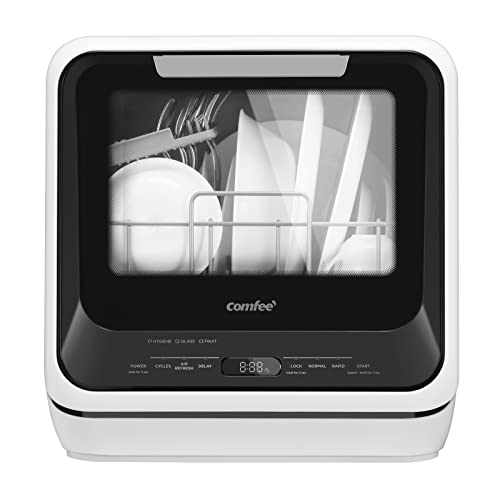
COMFEE’ Countertop Dishwasher With Water Tank — Names RVs in its title
The COMFEE’ leads because its listing does something rare in this category: it says the quiet part in the title. A portable countertop with a 1.32-gallon water tank and six programmes, no hookup needed — for RVs, the listing says, alongside dorms and apartments — with high-temp washing and air-dry, and 360-degree dual spray. When a manufacturer names the vehicle in the title, the machine’s dimensions, weight class, and programme thinking have at least been aimed at the road, and travellers tired of translating apartment products into rig life will feel the difference in the details: a tank sized for a day’s dishes for two, a spray system that covers a small tub completely, and a drying approach that does not demand a heated element’s appetite.
Air-dry rather than heated drying is a considered trade in a vehicle. It asks time instead of power, and on the road power is the scarcer currency — every heated finish is paid for in battery or in the generator’s evening voice. Six programmes cover the travelling repertoire from a quick rinse after a roadside lunch to the high-temp session after a market-day cook-up. The black finish suits the darker cabinetry of many rigs and hides road dust between wipe-downs.
- Water: 1.32-gallon tank, stated in the listing; no hookup needed
- Programs: 6, stated
- Wash and dry as stated: high-temp wash and air-dry
- Spray: 360° dual spray, stated
- Named habitats in the listing: RVs, dorms, apartments
- Efficiency wording in the listing: compact and energy efficient
- Finish: black
- Where to buy: the COMFEE’ countertop listing on Amazon — check price on Amazon
Strengths
- The title names RVs outright, so the design brief matches the buyer’s life without translation.
- A stated tank and no-hookup operation make it pitch-independent: serviced site or dry camp, same routine.
- Air-dry keeps the power budget gentle for battery-based travel.
Trade-offs
- Air-dry is slower than heated drying, so the morning turnaround needs planning on drive days.
- A 1.32-gallon tank defines a modest load; big cooking days may need two runs.
- No place-setting figure is stated, so load size must be judged from the tub, not a number.
Best for: couples touring in vans and trailers who want the machine the category itself recommends for the road.
Not suited for: large families in big rigs, whose dish volume will outgrow a tank machine by lunchtime.

NOVETE Portable Countertop Dishwasher — Tank and hose, both
The NOVETE hedges the hookup question in the most useful way: its title states a 5L built-in water tank and an inlet hose in the same breath, with five washing programs, a baby care cycle, an air-dry function, and an LED light. Read that as a machine with two water personalities. Off-grid, it is a tank machine, jug-filled and self-contained. On a serviced pitch or during a stay at a relative’s house, the hose connects and the jug retires. Travellers whose itineraries mix both worlds — most travellers, honestly — are exactly the buyers a dual-supply design serves, because the machine stops caring which kind of night it is.
Baby care on the programme list marks this machine for the young-family road: bottles and beakers washed hot and dried by air, in a vehicle where the alternative is a washing-up bowl balanced on a campsite tap. The LED light is a small mercy in a rig’s dim galley. Five programs is a calm count for a small panel, and the listing’s own positioning — for small apartments — translates to RV galleys without strain, since the two kitchens share the same dimensions and the same premium on every centimetre.
- Water: 5L built-in tank and inlet hose, both stated in the listing
- Programs: 5 washing programs, stated
- Named cycles in the listing: baby care; air-dry function
- Interior light: LED light, stated
- Positioning in the listing: compact, for small apartments — read: galley-sized
- Where to buy: the NOVETE portable listing on Amazon — check price on Amazon there
Strengths
- Tank plus hose covers both halves of a mixed itinerary without accessories or improvisation.
- A stated baby-care cycle serves travelling families at the exact point of pain.
- Air-dry keeps the electrical ask modest for solar-and-battery rigs.
Trade-offs
- No noise or capacity figure is stated, so quiet and load size are judged on arrival.
- Hose mode still needs the faucet within reach and an adapter that fits your tap’s thread.
- Five programs means the specialist cycles of larger siblings are absent.
Best for: mixed-itinerary travellers and young families who alternate between dry camps and serviced pitches.
A poor fit for: permanent-pitch residents who will never jug-fill and could spend the same money on a plumbed route.

Hermitlux Countertop Dishwasher — Seven programmes, glass door
The Hermitlux is the aesthete’s pick of the six: seven washing programs, a 5-litre built-in water tank, no hookup needed, and — the detail that changes its life in a rig — a glass door with an LED light. In a house, a dishwasher hides under a counter and its looks are a door panel’s business. In a motorhome, the machine sits on the counter in the living space, visible from the sofa, the dinette, and the bed. A glass door that shows a lit interior turns an appliance into a piece of the room’s furniture, and owners of small, beautiful rigs weigh that more than any programme count.
Seven programmes is the widest spread in this guide, giving the Hermitlux a cycle for the road’s variety: the quick turnaround at a one-night stop, the heavy session after a Dutch-oven evening, the gentle run for the good glasses bought at a vineyard en route. The listing names RV and apartment use directly. Its tank matches the five-litre cohort, so its water story is the known quantity of this guide — a day of dishes for a small crew per fill, drained to the sink, grey tank none the wiser.
- Water: 5-litre built-in water tank, stated in the listing; no hookup needed
- Programs: 7 washing programs, stated
- Door: glass door with LED light, stated
- Named habitats in the listing: RV and apartment use
- Where to buy: the Hermitlux countertop listing on Amazon — check price on Amazon before you commit
Strengths
- Seven programmes give the widest cycle repertoire of any pick here.
- A glass door and interior light suit rigs where the machine lives in the room, not under it.
- The stated tank and no-hookup design keep it pitch-independent like the rest of the tank cohort.
Trade-offs
- A glass door shows the load — charming mid-cycle, less charming when the load is last night’s pans awaiting a run.
- No drying method or noise figure is stated, so two everyday qualities are unknowns.
- Seven programmes on a small panel means smaller labels for tired eyes at midnight.
Best for: design-conscious tourers whose galley is also their living room and who run varied loads.
Weakest fit: buyers who want every quality — noise, drying, capacity — stated in numbers before purchase.

EUHOMY Countertop Dishwasher (6 Programs) — Quiet, with a fruit cycle
The EUHOMY’s title reads like a traveller’s diary: six programs — Normal, ECO, Quick, Baby Care/Strong, Fruit, Dry — dual spray arms with 360-degree coverage, a stated 40 dB, loads of 30+ items, and a 73-hour ventilation feature. Start with the fruit cycle, because it reveals the design’s imagination: road life involves market stops, and a machine that rinses the day’s peaches and market greens in its own programme understands the itinerary. The ventilation feature is the other traveller’s detail — a machine stored between trips, or left in a parked rig, stays fresher for being aired, and 73 hours of stated ventilation is aimed at exactly that parked week.
The stated 40 dB matters in a vehicle where the bed is six feet from the galley; a cycle that can run after the children are asleep in the bunks is a cycle that actually gets run daily. ECO and Quick cover the water-and-time budgets of dry camping, Baby Care/Strong covers the young family’s bottles, and the Dry programme gives the load a finishing pass that pure air-dry machines leave to the room. No hookup is required, per the title, placing it firmly in the tank cohort even though this listing leads with its programmes rather than its plumbing.
- Water: no hookup required, per the listing title
- Programs: 6, named in the listing — Normal, ECO, Quick, Baby Care/Strong, Fruit, Dry
- Noise figure in the listing: 40 dB
- Load scale in the listing: 30+ items
- Spray: dual spray arms, 360° coverage
- Storage feature in the listing: 73h ventilation
- Where to buy: the EUHOMY 6-program listing on Amazon — check price on Amazon on the page
Strengths
- A stated 40 dB is the quietest figure in this guide — bunk-friendly in a way rivals do not claim.
- The programme list is the most road-literate here: fruit, ECO, quick, and a dry finish.
- Stated ventilation answers the parked-rig storage problem nobody else in the pool mentions.
Trade-offs
- The title does not state a tank size, so its water fill must be confirmed on the listing page before dry-camp planning.
- A Dry programme is a finish, not a heated-dry system; plastics will still want a shake.
- Rich programme lists invite option paralysis in guests and borrowing relatives.
Best for: families touring with children, market shoppers, and anyone whose rig sleeps close to its galley.
Not the right match for: water accountants who need the tank’s size stated in the title before anything else is discussed.

Sunvivi Countertop Dishwasher With 5L Tank — Delay start, stated settings
The Sunvivi states the number the COMFEE’ leaves out: 3–4 place settings, printed in its title beside a 5L tank, a 30L capacity figure, seven programs — Self-Clean, Dry, Standard, Strong, Quick, Fruit, Glass — dual spray arms with 360-degree coverage, and a 12-hour delay. That delay is the road feature hiding in plain sight. A traveller on solar can load after lunch and set the machine to run at the battery’s richest hour; a traveller on a metered pitch can time the cycle to the tariff’s kindest window; a light sleeper can push the whole business to mid-morning. Delay turns a countertop appliance into a schedulable citizen of the vehicle’s power system.
Three to four place settings honestly sizes the machine: a couple’s full day, or a small family’s main meals with a pan washed at the sink in parallel. The Glass programme courts the travellers who carry real glassware — a constituency every RVer recognises, divided fiercely from the enamel-mug school — and Self-Clean acknowledges that a machine living on variable campsite water needs its own hygiene cycle. Fruit appears again, confirming the category has collectively understood the market-stop lifestyle.
- Water: 5L tank, stated in the listing
- Capacity as stated: 30L capacity; 3–4 place settings
- Programs: 7, named in the listing — Self-Clean, Dry, Standard, Strong, Quick, Fruit, Glass
- Spray: dual spray arms, 360° coverage
- Timing: 12h delay, stated
- Where to buy: the Sunvivi countertop listing on Amazon — check price on Amazon there
Strengths
- A stated place-setting count lets a buyer match machine to crew without guesswork.
- The 12-hour delay integrates the machine with solar, tariff, and sleep schedules.
- Self-Clean and Glass programmes show a design that has thought about road water and real glassware.
Trade-offs
- Three to four place settings is a hard ceiling for family-sized cooking days.
- No noise figure is stated, so bunk-distance quiet is unproven.
- Seven programmes plus delay settings make the panel the busiest of the tank cohort.
Best for: solar-equipped couples and deliberate schedulers who run their rig like a small, well-kept ship.
Poorly suited to: crews of five whose place-setting arithmetic fails before the machine is even unboxed.

Midea Countertop Dishwasher With Tank — Baby care, high-temp drying
The Midea closes the six with the family brief stated in its first line: a 1.32-gallon tank, baby care, 5+1 programs, no hookup needed, high-temp drying, and a self-description as compact and quiet, aimed at apartments, dorms, and RVs — all three named in the title. High-temp drying is the differentiator in a guide where most rivals air-dry: heat at the finish, which in a vehicle costs power and buys speed and drier plastics, a trade young families make gladly because bottles and beakers cycle through the day at a tempo air-drying cannot serve. The plus-one in the program count suggests a specialist extra beyond the standard five, and the baby-care headline tells you which specialist the maker had in mind.
Midea’s presence also brings a service-network comfort the smaller brands cannot match: a global appliance maker behind a countertop machine is a reassurance when the machine lives in a vehicle that crosses regions. Compact and quiet are claims rather than figures in this title — no decibel number is stated — so this guide reports them as the maker’s words and rests its recommendation on the stated tank, the stated baby care, and the stated high-temp drying, which are the checkable parts.
- Water: 1.32-gallon tank, stated in the listing; no hookup needed
- Programs: 5+1 programs, stated
- Named cycle in the listing: baby care
- Drying as stated: high-temp drying
- Named habitats in the listing: apartments, dorms, RVs
- Where to buy: the Midea countertop listing on Amazon — check price on Amazon before ordering
Strengths
- High-temp drying answers the bottle-and-beaker turnaround that defines family road life.
- The title names RVs among its habitats, so the brief is aimed rather than adapted.
- A major maker’s backing steadies parts and service questions across regions.
Trade-offs
- Quiet is claimed without a figure, so light sleepers cannot verify the bunk test in advance.
- High-temp drying spends power that air-dry rivals save — a real cost off-grid.
- No place-setting count is stated, so family capacity must be judged from the tub.
Best for: young families on the road whose bottle turnaround makes heated, fast drying worth its power.
A weak match for: strict off-grid minimalists for whom every heated finish is a battery decision.
Across the Six: Tanks, Programmes, and Stated Numbers
| Machine | Water route | Programmes | Figure worth knowing |
|---|---|---|---|
| COMFEE’ Countertop Dishwasher With Water Tank | 1.32Gal tank, no hookup | 6 | High-temp wash with air-dry, as stated |
| NOVETE Portable Countertop Dishwasher | 5L tank plus inlet hose | 5 | Baby care cycle stated |
| Hermitlux Countertop Dishwasher | 5L tank, no hookup | 7 | Glass door with LED light |
| EUHOMY Countertop Dishwasher (6 Programs) | No hookup | 6 | 40 dB stated; 73h ventilation stated |
| Sunvivi Countertop Dishwasher With 5L Tank | 5L tank | 7 | 3–4 place settings and 12h delay stated |
| Midea Countertop Dishwasher With Tank | 1.32Gal tank, no hookup | 5+1 | High-temp drying stated |
The Traveller’s Arithmetic: Water, Grey Tanks, and Days Between Stops
Every RVer already thinks in tanks, and the dishwasher simply joins the ledger. A five-litre fill is a small, knowable entry: two loads a day for a couple is ten litres of fresh water moved to the grey tank, a quantity any traveller can set against their fresh capacity and their dump rhythm without a spreadsheet. That knowability is the tank machines’ deepest virtue — the plumbed route and the hose route both draw from the same fresh tank in the end, but they draw it uncounted, programme by programme, and uncounted draws are how a dry camp ends a day early. Judge these machines the way you judge a shower head or a toilet flush: as citizens of a closed system whose totals you personally carry.
Power belongs in the same ledger, stated carefully: only the listings’ own words are used in this guide, and none of the six titles prints a wattage to plan around, so the honest planning method is behavioural. Air-dry machines ask little beyond the wash itself. A high-temp drying finish, as the Midea states, asks more at the end of the cycle. A delay function, as the Sunvivi states, lets you choose when the asking happens. Travellers who already schedule their kettle and their microwave around a battery monitor will find a dishwasher is just one more schedulable citizen — and the full-time residents who winter in one place should note the neighbouring category of garage-tolerant cold storage in Best Garage-Ready Upright Freezers, where the same ambient-temperature discipline governs a different appliance entirely.
Fresh water deserves the last word in the ledger, because it is the tank every other system drinks from. A household that knows its dishwasher spends a stated five litres a load can budget the galley the way it budgets drinking and cooking — as one plan, not three surprises. That is the quiet transformation the tank machines work on a trip: dishwashing stops being an act of faith at a campsite tap and becomes a line item, and line items are what let a traveller stay out longer on the same tanks. Ask any full-timer what extended their range and the answer is rarely a bigger tank; it is better knowledge of the small ones.
Fitting One Into a Galley: Measure These Three Things
Counter height clearance comes first: these machines are taller than they photograph, and RV galleys often carry low lockers above the worktop, so measure the vertical gap before the box is opened, not after. Second, the sink’s distance: the drain hose sets a leash, and a machine parked beyond it will be plumbed by improvisation, which in a moving vehicle means a leak with a journey attached. Third, the door’s swing and the load’s path: the machine’s door opens toward the cook in a space where the cook is also the entire room, so walk the motion — door down, rack out, plates in — in the actual galley, ideally with the other traveller standing where they will inevitably be standing.
Then secure the machine for travel as seriously as you secure the kettle. A countertop dishwasher in transit is a heavy box with water in its past; makers design for counters, not for roundabouts, so the rig’s own discipline — a non-slip mat, a strap or a dedicated locker for drive days, tanks drained before departure — is part of the product you are really buying into. Travellers who build the machine a home bay, rather than a counter corner, report the familiar miracle: the appliance disappears from the list of things the road makes them think about. The measuring habit itself is borrowed from the fixed kitchen, where the cavity arithmetic in Best Mid-Range Wall Ovens punishes exactly the same measure-after-delivery optimism.
A fourth measurement belongs to full-timers: the counter’s opportunity cost. A galley worktop in a rig is prep surface, office, and bar in rotation, and a dishwasher’s footprint must be rented from all three. Machines that earn the rent do so by being used daily; a machine used twice a week is a storage box with a drain. Before buying, live a fortnight with a cardboard box of the machine’s dimensions parked in the intended spot. The fortnight will tell you the truth about the footprint more honestly than any review, and it is the cheapest experiment in this entire guide.
Second-Hand Machines and Warranties That Travel
The used market in these machines is lively, because rigs change hands and galleys get remodelled, and a second-hand countertop can be a shrewd buy or a damp mistake. Inspect the tank and its cap first — a tank that has lived with hard water carries its history in scale you can see and smell — then the drain hose for the perishing that age and storage bring, then run a full cycle before money moves, listening for a pump that strains and watching for weeps at every joint. A machine that completes a hot cycle dry-floored and quiet has passed the only examination that matters. Ask after its winters: a unit stored wet through a freeze may pass a summer test and fail in October, which is a question worth asking in the seller’s kitchen rather than your own awning.
Warranties deserve a traveller’s reading too. A machine bought for a vehicle lives a harder life than the countertop in a flat — vibration, variable water, long storage — and while this guide makes no claims about any maker’s terms, the practical advice is portable: keep the receipt with the vehicle’s documents rather than the house’s, register the product if the maker offers it, and photograph the serial plate into the same phone album as the rig’s other appliances. When something fails three states from home, that album is the difference between a warranty conversation and a replacement purchase, and it costs nothing but a minute at unboxing.
Three Days on the Road, Three Ways of Washing
Day one belongs to the dry campers: a couple in a van at a forest pull-off, fresh tank finite, evening coming down cold. Breakfast and lunch dishes wait in the machine through the day — loading as you go is the tank traveller’s core habit — and after a one-pan dinner the COMFEE’ or the EUHOMY runs once, five litres or a gallon and a third spent with full knowledge, air or a gentle dry finish while the couple walks the dog. The grey tank’s needle barely acknowledges the day. Day two belongs to the serviced-pitch family: hookups in, hose connected if the machine offers one, the baby-care cycle turning bottles around for the night feed, the high-temp drying of the Midea earning its power from the post rather than the battery. The machine behaves like a house appliance because, for tonight, the rig is a house.
Day three belongs to the rally: six rigs, one shared feast, and the host’s machine running in rotation while the biggest pans take the bowl, exactly as the crew section prescribed. What all three days share is the absence of the old alternative — the basin of cooling water, the queue at the site tap, the tea towel’s grey career. The machines differ, the water stories differ, and the dividend is the same: the evening returns to the people it belonged to. That dividend, multiplied across a season, is the entire case for the category, and it is why a guide that began with tanks and hoses ends, as every traveller’s story does, with time.
Detergent, Pods, and the Half-Empty Bottle Problem
Consumables shrink on the road like everything else, and the dishwasher’s appetite deserves the same planning as the coffee. Pods travel best: pre-dosed, unspillable, and indifferent to the humidity that turns a box of powder into a single archaeological lump by August. Liquid gels ride worst, migrating in heat and decorating whatever they were packed beside. A fortnight’s supply weighs little and stores anywhere; a season’s supply is a locker argument the machine will lose to food. The dosing discipline from the fixed kitchen applies with interest — a small machine overdosed foams enthusiastically in a small tub — and the grey tank downstream prefers the measured pod for the same reasons a septic tank does: chemistry in known quantities.
Water quality is the consumable nobody packs. Campsite and marina fills vary from soft to liquid gravel, and a small machine’s filter and spray holes feel hard or silty water sooner than a house machine’s do. The fill-jug filter mentioned among the road habits earns its place here as standard kit, and a traveller moving between regions learns to read the machine’s first cycle in a new place the way they read a new anchorage: attentively, once, before trusting it with the good glasses.
When the Honest Answer Is No Dishwasher at All
This guide sells machines, so let it also mark its own border. The solo weekend warrior in a small van, eating one-pan meals off one plate, gains nothing from any pick here that a washing-up bowl and a microfibre cloth do not provide at a hundredth of the payload. The off-grid purist counting every amp-hour through a dark December will find even an air-dry cycle a guest the battery did not invite. And the traveller whose joy is the campsite tap’s society — the queue, the chat, the shared grumbling about the weather — should not let an appliance abolish a ritual they secretly love. A dishwasher in a rig is a tool for buying back evenings, and where the evenings were not being spent on dishes, there is nothing to buy back.
For everyone else — the couples tired of the bowl, the families drowning in beakers, the full-timers whose rig is simply their house — the category has matured past novelty. The six machines above are not camping gadgets; they are small, serious appliances whose titles state tanks, programmes, and temperatures that a buyer can plan a vehicle’s water and power around. That seriousness, more than any single feature, is what this guide verified.
Winterising, Storage, and the Parked Season
A house dishwasher never meets a season; a vehicle one meets two — the touring months and the parked ones — and the parked months are where the quiet damage happens. Water left in a tank, a pump, or a hose loop through a freeze is a cracked component discovered in April, so the drain-down is a ritual with a date: tank emptied, a final rinse cycle run and drained, hoses disconnected and hung, the door left ajar against the sealed-damp smell that otherwise greets the spring. The EUHOMY’s stated 73-hour ventilation is aimed at the milder version of this problem — the parked week rather than the frozen quarter — and the habit it encourages, airing the machine rather than sealing it, generalises to every pick in the guide.
Storage position matters too. A machine that winters in the rig should ride out the cold secured as it rides the road, because parked vehicles still get nudged, jacked, and occasionally towed. A machine that winters in the house should be carried by its body, never by its door or its hose fittings, and stored with its tank cap or inlet as the maker directs. None of this is difficult; all of it is the difference between a machine that starts its third season like its first and one that spends the spring being apologised for. Travellers already fluent in winterising water heaters and fresh tanks will find the dishwasher adds five minutes to a familiar liturgy — and should write those five minutes into the checklist rather than trusting memory, because memory is the first casualty of the season’s last trip.
Weight, Balance, and the Payload Ledger
Every kilogram in a vehicle is audited by somebody — the payload plate, the axle limit, the fuel bill — and a countertop dishwasher applies for its place in that ledger like everything else. The honest accounting includes its working wardrobe: the machine itself, a tank of water at the start of a drive day if the household forgets its own drain rule, the jug, the hoses, and the crockery that no longer needs a washing-up bowl’s worth of storage. Against that, credit what the machine displaces: the bowl, the draining rack, the spare tea towels, and — travellers insist this counts — the evening hour at a campsite tap in the rain. Payload-tight vans should weigh the decision literally, on a scale, the way they weigh everything; generous fifth wheels will find the ledger settles itself.
Balance is the subtler entry. A machine parked high and far behind the axle behaves differently in the vehicle’s manners than the same machine low and central, and the galley it wants to live in is rarely the spot the payload would choose. The resolution is the home-bay idea from the fitting section: build the machine’s place once, low and secured, with the drain’s short journey to the sink preserved, and the argument between the kitchen’s wishes and the chassis’s physics ends in a draw that both can live with for a hundred thousand miles.
Life With a Jug: the Fill Ritual Nobody Photographs
Every tank machine comes with an invisible accessory: the walk to the tap with a jug, twice a day, in all weathers the trip provides. Owners divide sharply on this ritual, and the division predicts satisfaction better than any specification. For one temperament, the jug is the machine’s honesty made physical — you feel the water you are spending, you notice the load is half-empty before you spend it, and the grey tank’s arithmetic stays in your hands. For another temperament, the jug is a tax levied at the exact moment the evening was supposed to relax, and within a month the machine is a counter ornament while the washing-up bowl returns to power. Neither temperament is wrong. Both should buy accordingly: the hose-fed flexibility of the NOVETE exists for the second temperament’s serviced nights, and the plumbed route exists for those who want the ritual abolished entirely.
There are refinements that soften the ritual for everyone. A dedicated jug that lives beside the machine, marked at the tank’s fill line, ends the guesswork and the overflow. Filling during the morning’s other water errands — kettle, bottles, the dog’s bowl — folds the walk into a round that already exists. And a household rule that the machine is loaded before it is filled, never the reverse, prevents the saddest sight in the tank world: a full tank spent on a half load because someone filled first and lost interest. Small disciplines, honestly reported, are worth more than a seventh programme.
The jug also teaches the trip’s youngest travellers their first water lesson, and veterans of family touring will recognise the scene: a child solemnly carrying the fill, understanding for the first time that water in a vehicle is carried, counted, and finite. Machines that make a household’s resources visible tend to raise households that respect them, which may be the tank design’s longest-lasting feature — it outlives the machine, the rig, and eventually the child’s own first van.
Sound in a Thin-Walled Box
A house forgives appliance noise by putting rooms between the machine and the sleeper. A vehicle offers no such diplomacy: the galley is the bedroom is the lounge, and a dishwasher’s cycle becomes a roommate. That is why the one stated figure in this guide — the EUHOMY’s 40 dB — carries weight out of proportion to its digits, and why the absence of figures elsewhere in the pool is a genuine shopping problem rather than a pedant’s complaint. Travellers who sleep within earshot should treat a stated number as a feature and an unstated one as a question to ask the seller, because a machine that cannot be run after bedtime will be run at worse times or not at all.
Placement tunes the acoustics you get. A machine on a solid, level surface with its feet planted hums at its rated character; the same machine on a flexing countertop above a hollow locker gains a drum it was never designed with. The non-slip mat recommended for travel doubles as an acoustic mercy at rest. And the cycle’s own rhythm helps: spray phases are the voice, fills and drains are punctuation, and most travellers report the sound becomes weather within a week — noticed only when a guest, sleeping in the converted dinette, asks what the gentle rain is.
There is a social side to that weather. A quiet machine lets the galley run on the household’s schedule rather than the sleeper’s, which in a one-room vehicle is the difference between a dishwasher that serves the evening and one that dictates it. When two finalists tie on tank and programmes, let the stated noise figure — or its absence — break the tie, and let the bunk, not the brochure, cast the deciding vote.
Choosing by Crew: Solo, Couple, Family, and the Occasional Crowd
Solo travellers should buy the smallest honest machine and the simplest panel, because their loads are a mug, a plate, and a pan, and a tank load every other day is a rhythm that keeps water fresh and the galley clear; any pick here serves, and the choice can rest on the door they enjoy looking at. Couples are the category’s centre of gravity — a day’s dishes per tank, a programme for the market haul, a quiet figure for the shared sleeping space — and the COMFEE’ and EUHOMY state their cases to exactly this crew. Families should start from the stated capacities and the bottle question: the Sunvivi’s printed 3–4 place settings draw the honest line, and the Midea’s baby care and high-temp drying answer the tempo that makes families choose a machine at all.
The occasional crowd — the rally weekend, the family rendezvous, the festival pitch where your rig becomes the group’s kitchen — should not drive the purchase. Every machine in this guide will be outnumbered by a crowd, and the correct crowd strategy is the host’s ancient one: the machine runs the everyday load in rotation while the biggest pans take the washing-up bowl, and nobody apologises. Buy for the crew you are on the two hundred ordinary nights, and let the five extraordinary ones improvise, because a machine sized for the crowd will crowd the galley for the other fifty weeks of the year.
Road Habits That Break Good Machines
Driving with a full tank of wash water is the classic: sloshing loads shift, seals weep, and the galley floor learns about it at the next fuel stop. Drain before departure, always. Second is the mystery-water problem — campsite fills of unknown hardness and sediment that fur a small machine faster than house water ever would; an inline filter on the fill jug is cheap insurance, and the self-clean programme the Sunvivi states exists for a reason. Third is the overloaded holiday load, when the whole day’s cooking is rammed in at angles no spray can negotiate. Fourth is winter: a machine stored in an unheated rig with water in its lines is a cracked pump waiting for spring, so the parked-season drain-down belongs on the same checklist as the water heater’s. Fifth is running any heated finish off a struggling inverter because the evening felt domestic — the battery remembers what the evening forgets.
Final Recommendation
Take the COMFEE’ if you want the machine that names your life in its title — tank, no hookup, six programmes, air-dry gentleness on the power budget. Take the NOVETE if your itinerary mixes dry camps with serviced pitches and you refuse to choose between jug and hose. The Hermitlux dresses the prettiest galley, the EUHOMY runs the quietest stated cycle with the most road-literate programme list, the Sunvivi schedules itself around your solar, and the Midea dries bottles at family speed. Whichever rides with you, measure the galley before the box arrives — because on the road, the best dishwasher is the one that fits the vehicle, respects its tanks, and turns dish duty back into the ten quiet minutes it was in the house.
Frequently Asked Questions
Can a countertop dishwasher really run without any hookup?
Yes — that is the tank design’s whole point. The five picks here whose titles state a built-in tank, plus the no-hookup EUHOMY, fill from a jug and drain into the sink. Only the drain needs a destination, and every RV galley already has one.
How many dishes does a 5L tank load actually cover?
Think in place settings where a title states them — the Sunvivi states 3–4 — and in item counts where stated, as the EUHOMY’s 30+ items. In practice a tank load covers a couple’s day of dishes or a small family’s main meal, and the honest test is your own crew’s worst cooking day.
Is a plumbed 18-inch built-in better for a large motorhome?
It can be, if the rig has the cabinet bay, the water capacity, and the travel pattern of long stays — it is a fixed-kitchen answer, covered in this guide as a route rather than a pick because the verified pool is countertop-shaped. For mixed itineraries, the tank machines’ freedom usually wins.
What about power draw on battery and solar setups?
The six titles do not state wattages, so plan behaviourally: air-dry models ask least, a stated high-temp drying finish asks more at the cycle’s end, and a delay function — the Sunvivi states 12 hours — lets you place the draw inside your system’s richest hours.
Can these machines handle real glassware on the road?
The Sunvivi states a Glass programme outright, and the Hermitlux’s seven programmes serve varied loads; beyond titles, the traveller’s rule is packing — glasses that ride in the machine’s rack for washing should ride secured for driving, because the road is rougher than any cycle.
What happens to the grey tank when a dishwasher joins the rig?
It gains a small, predictable entry. A tank machine’s fill is a stated quantity — five litres or 1.32 gallons in this guide’s titles — and every load moves exactly that from fresh to grey, which makes the dishwasher easier to plan around than a running tap at a washing-up bowl ever was.
Should the machine travel on the counter or in a locker?
Secured is the only non-negotiable. A home bay or a strapped, matted counter position both work; an unsecured machine on a smooth worktop is a projectile with plumbing. Drain the tank before drive days whichever home you choose, and let the cardboard-box fortnight from this guide’s fitting section decide whether the counter can spare the footprint at all.
Related Guides
Countertop appliances are the travelling kitchen’s whole strategy, and the cooking side of that strategy lives in our guide to Best Countertop Rotisserie Ovens — another category where a compact box has to earn a permanent place on a small worktop.


