What's inside
- Key Takeaways
- Quick Picks
- How Did We Draw the Mid-Range Line for This Guide?
- The Mid-Range Ledger: Features Side by Side
- Touch Panel or Knobs — How Should a Mid-Range Buyer Actually Decide?
- What Does a Function Count Buy You Between Eight and Twelve?
- Which Details Separate a Good Mid-Range Oven From a Tiring One?
- What Are the Standard Mid-Range Buying Mistakes?
- What Does the Mid-Range Feel Like After a Year of Dinners?
- How Should You Measure and Plan for a Mid-Range Replacement?
- What Upkeep Does This Tier Ask in Return?
- Who Should Buy Below This Tier, and Who Should Buy Above It?
- What Does This Field Say About Where Compact Ovens Are Heading?
- How Do You Choose Between Two Picks That Tie on Paper?
- What Should the First Fortnight With a New Mid-Range Oven Establish?
- Why Does This Guide Trust Listings More Than Reputations?
- How Does Convection Change Ordinary Cooking in a Cavity This Size?
- What Role Does the Safety Lock Play Beyond Households With Toddlers?
- How Should a Landlord or a Seller Read This Field?
- What Is the Case for Buying the Tier’s Quietest Specification?
- Final Recommendation
- Frequently Asked Questions
- Related Guides
As an Amazon Associate I earn from qualifying purchases. This post may contain affiliate links at no extra cost to you.
cottageverdict.com is reader-supported. When you buy through links on our site, we may earn an affiliate commission.
Every oven below is sold on Amazon, and each pick links to its own listing there so you can check price on Amazon once you know which feature set matches your cooking. One framing note first, because it governs the whole guide: mid-range here is a description of equipment, not of expenditure.
The best mid-range wall ovens occupy the most honest territory in the built-in world — the ground between the bare-bones compact and the flagship double. This guide defines that ground by features rather than by money: a mid-range oven, as the six verified listings below draw it, is a single built-in with convection, a real menu of cooking functions rather than a token dial, controls that can be touch or mechanical without apology, and the safety and cleaning details — locks, layered door glass, enamel cavities — that used to live only at the top of the market. You will find no prices and no price bands in this article, because a tier defined by a number rots the moment the number moves; a tier defined by equipment stays true.
The field itself is a portrait of where the volume market has gone. Five of the six picks are 24-inch singles from the value-engineered brands that now dominate compact built-ins — Garvee appears three times across two brand names, ThermoMate once, Zomagas once — and the sixth, the FinerFurnis, is a convection single whose listing does not state a width, so this guide claims none for it. Function counts run from eight to twelve. Power figures, where listings state them, cluster around the same assertive neighborhood. Convection is universal here, which would have been a flagship sentence not long ago.
Who shops this tier? The renovator replacing a dead compact oven who wants the replacement to feel like progress. The landlord fitting a kitchen that must impress tenants and survive them. The cook whose single oven works hard every day and whose wishlist reads: convection that actually moves air, a timer and a lock, a door that stays cooler, an interior that wipes clean. That wishlist is precisely what these six listings compete on, and the differences between them — control style, function count, door glass, stated wattage — are the differences this guide will spend its length on.
Key Takeaways
- Mid-range in this guide means a feature set, not a sum of money: convection on every pick, eight to twelve cooking functions, and modern safety and cleaning details throughout.
- The ThermoMate states the longest menu in the field at 12 functions, with 3D heating, 3100W, sensor touch control, and a safety lock, all ETL certified.
- The Zomagas states the largest cavity at 2.8 cubic feet and the highest power figure at 3220W, with a 360-degree rotisserie and triple glass door.
- Garvee’s two listings split the control question cleanly: 10 functions behind touch control, or 8 functions behind mechanical knobs in black.
- The FinerFurnis listing states no width, so none is claimed for it here; its case rests on convection with a fan, a rotisserie, and dual control styles.
Quick Picks
| Pick | Badge | Why it earned its place |
|---|---|---|
| FinerFurnis Electric Single Wall Oven | Convection with a rotisserie | Built-in convection with a fan, bake, broil, and roast modes, a rotisserie, timer, and safety lock, with touch and knob control both in the picture. |
| Garvee 24-Inch Electric Wall Oven (10 Functions) | Touch control, ETL certified | Ten functions and convection behind a touch panel, with 3000W, a timer, a safety lock, and ETL certification stated. |
| Garvee 24-Inch Electric Wall Oven (8 Functions) | The knob-driven black oven | Eight functions and convection run by mechanical knobs, at 3000W in a black 2.5 cubic foot single. |
| ThermoMate 24-Inch Convection Wall Oven (12 Functions) | The longest menu in the field | Twelve functions, 3D heating, 3100W, sensor touch control, and a safety lock in an ETL certified 2.6 cubic foot cavity. |
| Zomagas 24-Inch Wall Oven | Biggest cavity, strongest stated power | A 2.8 cubic foot cavity, 3220W, nine functions, a 360-degree rotisserie, triple glass door, and enamel cavity behind mechanical knobs. |
| GarveeLife 24-Inch Electric Wall Oven | Layered glass, easy-clean cavity | Ten functions, convection, and 3000W behind touch control, with a three-layer tempered glass door and an enamel easy-clean cavity. |
How Did We Draw the Mid-Range Line for This Guide?
From below, the line excludes the stripped basics — ovens whose entire offer is a cavity and a dial. From above, it excludes the doubles, the steam systems, and the design series that the flagship guide in this series handles separately. What remains, and what every pick here had to show, is a single oven with convection, a function count in the high single digits or beyond, and at least one detail from the modern comfort list: a safety lock, layered door glass, an enamel easy-clean cavity, a rotisserie, or touch control. Every specification quoted comes from the listings’ own titles, because a tier argued from verified features needs no other authority.
We also let the field’s repetitions speak. Three listings from the Garvee family made the cut not by favoritism but because the family’s variations — touch versus knob, Garvee versus GarveeLife — map exactly onto the choices real buyers in this tier actually face. Readers whose kitchens run on well water and hard lessons will recognize the same evidence-first habit in Best Dishwashers for Hard Water Areas, where claims are likewise credited only where a listing states them.

FinerFurnis Electric Single Wall Oven — Convection with a rotisserie
The FinerFurnis opens the guide with a small act of honesty that sets its tone: its listing describes a built-in electric single wall oven with convection and a fan, a large capacity, bake, broil, and roast modes, a rotisserie, a timer, and a safety lock — and it nowhere states the oven’s width. So this guide states none either. Buyers whose cutout is a known 24 inches should treat the width as a question to settle from the manufacturer’s documentation before ordering; buyers with flexibility will find the rest of the proposition complete enough to justify the homework.
What the listing does commit to is a well-rounded mid-range hand. Convection with a fan is the tier’s entry ticket, and the FinerFurnis holds it. The rotisserie is less common at this level and lifts the pick toward roasting households. The control picture is intriguingly double — the title names both touch control with an LED display and mechanical knobs — which reads as a hybrid panel offering precision where it helps and tactility where it counts. Add the safety lock, a feature parents and landlords both price correctly, and the FinerFurnis becomes the field’s all-rounder: nothing about it leads a category, and almost nothing about it is missing.
- Format: electric single wall oven, built-in
- Width: not stated in the verified listing title — confirm before ordering
- Convection: built-in convection with fan, as stated in the listing
- Capacity: described in the listing as large capacity
- Modes named in the listing: bake, broil, roast, with rotisserie
- Controls: touch control and LED display, mechanical knobs control, as stated in the listing
- Safety: timer and safety lock as stated in the listing
- Where to buy: the FinerFurnis electric single wall oven listing on Amazon — check price on Amazon
Strengths
- A rotisserie at this tier widens the roasting repertoire beyond the class norm.
- Hybrid touch-and-knob control hedges the great control debate in one panel.
- A safety lock is stated, which families and landlords both value correctly.
Trade-offs
- The unstated width demands documentation homework before it can be shortlisted for a fixed cutout.
- No function count is given, so menu comparisons stay qualitative for this pick.
- No power figure is stated in the verified title.
Best for: buyers with flexibility on dimensions who want the tier’s all-round feature hand in one oven.
Not suited for: shoppers with a fixed 24-inch cutout who need the width confirmed by the listing itself.

Garvee 24-Inch Electric Wall Oven (10 Functions) — Touch control, ETL certified
This Garvee is the tier’s modern face: ten functions and convection in a 2.5 cubic foot cavity, run from a touch control panel, with a timer and safety lock, ETL certification stated in the listing, and 3000W on a 240V supply. Ten functions is the count at which a mode menu stops being a garnish and becomes the way a household actually cooks — the specific setting for the specific dish, chosen by name. Touch control suits that philosophy, because a panel can present ten named options more legibly than a knob’s crowded circumference can.
The supporting facts are the ones this guide keeps rewarding. ETL certification gives the oven its paperwork footing. The safety lock makes the touch panel’s one vulnerability — the curious child’s palm — a solved problem rather than a worry. And 3000W promises a compact cavity that preheats with intent. In stainless steel, this is the pick for the renovator who wants the replacement oven to feel unmistakably newer than the one it replaces: same column, same size class, a generation’s worth of interface and menu in between.
- Nominal width: 24 inches, built-in electric single wall oven
- Cavity capacity: 2.5 cu. ft. as stated in the listing
- Functions: 10 per the listing
- Power: 3000W, 240V as the listing states
- Convection: stated in the listing
- Controls: touch control, with timer and safety lock
- Certification: ETL certified from the listing itself
- Finish: stainless steel
- Where to buy: the Garvee 10-function wall oven listing on Amazon — check price on Amazon
Strengths
- Ten named functions behind a legible touch panel is the tier’s modern formula, complete.
- ETL certification and a safety lock cover the paperwork and the family angles together.
- 3000W on 240V gives the compact cavity assertive heating.
Trade-offs
- Touch panels are the control style some households simply dislike; the sibling below answers them.
- No rotisserie is stated for this model.
- The cavity is the field’s common 2.5 cubic feet rather than a leader.
Best for: renovators who want the full modern package — menu, panel, certification, lock — in a 24-inch column.
A poor fit for: knob loyalists, who should take the same brand’s eight-function model instead.

Garvee 24-Inch Electric Wall Oven (8 Functions) — The knob-driven black oven
The second Garvee argues that mid-range modernity does not require a touch panel. Eight cooking functions and convection in the same 2.5 cubic foot, 3000W platform, run by mechanical knobs, finished in black. Eight functions is still a real menu — well past the basic tier’s handful — and behind knobs it becomes a menu you can work by feel, with wet hands, while looking at the food instead of the controls. For a great many cooks that is not a compromise at all; it is the preferred interface, finally offered without surrendering the feature count.
Black is the other half of its identity, and in the current kitchen era it is a considered choice rather than a leftover one: black appliances anchor painted cabinetry and warm wood in a way stainless no longer monopolizes. The mechanical platform also carries the durability argument this guide has made before — knobs age gracefully, cost little to service, and never wait for a software mood. Choose this Garvee when the household’s hands prefer turning to tapping, and the kitchen’s palette prefers black; the feature sacrifice against its touch sibling is exactly two functions and a panel, no more.
- Nominal width: 24 inches, built-in electric single wall oven
- Cavity capacity: 2.5 cu. ft. in the listing’s own words
- Functions: 8 cooking functions per its listing
- Power: 3000W as listed
- Convection: single convection oven, as described in the listing
- Controls: mechanical knob control
- Finish: black
- Where to buy: the Garvee 8-function wall oven listing on Amazon — check price on Amazon
Strengths
- Eight functions behind mechanical knobs — the tier’s features without the panel.
- Black finish serves the post-stainless kitchen without leaving the class formula.
- Knob hardware is the most serviceable control system an oven can carry.
Trade-offs
- Two fewer functions than its touch-controlled sibling, and no stated safety lock.
- ETL certification is not claimed in this listing’s title, unlike its sibling’s.
- Black shows flour and dust more honestly than stainless does.
Best for: knob-preference households in black kitchens that refuse to drop to the basic tier.
Not the right match for: buyers who want certification and a lock stated in the listing itself.

ThermoMate 24-Inch Convection Wall Oven (12 Functions) — The longest menu in the field
Twelve functions. In a field where eight is respectable and ten is generous, the ThermoMate’s stated dozen is the headline, and the supporting cast is built to match: a 2.6 cubic foot convection cavity — a shade larger than the field’s common 2.5 — with 3D heating, 3100W of power, sensor touch control, a safety lock, and ETL certification, all stated in the listing. 3D heating is the maker’s name for air and heat arranged to reach the cavity as a volume rather than as a draft, and it is the right ambition for a menu this long: specialty functions are only as good as the evenness underneath them.
Sensor touch is the control philosophy that suits a dozen functions, presenting them as named choices rather than as positions on an over-committed dial. The safety lock again earns its mention in a panel-controlled oven. Stainless steel keeps the presentation mainstream. The honest question this pick asks its buyer is the one the whole tier asks in miniature: will your household use twelve functions, or will it use four of them twelve ways? Cooks with a varied repertoire — the proofing, the dehydrating, the slow roasts alongside the weeknight bakes — will find the dozen a working library. Everyone else should admire it and buy the eight.
- Nominal width: 24 inches, electric wall oven
- Cavity capacity: 2.6 cu. ft. from the listing
- Functions: 12 per the listing
- Heating: 3D heating, convection, as the listing states
- Power: 3100W from the listing itself
- Controls: sensor touch control, with safety lock
- Certification: ETL certified in the listing’s own words
- Finish: stainless steel
- Where to buy: the ThermoMate 12-function wall oven listing on Amazon — check price on Amazon
Strengths
- Twelve functions is the field’s longest menu, backed by 3D heating and 3100W.
- A 2.6 cubic foot cavity edges past the class’s standard size.
- ETL certification and a safety lock complete the paperwork-and-family picture.
Trade-offs
- A dozen functions is surplus for households whose repertoire runs to four.
- Sensor touch is the least tactile interface here; knob cooks should look elsewhere in the guide.
- No rotisserie is stated among its many functions.
Best for: varied, repertoire-driven cooks who will genuinely work a twelve-function menu.
Poorly suited to: minimalists who want the oven to offer less and mean it.
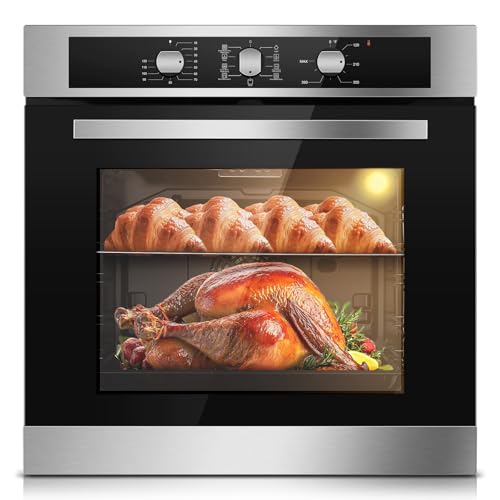
Zomagas 24-Inch Wall Oven — Biggest cavity, strongest stated power
The Zomagas wins the field’s two most physical arguments. Its cavity is stated at 2.8 cubic feet — the largest in this guide — and its power at 3220W, the highest figure any listing here commits to, driving a 360-degree rotisserie across nine functions. Behind mechanical knobs. That combination is a deliberate statement: maximum cooking substance, minimum interface theater. The triple glass door and enamel cavity stated in the listing complete a pick that spends its specification budget on the parts of the oven that touch food and heat, and declines to spend it anywhere else.
The listing’s final phrase deserves a raised eyebrow of interest rather than skepticism: it positions the oven for restaurant use as well, and the specification makes the ambition legible — power, cavity, rotisserie, enamel that wipes down between services. Home buyers should read that as a durability hint rather than a commercial certification, which the title does not claim. For the household that roasts large, often, and without patience for underpowered preheats, the Zomagas is the mid-range field’s heavy lifter, and its knob control makes it the heavy lifter you can operate with oven mitts half on.
- Nominal width: 24 inches, wall oven
- Cavity capacity: 2.8 cu. ft. per its listing
- Power: 3220W as listed
- Functions: 9 from the listing
- Rotisserie: 360-degree rotisserie per the listing
- Controls: mechanical knobs
- Door: triple glass door as the listing states
- Interior: enamel cavity from the listing itself
- Where to buy: the Zomagas 24-inch wall oven listing on Amazon — check price on Amazon
Strengths
- The largest stated cavity and highest stated wattage in the field, together.
- A rotisserie and triple glass door spend the budget on cooking and safety.
- Mechanical knobs suit gloved, busy, roast-driven cooking.
Trade-offs
- No touch panel or digital timer is stated for the control romantics.
- ETL certification is not claimed in the verified title.
- Its restaurant positioning is the maker’s framing, not a commercial certification.
Best for: roast-driven households that rank cavity and wattage above interface style.
A weak match for: buyers who want a touch panel and certification stated in the listing.

GarveeLife 24-Inch Electric Wall Oven — Layered glass, easy-clean cavity
The GarveeLife closes the field by attending to the two surfaces a household touches most: the door and the cavity walls. Its listing states a three-layer tempered glass door — insulation, a cooler front, and a steadier cavity in one specification — and an enamel easy-clean cavity behind it. Between those surfaces sits the familiar, complete formula: 2.5 cubic feet of convection, ten versatile cooking functions, 3000W, and touch control. If the first Garvee in this guide is the tier’s modern face, the GarveeLife is the same face after a year of ownership has been considered — the version specified by someone who has cleaned ovens before.
That emphasis is more practical than glamorous, and deliberately so. Door glass and cavity finish decide how an oven ages in a working kitchen: whether the front stays pleasant to stand before, whether the interior wipes clean in minutes or demands a Saturday. Ten functions and convection ensure the cooking side needs no apology meanwhile. Households choosing between the two Garvee-family touch models are really choosing an emphasis — certification and lock on one side, layered glass and easy-clean enamel on the other — and either emphasis is a defensible definition of what mid-range should mean.
- Nominal width: 24 inches, built-in electric wall oven
- Cavity capacity: 2.5 cu. ft. in the listing’s own words
- Functions: 10 versatile cooking functions per its listing
- Power: 3000W as listed
- Convection: stated in the listing
- Controls: touch control from the listing
- Door: 3-layer tempered glass door per the listing
- Interior: enamel easy-clean cavity as the listing states
- Where to buy: the GarveeLife 24-inch wall oven listing on Amazon — check price on Amazon
Strengths
- Triple-layer door glass and an easy-clean enamel cavity target long-term ownership directly.
- Ten functions with convection and 3000W keep the cooking specification complete.
- Touch control matches the field’s modern interface expectation.
Trade-offs
- Neither ETL certification nor a safety lock is stated in its verified title.
- Its specification overlaps its Garvee sibling closely; the difference is emphasis.
- No rotisserie is named among the ten functions in the listing.
Best for: households that prioritize door insulation and painless cleaning in a complete touch-control package.
Weakest fit: buyers who need certification stated in the listing before anything else.
The Mid-Range Ledger: Features Side by Side
| Model | Stated capacity | Functions | Stated power | Controls | Notable stated extra |
|---|---|---|---|---|---|
| FinerFurnis Electric Single Wall Oven | Large (figure not stated) | Count not stated | Not stated | Touch and knobs | Rotisserie, safety lock |
| Garvee 24-Inch Electric Wall Oven (10 Functions) | 2.5 cu. ft. | 10 | 3000W | Touch | ETL certified, safety lock |
| Garvee 24-Inch Electric Wall Oven (8 Functions) | 2.5 cu. ft. | 8 | 3000W | Mechanical knobs | Black finish |
| ThermoMate 24-Inch Convection Wall Oven (12 Functions) | 2.6 cu. ft. | 12 | 3100W | Sensor touch | 3D heating, ETL certified, lock |
| Zomagas 24-Inch Wall Oven | 2.8 cu. ft. | 9 | 3220W | Mechanical knobs | Rotisserie, triple glass door |
| GarveeLife 24-Inch Electric Wall Oven | 2.5 cu. ft. | 10 | 3000W | Touch | 3-layer glass, easy-clean enamel |
Read the ledger by columns and the tier’s character emerges: convection everywhere, power clustered tightly, capacities within a few tenths of each other — and the real competition happening in the last two columns, where control philosophy and one thoughtful extra decide each pick’s identity.
Touch Panel or Knobs — How Should a Mid-Range Buyer Actually Decide?
By watching your own hands cook for a week. Touch panels — the Garvee 10-function, the ThermoMate’s sensor touch, the GarveeLife — present long menus legibly, wipe clean in one pass, and pair naturally with timers and locks. They ask for dry fingers and a moment’s attention. Knobs — the Garvee 8-function and the Zomagas — answer instantly, work with mitts and wet hands, and will still be turning, uncomplaining, when the household’s second refrigerator arrives. Neither is the future and neither is the past; they are two theories of control, and this tier is unusual in offering both at full feature strength.
The household tiebreakers are concrete. Young children argue for a lock, which the touch models here state more often. Roasting with bastes and turns argues for knobs that can be nudged without looking. A cook who uses six functions weekly argues for the panel that names them all. And a household divided against itself can look at the FinerFurnis, whose listing puts touch and knobs on the same front — the field’s own compromise candidate. The same fit-the-machine-to-the-household discipline governs gentler corners of the home, incidentally, as Best Dishwashers for Septic Systems shows for households whose plumbing asks its own specific questions.
What Does a Function Count Buy You Between Eight and Twelve?
Mostly, names for things you already do. The jump from eight to ten to twelve functions rarely adds a new physical capability — the elements, fan, and cavity are what they are — but it adds presets that encode time-and-temperature judgment for specific dishes, and presets are worth exactly as much as the cook’s willingness to trust them. A household that roasts by instinct will use three functions on a twelve-function oven and lose nothing. A household learning to cook, or cooking across a wide repertoire of cuisines and techniques, will find the longer menus genuinely instructive — the oven as a recipe’s first draft.
The honest way to shop the column is to list the functions your last month of cooking would have named, then buy the shortest menu that covers the list with one or two ambitions to spare. That arithmetic lands most households on eight or ten, sends the repertoire collectors to the ThermoMate’s twelve, and explains why this guide refuses to rank the field by the count alone. A function you never select is not a feature; it is a label you clean around.
Which Details Separate a Good Mid-Range Oven From a Tiring One?
The door and the cavity, encountered daily and cleaned weekly. Layered glass — triple on the Zomagas, three-layer tempered on the GarveeLife — keeps the front cooler and the cavity steadier, and in compact kitchens where the cook stands close, that difference is felt on the skin. Enamel interiors, stated by the GarveeLife and the Zomagas, wipe clean without specialty products and forgive the occasional neglected spill better than bare finishes. A safety lock, stated by the FinerFurnis, the touch Garvee, and the ThermoMate, converts a panel’s vulnerability into a non-issue for households with small, curious residents.
None of these details will headline a listing photograph, and together they decide whether an oven is still pleasant in year five. The mid-range tier’s maturity is visible exactly here: features that were once flagship garnish — layered glass, enamel, locks — have become the field’s competitive ground, which means buyers at this level are choosing among comforts rather than among compromises. Even the freezer aisle has learned the same lesson about daily-touch details, as Best Freezers With Drawers shows for a category that stopped competing on cubic feet alone.
What Are the Standard Mid-Range Buying Mistakes?
The first is shopping the tier by money anyway — hunting a number instead of a feature set, and ending with an oven whose specification nobody actually compared. The second is the function-count auction: paying in complexity for a dozen modes when the household’s repertoire is four dishes deep. The third is ignoring the control question until installation, then discovering the household’s hands hate the panel or miss it. The fourth is skipping the cutout measurement because the oven is the same nominal width as the old one — the compact guides in this series repeat the warning because the returns data keeps proving it.
The fifth mistake is forgetting the electrical fine print: several picks here state 240V and wattages around the 3000W mark, and the circuit feeding a decades-old compact oven may have opinions about that. Confirm the supply against the chosen model’s documentation before the order. The sixth is treating the FinerFurnis’s unstated width as a detail to resolve after delivery; it is a question for the documentation, answered before money moves, like every other unstated figure in this guide.
What Does the Mid-Range Feel Like After a Year of Dinners?
The tier’s promise is not excitement; it is the absence of friction, compounded daily. Convection that evens the tray of vegetables without a mid-cook rotation you have to remember. A timer that lives where your eyes already go. A door that a passing hip can brush without consequence. A cavity that wipes clean while the plates are still warm from the dishwasher. None of these moments will ever be described at a dinner party, and together they are the entire experience of owning a well-chosen mid-range oven — an appliance that has quietly stopped being a topic in its own kitchen.
That invisibility is the correct test of the tier, and it cuts against both neighbors. The basic oven stays visible through its limitations, which interrupt recipes and invent workarounds. The flagship stays visible through its capabilities, which demand to be used, learned, and maintained. The mid-range oven, chosen well, disappears into the cooking itself — and households should shop for exactly that disappearance, weighing the daily-touch details in this guide more heavily than any headline count.
How Should You Measure and Plan for a Mid-Range Replacement?
The routine is the one this series teaches for every built-in, and it bears repeating because this tier is bought mostly as replacement. Power off at the breaker, slide the old oven out, and measure the cutout’s width, height, and depth twice each, keeping the smallest honest figures. Photograph the junction box’s position and the old unit’s rating plate. Compare those numbers against the documentation of the model you choose — remembering that nominal width, which five of these picks state as 24 inches and one does not state at all, is the beginning of the conversation rather than its conclusion.
Then plan the electrical half with the same care. The stated figures in this field — 3000W on several models, 3100W on the ThermoMate, 3220W on the Zomagas, a stated 240V supply on the touch Garvee — describe appetites that an older compact circuit may or may not share. A planned electrician’s visit before delivery day converts that uncertainty into a line item; an unplanned discovery converts it into a delay with an oven in the hallway. Mid-range buyers are, by temperament, planners — the tier rewards the temperament at every step.
What Upkeep Does This Tier Ask in Return?
Very little, and mostly wiping. The enamel cavities stated by the GarveeLife and the Zomagas clean with a damp cloth and ordinary attention; the layered glass doors want the same cloth on their inner faces after splashy cooks. Touch panels ask to be cleaned with a soft, barely damp cloth rather than a dripping sponge, for the electronics’ sake. Knob models ask for almost nothing at all, which remains their quiet argument. No pick in this guide states a self-cleaning cycle, so the honest expectation is manual upkeep — measured, at these cavity sizes, in minutes per week rather than in dreaded afternoons.
The rotisserie models — the FinerFurnis and the Zomagas — add their hardware to the sink’s evening soak, a two-minute habit that keeps the feature inviting. Locks, where fitted, want an occasional test so the household learns the gesture before a small hand makes it urgent. That is the whole maintenance contract of the modern mid-range: small, regular, and unglamorous, in exchange for an oven that behaves identically in year five as in week one.
Who Should Buy Below This Tier, and Who Should Buy Above It?
Buy below it if the oven’s life will be genuinely simple — a granny flat’s reheating and occasional bake, a rental where durability outranks delight, a second kitchen that exists for overflow. The basic compacts in the 24-inch guide elsewhere in this series serve those lives honestly and ask less of the budget for capabilities nobody will invoke. Buy above it if the diary says so: two-temperature cooking every week, steam ambitions, feasts that strain a single cavity into scheduling. The flagship doubles have their own guide, and households that belong there will feel this tier’s single cavities as a ceiling within a month.
Everyone between those poles — which is most renovating households — is this tier’s citizen. The mid-range is not the compromise between the oven you want and the oven you can justify; properly understood, it is the tier where the feature set and the cooking life meet without either one pretending. That meeting point is why this guide exists, and why its six listings were chosen to span the meeting point’s real geography: controls, counts, cavities, and the small details that decide year five.
What Does This Field Say About Where Compact Ovens Are Heading?
That the flagship’s old luxuries have finished their migration downward. Convection is now the floor rather than the ceiling of the class. Double-digit function counts appear behind both panels and — in spirit — knobs. Layered door glass, enamel cavities, and safety locks compete openly at a level where, a generation ago, the competition was whether the oven had a light. The brands doing the migrating are the value-engineered names that fill this guide, and their method is visible in every listing here: state the specification, all of it, in the title, and let the buyer compare without a showroom’s mediation.
For buyers, the migration is pure gain, with one discipline attached: as features standardize, the remaining differences concentrate in exactly the places this guide has emphasized — control feel, stated certifications, door construction, and the honesty of the specification itself. Shop those, and the mid-range’s golden moment becomes your kitchen’s ordinary Tuesday, which is the highest praise this tier has ever wanted.
How Do You Choose Between Two Picks That Tie on Paper?
Ties are this tier’s natural condition — three models share a capacity and a wattage, two share a function count — so the tiebreakers deserve to be named plainly. Prefer the listing that states its certification when paperwork matters to your household or your insurer. Prefer the door construction that suits your walkway’s traffic. Prefer the control your least technical household member operates without a sigh. Prefer the brand whose documentation answers your remaining questions — the FinerFurnis’s width among them — completely and without evasion. An oven is chosen in an afternoon and used for a decade; the tiebreakers are all decade-shaped, and the specification sheet is only the first round.
There is also the matter of the second cook. Most kitchens have one, whether a partner, a teenager, or a parent who visits and immediately starts helping. Stand that person in front of your shortlist’s photographs and ask which front they would rather face with a tray in their hands. The answer is data, of the kind no listing provides, and in a tier of near-ties it is often the deciding data.
What Should the First Fortnight With a New Mid-Range Oven Establish?
Two habits and one fact. The first habit is the wipe: cavity and door glass cleaned while warm, every time, until it stops feeling like a resolution and starts feeling like clearing the table. The second habit is the menu tour: cook one dish on each of the functions you actually bought the oven for, early, while the manual is still on the counter and the settings are still new enough to be interesting. A function first used in month nine is a function half wasted; a function used in week one becomes part of the repertoire the oven was bought to serve.
The fact to establish is your cavity’s truth: where it browns fastest, which rack level your staple dishes prefer, how its timer’s voice carries to the room where your household actually sits. Every oven has this geography, and the mid-range’s even, fan-assisted cavities have kinder geographies than most — but kinder is not identical, and a fortnight of attention buys a decade of instinct. Write the two or three findings inside a cupboard door, as this series keeps advising, and let the next cook inherit them.
Why Does This Guide Trust Listings More Than Reputations?
Because in this tier, reputation is the lagging indicator. The brands that fill the field earned their places by publishing specifications the older names once kept for showrooms — function counts, wattages, certifications, door constructions, all stated where a buyer can compare them at midnight. A guide that repeated reputations instead of reading listings would misdescribe the modern compact market entirely, praising ghosts and overlooking the ovens households are actually, successfully cooking with. The method has a cost: figures a listing omits, like one pick’s width, must be reported as omissions rather than filled in from vibes. This guide pays that cost gladly, because the alternative — invented certainty — is the one thing a buyer cannot cook with.
How Does Convection Change Ordinary Cooking in a Cavity This Size?
In a compact cavity, still air stratifies: the top runs fierce, the bottom lags, and the cook compensates with rotations and rack shuffles learned over months. Convection — present, in one stated form or another, in every pick in this guide — replaces that apprenticeship with physics. Moving air scrubs the boundary layer off the food’s surface and delivers the cavity’s temperature evenly to every rack, which is why a mid-range compact can bake two trays at once with a straight face. Roasts brown as units instead of as landscapes. Frozen foods, the compact kitchen’s staple, cook from the state they are actually in rather than from the thawed state the recipe assumed.
The adjustment for converts is small and worth stating: fan-assisted heat is efficient enough that experienced cooks watch the first runs of familiar dishes closely, since browning arrives a little ahead of the old schedule. Within a week the new timing is instinct. What does not change is the tier’s essential bargain — convection is doing quiet, continuous work that used to require the cook’s vigilance, and vigilance is the one ingredient every household runs short of on a weeknight.
What Role Does the Safety Lock Play Beyond Households With Toddlers?
A wider one than its name suggests. The locks stated by the FinerFurnis, the touch Garvee, and the ThermoMate protect the cooking program itself — against the hip that brushes a panel in a galley kitchen, the guest who helpfully presses things, the cleaner who wipes the front with enthusiasm and resets the timer into another timezone. In panel-controlled ovens the lock is less a child device than an integrity device: the cycle you set is the cycle that runs. Landlords value it for the tenant-proofing; hosts value it during parties, when the kitchen fills with helpful strangers; every household values it the first time it silently does its job.
Its presence in three of six listings also marks the tier’s center of gravity. Basic ovens omit it because their knobs are their lock. Flagships assume it. The mid-range is where the lock becomes a competitive feature, named in titles and weighed by buyers — one more sign that this tier is where the modern oven’s standard equipment is currently being decided.
How Should a Landlord or a Seller Read This Field?
As a menu of signals. A mid-range built-in tells a tenant or a buyer that the kitchen was fitted deliberately, recently, and to a modern standard — convection, a real function menu, a front that photographs like the current decade. The knob-driven picks argue durability under rotating hands; the touch Garvee’s stated lock and certification argue documented care. Either argument outperforms the two failure modes of rental kitchens: the exhausted basic oven that apologizes for the whole room, and the fragile flagship whose features read as future repair bills. Fit the tier, state the facts in the listing, and let the oven do a small, daily piece of the property’s persuading.
Sellers should note the corollary: in a compact kitchen, the oven is at eye level in every viewing photograph, and a mid-range front in a clean column is the cheapest-looking expensive decision in the room — except that this guide does not price decisions, so call it instead the most visible one. Choose the finish that composes with the room, keep the glass honest, and the appliance will hold its side of the conversation with every visitor.
What Is the Case for Buying the Tier’s Quietest Specification?
Notice which pick in this field argues least and consider why it might be right. The Garvee 8-function makes no claim to certification in its title, offers no lock, no layered glass, no rotisserie — and yet it may be the correct oven for more households than any other listing here, because its omissions are all in the garnish and its presences are all in the cooking: convection, eight functions, full stated power, an honest cavity, controls that will outlive the kitchen’s next repaint. The mid-range’s maturity means the floor of the tier is already high; a buyer who needs none of the extras is not settling by choosing the quiet specification, but editing.
The same logic, inverted, protects buyers at the tier’s busy end: the ThermoMate’s twelve functions and the GarveeLife’s layered glass are worth their complexity only to households that will use them weekly. Editing, in both directions, is the skill this tier rewards — knowing which of its now-standard comforts your household will actually touch, and declining the rest without a flicker of regret.
Final Recommendation
Take the ThermoMate if your cooking will honestly use the longest menu — twelve functions over 3D heating is the tier’s fullest expression. Take the Zomagas if your priorities are physical: the biggest cavity, the strongest stated power, and a rotisserie behind honest knobs. Between the Garvee family’s three, choose by interface and emphasis — touch with certification and a lock, knobs in black, or touch with layered glass and an easy-clean cavity — and take the FinerFurnis if its hybrid controls and rotisserie fit a kitchen whose dimensions you have verified from its documentation. The mid-range oven is the one your household will use without thinking, every day, for years — so choose the one whose controls, cavity, and cleaning already match the way your household thinks.
Frequently Asked Questions
What makes an oven mid-range if price is not the definition?
Its feature set: a single built-in cavity with convection, a substantial function menu, and modern details like layered door glass, enamel interiors, safety locks, or touch control — without crossing into double ovens, steam systems, or design-series flagships.
Is twelve functions meaningfully better than eight?
Only for households whose repertoire reaches for them. Extra functions are mostly named presets over the same heating hardware, so the gain is guidance and convenience, not raw capability. Buy the shortest menu that covers your real cooking, with a little ambition to spare.
Why does one pick have no width in this guide?
Because the FinerFurnis listing does not state one, and this guide claims nothing a listing does not. Its width must be confirmed from the manufacturer’s documentation before it can be matched to a specific cutout.
Do I need a 240V circuit for these ovens?
Several listings state 240V explicitly, including the Garvee 10-function model at 3000W. Treat the electrical requirement of your chosen model as a fact to verify against its documentation and your kitchen’s supply before ordering.
Are three listings from one brand family a problem?
No — the Garvee and GarveeLife models differ in the ways buyers actually choose: touch versus knob control, certification and lock versus layered glass and easy-clean enamel. The repetition maps the tier’s real decision points rather than padding the list.
Which pick is best for a rental kitchen?
The knob-driven models age most gracefully under varied hands — the Garvee 8-function in black or the Zomagas — while the touch Garvee’s stated safety lock and ETL certification argue for it where paperwork and families are the landlord’s concerns.
How long should a mid-range wall oven serve before it feels dated?
The cooking core — convection, capacity, power — ages slowly, because the physics does not move. Interfaces age faster, which is one quiet argument for the knob models’ longevity and for choosing touch panels whose designs are restrained. A well-chosen pick in this field should cook a decade without its specification embarrassing it, provided the household bought functions it uses rather than functions it admired.
Should I match the oven’s finish to my other appliances exactly?
Compose rather than match. A black oven among stainless companions, or the reverse, reads as a deliberate accent when the rest of the room is coherent, while a forced exact match with a discontinued shade reads as an accident. The field here offers stainless and black across its picks; choose the one your room’s light and cabinetry flatter, and let the oven be a citizen of the kitchen rather than a twin of the dishwasher.
What is the single most useful question to ask before ordering?
Whether the documentation for your chosen model confirms every figure your kitchen depends on — cutout, circuit, and, for one pick in this guide, the width itself. Listings open the conversation; documentation closes it. Asking that one question, and waiting for its answer, prevents nearly every disappointment this tier can produce.
Does a mid-range oven need professional installation?
The slide into a prepared cutout is simple, but the hardwired electrical connection deserves the same respect as at any tier: a qualified electrician for the final connection, and a planned check that the circuit suits the model’s stated supply. The tier’s buyers are planners by temperament, and installation is where that temperament pays its most visible dividend.
Why do so many of these ovens cluster at the same wattage?
Because the class has converged on what a compact cavity can usefully absorb: enough power to preheat briskly and recover quickly after the door opens, without asking the household circuit for anything exotic. The clustering is a sign of a mature category — the argument has moved from raw power to what the power is spent on, which is precisely the shift this whole guide documents.
Related Guides
Mid-range wall ovens are usually bought during a broader kitchen refresh, and readers who decide the built-in route is not for them often land on a full-size range instead. Our guide to Best 30-Inch Electric Ranges covers the freestanding alternative at the width most kitchens are built around.


