What's inside
- Key Takeaways
- Quick Picks
- What Did a Pick Have to Prove to Enter This Gas Field?
- The Whole Gas Field on One Page
- Natural Gas or Propane — Why the Fork Comes Before Everything?
- What Does a Safe, Correct Gas Installation Actually Involve?
- How Does Gas Cooking in a Small Cavity Differ From Electric?
- What Mistakes Do Small-Gas Buyers Make Most Often?
- What Is Everyday Cooking Like Over a Small Flame?
- How Do You Keep a Gas Cavity Clean and Honest?
- Ventilation: The Half of Gas Ownership Nobody Photographs?
- Why Does the Rotisserie Keep Appearing in This Class?
- How Should You Plan the Column for a Gas Built-In?
- Who Is This Class Really For, and Who Should Walk Away?
- What Does the Import-Led Shape of This Market Mean for Owners?
- How Do You Decide Between Near-Identical Import Picks?
- What Should the First Roast Tell You About Your New Oven?
- How Does a Small Gas Oven Age, and What Keeps It Young?
- Why Do Gas Loyalists Describe Electric Ovens as Cooking at a Distance?
- Final Recommendation
- Frequently Asked Questions
- Related Guides
As an Amazon Associate I earn from qualifying purchases. This post may contain affiliate links at no extra cost to you.
cottageverdict.com is reader-supported. When you buy through links on our site, we may earn an affiliate commission.
Every oven in this guide is sold on Amazon, and each pick links to its own listing there so you can check price on Amazon when you have chosen your fuel and your finish. Gas buyers should read the intro twice: in this class, the fuel decision and the safety planning are the purchase.
The best small gas wall ovens are the answer to a question most American kitchens never ask, and this guide will say so plainly at the start: the small gas wall oven is a very narrow class in the United States. The overwhelming majority of wall ovens sold in this country are electric, and at the compact 24-inch size the gas field narrows to a handful of models, led largely by a few import brands — Empava, ThermoMate, GASLAND — with one famous domestic name, Frigidaire, standing in the field. All six picks verified for this guide are 24-inch gas singles, and between them they cover natural gas and propane, stainless and black, knob control and digital timers.
Why does the class exist at all? Because some kitchens are plumbed for gas and their owners cook with conviction: off-grid and propane households, cooks who learned on flame and trust its response, older homes where the gas line already ends at the oven column and the electrical service would need real work to feed a hungry electric built-in. For those kitchens, the six ovens below are not curiosities — they are the entire realistic shopping list, and this guide treats them with the care a small field deserves. Where a specification matters, it is quoted only from the listings themselves: the one BTU figure in this guide, for instance, belongs to the Empava natural-gas model, whose title states 13,600 BTU/h, and no other pick is assigned a number its listing does not give.
Gas also changes the installation conversation in ways electric guides can soft-pedal. A gas wall oven needs a proper gas connection made by someone qualified, attention to ventilation, and respect for the fact that several of these models still plug into an ordinary 120V outlet to run their fans, timers, and ignition — a detail stated in their listings that surprises buyers who assumed gas meant independence from the socket. That hybrid nature is normal and safe when installed correctly, and the sections below walk through what correctly means.
Key Takeaways
- The US small gas wall-oven class is genuinely narrow and import-led: Empava, ThermoMate, and GASLAND supply most of it, with Frigidaire’s Gallery model the domestic exception.
- All six verified picks are 24-inch single gas ovens; capacities stated in listings cluster at 2.12 to 2.3 cubic feet, with the Frigidaire’s capacity unstated in its title.
- Fuel is the first fork: five picks burn natural gas, and the Empava LPG model is the propane variant — it is not interchangeable with the natural-gas version.
- Only one BTU figure is stated anywhere in the verified listings — 13,600 BTU/h on the Empava natural-gas oven — and this guide assigns no invented figures to the rest.
- Several models state a 120V cord plug in their titles: gas heats the cavity, but electricity still runs the fan, timer, and ignition.
Quick Picks
| Pick | Badge | Why it earned its place |
|---|---|---|
| Empava 24-Inch Natural Gas Wall Oven | The fully stated specification | Five cooking functions, a 360-degree rotisserie, convection fan, LED digital timer — and the field’s only stated output figure, 13,600 BTU/h. |
| ThermoMate 24-Inch Gas Wall Oven | ETL certified, rotisserie aboard | Bake, broil, and rotisserie functions with a convection fan and timer in a 2.12 cubic foot ETL certified cavity. |
| GASLAND 24-Inch Gas Wall Oven (Stainless) | The stainless all-rounder | Bake, broil, rotisserie, and convection fan with ETL certification and a timer, in stainless steel at 2.12 cubic feet. |
| GASLAND 24-Inch Gas Wall Oven (Digital Timer) | Black finish, digital timing | The GASLAND formula in black with a digital timer and easy-clean interior, for kitchens leaving stainless behind. |
| Frigidaire Gallery 24-Inch Gas Wall Oven | The domestic flagship of the class | Air fry and self-cleaning in a 24-inch gas wall oven from the Gallery line — features the import field does not state. |
| Empava 24-Inch LPG Wall Oven | The propane answer | Built for LPG with convection and rotisserie across five cooking modes — the pick for propane households, full stop. |
What Did a Pick Have to Prove to Enter This Gas Field?
Three things. It had to be a true built-in wall oven, not a range and not a countertop unit wearing the words. It had to burn gas — natural gas or LPG as its listing states — rather than merely offering a gas cooktop above an electric oven. And its fuel, capacity, and functions had to be readable from its own listing title, because in a class this small, buyers cannot afford folklore. Models that failed any test were left out regardless of brand fame, which is why this field is six honest ovens rather than a longer, softer list.
We also kept the fuel variants separate with deliberate care. Natural gas and propane are different fuels with different pressures and different hardware, and a listing that says LPG means LPG. The electric siblings of these same brands live in a different guide — readers cross-shopping the two fuels will find the 24-inch electric field mapped in Best Mid-Range Wall Ovens, where several of the same makers compete on elements instead of burners.

Empava 24-Inch Natural Gas Wall Oven — The fully stated specification
The Empava natural-gas model earns the lead position by telling you the most. Its listing states a 2.3 cubic foot cavity — the largest figure given by any of the import picks — five cooking functions, a convection fan, a 360-degree rotisserie, knob control, and an LED digital timer. Then it does something no other listing in this field does: it states the oven’s output, 13,600 BTU/h, in plain figures. In a class where specifications are often a rumor, a manufacturer that prints its heat output on the title is making a promise a buyer can plan around, and gas cooks — who think in flame and recovery the way electric cooks think in watts — will recognize the gesture as fluency in their language.
The combination it assembles is the enthusiast’s compact gas oven: flame heat for the sear and the roast, a fan to even it, a rotisserie to turn a chicken through its own juices, and a timer with a digital readout to keep the whole performance honest. Stainless steel keeps it neutral in most kitchens. The buyer’s homework is the class’s homework — a qualified gas connection, a verified cutout — but among the six, this is the listing that arrives with its paperwork in order, and for a niche purchase made largely online, paperwork is a form of trust.
- Nominal width: 24 inches, natural gas single wall oven
- Cavity capacity: 2.3 cu. ft. as stated in the listing
- Output: 13,600 BTU/h as stated in the listing
- Cooking functions: 5, with convection fan
- Rotisserie: 360-degree rotisserie as stated in the listing
- Controls: knob control with LED digital timer
- Finish: stainless steel
- Where to buy: the Empava natural gas wall oven listing on Amazon — check price on Amazon
Strengths
- The only stated BTU figure in the field, and the largest stated import cavity.
- Rotisserie plus convection fan is the most complete cooking kit among the import picks.
- Knobs for the cooking, a digital timer for the clock — each control where it belongs.
Trade-offs
- Natural gas only; propane households need its LPG sibling, not a conversion promise.
- No self-cleaning claim appears in the verified listing.
- An import brand’s service network is thinner than Frigidaire’s, which some buyers weigh heavily.
Best for: natural-gas households that want the most completely specified compact gas oven in the class.
Not suited for: propane homes, or buyers who want self-cleaning stated in the listing.

ThermoMate 24-Inch Gas Wall Oven — ETL certified, rotisserie aboard
ThermoMate’s gas entry leads with its paperwork: ETL certified, stated in the title, which in a niche class sold largely online is a meaningful comfort for the homeowner, the installer, and the inspector who may one day ask. Inside the 2.12 cubic foot cavity, the listing promises the working trio of bake, broil, and rotisserie functions, assisted by a convection fan — the fan being the detail that separates a modern gas oven from the uneven flame boxes of memory, spreading the burner’s heat so the back-left corner stops being a rumor and a hazard.
A timer is stated, and the listing is candid about the oven’s hybrid nature: a 120V cord plug runs the fan, timer, and ignition side of the appliance while gas does the heating. That candor is worth rewarding with attention, because it shapes installation planning — the column needs both the gas line and an outlet within reach. Stainless steel finish and a function list aimed squarely at roasting households make the ThermoMate the steady, certified center of this field: not the most specified, not the most famous, but arguably the easiest to defend in every conversation a gas appliance eventually has with professionals.
- Nominal width: 24 inches, natural gas wall oven
- Cavity capacity: 2.12 cu. ft. as stated in the listing
- Certification: ETL certified per the listing
- Functions: bake, broil, rotisserie, with convection fan
- Controls: timer as the listing states
- Electrical: 120V cord plug from the listing itself
- Finish: stainless steel
- Where to buy: the ThermoMate gas wall oven listing on Amazon — check price on Amazon
Strengths
- ETL certification stated outright, the paperwork comfort this class often skips.
- Rotisserie and convection fan cover the roasting household’s whole repertoire.
- The 120V plug requirement is disclosed in the title, planning-friendly and honest.
Trade-offs
- The 2.12 cubic foot cavity is shared with the GASLAND pair and trails the Empava’s stated 2.3.
- No output figure is stated, so flame comparisons stay qualitative.
- Self-cleaning is not among the features its listing names.
Best for: gas households that want certification in writing and a rotisserie in the cavity.
A poor fit for: buyers chasing the largest stated cavity or a self-cleaning cycle.

GASLAND 24-Inch Gas Wall Oven (Stainless) — The stainless all-rounder
GASLAND, as its name announces, builds its whole identity around flame, and this stainless 24-inch wall oven is its straightforward proposition: bake, broil, and rotisserie functions, a convection fan, ETL certification, a timer, and a 2.12 cubic foot cavity, wrapped in stainless steel. The specification rhymes closely with the ThermoMate’s — same stated capacity, same function trio, same certification — and that rhyme is itself useful information about the class: the import field has converged on a formula for the compact gas oven, and the GASLAND is that formula executed without decoration.
Where it earns its own slot is in the completeness of the package at the everyday end of the class. The 120V cord plug is stated, so the electrical half of the installation holds no surprises. The rotisserie is present, which not every maker bothers with at this size. And the brand’s single-fuel focus means its documentation and support conversations start from gas rather than arriving there. Buyers choosing between this and the ThermoMate are choosing at the margins — finish details, control feel, support preference — and should let those margins decide without anxiety, because the core proposition is honestly shared.
- Nominal width: 24 inches, natural gas wall oven
- Cavity capacity: 2.12 cu. ft. in the listing’s own words
- Certification: ETL certified natural gas wall oven, per its listing
- Functions: bake, broil, rotisserie, with convection fan
- Controls: timer as listed
- Electrical: 120V cord plug from the listing
- Finish: stainless steel
- Where to buy: the GASLAND stainless gas wall oven listing on Amazon — check price on Amazon
Strengths
- The class formula complete in one listing: certification, rotisserie, fan, timer.
- A gas-specialist brand whose support starts from flame.
- Stainless finish matches the majority of existing kitchen suites.
Trade-offs
- Specification closely parallels the ThermoMate, so differentiation is a matter of margins.
- No BTU figure is stated for cross-shopping against the Empava’s number.
- Air fry and self-cleaning belong to the Frigidaire in this field, not here.
Best for: stainless kitchens that want the complete, certified import formula from a gas-only brand.
Not the right match for: feature hunters, whose eyes belong on the Frigidaire Gallery model.

GASLAND 24-Inch Gas Wall Oven (Digital Timer) — Black finish, digital timing
The second GASLAND is the same compact gas idea turned toward a different kitchen: black finish, a digital timer up front, and an easy-clean interior stated in the listing. The cooking core is familiar — bake, broil, and convection with a rotisserie, in the same stated 2.12 cubic foot cavity, ETL certified, plugging into 120V for its electrical duties. What changes is the temperament. The digital timer suits cooks who run their kitchen by the clock and want the readout legible across the room, and the black front suits the growing number of kitchens that have left the all-stainless era behind.
The easy-clean interior deserves its line, because gas ovens ask for a particular kind of upkeep — flame cooking leaves its own residues, and a cavity designed to wipe clean lowers the activation energy of keeping it that way. Between the two GASLAND listings, the choice is therefore honest and simple: stainless and the classic presentation, or black with digital timing and the easy-clean emphasis. Households renovating in black should not have to choose between their palette and the class’s core formula, and thanks to this listing, they do not.
- Nominal width: 24 inches, natural gas wall oven
- Cavity capacity: 2.12 cu. ft. per the listing
- Certification: ETL certified for safety, as the listing states
- Functions: bake, broil, convection, with rotisserie
- Controls: digital timer from the listing itself
- Interior: easy-clean interior in the listing’s own words
- Electrical: 120V plug per its listing
- Finish: black
- Where to buy: the GASLAND digital timer model listing on Amazon — check price on Amazon
Strengths
- The class’s core formula in black, with a digital timer for clock-driven cooks.
- Easy-clean interior stated, matched to gas cooking’s real residues.
- Rotisserie and convection survive the change of clothes intact.
Trade-offs
- Black is the only stated finish; stainless loyalists should take the sibling listing.
- Capacity and core functions mirror the other import picks rather than exceeding them.
- No output figure is given in the verified title.
Best for: black-appliance kitchens that want digital timing and the full import formula.
Poorly suited to: buyers matching an existing stainless suite knob for knob.
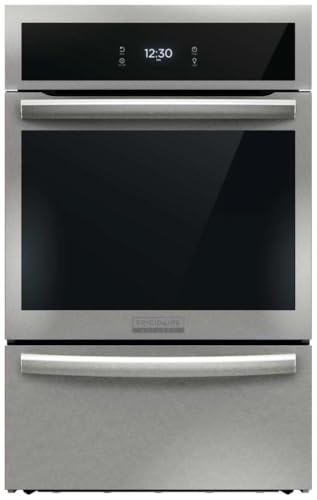
Frigidaire Gallery 24-Inch Gas Wall Oven — The domestic flagship of the class
The Frigidaire Gallery model — GCWG2438AF, as its listing names it — is the oven that proves the class is not entirely an import story. It brings two features none of the import listings state: air fry and self-cleaning, inside a 24-inch single gas built-in wall oven wearing the Gallery badge, Frigidaire’s dressed tier. Air fry over gas heat is a combination the rest of the field does not offer, and self-cleaning matters doubly in a gas cavity, where the residues of flame cooking make manual scrubbing the least pleasant version of an already unloved chore.
The domestic badge carries its own practical weight: Frigidaire’s service network, parts pipeline, and installer familiarity are the deepest available to this class, and for many gas households that infrastructure is the deciding feature no specification sheet prints. The listing’s restraint should be noted with the same honesty applied elsewhere in this guide — its title states no capacity figure, so none is claimed here, and the buyer should take the number from the manufacturer’s documentation. What the title does establish is enough to define the pick: the feature flagship of the small gas class, from the one household name standing in it.
- Nominal width: 24 inches, single gas built-in wall oven
- Features named in the listing: air fry, self-cleaning
- Series: Frigidaire Gallery
- Model: GCWG2438AF as listed
- Finish: stainless steel
- Capacity: not stated in the verified listing title — confirm from manufacturer documentation
- Where to buy: the Frigidaire Gallery gas wall oven listing on Amazon — check price on Amazon
Strengths
- Air fry and self-cleaning are stated here and nowhere else in the field.
- The deepest service and parts network available to a small gas oven buyer.
- Gallery-tier presentation in a class that mostly dresses plainly.
Trade-offs
- Its listing states no cavity capacity, so comparison homework is required.
- No rotisserie is named, where three import rivals state one.
- Natural gas is the stated fuel; propane households must look to the Empava LPG.
Best for: gas households that want modern features and a domestic service story behind a compact built-in.
A weak match for: rotisserie devotees, or propane kitchens.

Empava 24-Inch LPG Wall Oven — The propane answer
This pick exists for one reader, and for that reader it is the most important listing in the guide: the household that cooks on propane. The Empava LPG is a built-in single wall oven made for liquefied petroleum gas, stated as such in its title, with convection and rotisserie across five cooking modes and knob control in stainless steel. Propane households — rural homes, off-grid kitchens, places where the tank in the yard is the gas grid — are routinely told to convert, adapt, or go electric. This oven simply speaks their fuel natively, and in a class this narrow, a native speaker is a find.
The distinction must be kept bright: LPG and natural gas are not interchangeable, and an oven built for one is not a candidate for the other without manufacturer-sanctioned conversion, which this guide does not improvise. If your home runs on natural gas, the pick above this one — the same maker’s natural-gas model, with its stated BTU figure — is your Empava. If your home runs on propane, this is your Empava, and the rest of the field mostly falls away. Five modes and a rotisserie mean the propane kitchen gives up nothing in repertoire for its fuel choice, which is exactly how it should be.
- Nominal width: 24 inches, built-in LPG single wall oven
- Fuel: LPG (propane) — a distinct variant, not a natural-gas model
- Cooking modes: 5 from the listing
- Features named in the listing: convection, rotisserie
- Controls: knob control
- Finish: stainless steel
- Where to buy: the Empava LPG wall oven listing on Amazon — check price on Amazon
Strengths
- Native propane design in a class where propane is usually an afterthought.
- Five cooking modes with convection and rotisserie — no repertoire surrendered.
- Knob control suits off-grid and rural kitchens that value mechanical simplicity.
Trade-offs
- Useless to natural-gas households; the fuel match is absolute.
- No capacity or output figure is stated in the verified title.
- Propane installations carry their own professional requirements, tank to oven.
Best for: propane and off-grid households that want a true built-in wall oven on their own fuel.
Weakest fit: any kitchen plumbed for natural gas — take the sibling model instead.
The Whole Gas Field on One Page
| Model | Fuel | Stated capacity | Signature stated features |
|---|---|---|---|
| Empava 24-Inch Natural Gas Wall Oven | Natural gas | 2.3 cu. ft. | 13,600 BTU/h, 5 functions, rotisserie, LED digital timer |
| ThermoMate 24-Inch Gas Wall Oven | Natural gas | 2.12 cu. ft. | ETL certified, rotisserie, convection fan, 120V plug |
| GASLAND 24-Inch Gas Wall Oven (Stainless) | Natural gas | 2.12 cu. ft. | ETL certified, rotisserie, convection fan, timer |
| GASLAND 24-Inch Gas Wall Oven (Digital Timer) | Natural gas | 2.12 cu. ft. | Digital timer, easy-clean interior, black finish |
| Frigidaire Gallery 24-Inch Gas Wall Oven | Natural gas | Not stated in title | Air fry, self-cleaning, Gallery series |
| Empava 24-Inch LPG Wall Oven | LPG (propane) | Not stated in title | 5 modes, convection, rotisserie |
The table’s shape is the class’s shape: one propane island, one domestic flagship, and a converged import formula offered in two finishes and two control styles, with a single stated power figure standing where a column of numbers would live in a healthier market.
Natural Gas or Propane — Why the Fork Comes Before Everything?
Because the two fuels are different substances delivered at different pressures, and ovens are built — jetted, regulated, and certified — for one or the other. A natural-gas kitchen chooses among five of this guide’s six picks. A propane kitchen chooses the Empava LPG and the occasional conversion conversation it should have only with a manufacturer and a licensed installer, never with a forum and a wrench. Households planning a home should treat the fuel question as infrastructure, settled with the tank or the street line, long before finishes are admired.
There is a wider kinship worth naming: the freestanding side of the gas world asks the same fuel-first question, and readers weighing a range instead of a built-in for an off-grid or propane kitchen will find the same logic waiting for them there. The wall oven’s version of the answer is simply more exclusive — six models, two fuels, and no room for ambiguity about which is which.
What Does a Safe, Correct Gas Installation Actually Involve?
A qualified gas fitter, full stop — this is the one installation in the kitchen that does not belong to enthusiastic DIY. The fitter makes the gas connection with the correct fittings and sealant practice, checks the line and the shutoff, leak-tests the joints, and confirms the oven’s ignition and flame behavior before anyone roasts anything. Ventilation gets its professional look as well: gas combustion produces moisture and byproducts that a kitchen must move out, and the room’s existing venting should be assessed rather than assumed. Several picks state a 120V plug for their fans, timers, and ignition, so the electrician’s small part — an outlet where the listing expects one — belongs in the same plan.
After installation, the household’s own safety habits are simple and non-negotiable. Know where the gas shutoff lives. Treat any persistent gas smell as a stop-everything event handled by professionals, not by troubleshooting. Keep the oven’s documentation with its fuel type written large on the front, so a future service visit starts from the truth. None of this is fear; it is the ordinary respect a fuel-burning appliance is owed, and millions of gas kitchens practice it so routinely it becomes invisible — which is the goal.
How Does Gas Cooking in a Small Cavity Differ From Electric?
Flame heat arrives with moisture — combustion’s natural byproduct — and generations of cooks have prized the gentler roasting environment it makes, where meats stay succulent and bread crusts behave differently than in dry electric heat. Gas also answers the control instantly: a broiler’s intensity changes when the flame changes, without an element’s slow glow and fade. Against those virtues, the small gas cavity historically ran uneven, hot at the back and lazy at the front — which is why the convection fans stated across this field matter so much. The fan is the technology that lets a compact gas oven keep flame’s character and lose flame’s patchiness.
The rotisseries stated by four of the six picks belong to the same story. Turning food through flame-kissed air is one of the oldest cooking arrangements there is, and its presence across the import field tells you who these ovens are for: households that roast, deliberately and often. Electric guides talk about modes; this class talks about birds. Choose your class by which conversation sounds like your kitchen — and note that cleanup after a feast is fuel-agnostic, which is why the high-capacity end of the wash-up world gets its own treatment in Best Large-Capacity Dishwashers.
What Mistakes Do Small-Gas Buyers Make Most Often?
The gravest is the fuel mix-up: ordering the natural-gas model for a propane home, or assuming the LPG pick can simply be hooked to the street line. Read the fuel word in the title as the most important word there. The second is treating the gas connection as a handyman task; it is a licensed trade’s task, everywhere and always. The third is forgetting the electrical half — several of these ovens need that stated 120V outlet for fan, timer, and ignition, and a column without one is a project paused at the worst moment.
The fourth mistake is importing electric expectations: hunting for a BTU league table that this class does not publish, when only one listing states a figure at all. Judge the others by their stated functions and certifications rather than by numbers nobody gave you. The fifth is neglecting ventilation because the oven is small; combustion is combustion at any cavity size. And the sixth, gentlest mistake is buying the Frigidaire for its badge alone without noticing that its listing leaves capacity unstated — a fine oven, bought best with its documentation read, like every pick in this honest little field. Glassware households planning the rest of a small kitchen around a gas column will also appreciate why rack geometry gets a dedicated guide in Best Dishwashers for Tall Glasses — small kitchens reward those who measure everything, not just the oven.
What Is Everyday Cooking Like Over a Small Flame?
Gas cooks describe a responsiveness that electric elements approximate but never quite copy. Turn the control and the heat changes — the broiler’s intensity, the oven’s recovery after the door opens for a baste, the gentle fall when a sauce moves from oven to rest. In a small cavity that responsiveness is amplified, because there is less air mass between the flame’s decision and the food’s experience of it. Roasting households feel it most: a chicken in a 2.12 cubic foot gas cavity with the fan running browns with an enthusiasm that surprises cooks raised on compact electrics, and the rotisserie models turn that enthusiasm into a weekly ritual rather than a monthly project.
The learning curve is real but short. Flame heat has a personality — a touch more intensity where the burner breathes, a kindness to foods that benefit from ambient moisture — and the first month with any of these ovens is partly an introduction. Cooks who rotate pans once mid-roast and keep a simple oven thermometer’s counsel for the first weeks calibrate quickly. After that, the gas oven’s temperament becomes the household’s instinct, and going back to an element’s slow negotiations feels, to the converted, like cooking through a translator.
How Do You Keep a Gas Cavity Clean and Honest?
Gas cooking leaves a different signature than electric: a fine, tenacious film from combustion alongside the usual splatters, which rewards prompt, gentle wiping over occasional heroic scrubbing. The easy-clean interior stated by the black GASLAND and the self-cleaning cycle stated by the Frigidaire are the two ends of the class’s answer — one lowers the effort of the manual routine, the other replaces the routine with a cycle. For the manual models, the rhythm that works is unglamorous: wipe the cavity while it is warm after roasting, keep the burner area free of foil and debris, and never line the floor with anything that can interfere with flame or airflow.
The professional rhythm matters too. A gas appliance deserves an occasional qualified look — burner flame pattern, ignition reliability, connection integrity — folded into the household’s other service habits rather than saved for failures. Owners who treat that check as routine own ovens that light first time in year ten. It is a small tax on the fuel’s virtues, and gas households, who chose the fuel deliberately, generally pay it without resentment.
Ventilation: The Half of Gas Ownership Nobody Photographs?
Every gas flame drinks room air and returns heat, moisture, and combustion byproducts to the kitchen, and the room must be able to refresh itself. A working range hood or a genuinely ventilated kitchen is not an accessory to a gas wall oven; it is part of the appliance’s system, as surely as the gas line is. Small cavities do not exempt anyone — the flame that heats 2.12 cubic feet still burns at full character. Before installation, confirm the kitchen’s venting path actually leaves the house rather than recirculating bravely, and let the gas fitter’s visit include a look at it.
The moisture side of combustion surprises electric converts most. A gas roast humidifies its own cavity, which bakers and roasters prize, but the kitchen beyond the door receives its share too, and a steamed-up winter window is the visible receipt. Good venting makes the receipt trivial. Plan it with the same seriousness as the fuel line, and gas ownership’s least glamorous requirement becomes the one you never think about again.
Why Does the Rotisserie Keep Appearing in This Class?
Count the listings: the Empava natural-gas model, the ThermoMate, the stainless GASLAND, and the Empava LPG all state a rotisserie, and the black GASLAND carries one too. Five of the six picks, in other words, assume the buyer roasts whole birds and joints often enough to want them turning. That is a portrait of the class’s customer drawn by the manufacturers themselves — not the reheating household, not the occasional baker, but the deliberate roaster whose week is built around flame and patience. The rotisserie is also honest engineering for a small cavity: a turning bird bastes itself and browns evenly in a space too small for the cook to keep rearranging it by hand.
If that portrait is not your kitchen, the class still holds the Frigidaire, whose air fry and self-cleaning speak to a different household entirely. But most readers who arrive at a small gas wall oven arrive as roasters, and the field’s near-unanimous rotisserie tells them they have come to the right short list. Buy the spit, learn its balance, keep its parts clean, and a 24-inch gas oven will produce Sunday results on a Tuesday schedule.
How Should You Plan the Column for a Gas Built-In?
The planning list has three columns of its own: the opening, the fuel, and the air. The opening wants the same measured discipline as any built-in — width, height, and depth taken twice from the actual cabinet, compared against the chosen model’s documentation. The fuel wants the line’s route, the shutoff’s position, and the fitter’s appointment, all settled before delivery day. The air wants the ventilation path confirmed and the stated 120V outlet placed where the fan and ignition can reach it. A gas column planned on all three columns installs in a morning; a gas column planned on one installs in episodes.
Leave the old oven’s evidence intact until the new one is lit: its fuel type, its connection arrangement, and its rating plate answer questions the new installation will ask. Photograph the whole arrangement before disconnection, the way the replacement guides in this series teach for every fuel. Gas simply raises the stakes of the same good habits — and rewards them with an installation nobody has to revisit.
Who Is This Class Really For, and Who Should Walk Away?
The class’s true audience is narrower than its listings suggest, and naming it protects everyone else. Stay if your kitchen is plumbed for gas and your household cooks with the flame’s habits — roasting often, broiling decisively, valuing instant response over digital ceremony. Stay if you are a propane household tired of being the industry’s rounding error, because this field contains a native answer for you. Stay if your electrical service is old and small, and a hungry electric built-in would demand a panel saga your house does not need. For those three audiences, these six ovens are not a compromise category; they are the correct appliances, scarce because the audience is specialized rather than because the products are wanting.
Walk away if your kitchen has no gas line and no propane, because adding fuel infrastructure for a 24-inch oven inverts every economy the purchase might claim. Walk away if your cooking is baking-led and precision-obsessed, since the electric compact class offers finer stated control and a wider field to choose from. And walk away if the household includes anyone whose comfort with a fuel-burning appliance is uneasy — an oven should be the calmest object in the kitchen, and no feature list outranks the cook’s peace. The electric guides in this series will receive defectors warmly; several of this field’s own brands compete there too.
What Does the Import-Led Shape of This Market Mean for Owners?
Practical things, mostly good. The import brands that lead this class — Empava, ThermoMate, GASLAND — compete by stating their specifications in the open, because they cannot coast on showroom presence; that is why this guide’s listings quote capacities, certifications, and even a BTU figure from titles alone. Their ovens arrive through ordinary parcel and freight channels, which makes the delivery inspection ritual from the other guides doubly important: unbox, photograph, and test the ignition sequence before the packaging leaves.
The counterweight is service geography. A domestic giant’s technician network has no real equivalent among the import field, so owners should identify their local appliance service options before they need them, and keep documentation — model, fuel, purchase record — filed where a future technician can be handed it in one envelope. That is no reason to avoid the class; it is the owner’s manual for a market shaped differently from the mainstream, and households that read it in advance report the calmest ownership stories in the category.
How Do You Decide Between Near-Identical Import Picks?
The ThermoMate and the two GASLANDs converge so closely — same stated capacity, same function family, same certification — that the decision belongs to the second-order facts. Which finish does your kitchen wear? Does a digital timer serve your cooking better than the classic arrangement? Does the easy-clean interior’s promise matter to your household’s actual wiping habits? And which brand’s documentation and support conversation feels more substantial when you read them side by side? At parity of specification, those are not tiebreakers of last resort; they are the real differences, worn openly.
The Empava natural-gas model stands slightly apart from that trio on stated facts — a larger stated cavity and the field’s only output figure — and the Frigidaire stands apart on features and infrastructure. A useful way to run the whole decision is as a series of gates: fuel first, then the Frigidaire question (features and network, or the import formula?), then the Empava question (the stated specification, or the converged trio?), then finish and timer among whatever remains. Four gates, honestly answered, and the short list has chosen itself.
What Should the First Roast Tell You About Your New Oven?
Choose the bird you know best and watch it like a reviewer. Note where the skin browns first, whether the fan’s work is audible in the next room, how the timer’s warning reaches you, and whether the rotisserie — if your pick carries one — turns true without a wobble or a knock. A first roast is a calibration ceremony: it teaches you the cavity’s hot geography while the food is forgiving, and it surfaces any installation question while the fitter’s visit is still recent enough to be a conversation rather than a claim. Write down the two or three facts it teaches, on paper, inside a cupboard door — the household’s future roasts will be cooked from those notes.
Then cook the second thing: the weeknight dish, the one that will actually define the oven’s life. Flagship moments are rare in every kitchen; Tuesday is the electorate. An oven that handles the bird beautifully and the Tuesday casserole gracelessly has told you something important about rack position and timing that a month of ordinary cooking will refine. Give the appliance its month before judging it, and judge it by the whole month, not the ceremony.
How Does a Small Gas Oven Age, and What Keeps It Young?
Gas ovens age at their ignition, their seals, and their burner ports — a short list, and a manageable one. Igniters tire after years of daily service and announce it with slow, reluctant lighting long before they fail outright; that announcement is a service call made cheap by being early. Door seals compress and benefit from the same cleaning attention as any gasket. Burner ports clog gradually with the debris of enthusiastic roasting, and a professional’s brush during a routine visit restores the flame’s even temper. None of these is a design flaw; they are the maintenance surface of a fuel-burning appliance, smaller than the surface an equivalent vintage of electronics presents.
The households whose compact gas ovens reach a graceful old age share one habit: they treat the appliance as a system with a fuel supply, an air supply, and an ignition, and they keep all three in professional sight on a gentle schedule. Do that, and the narrow little class this guide covers will repay you the way it repays its loyalists everywhere — with a flame that lights when asked, browns where promised, and asks for remarkably little conversation in between.
Why Do Gas Loyalists Describe Electric Ovens as Cooking at a Distance?
Because the element interposes a delay between intention and event that flame never learned. An electric oven’s heat is scheduled; a gas oven’s heat is present. Cooks raised on flame read a broiler’s mood the way drivers read a manual gearbox — directly, continuously, and with a confidence that looks like intuition and is really just unmediated feedback. None of this makes gas objectively better; it makes gas subjectively native to the households that grew up with it, and appliances live in the subjective far more than engineers admit. A kitchen is operated by hands and habits, and the fuel those hands trust is a legitimate specification.
That loyalty explains the class’s survival better than any market analysis. Electric wall ovens outsell these six models by orders of magnitude, yet the small gas field persists, restocked and revised, because its customers are not comparison-shopping a fuel — they are replacing one. When a gas household’s oven dies, the question is never gas or electric; it is which gas oven, and the answer is short enough to fit in this guide. Loyalty that specific is the sturdiest demand in the appliance world, and it is why a class this narrow still earns a careful, current guide rather than a footnote.
Final Recommendation
Propane households can stop reading at the Empava LPG — it is the field’s native answer, with a full repertoire aboard. Natural-gas households choose by temperament: the Empava natural-gas model for the most completely stated specification, the ThermoMate or either GASLAND for the certified import formula in your finish, and the Frigidaire Gallery when air fry, self-cleaning, and a domestic service network outweigh a stated capacity figure. Whichever you choose, hire the gas fitter before you unbox anything. A small gas wall oven is a specialist’s appliance bought by households who know exactly why they want flame — and for those households, this short list is not a limitation but a relief.
Frequently Asked Questions
Why are there so few small gas wall ovens in the US?
Because the American wall-oven market consolidated around electric models, and the compact gas niche is served mainly by a few import brands plus Frigidaire. The demand is real but specialized — gas-plumbed, propane, and off-grid kitchens — so the field stays narrow.
Can a natural gas oven be converted to propane?
Only through a manufacturer-sanctioned conversion performed by a qualified professional — never as an improvisation. This guide’s cleaner answer is the Empava LPG, an oven built for propane from the start, which removes the conversion question entirely.
Why does a gas oven need an electrical plug at all?
Because the fan, timer, ignition, and controls run on electricity even though the heat comes from gas. Several listings in this guide state a 120V cord plug openly, and your column needs an outlet within reach for them.
What does 13,600 BTU/h tell me about the Empava?
It is the oven’s stated heat output — the only such figure published by any listing in this field. It gives gas cooks a concrete sense of the burner’s strength and recovery, and its presence signals a manufacturer willing to specify rather than imply.
Is a convection fan important in a gas oven?
Yes — it is the feature that evens out flame heat’s natural patchiness in a small cavity. Every pick in this guide states some form of fan or convection, which tells you the class itself considers it essential rather than optional.
Can I install a gas wall oven myself if I am handy?
The cabinetry and slide-in, yes; the gas connection, no. Gas work belongs to qualified fitters who leak-test and certify the connection. Plan the professional visit as part of the purchase, and the rest of the project is straightforward.
Does a gas wall oven heat the kitchen more than an electric one?
Any oven heats the room it vents into, and a small cavity of either fuel sheds less heat than a large one. The practical difference owners notice is the moisture: gas cooking adds humidity to the kitchen’s air along with warmth, which good ventilation — recommended throughout this guide — handles as a matter of routine.
What should I tell the gas fitter before the appointment?
The oven’s exact model and fuel type, the age and arrangement of the existing line and shutoff, and whether the column also needs the 120V outlet several of these listings assume. A fitter who arrives knowing the fuel and the model arrives with the right fittings, and the visit becomes an installation instead of an assessment followed by a second visit.
Are the import brands in this class a riskier long-term bet?
They are a different bet rather than a strictly riskier one: strong stated specifications and open documentation, balanced against thinner local service networks than Frigidaire’s. The mitigation is administrative — identify your service options early and keep the oven’s paperwork complete — and households that do it report ownership as calm as any in the category.
How do I know whether my home’s gas is natural gas or propane?
Look at the supply, not the appliance. A meter on the street line means natural gas; a tank on the property means propane. If neither is obvious, your fuel bill or a call to the supplier settles it in a minute — and it must be settled, in writing, before any model in this guide is ordered, because the fuel decides the shortlist before any other fact gets a vote.
Is the rotisserie worth centering a purchase on?
Only if whole birds and joints anchor your cooking, in which case it stops being a feature and becomes the reason the oven exists in your kitchen. Households that roast whole chickens monthly or more will use the spit until it feels indispensable; households that roast twice a year will find it a well-made accessory that mostly watches. The field’s near-unanimous inclusion of it means you rarely have to choose between a rotisserie and the rest of the formula — but if the Frigidaire’s features call louder, its lack of a stated rotisserie is the honest price of answering.
Related Guides
Gas cooks weighing the built-in route against a freestanding one — especially in propane or off-grid homes — should see the range side of the argument before committing cabinetry. Our guide to Best 24-Inch Gas Ranges for Off-Grid Kitchens covers the compact gas ranges built for exactly those households.


