What's inside
- Key Takeaways
- Quick Picks
- How Did We Decide What Counts as High-End Here?
- Six Flagships, One Feature Ledger
- What Does the Second Cavity Actually Change About Cooking?
- Steam, Zones, Air Fry — Which Signature Feature Fits Your Cooking?
- How Should You Plan a Column Around a Double Oven?
- Where Do Premium Buyers Most Often Misjudge?
- What Does an Ordinary Week Look Like With Two Cavities?
- How Do the Convection Claims in This Field Actually Differ?
- Are Smart Features Substance or Decoration at This Tier?
- What Does Ownership Ask of You at This Level?
- When Should a Premium Shopper Deliberately Step Down a Tier?
- How Does a Flagship Double Change the Rest of the Kitchen Around It?
- What Should the First Month With a New Flagship Teach You?
- Why Does This Guide Refuse to Talk About Money at All?
- How Do You Compare Two Flagships When Both State Everything You Want?
- What Separates a Flagship Kitchen From a Kitchen With a Flagship Oven?
- What Role Does the Display Play in a Flagship’s Daily Temperament?
- Final Recommendation
- Frequently Asked Questions
- Related Guides
As an Amazon Associate I earn from qualifying purchases. This post may contain affiliate links at no extra cost to you.
cottageverdict.com is reader-supported. When you buy through links on our site, we may earn an affiliate commission.
Every oven below is sold on Amazon, and each pick links to its own listing there so you can check price on Amazon once a model earns your attention. A note on method before the picks: this guide defines high-end entirely by what the ovens do, never by what they cost.
The best high-end wall ovens are all, in this verified field, double ovens — two full cavities stacked in a 30-inch column — and that is the first honest thing to say about the premium tier. Luxury in a wall oven is not a finish or a badge; it is capability that lesser ovens structurally cannot offer. Two cavities cooking at two temperatures at once. Steam injected into a bake. A single cavity that divides into two zones. Convection systems engineered past the point of merely moving air. The six listings verified for this guide each stake their claim on features stated in their own titles — steam cook, Flex Duo, dual true convection in the form of true European convection with direct air, air fry, self-cleaning — and this guide will judge them on exactly those claims and no others.
That discipline cuts two ways. It means no pick here is praised for things its listing does not state, and it means the word premium in this article is a description of equipment, not of expenditure. You will find no prices, no price bands, and no arguments about what any of these ovens is worth, because those arguments age badly and help nobody choose. What you will find is a feature-by-feature account of the most capable double wall ovens that could be verified, written for the cook deciding which capability their kitchen actually needs.
Who is this tier for? The household that cooks two dishes at two temperatures often enough to feel a single cavity as a scheduling problem. The baker who has read about steam for three years and wants it in the wall rather than in another countertop box. The entertainer whose holidays run on synchronized roasting. If none of those sentences describes your kitchen, the honest advice is to enjoy reading about the flagship class and buy further down the range — the mid-range guide in this same series exists for you. If one of them does, read on: the differences between these six are real, and they are differences of cooking philosophy as much as of specification.
Key Takeaways
- All six verified picks are 30-inch double wall ovens; in this class, the second cavity is the foundation every other premium feature stands on.
- Premium status here is argued only from title-stated features: steam cook on both Samsung models, Flex Duo on one of them, air fry and self clean on the ZLINE, precision cooking modes and a 7-inch touch display on the GE Profile.
- The GE Profile states the largest total capacity in the field at 10 cubic feet across its two cavities.
- Steam appears twice, both times from Samsung — the NV51K6650DG/AA with steam cook, and the Flex Duo model that adds a dividable cavity to the same idea.
- The Rangaire is the field’s quiet insurgent: glass touch controls, true convection, self-cleaning, and easy reach racks without the famous badge.
Quick Picks
| Pick | Badge | Why it earned its place |
|---|---|---|
| ZLINE Autograph Edition Double Wall Oven | Professional stance, designer handles | True convection across both cavities with air fry and self clean, in satin stainless steel finished with polished nickel helix handles. |
| Samsung 30-Inch Smart Double Wall Oven With Steam Cook | Steam enters the wall | Steam cook and Wi-Fi in a large-capacity double, in fingerprint resistant black stainless steel. |
| GE Profile PTD9000 Double Wall Oven | The capacity flagship | 10 cubic feet total, precision cooking modes, a touch 7-inch display, and true European convection with direct air. |
| Café Professional Series Double Wall Oven | The designer’s series | A smart built-in convection double from the Professional Series — the premium line designers specify by name. |
| Samsung Flex Duo Double Wall Oven | One cavity, two zones | Flex Duo dividing, steam cook, and Wi-Fi — the most flexible single footprint in this guide. |
| Rangaire RWOD301GS Double Wall Oven | The quiet insurgent | Glass touch controls, true convection, self cleaning, and easy reach racks from a challenger brand. |
How Did We Decide What Counts as High-End Here?
By features, stated in listings, that change what an oven can do. A pick had to be a double wall oven — the format is the tier’s entry ticket — and it had to name at least one capability beyond competent baking in both cavities: steam, a dividing cavity, air fry, precision cooking modes, a serious convection architecture, or design-series standing paired with smart convection. Finishes were recorded but never argued from; a beautiful oven with ordinary abilities would not have made this list, and an ordinary-looking oven with extraordinary abilities would have.
We also refused the two easiest shortcuts in premium writing. The first is price as proof — this guide contains no prices at all, by standing rule. The second is heritage as proof — famous badges appear here, but each is required to state its features like everyone else, which is why the tersest listing in the field, the Café, is handled with the same care as the most detailed. Readers at the other end of the fuel spectrum will find a very different flagship conversation in Best Small Gas Wall Ovens, where the premium question is asked of flame rather than of electronics.

ZLINE Autograph Edition Double Wall Oven — Professional stance, designer handles
ZLINE’s Autograph Edition is the pick that treats the double oven as professional equipment wearing jewelry. The listing’s cooking claims are stated plainly: professional true convection across the double format, air fry, and self clean — a trio that covers the three jobs a flagship double is actually bought for, namely even heat in both cavities, a weeknight crisping mode that retires the countertop basket, and an end to scrubbing two cavities by hand. Air fry in a full-size cavity deserves emphasis: it scales the technique from a snack for two to a tray for the table, which is the difference between a feature and a habit.
The Autograph part of the name is the finish story, and it is told in hardware: satin stainless steel set off by polished nickel helix handles. Handles are the part of an oven you touch every time, and ZLINE’s bet is that a flagship should announce itself at the point of contact. In a kitchen built around pro-style ranges and statement hardware, this is the double that matches the room’s intent rather than merely its palette. The judgment this guide offers is simple: the cooking claims qualify it for the tier, and the handles make it the tier’s most deliberate piece of design. Buyers whose kitchens lean modern-minimal may find the jewelry loud; buyers building a professional statement wall will find every other pick quiet.
- Nominal width: 30 inches, double wall oven
- Convection: professional true convection as stated in the listing
- Features named in the listing: air fry, self clean
- Finish: satin stainless steel
- Hardware: polished nickel helix handles
- Series: Autograph Edition
- Where to buy: the ZLINE Autograph Edition listing on Amazon — check price on Amazon
Strengths
- True convection, air fry, and self clean are all stated — the flagship checklist without asterisks.
- Air fry at double-oven scale turns a countertop trick into a family technique.
- The helix handles give the tier’s most distinctive point-of-contact design.
Trade-offs
- No steam claim appears in the verified listing, so steam bakers should look to the Samsungs.
- The statement hardware commits a kitchen’s metal palette around it.
- Wi-Fi is not among the features its listing states.
Best for: pro-style kitchens that want flagship cooking claims delivered with unmistakable hardware.
Not suited for: bakers whose premium non-negotiable is steam injection.

Samsung 30-Inch Smart Double Wall Oven With Steam Cook — Steam enters the wall
Steam is the feature that separates the modern flagship from its ancestors, and this Samsung — model NV51K6650DG/AA — is one of two ovens in the guide that states it. Steam cook, as the listing names it, brings moisture into the bake in the way bakers have chased with Dutch ovens and spray bottles for generations: a crust that blisters and shines, a crumb that stays tender, roasts that baste themselves from the inside of the process rather than from a cook’s vigilance. Putting that capability in the wall, in a double oven with large capacity as the listing states, is the premium argument in its purest form — a technique that was previously a workaround becomes a setting.
Wi-Fi is the second stated pillar, and its value is practical rather than theatrical: preheating on the way home, a timer that lives on the device already in your hand, an oven that reports itself done instead of beeping into an empty kitchen. The finish is fingerprint resistant stainless in its black variant, the listing’s own phrasing pointing to the darker, softer metal that has become the modern flagship’s alternative to bright steel. Between the steam, the connectivity, and the double format, this Samsung is the guide’s clearest expression of the connected flagship — the oven as an appliance that participates in the household’s systems instead of merely occupying its wall.
- Nominal width: 30 inches, smart double wall oven
- Steam: steam cook as stated in the listing
- Connectivity: Wi-Fi as stated in the listing
- Capacity: described in the listing as large oven capacity
- Finish: fingerprint resistant stainless steel, black
- Model: NV51K6650DG/AA as stated in the listing
- Where to buy: the Samsung steam cook double oven listing on Amazon — check price on Amazon
Strengths
- Steam cook stated in the listing — the tier’s defining technique, built into the wall.
- Wi-Fi connectivity fits the oven into the household’s existing habits and devices.
- Fingerprint resistant finish suits the busiest kitchens, not just the tidiest.
Trade-offs
- The cavity cannot divide into zones; for that trick, its Flex Duo sibling is the pick.
- Steam systems add a water routine — filling and emptying — to the oven’s housekeeping.
- Smart features reward households that will actually connect them; others pay for silence.
Best for: bakers and connected households who want steam and Wi-Fi in a full double format.
A poor fit for: cooks who want one cavity to behave as two independent zones.

GE Profile PTD9000 Double Wall Oven — The capacity flagship
The GE Profile PTD9000SNSS makes the most numerate claim in this guide: 10 cubic feet of total capacity across its two cavities, stated in the listing where rivals speak in adjectives. Ten cubic feet is feast arithmetic — the turkey below and everything that must not taste of turkey above, with room left for the late addition nobody warned the cook about. For the household whose year is organized around two or three enormous cooking days, that number is not a statistic; it is the entire purchase justification, and GE states it in plain figures.
The rest of the listing reads like a flagship’s table of contents. Precision cooking modes promise guided, repeatable results for dishes where repeatability is the luxury. The touch display is a full 7 inches, large enough to be an interface rather than a keyhole. And the convection is specified with unusual care: true European convection with direct air, a phrasing that describes air delivered into the cavity with intent rather than merely circulated within it. GE Profile is the maker’s technology-forward line, and this model is its argument that the flagship contest should be judged on capacity, guidance, and air — three things a cook can verify at the first holiday.
- Nominal width: 30 inches, built-in convection double wall oven
- Total capacity: 10 cu. ft. across both cavities, per the listing
- Cooking system: precision cooking modes as the listing states
- Display: touch 7-inch display from the listing itself
- Convection: true European convection with direct air
- Model: PTD9000SNSS in the listing’s own words
- Finish: stainless steel
- Where to buy: the GE Profile PTD9000 listing on Amazon — check price on Amazon
Strengths
- The stated 10 cubic feet total is the field’s capacity benchmark.
- Precision cooking modes aim at repeatability, the true luxury of feast cooking.
- A 7-inch touch display is a genuinely usable interface at arm’s length.
Trade-offs
- Steam is not among the features its listing states.
- Maximum capacity means maximum column commitment; measure the opening twice.
- Guided modes reward cooks who like guidance and mildly restrain those who do not.
Best for: feast-driven households that plan menus in cubic feet and want the largest stated total capacity in the class.
Not the right match for: steam-first bakers, or small households that will heat two large cavities to cook for two.

Café Professional Series Double Wall Oven — The designer’s series
The Café listing is the most economical with words in this field — a Professional Series 30-inch smart built-in convection double wall oven — and the economy itself tells the story. Café is the line that kitchen designers specify when the appliances are part of the room’s composition, a brand built on the premise that premium kitchens are designed, not assembled. Its Professional Series naming claims the tier outright, and the verified facts — smart, built-in, convection, double — are exactly the four pillars a flagship double must stand on.
Because the title states no capacity figure and no specialty mode, this guide claims neither for it, and readers should treat that restraint as the correct way to shop this pick: the Café is bought through a design conversation, where its finishes, hardware options, and the way its front composes with cabinetry are the substance, and the manufacturer’s documentation supplies the figures. What can be said from the listing is that the format and the intelligence are present — a smart convection double from the Professional Series — and that in the premium tier, the series a designer reaches for is itself a feature a household lives with daily, in the room’s coherence rather than in any single meal.
- Nominal width: 30 inches, smart built-in double wall oven
- Convection: stated in the listing title
- Series: Café Professional Series
- Format: double wall oven, built-in
- Capacity and specialty modes: not stated in the verified listing title — confirm from manufacturer documentation
- Where to buy: the Café Professional Series double oven listing on Amazon — check price on Amazon
Strengths
- The Professional Series is the design trade’s own flagship line.
- Smart convection double format covers the tier’s non-negotiables.
- A front designed to compose with cabinetry rather than merely fill it.
Trade-offs
- The listing states the fewest specifics in the field; homework is part of the purchase.
- No steam or air fry claim appears in the verified title.
- Design-led buying suits planned kitchens better than urgent replacements.
Best for: designed kitchens where the oven’s series and presence matter as much as its specification sheet.
Poorly suited to: buyers who want every figure settled by the listing before engaging further.
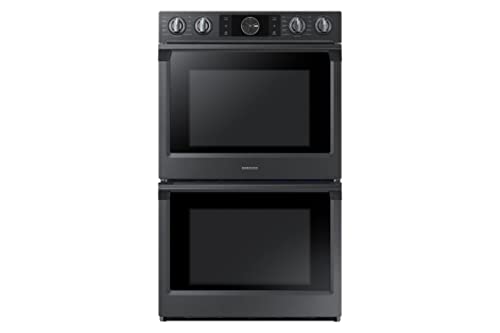
Samsung Flex Duo Double Wall Oven — One cavity, two zones
The Flex Duo — model NV51K7770DG/AA — is the cleverest architecture in this guide. Its listing states the Flex Duo system alongside steam cook and Wi-Fi in a large-capacity double format, and Flex Duo is Samsung’s answer to the double oven’s one inefficiency: the days when you need two temperatures but only one dish each, and heating two full cavities feels like burning money to warm air. The Flex Duo idea divides a cavity into zones, so a single space can behave as two — the small roast at its temperature, the gratin at its own — while the second full cavity waits for the days that genuinely need it.
That makes this the efficiency flagship as much as the flexibility one: three effective cooking spaces in a two-cavity column, each sized closer to the meal being cooked. Add the steam cook it shares with its sibling and the same Wi-Fi connectivity, and the Flex Duo reads as the pick for the household whose cooking varies wildly in scale — Tuesday for two, Saturday for ten — and wants one appliance that reshapes itself to the day. The sibling comparison is the decision: the plain steam model is the simpler instrument; this one is the shape-shifter, and households should choose by how honestly variable their cooking really is.
- Nominal width: 30 inches, smart double wall oven
- Flexibility: Flex Duo dividing system per its listing
- Steam: steam cook as listed
- Connectivity: Wi-Fi from the listing
- Capacity: described in the listing as large oven capacity
- Finish: fingerprint resistant stainless steel, black
- Model: NV51K7770DG/AA per the listing
- Where to buy: the Samsung Flex Duo double oven listing on Amazon — check price on Amazon
Strengths
- Flex Duo zoning makes one footprint behave as up to three cooking spaces.
- Steam cook and Wi-Fi match its sibling’s flagship credentials.
- Zone cooking suits variable households better than any fixed format.
Trade-offs
- A divided cavity is two small spaces, not one large one, while the divider is in.
- The system’s flexibility is wasted on households whose cooking never varies.
- More architecture means more to learn before the oven feels familiar.
Best for: households whose cooking swings between intimate and enormous, sometimes in the same week.
A weak match for: cooks who want two plain, full cavities and nothing cleverer.

Rangaire RWOD301GS Double Wall Oven — The quiet insurgent
Every premium field needs one entrant that asks why the famous names should have it all, and here it is the Rangaire RWOD301GS. Read its stated specification without the badge and it belongs in this company on merit: a 30-inch electric double wall oven with glass touch controls, true convection, self cleaning, and easy reach racks. True convection is the tier’s core technology and Rangaire states it outright; self-cleaning across two cavities is the tier’s core convenience and it states that too. The easy reach racks are the detail of a maker thinking about the cook’s arms rather than the brochure’s adjectives — racks designed around the lift, in the format where lifts are heaviest.
The glass touch front gives the Rangaire the sleek, handle-forward minimalism that much of the modern premium market has adopted, a different aesthetic wager from ZLINE’s hardware jewelry or Café’s design-series presence. What the insurgent asks of the buyer is a small act of independence: to weigh stated features over inherited reputation, and to accept a younger brand’s service story in exchange for a specification that competes line for line. Households that buy appliances the way they buy tools — by the spec sheet and the feel in the hand — will find this pick the most interesting conversation in the guide.
- Nominal width: 30 inches, electric double wall oven
- Controls: glass touch controls as the listing states
- Convection: true convection from the listing itself
- Cleaning: self cleaning in the listing’s own words
- Racks: easy reach racks per its listing
- Model: RWOD301GS as listed
- Finish: stainless steel
- Where to buy: the Rangaire RWOD301GS listing on Amazon — check price on Amazon
Strengths
- True convection and self cleaning stated — the flagship essentials without the famous badge.
- Easy reach racks address the double oven’s heaviest daily task directly.
- Glass touch controls give the column a clean, modern face.
Trade-offs
- No steam, air fry, or Wi-Fi claim appears in the verified listing.
- A challenger brand carries a thinner long-term service story than GE or Samsung.
- Design-series presence is not its game; its face is deliberately quiet.
Best for: specification-led buyers happy to trade badge heritage for stated flagship features.
Weakest fit: households that want steam or app connectivity as part of the premium package.
Six Flagships, One Feature Ledger
| Model | Signature stated feature | Convection claim | Cleaning | Connectivity |
|---|---|---|---|---|
| ZLINE Autograph Edition Double Wall Oven | Air fry; polished nickel helix handles | Professional true convection | Self clean | Not stated |
| Samsung 30-Inch Smart Double Wall Oven With Steam Cook | Steam cook | Not specified in title | Not stated | Wi-Fi |
| GE Profile PTD9000 Double Wall Oven | 10 cu. ft. total; precision cooking modes; 7-inch touch display | True European convection with direct air | Not stated | Not stated |
| Café Professional Series Double Wall Oven | Professional Series standing | Convection stated | Not stated | Smart |
| Samsung Flex Duo Double Wall Oven | Flex Duo zoning; steam cook | Not specified in title | Not stated | Wi-Fi |
| Rangaire RWOD301GS Double Wall Oven | Easy reach racks; glass touch controls | True convection | Self cleaning | Not stated |
The ledger’s gaps are as instructive as its entries. No single oven states everything — steam lives with Samsung, capacity’s biggest number with GE, air fry with ZLINE, rack ergonomics with Rangaire, series standing with Café — which is why the premium decision is a choice of philosophy, not a coronation.
What Does the Second Cavity Actually Change About Cooking?
Everything about timing. A single oven imposes a queue: dishes wait for the cavity, temperatures compromise toward each other, and the cook becomes a scheduler. Two cavities abolish the queue. The roast rests in one while the gratin browns in the other; the bread proofs low while dinner roasts high; the holiday’s five dishes stop negotiating for one thermostat. Cooks who have lived with a double describe the change less as capacity than as calm — the meal stops being a logistics exercise and becomes cooking again.
The second cavity also changes ordinary weeks, which is where it must justify itself. Two weeknight dishes at genuinely different temperatures — fish above, potatoes below — stop requiring the compromise temperature that served neither. A small meal can use one cavity while the other stays cold and clean. The premium format’s real product is not space; it is the end of sequencing, and households should buy it when sequencing is the pain they actually feel. Households whose cooking is one dish at a time will find the second cavity an expensive cupboard, and the honesty of this guide requires saying so at the flagship table itself.
Steam, Zones, Air Fry — Which Signature Feature Fits Your Cooking?
Steam belongs to bakers and to anyone whose roasts dry out in defiance of every brine. The two Samsung models carry it, and the choice between them is the guide’s neatest fork: the same steam idea, with or without the Flex Duo’s dividing trick. Zones belong to variable households — the Flex Duo’s divided cavity is a third oven that appears when needed and vanishes when not, and its value scales with how wildly your cooking swings in size. Air fry, stated by the ZLINE, belongs to households that crisp constantly and would rather do it on a full tray than in a countertop basket’s shifts.
Notice what kind of features these are: none of them photographs. They are capabilities that show up in the food and in the cook’s evening, not in the showroom’s light. That is the premium tier’s mature form — the money, wherever it goes, buying technique. The same instinct for capability over costume guides the efficiency conversation in Best Energy-Saving Dishwashers, where the flagship question is asked about water and watts instead of steam and zones.
How Should You Plan a Column Around a Double Oven?
A double oven is the tallest citizen of the cooking wall, and the column must be planned as its home rather than its hole. The cutout is taller, the electrical appetite is larger, and the unit’s weight demands cabinetry that was expecting it. Measure the full column you can surrender, confirm the circuit with the same rigor the compact guides teach, and think about what lives above and below: a double leaves no room in its column for the microwave, which must find its own home — a fact that has redesigned more kitchens than any feature list.
Ergonomics deserve a paragraph of their own at this size. In a double, one cavity will sit low and the other high, and neither is at the perfect height a single oven enjoys. The lower cavity’s floor-level lifts are where easy reach racks — Rangaire’s stated specialty — stop sounding like a brochure line. The upper cavity’s height is where door swing and steam venting meet the cook’s face, and where a household’s shorter members should be consulted before the column height is fixed. Plan the wall around the bodies that will use it, and the flagship will feel like one.
Where Do Premium Buyers Most Often Misjudge?
The classic error is buying the tier for the room’s photograph and the cooking of a different household — steam for a family that never bakes, zones for a cook whose meals never vary, a second cavity for a table of two. The second error is the mirror image: dismissing the tier as vanity when the household’s feasts genuinely strain a single oven every month. Both errors come from shopping the idea of the appliance instead of the diary of the kitchen, and the cure is a month of honest notes about what your current oven was asked to do.
The third error is feature-count gambling — assuming the longest list wins, when the ledger above shows every flagship specializing. The fourth is neglecting the unglamorous half of premium ownership: two cavities to keep clean, steam reservoirs to maintain where fitted, and connected features that only pay rent when the household actually connects them. The same discipline — match the machine to the life actually lived, in every category and at every tier — governs the whole kitchen’s purchases, and it scales down as gracefully as it scales up, as the compact end of the market shows in Best Dishwashers for RVs.
What Does an Ordinary Week Look Like With Two Cavities?
Flagships are bought at holidays and lived with on Tuesdays, so the Tuesday audit matters. The ordinary miracle of the double is not the feast; it is the unremarkable evening when garlic bread needs five fierce minutes while the casserole holds at a gentle heat below, and nobody performs the hot-plate shuffle on the counter. It is the frozen pizza that no longer evicts the roasting vegetables. It is baking a tray of cookies in the upper cavity while dinner occupies the lower, because dessert stopped being a scheduling negotiation. Households report that the second cavity’s deepest effect is psychological: the oven stops being a bottleneck the cook plans around and becomes a space the cook plans within.
The honest Tuesday costs deserve their sentence too. Two cavities present two interiors to keep clean, though self-cleaning — stated by the ZLINE and the Rangaire — converts that chore into a cycle and a wipe. A large double also heats a large face of cabinetry’s worth of kitchen on a summer evening when only one small dish is cooking, which is where the Flex Duo’s zoning earns a second look from small-meal households: the divided cavity is the flagship’s answer to its own excess, a small oven conjured inside the large one. Judge the format by your calendar’s ratio of feasts to Tuesdays, and choose the architecture whose ordinary week matches yours.
How Do the Convection Claims in This Field Actually Differ?
Convection is the word every flagship uses and no two use identically, so the listings’ exact phrasings are worth reading like contracts. ZLINE claims professional true convection. Rangaire claims true convection. GE specifies true European convection with direct air — the most articulated claim in the field, describing both the architecture and the delivery. Café states convection without ornament. The two Samsungs build their headlines on steam and zoning instead, leaving their convection story to their documentation. True convection, in the industry’s settled usage, means a heating element works with the fan so the moving air is itself heated, evening the cavity far better than a fan merely stirring the oven’s ambient heat.
For the buyer, the translation is practical. Where true convection is stated, multi-rack baking — the double oven’s signature party trick, trays on several levels at once — is the capability being promised, and it is the first thing to test in the oven’s first month. Where the claim is plainer, single-rack excellence is the safer expectation. None of this ranks the ovens by itself, because steam and zoning are convection-independent virtues; it simply tells each buyer which promise they are actually holding, in the manufacturer’s own words, rather than in the category’s general glow.
Are Smart Features Substance or Decoration at This Tier?
Wi-Fi is stated by both Samsung models and smart standing by the Café, and the honest evaluation depends on which of two households you are. For the connected household — phones already running the lights, the thermostat, the doorbell — an oven that preheats from the car and announces itself done is a genuine extension of a working system, and the feature will be used weekly. For the household that has declined every other smart appliance, the same radios will sit unconfigured for a decade, and the ovens should be chosen as if the feature were absent — which, in the Samsungs’ case, still leaves steam and zoning standing on their own merits.
The deeper point is that connectivity is the only flagship feature whose value the buyer, not the oven, determines. Steam steams regardless of philosophy. A divided cavity divides for the skeptic and the enthusiast alike. But a smart oven in an unconnected home is a conventional oven with a longer manual, and premium buying done honestly prices it that way. Choose the connected picks for their cooking systems first, and let the Wi-Fi be the bonus it honestly is.
What Does Ownership Ask of You at This Level?
Premium ovens repay a small amount of deliberate care. Steam models ask for their water routine — reservoirs filled, emptied, and occasionally descaled, a rhythm measured in minutes that keeps the signature feature performing like one. Self-cleaning models ask for the cycle to be run as maintenance rather than as emergency, and for racks to be treated as the manufacturer directs around it. Touch interfaces ask for clean hands and soft cloths. None of this is servitude; it is the ordinary housekeeping of capable machines, and it is lighter, hour for hour, than the workarounds these ovens replace — the spray bottles, the Dutch oven shuffles, the single-cavity scheduling that used to run the kitchen’s evenings.
Documentation is the other ownership habit, and at this tier it matters more because the machines will outlast several phones and possibly a car. Keep the model numbers, the installation measurements, and the electrical particulars with the house papers. A flagship double is a fifteen-year resident; the household that treats its paperwork as part of the appliance will find every future service visit shorter, cheaper in time, and strangely more pleasant.
When Should a Premium Shopper Deliberately Step Down a Tier?
When the honest diary says so. If a month of notes shows one dish at a time, one temperature at a time, and holidays hosted elsewhere, the flagship’s capabilities are a theater ticket to a play your kitchen never stages — and the mid-range single ovens elsewhere in this series will cook your actual life beautifully. If the second cavity would mostly store the roasting pan, it has already told you its destiny. Stepping down is not settling; it is the same fit-first discipline that makes the flagship buyers in this guide so confident, applied at a different altitude.
Step down also when the column argues against you — when the kitchen cannot give a double its height without a remodel nobody wants, or when the electrical service would need a saga of upgrades to feed one. The premium tier will still be there, in the next kitchen or the next renovation, and an excellent single oven installed cleanly now beats a flagship forced into a wall that resents it. Buy the oven your kitchen and your calendar agree on; at every tier, that agreement is the whole definition of high-end.
How Does a Flagship Double Change the Rest of the Kitchen Around It?
A double oven evicts the microwave from the column, and that single eviction reorganizes the room. The microwave must land somewhere — a drawer unit below a counter, a shelf in a pantry, a dedicated nook — and each landing has its own cost in cabinetry and habit. The range, meanwhile, is freed from oven duty entirely in a wall-oven kitchen, which is why these columns so often pair with a cooktop rather than a full range: the wall takes the baking, the counter takes the burners, and the kitchen’s two cooking stations can be used by two cooks without negotiation. Planning a flagship purchase is therefore planning a small ecosystem, and the households happiest with their doubles are the ones who drew the whole wall, not just the oven’s rectangle, before ordering.
The double also changes the kitchen’s social geometry. Two cavities at two heights invite division of labor — one cook on the roast below, another on the gratin above — in a way a single oven never does. During feasts the wall becomes a station two people can work in parallel, and the host stops performing the solo traffic control that used to define the hour before dinner. It is an unlisted feature, present in every pick in this guide, and for entertaining households it may be the most valuable one here.
What Should the First Month With a New Flagship Teach You?
Deliberate calibration. Cook the dishes you know best in the new cavities and watch what the oven does to them: where the browning runs ahead, which rack level tells the truth, how the steam setting changes your standard loaf, how the divided zone handles the Tuesday two-temperature problem. Flagship ovens are instruments with personalities, and the first month is when the household learns its particular one. Keep notes without embarrassment — professional kitchens do — because the second holiday will be cooked from the first one’s lessons.
Test the signature feature early, while the purchase is fresh and support is attentive. Steam users should bake the loaf that justifies the reservoir. Flex Duo households should run the divided cavity through a real weeknight, not a demonstration. Air fry should meet the household’s actual frozen repertoire. A flagship whose headline feature turns out to be a stranger is a conversation to have in month one, not year three — and in practice, the features that survive the first month’s testing become the ones the oven is loved for in year ten.
Why Does This Guide Refuse to Talk About Money at All?
Because the premium question, asked honestly, is about fit between capability and cooking — and price talk corrupts that question in both directions. A costly oven is not thereby capable, and a capable oven is not thereby a bargain; the two conversations share a checkout and nothing else. By judging the six verified flagships strictly on the features their listings state — steam, zoning, capacity, convection architecture, guided modes, rack design — this guide leaves every reader with the only comparison that survives contact with their own kitchen: which of these capabilities will your cooking actually use, weekly, for a decade?
That refusal has a second benefit: it makes the guide durable. Listings change, lines are refreshed, and yesterday’s flagship specification becomes tomorrow’s standard — but a reader who learned to ask which capability fits their calendar can evaluate any successor model in minutes. The ovens above are this season’s verified answers. The method is the permanent part, and it is yours to keep.
How Do You Compare Two Flagships When Both State Everything You Want?
Ties at this tier are broken by the second-order truths. Which maker’s service network reaches your town with the shortest wait? Which interface — GE’s large touch display, Rangaire’s glass touch front, Samsung’s connected panel — matches the hands that will use it daily, including the household member least patient with technology? Which cavity arrangement puts the more-used oven at the kinder height? And which finish composes with the room you actually have, rather than the room in the brochure? None of these questions appears on a specification sheet, and together they decide more decade-long satisfaction than any single feature does.
There is also the household vote, which premium purchases sometimes skip and always regret. The cook who will live in front of the column should stand in front of the finalists’ photographs — or better, their showroom selves — and reach for the controls in imagination. A flagship is touched thousands of times. The one whose handles, display, and doors feel like they were designed for your family’s hands is not the sentimental choice; it is the ergonomic one, and ergonomics is just satisfaction measured in advance.
What Separates a Flagship Kitchen From a Kitchen With a Flagship Oven?
Intention, distributed evenly. A flagship oven dropped into an accidental kitchen performs like a concert piano in a hallway — capable, admired, and slightly stranded. The kitchens that honor these ovens share small coherences: lighting that reaches into the cavities’ neighborhood, a landing surface within a pan’s travel of the column, ventilation that keeps pace with two cavities running at feast temperature. None of it requires luxury elsewhere; it requires the wall to be thought of as a workstation whose centerpiece happens to be magnificent.
That is the final premium truth this guide can offer: the oven is the largest single decision, not the only one. Buy the flagship your cooking justifies, then give it the few feet of considered kitchen it deserves, and the combination will out-cook and out-last combinations costing far more in scattered upgrades. High-end, in the end, is a property of the whole arrangement — the oven is simply where it is easiest to see.
What Role Does the Display Play in a Flagship’s Daily Temperament?
Two of this field’s interfaces deserve a buyer’s pause. GE’s stated 7-inch touch display is large enough to present guided cooking as a conversation rather than a code, and in a double oven — where two cavities’ states must be readable at a glance from across the kitchen — screen size is a safety feature as much as a convenience. Rangaire’s glass touch front takes the opposite aesthetic path, dissolving the controls into the surface so the column reads as one calm plane. Both philosophies beat the cramped keypad era they replace, and the choice between them is a choice about how the household likes its information: presented generously, or presented quietly.
Underneath the glass, what matters is legibility at the two moments that count — setting a temperature with wet hands, and checking two cavities’ progress with a pan in each. Whichever finalist you favor, audition those two moments before the order. A flagship’s interface is its handshake, repeated daily for a decade, and a handshake that annoys will be remembered long after the steam settings blur into habit.
Final Recommendation
Choose the GE Profile if your premium is measured in cubic feet and repeatable feasts; choose a Samsung if steam is the technique your cooking has been waiting for, and let the Flex Duo question — how variable is your household, really — decide which Samsung. Choose the ZLINE if air fry at full scale and hardware with presence speak your kitchen’s language, the Café if the room is being designed and the series is the point, and the Rangaire if you buy by the ledger and like what it totals. A flagship double oven is the rare appliance that should be chosen like a philosophy, because for the next decade your dinners will be cooked inside whichever one you pick.
Frequently Asked Questions
What makes a wall oven high-end if not its price?
Capability that lesser formats cannot offer: a second full cavity, steam injection, a dividing zone system, precision guided cooking, or a convection architecture specified beyond the ordinary. This guide argues premium status only from features the listings themselves state.
Is a double oven worth it for a household of two?
Only if the two cook like a household of six on a schedule. The second cavity earns its keep through simultaneous two-temperature cooking; small households that rarely do that are better served by an excellent single oven and the money kept for other tools.
What does steam cook actually do for bread?
Moisture in the early bake keeps the crust supple while the loaf expands, then lets it set into the blistered, glossy finish bakers chase with Dutch ovens and ice cubes. Built-in steam turns that workaround into a setting, which is why both Samsung picks headline it.
How is Flex Duo different from simply having two cavities?
A double oven’s cavities are fixed sizes. Flex Duo lets one cavity divide into two zones at different temperatures, so the column can present three cooking spaces of flexible size — the answer for households whose meals swing between small and enormous.
Does the Café pick lack features the others have?
Its verified listing is simply terser: smart, convection, double, Professional Series. Specialty claims like steam are not stated in its title, so this guide does not assert them; the model’s full documentation is the place to confirm its complete specification.
Will a double oven fit the column my single oven occupies?
Almost never without cabinet work — a double needs a substantially taller opening. Measure the full column you can give it, and treat the answer as the first fact of the purchase, before any feature comparison begins.
How long should a flagship double oven remain satisfying?
These are decade-plus appliances, and their satisfaction curve depends on the match made at purchase. A double whose signature features fit the household’s real calendar stays delightful for its whole service life; one bought for an imagined cooking life begins to feel oversized within a year. The first month’s honest testing, described above, is the best predictor of the tenth year’s contentment.
Should the upper or lower cavity be the one used daily?
Households settle this by height and habit: the cavity at the kinder lifting height becomes the daily driver, and the other becomes the feast and overflow cavity. When you plan the column, put the configuration you will use every day where your body wants it, and let the holidays climb or stoop — they are rarer, and adrenaline is a fine ergonomic aid twice a year.
Do flagship ovens hold their appeal when cooking fashions change?
The durable ones do, because their signatures are techniques rather than trends. Steam, even convection, flexible zoning, and honest capacity were valuable thirty years ago and will be valuable in thirty more. Fashions move through finishes and interfaces; the cooking physics underneath them barely moves at all, which is why this guide judged the field on physics.
Related Guides
Steam is the thread that runs from this flagship class down to a dedicated category of its own, and readers whose interest in these ovens began with steam should follow it. Our guide to Best Home Steam Ovens covers the specialist machines, from countertop units to built-ins, for cooks who want the technique without the double-oven commitment.


