What's inside
- Where to Buy an Energy-Saving Dishwasher, and Why the Verified Low-Energy End Is Compact
- Key Takeaways
- Quick Picks
- How Did We Decide Which Machines Count as Energy-Saving Here?
- The Designated Field, Compared
- Where Does a Dishwasher’s Energy Actually Go?
- How Much of the Saving Is the Machine, and How Much Is You?
- How Do Tariffs, Solar and Water Heaters Join the Calculation?
- What Does Standby, Half-Load and Other Small Leaks Add Up To?
- How Should Renters and Students Read This Guide?
- What Happens to Efficiency as a Machine Ages?
- Saving-Energy Mistakes That Cost More Than the Machine
- How Do You Audit Your Own Kitchen Before Believing Any Badge?
- What Is the Efficient Answer for the Holiday House and the Second Kitchen?
- How Does Water Temperature From the Tap Change the Machine’s Work?
- How Should a Household Phase In the Saving Habits Without a Revolt?
- What Does This Guide Refuse to Claim, and Why Does That Matter?
- How Do the Five Linked Machines Divide the Small-Household Map?
- What Should Be Measured at the Listing Before Any of These Is Ordered?
- A Short History of Why Dishwashers Became the Efficient Option at All
- What About the Water Itself — Is Saving It the Same Fight?
- Final Recommendation
- Frequently Asked Questions
- Related Guides
As an Amazon Associate I earn from qualifying purchases. This post may contain affiliate links at no extra cost to you.
cottageverdict.com is reader-supported. When you buy through links on our site, we may earn an affiliate commission.
Where to Buy an Energy-Saving Dishwasher, and Why the Verified Low-Energy End Is Compact
The best energy-saving dishwashers begin with a physical truth that no badge can repeal: a small tub heats less water, moves less water and dries a smaller room of air than a big one, so the verified low-energy end of the market tilts compact. That is why this guide’s linked picks are countertop and portable machines whose titles carry the Energy Star designation outright, plus one class-level discussion of the built-in Energy Star field for households whose loads demand a full-size tub. The tilt is stated plainly here, in the introduction, rather than discovered sheepishly at the end: if your household washes small loads, the efficient machine is a small machine, and the five linked picks below are its verified representatives.
The discipline of this guide is strict about the words Energy Star: the designation is claimed only where a listing title states it. All five linked titles state it — two countertop machines from COMFEE’ and Midea, two from BLACK+DECKER in countertop and portable forms, and an SPT countertop with a delay start and LED display. No gallons-per-cycle figure appears anywhere in this article, because no title in the pool states one, and an energy guide that invents its central statistic would be a fraud in a green frame. What the guide can do — and does — is explain where a dishwasher’s energy actually goes, so readers can judge any machine, linked or not, by physics rather than by poetry.
Each linked name opens its Amazon listing, where you can check price on Amazon and confirm dimensions and full specifications. No prices and no fixed ratings appear here; efficiency is a property of your loads and your habits as much as of the machine, and the guide treats it that way throughout.
Key Takeaways
- Every linked pick states Energy Star in its own title; the designation is claimed nowhere else in this guide.
- Small tubs use less water and energy per load — the honest reason the verified efficient end is compact.
- Four of the five linked machines are countertop or portable; the built-in Energy Star class is covered at class level.
- Delay start, where titled, lets a load run when your tariff or your solar panels say so.
- Capacity discipline beats badge shopping: a full compact out-saves a half-empty giant.
- Capacity-first households should read Best Large-Capacity Dishwashers alongside this guide and weigh the trade openly.
Quick Picks
| Pick | Badge | Why it stands out |
|---|---|---|
| COMFEE’ Countertop Dishwasher (Energy Star) | Eight Programs, ECO Aboard | Energy Star portable with six settings, eight programs and a named ECO cycle. |
| Midea Countertop Dishwasher (Energy Star) | Quiet Compact, 52 dB | Six settings, a 6+2 cycle set and a titled noise figure for small spaces. |
| BLACK+DECKER BCD6W Countertop Dishwasher | Delay-Start Saver | Energy Star Certified in the title, seven programs and a 24-hour delayed start. |
| SPT SD-2225DWA Countertop Dishwasher | LED, Delay, Designation | Energy Star in the title with delay start and an LED display, in white. |
| BLACK+DECKER BPD8B 18-Inch Portable Dishwasher | Portable Eight Settings | The set’s largest linked capacity in a mobile 18-inch frame with a steel tub. |
| The built-in Energy Star class (class discussion) | Full-Size Efficient Route | What to verify when a family’s loads demand a plumbed-in machine. |
How Did We Decide Which Machines Count as Energy-Saving Here?
One rule governed admission: the words Energy Star had to appear in the manufacturer’s own listing title. That rule is stricter than the market’s habits — plenty of efficient machines are sold with the designation buried in a specification PDF, and plenty of inefficient ones borrow green language without any designation at all — but a guide’s job is verification, and a title is what can be verified from the pool this article stands on. Machines meeting the rule formed the linked set; the built-in class, where designations certainly exist but no built-in listing was verified for this guide, is discussed at class level with the checks a buyer should run.
The second screen was shape. The pool’s verified designated machines were compact — countertops and a portable — and rather than apologising for that, the guide makes it the article’s thesis: per-load consumption scales with tub size, so the efficient frontier for small households genuinely is small. The counterweight is stated wherever it matters: a compact run three times to clear a family’s day can spend more than a full-size machine run once, which is why the class discussion exists and why the families guide on this site should be read alongside this one by larger households.
Features were credited only where titled: the COMFEE’ ECO program, the BLACK+DECKER BCD6W’s 24-hour delayed start, the Midea’s 52 dB, the SPT’s LED and delay. Where a title is silent — most are silent about water consumption — the guide explains the physics that would decide the question instead of filling the silence with a number.
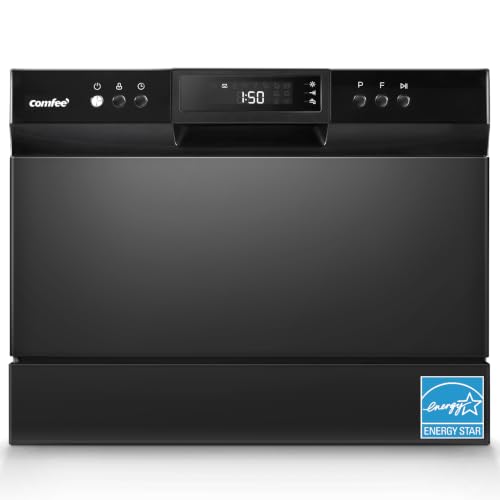
COMFEE’ Countertop Dishwasher (Energy Star) — Eight Programs, ECO Aboard
The COMFEE’ leads the set because its title does the most verifiable work: Energy Star, portable, six place settings, eight washing programs — and among the named programs, an ECO cycle stated outright, alongside Speed, Baby-Care and Glass. An ECO programme is the efficiency feature a household actually operates: a longer, cooler wash that trades time for heat, which is the correct trade in a machine whose water volume is already small. Naming it in the title lets this guide say, with evidence, that the machine’s efficiency is a designed behaviour and not merely a test-cycle result.
COMFEE’ has become one of the countertop category’s defining names by treating the format as a real appliance class rather than a novelty, and this model shows the maturity: a programme list that includes the cycles small households genuinely rotate — the quick turnaround, the gentle glass run, the careful baby-care wash — rather than a dial of duplicates. In an efficiency guide the point is sharper than convenience: a machine with the right programme gets run on it, and a machine without it gets run on the wrong one, at the wrong temperature, for years.
Six place settings at countertop scale describes the guide’s core reader precisely: the dorm, the small flat, the couple’s kitchen, the office. Eight programs across that small tub is a generous repertoire — the baby-care cycle serving young parents, the glass cycle serving anyone whose stemware has survived too many sink accidents. The black finish suits the modern small kitchen it will sit in, visible on the counter as all countertop machines are, which makes its looks a legitimate part of the specification rather than a vanity.
Efficiency in this format has a rhythm worth learning: run it full, run it on ECO when the soil allows, and let the small tub’s physics do the rest. A countertop machine’s per-load appetite is modest by construction; the household that pairs it with full loads owns one of the lowest per-plate washing costs available in the category, stated qualitatively because that is how honest guides state it.
- Format: countertop portable, black
- Designation: Energy Star, per the listing title
- Capacity: 6 place settings
- Programs: 8 washing programs, including ECO, Speed, Baby-Care and Glass
- Audiences named in title: dorm, RV and apartment
- Where to buy: the COMFEE’ Countertop Dishwasher listing on Amazon — check price on Amazon
Strengths
- A named ECO cycle makes efficiency an operating choice.
- The widest program repertoire among the countertops here.
- Designation and capacity both stated plainly in the title.
Trade-offs
- Six settings caps the household size it can serve.
- ECO cycles run long — the time-for-heat trade is real.
- Countertop permanence costs work surface daily.
Best for: small households that will actually use the ECO programme as their default.
Not suited for: families, whose loads would multiply its cycles past any saving.

Midea Countertop Dishwasher (Energy Star) — Quiet Compact, 52 dB
Midea’s countertop entry pairs its Energy Star title with the set’s only countertop noise figure: 52 dB, described in the title as quiet and compact. In a studio or a small flat, where the dishwasher shares air with the bed and the desk, that figure is an efficiency of a different kind — the machine can run at hours when a louder one would be postponed, and postponed loads become hand-washed loads, which spend more hot water than any programme in this guide. Quiet, in small spaces, is an energy feature by the back door.
There is a small-space subtlety in the Midea’s favour that deserves stating: in a studio, the dishwasher is also a piece of furniture in the room where the household sleeps, studies and entertains, and a silver, quiet, compact machine earns its counter the way a good lamp earns its table. Appliances that offend get used less, and a machine used less gets replaced by the sink — the least efficient outcome in this entire article. Likeability is an efficiency feature in small homes, however unscientific that sounds to a specification sheet.
The title’s cycle arithmetic — 6+2 cycles — suggests a core repertoire plus two additions, and six place settings matches the COMFEE’ at the format’s standard capacity. Silver is the finish, a neutral choice for a machine that will live visibly on a counter among other appliances. Midea’s manufacturing scale, noted in this site’s top-control guide as the mainstream centre’s quiet argument, stands behind the badge: this is a high-volume design whose weaknesses have had every opportunity to be found.
Choose between this and the COMFEE’ by your room’s priorities: the COMFEE’ sells the programme list and the named ECO; the Midea sells the decibel and the silver calm. Both carry the designation in the title, both wash six settings, and both will out-save any full-size machine run at their scale of load. The difference is which small-space virtue your flat needs more.
- Format: countertop portable, silver
- Designation: Energy Star, per the listing title
- Capacity: 6 place settings
- Cycles: 6+2 cycles, per the listing title
- Noise: 52 dB, per the listing title
- Where to buy: the Midea Countertop Dishwasher listing on Amazon — check price on Amazon
Strengths
- A titled noise figure, rare honesty in the countertop class.
- Designation plus compact scale for studio living.
- A mainstream maker’s mature, high-volume design.
Trade-offs
- No named ECO programme in the title to lean on.
- 52 dB is quiet for the format, not silent in absolute terms.
- Six settings, again, is a small household’s ceiling.
Suits best: studio and flat dwellers who run the machine within earshot of everything.
A poor fit for: anyone needing a programme menu longer than the week.
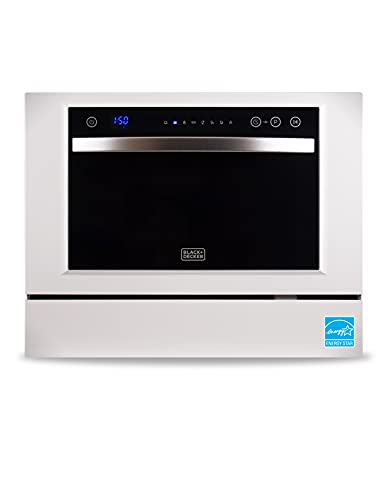
BLACK+DECKER BCD6W Countertop Dishwasher — Delay-Start Saver
The BCD6W’s title carries its designation in the full form — Energy Star Certified — and adds the feature this guide most wants to talk about: a 24-hour delayed start. Delay is the tariff feature. Households on time-of-use pricing, households with rooftop solar, households whose water heater recovers overnight — all of them can move a wash to the hour when energy is cheapest or greenest, and a 24-hour window means the machine can be loaded at breakfast and run at midnight without a second touch. Efficiency, in a connected grid, is increasingly about when, and this countertop is the pick that treats timing as a first-class feature.
Think about the household rhythm the delay creates at its best: dinner’s load is stacked by nine, the machine waits in the dark, and at the tariff’s cheapest hour it washes a sleeping house’s dishes with nobody awake to hear it. The morning begins with clean plates and a bill that quietly shrank. Multiply that small, smug morning by a year and the BCD6W’s owners understand their machine the way sailors understand a tide table — as a rhythm the household is timed to, profitably.
Seven wash programs and a six-place-setting capacity fill out a specification that matches the format’s mainstream: enough repertoire for glassware evenings and pot evenings, enough room for a couple’s day. The white finish is the classic countertop choice, bright in small kitchens. BLACK+DECKER appears twice in this guide’s linked set — here and in the portable below — which lets a buyer stay inside one brand’s service world across two formats if the household’s needs change shape.
Practically, the delay feature also disciplines loading: a machine set to run at a fixed hour becomes a deadline the household loads toward, and loads that are planned are loads that are full. The BCD6W’s saving is therefore partly behavioural — it turns efficiency into a routine rather than a resolution — and routines outlast resolutions by years.
- Format: countertop, white
- Designation: Energy Star Certified, per the listing title
- Capacity: 6-place setting capacity
- Programs: 7 wash programs
- Timing: 24-hour delayed start
- Where to buy: the BLACK+DECKER BCD6W listing on Amazon — check price on Amazon
Strengths
- Delayed start converts tariffs and sunshine into savings.
- Full certification wording stated in the title.
- Seven programs covers the small household’s whole week.
Trade-offs
- Delay helps only households whose pricing or solar rewards it.
- Six settings remains the countertop ceiling.
- White shows a busy kitchen’s splashes more than darker finishes.
Ideal for: households on time-of-use tariffs or with solar to spend at noon.
Not the right match for: households whose pricing is flat and whose loads cannot wait.

SPT SD-2225DWA Countertop Dishwasher — LED, Delay, Designation
SPT’s countertop entry states the essentials in a single breath: Energy Star, a delay start, an LED display, white. The delay start earns it a place beside the BCD6W in the timing conversation — two machines in this set can be told when to wash — while the LED display is the usability line: in a format where controls are often minimal dials, a legible display tells the small household what the machine thinks it is doing, and a machine whose state is legible gets run on the right programme more often. Right programmes are efficiency in practice; wrong ones are the same load washed twice.
SPT’s presence in both this guide and the stainless-tub one is a small lesson in how to read a catalogue: the same maker’s countertop here is bought for its designation and delay, its built-in there for its tall steel tub, and neither purchase borrows the other’s virtues. Households building a kitchen across several of this batch’s guides will meet the pattern repeatedly — a brand is a service network and a design language, while the specification lives model by model, title by title.
The title gives no capacity figure, and this guide gives none either — the listing itself carries the full specification, and readers should confirm the settings count there before ordering, as with every quiet title in this batch of guides. What can be said from the title is the shape of the offer: a designated countertop with timing control and a display, from a maker whose built-in machines appear elsewhere in this batch with their own designations stated.
Consider this the set’s straightforward designated option: no named ECO to discuss, no decibel to compare, just the certification in the title and the two features — delay and display — that most change daily use. Households cross-shopping it against the COMFEE’ or Midea should decide by which titled extras they will actually operate: the programme, the quiet, or the timing.
- Format: countertop, white
- Designation: Energy Star, per the listing title
- Timing: delay start
- Display: LED, per the listing title
- Capacity: not stated in the title — confirm on the listing
- Where to buy: the SPT SD-2225DWA listing on Amazon — check price on Amazon
Strengths
- Designation and delay start stated together in the title.
- An LED display keeps programmes legible and mistakes rare.
- White countertop format suits bright small kitchens.
Trade-offs
- The title leaves capacity for the buyer to verify.
- No noise figure for the small-space comparison.
- Fewer titled talking points than its countertop rivals.
Pick it for: a designated countertop with timing control and a clear display.
Poorly suited to: buyers who want every number in the title before they click.
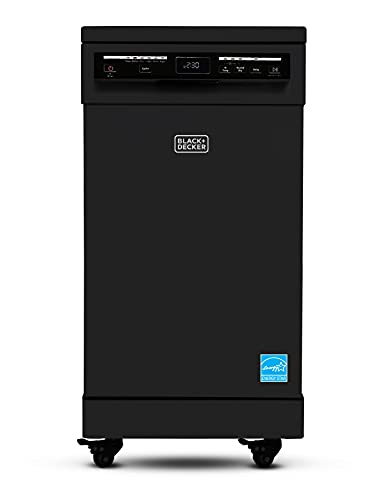
BLACK+DECKER BPD8B 18-Inch Portable Dishwasher — Portable Eight Settings
The BPD8B is the bridge machine of this guide: an 18-inch portable with eight-place-setting capacity, six wash programs, an LED display, a stainless steel tub and the Energy Star designation in its title. Portable here means the freestanding, roll-to-the-sink format — a machine that serves kitchens with floor space but no cabinet slot, connecting for the wash and wheeling away after. For renters in houses with generous kitchens and ungenerous landlords, it is the largest efficient answer that asks nothing of the cabinetry.
The portable format has one more efficiency trick the built-ins cannot copy: it can be retired from the kitchen entirely. In a small house where the machine serves a weekly rhythm rather than a daily one, the BPD8B parks in a utility corner and the kitchen breathes between washes — no standby display in the room, no permanent claim on the cabinet run. Appliances that can leave are a category of their own, and for households whose washing is episodic, leaving is a feature with a measurable value in space if not in watts.
Eight settings is the capacity where a small family’s day fits in one run, and that single-run property is the machine’s whole efficiency argument at family scale: one eight-setting load through a designated portable spends less than the same dishes split across two countertop cycles. The steel tub, stated in the title, adds the durability and drying virtues this site’s stainless guide examines, in a machine that will be moved, bumped and lived with more physically than any built-in.
Six programs and an LED display complete a specification pitched at the household graduating from countertop scale. Readers whose lives are genuinely mobile — the machine following a household between rentals — will also find its format kin to the tall-glasses and travel end of the category, a world touched again in our guide to Best Dishwashers for Tall Glasses, where rack geometry takes the starring role.
- Format: 18-inch portable, black, mobile
- Designation: Energy Star, per the listing title
- Capacity: 8-place setting capacity
- Programs: 6 wash programs, LED display
- Tub: stainless steel tub, per the listing title
- Where to buy: the BLACK+DECKER BPD8B listing on Amazon — check price on Amazon
Strengths
- The set’s largest linked capacity with the designation attached.
- Steel tub in a machine built to be moved.
- No cabinet work — the renter’s full-size alternative.
Trade-offs
- Needs floor space and a parking spot between washes.
- Hookup-and-wheel routine is a ritual some households tire of.
- Eight settings still will not clear a feast in one run.
Made for: renters and small families who need one-run capacity without cabinetry.
A weak match for: kitchens where floor space is scarcer than counter space.
The Built-In Energy Star Class — Full-Size Efficient Route
The final slot is a class discussion, included because the honest map of efficient dishwashing does not end at the countertop. Built-in machines carrying the Energy Star designation exist across the mainstream — this site’s own families guide includes a linked built-in whose title states the certification — but no built-in listing was verified into this guide’s pool, so the class is covered the way unverified things are covered here: at class level, with the buyer’s checklist rather than a borrowed product.
Shopping the class well means resisting one specific temptation: the oversized designated machine bought because its per-cycle test number looked virtuous. Test cycles are run full, by definition; your kitchen’s cycles will be run at your family’s fullness, which is the number that decides the truth. A class shopper should therefore shop capacity downward until it meets the household’s honest load, then check the designation — in that order, always, because the order is where the saving lives.
The checklist has four lines. Confirm the designation on the specific model’s own listing, not the range’s brochure. Compare the machine’s capacity against your household’s real load, because per-load efficiency only counts when the load is full. Prefer a model whose ECO programme you will genuinely use, and read its length before buying — an eco cycle the household always cancels saves nothing. And weigh the delay start if your tariff rewards timing; in the built-in class the feature is common enough to insist on.
Why does the class matter enough for a slot? Because the countertop thesis of this guide inverts at family scale. A household of six washing in a six-setting machine runs the little tub three times a day, heating three tubs of water; the same household in a designated full-size machine runs once. Efficiency is per plate washed, not per cycle — and at family volume the big designated machine is the frugal one. Readers living that arithmetic should treat this section as the guide’s main door, not its footnote.
- Format: full-size built-in, plumbed, at class level
- Designation: verify Energy Star on the specific model’s listing
- Efficiency logic: per plate washed, at full loads
- Features to insist on: a usable ECO programme, delay start where tariffs reward it
- Availability: appliance and marketplace channels; no listing linked in this guide
- Where to buy: through the model’s own listing — no link is provided for this class in this guide
Strengths
- One full load beats three small ones at family scale.
- The widest model choice of any route in this guide.
- Permanent installation ends the countertop compromises.
Trade-offs
- Requires cabinetry, plumbing and ownership of the kitchen.
- Designations and figures must be verified model by model.
- A half-filled big machine is the least efficient option here.
Strongest for: families whose daily volume makes the compact route false economy.
Weakest fit: small households, for whom the five linked compacts are the efficient frontier.
The Designated Field, Compared
| Machine | Shape | Settings as titled | Efficiency signature |
|---|---|---|---|
| COMFEE’ Countertop Dishwasher (Energy Star) | Countertop | 6 | Named ECO program, 8 programs |
| Midea Countertop Dishwasher (Energy Star) | Countertop | 6 | 52 dB titled quiet |
| BLACK+DECKER BCD6W Countertop Dishwasher | Countertop | 6 | 24-hour delayed start |
| SPT SD-2225DWA Countertop Dishwasher | Countertop | Not stated | Delay start, LED display |
| BLACK+DECKER BPD8B 18-Inch Portable Dishwasher | Portable 18-inch | 8 | One-run capacity, steel tub |
| The built-in Energy Star class | Built-in | Verify per model | Full loads at family scale |
Where Does a Dishwasher’s Energy Actually Go?
Mostly into heat. Heating the wash and rinse water is the dominant spend in any cycle, which is why the variables that matter are water volume and temperature — and why a small tub, heating a small volume, starts with a structural advantage no programme can fully erase from a big one. The pump’s work is the second spend, spray pressure against gravity for an hour; drying is the third, cheap when it is condensation against a cool wall, dearer when a heating element does it actively. A reader who holds those three spends in mind can read any specification — including the ones this guide could not verify — and know which numbers are load-bearing.
Time is the trade the ECO programme makes explicit: a cooler wash needs longer contact to clean equivalently, so efficient cycles are slow cycles. Households that understand the trade stop experiencing it as a flaw. The machine is not dawdling; it is substituting minutes for degrees, and minutes, in an overnight run, are free.
How Much of the Saving Is the Machine, and How Much Is You?
Roughly, the machine sets the floor and the household sets the result. A designated compact run half-empty on its hottest programme can spend more per plate than an undesignated built-in run full on eco — the designation certifies the machine’s potential under a standard load, not the household’s behaviour under real ones. The behaviours that collect the saving are unglamorous: fill the tub, scrape instead of pre-rinsing under a hot tap, choose the programme the soil deserves rather than the strongest one available, and let the delay start move the load to the grid’s generous hours where your pricing allows.
There is a maintenance clause too: a scaled element heats water through its own insulation, and a clogged filter makes the pump labour. The efficient machine kept clean stays efficient; the efficient machine neglected becomes an ordinary one wearing a badge. Households in hard-water areas should read this alongside the descale rhythm — efficiency and water treatment are the same conversation held in different rooms, much as the garage-cold storage of a big efficient kitchen is covered in our guide to Best Garage-Ready Upright Freezers.
How Do Tariffs, Solar and Water Heaters Join the Calculation?
A dishwasher does not buy energy from the grid in the abstract; it buys hot water and electricity at your household’s specific prices, at specific hours. A home whose water is heated by an efficient system starts every cycle ahead of a home heating with an elderly electric tank, whatever machines they own. A home with rooftop solar owns a midday surplus that a delay-start machine can be told to drink. A home on a time-of-use tariff owns cheap hours that exist only for appliances patient enough to wait for them — and in this guide, patience is a titled feature on two of the five linked machines.
The practical exercise takes ten minutes: read your tariff, note your water heater’s fuel, and look at your roof. Those three facts rank the picks above more decisively than any comparison table, because they decide whether the BCD6W’s delay is worth money or merely charm, and whether your household’s efficient frontier is a countertop at noon or a built-in at midnight.
What Does Standby, Half-Load and Other Small Leaks Add Up To?
The leaks are worth naming because they are the difference between two households owning the same machine. Standby draw — the display and board sipping power all day — is small per hour and endless per year; a machine with a legible display, like the SPT’s LED, earns its sip by preventing wrong programmes, but households counting every watt can switch at the wall where the installation allows. The half-load leak is larger and has been this guide’s refrain: a tub filled with air heats the same water as a tub filled with plates, divided by half the plates.
The third leak is the rewash, the most expensive cycle a household runs because it spends a whole second load to fix the first. Soil-matched programmes, honest loading and the occasional heavy cycle prevent it. Efficiency, audited honestly, is a household system with a designated machine at its centre — not a badge with a kitchen attached.
How Should Renters and Students Read This Guide?
As the audience it was secretly written for. The countertop designated machines ask nothing of a landlord, draw from a tank or a tap adapter, and leave with the tenant at the lease’s end — taking their efficiency with them, which no built-in can do. For a student house or a first flat, the COMFEE’ and Midea’s six-setting scale matches the crockery a small household actually owns, and the designation in their titles means the small machine is also the certified one, a combination earlier generations of renters could not buy at any size.
The portable BPD8B is the renter’s graduation step: house-sized capacity, still no cabinet work. Between those poles, a renting household can be as efficient as an owning one — in this category, unusually, the lease is no excuse.
What Happens to Efficiency as a Machine Ages?
It erodes at the surfaces: scale on the element insulates it into longer heating, a worn spray arm wastes pressure, a tired seal leaks heat and steam, a clogged filter makes the pump push against its own debris. None of these failures announces itself on a bill as a line item; the household simply notices the machine taking longer and washing worse, and blames its age in general. The specific truth is kinder: most of the erosion is reversible with the descale, the filter rinse and the seal wipe that this site’s guides keep recommending, because they are the same three chores wearing different hats.
Buyers should therefore read a designation as a starting condition, not a lifetime guarantee, and households that keep the three chores will still be collecting the designation’s value in year eight. The efficient machine is not the one with the badge; it is the one whose badge is still true.
Saving-Energy Mistakes That Cost More Than the Machine
The first mistake is the badge-only purchase: a designated machine bought in the wrong size for the household, whose per-plate arithmetic never materialises. The second is pre-rinsing under running hot water, a habit that can spend the wash’s entire hot-water budget before the machine starts — scrape into the bin and let the dishwasher be the washer. The third is the cancelled ECO: a household that finds the long cycle intolerable and runs the quick hot one forever has bought an efficient machine and declined to use it.
Fourth, the half-load habit in a big machine, addressed throughout this guide because it is the category’s commonest false economy. Fifth, neglecting the filter and the element until the machine’s appetite quietly grows. None of these mistakes appears on a receipt; all of them appear on the year’s utility history.
How Do You Audit Your Own Kitchen Before Believing Any Badge?
One week with a notebook outperforms a month of brochure reading. Count the loads, honestly, including the shameful half-loads and the rewashes; note the hour each ran; and weigh — literally, if a scale is handy — nothing at all, because the point is the count, not the cargo. At the week’s end the household owns its true numbers: loads per week, settings per load, hours of the day. Every claim in this guide can then be priced against the household’s own data, and the right machine usually names itself from the notebook’s last page.
The audit also exposes the sink’s hidden share. Many households discover their dishwasher was never the problem: a third of the week’s hot water went to hand-washing odds and ends that a full-load discipline would have absorbed. Fix the discipline first and some households will find their existing machine was efficient all along — a conclusion this guide is happy to reach, since it was written to save energy rather than to sell dishwashers.
What Is the Efficient Answer for the Holiday House and the Second Kitchen?
Episodic kitchens invert the usual arithmetic: a machine used twenty weekends a year should be judged on simplicity and survival, not on per-load refinement. The designated countertops fit that life well — small volumes heated, no winterising drama beyond the maker’s instructions, and a designation that keeps the occasional load honest. The second kitchen in a main home — the basement bar, the guest suite — makes the same argument at smaller scale: right-size the machine to the episodic load and the year’s total stays tiny whatever the badge.
What episodic kitchens should avoid is the retired giant: a full-size machine demoted to the holiday house, run at a quarter for a decade, spending family-scale heat on guest-scale loads. Send the big machine where the big loads live, and let each kitchen own the size its calendar deserves.
How Does Water Temperature From the Tap Change the Machine’s Work?
A dishwasher does not heat from cold in the way owners imagine: it takes the household’s hot supply and tops it up to programme temperature, so the distance between your water heater’s setting and the wash’s target is work the machine either does or does not have to do. A supply arriving reasonably hot shortens the machine’s heating phase on every cycle — one reason two identical machines post different appetites in different houses. The counterweight is safety and scale: scalding supplies are a household hazard and a scale accelerant, and this guide recommends no heroics at the water heater, only awareness that the machine’s efficiency is partly plumbed before it is purchased.
Households replacing a water heater and a dishwasher in the same season hold a rare card: the pair can be chosen together, heater recovery and machine timing in mind, and the combined system will out-save either appliance optimised alone. Efficiency, at the house scale, is a property of systems — which is the thought this whole article has been circling since its first paragraph.
How Should a Household Phase In the Saving Habits Without a Revolt?
One habit a month, in the order the audit indicts them. First the full-load rule, because it is the largest and the easiest to see working. Then the scrape-don’t-rinse conversion, which needs a week of faith before the results argue for it. Then the programme discipline — the soil deciding the cycle — and finally the timing, for households whose tariff rewards it. A household that changes everything in a weekend changes nothing by the second month; a household that changes one thing and watches it work builds the next change on evidence.
Children, again, are the household’s best enforcement: a child taught that the machine runs when it is full becomes the family’s load auditor without being asked, and the audit outlives the novelty. Efficiency that is taught becomes culture; efficiency that is announced becomes a poster. The machines in this guide are patient either way — but they were designed for the culture.
What Does This Guide Refuse to Claim, and Why Does That Matter?
It refuses per-cycle water figures, because none were in the verified titles. It refuses to call any machine efficient without the designation in its title, however frugal its shape appears. And it refuses to rank the five linked machines by a savings number that would have to be invented to be printed. Those refusals are the guide’s method made visible, and they matter because energy is the category where invented numbers do the most damage — a fabricated figure does not merely mislead one purchase, it teaches the reader that all such figures are folklore, including the true ones on the listings.
So the article ends where it began: with the physics, the designation and the household’s own audit. A reader who trusts those three will choose well among the five linked machines or beyond them, and will still be choosing well when the next generation of badges arrives to be verified all over again.
How Do the Five Linked Machines Divide the Small-Household Map?
Step back and the set resolves into territories. The COMFEE’ holds the programme-lover’s ground — eight cycles and a named ECO for the household that enjoys choosing. The Midea holds the studio’s ground, where quiet is the rent a machine pays for its counter. The BCD6W holds the tariff’s ground, washing when the grid is generous. The SPT holds the legibility ground — display, delay, designation, no mysteries. And the BPD8B holds the bridge to family scale, eight settings on wheels, for the household whose loads have outgrown the counter but whose kitchen has not outgrown the landlord.
A small household can locate itself on that map in one question — what does my room lack: programmes, quiet, timing, clarity or room itself? — and the answer is its machine. Guides exist to make one question do the work of fifty, and in this category, where the physics is simple and the designations are verifiable, one honest question genuinely suffices.
What Should Be Measured at the Listing Before Any of These Is Ordered?
Three measurements, all unglamorous. The counter’s depth and the cupboard’s clearance above it, because a countertop machine that cannot open its door under your cabinets is a sculpture. The sink’s distance, because every one of these machines drains there and a hose stretched across a walkway is a household feud in rubber form. And the household’s largest everyday item — the dinner plate’s diameter, the favourite pan — against the listing’s interior dimensions, because six place settings is a standardised fiction that assumes standardised plates.
Measure those, confirm the designation on the listing matches the title this guide verified, and the purchase is as safe as appliance purchases get. The efficient household is, in the end, a measuring household — of loads, of hours, of openings — and its machines merely keep up.
A Short History of Why Dishwashers Became the Efficient Option at All
It surprises households to learn that the machine was not always the frugal choice: early dishwashers were luxury appliances judged on convenience alone, and the sink won every efficiency argument of their era. The inversion came from two directions at once — machines learned to wash with a measured, recycled fill instead of a running tap’s abundance, and their programmes learned to trade time for temperature. The modern designated machine, washing a full load on a few measured litres, is the end of that long argument: the appliance became the conservation device.
The compact end of this guide is where that history is heading next. As households shrink and kitchens urbanise, the efficient frontier moves toward machines sized for the loads people actually have — which is why a guide to energy-saving dishwashers in this decade is, honestly and without apology, a guide whose heroes sit on countertops.
What About the Water Itself — Is Saving It the Same Fight?
Mostly, yes, and the overlap is convenient: the water a dishwasher saves is overwhelmingly hot water, so every litre conserved is energy conserved twice — once at the tap’s supply and once at the heater. Households in water-stressed regions feel the point doubly, and for them the compact thesis of this guide strengthens again: small tubs, full loads, programmes matched to soil. The one place the two fights diverge is detergent concentration — less water asks more of the chemistry — which is why the efficient programmes in these machines are engineered as systems rather than merely smaller fills.
The household takeaway needs no new habits: everything this article has recommended for energy — fullness, programme discipline, maintenance, timing — serves the water ledger in the same motion. Few environmental bargains are this tidy, and the dishwasher, of all appliances, turns out to offer one.
Final Recommendation
One last encouragement for the household still washing everything at the sink out of a suspicion that machines are the extravagant option: run the audit from this guide for a single week with a borrowed or first compact machine, and let your own notebook settle the argument. The households that convert on evidence stay converted; the ones converted by slogans drift back to the tap by spring, taking their hot water with them.
Small households: choose among the designated compacts by the titled extra you will actually use — the COMFEE’ for its named ECO and programme depth, the Midea for small-space quiet, the BCD6W or the SPT for timing, the BPD8B when eight settings in one run matters more than counter space. Larger households: take the class route, verify the designation on the exact model, and size the machine to be run full. In both directions the principle is the same, and it is the sentence this whole guide was written to earn: the most energy-saving dishwasher is the smallest one your household can honestly fill — no smaller, or the cycles multiply; no larger, or the air gets washed.
Frequently Asked Questions
Does Energy Star in a title guarantee the lowest running cost?
It guarantees the machine met the programme’s standard under test conditions; your running cost still depends on load fullness, programme choice and your tariff. Treat the designation as the entry ticket — the five linked machines hold it in their titles — and your own habits as the rest of the result.
Why are there no gallons-per-cycle figures in this guide?
Because no listing title in the verified pool states one, and this guide quotes specifications only from titles. The figure exists on the full listing and on the designation’s own documentation for each model; check it there, where it is the manufacturer’s number rather than a guide’s guess.
Is a countertop dishwasher really more efficient than a built-in?
Per load, generally yes — less water, heated in a smaller tub. Per plate, only when the household’s loads match its size. A small family running one countertop load a day is at the efficient frontier; a large family running three is not, and should take the built-in class route described in this guide.
Does the ECO cycle clean as well as the normal one?
For everyday soil, a longer cooler wash is designed to reach the same result by trading time for temperature. For baked-on cookware, the heavier programmes exist and should be used without guilt — an efficient household is not one that rewashes, since a second cycle spends everything the first one saved.
Is hand-washing ever the efficient option?
For a handful of items, yes — a mug and a plate under a miserly tap beat heating a tub. The crossover arrives quickly, though: beyond a small load, a full machine on an efficient programme spends less hot water than a sink session, because the sink’s tap runs continuously while the machine reuses its measured fill. The honest rule is handfuls by hand, loads by machine, and no guilt in either direction.
Do countertop machines need a special tap or plumbing?
The format’s whole point is that they do not: countertop machines in this class work from a tap connection or a filled tank and drain to the sink, which is why they dominate the renter and student end of this guide. Confirm the exact arrangement on the listing of the model you choose, since connection styles vary, and keep the sink’s measurements from this guide’s checklist beside you while you do.
Should I replace a working dishwasher just for the designation?
Rarely on efficiency grounds alone: a functioning machine carries years of embodied value, and the saving from a designated replacement accrues slowly, load by load. The case strengthens when the old machine is failing, is the wrong size for the household, or lacks the programmes you would actually use — replacement then buys several goods at once, and the designation should be a requirement of the new machine rather than the reason for its purchase.
Can delay start really save money?
Where pricing varies by time of day, or where rooftop solar generates a midday surplus, yes — the load runs when energy is cheapest or self-made. On a flat tariff it saves nothing directly, though households still value it for hot-water recovery and for waking to a finished load.
Related Guides
Efficiency planning usually spans the whole kitchen, and readers weighing the cold side of the same ledger may enjoy Best 10 Cu. Ft. Refrigerators — the right-sized refrigerator argument, made for the appliance that runs all day. For the capacity counterweight to this guide, the large-capacity companion linked in the Key Takeaways states the other side fairly.