What's inside
- Key Takeaways
- Quick Picks
- How Did We Shortlist Six Tubs From a Crowded Size Class?
- Why Does Sixty Inches Suit a Small-to-Medium Bathroom So Well?
- How Do the Six Tubs Compare Side by Side?
- How Much Room Should You Leave Around a Freestanding Tub?
- Which Filler Works Best: Floor-Standing, Wall-Mounted, or Deck-Mounted?
- Can a Normal Floor Carry a Filled Sixty-Inch Tub and a Bather?
- How Do You Keep an Acrylic Shell Looking New for a Decade?
- Where Do Towels, Bottles, and Books Live Without a Deck?
- What Should Happen on Delivery Day, Step by Step?
- What Mistakes Do Freestanding Tub Buyers Keep Making?
- Will Your Water Heater Fill a Sixty-Inch Tub Without Going Tepid?
- How Do Children and Dogs Fare in a Freestanding Tub?
- Final Recommendation
- Frequently Asked Questions
- Related Guides
As an Amazon Associate I earn from qualifying purchases. This post may contain affiliate links at no extra cost to you.
cottageverdict.com is reader-supported. When you buy through links on our site, we may earn an affiliate commission.
Where to buy: Each of the six tubs below is listed on Amazon under its linked name. Measure your bathroom’s clear floor and doorway widths first, then check price on Amazon for the shapes that genuinely fit.
Five feet is the length a bathroom gives you when it is being polite but not generous, and the best 60-inch freestanding tubs exist to make that politeness feel like luxury. A freestanding tub asks for no alcove, no tiled surround, and no deck carpentry; it stands on its own feet or its own flat base in the middle of the room’s attention, and at sixty inches it does so inside bathrooms that could never host the grand seventy-two-inch centrepieces of magazine photography. The surprise for most shoppers is how much bathing survives the modest footprint. Modern acrylic shells use thin, strong walls and steeply shaped ends, so the interior of a good sixty-inch tub can cradle a tall adult more completely than the interior of a clumsy longer tub from a generation ago.
Choosing within the size is a study in small decisions with long shadows. A flat-bottom oval stands anywhere and cleans easily beneath its rim shadow. A double-ended shape lets two people share, or one person choose either end depending on where the window light falls. A double slipper raises both ends into backrests with a vintage silhouette. Trim colour — chrome, brushed gold, the finish of the drain and overflow — quietly decides whether the tub agrees with the rest of the room’s metal. And beneath every one of these judgements sits the practical trio nobody photographs: how the water gets in, how it gets out, and how you will clean the floor in the narrow crescent between tub and wall.
This guide walks those decisions in order. Six verified tubs are reviewed one by one, with their shapes, capacities, and quirks described plainly. Then come the placement questions that separate a happy installation from a beautiful mistake: floor loading, filler reach, drain alignment, and the cleaning gap that every freestanding owner should measure before falling in love. Sixty inches is a constraint, but as the six tubs below prove in six different dialects, it is the kind of constraint that good design enjoys.
Key Takeaways
- Sixty inches fits a freestanding silhouette into bathrooms that cannot spare the clearance a 72-inch tub demands.
- Interior shape matters more than exterior length: sloped ends and double-ended designs decide real stretching room.
- All six picks are acrylic, so one or two adults can position them without the crew a cast-iron tub requires.
- Plan the filler before the tub: floor-standing fillers need floor supply lines, while wall-mounted spouts need reach.
- Leave a cleaning crescent you can actually work in, or choose a back-to-wall placement rhythm instead.
- The MEDUNJESS pair bookend the list — a certified all-rounder first, a raised-end slipper shape last.
Quick Picks
| Pick | Badge | Why it made the list |
|---|---|---|
| MEDUNJESS 60″ Freestanding Tub | Certified all-rounder | cUPC certification, deep soaking intent and integrated drain hardware in a gloss-white shell. |
| MonBlari 60″ Acrylic Freestanding Bathtub | Ergonomic slope pick | A sloped backrest profile and a stated capacity figure make its bathing geometry easy to judge. |
| WOODBRIDGE 59″ Freestanding Tub, Brushed Gold Trim | Warm-metal accent pick | Brushed gold overflow and drain hardware warm up a classic white soaking silhouette. |
| Tubcraft 60″ Acrylic Freestanding Bathtub, Glossy White | Flat-bottom stander | A flat base and chrome pop-up drain suit rooms that want the tub planted with minimal fuss. |
| SJ STAR & JANE 60″ Freestanding Double-End Tub | Two-ended colour soaker | Double ends plus an uncommon milk coffee finish give small bathrooms a softer palette option. |
| MEDUNJESS 60″ Double Slipper Freestanding Tub | Raised-ends slipper shape | Both ends rise into backrests, turning a compact footprint into a lounging silhouette. |
How Did We Shortlist Six Tubs From a Crowded Size Class?
Sixty inches is the most contested length in the freestanding market, because it is the size that fits the standard bathroom, so the catalogue overflows with near-identical white ovals. We filtered for differences a bather can feel. Shape came first: this list deliberately spans a plain deep soaker, a sloped ergonomic shell, a trim-accented classic, a flat-bottom oval, a double-ended design in a colour finish, and a double slipper, so that readers compare silhouettes rather than logos. Certification came second, and the picks that carry cUPC recognition say so in their reviews, because a listed tub has passed dimensional and performance checks that unlisted shells simply have not volunteered for.
Hardware completeness was the third filter. A freestanding tub needs a drain and an overflow that agree with each other and with the room’s plumbing, and kits that integrate both save a separate errand and a possible mismatch of finishes. Where a listing states a capacity, we print it, because gallons translate directly into water-heater demand and floor load. Where a listing is silent, the review says what can be judged from shape alone and leaves the rest as a question for the seller. Finally, we kept every pick in acrylic. At this size a cast-iron freestanding tub is a multi-person lift with a premium freight story, and while that material has its devotees, the sixty-inch shopper is usually renovating a modest bathroom on a human schedule — acrylic’s warmth to the touch, modest weight, and repairable surface fit that project honestly.
Why Does Sixty Inches Suit a Small-to-Medium Bathroom So Well?
The geometry is forgiving in three directions at once. Lengthwise, sixty inches slides into the footprint a standard alcove tub vacates, which means a renovation can convert a walled-in bathing corner into an open, sculptural arrangement without moving the room’s other fixtures. Widthwise, most sixty-inch freestanding shells run narrower than their longer cousins, preserving the passage between tub and vanity that makes a small bathroom feel navigable rather than furnished wall to wall. Visually, a shorter tub leaves breathing room at both ends, and that negative space is what makes a modest room read as calm instead of crowded — the eye registers the tub as an object in a room, not as the room’s entire contents.
There is a bathing dividend too, and it is counterintuitive. In a very long tub, a shorter bather drifts; the feet lose the far end, the body slides, and the soak becomes a series of small corrections. In a well-shaped sixty-inch shell, most adults can brace feet against the far end and settle, genuinely still, with the waterline where they placed it. Couples reading this guide together should note the honest exception: two adults in sixty inches is an intimate squeeze rather than a soak, and households that bathe together regularly are the ones who should stretch toward the longer formats examined in our guide to Best 72-Inch Tubs. For the solo soaker, though, sixty inches is not a compromise size at all. It is frequently the correct size wearing a modest label.

MEDUNJESS 60″ Freestanding Tub — Certified all-rounder
The first MEDUNJESS on this list is the tub we would hand to a friend who asked for one safe recommendation and no homework. Its listing leads with cUPC certification, which places the shell inside a recognised testing regime for dimensions, drainage, and structural soundness — paperwork that sounds dull until a drain misaligns or a rim flexes, at which point paperwork becomes the difference between a warranty conversation and an argument. The shape is a contemporary deep-soaking oval in gloss white, with an integrated overflow and drain supplied as part of the design, so the hardware’s finish and fit are settled by the maker rather than improvised at installation.
In the water, the tub’s virtue is depth discipline. Deep-soaking intent in a sixty-inch shell means the interior walls run steep and the overflow sits high, so a bather can raise the waterline toward the shoulders without the tub needing extra length to compensate. The acrylic surface warms quickly under the fill, which matters more than brochures admit: the first minute of a soak in a cold-feeling shell can sour an otherwise good bath, and acrylic’s low thermal appetite avoids that small daily disappointment. Gloss white is the finish that disappears most gracefully into both tiled and painted rooms, and it shows water clarity honestly, which helps owners notice a bath oil that will make the base slippery before it surprises anyone’s feet.
Placement follows the standard freestanding script with no traps. The shell is light enough for two adults to carry through a normal doorway and nudge into final position, the drain lands where a flexible connector can forgive small misalignments, and the silhouette leaves the cleaning crescent accessible from either end. It is not the most theatrical tub in this guide — the slipper and the colour-finished double-ender both out-dress it — but theatre is not what most sixty-inch bathrooms lack. They lack a certified, deep, uncomplicated centrepiece, and that is precisely the garment this tub is cut from. Shoppers who want the paperwork and the depth in one box can visit the MEDUNJESS listing on Amazon to check price on Amazon and confirm the drain configuration against their rough-in.
- Certification: cUPC certified per listing
- Shape: contemporary oval, deep soaking intent
- Hardware: integrated overflow and drain supplied
- Finish: gloss white acrylic
- Install: two-person carry, flexible drain alignment
Strengths
- Certification removes a whole class of doubts
- High waterline rewards shorter, deeper soaks
- Integrated hardware ends finish-matching errands
Trade-offs
- Plain silhouette will not anchor a dramatic room
- Gloss white shows every water spot between cleans
- Solo soaking shape; couples should look longer
Best for: renovators who want one certified, deep, simple answer. Not suited for: couples planning to share most of their soaks.

MonBlari 60″ Acrylic Freestanding Bathtub — Ergonomic slope pick
MonBlari publishes the number most makers hide, and this review respects it for that: the listing states a capacity of just over sixty-six gallons, which lets a buyer do real arithmetic about water heating and floor load before the tub leaves the warehouse. The shell’s other headline is its sloped ergonomic support, a backrest angle shaped to hold a reclining bather without the slow submarine slide that plagues straight-walled ovals. In practice the slope decides where the evening goes — a well-judged backrest lets the shoulders drop and the book stay dry, while a poor one turns the soak into abdominal exercise. MonBlari has clearly thought about that angle rather than merely curving the end and hoping.
The supporting cast of features reads like an owner’s diary. An anti-yellowing surface treatment addresses the slow cosmetic drift that makes older acrylic tubs look tired against new white tiles. The drain is specified as an anti-leak PVC design, and the adjustable stainless steel bracket beneath the shell lets installers level the tub precisely on floors that are honest about their age — which is to say, most floors in most houses, where a rigid base would rock almost imperceptibly and creak about it for years. Stain resistance and heat retention claims round out a listing that spends its words on ownership rather than on adjectives, a habit this guide wishes were contagious across the category.
Who should choose it? Bathers who read in the tub, work on laptops balanced at the rim’s edge of safety, or simply recline for a long time will feel the backrest slope earning its keep nightly. The stated capacity also suits households with modest water heaters, because sixty-six gallons is a fill that a mid-sized tank can serve without the last third of the tub running lukewarm. Pair it with a filler whose spout reaches comfortably over the rim — the sloped end is for backs, not for hardware — and the MonBlari becomes the quiet overachiever of this size class. Its Amazon page carries the full dimension drawings, so measure your alcove of open floor, then check price on Amazon for the MonBlari once the tape has given its blessing.
- Capacity: just over 66 gallons, stated
- Backrest: sloped ergonomic support profile
- Surface: anti-yellowing, stain-resistant treatment
- Base: adjustable stainless steel bracket for levelling
- Drain: anti-leak PVC design per listing
Strengths
- Published capacity enables honest heater maths
- Backrest slope holds a reader in place
- Levelling bracket forgives imperfect floors
Trade-offs
- Single-ended comfort; the far end is plain
- Feature-led listing offers less romance than rivals
- Mid-sized capacity will not thrill volume seekers
Best for: long, reclined, book-in-hand soaks in ordinary bathrooms. Not suited for: two-ended sharing or maximum-gallon bragging rights.

WOODBRIDGE 59″ Freestanding Tub, Brushed Gold Trim — Warm-metal accent pick
One inch shorter than the class standard and considerably warmer in personality, the WOODBRIDGE earns its seat through a single design decision executed completely: the overflow and drain wear brushed gold, and that soft, unlacquered-looking warmth transforms a white acrylic soaker into a piece that can hold a room with brass sconces, warm wood, or the honeyed tones of a cottage-style renovation. Trim is where freestanding tubs most often betray a budget, because the eye travels straight to the two metal circles on an otherwise unbroken shell. WOODBRIDGE, a maker whose catalogue runs deep in this category, treats the trim as the jewellery it is, and the rest of the tub is a competent contemporary soaker that stays politely out of the jewellery’s way.
The fifty-nine-inch length deserves a word of defence, because shoppers sometimes pass over near-size tubs fearing a bathing penalty. Inside the shell, one inch of length is functionally invisible; what a bather feels is the end slope, the floor length, and the waterline height, and this tub’s contemporary shaping spends its inches on those sensations rather than on the tape measure. The shorter exterior can even rescue a layout, buying back the inch that lets a door swing clear or a linen tower stand where it belongs. Owners renovating period houses, where bathrooms were drawn by people who considered five feet generous, will understand immediately why a fifty-nine-inch option exists and why it sells.
Care notes for the trim are simple and worth stating before purchase rather than after. Brushed gold finishes prefer soft cloths and mild cleaners; abrasive pads that acrylic tolerates will dull the metal’s brushed grain over time, and the two materials share a rim, so the gentlest routine governs both. Match the filler finish as closely as the market allows — a chrome filler over a gold overflow reads as an oversight at conversational distance — and the room will look composed rather than assembled. For a bathroom leaning warm, this is the most persuasive sixty-inch-class silhouette in the guide, and the WOODBRIDGE listing on Amazon is the place to check price on Amazon and inspect the trim photographs at full size.
- Length: 59 inches, near-class footprint
- Trim: brushed gold overflow and drain
- Shape: contemporary soaking silhouette
- Shell: white acrylic, warm-room friendly
- Maker: WOODBRIDGE, deep tub catalogue
Strengths
- Gold trim composes warm-metal bathrooms
- Shorter body rescues tight door swings
- Maker depth eases parts and matching
Trade-offs
- Trim finish needs gentler cleaning habits
- Filler should match gold to look intentional
- One inch less for bathers at the tallest end
Best for: warm-toned renovations wanting composed metal accents. Not suited for: chrome-committed rooms or abrasive-cleaner households.

Tubcraft 60″ Acrylic Freestanding Bathtub, Glossy White — Flat-bottom stander
Tubcraft’s entry is the pragmatist of the six: a contemporary oval with a flat bottom, a chrome pop-up drain, and an integrated overflow, described by its maker as a deep soaker for the master bath. The flat base is the detail to dwell on. Tubs that stand on a level footprint distribute their load evenly, sit without rocking on ordinary floors, and present a thin, predictable shadow line that makes the floor beneath them simple to mop right up to the shell. In a household where the bathroom floor is cleaned often and quickly — children, dogs, the usual joyful traffic — that grounded stance is worth more than a sculptural pedestal flourish.
The interior follows the deep-soaker brief, with the flat floor inside giving bathers a stable platform for standing entry and exit, a small mercy that grows larger with every year a household ages. Chrome hardware keeps the tub neutral among metal finishes, which suits renters of the long term — owners who know their next renovation may swing the room’s palette and want a tub that will not argue with either direction. The pop-up drain operates by pressure rather than by a lever or chain, keeping the rim line clean and removing the small, cold shock of a dangling plug chain against a warm ankle, a detail so minor that nobody lists it as a requirement and so pleasant that nobody gives it up willingly afterwards.
Where the Tubcraft asks for judgement is presence. Its lines are contemporary and calm, and in a room with strong tile or a bold floor it will serve as the quiet ground against which those choices shine. In a plain white room with plain white walls, it may read as one calm object too many, and the slipper-shaped or colour-finished picks further down this list exist for exactly that room. Judge your bathroom honestly, and if it already has a protagonist, let the Tubcraft be the finest supporting actor in the category. The Tubcraft page on Amazon holds the dimension sheet and is the right place to check price on Amazon once your floor measurements agree.
- Base: flat bottom, even load spread
- Shape: contemporary oval, deep soaking
- Drain: chrome pop-up, integrated overflow
- Finish: glossy white acrylic
- Stance: stable standing entry and exit
Strengths
- Flat base simplifies placement and mopping
- Stable interior floor suits all ages
- Chrome neutrality survives palette changes
Trade-offs
- Calm styling may underplay a plain room
- Single-ended reclining geometry
- Gloss finish advertises water spots
Best for: busy family bathrooms needing a grounded, neutral soaker. Not suited for: rooms asking the tub to be the drama.

SJ STAR & JANE 60″ Freestanding Double-End Tub — Two-ended colour soaker
Two decisions lift this tub out of the white-oval crowd. The first is symmetry: both ends of the shell are shaped for reclining, with the drain and overflow placed centrally, so a bather chooses an end by mood, by window, or by which side the evening light enters, and two bathers of modest ambition can share the tub facing each other without one of them negotiating with the drain hardware. The second decision is colour. The finish is listed as milk coffee, a warm, pale neutral that softens the clinical brightness a gloss-white tub brings to a small room. Against sage tiles, warm woods, or the linen tones of a cottage bathroom, that gentle tint looks deliberate in a way white sometimes cannot.
The listing adds cUPC certification, which puts this design-led tub inside the same tested framework as the MEDUNJESS all-rounder — a reassuring combination, because expressive shapes occasionally arrive with expressive plumbing, and this one promises not to. Space-saving design is the maker’s own framing, and it is fair: the double-ended layout extracts two backrests from sixty inches by spending the middle of the tub wisely, and the overflow placement keeps the waterline symmetric whichever end hosts the bather’s shoulders. For a main bathroom shared by partners with opposite schedules, the either-end freedom also means the tub never has a wrong way round when the room is replanned.
Colour is the consideration to settle before ordering, and it deserves more than a glance at a thumbnail. A tinted tub commits the room: towels, bath mats, and any future repaint will be chosen in its company, and replacement hardware should be sampled against the actual shell under your own lighting, because warm whites shift character between daylight and evening bulbs more than pure white does. Households that enjoy that kind of composing will find this the most personal tub in the guide. Households that redecorate on impulse may prefer to keep the shell neutral and let textiles carry the colour. If your palette is settled and warm, visit the SJ STAR and JANE listing on Amazon to check price on Amazon and study the finish photographs closely.
- Shape: double-ended oval, central hardware
- Finish: milk coffee warm neutral tone
- Certification: cUPC certified per listing
- Hardware: overflow and drain included
- Intent: space-saving deep soaking design
Strengths
- Either-end reclining doubles the layout options
- Warm finish softens small-room brightness
- Certification backs the expressive shape
Trade-offs
- Tinted shell commits future colour choices
- Centre drain suits some rough-ins better than others
- Two bathers share snugly at this length
Best for: warm-palette bathrooms and either-end solo soaking. Not suited for: frequent redecorators who change colour schemes yearly.
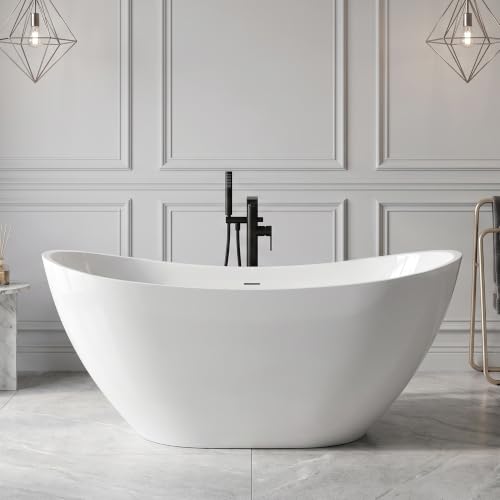
MEDUNJESS 60″ Double Slipper Freestanding Tub — Raised-ends slipper shape
The slipper silhouette is the oldest shape in this guide — both ends of the tub rise in a graceful flare that cradles the back and shoulders — and MEDUNJESS builds it at sixty inches with the same certification discipline as its plainer sibling. A double slipper does something no flat-rimmed oval can: it raises the bather’s upper body out of the water at a supported angle while the legs stretch low, producing the chaise-longue posture that made the shape famous in the era of the long, unhurried bath. At this size the effect is concentrated rather than diluted, because the raised ends shorten the flat floor and bring the backrests within everyone’s reach.
That concentration is also the shape’s honest cost, and this review will not hide it. Tall bathers who measure a tub by full-length stretch will feel the slipper’s geometry trading their legroom for back support, and bathers who like to sit bolt upright at one end will find the flare insisting on a recline. The shape has a point of view, and it rewards households that share it. What the double slipper returns for its opinionated design is presence: of the six tubs here, this is the one guests will name when describing the bathroom afterwards, and in a guest-suite or a primary bath designed as a retreat, that memorability is a functional quality, not vanity.
The integrated overflow and drain keep the installation story as simple as its sibling’s, and cUPC certification again anchors the romance to tested plumbing. Place this tub where its silhouette can be seen from the doorway — a slipper hidden in a corner wastes its best angle — and give thought to the filler, because a raised end and a floor-standing filler compete for the same visual line; a wall-mounted spout that arcs over the flare often composes better. Bathers who soak to lounge, read, and linger will find the shape’s argument persuasive within one bath. To act on it, the double slipper’s Amazon listing is where to check price on Amazon and confirm the raised-end dimensions against your ceiling of expectations.
- Shape: double slipper, both ends raised
- Certification: cUPC certified per listing
- Hardware: integrated overflow and drain supplied
- Posture: supported recline, chaise-like angle
- Finish: acrylic soaking shell, gloss presentation
Strengths
- Back support is built into the silhouette
- Most memorable profile of the six picks
- Certified plumbing under a vintage shape
Trade-offs
- Raised ends shorten full-length stretch
- Recline is imposed rather than optional
- Needs doorway visibility to earn its keep
Best for: loungers and readers in retreat-style bathrooms. Not suited for: the tallest bathers who prioritise legroom above all.
How Do the Six Tubs Compare Side by Side?
| Pick | Shape | Standout trait | Hardware finish |
|---|---|---|---|
| MEDUNJESS 60″ Freestanding Tub | Deep oval | cUPC certification | Integrated, matched |
| MonBlari 60″ Acrylic Freestanding Bathtub | Sloped single end | Stated 66-gallon capacity | Anti-leak PVC drain |
| WOODBRIDGE 59″ Freestanding Tub, Brushed Gold Trim | Contemporary soaker | Warm brushed gold trim | Brushed gold |
| Tubcraft 60″ Acrylic Freestanding Bathtub, Glossy White | Flat-bottom oval | Grounded, even stance | Chrome pop-up |
| SJ STAR & JANE 60″ Freestanding Double-End Tub | Double-ended oval | Milk coffee finish | Central, included |
| MEDUNJESS 60″ Double Slipper Freestanding Tub | Double slipper | Raised backrest ends | Integrated, matched |
How Much Room Should You Leave Around a Freestanding Tub?
Manufacturers draw their tubs floating in generous white space, but real bathrooms negotiate in inches, and the negotiation should happen on paper before the delivery van is booked. Lengthwise, a hand’s breadth beyond each end is the minimum that lets the tub read as freestanding rather than wedged; more is better where the room allows it, because the gap is where the eye confirms the silhouette. Along the long sides, one side usually faces the room and needs only visual clearance, while the wall side carries the cleaning question. A mop, a cloth on a handle, or a slim vacuum head needs a crescent it can travel through; if the gap is narrower than your tools, dust will colonise it in full view of everyone who soaks, which quietly poisons the luxury the tub was bought to provide.
There are two honourable escapes when the room cannot fund a full cleaning crescent. The first is placement a short distance from the wall with a planned tool — owners who choose their gap to match a specific slim mop have solved the problem by design rather than by luck. The second is a back-to-wall bathing arrangement, where the tub’s flat side sits close to the wall and the room gives its clearance to the front instead; households exploring built-in formats with similar footprints will find the alcove approach compared in Best Alcove Soaking Tubs. What does not work is the accidental gap — the four-inch slot nobody chose, too wide to seal and too narrow to clean. Measure the room, choose the gap, and the freestanding life stays as serene as the photographs promised.
Which Filler Works Best: Floor-Standing, Wall-Mounted, or Deck-Mounted?
A freestanding tub has no deck, so the filler conversation narrows to two real candidates and one impostor. The floor-standing filler is the category’s signature pairing: a tall, elegant column rising beside the tub with its own supply lines roughed into the floor. It composes beautifully and keeps the rim completely clear, but it is a plumbing commitment made before the floor is finished, and its spout reach must be checked against the tub’s rim width so the stream lands in water rather than on the far wall of the shell. The wall-mounted spout is the renovator’s friend, reusing supply lines that often already exist behind the wall, provided its projection clears the near rim and its height clears the raised end of a slipper or the flare of a sloped backrest.
The impostor is the handheld shower on a long hose pressed into service as the only filler. It works in the sense that water eventually arrives, but filling sixty gallons through a shower head is a slow, splashing apprenticeship nobody should serve nightly. A handheld makes an excellent companion — for rinsing the shell, washing hair, and bathing children or dogs — alongside a proper filler, not instead of one. Flow rate deserves a number-check too: a modest filler on a deep tub turns filling into a quarter-hour ritual, which some households genuinely enjoy as the overture to the soak and others experience as a standing appointment with a running tap. Choose the filler whose flow, reach, and finish all agree with the tub in front of you, and the pairing will feel designed rather than accumulated.
One refinement separates good filler pairings from great ones: the hand shower’s parking place. A filler column with an integrated handheld, parked at a height a seated bather can reach without standing, turns rinsing hair and washing the shell into seated tasks, and seated tasks are the ones that actually happen at the end of a relaxing soak. Check that detail in the filler’s drawings rather than discovering its absence with shampoo in your eyes, and prefer a hose long enough to reach the far end of the shell for the weekly rinse of the cleaning crescent described above. Small reach decisions, made on paper, are what make a freestanding bathroom feel quietly luxurious in year two rather than merely photogenic in week one.
Can a Normal Floor Carry a Filled Sixty-Inch Tub and a Bather?
Usually, yes — with the arithmetic done rather than assumed. Acrylic is the freestanding material that keeps this conversation calm: the shells in this guide can be carried by two adults, so the structure’s real burden is water plus bather. Sixty-odd gallons of water weighs in the neighbourhood of five hundred pounds, and spreading that across the tub’s footprint — especially a flat-bottom footprint like the Tubcraft’s — produces a load per square foot that sound residential floors handle routinely, comparable to a full bookcase or a piano’s polite end. The cautions attach to the exceptions: elderly joists with unknown history, floors with visible spring or past water damage, and tubs placed mid-span in rooms that were never meant for bathing at all, such as a converted bedroom on an upper floor.
The prudent sequence costs nothing. Note where the joists run if you can, favour placement that straddles support rather than floating between it, and let a builder glance at the plan if the house is old or the floor feels lively underfoot. Spread matters more than totals, which is why the flat-bottom and bracket-based designs in this list earn quiet points: they present the load to the floor as a broad, even argument instead of four small, pointed ones. Households weighing a tub-and-shower layout instead — where the bathing load shares a footprint with daily showering — will find the combined formats surveyed in Best Bath Tubs for Shower-Tub Combos. For the classic freestanding plan in a true bathroom, though, the floor question is a check, not an obstacle.
How Do You Keep an Acrylic Shell Looking New for a Decade?
Acrylic’s care routine is short, and its enemies are specific. The surface is a continuous, non-porous skin, which means dirt and bath residue sit on it rather than in it, and a soft cloth with mild liquid cleaner restores the gloss in minutes. The enemies are abrasion and chemistry in the wrong doses: scouring powders, stiff brushes, and solvent-heavy sprays will micro-scratch or dull the skin, and a micro-scratched surface collects grime faster, tempting the owner into harder scrubbing — the exact spiral that ages a tub prematurely. Break the spiral at the first step by keeping one soft cloth that lives for the tub alone, rinsing bath oils away before they dry at the waterline, and treating the weekly wipe as a two-minute habit rather than a monthly campaign.
Scratches, when they happen, are where acrylic quietly defeats heavier materials. A fine scratch in acrylic can usually be polished out with the maker’s recommended compounds, because the colour runs through the material rather than sitting on it as a coating. A chip in enamelled iron, by contrast, is a repair kit and a prayer. Hard water is the other slow adversary: mineral rings at the waterline yield to a cloth soaked in a mild acidic solution and patience, and a water softener, where fitted, repays its cost in the bathroom first. Teach the household two rules — no gritty cleaners, no standing dyed water from hair treatments left overnight — and a gloss shell in this size class will still be flattering the room when the towels around it have been replaced three times.
Where Do Towels, Bottles, and Books Live Without a Deck?
The freestanding format deletes the wide tiled deck that alcove bathers use as a shelf, and rooms that ignore the deletion improvise badly. The elegant answers are small and movable. A narrow stool or a low teak bench beside the tub holds the towel, the book, and the drink at rim height, and can be carried to the window for morning coffee duty in a house that enjoys double-duty furniture. A wall-mounted ledge within arm’s reach of the bather’s usual end corrals bottles without a single item balancing on the rim, and a simple hook rail keeps robes dry and off the floor. Caddies that bridge the rim work well on the flat-rimmed ovals in this list and less well on the slipper’s flare, which is one more reason the slipper’s buyer should plan the stool before the first soak rather than after the first dropped paperback.
Storage thinking should extend to the unglamorous inventory too. Bath salts, spare soaps, and the cleaning cloth all need a home that is not the floor crescent, because every object stored behind the tub makes the weekly clean slower and therefore rarer. A lidded basket that fits the room’s palette, a vanity drawer reserved for bath stock, or a small cabinet on the wall opposite all serve. The test of a finished freestanding bathroom is simple: stand at the door with the tub empty and count the objects touching the floor. In a composed room the answer is the tub, the stool, and nothing else, and that emptiness is what lets a sixty-inch bathroom feel like a retreat instead of a storage negotiation with water in the middle.
What Should Happen on Delivery Day, Step by Step?
Delivery day rewards a calm script. Before the van arrives, walk the route once more with the tape in hand — doorway widths, the stair turn, the final swing into the bathroom — and pad the corners that the shell will pass, because acrylic forgives a scuff far less gracefully at hour zero than it does a scratch in year three. When the tub is unboxed, inspect it where it stands, in good light, before signing anything: run a palm along the rim, look across the gloss at an angle for shipping rubs, and confirm the drain and overflow hardware in the box matches the finish you ordered. Photograph anything questionable before the packaging leaves, because delivery claims are a conversation held with evidence or not held at all.
Placement comes before plumbing in the day’s order. Set the shell in its intended position, dry, and live with the sight for an hour if the schedule allows: sit in it clothed, check the view, the light, the reach to the stool position, and the cleaning crescent with your actual mop. Adjustments cost nothing at this stage and a great deal after the drain is sealed. Only then should the plumber connect, fill the tub partway, and watch the drain and overflow through a full test cycle, because a leak discovered with five gallons aboard is a towel problem, while the same leak discovered at fifty gallons is a ceiling problem in the room below. Finish the day by filling the tub properly and taking the first soak in the evening the work ends — a small ceremony that converts a renovation into a room, and confirms while the receipts are still warm that the sixty inches were spent exactly as intended.
What Mistakes Do Freestanding Tub Buyers Keep Making?
Measuring the room but not the journey is the classic opener: a tub that fits the bathroom beautifully and cannot pass the stairwell turn or the bathroom doorway is a sculpture for the hallway. Measure every door, turn, and ceiling pinch on the route, and remember that acrylic’s lightness tempts carriers into angles a heavier tub would never attempt. The second mistake is ordering the tub before the drain position is known, because freestanding drains forgive inches, not feet; the rough-in and the tub’s drain point must be introduced to each other on paper. Third is filler procrastination — choosing the spout after the floor is closed, when the floor-standing option has quietly expired.
Two aesthetic mistakes complete the set. One is ignoring the view from the doorway, which is where the tub will be seen ninety percent of the time; a silhouette chosen from above, in a render, may present its least interesting angle to the door. The other is forgetting the small furniture of bathing — a stool for the towel, a ledge for the book and the glass, a hook within arm’s reach. A freestanding tub has no surrounding deck to hold these things, and rooms that plan for them feel composed, while rooms that do not accumulate a damp archaeology of items balanced on the rim.
Will Your Water Heater Fill a Sixty-Inch Tub Without Going Tepid?
A tub is only as warm as the system behind the wall, and sixty-inch shells sit at a fortunate point in the arithmetic. A typical fill uses the tub’s stated capacity discounted by the bather’s own displacement — you occupy gallons you therefore do not draw — and lands in a range that a standard tank heater serves comfortably, provided the tank is not simultaneously feeding a shower, a dishwasher, and a washing machine. The MonBlari’s published figure is the useful model here: when a maker states capacity, the household can compare it honestly against the heater’s first-hour rating and plan bath time the way it plans oven time on a holiday, by simply not scheduling three hot-water events into the same hour.
Households that discover a shortfall have gentler remedies than a new heater. Raising the tank’s set temperature within safe limits and fitting a mixing valve stretches the effective supply. Filling during the heater’s quiet hours — after the morning showers have recovered, before the evening laundry — costs nothing at all. And the deep, steep-walled shells in this guide help on the demand side, because a high waterline around the shoulders in a compact volume feels more luxurious than a low waterline in a larger one. Judge the system as a whole, and the sixty-inch class usually passes with the equipment already in the house, which is one more reason it has become the renovation size of choice.
How Do Children and Dogs Fare in a Freestanding Tub?
Families bathe more than adults in these tubs, and the format has a personality with small bathers. The high rim that makes a freestanding soak feel cocooned also makes lifting a toddler in and out a taller task than over an alcove’s low apron, so parents of the very young should rehearse the lift with the tub dry and decide whether a sturdy step that lives beside the shell solves it gracefully. Once inside, children generally adore the deep water and the boat-like feeling, and the flat interior floors of designs like the Tubcraft give small feet a steadier platform than a curved slipper base. Supervision rules are unchanged by fashion: young children stay within arm’s reach in any tub, at any depth, without exception.
Dogs are the other constituency, and here the freestanding shape earns mixed notices honestly given. A handheld shower paired with the filler turns the tub into an excellent dog wash for animals that can be lifted or will step in from a low platform, and the acrylic surface tolerates claws better than owners fear, with fine marks polishing out as described earlier. Large, reluctant dogs and low rims do not mix, and households whose bathing calendar is half canine should weigh the alcove formats kindly. For the occasional muddy spaniel, though, a sixty-inch shell, a handheld spray, and a towel staged on the stool make short, cheerful work of the whole muddy business.
Final Recommendation
Let the room cast the first vote. A straightforward renovation that wants depth, certification, and no surprises should take the first MEDUNJESS and spend its remaining budget on a good filler. Readers and recliners will feel the MonBlari’s slope nightly. Warm-metal rooms belong to the WOODBRIDGE, busy family floors to the Tubcraft, and settled warm palettes to the SJ STAR and JANE double-ender. Save the double slipper for the bathroom that wants a signature, and it will sign the room every single day. Whichever silhouette you choose, choose its gap, its filler, and its drain on paper first — because a sixty-inch freestanding tub, honestly placed, gives a modest bathroom the one thing no fixture twice its price can fake: a room that feels finished.
Frequently Asked Questions
Will a 60-inch tub really fit an adult comfortably?
For most adults, yes — the interior shaping matters more than the exterior tape. Sloped or raised ends let the back recline while the feet brace, and the waterline in a deep shell reaches the shoulders sooner than in a shallow longer tub. Very tall bathers should study the floor length and end angles of the slipper and double-ended designs especially carefully.
Is acrylic a compromise compared with cast iron?
It is a different balance rather than a lesser one. Acrylic is warmer to the touch, far lighter to install, kinder to floors, and repairable if scratched. Cast iron holds heat longer in the shell itself and feels immovable, but at this size it demands freight handling and a crew, plus a floor conversation that acrylic rarely triggers. Most sixty-inch renovations are better served by acrylic’s balance, and bathers who pre-warm an acrylic shell with a first splash of hot water close most of the remaining warmth gap before they ever settle in.
How do I clean behind a freestanding tub?
Plan the gap when you place the tub: either leave a crescent wide enough for a slim mop or cloth tool, or set the tub close enough to the wall that no dust trap forms. A handheld shower on a hose also helps rinse the floor crescent during the weekly clean, which is one more reason to pair one with the main filler.
Does a freestanding tub need a special drain?
It needs a drain assembly that matches the tub and a rough-in positioned within the connector’s forgiving range. The picks here include integrated drain and overflow hardware, which settles the matching question. Have a plumber confirm the floor drain position against the chosen tub’s drawings before the floor is finished.
Can two people soak in a 60-inch tub?
Two people can share a double-ended sixty-inch tub briefly and affectionately, but it is not a two-person soaker in the spacious sense. The double-ended SJ STAR and JANE is the best-shaped candidate here for sharing. Couples who bathe together often should look at longer formats where both bathers can actually stretch.
What filler height suits a freestanding tub?
The spout must clear the rim — including a slipper’s raised end if you fill over it — and project far enough to land the stream inside the shell. Check the tub’s rim height and width against the filler’s published reach before ordering either, and favour a flow rate that fills the tub in a time your household finds pleasant rather than tedious.
Related Guides
Shoppers who love the sixty-inch footprint but prefer the gleam and heft of enamelled surfaces should compare the traditional route in Best 60-Inch Porcelain Bathtubs, where porcelain enamel over steel and composite cores is weighed against the acrylic shells reviewed here, with the same sixty-inch footprint held constant so the comparison stays purely about material, weight, and feel.



[…] Households often pair a patio spa with a proper indoor soak for the coldest weeks, and our guide to Best 60-Inch Freestanding Tubs covers that indoor half of the ritual for bathrooms with five feet of clear wall. Back outdoors, […]
[…] the indoor half of a bathing renovation will find the same measure-twice discipline in our guide to Best 60-Inch Freestanding Tubs , where sixty inches of tub must negotiate alcoves, doors and floor loading in a finished […]