What's inside
- Key Takeaways
- Quick Picks
- How Did We Choose These Combo Systems?
- What Makes a Tub Safe and Comfortable to Shower In?
- How Deep Should a Family Combo Tub Be?
- How Do You Plan a Combo Replacement Without Losing Your Bathroom for a Month?
- How Do Vikrell, Acrylic, Fiberglass and Solid Surface Compare in Combo Duty?
- What Should You Know About Valves, Heads and Water Pressure in a Combo?
- Common Mistakes in Tub-Shower Combo Projects
- Final Recommendation
- How Do You Clean a Combo Surround Without Wrecking It?
- How Does a Combo Serve a Multigenerational Household?
- What Does a Combo Replacement Really Cost, Line by Line?
- How Do You Water-Test and Commission a New Combo Properly?
- Why Do One-Piece Surrounds Rarely Appear in Remodels?
- How Should Lighting and Ventilation Change with a New Combo?
- What Separates a Combo That Ages Gracefully from One That Dates in Five Years?
- How Do You Decide Between Repairing the Old Combo and Replacing It?
- Frequently Asked Questions
- Related Guides
As an Amazon Associate I earn from qualifying purchases. This post may contain affiliate links at no extra cost to you.
cottageverdict.com is reader-supported. When you buy through links on our site, we may earn an affiliate commission.
Where to buy: the kits and wall systems below are listed on Amazon with their piece counts, dimensions and drain hands shown, so you can check price on Amazon for the configuration that matches your alcove before ordering.
Most family bathrooms do not have the luxury of choosing between a bath and a shower, so they choose both in the same sixty inches. The best bath tubs for shower-tub combos are the ones that treat the double duty seriously: a tub floor that stays secure under standing feet, walls that shrug off daily spray without grout drama, a rim height that children and grandparents can step over, and shelving that swallows the shampoo economy of an entire household. A combo that only bathes well will annoy you every morning; one that only showers well will disappoint you every Sunday evening.
The six options here approach the partnership from different directions. Three STERLING Ensemble systems deliver complete, matched tub-and-wall packages in three widths, the American Standard Studio set brings a design-led wall system to a standard tub footprint, WOODBRIDGE pairs a soaking tub with solid-surface panels for a more premium finish, and the From Plain To Beautiful panel kit renovates the walls around a tub you already own. Between them they cover full replacements, cosmetic rescues and everything in the family-bathroom middle.
What unites the picks is an insistence on waterproof honesty. A shower throws water at walls in a way a bath never does, and the surround — not the tub — is where combo installations succeed or fail over a decade. Every system below manages that water with interlocking panels, sealed seams or solid surfaces rather than hope and grout, and every tub floor was chosen with standing showers in mind as much as reclining soaks.
Key Takeaways
- The surround decides a combo’s lifespan: showers attack walls daily, so panel and solid-surface systems outlast tired grout in family service.
- Thirty-six and forty-two-inch widths transform showering elbow room inside the same sixty-inch alcove length.
- Tub depth is a family compromise — deep enough for a child’s bath, low enough at the rim for safe daily step-over.
- Matched kits remove the compatibility gambling between tubs, walls and drain positions.
- Wall-panel-only kits can rescue a sound tub and tired surround for a fraction of full replacement cost.
Quick Picks
| Pick | Badge | Why it earns its place |
|---|---|---|
| STERLING Ensemble Bath and Shower Kit 60″ x 36″, Right-Hand | Best Complete Family Kit | A matched tub and surround at thirty-six inches wide, with storage shelving moulded into the walls. |
| STERLING Ensemble Medley Bath/Shower 60″ x 32″ | Best Standard-Width Kit | The classic thirty-two-inch Ensemble format with a taller surround for standard alcove replacements. |
| STERLING Ensemble Bath and Shower Kit 60″ x 42″, Left-Hand | Best Wide Shower Feel | Forty-two inches of width gives a combo that showers like a stall while keeping a real tub below. |
| American Standard Studio Bathtub Wall Set | Best Designer Wall System | A clean-lined sixty-by-thirty-two wall set in Arctic white from a heritage bathroom brand. |
| WOODBRIDGE 60″ Alcove Bathtub and Shower Kit | Best Solid-Surface Upgrade | A soaking tub paired with four-piece solid-surface wall panels for a stone-like, grout-free finish. |
| From Plain To Beautiful Subway Tub and Shower Wall Panels | Best Walls-Only Rescue | Subway-look panels covering ninety-six square feet to renew a surround without replacing the tub. |
How Did We Choose These Combo Systems?
We judged each candidate as a system, because that is how a combo lives. The tub had to offer a floor profile suitable for standing — broad, gently textured footing rather than a narrow sculpted well — and a rim height a household can step over thousands of times without thinking about it. The walls had to manage shower spray with engineered seams, interlocking edges or solid panels, and to offer storage, because a family combo without shelving becomes a rim crowded with bottles waiting to fall on toes.
Material guided the shortlist. Vikrell, STERLING’s solid composite, dominates the complete kits because it resists chipping and staining, carries colour through its thickness and assembles in pieces that fit through ordinary doorways — a practical detail that decides whether a kit can even reach an upstairs bathroom. Solid-surface panels earned the WOODBRIDGE its place for buyers who want a heavier, stone-adjacent feel, while the panel-only kit serves the large population whose cast-iron or acrylic tub remains sound beneath a failing surround.
We also checked the unglamorous compatibilities: drain hand against the room’s plumbing, overall height against ceiling and soffit, and piece sizes against stairwell turns. A combo is a decade-long commitment installed in a day, and the guides elsewhere in this series take the same systems view — readers outfitting the rest of a hard-working household will find the same philosophy applied to footwear in Best Canvas Slippers for Men, where materials are likewise chosen for daily duty rather than display.

STERLING Ensemble Bath and Shower Kit 60″ x 36″, Right-Hand — Best Complete Family Kit
The thirty-six-inch Ensemble is the sweet spot of the STERLING range for most family bathrooms: four inches wider than the standard alcove tub, which reads as a small number on paper and a large one under a shower. Elbows stop negotiating with the walls, a parent washing a child’s hair gains working room, and the bath below remains a proper sixty-inch soak. The kit arrives as a matched set — Vikrell tub and surround engineered for each other — with moulded shelving in the walls and a right-hand drain configuration.
Vikrell deserves its reputation in this role. The solid composite shrugs off the dropped bottles, bath-toy artillery and cleaning enthusiasm of family life without the chipping that haunts enamel or the grout maintenance that haunts tile. The surround pieces interlock and seal by design, and the whole system is made to be installed by a competent remodel crew in the rhythm of a normal bathroom project rather than a specialist expedition. The tub floor is broad and shower-friendly, and the rim height keeps the daily step-over unremarkable, which is precisely what a family needs from it.
Choose the right-hand version when your drain sits right as you face the tub, and confirm ceiling clearance for the seventy-two-inch overall height before ordering. Because tub and walls arrive matched, the usual compatibility questions between separate components simply vanish. The kit is sold through its Amazon listing with freight arrangements shown; check price on Amazon there and note the delivery window, since a bathroom remodel schedules itself around a box of this size.
- Footprint: 60 x 36 inches; overall height 72 inches
- Material: Vikrell solid composite
- Drain: right-hand configuration
- Walls: interlocking surround with moulded shelving
- Use: bathing and daily showering for families
Strengths
- Extra width over standard tubs transforms shower comfort
- Matched kit removes tub-to-wall compatibility risk entirely
- Vikrell surface resists chips and needs no grout care
Trade-offs
- Seventy-two-inch height needs confirming against low ceilings
- Right-hand drain only in this configuration
- Modular look is practical rather than luxurious
Best for: families replacing a full alcove combo who want one matched, durable system
Not suited for: homes chasing a high-end stone aesthetic or with left-hand plumbing

STERLING Ensemble Medley Bath/Shower 60″ x 32″ — Best Standard-Width Kit
The Medley is the Ensemble idea at the classic thirty-two-inch width, stretching the surround taller — seventy-five inches overall — for bathrooms whose shower spray and taller users outgrow standard wall heights. It suits the enormous installed base of sixty-by-thirty-two alcoves directly: same pocket, same drain logic, but a fresh Vikrell system with moulded storage and walls that reach higher against the spray. For a like-for-like family bathroom renewal, this is the lowest-drama complete kit in the guide.
Daily life in the Medley is defined by small mercies. The shelving keeps bottles off the rim and out of the bath water. The tub floor stands flat and secure for showers, while the well still fills deeply enough for children’s baths and an adult’s occasional soak. Vikrell’s matte solidity cleans with ordinary products and does not ask its owner to think about grout, sealant beads beyond its engineered seams, or the slow staining that ages cheaper surrounds.
This configuration carries a right-hand drain, so left-plumbed rooms should look to the wider left-hand sibling or the wall-set alternatives below. As with all STERLING kits, the pieces are sized to travel through the house, a mercy on installation day. It is retailed through the listing with its series details stated; check price on Amazon there, and measure your alcove’s width at several heights, because older walls bow and a thirty-two-inch kit deserves a truthful thirty-two inches.
- Footprint: 60 x 32 inches; overall height 75 inches
- Material: Vikrell solid composite
- Drain: right-hand configuration
- Walls: tall surround with integrated storage
- Use: standard alcove replacement with shower duty
Strengths
- Taller surround suits taller users and enthusiastic showers
- Direct fit for the most common alcove size in housing
- Integrated shelving ends the bottle-balancing era
Trade-offs
- Standard width gives no extra shower elbow room
- Right-hand drain limits plumbing layouts served
- Piece-together assembly rewards careful, patient installation
Best for: standard alcoves needing a complete, taller-walled renewal without layout changes
Not suited for: households wanting the wider showering feel of the thirty-six or forty-two-inch kits

STERLING Ensemble Bath and Shower Kit 60″ x 42″, Left-Hand — Best Wide Shower Feel
Forty-two inches is where a tub-shower stops feeling like a compromise and starts feeling like a small shower room with a bath attached. This left-hand Ensemble stretches the formula to its widest, giving stand-up showering genuine lateral freedom — room to wash hair without touching walls, room for two children to share the spray under supervision, room for a shower stool later in life. The tub below remains a full sixty-inch bath, so nothing about the soaking side of the contract is surrendered.
The catch is architectural honesty: a forty-two-inch combo needs a forty-two-inch alcove, which usually means this kit belongs to remodels that are moving a wall, converting a larger bathroom or building new. It is not a drop-in replacement for a thirty-two-inch pocket, and ordering it as one would be an expensive misunderstanding. Where the space exists, though, the Vikrell system delivers the same chip-resistant, grout-free service as its siblings, with shelving moulded in and a left-hand drain for the plumbing layouts the other Ensembles do not serve.
Families planning a bathroom around this kit should think of it as the room’s anchor and design outward: a glass door becomes practical at this width, ventilation matters more with the larger spray volume, and the floor outside deserves a mat zone sized for real splashing. The kit ships as a multi-piece system through its listing; check price on Amazon there and confirm freight delivery arrangements, since the cartons are substantial even in pieces.
- Footprint: 60 x 42 inches; overall height 72 inches
- Material: Vikrell solid composite
- Drain: left-hand configuration
- Walls: interlocking surround with shelving
- Use: wide-format family showering and bathing
Strengths
- Widest showering space of any pick in this guide
- Left-hand drain serves layouts the other kits miss
- Same durable, grout-free Vikrell system throughout
Trade-offs
- Requires a genuinely wide alcove or a remodel that creates one
- Larger spray volume asks more of ventilation and doors
- Cartons are bulky even though the system is modular
Best for: remodels with the space to go wide, especially with left-hand plumbing
Not suited for: like-for-like swaps in standard thirty-two-inch alcoves
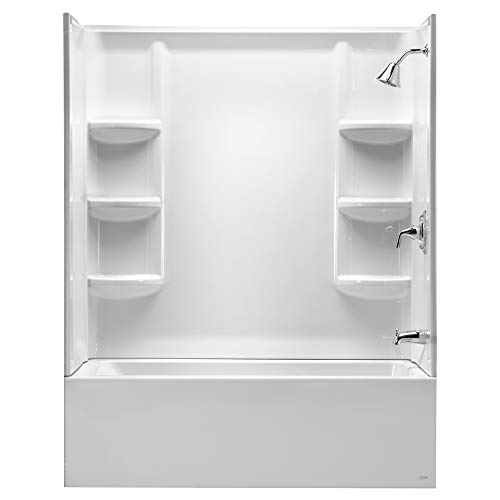
American Standard Studio Bathtub Wall Set — Best Designer Wall System
American Standard’s Studio line speaks a cleaner design language than the workhorse kits above: smooth Arctic-white wall panels with restrained lines, made to wrap a standard sixty-by-thirty-two tub in a coordinated, almost architectural finish. The Studio wall set is exactly that — the wall system — designed to pair with a compatible Studio tub, which makes it the pick for renovators who want brand-coherent design control over the pairing rather than a single boxed answer.
The appeal in a family bathroom is the surface itself. Smooth, non-porous walls wipe clean in seconds, present no grout lines to scrub or reseal, and keep their bright white through years of shampoo chemistry. The Studio aesthetic suits bathrooms leaning modern — matte black or chrome fixtures both sit naturally against it — and the panel format installs over the prepared alcove with the tub, following the system’s specified sequencing. Storage is handled by the tub and accessory choices rather than deep moulded shelving, so households with a large bottle census should plan a niche or shelving addition.
Buy this as part of a deliberate pairing: confirm the exact Studio tub model the wall set matches, the drain hand of that tub against your room, and the total finished height. Sold as a wall set through its listing, it invites a considered basket rather than a single click; check price on Amazon there and price the matched tub alongside it so the system’s true total is the number you compare against the complete kits above.
- Format: wall set for 60 x 32 inch tub pairing
- Colour: Arctic white
- Brand system: American Standard Studio
- Walls: smooth panel surround
- Use: design-led combo renovation
Strengths
- Clean, modern lines elevate a standard alcove dramatically
- Smooth panels clean faster than any textured surround
- Heritage brand with a coherent wider fixture ecosystem
Trade-offs
- Tub is a separate, specific purchase to match carefully
- Less moulded storage than the STERLING kits
- Design-led pricing exceeds the workhorse kits per function
Best for: design-conscious renovators pairing a matched Studio tub and walls
Not suited for: buyers wanting one box that contains the entire combo

WOODBRIDGE 60″ Alcove Bathtub and Shower Kit — Best Solid-Surface Upgrade
WOODBRIDGE bundles its sixty-by-thirty-two alcove soaking tub with four-piece solid-surface shower wall panels, and the result is the most premium-feeling system in this guide that still installs like a kit. Solid surface is the material of upmarket surrounds: dense, warm to the touch, repairable if scratched, and finished here in a clean white that reads closer to stone than to plastic. The tub beneath is a right-drain soaking design, so the bathing side of the partnership is taken seriously rather than treated as a shower tray with ambitions.
The four-piece panel format balances manoeuvrability with seam economy — few enough joints to look calm, small enough pieces to reach an upstairs bathroom. Seams in solid surface are sealed and can be made visually quiet, and the absence of grout removes the combo’s most common ageing failure at a stroke. For households whose previous bathroom died by a thousand grout lines, that sentence alone justifies the upgrade tier this kit occupies.
Plan the project as a system install: tub set and plumbed first, panels fitted to the prepared walls, fixtures chosen to suit the uncluttered finish. The right-drain configuration fixes the plumbing side, so verify before ordering. It is offered through the listing as a complete kit with its model codes stated; check price on Amazon there, where the combined tub-and-panels proposition can be weighed directly against tiling a surround from scratch in money and in weekends.
- Footprint: 60 x 32 inches alcove
- Tub: soaking design, right drain
- Walls: four-piece solid-surface panels
- Finish: clean white, stone-like feel
- Use: premium grout-free combo renovation
Strengths
- Solid-surface walls feel substantial and repair gracefully
- Soaking-oriented tub serves bathers better than basic combo tubs
- Grout-free walls remove the classic combo failure mode
Trade-offs
- Premium tier costs more than composite kits
- Right-drain only in this kit configuration
- Panel fitting rewards precise wall preparation
Best for: renovators wanting a stone-like, grout-free surround with a real soaking tub
Not suited for: strict-budget projects where the STERLING kits already satisfy

From Plain To Beautiful Subway Tub and Shower Wall Panels — Best Walls-Only Rescue
Not every combo renovation needs a new tub. Cast-iron and quality acrylic tubs routinely outlive their surrounds by decades, and this panel kit exists for exactly that situation: ninety-six square feet of gloss-white subway-pattern wall panels that install over the existing surround area, transforming a tired, stained or dated shower zone while the sound tub below stays in service. The subway pattern delivers the classic tiled look — without tile, grout or a tiler.
The panels cut and bond as a renovation system, which puts this project within reach of confident DIY households working over a weekend rather than a remodel crew working over a fortnight. Because the tub remains, the plumbing remains untouched too, and with it the largest risks and costs of combo replacement. The finished surface wipes clean like any modern panel, and the gloss subway relief catches light in a way flat panels cannot, lending small bathrooms a borrowed sense of architecture.
Honesty about scope matters here. Panels renew walls; they cannot fix a flexing tub, a failing drain or water damage already inside the wall, and any of those discoveries should pause the cosmetic work for real repair. Measure the surround area carefully against the ninety-six-square-foot coverage, accounting for cuts around fixtures. The kit is sold through its listing with coverage stated plainly; check price on Amazon there and compare it against the cost of retiling, which is the comparison this product was born to win.
- Coverage: 96 square feet of wall panels
- Pattern: subway tile look, gloss white
- Scope: surround walls only, tub not included
- Install: cut-and-bond renovation panels
- Use: cosmetic rescue over a sound existing tub
Strengths
- Renews the surround without touching tub or plumbing
- Subway relief gives a tiled look with panel simplicity
- Weekend-scale project for confident DIY households
Trade-offs
- Cannot remedy tub, drain or in-wall water damage
- Finished result depends on careful measuring and cutting
- Adds no storage shelving by itself
Best for: homes with a sound tub under a failing or dated surround
Not suited for: full replacements where the tub itself is cracked, flexing or leaking
What Makes a Tub Safe and Comfortable to Shower In?
Showering in a tub is a standing activity performed on a wet, curved surface, so the details that matter are different from soaking details. The floor of the well should be as flat and broad as the design allows, with a texture or a well-chosen mat providing grip; sculpted wells with narrow floors belong to dedicated soakers, not family combos. Rim height governs the step-over, the single most repeated movement in the bathroom: lower rims suit children, older relatives and anyone with a cranky hip, while deeper tubs trade step-over ease for immersion. Every household should choose that trade consciously rather than discover it.
The walls contribute more than waterproofing. A surround that reaches high enough contains the spray of a tall user’s shower, and shelving placed within the wet zone but out of the direct stream keeps bottles reachable without rim clutter. Grab points deserve thought too: a sturdy, properly anchored grab bar near the entry side is a comfort feature for every age, steadying the step-over in wet conditions, and planning its blocking during a remodel costs almost nothing compared with retrofitting it later.
Doors and curtains finish the system. Curtains are forgiving, cheap and kind to small rooms; glass doors contain spray better, look sharper and demand a wider, more confident step-over zone. At thirty-six inches and above, doors become genuinely practical; at thirty-two, many families still prefer a curtain’s flexibility. Whichever you choose, ventilation is the silent partner — an effective fan keeps the whole combo drier, kinder to sealant and far less welcoming to mildew. Readers whose bathrooms lean toward dedicated soaking rather than combination duty will find the contrasting priorities explored in Best 5-Foot Jacuzzi Tubs, where jets and depth outrank standing room entirely.
How Deep Should a Family Combo Tub Be?
Depth in a combo is a three-way negotiation between bathers, children and step-over safety. A deeper well delights the adult soaker and gives small children a proper bath with water over their legs, yet every inch of wall height is an inch every household member must clear, wet-footed, twice per shower. The mainstream combo tubs in this guide sit in the proven middle: deep enough for a satisfying soak to the chest when reclined, low enough at the rim that the daily step remains unthinking for most adults and manageable for children with a hand offered.
Households with toddlers often discover that a moderate tub plus a removable infant bath inside it beats a very deep tub for the early years, because the small bath brings the baby up to a comfortable working height for the parent’s back. Households with teenagers, meanwhile, care more about shower performance than bath depth at all, which argues for width and wall height over well depth. The forty-two-inch Ensemble exists precisely for that stage of family life.
Measure your current tub’s rim height and live with the number for a day before deciding. If the present step-over already registers in your knees, do not buy deeper. If baths feel like sitting in a puddle, an inch or two more depth will transform them. The right answer is written in your household’s joints and habits, not in any catalogue.
How Do You Plan a Combo Replacement Without Losing Your Bathroom for a Month?
Sequencing is the whole secret. Order the complete system — tub, walls, drain kit, valve and trim — before demolition, and store it all until every box is in the house, because a bathroom torn open while a surround ships is a household in exile at the neighbours’ shower. Confirm drain hand and alcove dimensions against the delivered pieces, not the website drawings, while returns are still painless. Photograph the existing plumbing before it is disturbed, and arrange the waste disposal of the old unit in advance; old tubs are awkward freight that nobody improvises well.
During installation, insist on the unglamorous checkpoints: a level tub that does not rock, full support under its base, a water test of the new drain before walls close, and sealant applied to dry, clean surfaces rather than rushed onto dust. Panel systems reward patience at their seams; tile rewards it at its waterproofing. Either way, the day saved by hurrying is repaid in the year of the first leak.
Households redesigning the whole wet zone at once may find it useful to compare these kits with the dedicated soakers in Best Acrylic Soaker Tubs before committing, because the moment a second bathroom enters the plan, the case for a dedicated soaking tub strengthens and the combo can specialise in showering. Within a one-bathroom home, though, the systems above remain the most versatile square footage in the house.
How Do Vikrell, Acrylic, Fiberglass and Solid Surface Compare in Combo Duty?
Combo surrounds live a harder life than bath-only walls because they are sprayed daily, leaned against, and cleaned by people in a hurry. Vikrell, the solid composite in the STERLING kits, was engineered for this punishment: it is dense through its whole thickness, so chips do not reveal a different-coloured substrate, it resists the staining of hair dyes and bath products, and its moulded forms arrive with shelving and grab-friendly contours already shaped. Its weakness is aesthetic range — you choose from the maker’s designs rather than inventing your own.
Acrylic surrounds share the glossy repairability of acrylic tubs and can look excellent, though thin acrylic backed by foam or wood varies widely in rigidity; press a palm against a showroom panel before judging. Fiberglass gelcoat systems sit at the budget end, light and inexpensive, but their surfaces chalk and craze sooner under daily spray and aggressive cleaning, which is why no gelcoat kit leads this guide. Solid surface, the WOODBRIDGE route, feels the most substantial and repairs the most gracefully, at the highest material cost and with the least tolerance for sloppy wall preparation beneath it.
The tub materials follow their own familiar logic. Vikrell and acrylic both serve families well; cast iron, where an existing tub survives beneath a panel rescue, remains the heavyweight champion of durability and heat retention. The practical conclusion is that any of the systems above, correctly installed, outlasts a poorly installed example of a theoretically superior material — the recurring sermon of this entire batch of guides, preached because it keeps proving true.
What Should You Know About Valves, Heads and Water Pressure in a Combo?
The finest surround cannot rescue a miserable shower, and the shower’s character is set behind the wall. A modern pressure-balancing or thermostatic valve protects bathers from temperature surges when a toilet flushes or a washing machine fills — in a family bathroom, that protection is not a luxury but the difference between a calm shower and a scalding hop. Replacing the valve during a combo project costs a fraction of reopening finished walls later, and this guide’s standing advice is to do it whenever the existing valve is old, obscure or stiff.
Shower head choice interacts with the combo’s width. Rain heads delight in wider kits where the bather can step in and out of the fall; in a thirty-two-inch alcove, a quality standard head on a decent arm, ideally paired with a handheld on a hose, serves better and rinses children, dogs and the tub itself with far less theatre. Handhelds also transform cleaning day, letting you rinse walls and corners directly instead of throwing cupped handfuls of water like a pre-plumbing ancestor.
Water pressure is the quiet variable. Low-pressure homes should choose heads designed to feel generous at modest flow, and anyone replacing a valve should confirm the new trim’s flow characteristics suit the house. None of these decisions appears in photographs of finished bathrooms, yet together they decide whether the household praises the remodel every morning or merely photographs it once.
Common Mistakes in Tub-Shower Combo Projects
The costliest mistake is replacing only what is visible while ignoring what is wet. A beautiful new surround installed over water-damaged backing preserves the damage in a nicer frame, and the failure re-emerges through the new work within a season or two. Open, inspect and repair the substrate first; cosmetic systems like the panel kit are for sound walls under tired surfaces, not for archaeology. The second mistake is drain-hand roulette: ordering the mirror image of your plumbing and discovering it with the old tub already in the skip.
Third is neglecting ventilation while upgrading everything else. A new combo in a steamy, under-ventilated room ages its sealant and invites mildew regardless of material quality. Fourth is choosing depth or width by photograph rather than by the bodies and alcove you actually own. Fifth is forgetting the shower valve until the walls are closed; replacing an ageing valve during the project is cheap insurance bought exactly once.
Finally, families often under-plan storage and then blame the kit. Count the bottles your household genuinely keeps in the shower, and choose shelving, niches or door solutions for that number plus a guest margin. A combo that swallows the household’s real clutter stays serene; one that cannot will look improvised by the end of the first week.
One more household note belongs in the depth discussion: bath seats and stools that sit inside the tub change the effective depth a bather experiences, and they store neatly against the wider kits’ walls. Trying a seat in your current tub is a cheap experiment that tells you whether your household truly needs a deeper well or simply a better perch, and the answer frequently saves real money.
Storage, finally, is where a combo either stays serene or dissolves into rim clutter within a month. Count every bottle, razor and toy the household keeps in the wet zone and assign each a home — a moulded shelf, a niche planned into the surround, a caddy that drains rather than pools — before the first shower is taken. The kits with deep moulded shelving solve this silently; the smoother design-led walls ask you to solve it deliberately, and either answer works provided it is an answer rather than an accumulation.
Sound is the last unlisted specification. A hand run around a showroom surround, a knock on the panel, tells you whether the wall will drum under the shower’s drumming or answer with a solid, quiet thud. Dense materials and well-backed panels keep a bathroom feeling built rather than assembled, and in a room used at six in the morning by people other household members are sleeping beside, that quiet solidity is a courtesy as much as a quality.
Final Recommendation
For most family bathrooms, the thirty-six-inch STERLING Ensemble is the balanced answer: matched components, family-proof Vikrell, storage in the walls and showering room that the standard width cannot offer. Choose the Medley when your alcove is a strict thirty-two inches and taller walls appeal, the forty-two-inch Ensemble when a remodel gives you the width and your plumbing runs left, and the WOODBRIDGE kit when a grout-free, stone-like finish is worth the upgrade. The American Standard Studio set serves design-led pairings, and the subway panel kit remains the smartest money in this guide wherever a sound tub hides beneath a tired surround.
Measure the alcove, honour the drain hand, test the drain before the walls close, and a good combo will repay the care every single day — in showers that feel roomy, baths that feel generous and walls that simply never become a problem. That daily, unremarkable reliability is what a family bathroom is actually for.
How Do You Clean a Combo Surround Without Wrecking It?
Modern surround materials ask for rhythm and gentleness rather than force. A squeegee or quick towel pass over walls after the last shower of the day removes most of what would otherwise dry into soap film, and a weekly wipe with a mild bathroom cleaner keeps the surface ahead of mildew. Abrasive powders and scouring pads are the enemies of every material in this guide: they dull Vikrell’s finish, scratch acrylic’s gloss into a dirt trap and strip the sheen from solid surface, converting a low-maintenance wall into a high-maintenance one by your own hand.
Sealant lines deserve inspection rather than scrubbing. Where a bead of sealant lifts or blackens through its body rather than on its surface, cut it out and renew it; that is maintenance, not failure, and an hour with a sealant gun every few years is the rent these systems charge for their grout-free lives. Ventilation remains the silent ally — run the fan during showers and for a while afterwards, and every material in the room, from panels to paint, ages more slowly.
Hard water writes its signature on glass doors and bright panels first. A daily squeegee prevents most of it, and a vinegar-based wipe dissolves the rest if applied before the deposits mineralise into geology. Households in hard-water areas who adopt the squeegee habit find their combos looking newly installed for years, which is the cheapest form of pride in home ownership available.
How Does a Combo Serve a Multigenerational Household?
The family bathroom often serves a seven-year-old, a forty-year-old and a seventy-five-year-old in the same morning, and the combo format is quietly the best stage for that cast. Children get a real bath rather than a shower stall’s puddle. Adults get a genuine shower without surrendering the bath. Older relatives get a step-over they can manage with a steadying hand, especially when the remodel plans a grab bar’s blocking into the wall and a handheld shower within reach of a seated bather on a transfer stool.
Width becomes dignity at this scale of sharing. The wider Ensembles let an adult stand inside the tub area to help a child or an elder without performing the entire task from outside at arm’s length. Shelving at varied heights keeps a child’s shampoo low and an adult’s bottles separate. A curtain, rather than a fixed door, lets helpers open the whole side when assistance is needed, which is why many multigenerational homes keep the curtain even when the budget allowed glass.
None of this requires the bathroom to look institutional. Modern grab bars arrive in finishes that match faucets, stools fold away, and the kits above read as ordinary handsome family bathrooms. Planning for the household you will be in ten years, inside the remodel you are paying for today, is the definition of money spent once and spent well.
What Does a Combo Replacement Really Cost, Line by Line?
A complete kit is only the opening line of the invoice. Add the drain assembly where it is not included, the shower valve and trim, a shower head and handheld if they are being renewed, the fan upgrade the room probably needs, flooring repair at the tub’s edge, paint, and the labour or the weekend hours that hold it all together. Disposal of the old unit deserves its own line, since a cast-iron ancestor may need cutting into portable pieces before it leaves the room. None of this is an argument against the project; it is an argument for budgeting the project that actually exists rather than the one in the advertisement.
The panel-rescue route rewrites that ledger dramatically, which is its entire charm. Walls, adhesive and trim can total less than the labour alone on a full replacement, and the bathroom returns to service in days. The rescue is only honest, however, when the tub and the wall substrate are genuinely sound — a fact established by inspection, not by optimism. Where inspection finds rot, the full replacement stops being the expensive option and becomes the only one.
Across both routes, the savings that matter most come from decisions made once: keeping the drain where it is, keeping the alcove size where it is, and choosing a system whose parts will still be obtainable when a panel or a trim piece needs replacing in year nine. Standard sizes and mainstream brands are not boring choices in this category; they are the financial strategy itself.
How Do You Water-Test and Commission a New Combo Properly?
Commissioning is the half hour nobody photographs and everybody should perform. Before the surround closes access, fill the tub past the overflow, let it stand, and inspect every joint below and behind for the faintest weeping. Run the shower against each wall seam in turn while a second person watches the accessible edges and the ceiling of the room below. Operate the diverter repeatedly, because diverters that drip into the tub spout announce themselves early and are cheapest to correct while the installer is still in the house.
Then live in it deliberately for the first week. Note where water escapes the curtain or door line and adjust the head angle or curtain position once, properly, rather than tolerating a daily puddle. Check that the tub floor’s footing feels secure to every household member, add a mat if anyone reports hesitation, and confirm the fan actually clears the mirror in a reasonable time. Small corrections in week one are adjustments; the same items discovered in year two feel like defects, though nothing about them changed except your patience.
Keep the paperwork together at the end: kit model numbers, valve cartridge type, panel care instructions and a photograph of the plumbing before the walls closed. Future repairs — and every bathroom eventually has one — begin with identifying what is installed, and the household that can answer that question in one minute saves the first hour of every plumber’s visit.
Why Do One-Piece Surrounds Rarely Appear in Remodels?
New construction loves one-piece combos because the unit enters before the walls close, but remodels inherit doorways, stair turns and hall widths that a rigid sixty-inch shell simply cannot negotiate. That single logistical fact explains the entire modular market: STERLING’s multi-piece kits, WOODBRIDGE’s four panels and the cut-to-fit rescue panels all exist because they can travel through a finished house in pieces and assemble inside the alcove. When you evaluate any combo, add a delivery question to the specification questions — measure the route from kerb to bathroom, including the turn at the top of the stairs, before the order rather than during the delivery.
Modularity brings a second, quieter benefit: repairability. A damaged panel in a multi-piece system can sometimes be replaced alone, while damage to a one-piece surround is a conversation about the whole unit. Seams are the price of that flexibility, which is why the quality of a kit’s seam engineering — interlocks, backer design and specified sealants — matters more than the gloss of its showroom photograph. Judge kits by their joints and you will rarely judge them wrong.
How Should Lighting and Ventilation Change with a New Combo?
A remodel that opens walls is the one affordable moment to fix the two systems every bather notices and nobody budgets for. Lighting over a tub-shower needs to be rated for the wet location and bright enough for shaving, bottle-reading and spotting the first trace of mildew while it is still a rumour. A single dim ceiling fixture turns a white surround grey and hides exactly the grime the household needs to see. Place light so it enters the shower zone rather than silhouetting the bather against it.
Ventilation sizing follows the room and the fixture: a combo that hosts long showers in a family bathroom generates serious moisture, and the fan must move enough air, ducted genuinely outside, to clear it. Fan noise decides whether anyone uses the thing, so quieter models earn their premium every single morning. Timer or humidity-sensing switches remove the human from the equation, running the fan for the necessary tail after each shower without relying on memory. Build these into the project while the ceiling is open and the combo will age at half the speed of an identical installation in a steamy, dim box.
What Separates a Combo That Ages Gracefully from One That Dates in Five Years?
Restraint, mostly. White surrounds and classic subway relief have outlived every colour fashion of the last four decades because they let towels, paint and accessories carry the room’s personality — all things a household can change in an afternoon. Strongly coloured or heavily patterned surrounds commit the most expensive surface in the room to a single taste, and taste is a tenant that moves out without notice. The kits in this guide lean deliberately classic for that reason, and their makers’ replacement parts stay available precisely because the designs do not churn.
Hardware choices age the same way. Chrome and brushed nickel remain repairable, matchable and calm; fashionable finishes look wonderful until a single component needs replacing from a discontinued line. Households that love a bold finish can indulge it in the faucet and door hardware, which unscrew in minutes, while keeping the buried and bonded elements timeless. That division — permanent parts neutral, changeable parts expressive — is the closest thing bathroom design has to a universal law, and a combo bought under it will look intentional in every photograph from installation day to the distant listing photos when the house eventually sells.
How Do You Decide Between Repairing the Old Combo and Replacing It?
Work from the structure outward. If the tub is sound, the drain tight and the wall substrate dry, repair and resurfacing stay on the table: a panel rescue, fresh sealant, a new valve trim and a modern head can return a tired combo to cheerful service for a small fraction of replacement money. If the tub flexes, the floor beneath feels soft, or the walls hide moisture, replacement stops being the extravagant option, because every cosmetic dollar spent over active damage is a dollar spent twice.
Age the fixtures into the decision as well. A combo whose valve brand vanished a decade ago, whose drain weeps despite new washers and whose surround has already been patched twice is delivering a clear verdict in instalments. Households often replace in stages without noticing — a trim kit here, a resurfacing there — until the staged total exceeds the clean replacement they postponed. When the instalments start, price the whole project once, honestly, and let the comparison make the decision with numbers rather than with hope.
Frequently Asked Questions
Can a tub-shower combo ever feel as good as a separate shower?
At thirty-six inches wide and above, most users stop noticing the compromise, especially with a good shower head and a door or quality curtain. The thirty-two-inch standard remains perfectly serviceable; it simply asks a little more choreography from taller or broader bathers.
Are panel surrounds really waterproof enough for daily showers?
Yes, when installed as their systems specify, with seams sealed and edges finished correctly. Interlocking composite and solid-surface surrounds are engineered for exactly this duty and eliminate grout, which is where tiled surrounds most commonly admit water.
What should I do if my existing tub is fine but the walls are failing?
That is the panel-kit scenario: inspect the wall substrate for hidden water damage, repair anything unsound, then install a surround-only system such as the subway panels. You keep the plumbing untouched and finish in days rather than weeks.
How do I choose between a glass door and a curtain?
Doors contain spray better and look finished, but they fix the entry width and cost more; curtains flex around children, stools and laundry baskets and replace cheaply. Wider combos suit doors best, while standard widths often live happier with a quality curved curtain rod.
Is a deeper tub dangerous for children?
Depth itself is not the hazard; supervision is the constant rule for children in any water. Moderate combo depths suit family bathing well, and a removable infant bath inside the tub raises babies to a safer, more comfortable working height for parents.
Do I need a plumber for a panel-only surround rescue?
Not for the panels themselves, provided the plumbing stays untouched and the substrate inspection finds no hidden damage. The moment a drain, valve or supply line needs moving or repairing, bring in a licensed plumber for that portion and keep the cosmetic work in your own hands.
Can these kits be installed in a weekend?
Panel-only rescues can. Full kit replacements are usually a multi-day project once demolition, plumbing adjustments, setting and sealing are counted honestly, and rushing the sealant and levelling stages is how leaks are born.
Keep the installer’s name and the project date with that paperwork. Tradespeople who know their work will be revisited tend to welcome the record, and a future owner of the house inherits a bathroom whose history is an asset rather than a mystery.
A photograph of the finished room, taken in ordinary morning light, makes a fitting final page for that folder.
Related Guides
Shoppers comparing these systems against plain soaking tubs in the classic family footprint should read Best 60 x 30 x 14 Bathtubs, which covers the standard-dimension soakers these combos are measured against. Together the two guides span the full decision between dedicated soaking and double-duty design.


