What's inside
- Key Takeaways
- Quick Picks
- How Did We Judge Soakers When There Are No Jets to Count?
- Why Is Water Depth Worth More Than Length in a Soaker?
- How Do the Six Soakers Compare on the Numbers That Matter?
- How Do You Measure Soak Depth Before You Buy?
- How Do You Keep a Deep Soak Hot From First Page to Last?
- How Does Acrylic Compare With Stone, Iron, and Copper for Pure Soaking?
- How Should You Test-Sit a Soaker Before Committing?
- Which Accessories Genuinely Earn Their Place Around a Jet-Free Tub?
- Does a Morning Soak Ask Anything Different of the Tub?
- What Mistakes Do Soaker Buyers Keep Making?
- How Will a Deep Soaker Age Alongside the Household?
- What Should Waiting Feet Wear While the Tub Fills?
- What Does Installation Day Look Like for a Freestanding Soaker?
- How Do You Choose Between the Two Compact Specialists?
- Final Recommendation
- Frequently Asked Questions
- Related Guides
As an Amazon Associate I earn from qualifying purchases. This post may contain affiliate links at no extra cost to you.
cottageverdict.com is reader-supported. When you buy through links on our site, we may earn an affiliate commission.
Where to buy: All six soakers below are sold on Amazon under their linked names. Note the soak depth and drain position that suit your body and your floor, then check price on Amazon for your shortlist.
Strip away the pumps, the blowers, the chrome jet rings and the control panels, and a bath returns to its oldest form: a vessel, hot water, and time. The best acrylic soaker tubs are built for bathers who want exactly that — depth without machinery. The defining number in this category is not length, and it is not jet count, because there are no jets. It is water depth: the vertical distance from the tub’s floor to its overflow, which decides whether the water closes over your shoulders or stops politely at your ribs. A soaker that wins on depth lets a seated adult submerge to the collarbone in a shell that may be shorter than the bathroom’s previous tub, and that trade — depth over length — is the quiet revolution these six tubs represent.
Acrylic is the material that makes the revolution affordable and movable. A deep cast-iron soaker is a magnificent object that arrives with a freight plan; a deep acrylic soaker arrives with a delivery driver and can be carried upstairs by two people who have eaten breakfast. The surface warms quickly, holds its gloss with gentle care, and — because it is formed in a mould — can be shaped into the steep walls, sloped backs, and sculpted exteriors that deep soaking requires. This guide is deliberately narrower than a general survey of acrylic tubs: every pick here is a freestanding deep soaker, judged first on the depth it delivers and second on everything else. Shoppers who want the wider material story — alcove acrylic, acrylic versus other shells across every format — will find it in the general guide linked at the end; this page is for the depth seekers.
Six tubs follow, from a compact fifty-five-inch specialist to a fluted sixty-nine-inch statement, each reviewed for the bather it fits and the bather it will frustrate. After the reviews come the measuring lessons: how to read a soak-depth figure, how drain position changes a room, and how to keep deep water hot for the length of a long chapter.
Key Takeaways
- Water depth to the overflow is the number that decides a soaker; length is only its supporting actor.
- Every pick here is jet-free: still water, full submersion, and nothing mechanical to maintain.
- The Empava publishes the depth outright — a 15-inch soak — giving depth shoppers a rare hard figure.
- Compact deep soakers like the 55-inch DeerValley trade stretch for submersion, a trade many bathers prefer.
- Centre drains free both ends of the tub, so the bather chooses a backrest rather than inheriting one.
- Acrylic keeps deep shells light enough for upper floors and two-person installation days.
Quick Picks
| Pick | Badge | Why it made the list |
|---|---|---|
| DeerValley 55″ Acrylic Freestanding Deep Soaking Tub | Compact deep-soak specialist | Fifty-five inches of centre-drain depth for bathrooms where length is the scarce resource. |
| Empava 59″ Freestanding Deep Soaking Tub | Measured 15-inch soak depth | A stated 15-inch soak, anti-slip floor and certification in one near-sixty-inch shell. |
| 66″ Lucite Acrylic Freestanding Bathtub | Lucite-grade clarity pick | Lucite acrylic, a non-slip base and certified construction at a generous sixty-six inches. |
| 69″ Oval Acrylic Deep Soaking Tub, Fluted | Sculpted fluted statement | Vertical fluting and a rolled rim wrap the deepest visual drama around a long soak. |
| WOODBRIDGE Acrylic Freestanding Soaking Tub | Small-footprint WOODBRIDGE soaker | The maker’s soaking design compressed to fifty-four inches with brushed nickel hardware. |
| SYLONWILL 61″ Classic Oval Deep Soaking Tub | Heavy-duty classic oval | A heavy-duty build promise inside the most traditional oval in the list. |
How Did We Judge Soakers When There Are No Jets to Count?
A jetted tub can hide behind its specification sheet; a soaker stands naked. With no machinery to describe, the only honest criteria are the ones a body feels, so we ranked these six on geometry first: the depth from floor to overflow, the angle of the backrest where a bather actually leans, the length of the flat floor where the body rests, and the position of the drain relative to the bather’s heels. A centre drain, for example, is not a plumbing footnote — it is the feature that frees both ends of the shell for reclining, and two of these picks earn real credit for it. Wall steepness mattered next, because steep interior walls are how a modest footprint holds a serious depth of water without turning the exterior into a barrel.
Construction evidence came second. Certifications are named where listings claim them, anti-slip floors are credited where they appear, and one pick is made from Lucite-brand acrylic sheet, a distinction worth explaining in its review because sheet quality is the invisible difference between a gloss that lasts a decade and one that tires in three winters. Finally, we spread the list across the size ladder on purpose — fifty-four to sixty-nine inches — because the soaker shopper’s real question is rarely which brand, but how much length their depth requires. A short bather in a fifty-five-inch deep shell can out-submerge a tall bather in a shallow sixty-seven, and this list is arranged so both readers can find their arithmetic.
Why Is Water Depth Worth More Than Length in a Soaker?
Picture two baths. In the first, the tub is long and shallow: you lie extended, knees and chest above the waterline, turning periodically like something on a spit to keep every surface warm. In the second, the tub is shorter and deep: you sit with knees bent, and the water closes over shoulders, chest, and the base of the neck in a single still envelope. Most bathers, offered both honestly, choose the envelope. Warmth in a bath is coverage, and coverage is depth. The overflow’s height is the ceiling on that coverage, which is why this guide treats the floor-to-overflow measurement as the headline figure and regards exterior length as the room-planning number instead.
Depth also changes the soak’s economics in the bather’s favour. A compact deep tub reaches shoulder coverage with less total water than a long shallow one, because the bather’s bent-knee posture displaces the volume efficiently and the steep walls waste nothing on dry interior slopes. Less water per soak means a kinder demand on the heater and a faster fill at the same flow rate — the rare luxury that costs less to run than the compromise it replaces. Bathers who rent, or who bathe where a permanent tub cannot go, sometimes ask whether the inflatable formats can imitate this depth trick; the honest comparison appears in our guide to Best Adult Inflatable Bath Tubs, where portable shells chase a similar envelope by entirely different means. For a fixed bathroom, though, the moulded deep soaker remains the depth instrument of precision.
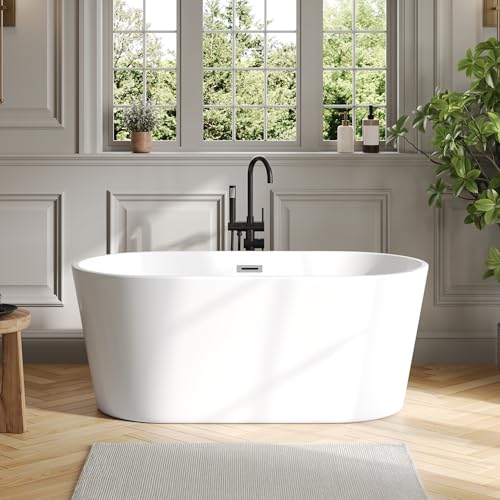
DeerValley 55″ Acrylic Freestanding Deep Soaking Tub — Compact deep-soak specialist
DeerValley’s fifty-five inches will look like a limitation until the first soak explains the design. The shell spends its compact footprint on depth and posture rather than on stretch: steep walls, a centre drain, and an integrated overflow combine to put a seated bather deep in the water with knees bent and shoulders submerged, in bathrooms — ensuites, converted corners, small primary baths — where a sixty-inch tub would crowd the vanity’s swing or the door’s arc. The centre drain is the layout’s quiet genius. With the waste in the middle, neither end of the tub is the plumbing end, so the bather reclines against whichever slope suits the evening, and a second, smaller bather or a child can share the far end without negotiating with a drain cover.
The ergonomic shaping in the listing’s description is doing real work here. In a short tub, the backrest angle is the whole game: too upright and the soak becomes a sit; too reclined and the bather slides until the neck finds the rim at an unhappy angle. DeerValley shapes for the supported middle — a slope that holds the torso while the deep water does the floating — and the result suits the way compact-soaker owners actually bathe: thirty to forty-five minutes, book or music, fully enveloped. The white standalone form also plays well in shower-adjacent layouts, where the tub stands within a wet zone and its compactness leaves the shower its honest share of the room.
Who should walk past it? Tall bathers who measure a soak by leg extension will find fifty-five inches a posture, not a stretch, and couples should treat it as a one-person instrument with occasional visiting rights. Everyone else — and especially renovators of small bathrooms who feared depth was a large-room privilege — should measure their floor against this shell before assuming anything. DeerValley’s Amazon listing carries the interior dimensions that matter, so compare your seated height against them and check price on Amazon when the numbers promise the envelope you are after.
- Length: 55 inches, compact footprint
- Drain: centre position, both ends recline
- Overflow: integrated, high waterline intent
- Shape: ergonomic deep soaking design
- Setting: small baths and wet-zone layouts
Strengths
- Full submersion inside a tiny footprint
- Centre drain frees both backrests
- Fits bathrooms longer tubs cannot enter
Trade-offs
- No full-length stretch for tall frames
- Bent-knee posture is the design’s premise
- Sharing is a squeeze, not a feature
Best for: small-bathroom renovators who refuse shallow compromises. Not suited for: tall bathers who soak to stretch out flat.

Empava 59″ Freestanding Deep Soaking Tub — Measured 15-inch soak depth
Empava does the thing this guide wishes every maker would do: it prints the soak depth. Fifteen inches of water, floor to overflow, is a figure a shopper can hold against their own seated torso and judge without imagination — for most adults it means a waterline at the upper chest to collarbone when seated, which is the envelope this category exists to deliver. At fifty-nine inches the shell stays inside the near-sixty class that fits ordinary bathrooms, and the specification continues in the same honest register: ergonomic back support, an anti-slip bottom, cUPC certification, and the drain and overflow included rather than itemised as surprises.
The anti-slip floor deserves more than a passing nod in a deep tub. Depth multiplies the consequences of a slick base, because entering and leaving a deep shell involves a higher step-over and a moment where the bather’s weight transfers across wet acrylic; a textured floor turns that moment from a negotiation into a non-event, and for older bathers or households bathing children it may be the single most valuable line in the specification. Empava’s broader catalogue leans toward jetted spectacle, which makes this plain, deep, certified soaker an interesting act of restraint from the same stable — the depth is the feature, and the listing knows it.
Pairing counsel: the fifty-nine-inch length and the fifteen-inch depth make this the list’s most balanced answer for a primary bathroom that wants one tub to serve every bather in the house. Shorter bathers get the envelope without drowning in length; taller bathers get genuine submersion with knees bent and no complaint worth printing. A filler with a handheld companion will serve the deep shell well for rinsing, and the included hardware settles the finish-matching before the first tile is cut. Empava’s Amazon page is the place to verify the depth figure against the dimension drawing and check price on Amazon for this measured, certified soaker.
- Soak depth: 15 inches, stated in listing
- Length: 59 inches overall
- Floor: anti-slip bottom texture
- Certification: cUPC certified per listing
- Hardware: drain and overflow included
Strengths
- Published depth ends the guessing game
- Anti-slip base suits deep step-overs
- Balanced size serves a whole household
Trade-offs
- Deep step-over needs care from stiff knees
- Plain styling next to the fluted pick
- Near-sixty length still crowds tiny rooms
Best for: households wanting one certified deep soaker for everyone. Not suited for: bathers who need a low, easy entry above depth.

66″ Lucite Acrylic Freestanding Bathtub — Lucite-grade clarity pick
Most acrylic tubs are described by their shape; this one is described by its sheet. Lucite is a branded acrylic known in the industry for colour consistency and surface clarity, and a tub formed from it carries a gloss that reads deeper and stays truer than generic sheet — the difference between a white that glows under bathroom light and a white that merely reflects it. At sixty-six inches, the shell gives the depth-seeking bather something the compact picks cannot: length enough to combine submersion with a genuine stretch, so the soak offers both postures — knees bent and enveloped, or legs extended and floating — in a single fill.
The supporting specification is grown-up in the ways that matter over years. cUPC certification places the tub inside the tested framework. A non-slip base addresses the deep-tub entry described in the Empava review. The chrome drain keeps the hardware neutral among metal palettes, and the listing’s mention of an integrated water bypass — its overflow arrangement — speaks to tidy, concealed water management rather than a visible slot that interrupts the rim’s line. Installation is described as straightforward, and at sixty-six inches of acrylic the shell remains a two-person carry, which keeps this largest-of-the-classic-sizes within the reach of a normal renovation crew and a normal doorway, provided the route is measured with the respect all longer tubs demand.
Choose this tub when the bathroom has the floor for it and the household’s bathers span heights: it is the list’s best answer to the mixed-stature family, where the compact deep shells delight one partner and fold the other. The Lucite surface also suits rooms with strong natural light, where lesser gloss shows every micro-flaw by noon; a clarity-grade sheet under a window is a daily pleasure that never appears on a comparison chart. The listing on Amazon holds the full drawings, so confirm the sixty-six against your long wall and check price on Amazon when the room agrees to the length.
- Material: Lucite-brand acrylic sheet
- Length: 66 inches, stretch plus depth
- Base: non-slip floor per listing
- Certification: cUPC certified design
- Drain: chrome, with integrated bypass overflow
Strengths
- Sheet quality shows under natural light
- Both bathing postures in one shell
- Certified, grippy, and hardware-complete
Trade-offs
- Needs a room that can present 66 inches
- Larger fill than the compact picks use
- Premium sheet positions it above budget tiers
Best for: mixed-height households with a generous bathroom. Not suited for: compact ensuites or minimal-fill budgets.

69″ Oval Acrylic Deep Soaking Tub, Fluted — Sculpted fluted statement
Every list needs one tub that begins conversations, and the fluted sixty-nine is unmistakably this one. Vertical fluting runs around the exterior — a series of fine, even ribs that catch light and shadow in alternating stripes — and a rolled rim softens the top edge where arms rest and where the eye lands first. The effect is closer to furniture or ceramic ware than to bathroom equipment, and in a room with plain walls it supplies all the texture the space requires. Crucially, the drama is worn outside; the interior remains a smooth, deep oval soaking shell, so the bather’s experience is the category’s classic envelope, merely delivered by the best-dressed vessel in the guide.
At sixty-nine inches the shell serves the tall-bather brief as faithfully as the seventy-two-inch class does, with a slightly easier claim on the room. The rolled rim has a practical side beyond beauty: it gives wet hands a generous, comfortable grip during entry and exit, and it sheds the occasional splash back into the tub rather than letting it sheet down the fluting. The fluted exterior does ask one thing of its owner — dust and bathroom mist settle in texture more willingly than on a plain shell, so the weekly wipe should include a soft brush or cloth worked around the ribs, a two-minute ritual that owners of statement pieces tend to accept as the rent on beauty.
Placement should honour the profile: this tub wants clearance on all visible sides and a doorway view that includes its textured flank, because a fluted shell pushed against a wall spends half its sculpture on an audience of tiles. Floor-standing fillers compose especially well with the rolled rim, rising beside the tub like a second piece of the same furniture set. If your renovation has been waiting for its protagonist and your bathers run tall, the fluted oval is the protagonist with a depth figure to match its silhouette. Its Amazon listing offers the photographs this design deserves, so study them at full size and check price on Amazon when the room is ready for its statement.
- Length: 69 inches, tall-bather friendly
- Exterior: vertical fluted texture
- Rim: rolled edge, easy wet grip
- Interior: smooth deep oval soaker
- Presence: furniture-grade statement piece
Strengths
- Texture turns the tub into the room’s art
- Rolled rim grips kindly and sheds splashes
- Length plus depth serves tall bathers fully
Trade-offs
- Fluting collects dust between wipes
- Needs all-round clearance to justify itself
- Statement styling will not suit quiet rooms
Best for: design-led primary baths with tall bathers. Not suited for: minimalists or tight, clearance-poor layouts.
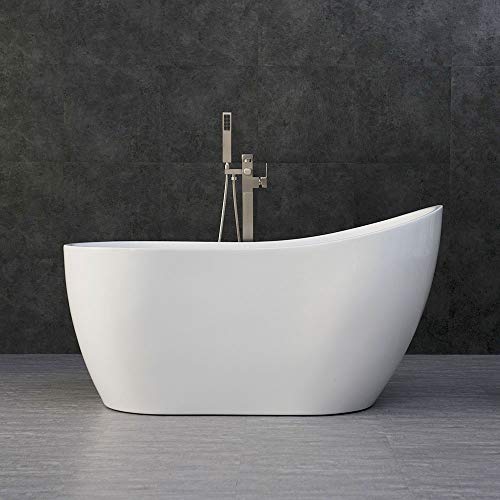
WOODBRIDGE Acrylic Freestanding Soaking Tub — Small-footprint WOODBRIDGE soaker
WOODBRIDGE appears in this guide’s other size classes at fifty-nine and seventy-two inches; here the maker compresses its contemporary soaking design to fifty-four, the smallest footprint in the list, and finishes the hardware in brushed nickel. The proposition is precise: the smallest bathrooms — the ensuite carved from a wardrobe’s ambition, the cottage bath under the eaves — should not be exiled from the deep-soaking conversation merely for being small. A fifty-four-inch shell with WOODBRIDGE’s shaping discipline delivers the envelope by posture, exactly as the DeerValley does, but with the backing of a catalogue deep enough that matching fittings and future parts are a search rather than a scavenger hunt.
The brushed nickel overflow and drain sit in the diplomatic middle of the metal spectrum, agreeing with chrome taps and with warmer accents alike, which matters in small rooms where every finish is visible in a single glance and a mismatch has nowhere to hide. The contemporary profile — clean oval lines, no ornament — performs the small-room trick of looking intentional rather than squeezed: the tub reads as a chosen object in a composed space, not as the survivor of a size compromise. Guests consistently misjudge such tubs as larger than they are, because proportion, not dimension, is what the eye actually measures.
The bathing truth is the compact truth, stated once more without apology: knees bent, water high, stretch surrendered. For the solo bather of average height or below, that surrender buys the full envelope in rooms no other pick here can enter, and for guest baths it buys something subtler — a soak that makes visitors feel the house was designed kindly. Tall owners should test-sit the dimensions against their own seated measurements with unusual care, because fifty-four inches forgives nothing. When the tape confirms the fit, the WOODBRIDGE listing on Amazon is the spot to check price on Amazon and review the nickel finish against your room’s other metals.
- Length: 54 inches, smallest here
- Trim: brushed nickel overflow and drain
- Profile: contemporary soaking oval
- Maker: WOODBRIDGE deep catalogue support
- Setting: ensuites and cottage bathrooms
Strengths
- Enters bathrooms every rival must skip
- Nickel trim mediates mixed metals
- Maker depth supports parts for years
Trade-offs
- Strictly a bent-knee bathing posture
- Tall bathers must measure with real care
- Compact volume cools a touch faster
Best for: the smallest bathrooms that still deserve deep water. Not suited for: tall bathers or stretch-first soaking styles.

SYLONWILL 61″ Classic Oval Deep Soaking Tub — Heavy-duty classic oval
The SYLONWILL closes the list with the most traditional proposition of the six: a classic oval, sixty-one inches by thirty-one, in glossy white, described by its maker as heavy duty. That phrase, in a category of moulded shells, points at wall substance and rim rigidity — the qualities a hand tests instinctively when it grips the edge of an empty tub in a showroom. A shell that feels solid unfilled tends to feel calm filled, without the faint flex or drum that lighter constructions can transmit when a bather shifts position, and for households that include enthusiastic bathers — teenagers, the family dog’s bath day, a bather who hauls on the rim to stand — that substance is a daily reassurance rather than a specification.
The classic oval shape is the other half of the appeal, and classic here is a considered choice rather than a failure of imagination. An oval with balanced ends and no sculptural gestures agrees with every bathroom era from Victorian revival to this year’s minimalism, which makes the SYLONWILL the safest long-term resident in the list for houses whose style evolves around their fixtures. At sixty-one inches it sits a breath above the standard sixty, buying a small but real increment of legroom while keeping the footprint inside the ordinary bathroom’s generosity, and the deep-soaking design keeps the waterline where this category promises it will be.
Buyers who renovate rental properties, family homes with hard use ahead, or simply their own forever bathroom with an eye on the second decade will recognise this pick’s argument immediately: depth, substance, and a shape that will never need explaining. The gloss white finish asks for the standard gentle care described elsewhere in this guide, and rewards it by staying the neutral ground against which towels and textiles can change with the seasons. SYLONWILL’s Amazon page carries the shell’s drawings and is the place to check price on Amazon for the heavy-duty classic of the list.
- Size: 61 by 31 inches, classic oval
- Build: heavy-duty shell per listing
- Finish: glossy white acrylic
- Design: deep soaking interior
- Character: era-proof, hard-use friendly
Strengths
- Substantial feel under hand and bather
- Classic shape survives style changes
- Slightly longer than the standard sixty
Trade-offs
- No certification headline in the listing
- Traditional looks will not thrill modernists
- Heavier shell asks a firmer carry plan
Best for: hard-use family homes and forever bathrooms. Not suited for: shoppers chasing a sculptural centrepiece.
How Do the Six Soakers Compare on the Numbers That Matter?
| Pick | Length | Depth story | Signature trait |
|---|---|---|---|
| DeerValley 55″ Acrylic Freestanding Deep Soaking Tub | 55 in | Deep for its size | Centre drain freedom |
| Empava 59″ Freestanding Deep Soaking Tub | 59 in | 15 in stated soak | Anti-slip, certified |
| 66″ Lucite Acrylic Freestanding Bathtub | 66 in | Deep with stretch | Lucite sheet clarity |
| 69″ Oval Acrylic Deep Soaking Tub, Fluted | 69 in | Deep, tall-bather | Fluted exterior |
| WOODBRIDGE Acrylic Freestanding Soaking Tub | 54 in | Deep for its size | Nickel trim, tiny footprint |
| SYLONWILL 61″ Classic Oval Deep Soaking Tub | 61 in | Deep classic oval | Heavy-duty build |
How Do You Measure Soak Depth Before You Buy?
Bring your own body to the arithmetic, because no catalogue photograph can sit in the tub for you, and the difference between a depth that envelopes and a depth that merely wets is measured on your own frame or not at all. Sit on a chair against a wall, in your bathing posture, and have someone measure from the seat to your collarbone; that figure is the water depth your shoulders are asking for, and any tub whose floor-to-overflow measurement meets it will deliver the envelope, whatever its length. Then measure the same body’s seated length — back to knees, knees to feet — and hold it against the tub’s interior floor length to learn which posture the shell intends: full stretch, knees softly bent, or the compact curl of the fifty-four and fifty-five-inch specialists. Makers publish exterior dimensions in headlines and interior dimensions in drawings, and the drawings are where a soaker purchase is actually decided.
Overflow style quietly modifies the number. A high, slot-style overflow lets the waterline sit close to the rim, while a traditional round overflow set lower in the wall caps the depth a few inches shy of the shell’s apparent promise. Neither is dishonest, but only one matches a depth-first brief, so the overflow’s position belongs on the checklist beside the depth figure itself. Households bathing in stages of life — toddlers today, teenagers tomorrow — sometimes ask how the deep-soaker choice interacts with the family-bathing years, and the staged answer, from first sink baths to independent soaking, is mapped in Best Baby Bathing Tubs and Seats. The deep tub waits at the end of that journey as the fixture the children will eventually claim.
How Do You Keep a Deep Soak Hot From First Page to Last?
Still water cools from the top, and a deep soak’s enemy is the long, undisturbed chapter. The defences are simple and cumulative. Start a degree or two warmer than your comfort point, because the shell and the room will take their small tax in the first minutes. Pre-warm the shell itself with a splash of hot water while the tub fills, so the acrylic does not drink the first fill’s heat. Keep the room’s door closed and the extractor off during the soak — ventilation can have its turn afterwards — because moving air across a large water surface is a cooling machine. A bath caddy or a simple insulated cover panel laid across the unused half of the tub, where the design allows, slows the surface loss noticeably on the longest reads.
The top-up ritual deserves defending rather than apologising for. Every long-soak tradition in the world includes adding hot water midway, and a filler within reach — or a handheld on a long hose parked at the rim — turns the top-up into a ten-second pleasure rather than an expedition. Bathers who soak with a partner will find the deeper shells in this list hold their shared temperature generously, because two bathers displace more water and present less surface per person. Judge your own habit honestly: if your soaks run twenty minutes, any pick here stays welcoming; if they run past the hour, the starting temperature and the top-up plan matter more than the shell, and every pick here rewards the planner equally.
How Does Acrylic Compare With Stone, Iron, and Copper for Pure Soaking?
Depth seekers eventually interrogate the other materials, and each has an honest answer. Cast iron holds heat in its mass and feels immovable, but a deep iron soaker weighs enough to rewrite the floor plan and the delivery plan simultaneously, and its enamel demands chip discipline forever. Solid-surface and stone-resin shells offer a matte, sculptural presence and excellent heat behaviour at a weight between acrylic and iron, with prices that climb accordingly. Copper conducts heat so eagerly that the first fill warms the metal as much as the bather, then rewards long soaks with a living patina that households either romanticise or resent. Against that company, acrylic’s case is democratic: the lightest deep shells, the warmest first touch, the easiest repair, and the lowest tier at which genuine depth can be bought.
The material also shapes what shapes are possible. Because acrylic sheet is heated and drawn into a mould, designers can pull steep walls, compound curves, and features like the fluted exterior in this list at prices that carved or cast materials cannot approach. That formability is why the deep-soaking renaissance happened in acrylic first: the geometry of submersion — high overflow, steep sides, sculpted back — is moulding’s home ground. Bathers choosing acrylic are not accepting the budget substitute for a nobler tub; they are choosing the material in which the modern soaker was invented, with a care routine gentler than iron’s and a delivery day kinder than stone’s. The verdict of this guide is that for depth per unit of money, weight, and worry, no rival material currently answers back.
How Should You Test-Sit a Soaker Before Committing?
Where a showroom or a friend’s renovation offers the chance, the test-sit is worth more than an hour of reviews, this one included. Arrive with your measurements from the depth section above and a willingness to look mildly eccentric: sit in the dry shell in your bathing posture, close your eyes, and let your body file its report. The backrest should meet your spine without a negotiation. Your heels should find a position that does not require pressing into the far wall to stay put. Your arms should discover a natural rest — rim, waterline ledge, or the shell’s own shaping — because an hour is a long time for arms to improvise. Then rehearse the exit, which is the movement deep tubs make interesting: hands on the rim, weight forward, feet finding the floor inside before the step over the wall. A shell that admits you gracefully and releases you safely has passed the only examination that cannot be faked by a specification sheet.
Households buying online without a test-sit can simulate the examination honestly. Tape the tub’s interior floor length and width onto a clear floor, mark the backrest angle with cushions, and sit inside the outline at bath posture while someone reads the overflow height against your collarbone from the depth measurement. It feels theatrical for four minutes and informative for a decade, which is the correct exchange rate for pre-purchase rituals. Pay particular attention to the household’s tallest and shortest bathers in the same simulation, because a soaker is a shared instrument and the extremes of the family are where a compromise announces itself. The picks in this list span fifty-four to sixty-nine inches precisely so that the simulation ends with a shell whose posture matches the bodies that will actually use it.
Which Accessories Genuinely Earn Their Place Around a Jet-Free Tub?
A soaker’s simplicity invites accessories, and most of them are clutter auditioning for a purpose. The few that earn their keep share a trait: they serve the water, the bather’s reach, or the exit. A bath caddy that fits the shell’s rim width turns the far end into a library and a drinks shelf, and on the flat-rimmed ovals here it sits securely; on the fluted and slipper profiles, a side stool does the same work without balancing on a curve. A quality bath pillow transforms the backrest equation for bathers whose chosen shell leans firm, and it should be chosen for the tub’s actual angle rather than from a photograph. A handheld shower on an adequate hose is the soaker’s true companion appliance — rinsing hair, rinsing the shell, rinsing the dog — and it converts the weekly clean from a chore into a rinse that happens while the tub drains.
The rest of the catalogue can mostly be declined with a clear conscience. Rotating trays, floating speakers, and elaborate rack systems solve problems a stool and a shelf solve silently, and every object stored on a rim is an object that will eventually be knocked into the water at the exact moment both hands are occupied. The discipline that suits a jet-free tub is the discipline of the tub itself: few things, each earning its place, nothing mechanical between the bather and the water. Households that hold that line find the bathroom stays calm to look at and quick to clean, which are the two qualities that keep a daily soak feeling like a ritual rather than a production.
Does a Morning Soak Ask Anything Different of the Tub?
Evening soaking dominates the imagination, but a devoted minority bathes in the morning, and the deep soaker serves them with a different emphasis. A morning soak is shorter, hotter, and functional — a reset before the day rather than a dissolution after it — so fill speed and heat retention across twenty minutes matter more than the hour-long envelope, and the compact deep shells shine here because their smaller volumes reach temperature quickly and their full submersion delivers the reset without a long appointment. Morning bathers also notice light: a tub placed where early sun lands turns a hygiene routine into the best-lit quarter hour of the house’s day, and the gloss of a clean acrylic shell returns that light generously.
Households split between morning and evening bathers should choose for the evening, because the longer soak is the stricter examination, and then let the morning bather enjoy the surplus. The one arrangement worth planning for both is the filler: a thermostatic control that can be set once and trusted lets the morning’s half-asleep operator fill by habit, and lets the evening’s reader top up without a temperature negotiation. Time-of-day thinking sounds precious until a household realises its tub serves two different rituals in the same shell — at which point the deep, simple, jet-free design reveals its final virtue, which is that it asks nothing of either ritual except hot water and a little uninterrupted time.
What Mistakes Do Soaker Buyers Keep Making?
Shopping by exterior length is the founding error of the category, and this entire guide exists to retire it: a shallow sixty-seven disappoints where a deep fifty-nine delights, and the tape measure cannot tell the difference — only the depth figure can. The second mistake is ignoring the step-over. Depth lives on both sides of the shell wall, and a high waterline means a high rim to cross; households should rehearse the entry against the published rim height, especially where knees or balance are considerations, and consider a stable step as part of the installation rather than an admission. Third is the drain surprise: centre, left, and end drains each ask something different of the floor beneath, and discovering the mismatch after the floor is finished converts a small fact into a large bill.
The last mistakes are habits rather than purchases. Owners sometimes fill a deep soaker like a shallow one — water to the old line — and conclude the tub underdelivers, when the overflow was placed high precisely to invite the extra inches. Others let bath oils bake onto the waterline of a gloss shell through a summer of quick rinses, then blame the acrylic for a film that a weekly cloth would have prevented. A deep soaker is the simplest fixture in the bathroom; it asks only to be filled to the depth it was built for and wiped while it is still warm, and it repays those two small faithfulnesses with the oldest pleasure in the house.
How Will a Deep Soaker Age Alongside the Household?
A tub bought for depth tends to be bought for a long tenancy, and its second decade asks different questions than its first. Children who once needed a parent’s arm over the rim become teenagers who claim the deep water for hour-long sovereignty, and the shell’s size should be chosen with that future bather in the room — one more argument for the mid-length picks when the household is young. Knees and hips change their requests too, and the anti-slip floor and rim grip that seemed like specification garnish at purchase become the features the household thanks at year fifteen. Acrylic’s repairability pays its quiet dividend across the same span: the dropped bottle, the gritty scouring pad used by a well-meaning guest, the small catastrophes of a lived-in house can be polished back rather than lived with forever. Choose the depth for tonight, by all means — but let the shell’s manners across twenty years cast a vote as well, because a soaker is one of the few purchases a household makes that its future selves will have a daily opinion about.
What Should Waiting Feet Wear While the Tub Fills?
A deep fill takes a few unhurried minutes, and the household that bathes nightly usually develops a small choreography for them: salts measured, towel staged, feet kept warm on the cool floor rather than in it. That last detail sends many readers toward house shoes with covered toes and a proper heel, which stay on during the step-over dance and keep the whole foot warm while the water climbs — the styles compared in Best Closed-Toe and Closed-Heel Slippers were practically designed for the filling interval. Choose a pair with a sole that grips tile, park them where the bather’s feet land on exit, and the soak’s first and last ten seconds become as considered as the hour between them.
What Does Installation Day Look Like for a Freestanding Soaker?
Freestanding soakers enjoy the simplest installation story in the bathroom, and a calm day follows a short script. The shell arrives, is inspected in good light for transit marks, and is walked to the bathroom by two carriers who have already measured the route. It stands dry in its intended position first — not plumbed, just present — while the household confirms the sight lines, the cleaning crescent, and the filler’s reach with their own eyes rather than the drawing’s. The drain connection follows, using the flexible tolerance built into most freestanding assemblies to reconcile the shell’s drain with the floor’s rough-in, and then the test that matters: a partial fill, a pause, and dry hands checking every joint before the tub is trusted with a full depth of water.
The final step is the levelling check, because a deep tub announces a slope honestly — the waterline is a spirit level that cannot be argued with, and a shell sitting a few millimetres proud on one side will show it at the overflow. Adjustable feet or brackets, like those noted on one of this list’s compact rivals in the freestanding class, exist precisely for this moment, and five patient minutes with them buys a decade of even waterlines. Sealant, where the design calls for it at the base, is applied after the test fill, not before, so that no bead of silicone is asked to hide a problem the water has not yet been allowed to reveal. By evening, the simplest fixture in the house is ready for its first unhurried use.
How Do You Choose Between the Two Compact Specialists?
The DeerValley and the WOODBRIDGE sit a single inch apart in length and a whole philosophy apart in emphasis, so the choice between them teaches the category in miniature. The DeerValley’s centre drain is its argument: both ends free, posture chosen nightly, a tub that behaves like a small, deep room. The WOODBRIDGE answers with maker depth and nickel diplomacy: a catalogue behind it, hardware that agrees with any metal in the house, and a profile that flatters the tiny rooms it was drawn for. Bathers who soak facing the window one night and the door the next will feel the centre drain’s freedom weekly. Bathers renovating a period ensuite, where fittings must compose across brands and decades, will feel the WOODBRIDGE’s steadiness yearly. Neither answer is the consolation prize; they are two different definitions of what a small bathroom’s luxury consists of, and the household’s own habits — variety of posture versus harmony of finish — should cast the deciding vote without regret in either direction.
Final Recommendation
Decide your posture first, and the list sorts itself. Bathers who want the envelope in the smallest possible room should take the DeerValley or the WOODBRIDGE and enjoy depth that their floor plan had no right to expect. Households wanting one certified, measured, anti-slipped answer for every bather should take the Empava and its published fifteen inches. Rooms with length to spend divide by taste: the Lucite sixty-six for clarity and mixed heights, the fluted sixty-nine for theatre, and the SYLONWILL for substance in a classic line. Whichever shell you choose, fill it to the overflow it was given and let the water close over your shoulders in complete, machinery-free silence — because the deepest luxury in a modern bathroom is a tub with nothing to switch on.
Frequently Asked Questions
What soak depth should I look for?
Measure your own seated height to the collarbone and treat that as the target; for most adults it falls in the mid-teens of inches. The Empava’s stated fifteen-inch soak is a useful benchmark. A tub whose overflow sits well below your target will leave shoulders in the air regardless of its length.
How long does a deep soak stay comfortable?
Most bathers find forty minutes to an hour is the natural span: long enough for the day’s tension to leave the shoulders, short enough that the water is still welcoming at the end when the starting habits in this guide are followed. Longer soaks are a pleasure some households cultivate deliberately, with a top-up ritual and a thicker book, and the deeper shells here accommodate that cultivation without any change of equipment — only the starting temperature and the door kept closed against the house’s cooler air.
Are soaker tubs colder than jetted tubs?
No — they simply lack a heater to disguise heat loss. Still water in a deep shell holds its temperature well, especially with the starting-temperature and top-up habits described above. Jetted tubs move water across the skin, which can feel cooler despite the machinery, so many bathers find a deep still soak warmer in practice.
Is acrylic durable enough for a deep tub used daily?
Yes, with gentle care. The surface is non-porous, repairable if scratched, and warm to the touch. Avoid abrasive cleaners, wipe bath oils from the waterline weekly, and a quality shell — particularly a Lucite-sheet one — will keep its gloss through years of daily soaking.
Centre drain or end drain: which is better?
Centre drains free both ends for reclining and suit tubs used from either side. End drains match more existing rough-ins and keep the plumbing at one end of the room. The better choice is the one that agrees with both your bathing posture and your floor’s existing waste position.
Can a deep soaker work in a rental-friendly renovation?
A freestanding acrylic soaker is among the more reversible upgrades: it connects to existing drain and filler points, needs no deck or surround construction, and can leave with you if the tenancy and the landlord’s terms allow. Confirm the drain position and keep the original fixtures stored safely.
Do I need a bigger water heater for a deep soaker?
Not usually. Compact deep tubs often use less water than a long shallow tub filled to a modest line, because the bather’s bent-knee posture displaces volume efficiently. The sixty-six and sixty-nine-inch picks draw more, so check their capacities against your heater’s recovery if baths run back to back.
Related Guides
For the full material story — acrylic in alcove, drop-in, and freestanding forms, weighed against the other shells a bathroom can wear — continue to Best Acrylic Bathtubs, the general companion to this depth-first selection, and the right next read for anyone whose shortlist has started to include alcove renovations or a second bathroom where the depth-first rules of this page will need translating into a different format’s language altogether.


