What's inside
- Key Takeaways
- Quick Picks
- How Did We Choose These Closed-Back Slippers?
- Why Does a Closed Heel Matter So Much on Stairs?
- How Warm Is Warm Enough? Reading Linings Honestly
- How Should Closed-Back Slippers Fit?
- What Does a Covered Toe Actually Protect You From?
- How Should You Read Memory Foam Claims Without a Laboratory?
- Common Mistakes When Buying Closed-Back Slippers
- Final Recommendation
- How Do You Keep Fleece, Knit and Faux Fur Looking Alive?
- How Do Closed-Back Slippers Serve Households with Children and Pets?
- When Should a Closed-Back Slipper Be Replaced?
- What Does the Morning Routine Reveal About a Slipper?
- How Do Closed-Back Slippers Compare with Slipper Socks and Booties?
- Why Do Hospitals and Hotels Keep Choosing Enclosed Slippers?
- How Should You Break In a Stiff New Heel Counter?
- What Role Does the Outsole Play in an Enclosed Slipper’s Character?
- How Do You Gift Closed-Back Slippers Without Guessing Wrong?
- How Do the Seasons Change What You Ask of an Enclosed Slipper?
- What Should You Check in the First Fortnight of Ownership?
- Frequently Asked Questions
- Related Guides
As an Amazon Associate I earn from qualifying purchases. This post may contain affiliate links at no extra cost to you.
cottageverdict.com is reader-supported. When you buy through links on our site, we may earn an affiliate commission.
Where to buy: each pair below is listed on Amazon in women’s size ranges with colour choices on the product page, so you can check price on Amazon in your size before deciding which closed-back design suits your floors.
A slipper can fail a foot in two directions: it can let the toes meet the furniture, and it can abandon the heel on the stairs. The best closed-toe and closed-heel slippers refuse both failures at once. A covered toe stands guard against table legs, door frames and the dropped phone charger; a closed heel keeps the slipper attached to the foot through staircases, quick turns and the backwards shuffle every cook performs at a stove. What sounds like a small design decision becomes, over a winter of evenings, the difference between footwear you trust and footwear you supervise.
Warmth is the third dividend, and the most immediate. A fully enclosed slipper wraps the whole foot in its lining, sealing the gaps at the heel and toes where open designs leak heat to a draughty hallway. The six pairs in this guide — all women’s closed-back designs, since that is where this category’s best engineering currently lives — divide by lining, cuff and sole: deep teddy fleece for cold houses, knit cuffs that hug the ankle, memory foam in several densities, and rubber soles that all claim some outdoor ambition.
A note on scope before the reviews: this guide talks about comfort, warmth and household practicality only. Closed-back slippers are not medical devices, and nothing here promises relief for any foot condition; readers with specific health concerns should take advice from their own clinicians and treat these pages as what they are — a guide to cosier, more secure evenings at home.
Key Takeaways
- A closed heel is a safety feature on stairs, keeping the slipper on the foot instead of half a step behind it.
- A covered toe protects against the furniture collisions every household choreographs nightly.
- Full enclosure traps warmth around the entire foot, which is why closed designs dominate cold-house recommendations.
- Memory foam, fleece and knit cuffs solve different problems; choose by your floors and your temperature, not by softness alone.
- All six picks here are women’s closed-back slippers, the centre of gravity of this category.
Quick Picks
| Pick | Badge | Why it earns its place |
|---|---|---|
| RockDove Women’s Teddy Fleece Closed-Back Slipper | Best for Cold Houses | Deep teddy fleece inside a lightweight closed back, built for maximum warmth per step. |
| Dearfoams Women’s Rebecca Closed-Back Slipper | Best Trusted Classic | A long-running memory foam design from a heritage slipper brand, offered in wide widths. |
| ULTRAIDEAS Women’s Memory Foam Closed-Back Slippers | Best Indoor-Outdoor Sole | A loafer-shaped closed back on a soft rubber sole made for house-to-garden duty. |
| RockDove Women’s Knit Cuff Closed-Back Slippers | Best Ankle-Hugging Fit | A knitted cuff seals around the ankle while memory foam handles the cushioning below. |
| HomeTop Women’s Closed-Back Fuzzy Slippers | Best Plush Craftsmanship | Shearling-style lining, dense foam and an ankle wrap in a carefully stitched chestnut package. |
| Litfun Women’s Fuzzy Memory Foam Closed-Back Slippers | Best Faux-Fur Finish | A faux fur collar over memory foam comfort, with a non-slip sole for hard floors. |
How Did We Choose These Closed-Back Slippers?
We began at the heel, because the heel is this category’s reason to exist. A genuine closed back rises high enough to cup the heel and stays there through a staircase test — not a decorative lip that the foot escapes by the third step. From there we examined the toe: fully covered, with enough structure to matter against furniture, and enough room inside that toes rest rather than press. Linings were judged by the job they claim — deep fleece for cold houses, lighter knits for heated ones — and memory foam by its density, since foam that collapses in a fortnight is a loan, not a feature.
Soles had to respect hard floors quietly and grip them honestly. Every pick here carries a rubber or rubber-style outsole rated by its maker for indoor use with some outdoor tolerance, because a closed-back slipper that cannot cross a patio is a slipper that gets swapped for shoes six times a day, and a swapped slipper is an unworn one. We also favoured makers who publish care instructions and offer width or size breadth, since enclosed designs forgive sizing errors far less than open ones do.
Readers comparing enclosure philosophies may enjoy the contrast with the dance world’s choices in Best Split-Sole Ballet Slippers, where the foot is deliberately freed rather than wrapped — two categories solving opposite problems with equal conviction. Here, enclosure is the entire point, and each pick below was graded on how completely and comfortably it achieves it.

RockDove Women’s Teddy Fleece Closed-Back Slipper — Best for Cold Houses
RockDove wraps the closed-back idea in teddy fleece and aims it squarely at the cold end of the market. The fleece — that short, dense, lamb-like pile — lines the slipper’s interior and collars its opening, so the foot slides into warmth that reaches the ankle rather than stopping at the toes. The maker emphasises how light the pair feels for its warmth, which matters more than it sounds: a heavy slipper is a slipper left by the bed, while a light one gets worn to every room the evening visits.
The closed back here is a proper heel cup rather than a gesture, and testers of this style consistently praise the secure, held feeling on stairs and in quick kitchen turns. Underfoot, the cushioning is tuned for comfort across an evening rather than for standing shifts, and the outsole handles indoor floors with the occasional doorstep excursion. The off-white colourway featured in the listing is the brave choice for households with dark floors and pets; darker shades in the range forgive more.
Size by your usual shoe size and expect the fleece to settle into your foot’s shape over the first week, easing any initial snugness. This is the pair for stone floors, old houses and anyone whose feet announce the weather before the forecast does. It is sold through its listing in a range of sizes; check price on Amazon there, and note the care guidance, since fleece linings reward gentle washing and patient air-drying.
- Style: closed-back slipper, teddy fleece
- Lining: plush teddy fleece throughout
- Character: lightweight for its warmth
- Colour: off white featured, other shades in range
- Use: cold houses, hard floors, evening wear
Strengths
- Deep fleece warmth reaches the whole enclosed foot
- Secure heel cup inspires confidence on stairs
- Feels lighter than its insulation suggests
Trade-offs
- Light colourways show household dust quickly
- Fleece can run too warm in heated modern flats
- Cushioning suits evenings more than long standing
Best for: women in cold or draughty houses who feel winter through the floor
Not suited for: warm-flat dwellers who overheat in lined footwear

Dearfoams Women’s Rebecca Closed-Back Slipper — Best Trusted Classic
Dearfoams has been making slippers since the middle of the last century, and the Rebecca shows what that heritage buys: a closed-back memory foam slipper with no experimental urges, offered in wide widths as well as standard — a detail that immediately widens its welcome. The peacoat colourway in the listing is the sober navy that disappears into wardrobes, and the whole design reads as the default answer to the question this guide asks.
The memory foam footbed is the Rebecca’s centre of gravity, delivering the contouring softness the brand built its name on, while the closed back keeps that softness attached during stairs and hurried crossings. Dearfoams designs for the whole household’s rhythm — school runs to the door, evenings on hard floors, weekend mornings that drift onto the patio — and the sole is specified for that indoor-outdoor borderland rather than for the bedroom alone.
Long production runs carry a practical dividend: sizing is predictable, colours return season after season, and replacement pairs match the ones being retired. Women who value a known quantity over a novel one will find this the easiest purchase in the guide. It is retailed in its size and width range through the listing; check price on Amazon in your width, because the wide option is precisely the feature that makes this classic worth its place here.
- Style: classic closed-back slipper
- Footbed: memory foam cushioning
- Widths: wide options offered
- Colour: peacoat featured
- Brand: heritage slipper maker
Strengths
- Wide widths welcome feet most slippers ignore
- Predictable sizing from a long-running design
- Balanced for all-day household rhythms
Trade-offs
- Design is conservative beside trendier picks
- Memory foam softens further with heavy use
- Lining warmth is moderate, not arctic
Best for: women wanting a dependable, wide-friendly closed back from a known maker
Not suited for: shoppers chasing maximum plush or novelty styling

ULTRAIDEAS Women’s Memory Foam Closed-Back Slippers — Best Indoor-Outdoor Sole
ULTRAIDEAS shapes its closed back like a loafer, and that single decision changes the slipper’s social life: it looks finished enough for doorbells, school-gate dashes and the general public borderland of modern home life. Memory foam fills the footbed, the closed back keeps the loafer honest on the foot, and the soft rubber sole is explicitly an indoor-outdoor citizen, quiet on hard floors and untroubled by the path to the bins.
The black colourway featured here is the strategist’s choice, hiding the dust of real floors and pairing with everything from pyjamas to the leggings-and-jumper uniform of working from home. Warmth sits in the comfortable middle — a lined, enclosed foot without the deep-pile commitment of the fleece picks — which suits heated houses where the closed back’s job is security and toe protection more than insulation.
ULTRAIDEAS sells this design as a gift-friendly staple, and its easy sizing and broad appeal explain why. Choose your usual size, expect the foam to personalise within days, and let the loafer shape carry you from sofa to doorstep without a footwear decision in between. The pair is listed in its size range on the product page; check price on Amazon there and compare the black against the range’s softer shades for your floors.
- Style: closed-back loafer silhouette
- Footbed: memory foam
- Outsole: soft rubber, indoor-outdoor
- Colour: black featured
- Use: whole-house and doorstep duty
Strengths
- Loafer shape looks presentable beyond the lounge
- Sole genuinely serves house and garden path
- Enclosed warmth without deep-pile overheating
Trade-offs
- Foam-first cushioning flattens gradually over seasons
- Loafer styling divides traditional slipper tastes
- Moderate lining for genuinely cold houses
Best for: women wanting one presentable pair for house, door and garden
Not suited for: cold-house shoppers needing maximum fleece insulation

RockDove Women’s Knit Cuff Closed-Back Slippers — Best Ankle-Hugging Fit
RockDove’s second entry in this guide solves a different problem: the draught at the ankle and the heel that wanders in loose backs. A knitted cuff rises around the ankle like the top of a favourite sock, sealing the enclosure and holding the slipper in a gentle embrace, while memory foam below handles the cushioning. The oatmeal colourway featured is the soft neutral that seems designed by the concept of a quiet morning itself.
The cuff changes the wearing experience out of proportion to its size. Stairs feel planted, quick turns stay composed, and the warmth line rises to where socks usually end, which is precisely where open-backed and low-backed designs surrender their heat. RockDove also presents this pair as machine washable — a significant claim in the enclosed category, where linings often trap the week’s living beyond the reach of a surface wipe. Washability plus enclosure is a rare and valuable combination.
Feet that swell by evening should size thoughtfully, since a cuff that hugs at nine in the morning should still be kind at nine at night; the knit gives more than a woven back does, which helps. This is the connoisseur’s pick in the guide — less plush theatre, more considered fit. Find it in its size range through the listing and check price on Amazon, noting the washable claim in the maker’s own description before your first laundry day.
- Style: closed back with knitted ankle cuff
- Footbed: memory foam cushioning
- Colour: oatmeal featured
- Care: machine washable per maker
- Use: draughty houses, stair-heavy homes
Strengths
- Knit cuff seals warmth and secures the heel beautifully
- Machine washable, rare among enclosed slippers
- Memory foam comfort with a composed, tidy look
Trade-offs
- Cuff can feel snug on ankles that swell
- Oatmeal shade shows marks in busy households
- Less deep-pile cosiness than the fleece picks
Best for: women whose slippers wander or whose ankles feel every draught
Not suited for: anyone who dislikes anything encircling the ankle

HomeTop Women’s Closed-Back Fuzzy Slippers — Best Plush Craftsmanship
HomeTop approaches the closed back as a small piece of craft: fine stitching the maker is proud enough to headline, an ankle wrap of woolly texture, a shearling-style lining and a dense foam cushion underfoot, all finished in a warm chestnut that looks like it belongs beside a fireplace in a catalogue of good evenings. The textured TPR sole underneath keeps the poetry honest on hard floors, with grip patterned for indoor confidence and light outdoor tolerance.
The ankle wrap distinguishes this pair in wear. Where a standard closed back ends at the heel, the HomeTop’s wrap continues the enclosure upward, hugging the ankle in the manner of a low boot — a design that holds warmth in and hesitation out, especially on stairs and ladders to loft beds. The dense foam resists the rapid collapse that disappoints buyers of cheaper plush slippers, trading a little initial softness for a longer-lived cushion.
Chestnut is a forgiving, handsome colour for real homes, and the maker’s range of shades lets households match floors and tastes. Size as you would a shoe, and give the dense foam a few evenings to learn your stride before judging it. The pair is sold through its listing with its stitching and materials described in detail; check price on Amazon there, where the chestnut version’s sizing runs in the familiar women’s ranges.
- Style: closed back with ankle wrap
- Lining: shearling-style warmth
- Footbed: dense foam cushioning
- Outsole: textured TPR for grip
- Colour: chestnut featured, multiple shades
Strengths
- Ankle wrap extends warmth and security upward
- Dense foam promises longer-lived cushioning
- Fine stitching and finish feel genuinely crafted
Trade-offs
- Warmer and more enclosing than some feet want
- Dense foam feels firmer in the first evenings
- Crafted looks deserve gentler cleaning habits
Best for: women who want boot-like enclosure and a crafted finish
Not suited for: warm-house wearers who find full wraps too hot
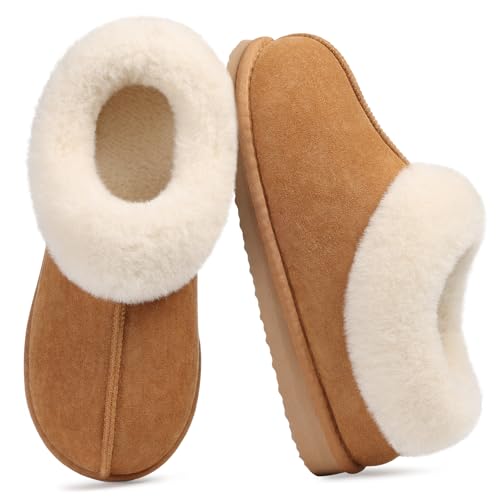
Litfun Women’s Fuzzy Memory Foam Closed-Back Slippers — Best Faux-Fur Finish
Litfun finishes the closed-back formula with a flourish: a faux fur collar framing the opening, fuzzy warmth through the lining and memory foam underfoot, in a chestnut closed-back build that treats the slipper as an item of visible pleasure rather than a hidden utility. The collar does practical work too, cushioning the ankle bones and sealing the top line of the enclosure against draughts, so the glamour is not purely decorative.
The non-slip sole is specified for the indoor-outdoor borderland, and the whole pair pitches itself at the gift-and-self-gift market with some justification: it photographs beautifully, arrives feeling indulgent and wears, by the maker’s description, like the memory foam slippers that dominate this category’s bestseller lists. Warmth is generous — this is a pair for women who run cold and houses that let them.
Faux fur asks for a little respect in return: keep it away from radiators, brush it back to life when it flattens, and wash only as the maker directs. Sized in the larger women’s range in this listing’s featured variant, it rewards careful size checking before ordering. Find the current colours and sizes on the product page and check price on Amazon there; the collar alone will tell you whether this is your pair the moment you see it on your own feet.
- Style: closed back with faux fur collar
- Footbed: memory foam cushioning
- Outsole: non-slip, indoor-outdoor
- Colour: chestnut in featured variant
- Use: warmth-first evenings and gifting
Strengths
- Faux fur collar seals the ankle and delights the eye
- Generous warmth for cold-running feet
- Memory foam comfort in a giftable package
Trade-offs
- Collar needs gentle care to stay handsome
- Warmth will overwhelm heated modern flats
- Featured variant sizing needs careful checking
Best for: women who want their warmth visible, plush and gift-worthy
Not suited for: minimalists and warm-house households
Why Does a Closed Heel Matter So Much on Stairs?
A staircase is the one place a slipper’s fit stops being about comfort and becomes about choreography. Descending, the heel lands first and the body’s weight commits before the toes arrive; a backless or low-backed slipper can stay behind on the step above, or twist half off, at exactly the moment both hands are carrying laundry. A closed heel removes that entire category of negotiation. The slipper arrives where the foot arrives, every step, and the wearer’s attention stays on the treads and the banister where it belongs.
The same logic governs the smaller acrobatics of home life: stepping backwards off a stool, pivoting at the stove with a pan in hand, hurrying to a door with a child on a hip. In each, an enclosed heel converts footwear from a variable into a constant. Households with stairs, split levels or loft ladders should weight this guide’s heel security above every other criterion, including softness — a truth as relevant to garden leisure, where the bench-seated spas in Best 6-Person Bench Hot Tubs reward the same preference for stable, stay-put design, as it is to the hallway.
None of this makes open-backed slippers foolish; they serve warm floors and short trips beautifully, as the neighbouring guides show. It makes the closed heel a deliberate choice for deliberate households — the ones who have counted their stairs and decided their footwear should keep up.
How Warm Is Warm Enough? Reading Linings Honestly
Lining vocabulary inflates faster than lining performance, so translate before you buy. Teddy fleece and faux fur describe pile — thousands of tiny fibres trapping air — and pile is genuine insulation, best measured by depth and density rather than by the softness of a first touch. Shearling-style linings imitate the wool-on-hide original with varying fidelity; the honest ones, like the HomeTop’s, pair their lining with dense foam and a wrap that keeps the warm air where the fibres trapped it. Knit cuffs and collars are not linings at all but seals, and they multiply the value of whatever lining sits below them by stopping the chimney at the ankle.
Match the lining to the house, not to the fantasy. A stone-floored cottage with a wood stove’s uneven heat wants the deepest fleece in this guide. A modern flat with underfloor heating wants the lightest enclosure that still protects toes and heels, and will experience deep fleece as a foot sauna. The wearer’s own thermostat matters equally: two people in the same room can honestly need different picks from this page, and households with both should buy both rather than compromising each into lukewarm dissatisfaction.
Remember, finally, that warmth and washability pull against each other. The deepest piles trap the most air and the most of everything else, and they dry the slowest after washing. The knit-cuff RockDove’s washable claim is precious precisely because it refuses that trade. Choose your priority knowingly and the lining will perform exactly as advertised.
How Should Closed-Back Slippers Fit?
Enclosed slippers forgive nothing, which makes fitting them the most technical paragraph in this guide. Start with length: toes should rest clear of the front seam with a small margin, because an enclosed toe that touches becomes an enclosed toe that presses by evening, when feet have swollen into their largest selves. Width matters next, and the Dearfoams’ wide option exists because standard lasts quietly exclude a large population of feet from this entire category.
The heel test is the signature check. Walk a staircase — or the shop’s demo steps, or your own hallway with deliberate heel strikes — and feel whether the back of the slipper travels with the foot or lags and catches. A good closed back moves as one object with the heel; a poor one, however plush, announces itself immediately. Cuffs and wraps should hug without marking the skin after ten minutes; a red ring is information, not a break-in phase.
Foam complicates the verdict kindly: memory foam footbeds compress into a personal mould over the first week, so a pair that feels merely firm on day one may feel tailored by day seven. Judge fit by the upper’s geometry — length, width, heel travel — and let the foam do its slow work beneath. Households renovating around the same comfort-first philosophy will recognise the principle in Best Affordable Clawfoot Tubs, where the right fit for the room likewise beats the grandest object in the wrong size.
What Does a Covered Toe Actually Protect You From?
Keep a mental census of your last ten stubbed toes and a pattern emerges: the same table leg, the same door frame, the same bed corner, ambushing the same foot in the dark. A covered toe does not make furniture kinder; it interposes a padded, lined barrier between the ambush and the anatomy, converting the midnight collision from an event into a non-event. For households that move around at night — parents, carers, anyone whose bladder keeps its own schedule — that barrier is not a luxury but the most-used safety feature in the home after the banister.
The protection extends beyond impacts. Covered toes stay warmer, stay cleaner on dusty floors, and stay out of the way of dropped objects, pet claws during play and the sharp little archaeology of children’s toys that carpets conceal. Ballet flats and open sandals offer none of this, which is why the enclosed slipper owns the evening hours in houses with hard floors and busy floors alike.
There is a psychological dividend too. A wearer who trusts her footwear moves through her own home at full stride, carrying, turning and climbing without the subconscious foot-braking that unprotected toes impose. That confidence is the real product this category sells; the fleece and foam are merely how it is delivered.
How Should You Read Memory Foam Claims Without a Laboratory?
Memory foam’s behaviour is governed by density, and density is the specification makers least like to print. High-density foam feels firmer on the first step, moulds more slowly and holds its cushioning through seasons of evenings; low-density foam delivers an immediate, theatrical sink and then, within weeks, the sensation of standing on the floor’s opinion of your foot. Since listings rarely volunteer the number, judge by behaviour described in long-tenure owner accounts: foam praised in month six is dense enough, whatever the label says.
Thickness is the second variable, and it trades against stability. A very thick, soft footbed can feel like walking on a mattress edge, which enclosed heels helpfully counteract by holding the foot centred over the cushion. The balanced designs in this guide pair moderate foam with structure around it — a cupped heel, a defined edge — so the softness serves the stride instead of wobbling it. That is why the loafer and the classic in this line-up feel composed rather than spongy despite their foam headlines.
Heat is memory foam’s quiet trait: it softens with warmth, which means it moulds best in the first minutes of wear and feels most personal by the end of an evening. Cold morning feet meet a firmer foam than the pair remembers from last night, a small daily reset that surprises new owners and then becomes part of the ritual. None of this requires laboratory knowledge — only the patience to judge a footbed across a fortnight instead of a first impression.
Common Mistakes When Buying Closed-Back Slippers
The first mistake is buying for the photograph of softness rather than for the house. Deep fleece in a warm flat, or a light loafer in a cold cottage, disappoints with complete reliability, and both errors are made daily by shoppers who never asked their floors a single question. The second is sizing by hope: enclosed designs punish the half-size optimism that open sandals forgive, and the returns process teaches the lesson at postage prices.
Third is neglecting the sole. A closed back on a slippery, wafer-thin sole is a secure upper on an insecure foundation, and hard modern floors expose the combination quickly. Fourth is treating all memory foam as equal; density decides whether the cushion survives the season, and the makers who specify theirs are telling you something. Fifth is washing plush linings on hot cycles against instructions, emerging with a matted souvenir of a slipper.
The final mistake is expecting medical outcomes from comfort footwear. These slippers warm, cushion, protect and secure — genuinely valuable things — but they are not treatments, and any pair marketed to you as one deserves suspicion rather than gratitude.
Final Recommendation
For the coldest houses, the RockDove teddy fleece is this guide’s warm answer, and for the most considered fit, its knit-cuff sibling is the connoisseur’s alternative. The Dearfoams Rebecca remains the safest classic, especially for wide feet; the ULTRAIDEAS loafer serves presentable whole-house duty; the HomeTop rewards those who want craft and an ankle wrap; and the Litfun brings the celebration, collar and all. Every pair here encloses the foot completely — the differences are in warmth, fit philosophy and finish, which is exactly where slipper differences should live.
Choose by your floors and your staircase, size with your evening feet in mind, and a closed-back slipper will repay you in the small, repeated currency of steps taken without a second thought. Security you never notice is the highest compliment home footwear can earn.
How Do You Keep Fleece, Knit and Faux Fur Looking Alive?
Plush linings die by neglect more often than by wear. The routine that saves them is unglamorous: shake the pair out weekly, air them sole-up overnight rather than entombing them in a cupboard, and keep them away from radiator heat, which bakes fibres brittle while they are still damp from the day. A soft brush run through teddy fleece or faux fur after drying restores the pile’s loft and with it the trapped air that does the warming. Ten seconds of brushing is the difference between a collar that looks loved and one that looks matted.
Washing follows the maker’s law, and the laws differ across this guide: the knit-cuff pair invites the machine, the deepest fleeces prefer gentler handling, and faux fur collars should meet water only as directed, then be brushed as they dry. In every case, dry slowly and completely before wearing; a lining put away damp will announce the fact chemically within days. Odour, when it develops, usually lives in the footbed rather than the pile, and responds to the same airing discipline plus the occasional sprinkle of bicarbonate left overnight and shaken out in the morning.
Storage at season’s end deserves the same care as storage of any winter textile: clean, fully dry, loosely shaped with paper, and kept somewhere ventilated. A plush slipper stored correctly greets October like an old friend; one stored damp greets it like a science project, and no amount of October enthusiasm can negotiate with mildew.
How Do Closed-Back Slippers Serve Households with Children and Pets?
A house with small children and animals is a house of sudden movements: the dash to catch a falling cup, the lunge for a toddling escapee, the sidestep around a cat materialising underfoot. Footwear that stays attached and covers the toes earns its keep in every one of those moments, which is why parents so often migrate to enclosed slippers during the years when their floors are busiest. The toe guard meets the toy bricks; the heel cup survives the lunge; the lining forgives the fact that the wearer’s own comfort ranked last in the day’s priorities.
Pets add their own specifications. Claws during play test uppers, and the sturdier constructions in this guide shrug off what thin satins cannot. Hair accumulates in fleece with agricultural enthusiasm, which makes the washable and brushable designs worth their premium in animal households. A dark or heathered colourway, chosen with the resident animals in mind, keeps the pair looking civilised between cleans — the chestnut and black picks here understand the assignment.
Children also borrow slippers, inevitably, usually at the exact moment theirs cannot be found. An enclosed pair on small feet is clownish but comparatively secure, which is more than can be said for an adult mule on a six-year-old. Households should still keep children’s own footwear by the door; the closed back simply makes the inevitable borrowing less of a trip hazard while the search continues.
When Should a Closed-Back Slipper Be Replaced?
Retirement announces itself through the sole and the heel before the upper confesses anything. A tread worn smooth at the heel turns hard floors into negotiations; a heel cup that has softened until it folds under the thumb no longer performs the security work this category exists for. Foam tells its own story — when the footbed’s mould of your foot becomes a permanent crater that no overnight rest restores, the cushioning has retired ahead of the rest of the shoe, and your knees will file the paperwork.
Linings have a subtler expiry. Pile that stays matted after brushing traps less air and therefore less warmth, so a pair can look intact while quietly demoting itself a season. The honest test is comparative: if a new pair of the same design feels dramatically warmer and more supportive, the old pair was not ageing gracefully but failing slowly, and the household budget should plan on this category as a one-to-two-year consumable under daily wear rather than a permanent possession.
Demotion softens the economics, as with all good house footwear: yesterday’s evening slipper becomes the pair for the garage, the garden in dry weather and the jobs where paint is involved. A closed back demotes especially well, since its security remains useful long after its plushness has retired from polite company.
What Does the Morning Routine Reveal About a Slipper?
Judge a slipper at seven in the morning, not seven in the evening. The morning foot is cold, slightly stiff and in a hurry; the morning floor is at its coldest; the morning staircase is descended with a mug in one hand and the day’s first errand in the other. A closed-back pair that goes on without a bending struggle, warms within minutes and descends those stairs without a thought has passed the only examination that repeats three hundred times a year. Evening impressions, formed on warmed feet and settled foam, flatter almost every design on the market.
The morning also exposes the entry design. A heel that needs a finger hook to pull up will, by February, be crushed down into a makeshift mule by a wearer in a hurry — the most common way closed backs die an unofficial death. The better designs in this guide shape their heel counters to invite the foot rather than resist it, and the knit cuff achieves entry by stretching rather than by structure. When you try a new pair, perform the no-hands entry test on a cold morning and believe the result completely.
Households that keep slippers by the bed should also notice where the pair spends the night: on a cold floor, a fleece lining starts cold and warms by wearing, while a pair kept near (never on) a heat source starts kind. Small domestic arrangements like these decide satisfaction more than any specification sheet, and they cost nothing but attention.
How Do Closed-Back Slippers Compare with Slipper Socks and Booties?
The enclosure family has cousins worth acknowledging. Slipper socks wrap the whole foot like these designs but replace the sole with grippy dots, gaining machine-wash simplicity and losing all outdoor ambition and most impact protection. Bootie slippers rise higher than any pick here, wrapping the ankle in duvet-like insulation — magnificent in a cold bedroom, theatrical in a kitchen, and often too warm for whole-evening wear in heated homes. The closed-back shoe-style slipper sits between them as the generalist: structured enough for stairs and doorsteps, warm enough for real houses, and shaped enough to stay on through the day’s acrobatics.
Choosing among the cousins is a matter of where your evenings happen. Bed-centred readers may honestly prefer the bootie; floor-centred households — cooking, tidying, supervising, fetching — belong to the shoe-style closed back. Many homes end up owning both and rotating by weather, which is not indecision but wardrobe, and the modest prices across this guide’s category make the two-pair solution available to most budgets that take their evenings seriously.
Why Do Hospitals and Hotels Keep Choosing Enclosed Slippers?
Institutions vote with their laundry budgets, and their verdict on enclosure is consistent: the slippers handed to patients and guests are overwhelmingly closed at the heel and usually at the toe. The reasons are actuarial rather than aesthetic — enclosed footwear stays on during corridor walks, protects toes in unfamiliar rooms and survives industrial washing better than delicate open designs. A home is not a hospital, thankfully, but the underlying physics of feet, floors and furniture is identical, and the domestic shopper can borrow the institutions’ homework without borrowing their décor.
The domestic difference is that home allows the upgrades institutions cannot: real memory foam instead of foam sheet, fleece depths chosen for one person’s thermostat, colours that answer to a sofa rather than to a procurement catalogue. The six picks in this guide are, in effect, the institutional logic finished with domestic pleasures, which is a fair description of most good household equipment.
How Should You Break In a Stiff New Heel Counter?
Some closed backs arrive with heel counters that feel overbuilt for the first evenings, and the correct response is patience in small doses: an hour the first evening, two the next, letting body warmth and movement teach the structure your heel’s geography. Forcing a full day immediately converts a promising pair into a blister with a receipt. A thick sock during the break-in evenings mediates the negotiation kindly, and the knit and fleece-lined designs in this guide generally need less of this diplomacy than firm, shoe-like backs do.
What break-in should never require is pain that sharpens, skin that breaks, or a heel that still escapes after a week of honest wear — those are fit verdicts, not phases, and they should be acted on while returns are simple. The distinction matters because enclosed slippers attract a hopeful stubbornness in their owners; the category’s whole promise is security, and a pair that wounds or wanders is failing its only exam.
What Role Does the Outsole Play in an Enclosed Slipper’s Character?
The outsole is the enclosed slipper’s handshake with the house. On polished wood and tile, a patterned rubber sole grips with a quiet confidence that felt and suede soles — romantic, silent, and treacherous on a kitchen spill — cannot offer. On carpet, the same sole should be smooth enough not to catch pile at every step. The picks in this guide live in that engineered middle, with tread patterns shallow enough for carpets and present enough for the doorstep dash in drizzle.
Thickness sets the floor’s temperature agenda. A substantial sole insulates the foot from cold stone far more effectively than any lining above it, because cold travels upward by contact, not by air. Households whose complaint is specifically cold-from-below should read sole construction before fleece depth — a lesson the teddy fleece pick supports by pairing its pile with a real sole rather than a fabric whisper. Conversely, thin soles preserve the barefoot information some wearers love, at the honest price of feeling every degree the floor owns.
Noise is the final spec nobody lists. Rubber soles announce themselves differently on wood than foam ones do, and in a house where one partner rises two hours before the other, the dawn chorus of a squeaky sole is a marital variable. Test a new pair on your hardest floor at your quietest hour; the result belongs in the purchase decision alongside warmth and fit.
How Do You Gift Closed-Back Slippers Without Guessing Wrong?
Slippers are among the most gifted objects in the home, and enclosed designs raise the stakes because their fit is precise. The giver’s safest intelligence is the recipient’s shoe size, not her slipper size in some other brand, and the safest designs are those with a little forgiveness engineered in — the knit cuff’s stretch, the fleece’s settle, the classic’s width options. A gift receipt tucked into the box is not an admission of doubt but the feature that lets a half-size error become a ten-minute exchange instead of a cupboard sentence.
Colour is the second guess to de-risk. Chestnut, black, navy and oatmeal — the palette this guide’s picks mostly wear — survive contact with real wardrobes and real floors, while novelty shades bet the gift on a taste the giver may only think she knows. When in doubt, gift the classic from the heritage maker: its predictability is precisely the quality that makes it a present rather than a project.
Finally, gift for the recipient’s house, not your own. The friend in the draughty cottage needs the fleece; the sister in the heated flat needs the loafer. The enclosed category contains both, and choosing between them correctly is the difference between a gift worn nightly and a gift photographed once, politely, and shelved.
How Do the Seasons Change What You Ask of an Enclosed Slipper?
Winter asks for everything at once: the deepest lining, the surest sole for the dash to a frosted bin, the heel security for stairs descended in the dark at both ends of the day. Spring and autumn ask for moderation — enclosure against draughts without the full fleece commitment — and the mid-weight picks in this guide, the classic and the loafer, quietly become the household’s most-worn objects in the shoulder months. Summer retires most enclosed slippers to the back of the cupboard, and that retirement is healthy: foam rests, fleece airs, and the pair returns in October with its loft forgiven another season.
Households in mild climates can run the calendar differently, wearing the lightest enclosed designs year-round and treating the deep fleece as travel equipment for cold-country visits. The principle survives every climate: match the enclosure’s warmth to the season’s floor temperature, and the category never feels like too much of a good thing. The wearer who owns two depths of closed back owns, in effect, a thermostat for her feet — adjusted not by a dial but by a choice at the cupboard each morning.
What Should You Check in the First Fortnight of Ownership?
Keep the box and the receipt for fourteen days, and use them as a deadline for honest judgement. In that fortnight a good enclosed pair will declare itself: the foam will have begun its personal moulding, the fleece will have settled to your foot’s true volume, and the heel will either travel like part of your body or have confessed its wander. Walk your real staircase at your real pace, stand through one full cooking session, and take the pair to the doorstep in the evening dew. Those three examinations, passed, predict years of satisfaction more reliably than any amount of carpet-pacing in a shop.
If the pair fails, act inside the window rather than negotiating with it for a season. Sizing exchanges in this category are routine, and the difference half a size makes to an enclosed heel is the difference between the security this guide promises and a prettier version of the problem you already owned. The fortnight rule is the cheapest expertise in footwear: it costs only the discipline not to throw the box away in triumph on the first evening.
Frequently Asked Questions
Are closed-back slippers safer on stairs than mules?
For most wearers, yes: the heel cup keeps the slipper travelling with the foot on every step, removing the lag and twist that backless designs can produce. Sensible pace and a hand near the rail still matter, but the footwear stops being a variable.
Will enclosed slippers make my feet too hot?
They can in warm, well-heated homes, which is why this guide grades warmth honestly from the light loafer to the deep fleece. Match the lining to your house’s real temperature and the enclosure becomes comfort rather than climate.
Can I wear closed-back slippers outside?
The rubber-soled picks here handle doorsteps, patios and garden paths comfortably. They remain slippers, not shoes: sustained outdoor walking, wet grass marathons and rough ground belong to footwear built for them.
How do I wash plush closed-back slippers?
Follow the maker first — one pick here is explicitly machine washable, while deep fleece and faux fur generally prefer gentle hand care and slow air-drying away from heat. Never tumble-dry a lined slipper unless its label invites you to.
What if I have wide feet?
Start with the Dearfoams Rebecca’s wide widths, and in any design, judge the fit by the upper’s room rather than hoping foam compression will manufacture width. Enclosed toes that press on day one rarely improve.
Do closed-back slippers help with foot problems?
They provide warmth, cushioning and a secure fit, which many wearers find comfortable, but they are not medical devices and this guide makes no health claims for them. Specific foot concerns deserve advice from a qualified clinician.
One last environment belongs in the record: the home workshop, craft room and garage threshold, where dropped tools and sharp offcuts make the covered toe a working feature rather than a comfort one. An enclosed pair with a sound sole is the lightest protective footwear most households own, and wearing it for those rooms is not fussiness but the same logic that keeps gloves in the same drawer.
And in the nursery, during the night feeds and the slow rocking walks, an enclosed heel and a quiet sole are simply the uniform of the hour — one more room where this category’s steadiness stops being a specification and becomes a kindness.
Keep the pair by the door you use most, not the door that looks best in photographs, and the habit will form itself.
A small hook or basket at that door keeps the pair aired, paired and ready, instead of migrating separately around the house like socks with ambitions.
Related Guides
Readers who like the enclosed idea but prefer an open, clog-style entry should continue to Best Clog Slippers, which covers the covered-toe, open-heel branch of the family in depth. Between that guide and this one, every philosophy of keeping toes safe at home is on the table.


