What's inside
- Quick Picks
- How We Chose These Picks
- Key Takeaways
- Detailed Reviews
- Comparison Table
- How to Choose Between a Colour Light and a Temperature Display?
- Where Does an LED Faucet Earn Its Keep Outside the Kitchen?
- Common Mistakes with LED Kitchen Faucets
- How Should You Look After the Light and the Spray Face?
- What About Fitting One in an RV or a Laundry Room?
- How Does the Temperature Signal Change a Family’s Morning?
- What Should You Check in the First Week of Ownership?
- Is an LED Faucet Worth Choosing Over an Ordinary Pull-Down?
- How Do You Install One Without Defeating the Feature?
- A Note on Guests, Children and the Learning Curve
- Final Recommendation
- Frequently Asked Questions
- Related Guides
As an Amazon Associate I earn from qualifying purchases. This post may contain affiliate links at no extra cost to you.
As an Amazon Associate, cottageverdict.com earns from qualifying purchases made through links in this guide — at no extra cost to you.
Where to buy: each of the six faucets below is an Amazon listing, and its name is linked in the Quick Picks table, again in its own review heading, and once more in the comparison table, so you can check price on Amazon and double-check the finish, the hole configuration and the sprayer style before anything goes in the basket. People searching for the best led kitchen faucets usually want one simple thing — a stream that tells them the water temperature at a glance — and this guide keeps that promise in focus while separating the models that merely glow from the one that actually shows a number.
Here is the idea, stated the way the listings state it. On the five light models in this group, an LED in or near the spray head changes colour with the temperature of the water passing through it, so a hand hovering under the tap gets a visual warning before it gets a scalding or an icy surprise. It is listing language, and we present it as such: the colour shift is the feature the makers describe, and its everyday value is real — a child reaching for the tap, a grandparent with reduced feeling in their hands, a cook filling a pan at midnight all benefit from information delivered by eye instead of by skin. The sixth faucet, the HOMELODY, does something different and should not be confused with the other five: its listing headlines an LED temperature display, a readout, rather than a colour-changing light. A readout and a glow are cousins, not twins, and the reviews below keep them in separate sentences.
Everything else about this group is solid, familiar faucet craft. All six are complete faucets — full bodies with pull-down sprayers — because replacement LED spray heads, which exist in the catalogue for repairing an existing faucet, were excluded from this guide at the selection stage. Four wear brushed nickel, one of those pairs it with a deck plate for one-or-three-hole sinks, one wears matte black, one is a commercial-style model, and the mounting stories range from single-hole simplicity to deck-plate flexibility for farmhouse, camper, laundry, utility and RV sinks, settings the listings themselves name again and again. This is a category aimed as much at the hard-working utility sink as at the show kitchen, and the reviews respect that spread.
Quick Picks
| Pick | Badge | One-line case |
|---|---|---|
| OWOFAN LED Kitchen Faucet Brushed Nickel | Best All-Rounder | An NSF certified stainless faucet with an LED pull-down sprayer and a deck plate covering one or three holes. |
| GIMILI Brushed Nickel LED Kitchen Faucet | Best Spray Pressure | A high-pressure double-headed spray design with the LED light, single-handle control and deck plate included. |
| OWOFAN LED Kitchen Faucet Matte Black | Best Dark Finish | The OWOFAN LED formula in 304 stainless with a matte black industrial look for farmhouse and bar sinks. |
| AIMADI Commercial LED Kitchen Faucet | Best Commercial Style | A commercial-shaped pull-down with LED light, pitched by its listing at farmhouse, camper, laundry and bar sinks. |
| DJS Brushed Nickel LED Kitchen Faucet | Best Swivel Range | Dual spray modes and a full 360-degree swivel in 304 stainless, fitting one or three holes with its deck plate. |
| HOMELODY LED Temperature Display Brushed Nickel | Best Readout | The one pick that displays temperature as a readout rather than only glowing, on a high-arc stainless body. |
How We Chose These Picks
Completeness came first: only full faucets were eligible, never the replacement LED spray heads that also crowd this corner of the catalogue, because a reader choosing a faucet should never be handed a spare part wearing a faucet’s photograph. Second, the LED claim had to be in the listing’s own title — every pick here carries LED light or an LED temperature display in its name, so the glowing feature is the product’s stated identity, not our embroidery. Third, we separated mechanism from mechanism. Five picks are LED-light models; one, the HOMELODY, headlines a temperature display; and where a title does not state how its light is powered, our spec boxes record the silence rather than guessing at batteries or water power, because both exist in this category and confusing them helps nobody. Fourth, we wanted the settings spread the listings themselves describe — farmhouse kitchens, yes, but also campers, RVs, laundry rooms, utility sinks and wet bars — because LED faucets are bought for those hard-working sinks at least as often as for island showpieces. Finally, construction claims were taken only where titled: stainless steel, 304 stainless, NSF certification appear in these pages exactly where the listings put them and nowhere else.
Key Takeaways
- On five picks the LED changes colour with water temperature — that is the listings’ own description of the feature.
- The HOMELODY is different: it shows temperature on an LED display readout instead of relying on colour alone.
- Every pick is a complete pull-down faucet; replacement LED spray heads were excluded on purpose.
- Brushed nickel dominates the group, with one matte black and one commercial-style alternative.
- Deck plates on several picks let one faucet cover one-hole or three-hole sink decks.
- Power source for the light is stated only where a title states it — elsewhere our spec boxes say so.
Detailed Reviews
The six divide into the colour-glow five and the readout one, and within the five, finish, spray pressure and swivel do the separating. Read the HOMELODY’s review with particular care if a number matters more to you than a hue.

OWOFAN LED Kitchen Faucet Brushed Nickel
The brushed nickel OWOFAN is the sensible centre of this category. Its title stacks the credentials a utility-minded buyer looks for: an LED light in the pull-down sprayer, stainless steel construction, NSF certification, a single handle, and a deck plate that lets the same faucet serve a one-hole or a three-hole sink. The settings its listing names read like a tour of the hardest-working sinks in a property — farmhouse, camper, laundry, utility, RV, wet bar — and that breadth is the honest summary of who buys LED faucets. The colour-changing light earns its keep in exactly those places: the laundry sink where hands plunge into unknown water, the RV where the water heater’s mood is a daily mystery, the bar sink where a quick rinse should not become a scald.
Brushed nickel is the right finish for that workload. It shrugs off fingerprints, sits calmly beside stainless appliances, and does not demand the polishing ritual a mirror finish imposes on a sink that gets used by everyone. The deck plate deserves a sentence of respect, because it converts a one-hole faucet into a three-hole solution without a separate purchase, covering the spare holes of an older sink and sparing the owner a sink replacement conversation. Where the listing is silent, we stay silent: it does not state how the LED is powered, so if battery versus water-powered matters to you — and in an RV it genuinely might — confirm it on the listing page before ordering. As the group’s all-rounder, though, the OWOFAN’s combination of certification language, mounting flexibility and the colour signal is the benchmark the other five are measured against.
- Finish: Brushed Nickel
- LED type: LED light in pull-down sprayer
- Construction: stainless steel, per title
- Certification named: NSF Certified
- Handle: single handle (1 Handle Faucet)
- Mounting: deck plate, 1 or 3 hole
- Settings named in title: farmhouse, camper, laundry, utility, RV, wet bar sinks
- LED power source: not stated in the listing
- Spray mode count: the title is silent on this
- Swivel range: no figure in the title
Strengths
- NSF certification named outright in the listing title
- Deck plate covers one-hole and three-hole decks alike
- Brushed nickel suits high-traffic utility and kitchen sinks
Trade-offs
- LED power source is not stated, so RV buyers must confirm
- Spray modes are not enumerated in the title
- Utilitarian styling will not anchor a showpiece island
Best for: households wanting one certified, flexible LED faucet for a kitchen or utility sink. Not suited for: anyone unwilling to confirm the light’s power source on the listing first.

GIMILI LED Kitchen Faucet Brushed Nickel
The GIMILI’s title leads with pressure: a high-pressure double-headed spray is its headline act, with the LED light and pull-down sprayer sharing the billing. That ordering tells you the intended buyer — someone whose current spray feels like a apology and who washes serious cookware. A double-headed spray arrangement spreads force across the work, and high pressure is the quality that moves baked egg off a frying pan and grit off the corners of a roasting tray without a soaking sermon first. Add single-handle control, stainless steel construction, a modern style note and a deck plate included in the box, and the GIMILI reads as the enthusiast’s pick of the five light models.
The LED here plays the same temperature-signalling role as on the OWOFAN — colour shifting with the water, per the category’s listing language — and the pairing of that signal with a forceful spray is more thoughtful than it first appears. High-pressure water deserves a temperature warning more than gentle water does, because it covers skin faster; a cook who can see at a glance that the stream is running hot will aim the blast accordingly. Brushed nickel keeps the peace visually. The listing does not state a swivel range or a spray-mode count beyond its double-headed description, and we have not invented either. Buyers with weak household water pressure should also think clearly: a high-pressure spray head shapes the water the house gives it, and no sprayer manufactures pressure the plumbing does not supply, so the GIMILI shines brightest in homes whose supply is already willing.
- Finish: Brushed Nickel
- LED type: LED light with pull-down sprayer
- Spray design: high pressure, double headed spray
- Construction: stainless steel construction
- Control: single handle control
- Mounting: deck plate included
- Style note in title: modern style
- LED power source: not stated in the listing
- Swivel range: not specified in the title
- Certification named: the title does not say
Strengths
- High-pressure double-headed spray targets stubborn cookware
- Deck plate included for flexible hole coverage
- Temperature colour signal pairs well with a forceful spray
Trade-offs
- Cannot create pressure a weak household supply lacks
- No certification language in the title, unlike the OWOFAN
- Power source for the light is left unstated
Best for: keen cooks with healthy water pressure who want spray force plus the temperature signal. Not suited for: homes with feeble pressure expecting the faucet to fix it.

OWOFAN LED Kitchen Faucet Matte Black
The second OWOFAN takes the same LED pull-down idea and dresses it for the industrial farmhouse kitchen: 304 stainless steel under a matte black finish, a single handle, and a model suffix, 9003R, that distinguishes it from its brushed nickel sibling. The settings list repeats — farmhouse, camper, laundry, utility, RV, wet bar — but the mood is entirely different. Matte black against a white apron-front sink or a concrete-look worktop is the defining gesture of the modern farmhouse style, and the LED’s colour glow against the dark finish is, if anything, easier to read than against a bright one, because the light has a dark canvas to announce itself on.
Separating the two OWOFANs honestly matters. The brushed nickel model’s title carries NSF certification language and a deck plate for one or three holes; this matte black model’s title instead specifies the 304 grade of stainless and an industrial character, and does not repeat the certification or deck-plate wording. We have kept those facts in their own reviews rather than letting the siblings share a pooled description, and shoppers should do the same: choose the nickel for its stated certification and mounting flexibility, choose the black for its stated steel grade and its look, and check the listing page for anything else that decides you. Matte black’s care note from elsewhere in this batch applies — dried hard water shows pale on dark finishes — but in the utility and bar settings this faucet names, character usually outranks that chore.
- Finish: Matte Black
- LED type: LED light, pull-down sprayer
- Steel grade stated: 304 stainless steel
- Handle: single handle
- Model suffix in title: 9003R
- Settings named in title: farmhouse, camper, laundry, utility, RV, wet bar sinks
- Deck plate: not stated in the listing
- Certification named: no mention in the title
- LED power source: none stated in the listing
- Spray modes: the title is silent on this
Strengths
- 304 stainless grade is specified outright in the title
- Matte black industrial look suits modern farmhouse schemes
- LED colour reads clearly against the dark finish
Trade-offs
- No deck plate or certification wording in its title
- Dried mineral marks show pale on matte black
- Spray specification is thinner than its sibling’s
Best for: farmhouse and bar-sink buyers who want the LED signal in a dark, industrial finish. Not suited for: households that require certification or deck-plate wording in writing.
AIMADI Commercial LED Kitchen Faucet
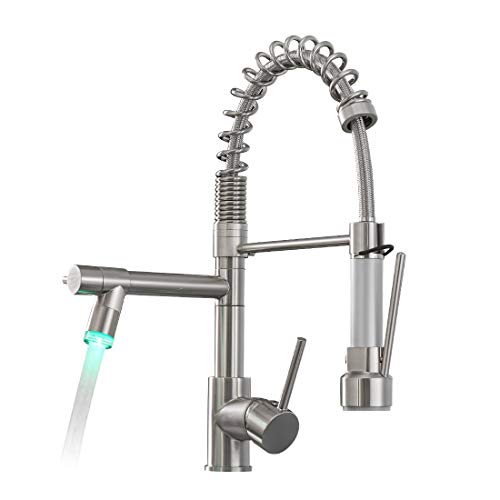
Commercial is the first word of the AIMADI’s name, and the shape follows the word: this is the faucet for buyers who look at restaurant pot-wash stations with envy. Its title promises a commercial pull-down with an LED light sprayer, a single handle, stainless steel construction, and suitability spanning farmhouse, camper, laundry, RV and bar sinks. Commercial styling in a domestic faucet buys two things — headroom and reach. The taller, more open architecture that suits a pot-wash line also suits the home preserver filling a canner, the home brewer rinsing a deep vessel, the family whose largest pan mocks ordinary arches. The LED signal rides along on the sprayer, giving the same glanceable temperature information as the rest of the five.
The honest cautions are about scale and setting. A commercial silhouette in a small galley kitchen can crowd the room visually and tower over a shallow sink, with the splashing that height over shallowness invites. The listing is also the most economical with specification among the six: no steel grade, no deck-plate wording, no swivel figure, no certification language appears in its title, and our spec box records those silences plainly. What the title does give — commercial form, LED sprayer, single handle, stainless construction, a wide settings list — is a coherent proposition for the right sink. Fit it to a deep bowl in a hard-working kitchen, a laundry room that handles everything from delicates to muddy boots, or a serious utility space, and its proportions stop being theatre and start being tools.
- Style: commercial pull-down
- LED type: LED light sprayer
- Construction: stainless steel
- Handle: single handle
- Settings named in title: farmhouse, camper, laundry, RV, bar
- Finish named in title: not stated in the listing
- Steel grade: not specified in the title
- Deck plate: the title is silent on this
- Swivel range: the title does not say
- Spray modes: no mention in the title
Strengths
- Commercial proportions give exceptional pot clearance
- LED sprayer keeps the temperature signal at the head
- Wide stated settings suit utility and laundry sinks
Trade-offs
- Large scale can overwhelm small kitchens and shallow sinks
- Title is sparse on grades, plates and certifications
- Finish is not named in the title and must be confirmed
Best for: deep-sink, high-volume kitchens and utility rooms wanting commercial reach. Not suited for: compact kitchens where the faucet must stay visually quiet.

DJS LED Kitchen Faucet Brushed Nickel
The DJS is the specification-lover’s pick among the light models, because its title bothers to enumerate what others leave vague: dual spray modes, a 360-degree swivel, 304 stainless steel, and one-or-three-hole fitting with a deck plate, aimed at farmhouse, RV and vessel basin settings. That swivel figure is the headline. A full-circle spout changes how a corner sink or a wide double bowl gets used — the faucet serves the sink, the draining board and the bucket on the floor beside the cabinet with equal willingness, and in an RV or a compact utility corner, where the sink moonlights in every direction, full rotation is not a luxury but the entire point.
Dual spray modes keep the water story simple — stream and spray, the two jobs every sink does daily — and the LED in the pull-down head adds the temperature colour signal on top. Brushed nickel, again, is the working finish: forgiving, appliance-friendly, unshowy. The listing does not name a certification or state the light’s power source, and the spec box says so without embroidery. Set against the OWOFAN brushed nickel, the DJS trades the OWOFAN’s NSF wording for a stated swivel range and a stated steel grade; set against the GIMILI, it trades spray pressure for rotation. Those are clean, honest axes to choose on, and a buyer with a corner sink or a double bowl will find the DJS’s axis is theirs.
- Finish: Brushed Nickel
- LED type: LED, pull-down sprayer
- Spray modes stated: dual spray modes
- Swivel stated: 360-degree swivel
- Steel grade stated: 304 stainless steel
- Handle: single handle
- Mounting: 1 or 3 holes with deck plate
- Settings named in title: farmhouse, RV, vessel basin
- Certification named: not stated in the listing
- LED power source: not specified in the title
Strengths
- Full 360-degree swivel serves corner and double sinks
- Steel grade and spray modes are stated, not implied
- Deck plate covers one-hole and three-hole decks
Trade-offs
- No certification language appears in the title
- Two spray modes is the simple menu, not the widest
- Light’s power source remains unstated
Best for: corner sinks, double bowls and RV owners who need full rotation. Not suited for: buyers prioritising stated certification above manoeuvrability.

HOMELODY LED Temperature Display Brushed Nickel
Everything about the HOMELODY’s title turns on one word: display. Where the other five faucets carry an LED light that shifts colour with temperature — the category’s listing language — this faucet headlines an LED temperature display, a readout on the faucet that shows the temperature itself. The distinction is not pedantry. A colour asks you to learn a code and judge a hue, which is quick and usually enough; a readout gives a number, which is what you want when the task has an actual target — water for a baby’s bottle, for bread dough, for a home-brew step, for any job where warm-ish is not a specification. Its title rounds out the proposition with a pull-down sprayer, a single handle, a high-arc stainless steel design in brushed nickel, and settings spanning RV, laundry, farmhouse and bar sinks.
Choose the HOMELODY when precision is the errand, and choose one of the five light models when a glance is all the errand needs. The display’s presence also raises the power question more sharply than a simple light does — a readout has to be powered somehow, and the title does not state the source, so the listing page is where that must be confirmed, particularly for RV and off-grid laundry settings where power arrangements are personal. The high arc suits the deep vessels its settings list implies, and brushed nickel keeps it visually at home beside the other working faucets here. In a batch built on an honest distinction, the HOMELODY is the distinction: not a brighter glow, but a different kind of information, offered to the cooks who cook by numbers.
- Finish: Brushed Nickel
- Temperature feature: LED temperature display (readout)
- Sprayer: pull-down sprayer
- Handle: single handle
- Spout form: high arc
- Construction: stainless steel design
- Settings named in title: RV, laundry, farmhouse, bar
- Display power source: the title is silent on this
- Spray modes: not given
- Deck plate: no mention in the title
Strengths
- Shows temperature as a readout rather than a colour alone
- High arc suits deep vessels in laundry and farmhouse sinks
- Suits tasks with a genuine target temperature
Trade-offs
- Display power source is not stated and needs confirming
- More information than glance-only users will ever consult
- No deck plate wording in the title
Best for: cooks and caregivers who work to actual temperatures and want them displayed. Not suited for: buyers who only want a quick hot-or-cold colour cue.
Six faucets, then, and one clean division between them: five that speak in colour and one that speaks in numbers. Everything after this point in the guide — the table, the choosing advice, the care notes — returns to that division, because it is the decision a buyer in this category actually has to make, and making it early turns the rest of the shopping into detail work.
Comparison Table
Read this table by mechanism first — light or display — and only then by finish and fittings, because the mechanism is the decision the rest of the purchase hangs on.
| Model | Temperature signal | Finish on the tin | Fitting notes from the title |
|---|---|---|---|
| OWOFAN LED Kitchen Faucet Brushed Nickel | LED light in sprayer | Brushed Nickel | Deck plate, 1 or 3 hole; NSF certified |
| GIMILI Brushed Nickel LED Kitchen Faucet | LED light | Brushed Nickel | High-pressure double-headed spray; deck plate included |
| OWOFAN LED Kitchen Faucet Matte Black | LED light | Matte Black | 304 stainless; plate not in listing |
| AIMADI Commercial LED Kitchen Faucet | LED light sprayer | Finish not in listing | Commercial pull-down form |
| DJS Brushed Nickel LED Kitchen Faucet | LED light | Brushed Nickel | 360-degree swivel; 1 or 3 holes with deck plate |
| HOMELODY LED Temperature Display Brushed Nickel | LED temperature display readout | Brushed Nickel | High arc; plate not in listing |
How to Choose Between a Colour Light and a Temperature Display?
Ask what decision the temperature information drives. If the answer is a hand about to go under the water — a child’s, a grandparent’s, your own at six in the morning — a colour change is the better interface, because it is read peripherally, instantly, without glasses or attention. The light models in this guide exist for that glance. If the answer is a task with a target — dough water that should be warm but not hot enough to harm yeast, a bottle that must be neither cold nor scalding, a brewing or preserving step written with a number in the recipe — then a colour is an estimate and a display is an answer, and the HOMELODY’s readout earns its place. Many households honestly need only the glance; kitchens that cook by numbers know who they are.
Then work through the sink itself. Count the deck holes and favour the deck-plate models — the brushed nickel OWOFAN, the GIMILI, the DJS — if your sink carries spare holes from an older faucet, because the plate covers them neatly and the alternative is visible plugs or a new sink conversation. Consider swivel honestly: a standard sink against a wall needs ordinary rotation, while a corner installation or a sink used from two sides makes the DJS’s full circle genuinely useful rather than a parlour trick. Consider scale, too. The AIMADI’s commercial proportions need a deep bowl and a room that can carry them; the same faucet over a shallow bar sink will splash and loom. And wherever the light or display’s power source matters to your setting — an RV with a considered electrical system, a laundry sink far from an outlet — treat the titles’ silence as homework and confirm the arrangement on the listing before the box is opened, not after.
Finish, in this category, is the easiest decision, because brushed nickel does so much quiet work: it hides the fingerprints of a busy sink, matches the appliance wall, and gives the LED’s colour a neutral background to read against. Matte black, on the second OWOFAN, is the deliberate exception for rooms already speaking that language. Whichever finish you choose, remember the light is the feature and the faucet is the tool — a glowing sprayer on a faucet whose spray, swivel and fit are wrong for your sink will annoy you daily in full colour.
Where Does an LED Faucet Earn Its Keep Outside the Kitchen?
The listings keep naming the same supporting cast — laundry, utility, RV, camper, wet bar, farmhouse — and they are right to. The laundry sink is where unknown temperatures bite hardest: hands plunge in to agitate, to check, to rescue a delicate garment, and a colour signal at the sprayer turns a guess into a glance. Soaking, stain treatment and hand-washing all run at temperatures that matter to fabric, and the signal earns its place weekly. In RVs and campers the case strengthens further, because small water heaters swing temperature as tanks deplete and as the system recovers; a faucet that announces the water’s state saves both discomfort and the fresh-water waste of running the tap while testing it with a wrist. Wet bars and utility sinks add the guest factor — visitors who do not know your plumbing’s temperament get the information from the light rather than from a surprise.
There is also an accessibility story here that deserves plain words. Reduced temperature sensation in the hands is common — with age, with circulation problems, with certain kinds of work — and a visual temperature signal restores information that touch no longer delivers reliably. For a household adapting a kitchen or a laundry room for an older relative, an LED faucet is one of the least intrusive adaptations available: it looks like an ordinary modern faucet, it asks for no new habits, and it quietly guards every interaction with hot water. That is comfort language, not a medical promise, and it is quite enough reason for many buyers on its own.
Common Mistakes with LED Kitchen Faucets
The category’s signature mistake is buying a replacement spray head believing it is a faucet. LED heads are sold separately for existing faucets, their photographs look complete, and the disappointment at the unboxing is entirely avoidable: check that the listing describes a faucet with a body and a handle, as every pick in this guide does. The second mistake is assuming how the light is powered. This category contains different power arrangements, titles often stay silent — several here do — and a buyer who needs a specific arrangement for an RV or an off-grid sink should confirm it on the listing rather than discover it under the sink. Third, shoppers ignore hole count until installation day; deck plates forgive a great deal, but only on the models that include them. Fourth, colour codes get trusted blindly in the first week: the light is a signal, not a laboratory instrument, and the sensible habit is to learn your own faucet’s hues against your own hand a few times before letting children treat the colour as gospel. Fifth, the spray face gets neglected. Mineral scale dims lights and strangles nozzles alike, and the gentle descaling routine that serves any faucet — soft cloth, mild soak, no pins in the nozzles — serves these doubly, because it protects the feature you paid extra for.
How Should You Look After the Light and the Spray Face?
Treat the head as the instrument it is. Wipe the spray face regularly so scale never gets a head start, and where build-up appears, a cloth soaked in a mild vinegar solution wrapped briefly around the head loosens it without tools or violence. Keep abrasive pads away from the lens and the nozzles both; a scratched lens reads dimmer and a damaged nozzle sprays crooked, and neither injury heals. Dry the finish after heavy use — brushed nickel forgives a great deal, matte black rather less — and check the hose’s travel under the sink now and then, clearing the stored bottles that creep into its loop, because a snagged hose presents as a faucet fault and is almost never one. If the light ever behaves oddly, the methodical order is water first, connections second, assumptions last: confirm the tap is running at a temperature that should trigger a change, let it run a few seconds since the sensor reads the water passing through it, and only then suspect the mechanism. Most LED faucet complaints dissolve somewhere inside that sequence.
What About Fitting One in an RV or a Laundry Room?
Compact plumbing rewards the same homework, done smaller. Measure the deck and the clearance behind it, because RV and laundry sinks often sit tight against walls or under cabinets that limit arch height; a high-arc design that sings in a farmhouse kitchen may not fit under a motorhome’s overhead locker. Check how the sink is used across a week — the RV faucet that also serves as the shower’s neighbour and the laundry faucet that fills buckets on the floor both argue for a generous swivel like the DJS’s stated full circle and a pull-down hose that reaches beyond the bowl. Weight and vibration belong in the RV conversation too: fittings travel, roads shake, and connections deserve a re-check after the first journeys, a five-minute habit that prevents the slow drip that finds the subfloor. And the temperature signal, as the earlier section argued, is worth more in these settings than in a house with a large, steady water heater — small tanks swing, and the light or the display tells you the swing has happened before your hands report it. Buyers who match the faucet to the vehicle’s or the room’s actual clearances, rather than to a photograph of a farmhouse kitchen, end up with the rare upgrade that feels native from the first trip or the first wash day.
How Does the Temperature Signal Change a Family’s Morning?
It helps to walk through the small scenes, because this feature lives or dies in scenes rather than specifications. Scene one: a child, newly tall enough to reach the tap alone, filling a cup before school. Without a signal, the child’s method is the ancient one — run the water, test with fingers, flinch or sip. With the light glowing its cool hue, the child has information before contact, and the parent’s morning loses one supervision task without losing safety, because the child still learns to check, only now the checking is visual and arrives a second earlier. Scene two: pasta night. The cook’s hands are floury, the pot is heavy, the colander waits in the sink, and the question of whether the tap has reached hot for a quick rinse of the serving bowls is answered by the sprayer’s colour as it swings into place, no wrist-testing, no pause in the choreography. Scene three: an older relative visiting, hands less sensitive than they once were, washing up as a contribution to the evening. The light quietly carries information their skin would deliver late, and nobody has to make a conversation of it. The faucet simply tells the truth about the water, to everyone, every time, without being asked.
Scene four belongs to the utility spaces the listings keep naming. A laundry soak at the temperature the detergent label wants; a camper’s quick wash after a cold night when the heater has only just lit; a bar sink rinse between guests where the water has been sitting in the line and runs at whatever temperature the room left it. In each, the signal substitutes for the test-and-wait ritual, and the substitution saves the thing these small sinks never have enough of — time at the tap, and water itself, since a glance replaces the gallons run down the drain while a hand judges. None of this transforms a kitchen. It removes a dozen tiny uncertainties a day, and features that remove tiny uncertainties are the ones still appreciated in year five, long after the novelty of the glow has worn off and only the usefulness remains.
What Should You Check in the First Week of Ownership?
New-faucet week repays a short, deliberate audit, and LED models add two items to the usual list. Start with the ordinary: run every mode, swing the spout through its full arc, pull the head to its full reach and let it dock a dozen times, then inspect under the sink with a torch and a dry tissue at every joint, because the weep that matters announces itself in the first days or not at all. Check the hose’s loop hangs clear of the stored bottles and that the weight travels freely, so the head’s docking stays positive. Then the LED items. Run the water cold, then warm, then hot, and watch the signal change across the range; learn where your faucet’s hues sit, because colour codes are a language each household should calibrate against its own hands once, deliberately, rather than assume. If your pick is the display model, compare its readout against a kitchen thermometer in a jug of water once — not because the listing promises laboratory accuracy, but because knowing your own instrument’s character is what makes an instrument useful.
Finish the week with the settings audit. Fill your largest vessel and time nothing — simply notice whether the arch, the reach and the spray pattern made the job easier than the old faucet did, and adjust what is adjustable: the stored clutter under the sink, the angle the faucet rests at, the household’s habits around the spray face. Note the model name and keep the listing details somewhere findable, since the day a part is needed is never the day you want to reconstruct a specification from memory. A faucet that passes its first week with dry joints, a learned colour language and a clear hose loop will almost certainly give years of unremarkable service — and unremarkable, in plumbing, is the highest praise there is.
Is an LED Faucet Worth Choosing Over an Ordinary Pull-Down?
Strip the glow away and every faucet in this guide is an ordinary modern pull-down — single handle, stainless construction in most cases, a sprayer on a hose — which is precisely why the comparison is fair. The LED feature is an addition to a competent base, not a substitute for one, and it should be priced in your mind as an addition: worth choosing when the information it provides solves a problem your household actually has, and worth skipping when it does not. The households with a real problem are easy to recognise. Children are reaching the tap alone for the first time. An older relative’s hands no longer report temperature faithfully. The sink in question is a laundry, utility or RV sink where water temperature swings with tanks, lines and distance from the heater. The cooking runs to tasks — bottles, doughs, preserving, brewing — where temperature is an ingredient. For those households the signal is not a novelty; it is the reason for the purchase, and the rest of the faucet merely has to be good, which these are.
The households without that problem should be equally honest in the other direction. A confident adult cook at a mains-fed kitchen sink with a responsive water heater already knows their tap’s behaviour in their bones; the light will delight for a fortnight and then become wallpaper. That buyer is better served spending their attention on spray quality, swivel, finish and fit — the things every faucet user touches daily — and several picks here still compete on exactly those grounds, the DJS on rotation, the GIMILI on pressure, the AIMADI on scale. Novelty is not a vice, but it is a poor foundation for a ten-year plumbing decision, and the LED category rewards buyers who can name the job the light will do in their house before they fall for the photograph of it glowing blue in a darkened showroom kitchen.
One middle path deserves naming, because it is where many families land: put the LED faucet where the vulnerable hands are. The main kitchen sink keeps its conventional faucet; the laundry or the downstairs utility sink — the one grandparents use, the one children are sent to — gets the signal. The listings’ own settings lists bless that strategy, naming those secondary sinks again and again, and it converts the LED from a whole-kitchen commitment into a targeted improvement exactly where temperature uncertainty lives. Whichever path you take, judge the result after a month by a simple test: are you still reading the signal, or have you stopped seeing it? Buyers who chose for a named job almost always answer that they read it daily without thinking — the surest sign the feature has become infrastructure rather than decoration.
How Do You Install One Without Defeating the Feature?
Installation follows the ordinary pull-down pattern — old faucet out, new body mounted, supplies connected, hose threaded and weighted, joints tested dry — with two LED-specific attentions layered on top. The first is gentleness around the head and its connections. The sprayer carries the light or feeds the display, so it should be handled as an instrument rather than a lump of plumbing: no wrench teeth on finished surfaces, no forcing of connectors that are designed to seat by hand and a modest turn, and no letting the head dangle and swing against the sink while the body is being secured. The second attention is the under-sink environment. Whatever arrangement powers the light lives down there or in the head itself, and it deserves a dry, uncramped home — clear of the hose’s sliding loop, away from the trap’s occasional weeps, and not buried behind the stored bottles that migrate back into every cabinet. Five minutes spent arranging that neighbourhood during installation saves every future investigation from beginning with an excavation.
Testing deserves its own slow pass on an LED model. Beyond the tissue test at the joints, run the water through its temperature range and watch the signal respond across cold, warm and hot, letting each stage run long enough for the water in the line to truly change — a faucet reads the water passing through it, and the line’s stored water will briefly lie to any sensor. Swing the spout, extend the head, dock it repeatedly, and confirm the light behaves consistently at every position, since a fault that appears only at full extension is exactly the fault worth finding on day one. Then write down what normal looks like: the hues at your usual temperatures, or the readout’s figures for your morning warm and your evening hot. That small record turns any future oddity into a comparison instead of a guess, and it takes ninety seconds. Installations done at this pace — ordinary care, plus instrument care, plus a documented baseline — are the ones whose owners are still praising the glow years later, because nothing about the feature was left to luck.
A Note on Guests, Children and the Learning Curve
Every LED faucet teaches its household a tiny language, and the teaching takes about a week. Adults calibrate fastest when they pair colour with sensation deliberately a few times — run warm, look, feel, agree — after which the glance alone suffices and the hand-testing habit fades on its own. Children treat the light as a game for the first days, which is a feature disguised as a distraction: a child who watches the colour change is a child learning that water has states worth respecting, and the lesson sticks better for being self-taught at the sink rather than lectured. Guests need no instruction at all, which is the quiet elegance of the system — the information is simply present at the point of use, in a form anyone can read, whether they have seen the faucet before or not. Households that expect this brief learning curve, and enjoy it rather than fighting it, find the signal becomes part of the kitchen’s background competence within a fortnight: noticed when needed, invisible when not, like the click of a good switch or the thunk of a well-hung door.
Final Recommendation
For most buyers the OWOFAN LED Kitchen Faucet Brushed Nickel is the balanced start — certified language in its title, a deck plate for real-world sinks, and the colour signal in a forgiving finish. Cooks who work to numbers should step straight to the HOMELODY LED Temperature Display Brushed Nickel and its readout, while corner sinks and double bowls belong to the DJS Brushed Nickel LED Kitchen Faucet and its full-circle swivel. Whichever you choose, you are buying information at the exact moment your hands are busiest — and once your eyes have learned to read the water before your skin does, an ordinary unlit tap will feel like it is keeping secrets from you.
Frequently Asked Questions
How does the colour-changing LED actually help?
Per the listings’ own description, the light changes colour with the temperature of the water flowing through it. That gives an at-a-glance signal before hands go under the stream — useful for children, for anyone with reduced feeling in their hands, and for quick checks in laundry and RV sinks where temperatures swing.
Is the HOMELODY the same kind of LED feature as the others?
No, and the difference is the point of its listing. The other five picks carry an LED light; the HOMELODY headlines an LED temperature display, a readout showing temperature. Choose the light for a quick hot-or-cold cue and the display when a task has a target temperature.
Are any of these just replacement spray heads?
None of them. Every pick in this guide is a complete faucet with a body, handle and pull-down sprayer. Replacement LED heads are sold elsewhere for repairing existing faucets and were deliberately excluded from this selection.
What powers the LED — batteries or the water flow?
It varies across this category, and several titles here do not state the source, so our spec boxes record the silence rather than guess. If the power arrangement matters to your setting — especially in an RV — confirm it on the product listing before ordering.
Will one of these faucets fit my three-hole sink?
Several picks include a deck plate that covers one-hole or three-hole decks — the brushed nickel OWOFAN, the GIMILI and the DJS state plate arrangements in their titles. Count your sink’s holes and match them against the listing before ordering.
Does an LED faucet need special cleaning?
Only the ordinary kind, done gently and regularly. Keep the spray face free of mineral scale with a soft cloth and a mild vinegar soak when needed, avoid abrasive pads near the lens and nozzles, and dry the finish after heavy use. A clean face keeps both the spray and the light reading clearly.
Can an LED faucet help in a laundry or utility room?
Arguably more than in the kitchen itself. Laundry and utility sinks are where hands plunge into water of unknown temperature — soaking, stain treatment, hand-washing — and where the supply often runs from a distant heater, so the first water out of the tap is rarely the temperature the handle promises. A colour signal, or the HOMELODY’s readout where precision matters for fabrics, replaces the plunge-and-flinch method with a glance, and the listings for most picks here name laundry, utility, RV and farmhouse sinks precisely because those are the rooms where the signal works hardest.
Related Guides
Three companion guides from the same series follow, covering neighbouring finishes and rooms.
Best Luxury Kitchen Faucets in Polished Nickel
Best Eco-Friendly Bath Mats for Kids



[…] Best LED Kitchen Faucets […]