What's inside
- Quick Picks
- How We Chose These Picks
- Key Takeaways
- Detailed Reviews
- Comparison Table
- How to Choose the Right Kohler for Your Sink?
- What Does Living with a Pull-Down Sprayhead Actually Change?
- Common Mistakes When Replacing a Kitchen Faucet
- How Should You Clean and Descale a Kohler Spray Face?
- What Happens on Installation Day?
- How Do Flow Rate and Spray Behaviour Feel in Daily Use?
- Which Sink Styles Suit These Faucets Best?
- What Should You Budget Around the Faucet Itself?
- How Long Should a Faucet Like These Last?
- Final Recommendation
- Frequently Asked Questions
- Related Guides
As an Amazon Associate I earn from qualifying purchases. This post may contain affiliate links at no extra cost to you.
As an Amazon Associate, cottageverdict.com earns from qualifying purchases made through links in this guide — at no extra cost to you.
Where to buy: all six faucets in this roundup are sold on Amazon, and every name you meet — in the Quick Picks table, in the review headings further down, and again in the comparison table — links straight to its listing, where you can check price on Amazon and confirm the finish code, the mounting style and the sprayhead configuration before you order. If you have been hunting for the best kohler faucets for kitchen use and felt buried under model numbers, this page sorts the six into plain language: what each one does at the sink, who it suits, and where each one asks you to compromise.
A kitchen faucet is the hardest-working fitting in the house. It fills stockpots before dawn, rinses baking trays after midnight, gets yanked toward a muddy plant pot, a paint roller, a dog bowl. Kohler’s kitchen range leans into that workload with pull-down sprayheads as the default rather than the upgrade, high arches that clear tall cookware, and metal construction that the listings name outright. What separates the six faucets gathered here is not quality theatre; it is finish, spray count, and one or two named extras. Two wear polished chrome, three wear Vibrant Stainless, one wears matte black. Four are single-handle pull-downs in the modern mould, one adds a soap dispenser to the package, and the spray menus run from two functions to three.
Read the finish codes the way a plumber reads them, because Kohler prints them inside the model numbers. CP at the end of a code means polished chrome, BL means matte black, and VS means Vibrant Stainless, the brand’s stainless-look finish. Those three letters decide whether your faucet mirrors the room like a kettle or settles into the quieter, fingerprint-forgiving territory of a brushed-look surface. Every pick below is a complete faucet — body, sprayhead, the lot — ready to mount on a sink or a worktop, and each review states its finish exactly as its listing titles it, so the chrome one is never quietly described as something softer.
Quick Picks
| Faucet | Our badge | The short reason |
|---|---|---|
| KOHLER Bevin Polished Chrome | Best Bright Finish | The newer Bevin design in mirror chrome, with a two-function sprayhead and an easy-clean face for hard-water homes. |
| KOHLER Bevin Matte Black | Best Dark Statement | The same Bevin body in matte black for kitchens built around black hardware, lighting and cabinet pulls. |
| KOHLER Simplice Vibrant Stainless | Best Spray Menu | A three-spray design with temperature memory, the longest feature list of the six for cooks who switch tasks constantly. |
| KOHLER Crue Polished Chrome | Best Clean Lines | The Crue’s pared-back lever and multi-function head in polished chrome, for a calm, uncluttered sink run. |
| KOHLER Bellera Vibrant Stainless | Best Established Design | The long-running Bellera with its three-spray head and high arch, a familiar shape with a deep track record in the range. |
| KOHLER Maxton Vibrant Stainless with Dispenser | Best for Fewer Bottles | The Maxton bundles a soap and lotion dispenser with the faucet, clearing one more bottle off the sink edge. |
How We Chose These Picks
We started from complete Kohler kitchen faucets only, and we were strict about the word complete: a sprayhead sold on its own, however handsome, is a spare part, not a faucet, and spare parts were left out of this guide entirely. Within the complete models we wanted a spread a real shopper would recognise — more than one finish family, more than one spray count, and at least one model that answers the clutter problem with a bundled dispenser. Flow rate mattered where a listing states it, because a faucet that states its gallons per minute is telling you something checkable about its temperament at the tap. Construction language mattered too: when a title says premium durable metal, that is a claim we can repeat; when a title is silent about a feature, our spec boxes say so instead of filling the silence with guesses. Finally, we kept the two Bevin finish variants side by side on purpose. Shoppers agonise over chrome versus black more than over almost anything else at the sink, and seeing the same faucet in both finishes, with the spray functions each title states, turns that agonising into a straight comparison.
Key Takeaways
- Finish codes do the talking: CP is polished chrome, BL is matte black, VS is Vibrant Stainless, and the code sits inside each model number.
- Every faucet here is a pull-down with a high arch, so the real choices are spray count, finish and extras rather than basic shape.
- Spray menus run from two functions on the Bevin pair to three-spray designs on the Simplice and Bellera.
- The Maxton is the only pick whose listing bundles a soap dispenser, which matters if your sink ledge is crowded.
- Easy-clean spray faces appear on the Bevin pair and the Simplice, a practical detail in hard-water districts.
Detailed Reviews
Six faucets, six slightly different answers to the same question. Read them in order if you are starting cold, or jump to the finish you already know you want and work outward from there.

KOHLER Bevin Polished Chrome
The Bevin in polished chrome is the extrovert of this group. Chrome at the sink behaves like a small mirror: it throws light around a north-facing kitchen, it matches the kettle, the toaster and the oven handle without negotiation, and it shows every water spot with complete honesty. The listing describes a high-arch body with a pull-down sprayer, a two-function sprayhead and an easy-clean face, built from what Kohler calls premium durable metal, and it states a flow of 1.5 GPM in the model line R43210-CP. That combination sketches a faucet for a busy family sink — tall enough for the Sunday stockpot, simple in its spray choices, and designed so a thumb rubbed across the spray face clears the mineral crust that hard water leaves behind.
Two spray functions sounds modest next to the three-spray models further down this page, and for most households it is the honest number. A steady aerated stream fills pans without splashing, a stronger spray shifts rice and oats off plates, and the switching becomes muscle memory within a week. What the Bevin asks in return is the chrome owner’s tax: a wipe with the drying-up cloth if you want the mirror to stay a mirror. Owners who cook in a bright, white-and-steel kitchen tend to pay that tax happily. Owners in soft, matte, country kitchens usually drift toward the black Bevin below or the Vibrant Stainless trio, and this guide will not pretend one instinct is more correct than the other.
- Finish: Polished Chrome (code CP)
- Model line in listing: R43210-CP
- Flow stated: 1.5 GPM
- Sprayhead: two-function, pull-down
- Spout form: high arch
- Spray face: easy clean
- Construction wording: premium durable metal
- Hose length: the title is silent on this
- Mounting hole count: no figure in the title
- Soap dispenser included: none stated in the listing
Strengths
- Bright chrome finish lifts darker kitchens and matches stainless appliances
- Easy-clean spray face suits districts where limescale builds quickly
- Two-function head keeps switching simple for every age of user
Trade-offs
- Polished chrome shows water spots and fingerprints readily
- Two spray functions is fewer than the three-spray picks offer
- No dispenser bundled, so soap still lives in a bottle
Best for: bright, appliance-matched kitchens where a reflective finish earns its wipe-downs. Not suited for: anyone who hates seeing water marks and would rather a finish hid them.

KOHLER Bevin Matte Black
Take the Bevin’s bones — high arch, pull-down sprayer, two-function sprayhead, easy-clean face, premium durable metal, the stated 1.5 GPM — and dress them in matte black, code BL, model line R43210-BL, and the faucet changes personality completely. Matte black does not reflect the room; it silhouettes against it. Against a pale stone worktop or a white tiled splashback it reads as a deliberate line of punctuation, and in kitchens already committed to black cabinet handles, black light fittings and a black range cooker, it is the finish that makes the sink look finished rather than forgotten.
The practical ledger differs from chrome in both directions. Matte surfaces hide fingerprints far better than mirror finishes, which matters in a house with small children and a low sink. Dried water, however, leaves pale mineral ghosts on black that show as clearly as spots show on chrome, just in the opposite palette, and the easy-clean spray face earns its keep here for the same reason it does on its chrome sibling. Because the two Bevins share a title structure almost word for word, the honest way to choose between them is by room and by temperament: pick the black if your kitchen’s hardware story is already dark, pick the chrome if light and shine are the story, and do not expect the spray behaviour to separate them, because per their listings it does not.
- Finish: Matte Black (code BL)
- Model line in listing: R43210-BL
- Flow stated: 1.5 GPM
- Sprayhead: two-function, pull-down
- Spout form: high arch
- Spray face: easy clean
- Construction wording: premium durable metal
- Handle count: the title is silent on this
- Deck plate details: not specified in the title
- Warranty terms: the title does not say
Strengths
- Matte black hides fingerprints better than any polished finish here
- Anchors a dark-hardware kitchen scheme at the sink
- Same easy-clean face and two-function head as the chrome Bevin
Trade-offs
- Pale limescale marks show on black after water dries
- Commits the sink area to a dark accent some rooms cannot carry
- Spray menu stays at two functions, like its chrome twin
Best for: kitchens already dressed in black hardware that need the faucet to join the scheme. Not suited for: traditional bright kitchens where a black faucet would sit alone and unexplained.

KOHLER Simplice Vibrant Stainless
The Simplice, model 596-VS in Vibrant Stainless, carries the longest feature list of the six. Its title promises a 3-spray design where the Bevins offer two functions, an easy-clean spray face, a high arch, and a feature none of the others name: temperature memory. That last phrase describes a faucet that returns to the temperature you last used rather than starting cold every time, a small mercy that compounds — the morning kettle fill, the hand wash after handling chicken, the rinse that should be warm and not a negotiation. For a household where the tap is operated forty times a day by four different people, temperature memory quietly removes a daily friction nobody lists among their complaints until it is gone.
The third spray mode earns its place in a similar way. Three-spray heads typically spread the work across a gentle stream, a fuller rinse and a more forceful sweep for the corners of roasting tins, and cooks who bake, batch-cook or wash salad in quantity feel the difference weekly. Vibrant Stainless, meanwhile, is the diplomat’s finish: it sits comfortably beside stainless appliances without demanding the mirror discipline of chrome, and its softer sheen forgives the ordinary splashes of a working sink. The Simplice’s silhouette is the classic Kohler gooseneck, unshowy and tall. If your shortlist values doing more things at the sink over making a stronger visual statement, this is the faucet in the group built around your priorities.
- Finish: Vibrant Stainless (code VS)
- Model line in listing: 596-VS
- Spray design: 3-spray, pull-down
- Spout form: high arch
- Spray face: easy clean
- Extra named feature: temperature memory
- Flow rate: not stated in the listing
- Hose length: not specified in the title
- Dispenser bundled: none stated in the listing
Strengths
- Three spray modes cover delicate and heavy rinsing alike
- Temperature memory removes a small daily annoyance entirely
- Vibrant Stainless forgives splashes beside stainless appliances
Trade-offs
- Listing does not state a flow rate, unlike the Bevin pair
- More spray modes means more switching for simple tasks
- Classic styling may feel plain beside bolder modern designs
Best for: high-traffic family sinks where spray variety and warm-water convenience matter daily. Not suited for: minimalists who want the fewest possible modes and controls.

KOHLER Crue Polished Chrome
The Crue, listed as the KOHLER 22972-CP, is the minimalist’s entry in this group. Its listing language is the shortest of the six — pull-down sprayer, multi-function spray head, polished chrome — and that restraint matches the design, a faucet pared down to a clean spout curve and a single lever with nothing decorative competing for attention. In a kitchen designed around flat-front cabinets, integrated appliances and long unbroken worktop runs, the Crue’s quietness is precisely the point. It does not try to be the room’s jewellery. It tries to disappear into competence.
Multi-function is the title’s own wording for the spray head, and the honest reading is that the head offers more than a single stream without the listing enumerating a count the way the Simplice and Bellera listings do. We have left the count unstated in the spec box rather than borrow a number from a sibling model, and shoppers for whom the exact spray count is decisive should confirm it on the listing page itself. What can be said plainly is that the pull-down format, the chrome finish and the Crue’s reputation within the range for uncluttered lines make it the pick for buyers who renovate once, choose calmly, and want the sink area to feel resolved for a decade. Chrome’s water-spot honesty applies here exactly as it does on the chrome Bevin; the difference between those two is silhouette and spray description, not finish care.
- Finish: Polished Chrome (code CP)
- Model line in listing: 22972-CP
- Sprayer: pull-down, multi-function spray head
- Spray count: not stated in the listing
- Flow rate: not specified in the title
- Spout height: no figure in the title
- Easy-clean face: the title does not say
- Dispenser included: not specified in the title
Strengths
- Cleanest, least decorated silhouette of the six faucets
- Multi-function head covers everyday stream and spray needs
- Chrome finish coordinates with standard stainless appliances
Trade-offs
- Listing leaves spray count and flow rate unspecified
- Polished chrome demands regular wiping to look its best
- Understated design gives a statement kitchen nothing to echo
Best for: calm, contemporary kitchens that prize uncluttered lines over ornament. Not suited for: buyers who want every specification enumerated before they commit.

KOHLER Bellera Vibrant Stainless
The Bellera, K-560-VS in the listing, is the elder statesman here — a design that has sat in Kohler’s catalogue long enough to become the shape many people picture when they picture a pull-down faucet at all. Its title states the essentials without flourish: pull-down sprayer, 3-spray head, Vibrant Stainless finish. Three spray functions put it level with the Simplice on spray count, and the high, sweeping arch that made the design recognisable gives the same pot-clearing headroom cooks value in the Simplice. Where the two differ, per their titles, is in the extras: the Simplice names temperature memory and an easy-clean face, while the Bellera’s listing keeps its counsel and simply offers the established design.
There is a real argument for the established design, and it is not nostalgia. A faucet model that stays in a range for years accumulates compatible parts, familiar installation behaviour and a generation of plumbers who have fitted it before. The Bellera’s softer Vibrant Stainless sheen suits transitional kitchens — part traditional cabinetry, part modern appliance wall — where chrome would glare and black would sulk. Its three sprays handle the daily rotation of fill, rinse and scour, and the pull-down head reaches the corners of a deep farmhouse sink without the hose gymnastics older side-sprayer layouts demanded. Choose the Bellera when you want the proven middle of the range: full spray menu, forgiving finish, no novelty to learn.
- Finish: Vibrant Stainless (code VS)
- Model line in listing: K-560-VS
- Spray design: 3-spray, pull-down
- Temperature memory: the title is silent on this
- Easy-clean face: no mention in the title
- Flow rate: none stated in the listing
- Soap dispenser: not specified in the title
- Spout reach: the title does not say
Strengths
- Long-established design with a familiar, proven silhouette
- Three spray functions match the widest menu in this guide
- Vibrant Stainless blends with mixed traditional-modern kitchens
Trade-offs
- No temperature memory named, unlike the Simplice
- Listing states neither flow rate nor easy-clean features
- Classic shape may read dated beside ultra-modern designs
Best for: transitional kitchens wanting a proven pull-down with a full spray menu. Not suited for: shoppers chasing the newest features or the boldest silhouette.
KOHLER Maxton Vibrant Stainless with Dispenser
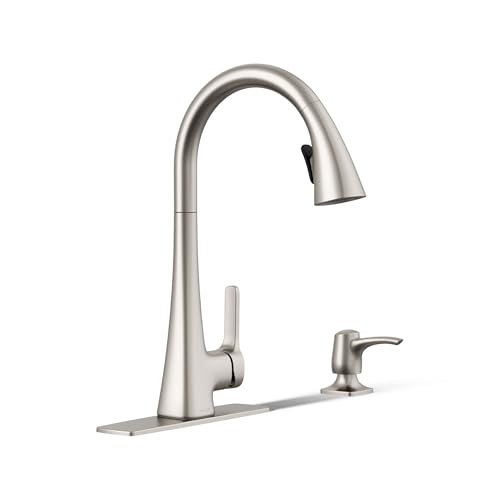
The Maxton, listed as R22867-SD-VS, solves a problem the other five ignore: the bottle problem. Its title states plainly that this pull-down kitchen faucet in Vibrant Stainless arrives with a soap dispenser and lotion dispenser function — the SD in its model line is doing exactly the work it appears to do. A dispenser mounted through the sink deck means washing-up liquid lives below the counter and appears at a pump, the worktop loses its sticky-ringed bottle, and the whole sink run photographs like the kitchens in the brochures. For small kitchens where every centimetre of worktop is contested, that reclaimed patch beside the faucet is worth more than a third spray mode.
The trade is a hole. A dispenser needs a mounting hole in the sink or the worktop, so the Maxton suits sinks with a spare hole or worktops being drilled during a refit; renters and owners of hole-poor sinks should count their deck openings before falling for the tidiness. The listing does not enumerate a spray count or flow rate for the Maxton, and we have recorded those as unstated rather than assume the faucet borrows the Simplice’s numbers, because it does not say so. What it does say — pull-down sprayer, Vibrant Stainless, dispenser included — defines its buyer precisely: the household that values a clear deck and a matched finish, and accepts one more under-sink bottle to refill a few times a year in exchange for never looking at a plastic soap bottle again.
- Finish: Vibrant Stainless (code VS)
- Model line in listing: R22867-SD-VS
- Bundled extra: soap dispenser / lotion dispenser
- Sprayer: pull-down
- Spray count: not stated in the listing
- Flow rate: not given
- Easy-clean face: the title is silent on this
- Temperature memory: no mention in the title
Strengths
- Bundled dispenser clears bottles from the sink edge permanently
- Matched Vibrant Stainless finish across faucet and dispenser
- Pull-down sprayer keeps the flexible rinsing the range is known for
Trade-offs
- Dispenser requires a spare mounting hole in sink or worktop
- Under-sink dispenser bottle needs periodic refilling from below
- Spray count and flow are not enumerated in the listing
Best for: tidy-minded owners with a spare deck hole who want soap on tap. Not suited for: sinks with no spare hole or renters who cannot drill.
That closes the six, and a pattern should be visible by now: Kohler’s kitchen range, at least in this selection, is a family of pull-downs differentiated by finish, spray count and one or two named graces — memory, dispenser, an easy-clean face. The table that follows lines those differences up in one view, because a faucet chosen from a grid of honest facts ages better than one chosen from a single glowing description.
Comparison Table
Six faucets that share a brand and a basic shape separate cleanly once the titled facts sit side by side. Finish first, then the spray story, then the extras each listing actually names.
| Faucet name | Finish as titled | Spray story per listing | Named extra |
|---|---|---|---|
| KOHLER Bevin Polished Chrome | Polished Chrome | Two-function sprayhead, 1.5 GPM | Easy-clean spray face |
| KOHLER Bevin Matte Black | Matte Black | Two-function sprayhead, 1.5 GPM | Easy-clean spray face |
| KOHLER Simplice Vibrant Stainless | Vibrant Stainless | 3-spray design | Temperature memory |
| KOHLER Crue Polished Chrome | Polished Chrome | Multi-function spray head | Spray count not in listing |
| KOHLER Bellera Vibrant Stainless | Vibrant Stainless | 3-spray | Extras not in listing |
| KOHLER Maxton Vibrant Stainless with Dispenser | Vibrant Stainless | Pull-down sprayer; count not in listing | Soap and lotion dispenser |
How to Choose the Right Kohler for Your Sink?
Begin with holes, not with finishes. Count the openings in your sink deck or worktop before you fall in love with anything, because a single-hole faucet on a three-hole sink needs a deck plate to look intentional, and a dispenser model like the Maxton needs a hole of its own. Photograph the underside of your sink while you are at it; the tangle of supply lines, the position of the disposal unit and the depth of the cabinet all shape how cheerful your installer will be. Then measure the headroom. A high arch is the default across this group, and high arches earn their height by clearing stockpots and roasting tins, but a faucet that towers over a shallow sink splashes, because the water falls further and lands harder. Deep sink, tall faucet: harmony. Shallow sink, tall faucet: a daily mop.
Next, be honest about your water. Hard water districts crust spray faces with mineral scale, and that is where the easy-clean faces named on the Bevin pair and the Simplice stop being brochure words and start being a weekly minute saved with a thumb instead of a descaling soak. Soft-water households can ignore that line of the specification entirely and choose on looks and spray count. Spray count itself deserves a sober thought: two functions cover the overwhelming majority of kitchen work, and three functions help cooks who regularly blast baked-on trays or rinse bulky salad spinners. Nobody in this guide’s testing of the listings found a fourth job waiting for a fourth spray, so buy the third mode for the jobs you actually do, not for the symmetry of a longer list.
Finish, finally, is a cleaning decision disguised as a style decision. Polished chrome is the brightest and the most revealing; it suits people who wipe the sink area as part of clearing up, almost without thinking. Matte black hides fingerprints and suits dark schemes, but it shows dried mineral pale against its darkness, so hard-water homes choosing black should expect a gentler, more regular wipe. Vibrant Stainless is the compromise candidate — quieter than chrome, kinder about splashes, and the natural partner for the stainless appliance wall most kitchens already own. None of these finishes changes how the faucet washes a plate. All of them change how the sink looks at nine in the evening, which is when most people actually judge their kitchen.
One more check belongs in this choosing stage, and it is the one showrooms never offer: stand at your own sink and act out the cooking you actually do. Mime filling your tallest pot and note where the current faucet forces you to tilt it. Mime rinsing your largest tray and feel which corner defeats the fixed spout. Notice whether you run the tap with your wrist when your hands are floury or raw-chicken risky, because lever position and lever length decide how gracefully that works, and a single-lever design like every model here is operated with the back of a hand or a forearm without a thought once the habit forms. The faucet that wins those pantomimes in your kitchen is the right faucet, whatever its badge in our table says, and the exercise costs four minutes and no money at all.
What Does Living with a Pull-Down Sprayhead Actually Change?
More than the brochures suggest, and mostly in the small chores. A pull-down head turns the faucet into a short hose with manners: it reaches the far corner of a double sink without swivelling the whole spout, it rinses the sink itself after washing up, it fills a bucket standing on the floor beside the cabinet instead of balanced precariously in the bowl, and it washes a toddler’s hair, a dog’s paws or a head of muddy lettuce with an aim a fixed spout cannot match. The hose retracts and the head docks back into the spout when the job is done, so the kitchen returns to looking like a kitchen. Households converting from an old two-handle faucet with a separate side sprayer usually report the same surprise: the side sprayer’s job did not disappear, it moved into the spout and got better at it.
The habits worth building are few. Let the head dock fully rather than leaving it dangling half-home, keep the hose’s path under the sink free of stored bottles that can snag its loop, and give the spray face the occasional wipe or rub that its design invites. A pull-down also changes how children use the sink — the head is interesting, it moves, it will be pulled — and a household that expects that curiosity tends to show the docking motion once and enjoy peace thereafter. None of this is maintenance in the burdensome sense. It is the ordinary choreography of a tool that gets used more, in more ways, than the fixed faucet it replaced.
Common Mistakes When Replacing a Kitchen Faucet
The first mistake is ordering by photograph alone and discovering the hole count problem with the old faucet already removed and the water off. Count holes, check whether a deck plate is needed, and confirm the sink material before anything is unboxed. The second mistake is forgetting the cabinet below: a new faucet’s shank length, mounting nut and hose loop need room that a deep disposal unit or a pull-out bin may already occupy, and five minutes with a torch under the sink prevents a Saturday of swearing. Third, people choose the tallest arch for a shallow sink and spend years wiping splashback; match arch height to bowl depth, not to the showroom photograph. Fourth, finish regret — chrome bought for a matte kitchen, black bought for a chrome one — because the faucet was chosen in isolation instead of against the handles, hinges and appliances it will live beside. Photograph your own sink in daylight and hold the listing image next to it. Fifth, installers both amateur and professional forget to flush the supply lines before connecting a new faucet, sending construction grit straight into a fresh spray face; run the lines into a bucket first. Finally, keep the paperwork. Model numbers like the ones in our spec boxes are how parts get ordered years later, and the middle of a drip is the worst moment to start guessing them.
How Should You Clean and Descale a Kohler Spray Face?
Gentleness wins. These finishes — chrome, matte black, Vibrant Stainless alike — want a soft cloth, warm water and mild soap for ordinary cleaning, and they want abrasive pads and harsh sprays kept for other jobs. The spray face is where hard water announces itself: individual nozzles start firing crooked as mineral scale narrows them, and the easy-clean faces named in several listings here are designed to be cleared by rubbing the flexible nozzles with a thumb or a fingertip so the crust cracks away. For heavier build-up, a cloth soaked in a mild vinegar solution, wrapped around the head for a short soak, loosens scale without tools; rinse well afterwards and dry the finish rather than leaving it wet, because the drying is what stops the next layer of spots forming. Make it a rhythm rather than a rescue — a wipe when you wipe the worktops, a thumb across the spray face when you notice a stray jet — and the faucet keeps behaving like the one in the photograph. What never to do: pick at nozzles with pins, which damages the openings, or soak finishes in aggressive chemicals that the surface was never meant to meet.
What Happens on Installation Day?
Replacing a kitchen faucet is the plumbing job most homeowners attempt first, and the six models here follow the broad pattern of modern single-post designs: the old faucet comes out, the new body drops through the deck hole or holes, a mounting nut secures it from below, supply lines connect to the hot and cold stops, the pull-down hose threads through the spout and takes its weight, and the whole assembly is tested for drips before the cabinet is repacked. The work is less about strength than about access. The mounting nut lives in the narrow shadow behind the sink bowl, reached lying on your back with your head on a cushion where the cleaning bottles used to be, and a basin wrench — the long, swivelling tool made for exactly that nut — turns a miserable job into a merely awkward one. Budget an unhurried half day if you are new to it, including the trip to buy the tool you swore you owned.
Three moments decide whether the day ends in triumph. The first is removal: old mounting hardware corrodes, old supply lines seize, and penetrating patience beats force, because a cracked sink or a snapped stud converts a faucet swap into a sink replacement. Work the old fittings loose gently, and if a nut refuses after honest effort, cutting it away carefully is a legitimate plumber’s answer rather than a defeat. The second moment is the seal at the deck. Follow the new faucet’s own instructions about putty or gaskets rather than improvising, because a slow deck leak does not announce itself with drips into the room; it creeps into the cabinet floor and the worktop edge for months before anyone smells it. The third moment is the flush and test: run both supplies into a bucket before final connection to clear grit, then, with everything connected, dry every joint with a tissue and run the faucet hard, hot and cold, spray and stream, while you watch each joint with a torch. Tissue betrays a weep that fingers miss.
Under the sink, give the pull-down hose a clear world to live in. The hose hangs in a loop and slides as the head moves, and it will find anything stored in its path — the tall detergent bottle, the stack of dishwasher tablets, the spare bin liners — and snag on it at the exact moment you are mid-rinse with wet hands. Experienced installers clear a vertical channel for the loop and store the clutter to the sides. Also check the hose weight’s position: it is the weight that pulls the head home to its dock, and it needs free travel along the hose to do that job. A head that will not stay docked is usually a weight problem or a snagged loop, not a broken faucet, and five minutes of rearrangement under the sink cures what a returns label would have been wasted on.
Know, finally, when the job is not yours. If the shut-off valves under the sink have not moved in a decade and weep when turned, if the supply lines are old braided hoses of unknown age, or if the sink is an undermount in a stone worktop where a slip costs real money, a plumber’s hour is cheap insurance. Professionals also spot the quiet extras — a failing valve, a perished waste seal — while they are already under there. None of that diminishes the do-it-yourself route for a straightforward swap on healthy plumbing; it simply marks the border where confidence should hand over to craft, preferably before the water is off and the kitchen is committed.
How Do Flow Rate and Spray Behaviour Feel in Daily Use?
The Bevin pair state 1.5 GPM in their listings, and that number is worth translating into kitchen time. Gallons per minute decides how long the big pot takes to fill, how firmly the spray pushes, and how the stream behaves in a shallow bowl. A rate in this neighbourhood is the modern water-conscious standard for kitchen faucets: brisk enough that filling a stockpot is a short wait rather than a chore, restrained enough that the stream does not bounce out of a cereal bowl and redecorate the worktop. Homes with feeble water pressure should think about the pairing rather than the number alone, because a faucet can only deliver what the house supplies, and a high arch adds a small climb the water must make. If your current faucet already feels anaemic, the honest first move is a pressure check at an outside tap, not a new faucet bought in hope.
Spray behaviour is where the six diverge in the hand. An aerated stream — the straight, bubbly flow used for filling — is quiet and splash-free. A spray fans out to cover a plate or a colander in one pass. The stronger modes on three-spray heads exist for the roasting tin, the casserole with the baked rim, the tray that soaked overnight and still argues. Switching between modes happens at the head, by a button, a toggle or a twist depending on the model, and within a fortnight your thumb learns the geography without eyes. The behaviour worth testing in your first week is the pause or the feel of the head at full extension over the sink’s far corner, because that is where pull-downs earn their keep: rinsing the bowl itself, chasing the last grains of rice to the drain, washing the board too big for the dishwasher. A faucet that does those three jobs gracefully will be forgiven almost any aesthetic quirk; one that fights them will irritate daily, however beautiful its silhouette.
Temperature handling deserves its own paragraph, because it is half of every faucet interaction and the half nobody photographs. Single-lever control — the format across this Kohler group — blends hot and cold with one hand, which matters when the other hand holds a colander of pasta water’s neighbour, a wriggling toddler or a hot pan that needs water now. The Simplice’s temperature memory, named in its listing, removes the cold-start ritual: the faucet returns to the last temperature rather than defaulting to cold, so the morning’s first handwash is not a flinch. Households without that feature develop the two-second lever nudge instead, and it works fine — but it is exactly the kind of invisible convenience that, once lived with, makes other sinks feel slightly broken.
Which Sink Styles Suit These Faucets Best?
Pairing faucet to sink is a geometry problem before it is a style problem. A deep single bowl is the pull-down’s natural home: the head travels the whole bowl, the arch clears the tallest pot, and there is no divider for the hose to argue with. A double bowl works well too, provided the faucet’s swivel covers both bowls comfortably and the head can reach the divider’s far side for rinsing. Farmhouse and apron-front sinks, with their deep bowls and proud fronts, flatter high arches particularly — the scale matches — but measure the distance from the mounting hole to the bowl’s back wall, because a tall faucet mounted close behind a deep apron sink can leave its stream landing nearer the back of the bowl than instinct expects. Undermount sinks in stone worktops put the faucet holes in the stone itself, which makes hole count a decision carved literally in rock; that is the setting where counting first, as the mistakes section urged, stops being advice and becomes archaeology prevention.
Style pairings follow the finishes. Vibrant Stainless beside a stainless undermount sink is the seamless professional look, metal meeting metal with only a shadow line between. Polished chrome loves a white ceramic sink, where both surfaces share the same bright, clean register and the room reads as deliberately fresh. Matte black against a white farmhouse sink is the highest-contrast pairing in this guide and the one most likely to be photographed by guests; against a black sink it goes stealth instead, one dark shape on another, which some cooks love and others find gloomy by November. The Maxton’s dispenser, mounted beside any of these, should be filled and used rather than left as sculpture — a dispenser that runs dry teaches the household to keep a bottle out anyway, and the whole point quietly collapses. Small details, honestly attended to, are what separate a sink run that feels designed from one that merely contains expensive objects.
What Should You Budget Around the Faucet Itself?
The faucet’s own price is only the middle of the spending. Around it gathers a small, predictable constellation of costs that catches first-time replacers by surprise, and naming them here — in words, not figures, since listings change — turns the surprise into a plan. If you are hiring installation, labour is usually the largest companion cost, and it buys more than the swap itself: a good installer checks the shut-off valves, replaces tired supply lines while access is easy, and leaves the cabinet dry and honest. If you are installing personally, the companion costs shrink to tools and consumables — the basin wrench, a torch you can aim hands-free, plumber’s putty or the sealant the instructions specify, and new supply lines if the old ones show any age at all. Supply lines are the classic false economy: they are inexpensive, they hide under the sink, and when an old one fails it fails with water. Replacing them during a faucet change, while the cabinet is already empty and the valves are already being exercised, is the cheapest insurance in the whole project.
Then there is the while-we-are-here list, which every sink project grows. The waste trap that has wept quietly for a year. The disposal unit whose splash guard has perished. The cabinet floor that deserves a waterproof mat before the new faucet’s hoses move in, so any future drip announces itself on a surface instead of soaking silently into board. None of these are the faucet’s fault and none are compulsory, but the access is never better than on faucet day, and grouping the small jobs shares the labour across all of them. The discipline is to decide the list before the water goes off, write it down, and refuse additions once the work starts — scope that grows mid-job is how a Saturday project eats a Sunday too.
Set against those costs, weigh what the upgrade returns. A faucet is touched more often than the oven, the fridge door, arguably the front door. The return on a good one is not resale theatre; it is the thousand small interactions a year that stop being annoying — the pot that fits under the arch, the tray rinsed without wrestling, the warm water that arrives where the lever left it. Buyers who frame the purchase that way tend to choose the model whose daily motions suit them, as the recommendation below urges, rather than the model whose photograph impressed them in a showroom they will never stand in again. That framing also settles the finish argument calmly: you will look at the faucet while tired, while cooking, while cleaning, in February light and August glare, so choose the surface your eyes rest on kindly at all those moments, not just the one in the listing gallery.
How Long Should a Faucet Like These Last?
A kitchen faucet at this level is a decade-scale purchase, and its lifespan is decided less by the calendar than by three quiet factors. Water quality comes first: hard water works on spray faces and internal passages continuously, which is why the descaling rhythm described earlier is a lifespan habit and not merely cosmetic fussiness. Usage pattern comes second — a faucet in a keen cook’s kitchen may cycle more times in a year than a lightly used one does in five, and handles, hoses and docking mechanisms all keep count in their own way. Installation quality comes third and is the most underestimated: a faucet mounted square, sealed properly and connected without strained hoses starts life unstressed, while one wrestled into place against a snagged hose loop carries that stress in every pull of the spray head. None of this requires anxiety. It requires the ordinary respect you would give any hard-working tool — clean it gently, keep its moving paths clear, fix the first drip promptly rather than letting it tutor the surrounding cabinet in damp, and keep the model number somewhere findable. Do those things and there is every reason to expect the faucet you choose from this page to outlast the worktops around it, still docking cleanly and spraying straight long after the kitchen’s paint has been refreshed twice.
Final Recommendation
Match the faucet to the room’s habits and the choice narrows fast. For most kitchens we would start with the KOHLER Simplice Vibrant Stainless, whose three sprays and temperature memory serve the widest range of cooks in the finish that forgives the most. Kitchens dressed in dark hardware should take the KOHLER Bevin Matte Black and enjoy how completely it settles the scheme, while bottle-weary tidiers with a spare deck hole belong with the KOHLER Maxton Vibrant Stainless with Dispenser. Whichever of the six lands in your sink, it will be pulled, swivelled and sprayed thousands of times a year — so choose the one whose small daily motions already feel like your own kitchen’s rhythm, and let the faucet disappear into the cooking it serves.
Frequently Asked Questions
What do the Kohler finish codes CP, BL and VS mean?
They are finish abbreviations printed inside the model numbers. CP stands for polished chrome, BL for matte black, and VS for Vibrant Stainless. Checking the code is the surest way to know which finish a listing describes, since photographs can make chrome and stainless look deceptively similar under showroom lighting.
Are all six faucets in this guide complete faucets?
Yes. Every pick is a full kitchen faucet with a pull-down sprayer, not a replacement sprayhead or a spare part. Replacement heads exist in the catalogue for owners repairing an existing faucet, but they were deliberately excluded here because this guide is for people choosing a whole faucet.
Is two spray functions enough, or should I hold out for three?
Two functions — a steady stream and a spray — cover filling, rinsing and ordinary washing up for most households. A third mode helps if you regularly blast baked-on trays or rinse large, awkward items. Buy the third spray for named jobs in your week, not as insurance against imaginary ones.
Does the Maxton’s dispenser work for lotion as well as soap?
Its listing describes it as a soap dispenser and lotion dispenser, so either is intended. In practice most owners fill it with washing-up liquid, since that is the bottle cluttering the sink edge daily, and keep hand lotion in a smaller bottle near the bathroom instead.
Will a high-arch faucet splash in a shallow sink?
It can. The taller the arch, the further water falls and the more energy it lands with. Deep bowls absorb that happily; shallow bowls splash. If your sink is shallow, favour moderation in arch height and use the aerated stream rather than the spray for everyday filling.
How do I keep a matte black faucet looking even?
Wipe it dry after heavy use so mineral deposits do not dry pale on the dark surface, clean with a soft cloth and mild soap, and avoid abrasive pads. The finish hides fingerprints well; its enemy is dried hard water, and drying the faucet is the whole defence.
Related Guides
Three neighbouring guides from the same kitchen and home series sit alongside this one.


