What's inside
- Key Takeaways
- Quick Picks
- How Did We Judge Tradition Without Falling for Costume?
- How Do the Six Traditional Faucets Compare Side by Side?
- What Makes a Faucet Traditional Rather Than Merely Old-Fashioned?
- How Do You Care for Oil-Rubbed Bronze Without Fading It?
- Which Traditional Faucet Suits a Farmhouse Sink, and Which Suits a Town Kitchen?
- How Do You Fit a One-Hole Bronze Faucet to a Three-Hole Sink?
- How Does a Traditional Faucet Change a Kitchen’s Sense of Time?
- What Should You Know About Lever Handles Shaped for Tradition?
- How Do Traditional Faucets Behave in Hard-Water Country?
- Why Do Soap Dispensers Keep Returning to Traditional Decks?
- How Should You Light a Traditional Sink Area?
- What Is the Resale and Rental Logic of a Traditional Faucet?
- How Do You Plan a Traditional Faucet Around an Existing Range Cooker?
- What Does the First Month With a Pull-Down Traditional Faucet Teach?
- How Should You Store Delicate Finishes During the Rest of a Renovation?
- Why Do Country Pubs and Farm Shops Choose Faucets Like These?
- How Do You Match Cabinet Hardware to a Traditional Faucet?
- What Is It Like to Host in a Kitchen With a Traditional Faucet?
- How Should You Decide Between the Two FORIOUS Picks?
- How Do You Keep a Traditional Spout’s Curve Free of Scale at the Tip?
- What Should a Buyer in a Listed or Historic Home Check First?
- How Do You Break the Tie Between Chrome Quiet and Bronze Character?
- What Is the Kindest Traditional Faucet for an Ageing Household?
- What Mistakes Do Traditional Faucet Buyers Keep Making?
- Final Recommendation
- Frequently Asked Questions
- Related Guides
As an Amazon Associate I earn from qualifying purchases. This post may contain affiliate links at no extra cost to you.
cottageverdict.com is reader-supported. When you buy through links on our site, we may earn an affiliate commission.
Where to buy: Every pick below links to its Amazon listing, where you can check price on Amazon and confirm hole patterns, included plates and dispensers. Traditional styling is easy to photograph and easy to get wrong in scale, so check the stated fit against your sink before the silhouette seduces you.
The best traditional kitchen faucets dress modern plumbing in the manners of an earlier kitchen: curved spouts, lever handles with a little ceremony in their shape, and finishes — brushed stainless with a soft glow, honest chrome, deep oil-rubbed bronze — that belong beside ceramic sinks and painted wood. Underneath the manners, the six picks here are contemporary machines, most with pull-down sprayers and single-lever control, because almost nobody restoring a period kitchen actually wants period plumbing.
That split personality is the category’s charm and its trap. The charm is a faucet that looks inevitable in an old room while working like a new one. The trap is assuming that traditional means uniform, when in fact these six divide sharply: two big-brand flagships in light finishes, two plain-spoken chrome classics, and two bronze vintage designs for farmhouse and country schemes. This guide keeps those families distinct and judges each on how completely it commits to its own idea of tradition.
Key Takeaways
- Traditional here is a styling language, not old technology: five of six picks use a single modern lever.
- Oil-rubbed bronze carries the vintage family, in two FORIOUS designs and one Derengge with a side sprayer.
- The Moen Brantford is the technology leader, with Power Boost and a Reflex docking system named in its listing.
- Deck plates decide real-world fit for the bronze picks, which between them cover one, two, three and four-hole sinks.
- One pick adds a soap dispenser, a small traditional convenience that keeps the sink deck off the bottle.
Quick Picks
| Pick | Badge | Why it earns a place |
|---|---|---|
| Moen Brantford Traditional Kitchen Faucet | Modern Classic Flagship | Period curves wrapped around Moen’s Power Boost spray and Reflex docking, in spot-resistant stainless. |
| Delta Classic Chrome Kitchen Faucet | Understated Chrome Classic | Delta’s plain three-hole chrome design for kitchens that want tradition without theatre. |
| Peerless Single-Handle Kitchen Faucet P110LF | Value Chrome Staple | The simplest traditional lever faucet in the guide, from a brand built on serviceable basics. |
| FORIOUS Vintage Kitchen Faucet Oil Rubbed Bronze | Bronze Farmhouse Pull-Down | High-arc bronze with a pull-down sprayer and a deck plate for one- or three-hole sinks. |
| Derengge Traditional High Arc Faucet | Bronze With Side Spray | A high-arc bronze design keeping the classic side sprayer, with an optional deckplate for two or four holes. |
| FORIOUS Vintage Faucet with Soap Dispenser | Bronze With Dispenser | The vintage pull-down formula plus a matching soap dispenser for a bottle-free deck. |
How Did We Judge Tradition Without Falling for Costume?
We asked each pick two questions. First, does the traditional styling survive contact with a real kitchen — does the curve clear a stockpot, does the handle work with wet hands, does the finish forgive a working week? Second, does the modern machinery underneath deserve the costume — is the sprayer genuinely useful, the fit honestly documented, the brand’s support real? A faucet that answered only the first question is a prop; one that answered only the second is a modern faucet in fancy dress.
Documentation was graded as strictly as in our other guides. The Moen’s listing names its spray and docking technologies; the bronze picks state their hole patterns and plate arrangements; the two plain chrome classics say almost nothing, and their reviews price that silence honestly rather than filling it with borrowed specifications.

Moen Brantford Traditional Kitchen Faucet — Modern Classic Flagship
The Brantford is the pick that refuses to make you choose between the look and the machinery. Its listing describes a traditional one-handle design in Spot Resist stainless, with a pulldown sprayer carrying two named Moen technologies: Power Boost, which gives the spray a harder-working mode for rinsing and fast filling, and the Reflex docking system, which is Moen’s name for a hose arrangement that lets the spray head pull out smoothly and settle back into its dock with a positive, finished feel.
Reflex matters more in daily life than its brochure language suggests. The difference between a sprayer that docks decisively and one that dangles a centimetre short is the difference between a faucet that feels engineered and one that feels tired, and it is felt at every single wash. Spot Resist is the other quiet gift: the finish is formulated to show fewer fingerprints and water spots, which in a brushed stainless traditional faucet means the soft glow survives a family week without a polishing ritual.
The Brantford’s styling is traditional in the American country sense — a bellied spout curve, a lever with shaped ends — rather than in the English bridge sense explored elsewhere in this batch. It suits painted cabinetry, apron sinks and the kind of kitchen where the range wears enamel and the shelves hold stoneware. Flow figures are not stated in the listing, and that box is marked accordingly below.
- Spray: pulldown sprayer with Power Boost, per the listing
- Docking: Reflex system, named in the listing
- Finish: Spot Resist stainless, formulated against spots and prints
- Handle layout: one handle, traditional styling
- Flow rate: not given in the listing
Strengths
- Decisive sprayer docking makes the faucet feel engineered at every use.
- Boost mode gives rinsing and filling a genuinely stronger gear.
- Spot-resistant finish keeps brushed stainless presentable with little effort.
Trade-offs
- American country styling may not satisfy strict period restorers.
- Pulldown hose and mechanism add parts a plain spout never needs.
- Listing leaves flow unstated, so pressure questions end at the product page.
Best for: period-styled kitchens that still want flagship modern convenience.
Not suited for: purists restoring to a specific historical pattern.

Delta Classic Chrome Kitchen Faucet — Understated Chrome Classic
Delta’s Classic is traditional by subtraction: a three-hole chrome faucet, model 100LF-WF, with no sprayer headline, no finish technology and no styling manifesto in its listing. What remains is the archetype itself — a lever, a spout, bright chrome — produced by one of the largest plumbing names in the world. In kitchens where the faucet is meant to be background, that restraint is the entire point, and it has kept this design family in catalogues while louder fashions rotated past.
Chrome deserves its defence in a guide full of brushed and bronze alternatives. It is the easiest finish to return to a shine, it matches the chrome that older kitchens already carry on hinges, rails and appliances, and it does not ask the room to reorganise around it. A Classic in chrome beside a white ceramic sink is the least argued-about combination in kitchen history, which is a genuine virtue in a house with more than one decision-maker.
The listing’s brevity means the specification boxes below are mostly unstated, and buyers who need a sprayer should look at the Derengge or either FORIOUS instead. The Classic’s promise is narrower and kept with big-brand reliability: standard fit, standard parts, a design that will still look appropriate when the kitchen around it has been repainted twice.
- Format: three-hole kitchen faucet, per the listing
- Finish: chrome
- Model: 100LF-WF, as titled
- Sprayer: none mentioned in the listing
- Flow rate: not stated in the listing
Strengths
- Timeless chrome archetype that never argues with a room.
- Delta’s parts ecosystem supports a very long service life.
- Simple mechanics keep installation and repair uncomplicated.
Trade-offs
- No sprayer is fitted, so rinsing wide bowls takes longer.
- Listing publishes almost nothing beyond format and finish.
- Plainness will bore buyers who want the faucet to be a feature.
Best for: quiet traditional kitchens and landlords who value serviceability.
Not suited for: anyone who rinses with a sprayer daily.
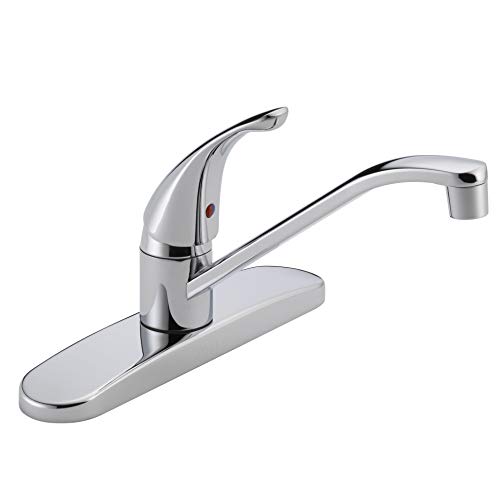
Peerless Single-Handle Kitchen Faucet P110LF — Value Chrome Staple
The P110LF is the guide’s baseline, the faucet against which fancier claims can be measured: a single-handle chrome kitchen faucet from Peerless, Delta’s value brand, described in its listing with nothing but the essentials. There is a place in every honest guide for the baseline. It is what fills rental kitchens, utility sinks and first homes, and it survives there because its mechanics are simple, its parts are findable and its shape offends nobody’s grandmother or grandchild.
Single-handle control at this level is a mature, solved technology, and the P110LF’s lever gives the one-handed temperature sweep that busier cooks prefer over the two-handle ceremony elsewhere in this batch. Chrome keeps the care routine at the level of a wipe. Nothing about the faucet asks to be photographed, and that is precisely its social function: it returns a tired kitchen to service, quietly, at the shallow end of the budget.
As with the Delta Classic, the listing states no flow, valve or sprayer details, and they are marked unstated below. Judge the Peerless against its actual promise — a mainstream-brand lever faucet in chrome with a model number and a support network — and it is a promise this category’s anonymous alternatives rarely match.
- Format: single-handle kitchen sink faucet
- Finish: chrome, per the listing
- Model: P110LF, as titled
- Sprayer: not mentioned in the listing
- Flow rate: not given in the listing
Strengths
- Mainstream brand backing at the value end of the category.
- Simple single-lever mechanics are cheap and easy to service.
- Neutral chrome shape suits almost any existing kitchen.
Trade-offs
- No sprayer or feature claims of any kind in the listing.
- Specification detail must be gathered from the product page.
- Design is deliberately unremarkable, which not every renovator wants.
Best for: rentals, utility sinks and budget replacements that must simply work.
Not suited for: feature-led renovations or sprayer devotees.

FORIOUS Vintage Kitchen Faucet Oil Rubbed Bronze — Bronze Farmhouse Pull-Down
FORIOUS builds its vintage case on colour and arc: a high-arc single-handle faucet in oil-rubbed bronze, stainless steel beneath the finish per the listing, with a pull-down sprayer and a deck plate covering one- or three-hole installations. The listing also names the rooms it imagines — farmhouse, laundry, RV, bar — which is a fair map of where a deep bronze faucet with modern innards earns its keep.
Oil-rubbed bronze is the most characterful finish in this guide, dark brown-black with warm edges that brighten where hands polish them. Against a white apron sink and wooden worktops it reads as heritage; against cream cabinetry it reads as warmth. It is also a finish with a temperament: it shows water spots as pale ghosts and asks for a dry wipe to keep its depth, and the high-touch edges will lighten over the years into what owners either call character or call wear, depending on the temperament they brought to the purchase.
The pull-down sprayer keeps the vintage honest, because a farmhouse sink in a working kitchen still has to rinse a preserving pan. The included deck plate is the other practical mercy, letting this single-hole design settle onto the three-hole sinks that farmhouses accumulate. Flow and valve figures are not stated in the listing and are marked that way below.
- Finish: oil rubbed bronze, per the listing
- Construction: stainless steel, stated in the listing
- Spray: pull-down sprayer, high arc
- Fit: deck plate for one- or three-hole installation
- Flow rate: not stated in the listing
Strengths
- Deep bronze finish delivers the farmhouse look without period plumbing.
- Pull-down sprayer gives a vintage shape modern rinsing reach.
- Included plate covers the common three-hole farmhouse sink.
Trade-offs
- Bronze shows water spots and needs a dry wipe to stay deep.
- High-touch edges will brighten with wear over the years.
- Brand support is thinner than the Moen and Delta networks.
Best for: farmhouse and country kitchens wanting bronze with modern innards.
Not suited for: bright contemporary kitchens or low-effort finish expectations.

Derengge Traditional High Arc Faucet — Bronze With Side Spray
Derengge keeps the oldest sprayer arrangement alive inside the bronze family: a single-handle high-arc faucet in oil-rubbed bronze with a separate side spray, an optional deckplate, and installation across two or four holes, model KF-6832TB-ORB per the listing. The two-or-four-hole spread is the widest fit claim in this guide, and it reflects the reality of older sinks, whose drillings follow the habits of whichever decade installed them.
The side sprayer divides opinion and deserves a fair hearing. It keeps the spout’s silhouette clean — no pull-down head interrupting the traditional curve — and it parks in its own holder like the faucets of fifty years ago. Its reach is shorter and its hose lives in the cabinet, but for rinsing a bowl’s corners and filling a kettle on the drainer it remains genuinely useful, and traditionalists often prefer its separate, deliberate feel to a head that pulls from the spout.
The optional deckplate is the detail to verify at order time, since optional can mean included-if-selected or available-separately depending on the listing’s configuration. Beyond that, the Derengge’s story is consistent: bronze warmth, a tall arc for farmhouse pans, and the classic sprayer layout, from a smaller brand whose support network cannot match the majors.
- Finish: oil rubbed bronze, per the listing
- Sprayer: side spray included, per the listing
- Fit: two or four holes, optional deckplate included per the listing
- Arc: high arc, traditional styling
- Flow rate: not stated in the listing
Strengths
- Widest hole-pattern flexibility of any pick in this guide.
- Side sprayer preserves the clean traditional spout silhouette.
- High arc clears the deep pans farmhouse cooking produces.
Trade-offs
- Side sprayer reach is shorter than a pull-down head’s travel.
- Deckplate terms should be confirmed on the product page before ordering.
- Bronze finish needs the same spot-conscious wiping as its FORIOUS cousins.
Best for: older sinks with unusual hole patterns and a taste for classic sprayers.
Not suited for: single-hole sinks or pull-down devotees.

FORIOUS Vintage Faucet with Soap Dispenser — Bronze With Dispenser
The second FORIOUS takes the first one’s formula — high arc, single handle, oil-rubbed bronze over stainless steel, pull-down sprayer, one- or three-hole fit across farmhouse, RV and bar settings — and adds the accessory traditional kitchens quietly love: a soap dispenser in the same finish. That addition changes the sink’s daily geography more than its size suggests, because the washing-up bottle leaves the deck, the back edge clears, and the whole arrangement looks composed rather than accumulated.
A deck-mounted dispenser fills from above on most designs and meters soap at the sink where the washing up actually happens, ending the drips that bottles leave on worktops and window sills. Matched in bronze, it also solves the accessory problem that plagues dark finishes, where a chrome dispenser beside a bronze faucet looks like a spare part. Buyers choosing between the two FORIOUS picks are really choosing whether that composed deck is worth the extra hole and the extra component.
The same bronze temperament applies: water spots show, edges brighten with handling, and a dry wipe is the price of depth. Flow and valve details remain unstated in the listing. As a package, though, this is the most complete vintage proposition in the guide — faucet, sprayer and dispenser speaking one finish language from a single box.
- Finish: oil rubbed bronze, per the listing
- Construction: stainless steel, stated in the listing
- Spray: pull-down sprayer, high arc
- Extra: soap dispenser included, per the listing
- Fit: one- or three-hole installation
Strengths
- Matching dispenser clears bottles from the deck in the same finish.
- Pull-down sprayer keeps modern rinsing inside a vintage silhouette.
- Complete single-box package suits farmhouse and bar installations alike.
Trade-offs
- Dispenser needs a deck hole and a refill routine from beneath or above.
- Bronze shows spots and brightens at touch points over time.
- More components mean more seals to inspect across the years.
Best for: farmhouse renovations wanting a composed, bottle-free sink deck.
Not suited for: decks without a spare hole or minimalists avoiding extras.
How Do the Six Traditional Faucets Compare Side by Side?
| Pick | Finish | Sprayer | Signature |
|---|---|---|---|
| Moen Brantford Traditional Kitchen Faucet | Spot Resist stainless | Pulldown | Power Boost and Reflex docking |
| Delta Classic Chrome Kitchen Faucet | Chrome | None mentioned | Three-hole archetype, big-brand support |
| Peerless Single-Handle Kitchen Faucet P110LF | Chrome | Not mentioned | Value baseline from a mainstream brand |
| FORIOUS Vintage Kitchen Faucet Oil Rubbed Bronze | Oil rubbed bronze | Pull-down | Deck plate for one or three holes |
| Derengge Traditional High Arc Faucet | Oil rubbed bronze | Side spray | Two- or four-hole flexibility |
| FORIOUS Vintage Faucet with Soap Dispenser | Oil rubbed bronze | Pull-down | Matching soap dispenser included |
The table’s real divide is light against dark. The three light-finished picks come from the big plumbing houses and trade on support and restraint, while the three bronze picks come from smaller brands and trade on atmosphere and fit flexibility. Neither trade is a trick. Decide which currency your kitchen values — decades of parts support or the exact warmth of bronze — and the shortlist writes itself.
What Makes a Faucet Traditional Rather Than Merely Old-Fashioned?
Proportion is the first marker: traditional spouts curve with a generosity modern minimalism trims away, and their handles carry shaped ends, bellied bases or lever silhouettes that reference a century of foundry patterns. The second marker is finish temperature. Traditional metals run warm or neutral — bronze, brushed stainless, honest chrome — while the cold gloss of a laboratory tap belongs to another family. The third is tactility: traditional handles are designed to be read by the hand, with enough shape to turn confidently with soapy fingers.
What traditional does not mean is inconvenience. Every pick here meters water with modern cartridges and levers, and most spray like contemporary faucets, because the style is a language spoken over modern engineering. The moment a faucet asks you to accept a drip, a weak stream or an unobtainable washer as the price of authenticity, it has crossed from traditional into theatrical, and none of the six here asks that.
How Do You Care for Oil-Rubbed Bronze Without Fading It?
Bronze’s depth lives in its surface, so cleaning is a study in restraint. Warm water and a soft cloth handle the daily splashes; a drop of mild soap handles the weekly film. The enemies are acids and abrasives — vinegar left sitting, gritty creams, scouring pads — which strip the dark finish unevenly and leave pale scars that no amount of wishing blends back. Dry the faucet after cleaning, because bronze’s characteristic spots are simply water allowed to dry in place, repeated until the pattern sets.
Expect the touch points to evolve. The handle’s high edges will lighten toward a warm brown-gold as hands polish them, and the spout’s underside may deepen where steam rises. Owners who chose bronze for its living quality read that evolution as the faucet settling into the house. Owners who wanted a frozen showroom finish should choose the Brantford’s spot-resistant stainless instead, and this guide says so in both reviews rather than letting either buyer discover it alone.
Which Traditional Faucet Suits a Farmhouse Sink, and Which Suits a Town Kitchen?
The farmhouse sink is deep, wide and usually apron-fronted, and it asks for height and reach: the two FORIOUS pull-downs and the Derengge’s high arc were drawn for exactly that bowl, in a bronze that belongs beside timber and stoneware. A farmhouse household also washes at volume, so the sprayer question settles itself — pull-down for reach, side spray for the traditionalists — and the deck plate question matters, because farmhouse sinks accumulate holes the way farmhouses accumulate outbuildings.
The town kitchen’s traditional sink is likelier a ceramic inset or a stainless bowl in a run of painted cabinets, and there the light family leads. The Brantford furnishes it with technology and a soft stainless glow, the Delta Classic keeps it quiet in chrome, and the Peerless serves the same room on a rental budget. Town traditional is about manners rather than scale, and a faucet that shouts farmhouse in a small city galley looks like a costume at a bus stop.
How Do You Fit a One-Hole Bronze Faucet to a Three-Hole Sink?
The deck plate is the bridge, and both FORIOUS picks carry one for exactly this migration. The plate sits under the faucet body, spans the outer holes and seals them against the splashes that would otherwise find the cabinet. Fit it with its gasket flat and uncompressed at the edges, tighten the central mounting evenly, and confirm the plate does not rock when the lever is worked hard, because a rocking plate pumps water under itself at every use.
Measure the hole spread before trusting the plate, since plates have a reach like everything else. A standard three-hole spread is the plate’s home territory; a widespread pattern defeats it, and in that case the Derengge’s two- or four-hole native fit, or a different faucet entirely, is the honest answer. The five minutes with a tape measure are the cheapest in the whole renovation.
How Does a Traditional Faucet Change a Kitchen’s Sense of Time?
Rooms have tempos, and fixtures set them. A laboratory-modern faucet makes a kitchen feel brisk and current; a traditional one slows the room’s pulse by a beat, suggesting that the house has been cooking for a long time and intends to continue. That suggestion is not fakery when the faucet works beautifully — it is the design doing its proper job, which is to make the room’s story legible. The Brantford’s curved spout over a ceramic sink tells the story every morning before a word is spoken.
The tempo argument also explains why traditional faucets disappoint in the wrong rooms. In a kitchen of handleless cabinets and induction glass, a bronze farmhouse faucet does not slow the tempo; it breaks it, arriving like a guest in period dress at a business meeting. Match the faucet’s century to the room’s dominant century, allowing one generation of difference for charm, and the composition holds together the way family photographs do.
What Should You Know About Lever Handles Shaped for Tradition?
Traditional levers are longer and more sculpted than modern paddles, and that shape has ergonomic consequences. A long lever turns with less force, which arthritic hands appreciate, and its shaped end gives soapy fingers something to hook behind rather than slide off. The counterweight is swing clearance: a generous lever sweeps a generous arc, and in a tight sink run that arc can meet the splashback at full hot or a tall dispenser at full cold. Measure the swing before the holes are committed, not after.
Lever orientation is the other quiet decision. Most single-handle traditionals mount the lever to the right of the spout or on top of the body, and right-handed households rarely notice the choice while left-handed cooks notice it daily. If the listing’s photographs show a fixed orientation, let the household’s dominant hand vote. It is a small democracy, exercised ten times a day, and it deserves its thirty seconds of consideration at purchase time.
How Do Traditional Faucets Behave in Hard-Water Country?
Scale does not care about styling, but styling changes how scale reads. On chrome it appears as a white crust that a descaling soak removes to a mirror; on brushed stainless it dulls the glow until the aerator’s soak day restores it; on bronze it lightens patches in a way that can look like wear until you learn its habits. The maintenance is identical in effort — aerator soaks, base wipes, no abrasives — but bronze owners in hard districts should expect the wipe to be daily at the spout tip, where drips dry in place.
The internal story is kinder. Cartridges and disc valves in all six picks live behind the same modern engineering, and hard water shortens their lives impartially. What a traditional buyer can do is choose the finish whose ageing they find beautiful under their own water’s signature, because the water will sign the faucet whatever you choose, and the only question is whether the signature looks like patina or like neglect.
Why Do Soap Dispensers Keep Returning to Traditional Decks?
Because the traditional kitchen was organised around the sink as a workstation, and a workstation keeps its tools mounted. The FORIOUS dispenser model revives that logic: soap at the point of work, in the faucet’s own finish, with the bottle banished to a cupboard. Modern minimalism reached the same conclusion by a different road, which is why the dispenser reads as both period and contemporary at once, a rare accessory that argues with nobody.
The practicalities are modest. A dispenser wants a hole, a reachable refill path and a pump that can be replaced when it eventually tires, and it repays those with a permanently clearer deck. Households that wash up by hand daily feel the repayment most; dishwasher households may find the dispenser becomes a hand-soap station instead, which is a perfectly honourable second career for it.
How Should You Light a Traditional Sink Area?
Traditional finishes are light-sensitive in a way chrome shrugs off. Bronze under cold white bulbs reads nearly black and loses its warmth; under warm light it glows like the metal in a pub rail. Brushed stainless under a north-facing window looks calm and grey, and under evening pendants it warms toward the room. When you judge these faucets in a showroom or from photographs, you are judging them under somebody else’s lighting, and the translation to your own kitchen is the last specification no listing can state.
Plan the sink’s light as part of the faucet choice. A warm pendant or under-cabinet strip over the sink flatters every finish in this guide and makes evening washing up pleasanter, while a single cold ceiling tube will make even the Brantford look like it belongs in a clinic. It is the cheapest transformation in the whole project and the one most often forgotten until the photographs disappoint.
What Is the Resale and Rental Logic of a Traditional Faucet?
Traditional is the safest styling bet a seller can place, because it offends the fewest viewers. A bronze farmhouse faucet in a period cottage photographs as character; the same money spent on an avant-garde modern piece photographs as a question. Landlords reach a similar conclusion by a harder road: the Delta and Peerless chrome picks survive tenants, take standard parts and never date a listing photograph, which is why they anchor the value end of this guide without apology.
The caution runs the other way for flips and quick sales. A strongly themed faucet — deep bronze, tall arc, dispenser — commits the room’s story, and if the rest of the kitchen does not support the theme, the faucet becomes the detail viewers remember for the wrong reason. In a neutral renovation, the Brantford’s soft stainless traditionalism threads the needle: period manners, modern machinery, and a finish that argues with nothing else in the room.
How Do You Plan a Traditional Faucet Around an Existing Range Cooker?
Period kitchens often centre on a range cooker whose enamel and brass or chrome trim already speak a finish language. The faucet should join that conversation rather than start a louder one. Bronze faucets sit naturally beside a cream or black range with brass rails, while a range trimmed in chrome argues for the Delta or the Brantford’s stainless, which reads as chrome’s softer cousin across a room. Stand where the cook stands and look from range to sink: the two objects will share your eyeline a thousand times, and their finishes should agree at that distance.
Heat is the second consideration. A sink close to a range lives in a climate of steam and splashed fat, and finishes there work harder. Spot-resistant stainless earns its premium in that microclimate, and bronze will patina faster on its range-facing side, an asymmetry its owners either embrace as the room’s honest record or avoid by choosing the lighter family. Neither answer is wrong, but both should be chosen in advance rather than discovered.
What Does the First Month With a Pull-Down Traditional Faucet Teach?
It teaches the hose. Owners new to pull-downs discover that the sprayer wants a clear cabinet to loop in, that the counterweight’s position decides the dock’s firmness, and that a sprayer which retracts reluctantly is usually reporting an obstruction rather than a fault. The first month is also when the household learns the sprayer’s true jobs: not the glamorous rinsing of the brochure, but the daily rinsing of the sink itself, sweeping crumbs to the waste in a way a fixed spout never could.
By the second month the traditional shape and the modern habit have fused, and the faucet stops being a renovation and becomes the sink. That fusion is the category’s whole promise, and the Brantford and the two FORIOUS picks deliver it most completely because their sprayers are integrated rather than appended. The Derengge’s side sprayer teaches a different, older rhythm, and households that prefer it are not behind the times; they are keeping a rhythm that suited their grandparents and still suits a deep farmhouse bowl.
How Should You Store Delicate Finishes During the Rest of a Renovation?
Faucets are usually fitted before the renovation ends, and then they live for weeks among plaster dust, tile cutting and painters. Protect the finish as if the room were already finished: a soft cloth wrap secured with tape on the spout and handle, the sprayer docked, and a household rule that the new faucet is not a handle for steadying ladders. Bronze and brushed finishes forgive a great deal, but a single drag of a gritty glove across the arc writes a line that no cleaner can fully erase.
Run the water before the wrap goes on and after it comes off, flushing the dust that renovation shakes loose into every line. Keep the aerator off during the dusty weeks if the faucet must be used, since it is a filter that will collect the building’s debris and throttle the stream, then refit it clean when the last tradesperson leaves. These are dull precautions, and they are the difference between a faucet that starts its life pristine and one that starts it pre-aged in the wrong way.
Why Do Country Pubs and Farm Shops Choose Faucets Like These?
Working traditional interiors — the farm shop’s wash corner, the pub’s pot sink — converge on the same answers as this guide for the same reasons. They choose shapes that can be understood by any pair of hands, finishes that survive a wet cloth and a busy Saturday, and brands whose parts a local merchant stocks. The Brantford’s docking and the Derengge’s sprayer are commercial instincts in domestic dress, and the plain chrome pair are quite literally the faucets such places have run for decades.
The lesson for a home buyer is to weight the unglamorous evidence. A design that survives a farm shop’s sink has passed a test no showroom can stage, and a finish that still looks right after ten thousand washes has answered the only durability question that matters. Tradition, in working rooms, is not a style at all; it is the residue of everything that did not break, did not date and did not ask to be replaced.
How Do You Match Cabinet Hardware to a Traditional Faucet?
Hardware is the faucet’s supporting cast, and the rule is family resemblance rather than identical twins. Bronze faucets want knobs and pulls in bronze, aged brass or blackened iron; a stainless Brantford sits happily with stainless, pewter or satin nickel; chrome classics ask only that the room’s other chrome be genuinely chrome. Exact finish matching across brands is a chase that ends in frustration, because every maker’s bronze is a private recipe, so aim for agreement in temperature and sheen and let small differences read as the natural variation of a lived-in room.
Sequence the purchases to protect the illusion. Choose the faucet first, since it is the largest and least changeable piece of metal at the sink, then carry its finish — or a photograph of it in daylight — to the hardware decision. Handles bought first have a way of vetoing the faucet you actually wanted, and the tail should not wag a dog this expensive.
What Is It Like to Host in a Kitchen With a Traditional Faucet?
Guests read traditional faucets without instruction, which is a hosting virtue nobody lists. A visitor washing hands or filling a glass at a Brantford or a Delta Classic understands the lever instantly and the sprayer within a second’s exploration, and nobody has to be rescued from a touch sensor’s moods or a novelty control’s secret handshake. In a house that entertains, that legibility prevents the small sink-side conferences that interrupt a cook mid-service.
The bronze picks add a different hosting note: they photograph like heritage and start conversations, and more than one owner reports that the faucet becomes the room’s ambassador in pictures of the renovation. If your kitchen’s social life runs through a camera as much as a table, that ambassadorial quality is a real feature, worth weighing alongside cartridges and hole counts without embarrassment.
How Should You Decide Between the Two FORIOUS Picks?
The two bronze FORIOUS designs share their arc, finish and sprayer, so the decision narrows to the dispenser and the deck it demands. Choose the dispenser model when the sink has a spare hole, the household washes up by hand daily, and the sight of a washing-up bottle genuinely irritates someone whose irritation matters. Choose the plainer model when holes are scarce, when a separate bar or laundry sink already hosts the bottles, or when the household simply prefers fewer components aging at different rates.
Either way, the pair illustrates this guide’s method: same maker, same finish, one honest difference, decided by the deck you own rather than by marketing. Bring the hole count of your actual sink to the decision, and the choice usually makes itself in under a minute.
How Do You Keep a Traditional Spout’s Curve Free of Scale at the Tip?
The aerator at a curved spout’s tip sits at an angle modern straight spouts avoid, and scale builds there asymmetrically, bending the stream before it throttles it. A stream that starts to lean or fork is the aerator asking for its soak, and the cure is the usual one: unscrew, rinse, soak in descaling solution, refit finger-tight. On high-arc bronze models, work with a cloth between wrench and finish if the aerator resists, because the tip is the most photographed inch of the faucet and the least forgiving of a slipped tool.
Make the soak a seasonal ritual tied to something you already do — the first heating day of autumn, the spring clean — and the stream will stay true for the faucet’s whole life. It is the smallest maintenance act in this entire batch of guides and the one with the most visible daily reward, a straight, quiet column of water exactly where the curve promises it.
What Should a Buyer in a Listed or Historic Home Check First?
Historic homes add two questions to the usual list. The first is permission: some listings and conservation rules care about visible alterations, and a faucet is usually safe territory, but a wall-fed or unusually drilled installation deserves a check before holes are made in old fabric. The second is compatibility with elderly plumbing — thread standards, pressure and pipe materials that predate the catalogue — which argues for the big brands’ standard fittings and for keeping every original part that comes off, bagged and labelled, against a future restorer’s gratitude.
Within those courtesies, traditional faucets are the historic home’s natural choice, and the guide’s spread serves it well: the Peerless and Delta for quiet rooms where the plumbing must simply behave, the Brantford where a family kitchen needs modern service, and the bronze family where the house’s story runs warm and agricultural. The building has been choosing for a century; the buyer’s job is to listen before specifying.
How Do You Break the Tie Between Chrome Quiet and Bronze Character?
Live with the question at the sink you own. Stand there at the hour you cook most, look at the light, the worktop and the pans you actually use, and ask which faucet would disappear into that scene and which would star in it. Kitchens that already star — a range with presence, a dresser of stoneware, a patterned floor — usually want the faucet to disappear, and the chrome pair or the soft Brantford will serve them better than a bronze headline competing with three others.
Quiet kitchens argue the opposite. A plain run of painted cabinets and a ceramic sink can take all the character a bronze high-arc offers and still ask for more, and there the FORIOUS and Derengge picks stop being decoration and become the room’s necessary warmth. The tie is never broken by the faucets themselves, which are all competent; it is broken by the room’s existing balance of statement and rest, read honestly in your own light.
What Is the Kindest Traditional Faucet for an Ageing Household?
Kindness at a sink is mostly leverage and legibility. A long single lever that turns with the heel of a hand, a sprayer that docks without a shove, and a finish that does not punish a missed wipe are the features that keep a kitchen independent as hands weaken. On those measures the Brantford leads this guide, its Reflex dock and spot-resistant surface reducing both the force and the housekeeping the faucet demands, while its traditional shape keeps the room familiar, which matters more with every year a household ages in place.
The plain chrome pair run it closer than their prices suggest, because a simple lever and a wipe-clean shine ask almost nothing of anyone, in any week, in any light. What ageing households should avoid is not any pick here but any faucet — in any guide — whose controls require grip, pinch or eyesight to operate. Judge by the weakest hands that will use the sink, and the traditional family’s levers will usually win the argument on kindness alone.
What Mistakes Do Traditional Faucet Buyers Keep Making?
The first is buying the photograph’s scale. Traditional faucets are drawn generously, and a high-arc bronze that looks noble over a farmhouse sink can crowd a small inset bowl and a low window. Measure the arc against your tallest pan and your sill. The second is finish mismatch in the other direction: oil-rubbed bronze beside chrome appliances and a black glass hob can look like three kitchens arguing, unless another warm metal in the room seconds the faucet’s motion.
Buyers also mistake optional for included, most often with deckplates and dispensers, and discover the truth with the old faucet already off. Read the listing’s configuration as carefully as this guide reads its titles. And there is the maintenance surprise: bronze and spot-resistant stainless ask for opposite relationships with the cleaning cloth, one needing a dry wipe to stay deep, the other shrugging off the week. Choose the relationship you will actually keep.
Final Recommendation
The Moen Brantford Traditional Kitchen Faucet is this guide’s first recommendation for most period-styled kitchens, because its docking, boost spray and spot-resistant finish deliver modern service inside traditional manners. Bronze devotees should choose the FORIOUS Vintage Faucet with Soap Dispenser for the composed deck, or its dispenser-free sibling for a simpler hole pattern, while the Derengge Traditional High Arc Faucet serves older sinks with awkward drillings. The Delta and Peerless remain the quiet chrome answers for rooms that want tradition as background.
Tradition, done properly, is not the past preserved but the past still working, so choose the faucet whose manners match your room and whose machinery matches your life. Then keep its paperwork, wipe it according to its finish, and let it do the quiet, daily work of making an old room feel inevitable and a new room feel genuinely inherited.
Frequently Asked Questions
Is oil-rubbed bronze hard to maintain?
It asks for a dry wipe after splashes and forbids acids and abrasives, which is a modest regime. In return it hides fingerprints better than chrome. Households unwilling to wipe should choose spot-resistant stainless or chrome instead.
What is a Reflex docking system?
It is Moen’s name for the hose and docking arrangement on the Brantford that lets the pulldown head travel smoothly and settle back into place positively. The benefit is felt daily: a sprayer that clicks home instead of dangling.
Can a traditional faucet have a pull-down sprayer?
Yes, and three picks here prove it. The sprayer hides inside the traditional spout curve, so the silhouette stays period while the rinsing turns modern. Only the side-spray Derengge keeps the older external arrangement.
Do I need the soap dispenser model?
Only if you value a clear deck and have a hole to give it. The dispenser removes the washing-up bottle from the sink’s edge and matches the bronze finish exactly, at the cost of one more component to refill and inspect.
Will a high-arc faucet splash more?
Height adds falling distance, so a high arc over a shallow bowl can splash. Over the deep farmhouse bowls these bronze picks were designed for, the arc is an advantage. Match arc to bowl depth rather than to photographs.
Are the plain chrome picks outdated?
Their listings are quiet, but the design is the opposite of outdated: it is the settled form a century of kitchens converged on, backed by the two largest support networks in this guide. Quiet is a style decision, not an expiry date.
How long should a traditional faucet last?
The body should outlast the kitchen’s paint cycles by a wide margin, with cartridges, hoses and sprayer heads treated as service parts along the way. The big-brand picks make that servicing easiest, because their parts carry model numbers and stay in catalogues. A traditional faucet bought with its paperwork kept is a twenty-year object wearing a five-minute annual maintenance habit.
Can a traditional faucet suit an RV or a bar?
Two listings here name those settings themselves. Compact traditional faucets suit RV galleys and home bars because their shapes are compact, their levers are legible to guests, and their finishes forgive the irregular cleaning of a second sink. Confirm the hole pattern and all the supply fittings very carefully indeed against the vehicle’s or the bar’s existing plumbing, since compact installations leave very little room for adaptation or error at all.
Related Guides
Traditional faucets rarely arrive alone in a renovation, so continue with Best Outdoor Kitchen Faucets for the garden room’s tougher brief, Best Egyptian Cotton Bath Sheets for traditional luxury in the bathroom, and Best Air Purifiers for Wildfire Smoke for protecting a period home’s air when the season turns.



[…] Water Coolers for Home covers the kitchen corner that keeps a wood-heated household hydrated, Best Traditional Kitchen Faucets suits the farmhouse sink the log carrier washes at, and Best Wooden Bath Mats continues the timber […]