What's inside
- Key Takeaways
- Quick Picks
- How Did We Judge a Layout Many Call Old-Fashioned?
- How Do the Six Two-Handle Faucets Compare Side by Side?
- Why Do Cooks Still Choose Two Handles on Purpose?
- How Do You Measure an 8-Inch Centerset Pattern Correctly?
- What Is Living With Two Valves Like Across a Decade?
- How Do You Keep a Two-Handle Faucet From Dripping at Both Taps?
- Which Handle Style Suits Your Hands: Lever or Crosshead?
- How Does a Two-Handle Faucet Suit a Household With Children?
- What Happens When One Handle Fails on a Two-Handle Faucet?
- How Do You Plumb a Two-Handle Faucet Without Cross-Threading the Supplies?
- Why Do Restaurants and Workshops Keep Twin Taps?
- How Should You Clean Around Four Deck Holes Without Damaging Seals?
- What Does the Sprayer Hose Do to Your Under-Sink Storage?
- How Do Two-Handle Faucets Pair With Instant Hot and Filtered Water Add-Ons?
- What Should a Buyer With a Widespread Sink Do Instead?
- How Do You Judge Handle Feel in a Showroom or From a Listing?
- Why Does the Fourth Hole Cause So Much Confusion?
- How Do You Retrain Your Hands After Years With a Single Lever?
- What Role Does the Aerator Play When Two Handles Feed One Spout?
- How Should You Stage the Swap From an Old Faucet to a New One?
- How Do Two-Handle Faucets Behave on Low-Pressure and Gravity-Fed Systems?
- Should You Keep the Old Faucet When the New One Goes In?
- How Do Guests and New Household Members Read Two Handles?
- What Mistakes Do Two-Handle Buyers Keep Making?
- Final Recommendation
- Frequently Asked Questions
- Related Guides
As an Amazon Associate I earn from qualifying purchases. This post may contain affiliate links at no extra cost to you.
cottageverdict.com is reader-supported. When you buy through links on our site, we may earn an affiliate commission.
Where to buy: Every model below links to its Amazon listing, where you can check price on Amazon and confirm hole counts, sprayer inclusion and the finish name. Two-handle faucets live or die by fit — an 8-inch centerset pattern is a promise about your sink’s drilling — so measure before you fall for a silhouette.
The best two-handle kitchen faucets ask you to give up the single lever’s one-handed convenience, and in return they offer something the lever cannot: independent, immediate command of hot and cold. Cooks who temper chocolate, proof yeast or wash a baby’s bottle at an exact lukewarm know why that matters. Separate handles also suit period kitchens where a lone modern lever looks like an intruder, and they spread wear across two valves instead of concentrating a decade of adjustments in one cartridge.
This guide’s six picks divide into two families. Four are deck-mounted centerset designs, most with high arcs and side sprayers, from Delta, Pfister and two value brands that publish surprisingly complete specifications. The sixth pick is a bridge, the format that lifts the same two-handle logic onto exposed pipework. Between them they cover chrome, polished chrome, stainless-look and brushed nickel, so the handle layout never forces a finish you did not want.
Key Takeaways
- Two handles give instant full-hot or full-cold and precise mixing, at the cost of needing a free hand for each adjustment.
- Most picks here are 8-inch centerset designs for three- or four-hole sinks; the bridge needs two or three holes at deck level.
- Two listings state a flow of 1.8 GPM; where a figure is absent, this guide marks it unstated rather than borrowing a neighbour’s number.
- Side sprayers appear on four picks and extend a traditional layout’s usefulness without changing its look.
- Ceramic disc valves are named in both Pfister listings, a meaningful durability signal in a two-valve faucet.
Quick Picks
| Pick | Badge | Why it earns a place |
|---|---|---|
| Delta Windemere Two-Handle Kitchen Faucet Chrome | Big-Brand Traditional | Delta’s Windemere pairs classic chrome curves with a side sprayer in a four-hole layout older sinks already have. |
| Pfister Pfirst 2-Handle Kitchen Faucet | High Arc, Full Swivel | A high-arc spout that turns a full circle, ceramic disc valves and a stainless finish in a three-hole fit. |
| Pfister Sonterra 2-Handle Kitchen Faucet | Documented Performer | The listing states flow, arc, valve and installation options outright, the most complete paperwork in this guide. |
| Cinwiny 2-Handle Kitchen Faucet | Modern Spec Sheet | SUS304 stainless construction, stated flow and a full swivel in brushed nickel with a sprayer included. |
| SHACO 2 Handle Kitchen Faucet | Certified and Supplied | Lead-free NSF certification, supply lines in the box and a four-hole fit aimed at painless replacement. |
| WOWOW Bridge Kitchen Faucet Brushed Nickel | Solid Brass Bridge | Solid brass construction under brushed nickel, shaped into a vintage farmhouse bridge without a sprayer. |
How Did We Judge a Layout Many Call Old-Fashioned?
We judged two-handle faucets by the standards their buyers actually hold: how precisely the handles meter, whether the specification is published honestly, and whether the design earns its counter space in a kitchen that could have had a lever. Listings that state flow rates, valve types and hole patterns scored trust before a single aesthetic point was awarded, because a faucet with two valves doubles the number of things a vague listing can hide.
We also insisted on format range. A guide that offered six identical centerset faucets would fail anyone restoring a farmhouse sink, so the bridge pick is deliberate. Equally, sprayer inclusion was weighed rather than assumed, since two of these designs ask you to wash up without one, and that trade deserves daylight rather than a footnote.

Delta Windemere Two-Handle Kitchen Faucet Chrome — Big-Brand Traditional
The Windemere is what most people picture when they picture a traditional kitchen faucet: two lever-style handles flanking a curved spout, bright chrome everywhere, and a side sprayer resting in its own deck hole. Delta lists it as a four-hole, two-handle design with the sprayer included, aimed squarely at the vast installed base of American sinks drilled exactly that way. As a replacement, it asks almost nothing of the kitchen it enters.
Daily life with the Windemere is unhurried and precise. Each handle governs its own supply, so scalding a pan clean or running a bowl of hand-hot washing water becomes a two-gesture routine your hands learn within a week. The side sprayer covers rinsing duty across the bowl, and chrome remains the easiest finish in this guide to keep bright, since it wipes clean and hides its own water spots behind reflections better than matte surfaces do.
The listing is comparatively terse about internals, naming neither a flow figure nor a valve type, so those boxes below say so plainly. What Delta offers instead is the support infrastructure of a major brand: cartridges and sprayer parts with model numbers, documentation and availability that value brands rarely match. For a like-for-like replacement in a traditional kitchen, that infrastructure is often the deciding argument.
- Layout: two handles, four-hole installation with side sprayer
- Finish: chrome, per the listing
- Sprayer: side sprayer included
- Flow rate: not stated in the listing
- Valve type: not stated in the listing
Strengths
- Drops into the four-hole pattern countless older sinks already have.
- Delta’s parts and documentation support is a long-term safety net.
- Chrome finish is the lowest-effort surface in this guide to keep bright.
Trade-offs
- Key internals are not published in the listing, so research ends at the product page.
- Four holes mean four deck penetrations to seal and clean around.
- Traditional styling will not satisfy a kitchen chasing a contemporary line.
Best for: straightforward replacements in traditional kitchens with four-hole sinks.
Not suited for: single-hole sinks or buyers who want every specification published.

Pfister Pfirst 2-Handle Kitchen Faucet — High Arc, Full Swivel
Pfister’s Pfirst two-handle model makes its case in geometry: a high-arc spout that swivels a full 360 degrees, mounted in a three-hole pattern with ceramic disc valves doing the metering. The high arc is the headline for anyone who has ever tried to fill a tall jug under a low spout and resorted to tilting it in the bowl. Here the jug stands upright, the pasta pot slides beneath, and the full swivel lets the spout serve either bowl or park against the wall.
Ceramic disc valves matter doubly in a two-handle faucet, because there are two of them ageing in parallel. Discs resist the washer wear that turns older twin taps drippy and vague, keeping each handle’s shut-off crisp. The stainless finish gives the traditional layout a slightly more contemporary surface, softer than chrome and kinder to fingerprints, which suits kitchens mixing period shapes with modern appliances.
No sprayer is mentioned in the listing, and that absence shapes the pick’s character. Washing up relies on the spout’s height and swing, which is perfectly workable in a single deep bowl and less generous across a wide double. The listing also leaves flow unstated. Buy this one for its arc, its swivel and its valves, having made peace with rinsing by bowl and brush.
- Arc: high arc, per the listing
- Spout movement: 360-degree swivel, stated in the listing
- Valves: ceramic disc valves, stated in the listing
- Installation: three-hole
- Flow rate: the listing does not state one
Strengths
- High arc plus full swivel covers tall vessels and double bowls elegantly.
- Ceramic disc valves promise crisp shut-off from both handles for years.
- Stainless finish softens the traditional shape for mixed-era kitchens.
Trade-offs
- No sprayer is included, limiting rinsing reach across wide sinks.
- Flow figure is not published in the listing.
- Three-hole fit will not cover a four-hole sink’s spare hole without extra hardware.
Best for: cooks with tall pots and double bowls who value swivel over spray.
Not suited for: four-hole sinks or households that rinse everything with a sprayer.

Pfister Sonterra 2-Handle Kitchen Faucet — Documented Performer
The Sonterra’s listing reads like an answer to every question this guide asks. High arc. Side sprayer. Polished chrome finish. A stated flow of 1.8 GPM. Installation across three or four holes. A ceramic disc valve. That completeness makes the Sonterra the easiest two-handle faucet here to buy with confidence, because the maker has committed the important numbers to print where they can be checked and compared.
The three-or-four-hole flexibility deserves emphasis. Sinks in real kitchens arrive with histories: a fourth hole may hold a soap dispenser, a filtered-water tap or nothing but a blanking cap. A faucet that installs happily either way lets you decide the fourth hole’s future yourself instead of having the faucet decide for you. The side sprayer then occupies one hole productively if you want it, extending rinsing reach across the bowl in the classic manner.
Polished chrome is the dressiest finish in this guide, mirror-bright and formal against ceramic sinks. It shows fingerprints more readily than the brushed and stainless surfaces here, a fair trade for buyers who like their traditional kitchens gleaming. Combined with the high arc, the Sonterra becomes the pick for a period room that still washes up like a working kitchen rather than a showpiece.
- Flow rate: 1.8 GPM, stated in the listing
- Valve: ceramic disc valve, stated in the listing
- Installation: three or four holes, per the listing
- Sprayer: side sprayer included
- Finish: polished chrome
Strengths
- Most complete published specification of any pick in this guide.
- Flexible hole count adapts to real sinks with complicated histories.
- High arc and sprayer together cover filling and rinsing without compromise.
Trade-offs
- Polished chrome shows fingerprints and asks for regular buffing.
- Side sprayer hoses add clutter in a crowded under-sink cabinet.
- Traditional shape offers nothing to kitchens wanting a modern silhouette.
Best for: buyers who read specifications and want a traditional faucet that answers back.
Not suited for: anyone hoping a two-handle faucet will look contemporary.

Cinwiny 2-Handle Kitchen Faucet — Modern Spec Sheet
Cinwiny writes its listing the way engineers write datasheets, and the result is refreshing: lead-free construction, an 8-inch centerset pattern across four holes, a high-arc spout with 360-degree swivel, a stated 1.8 GPM flow, SUS304 stainless steel as the build material and a sprayer in the package, all finished in brushed nickel. On paper, no pick in this guide offers more confirmed features per line of text.
SUS304 is the detail to dwell on. It is the food-industry grade of stainless steel, resistant to the corrosion that kitchen water and cleaning chemicals dish out, and naming the grade is a stronger promise than the word stainless alone. Brushed nickel over it gives a warm, soft sheen that sits comfortably beside stainless appliances without trying to match them exactly, a forgiving quality in mixed kitchens.
The honest caveat is brand depth. Cinwiny cannot offer Delta’s or Pfister’s decades of parts catalogues, so the long-term bet rests on standard fittings and the faucet’s stated materials doing their work. For buyers comfortable with that trade — and the specification gives real reasons to be — this is the value-engineered pick of the six, modern in its paperwork even while its two handles salute tradition.
- Construction: SUS304 stainless steel, stated in the listing
- Flow rate: 1.8 GPM, stated in the listing
- Pattern: 8-inch centerset, four holes, with sprayer
- Spout: high arc with 360-degree swivel
- Lead status: lead-free, per the listing
Strengths
- Named stainless grade and stated flow make the specification unusually checkable.
- Full swivel, high arc and sprayer cover every daily task.
- Brushed nickel blends with stainless appliances without a fragile exact match.
Trade-offs
- Smaller brand means a thinner long-term parts network than Delta or Pfister.
- Four-hole pattern needs the right sink or a willingness to blank a hole.
- Value-brand listings can revise contents, so confirm the box at order time.
Best for: specification-led buyers wanting modern materials in a classic layout.
Not suited for: buyers who rank decades of brand parts support above all else.

SHACO 2 Handle Kitchen Faucet — Certified and Supplied
SHACO aims its listing at the replacement buyer who wants the job finished in one parcel. The claims are practical ones: lead-free and NSF certified, a high-arc spout with a 360-degree swivel, a side sprayer, four-hole mounting on an 8-inch centerset pattern, supply lines included and an easy-installation pitch. Each item on that list removes either a worry or a second shopping trip, which is a coherent philosophy for a faucet in this class.
Certification is the headline worth pausing on. An NSF mark on a lead-free claim means an outside body has examined the product against a standard, which carries more weight than a bare adjective in a title. Combined with the included supply lines — the small parts whose absence has ruined more Saturday installations than any other — the SHACO presents itself as the low-friction route from an old dripping faucet to a working sink.
Flow and valve details are not stated in the listing, and they are marked that way below rather than inferred from the competition. The brand’s support network is likewise modest beside the majors. Judge this pick as what it declares itself to be: a certified, well-supplied replacement for a four-hole sink, from a maker competing on completeness of the box rather than depth of catalogue.
- Certification: lead-free, NSF certified, stated in the listing
- Pattern: 8-inch centerset, four-hole mount
- Spout: high arc with 360-degree swivel
- Included: side sprayer and supply lines, per the listing
- Flow rate: not stated in the listing
Strengths
- Third-party certification backs the lead-free claim with evidence.
- Supply lines in the box prevent the classic mid-installation parts run.
- Swivel, arc and sprayer together make a complete daily toolkit.
Trade-offs
- Flow and valve specifications are not published in the listing.
- Brand support is thinner than the major manufacturers represented here.
- Four-hole requirement excludes the many sinks drilled for fewer holes.
Best for: one-parcel replacement projects on four-hole sinks.
Not suited for: buyers who need published flow data before they commit.
WOWOW Bridge Kitchen Faucet Brushed Nickel — Solid Brass Bridge
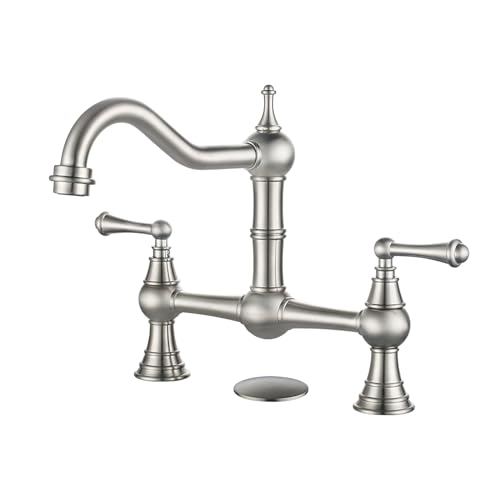
The bridge changes the two-handle conversation from layout to architecture. Hot and cold rise separately and join in an exposed horizontal bar, and WOWOW builds that bar from solid brass — the listing says so — beneath a brushed nickel finish, in vintage farmhouse style, as a two-handle 8-inch centerset design for two or three holes, sold without a sprayer. It is the same WOWOW bridge concept that appears in our brass guide wearing brushed gold; here the cooler nickel tone suits a different family of kitchens.
Brushed nickel over solid brass is a quietly luxurious combination: the hand feels the metal’s density through the handles, while the eye gets a soft silvery warmth that pairs with stone worktops and painted cabinetry. The bridge’s height gives the sink a furnished, deliberate look that deck-mounted centersets cannot reproduce, and the open deck between the uprights wipes clean in one pass of a cloth.
Without a sprayer, the sink works the old way, spout and swivel and a bowl of water, which farmhouse cooks have managed with for generations and modern spray addicts may genuinely miss. No flow figure is published in the listing. Buy the WOWOW for its construction and its silhouette, in that order, and it will not disappoint; buy it expecting sprayer convenience and it will.
- Construction: solid brass construction, stated in the listing
- Format: two-handle bridge, 8-inch centerset, two or three holes
- Finish: brushed nickel, per the listing
- Sprayer: none; sold without a sprayer
- Flow rate: not stated in the listing
Strengths
- Cast solid brass body gives the handles a dense, quality feel.
- Bridge silhouette furnishes a farmhouse sink like no centerset can.
- Two- or three-hole flexibility widens the sinks it can serve.
Trade-offs
- No sprayer limits rinsing across wide or double bowls.
- Bridge mounting will not suit sinks drilled for a single central hole.
- Exposed pipework collects dust and needs a deliberate wipe.
Best for: farmhouse renovations that want real metal and period architecture.
Not suited for: sprayer-dependent households or single-hole sinks.
How Do the Six Two-Handle Faucets Compare Side by Side?
| Pick | Holes | Sprayer | Stated flow | Signature detail |
|---|---|---|---|---|
| Delta Windemere Two-Handle Kitchen Faucet Chrome | 4 | Side sprayer | Not stated | Major-brand support network |
| Pfister Pfirst 2-Handle Kitchen Faucet | 3 | None mentioned | Not stated | High arc, full swivel, ceramic discs |
| Pfister Sonterra 2-Handle Kitchen Faucet | 3 or 4 | Side sprayer | 1.8 GPM | Most complete listing here |
| Cinwiny 2-Handle Kitchen Faucet | 4 | Sprayer included | 1.8 GPM | SUS304 stainless construction |
| SHACO 2 Handle Kitchen Faucet | 4 | Side sprayer | Not stated | NSF certified, lines included |
| WOWOW Bridge Kitchen Faucet Brushed Nickel | 2 or 3 | None | Not stated | Solid brass bridge body |
The pattern to notice is how the specification gap splits by brand size rather than by price. The two most documented listings come from Pfister’s Sonterra and the value brand Cinwiny, while the biggest name here, Delta, publishes the least in its title. Documentation is a habit, not a budget line, and this table rewards the makers who practise it.
Why Do Cooks Still Choose Two Handles on Purpose?
Temperature precision is the working reason. A single lever mixes hot and cold along one arc, and finding the same lukewarm twice is a small daily lottery. Two handles turn mixing into a repeatable recipe — hot opened a quarter turn, cold opened a half — that your hands memorise and reproduce without thought, which matters for yeast doughs, baby feeds, home brewing and any task where water temperature is an ingredient rather than a comfort.
Safety and independence follow. With separate valves, a failure in one handle rarely disables the whole faucet; you can shut down the hot side and still run cold while a part arrives. Households with children or elderly cooks also appreciate that full cold is a single, unambiguous handle, with no lever position to misremember. The layout is old because the logic is sound, and its survival in modern catalogues is evidence rather than nostalgia.
How Do You Measure an 8-Inch Centerset Pattern Correctly?
Centerset measurements are taken between the centres of the outer holes, not their edges, and 8 inches is the widespread kitchen standard that five of these picks are built around. Measure under the sink if the deck is crowded: the mounting studs reveal the true centres even when handles and sprayers hide them from above. Photograph the tape in place, because a measurement you can re-check beats a number you half-remember at the merchant’s counter.
While measuring, count every penetration, including the sprayer hole and any dispenser. A four-hole pattern with a sprayer is a different purchase from a four-hole pattern where the fourth hole must be blanked, and blanking caps in a matching finish are easier to source before the old faucet comes off. Finally, measure the deck’s thickness and the clearance beneath it, since mounting nuts need finger room that crowded, deep sinks do not always provide.
What Is Living With Two Valves Like Across a Decade?
Two valves age as a pair of small stories rather than one. The hot handle works harder in most kitchens, its washer or disc meeting hotter water and more frequent use, so it is usually the first to develop a drip or a squeak. The mercy of the layout is that servicing one side leaves the other fully functional, and the parts are typically handed twins — replace them together while the water is off and the tools are out, and the faucet resets its clock as a pair.
Handles themselves telegraph wear honestly. Lever handles loosen at their set screws every few years and need a minute with a hex key; crossheads can work loose on their splines if they are used as towel hooks by a determined household. None of this is failure, just the maintenance rhythm of a mechanical object, and owners who keep the little hex key in the cutlery drawer treat it as no more dramatic than descaling a kettle.
How Do You Keep a Two-Handle Faucet From Dripping at Both Taps?
Most twin drips share one cause: grit. When supply lines are disturbed, particles travel and lodge under valve seats and disc edges, and because both supplies were disturbed together, both handles can weep in the same week. Prevention is a flushing ritual — after any plumbing work, remove the aerator, run both handles fully for half a minute, and let the debris leave before the fine mesh traps it against the seats.
When a drip does settle in, diagnose before ordering. A drip that stops when the supply valve under the sink closes is a cartridge or seat issue inside the faucet; a drip accompanied by a damp cabinet floor is a connection, not a valve. Ceramic disc models like the two Pfisters usually need only a cartridge swap, while older washer designs ask for washers and seat dressing. Either job is within a confident homeowner’s reach with the water off and a photograph taken before the first part moves.
Which Handle Style Suits Your Hands: Lever or Crosshead?
Lever handles, fitted to most picks here, are the pragmatic default. They turn with a palm, a wrist or the heel of a floury hand, they show their open position at a glance, and they ask little grip strength from older hands. Crossheads, the plus-shaped classics of bridge faucets, demand a genuine grip and twist, which some cooks find more precise and others find hostile when hands are wet with washing-up foam.
Consider the household’s extremes rather than its average. The hands that matter are the tired ones at midnight, the arthritic ones at breakfast and the small ones learning to wash up. A handle style that serves those hands will never be regretted, while a style chosen for a photograph will be cursed quietly twice a day. Where a listing offers both, choose by grip; where it offers one, let that fact weigh honestly in the decision.
How Does a Two-Handle Faucet Suit a Household With Children?
Separate handles create a simple safety grammar a child can learn: the cold handle is the safe handle, and it is always in the same place. There is no lever arc to overshoot into scalding territory, and a parent can even temper the risk further by lowering the water heater’s setting while keeping adult control at the sink. The handles’ positions are legible across the room, so a supervising adult can see at a glance which supply a small hand is turning.
The layout also teaches cause and effect honestly. Children mixing their own hand-washing water with two handles learn proportion physically, a small daily lesson levers conceal. The counterpoint is speed: a child filling a water pistol under time pressure will open both handles fully and soak the splashback, which is an argument for deep bowls and a draining board rather than against the faucet style itself.
What Happens When One Handle Fails on a Two-Handle Faucet?
Life continues, which is the layout’s quiet superpower. A failed hot cartridge can be isolated at its supply valve while the cold side keeps the kitchen washing, cooking and cleaning. A single-lever faucet with a failed cartridge, by contrast, usually takes the whole sink out of service until the part lands. For households whose kitchen is also their utility room, laundry and only water source on the floor, that partial failure mode is worth real money.
Plan for the failure while everything works. Learn where each supply valve sits, turn both a quarter each season so they do not seize, and keep the faucet’s model information with the household paperwork. When the drip day arrives, you will isolate the guilty side in minutes, order the right cartridge from the model number, and swap it with the calm of someone who rehearsed. That rehearsal, not the handle count, is what separates a nuisance from an emergency.
How Do You Plumb a Two-Handle Faucet Without Cross-Threading the Supplies?
Twin supplies double the connections and therefore double the chances to start a thread crooked in the dark under a sink. Work by hand first: every compression or threaded joint should spin freely for several turns by fingers alone before any wrench appears. Resistance in the first turn is information, not a challenge, and backing off to restart costs seconds while a forced thread costs a fitting. Braided flexible lines, like those SHACO includes, forgive minor misalignment between faucet and valve in a way rigid copper never will.
Sequence matters too. Connect both supplies loosely, align the faucet body square to the sink, tighten the mounting hardware, and only then snug the supply nuts, so no joint is asked to pull the faucet into position. Fill the bowl, run both handles, and inspect each joint with a dry fingertip, which finds weeps that eyes miss in shadow. Leave the cabinet empty overnight with a sheet of paper beneath the joints, and let the morning’s dry paper sign off the job.
Why Do Restaurants and Workshops Keep Twin Taps?
Commercial sinks keep two handles for reasons that translate home. Gloves make fine lever work clumsy, but a gloved hand can slap a lever handle open. Separate supplies let staff dedicate one side — many workshops run the cold at full for rinsing and reserve hot for washing — and a broken handle in a working sink is swapped in minutes with the other side still serving. Durability in those settings is measured in cycles per day, and the twin-valve layout’s survival there is a field test no laboratory brochure can fake.
The home lesson is about matching the faucet to the work rhythm. A kitchen that behaves like a workshop at weekends — preserving, brewing, dyeing, washing garden produce — will use two handles the way workshops do, as tools rather than jewellery. A kitchen whose sink mostly rinses glasses may never exploit the layout’s strengths, and for that household the honest recommendation is a lever. This guide exists for the first kind of kitchen, and its picks are chosen accordingly.
How Should You Clean Around Four Deck Holes Without Damaging Seals?
Every deck penetration is a small frontier where water, soap and crumbs gather, and four-hole layouts have more frontier than most. The defence is a weekly pass with a soft brush around each base, lifting the grit that otherwise works under gaskets and stains the deck. Avoid flooding the bases with cleaner and leaving it to pool; sealants and plated edges both prefer a wipe-and-dry regime to a soaking.
Once a season, look from below. A torch and a dry hand under each mounting point will catch the slow seep that top-side cleaning hides, the kind that swells a cabinet floor over a winter. Reseating a gasket or adding a neat bead of sanitary sealant at that stage is a ten-minute mercy compared with replacing a cabinet base. Two-handle owners simply have twice as many points to bless with this attention, which is a fair price for the layout’s other gifts.
What Does the Sprayer Hose Do to Your Under-Sink Storage?
Four picks here carry a side sprayer, and every sprayer carries a hose that lives in the cabinet, looping down and rising as the head is drawn out. That loop claims the centre of the under-sink space and resents sharing it with tall bottles, which snag the hose and make the sprayer tug reluctantly. A cabinet organised with the loop in mind — bottles corralled in a door rack or a side caddy, the loop hanging free — keeps the sprayer drawing smoothly for years.
Inspect the hose when you inspect the joints. It flexes at the same points thousands of times, and its first wear shows as a stiffness or a faint weep at the crimp near the head. Replacement hoses are among the cheapest parts in plumbing when bought by model number early, and among the most annoying when bought by guesswork late. The sprayer is the hardest-working accessory in a traditional kitchen, and a minute of annual attention is all it asks in return.
How Do Two-Handle Faucets Pair With Instant Hot and Filtered Water Add-Ons?
A four-hole deck is a small ecosystem, and two-handle buyers often inherit spare capacity in it. The fourth hole that a sprayer does not claim can host a soap dispenser, while a separate filtered-water tap usually wants its own drilling at the sink’s corner. Plan the whole deck as one composition before ordering anything, because each addition competes for the same under-sink territory of hoses, tanks and valves, and the faucet’s mounting hardware has first claim on the centre.
Instant-hot tanks deserve a special note: their lines run near the faucet’s hot supply, and a tidy installer will keep the runs separated and labelled, so a future cartridge swap does not become a guessing game among warm pipes. Photograph the finished arrangement. In five years, that photograph will be worth more than the installation receipt when a plumber asks which valve feeds what, and it costs nothing but a moment’s foresight while the cabinet is still empty.
What Should a Buyer With a Widespread Sink Do Instead?
Widespread sinks space their holes beyond a centerset’s reach, and no plate stretches a fixed 8-inch body across a 12-inch spread. The honest options are a bridge, whose uprights can sometimes match wider spacings if the listing’s dimensions agree, or a different faucet architecture altogether with separate deck-mounted components. The WOWOW bridge in this guide publishes its centerset pattern, so measure your spread against it rather than assuming the farmhouse look guarantees a farmhouse fit.
If neither works, treat the sink as the senior partner. Sinks outlast faucets and cost more to change, so the faucet should adapt or be exchanged while the return window is open. The worst outcome in this category is not a returned parcel; it is a forced installation with flexed supplies and a body under permanent strain, quietly shortening the life of everything it touches.
How Do You Judge Handle Feel in a Showroom or From a Listing?
Handles communicate quality through resistance. A good handle turns with an even, slightly damped sweep and stops with certainty at both ends of its travel; a poor one feels notchy, loose in the middle of its arc or gritty near the close. In a showroom, work each handle a dozen times and listen — cartridges should be silent, and any clicking at the stops is a preview of year three. From a listing, ceramic disc valves are the strongest textual clue, which is why both Pfister picks earn trust their photographs alone could not.
Weight tells a parallel story. Handles with metal bodies carry a cool density that polymer handles imitate poorly, and in a two-handle design your hands make the comparison twice at every use. None of the listings here publishes handle materials, so that judgement waits for the box to open; keep the return option alive until your hands have voted, because they are the household members who will operate this purchase ten thousand times.
Why Does the Fourth Hole Cause So Much Confusion?
Because it has had so many careers. Across the decades the fourth hole has hosted sprayers, soap dispensers, air gaps for dishwashers, filtered-water taps and blanking caps pretending to be design choices. A replacement buyer inherits whatever the last renovation decided, and a faucet listing that says three or four holes, like the Sonterra’s, is really saying it can adapt to several of those histories. Inventory your own fourth hole before ordering: what sits in it, what feeds it from below, and whether you want that function to survive the swap.
If the answer is a dishwasher air gap, local rules may require it to remain, which settles the sprayer question for you. If it is a dispenser you never refill, the hole is an opportunity disguised as clutter. The deck of a working sink is prime real estate measured in centimetres, and a two-handle installation is the natural moment to audit every centimetre of it. Bring a torch, a notebook and an honest eye, because the deck you map today is the deck every future faucet in this kitchen will have to negotiate with.
How Do You Retrain Your Hands After Years With a Single Lever?
The first fortnight is the honest cost of switching, and it helps to expect it. Your wrist will reach for a lever that is not there while your eyes are on the pan, and the temperature will arrive a few seconds later than muscle memory promised. Build the new habit deliberately: decide a house mixing position for hand-washing, use it every time for a week, and the handles stop being a decision and become a reflex, the same way a new gear pattern settles in a car.
Households report one unexpected pleasure at the end of the retraining. Because mixing is now a two-part act, people become more conscious of how much hot water they actually use, and many find their default wash settling cooler and their full-hot reserved for jobs that earn it. Whether that thrift matters to you or not, the awareness is real, and it is the kind of behavioural footnote no specification table will ever print about a faucet.
What Role Does the Aerator Play When Two Handles Feed One Spout?
Both supplies meet in the spout and leave through one aerator, the small screened fitting that shapes the stream and mixes in air to soften it. When a two-handle faucet’s stream starts to splutter or lean, the aerator is the first suspect, and its cleaning is the cheapest repair in the house: unscrew, rinse the screens, soak away the scale, refit. A stream that still misbehaves with a clean aerator is telling you about pressure imbalance between the supplies, a story told by one handle running noticeably stronger than the other.
That imbalance is itself diagnostic. Equal handles and unequal streams point to a partially closed supply valve, a kinked line or a cartridge beginning to clog on the weaker side. Because the layout separates the supplies so cleanly, faults announce which side they live on, and a homeowner with a torch and ten minutes can usually narrow a problem to one valve, one line or one cartridge before any professional is called.
How Should You Stage the Swap From an Old Faucet to a New One?
Stage the job like a relay. The day before, clear the cabinet completely, lay a tray for the parts that will come off, and confirm the new box contains everything its listing promised — handles, sprayer, lines, mounting hardware — while a return is still painless. On the day, photograph the old plumbing, isolate and drain, and remove the old faucet before opening the new one’s small-parts bags, so nothing mingles and nothing is lost down the waste.
Fit the new body dry, check handle swing against the splashback, then connect and flush before the aerator goes on. Run the sprayer through its travel, work both handles through their arcs, and inspect with a dry hand. The whole swap, staged this way, fits inside a morning for a confident homeowner, and the kitchen returns to service before lunch rather than limping through a weekend of bottled water and takeaway guilt.
How Do Two-Handle Faucets Behave on Low-Pressure and Gravity-Fed Systems?
Older houses with header tanks feed their taps gently, and faucet choice matters more there than in any mains-pressure flat. Wide, simple waterways and an aerator that is not over-engineered for high pressure keep a gravity-fed stream respectable, while restrictive modern cartridges can reduce a gentle supply to a thread. None of these listings publishes a minimum operating pressure, so low-pressure households should put the question to the seller in writing and treat the answer as part of the specification they are buying.
The two-handle layout itself is neutral in this contest, neither helping nor hindering pressure, but it does help diagnosis: with separate handles you can feel and see each supply’s contribution plainly, learning in one experiment whether your hot feed from the tank is the weak sibling. That knowledge outlives the faucet, informing everything from shower choices to the day the system is finally converted to mains pressure.
Should You Keep the Old Faucet When the New One Goes In?
Keep it for a month, boxed in the garage, and you will thank yourself in at least one common future. If the new faucet arrives with a hidden fault that only a week of use reveals, the old one refits in an hour and restores the kitchen while warranties are argued. If the new one proves itself, the old faucet still has value as a source of standard parts, a donation to a community repair shelf, or a spare for a utility sink whose own faucet is living on borrowed time.
Photograph the old faucet in place before removal regardless. Its hole pattern, supply routing and sprayer position are the archaeological record of your sink, and the next person to work under that cabinet — possibly you, possibly a plumber billing by the hour — will read those photographs with gratitude. Disposal is the last step of a replacement, not the first, and treating it that way costs nothing but a corner of shelf space.
How Do Guests and New Household Members Read Two Handles?
Visitors understand two handles instantly, which is an underrated hospitality feature. Nobody stands at a twin-tap sink wondering which gesture produces cold, and nobody scalds themselves exploring a lever’s arc while holding your best saucepan. In holiday lets and multigenerational homes that legibility prevents the small accidents and floods that unfamiliar controls invite, and it is one reason the layout persists in rental properties whose owners have every incentive to simplify.
Label discipline still helps in one case: where handles are identical crossheads and the hot sits on the unexpected side, a guest’s confidence becomes a liability. Keep the convention of hot on the left wherever your plumbing allows, and if an old house reverses it, let everyone who cooks there learn the fact on day one rather than during a distracted midnight rinse.
What Mistakes Do Two-Handle Buyers Keep Making?
The first is assuming the sink’s holes from memory. Two-handle faucets are pattern-specific in a way single-hole levers are not, and a centerset bought for a widespread sink is a parcel travelling back. The second is forgetting the sprayer’s hole in the count, then discovering the new faucet and the old sprayer both want the same fourth hole. The third is judging the layout by a showroom minute: two handles feel charming for sixty seconds and must still feel right at the thousandth washing-up, with tired hands and a pan that needs exact warmth.
Buyers also neglect the valves in favour of the silhouette. Two faucets can share a shape while one hides ceramic discs and the other hides washers that will weep within a few years, which is why this guide prints valve information wherever a listing provides it and marks its absence where it does not. Finally, do not throw away the old handles’ set screws and the new faucet’s paperwork in the same tidy-up; future-you, hex key in hand at midnight, will want both.
Final Recommendation
For most households converting to or replacing a two-handle faucet, the Pfister Sonterra 2-Handle Kitchen Faucet is the complete answer: published flow, ceramic disc valve, flexible hole count, high arc and a sprayer. Specification-led buyers should look hard at the Cinwiny 2-Handle Kitchen Faucet, whose stainless grade and stated numbers out-argue many bigger names, while restorers will find their faucet in the WOWOW Bridge Kitchen Faucet Brushed Nickel. The Delta serves brand loyalists, the Pfirst serves swivel lovers, and the SHACO serves anyone who wants certification and supply lines settled in one box.
Two handles ask a little more of your hands at every wash, and repay it with control you can feel, so choose the pair whose numbers you have read and whose shape your kitchen deserves. If a season from now the handles have become invisible habits and the temperature lands where your hands expect it, the layout will have proved itself the way it has proved itself in working kitchens for a hundred years: quietly, twice a day, without asking for applause.
Frequently Asked Questions
Are two-handle faucets less convenient than a single lever?
They ask for two adjustments instead of one, which is slower when a hand is full. In exchange they give instant full-hot or full-cold and a repeatable mixing position your hands memorise. Busy cooks divide on the trade; temperature-sensitive cooks rarely go back.
Can a two-handle faucet replace a single-hole faucet?
Only if the sink or deck provides the holes the pattern needs. Centerset designs need their holes in a row at the stated spacing, and bridges need two deck holes. A single drilled hole with no knockouts rules both out without deck work.
What does 8-inch centerset actually mean?
It is the distance between the centres of the outer mounting holes. Measure centre to centre, ideally from the studs beneath the sink, and compare with the listing’s pattern before ordering, because edges and handle widths mislead the eye.
Do two-handle faucets waste more water while mixing?
They can, briefly, while you balance the pair, though a memorised handle position shortens that moment to seconds. Models with a stated flow, like the Sonterra and Cinwiny at 1.8 GPM, cap the rate regardless of how long the mixing takes.
Is a side sprayer worth the extra hole?
For wide or double bowls, usually yes: it rinses corners the spout cannot reach and fills vessels beside the sink. For a single deep bowl under a high swivelling spout, the Pfirst shows how well a kitchen can manage without one.
Which finish hides fingerprints best among these picks?
Brushed nickel and stainless finishes diffuse reflections and forgive handling, while polished chrome shows every print in exchange for its shine. Choose by how often you honestly wipe the sink area, not by how you hope to.
Do two-handle faucets suit a dishwasher-heavy kitchen?
Yes, comfortably. Households that machine-wash most loads use the faucet for filling, rinsing produce and hand-washing the few delicate pieces, all tasks where precise temperature and a dependable sprayer matter more than one-handed speed. The layout’s deliberateness is barely felt when the sink’s workload is light, and the handles wait, patient and legible, for the tasks that remain each day, without complaint or ceremony.
Related Guides
Two-handle layouts often belong to a broader traditional refresh, so keep reading with Best Wall-Mount Kitchen Faucets for the other classic mounting style, Best Slip-Resistant Bath Mats for safety underfoot elsewhere in the house, and Best Air Purifiers for Cigar Odor and Smoke for clearing the air after long evenings that started at this sink.


