What's inside
- Key Takeaways
- Quick Picks
- How Did We Sort Real Brass From Brass Colour?
- How Do the Six Brass Faucets Compare Side by Side?
- What Does Unlacquered Brass Actually Do Over Time?
- Why Does Solid Brass Cost More Than a Brass Finish?
- How Do You Clean Brass Without Ruining It?
- Which Sinks and Worktops Pair Best With Brass?
- How Do You Fit a Bridge Faucet to a Modern Sink?
- How Does Brass Behave With Hard Water and Coastal Air?
- What Should You Check in the First Week After Fitting a Brass Faucet?
- How Do Two Handles Change the Way You Cook?
- Why Do Restorers Hunt for Brass When Every Other Metal Is Easier?
- How Should You Photograph and Compare Brass Tones Before Buying?
- What Part Does the Cartridge Play in a Brass Faucet’s Life?
- Is Brass a Sensible Choice for a Family Kitchen?
- How Does a Brass Faucet Change the Sound and Feel of a Kitchen?
- What Should You Ask a Seller Before Ordering a Brass Faucet?
- How Do You Decide Between Patina and Polish as a Household?
- Where Does a Brass Faucet Sit in a Whole-Kitchen Budget?
- Can a Brass Faucet Work in a Rented or Soon-to-Be-Sold Home?
- How Do You Store the Paperwork a Brass Faucet Deserves?
- What Mistakes Do Brass Buyers Keep Making?
- Final Recommendation
- Frequently Asked Questions
- Related Guides
As an Amazon Associate I earn from qualifying purchases. This post may contain affiliate links at no extra cost to you.
cottageverdict.com is reader-supported. When you buy through links on our site, we may earn an affiliate commission.
Where to buy: Each faucet below links to its Amazon listing, where you can check price on Amazon and read the maker’s own wording about materials. With brass, the wording is the whole game: a listing that says solid brass construction is making a different promise from one that names a brass-coloured finish, and this guide keeps the two strictly apart.
Shoppers hunting the best solid brass kitchen faucets usually want two things at once: the weight and longevity of a faucet cast from real brass, and the warm, living colour that no plated substitute quite reproduces. The honest complication is that the word brass appears in listings for at least three different products — faucets built from solid brass, faucets finished in a brass tone over another metal, and faucets from a brand whose name happens to contain the word. This guide includes all three kinds, labels each one plainly, and reserves the term solid brass for the picks whose listings actually claim brass construction.
Two of the six picks are unlacquered solid brass, which means they leave the factory without a protective clear coat and will deepen into a patina that records every year of use. The others offer brass colour in polished or brushed form, including bridge designs that suit period kitchens. Read the reviews with that map in mind and you will know exactly what metal you are paying for in each case.
Key Takeaways
- Only three picks here have listings that claim solid brass construction; the Kingston Brass models are named for their brand and brass-tone finishes, and are labelled that way below.
- Unlacquered brass is a living finish: it darkens, spots and develops patina, which is either the attraction or a deal-breaker.
- Bridge faucets mount through two deck holes and suit period sinks, while the solid brass pull-down and gooseneck picks use a single hole.
- A brass sprayer or a brushed gold finish is not the same claim as a solid brass body, so read each spec box for what the listing actually states.
- Brass suits warm kitchens and traditional cabinetry, and it asks for gentle cleaning, never abrasive pads or harsh chemicals.
Quick Picks
| Pick | Badge | Why it earns a place |
|---|---|---|
| Brasscrafted Unlacquered Brass Pull Down Faucet | Solid Brass, Modern Format | A genuinely solid, unlacquered brass body wrapped around a contemporary pull-down sprayer and swivel spout. |
| Brasscrafted Unlacquered Brass Gooseneck Faucet | Solid Brass Purist | The listing spells out 100% solid brass, a ceramic disc valve and a living antique patina in plain language. |
| Kingston Brass Single-Handle Kitchen Faucet | Brushed Brass Finish, Single Lever | A straightforward single-handle design in a brushed brass finish for kitchens that want the colour without patina care. |
| Kingston Brass English Country Bridge Faucet | Polished Brass Bridge | A tall English country bridge silhouette in polished brass for period sinks and traditional rooms. |
| Kingston Brass Heritage Bridge Faucet | Bridge With Brass Sprayer | An 8-inch heritage bridge in brushed brass that adds a separate brass sprayer to the classic layout. |
| WOWOW Brass Bridge Kitchen Faucet | Solid Brass Bridge | The listing claims solid brass construction under a brushed gold finish, in a vintage farmhouse bridge shape. |
How Did We Sort Real Brass From Brass Colour?
The selection rule for this guide was documentary, not visual. A pick is described as solid brass only where its listing title uses words like solid brass or solid brass construction about the faucet itself. Where a title names a finish — brushed brass, polished brass, brushed gold — the review calls it a finish, however warm the photographs look. Brand names were ignored as evidence, because a company can call itself anything and still cast a faucet from another alloy.
Format variety was the second filter. Brass buyers split into camps that rarely overlap: modern cooks who want a pull-down sprayer in honest metal, traditionalists restoring a period sink who need a bridge, and minimalists who want a single sculptural gooseneck. The six picks cover those camps deliberately. The third filter was candour about upkeep, since unlacquered metal is the rare finish whose sellers and reviewers agree it will change; any pick that hides that fact would have been dropped.

Brasscrafted Unlacquered Brass Pull Down Faucet — Solid Brass, Modern Format
This is the pick for buyers who refuse to choose between honest material and modern convenience. The listing title states solid unlacquered brass outright, then lists thoroughly contemporary hardware: a high-arc commercial-style body, a swivel spout, a pull-down head offering stream and spray, and single-hole mounting. Lift it and the story continues, because solid brass has a heft that plated zinc or steel bodies cannot imitate; the faucet feels cast rather than assembled.
The unlacquered surface is the decision to think through. Without a clear coat, the brass will darken unevenly at first, water spots will show as pale rings, and the areas your hands touch daily will polish brighter than the rest. Brasscrafted’s buyers generally want exactly that record of use, the way chefs want a carbon-steel pan to blacken. If you would rather polish a faucet back to showroom shine every month, this finish will feel like a chore wearing a costume.
Functionally the dual stream-and-spray head covers the modern repertoire, filling with the stream and rinsing with the spray, while the swivel spout lets the tall arc serve a double bowl. Single-hole mounting keeps the deck clean, though owners of three-hole sinks should confirm plate options on the listing page, because the title does not mention an included plate.
- Construction: solid unlacquered brass, stated in the listing title
- Spray format: pull-down head with dual stream and spray
- Spout: high arc with swivel movement, per the listing
- Mounting: single hole, per the listing
- Flow rate: not stated in the listing
Strengths
- Genuine solid brass construction in a fully modern pull-down format.
- Living finish develops character instead of peeling like a failed coating.
- Single-hole deck keeps the sink area visually quiet.
Trade-offs
- Unlacquered brass will develop patina and water spotting; expect visible change within months.
- No deck plate is mentioned, so multi-hole sinks need checking before purchase.
- Solid brass weight demands a sound, rigid sink deck to mount on.
Best for: cooks who want real brass and a modern sprayer in the same object.
Not suited for: anyone who wants a finish that looks identical in year five and year one.

Brasscrafted Unlacquered Brass Gooseneck Faucet — Solid Brass Purist
If the pull-down above is brass with modern manners, this gooseneck is brass with its sleeves rolled up. The listing is the most explicit in the guide: 100% solid brass, a high-arc gooseneck shape, a 360-degree swivel spout, a ceramic disc valve and 3/8-inch supply lines, all under the honest banner of a living antique patina. There is no sprayer and no spray mode, just a single elegant curve of metal delivering water where you point it.
That simplicity is a philosophy. A gooseneck with no pull-down head has almost nothing to wear out except the cartridge, and the ceramic disc valve named in the listing is the right long-life choice. The full swivel makes the fixed spout more useful than it first appears, swinging to fill a bucket on the draining board or to serve the second bowl. The trade is rinsing power: without a spray, stuck food waits for a soak and a brush rather than being blasted off.
The patina language deserves respect rather than skimming. Living antique means the maker expects the surface to evolve, darkening in the recesses and brightening on the high points your hands polish. In a cottage kitchen with aged wood and stone, that evolution looks like belonging. In a laboratory-white modern kitchen it may simply look uneven, so match this faucet to a room that already celebrates materials changing over time.
- Construction: 100% solid brass, stated in the listing title
- Valve: ceramic disc, stated in the listing
- Spout: high-arc gooseneck with 360-degree swivel
- Supply lines: 3/8-inch, per the listing
- Sprayer: none; this is a spout-only design
Strengths
- The clearest solid brass claim of any pick in this guide.
- Few moving parts beyond the cartridge, which suits a buy-it-for-decades mindset.
- Full swivel gives a fixed spout surprising reach around the sink.
Trade-offs
- No sprayer at all, so rinsing relies on soaking and a washing-up brush.
- Unlacquered surface will patina unevenly by design, brightest where hands land.
- Gooseneck height and swing need clearance from shelves or windows behind the sink.
Best for: purists restoring a traditional kitchen who value material honesty over gadgets.
Not suited for: households that lean on a sprayer for most of their washing up.

Kingston Brass Single-Handle Kitchen Faucet — Brushed Brass Finish, Single Lever
Read this pick’s label carefully, because it teaches the guide’s central lesson. Kingston Brass is the brand name, and the listing title describes a single-handle kitchen faucet in a brushed brass finish; it does not claim a solid brass body. What you are buying is the colour and the convenience, delivered in a familiar single-lever format from a maker whose catalogue leans heavily into traditional styling. For many kitchens that is a perfectly sensible purchase, as long as nobody mistakes it for cast brass.
The brushed finish is the low-drama way to own the brass look. Brushing breaks up reflections, hides fingerprints better than a polished surface and keeps its appearance stable because it is a finished, protected surface rather than living metal. It will not develop patina, which owners of the two Brasscrafted picks would call a loss and owners of busy family kitchens will call a relief. The single handle keeps daily use simple, one hand for flow and temperature together.
The listing title is short, so several details a careful buyer wants, from spout height to valve type, are not stated in the listing and are marked that way below. Check the product page for the full specification before ordering, and weigh this pick on its stated merits: brand, finish and handle format.
- Finish: brushed brass, per the listing title
- Handle layout: single handle
- Construction material: the listing does not claim solid brass
- Spout height: not stated in the listing
- Valve type: not stated in the listing
Strengths
- Brass colour without any patina management or polishing routine.
- Single-lever control is the easiest format for mixed-age households.
- Brushed surface forgives fingerprints and everyday splashes.
Trade-offs
- Not a solid brass faucet, whatever the brand name suggests at a glance.
- Short listing leaves key dimensions to be confirmed on the product page.
- A coated finish can eventually wear at the handle’s high-contact edge.
Best for: buyers who want the brushed brass look with set-and-forget upkeep.
Not suited for: buyers specifically seeking cast solid brass construction.

Kingston Brass English Country Bridge Faucet — Polished Brass Bridge
The bridge is the oldest faucet architecture in this guide: hot and cold supplies rise through two separate deck holes and meet in a horizontal bar, the bridge itself, from which the spout climbs. Kingston’s English Country version dresses that layout in polished brass and traditional detailing, and the listing gives overall dimensions of 13.5 by 7.75 by 16.81 inches, a tall presence that suits deep apron-front sinks and old houses where the faucet is part of the room’s furniture.
Again, precision about materials: the listing names a polished brass finish and does not claim solid brass construction, so this review treats it as a brass-finished bridge from a brand specialising in period designs. Polished is the dressiest surface in the guide, mirror-bright and unapologetically formal. It shows every fingerprint and water spot, and in return it delivers the full antique-shop gleam that brushed finishes deliberately mute.
Two-handle control comes with the bridge territory, giving separate command of hot and cold. Cooks who grew up with twin taps will find it natural; cooks raised on single levers will need a week to stop reaching for one handle with a soapy hand. The tall spout clears serious cookware, and the bridge layout leaves the deck between the holes open, which makes wiping the sink’s back edge easier than around a wide single base.
- Format: two-hole bridge faucet, English Country styling
- Finish: polished brass, per the listing title
- Dimensions: 13.5 x 7.75 x 16.81 inches, stated in the listing
- Construction material: the listing does not claim solid brass
- Sprayer: none mentioned in the listing
Strengths
- Authentic period silhouette that modern single-hole faucets cannot imitate.
- Tall spout and open bridge make the sink’s back edge easy to clean.
- Published overall dimensions help planning against splashbacks and shelves.
Trade-offs
- Polished finish shows fingerprints and spots more than any other pick here.
- Two-handle control is slower to adjust with wet or floury hands.
- Bridge mounting needs two correctly spaced deck holes, so it will not fit every sink.
Best for: period renovations with apron-front sinks and a taste for formality.
Not suited for: minimalist kitchens or anyone who dislikes polishing.
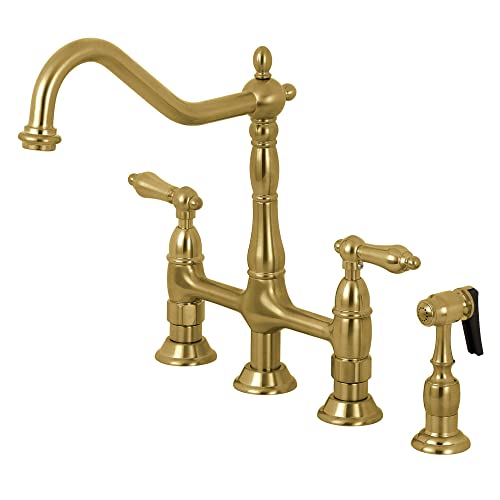
Kingston Brass Heritage Bridge Faucet — Bridge With Brass Sprayer
The Heritage keeps the bridge architecture and answers its oldest criticism, the missing sprayer, by adding one — and the listing specifies a brass sprayer, which is a material claim about that component even though the body itself is described by its brushed brass finish. An 8-inch bridge format matches the standard spacing of countless older sinks, making this the bridge most likely to drop into an existing kitchen without new holes.
A side sprayer changes what a traditional faucet can do. It will not match a pull-down head for reach, but it rinses the bowl’s corners, fills a kettle standing beside the sink and gives the bridge format a working tool its ancestors lacked. The brushed finish sits between the English Country’s polish and the unlacquered pair’s living surface: warm, muted and stable, asking only for a wipe rather than a polish or a patina philosophy.
As with its sibling, treat the material story exactly as the listing tells it. The sprayer is brass per the title; the body’s construction is not claimed as solid brass in the title, so buyers for whom cast construction is the whole point should look to the Brasscrafted pair or the WOWOW below. Buyers who want the heritage look with modern rinsing help will find this the most complete of the three Kingston designs.
- Format: 8-inch bridge faucet, Heritage styling
- Sprayer: brass side sprayer, stated in the listing title
- Finish: brushed brass, per the listing
- Construction material: body not claimed as solid brass in the listing
- Handle layout: two handles, as the bridge format implies
Strengths
- Adds a genuinely useful sprayer to the traditional bridge layout.
- Standard 8-inch spacing suits many existing period sinks.
- Brushed finish keeps the warm colour with modest upkeep.
Trade-offs
- Side sprayers reach less and retract less neatly than pull-down heads.
- Body construction is not stated as solid brass, so do not buy it as cast metal.
- Extra sprayer hole and hose add plumbing beneath an already busy deck.
Best for: traditional kitchens that want a bridge faucet without giving up a sprayer.
Not suited for: single-hole sinks or buyers who require a solid brass body.

WOWOW Brass Bridge Kitchen Faucet — Solid Brass Bridge
WOWOW’s bridge is where the two halves of this guide meet: the listing claims solid brass construction, then shapes that metal into a two-handle, 8-inch centerset bridge in vintage farmhouse style, finished in brushed gold and offered without a sprayer for two- or three-hole installation. If you want cast brass and a period silhouette in the same purchase, this is the only pick that promises both in its title.
The brushed gold finish deserves a sentence of its own, because gold-toned and brass-toned are cousins rather than twins. Brushed gold reads slightly brighter and more yellow than antique brass, which matters when the faucet must sit beside genuinely old brass hardware. Against new cabinet handles in a matching brushed gold the effect is seamless; beside a century-old brass rail it may look like the new penny it is, at least until the room’s other elements settle the eye.
Without a sprayer, washing up returns to the spout-and-sink partnership, helped by the bridge’s generous height. Two handles give the separate hot and cold control traditionalists prefer, and the option of two- or three-hole fitting widens the range of sinks it can serve. No flow figure appears in the listing, so that box is marked unstated rather than filled with optimism.
- Construction: solid brass construction, stated in the listing title
- Format: two-handle 8-inch centerset bridge, two- or three-hole fitting
- Finish: brushed gold, per the listing
- Sprayer: none; sold without a sprayer
- Flow rate: not stated in the listing
Strengths
- Solid brass construction in a true bridge format, a rare combination.
- Flexible hole options ease fitting onto older farmhouse sinks.
- Vintage styling is carried by the shape, not just the colour.
Trade-offs
- No sprayer, so rinsing big trays takes patience and a full bowl.
- Brushed gold tone may not match antique brass hardware exactly.
- Two-handle adjustment is slower than a single lever at a busy sink.
Best for: farmhouse renovations wanting cast brass in an authentic bridge shape.
Not suited for: cooks who rely on a sprayer or need an exact antique-brass match.
How Do the Six Brass Faucets Compare Side by Side?
| Pick | Material claim in listing | Format | Finish behaviour |
|---|---|---|---|
| Brasscrafted Unlacquered Brass Pull Down Faucet | Solid brass | Pull-down, single hole | Living patina, unlacquered |
| Brasscrafted Unlacquered Brass Gooseneck Faucet | 100% solid brass | Gooseneck spout, no sprayer | Living antique patina |
| Kingston Brass Single-Handle Kitchen Faucet | Finish only; no solid claim | Single handle | Stable brushed finish |
| Kingston Brass English Country Bridge Faucet | Finish only; no solid claim | Two-hole bridge | Polished, high shine |
| Kingston Brass Heritage Bridge Faucet | Brass sprayer; body finish only | 8-inch bridge with sprayer | Stable brushed finish |
| WOWOW Brass Bridge Kitchen Faucet | Solid brass construction | 8-inch bridge, no sprayer | Brushed gold finish |
The table’s middle column is the one to study. Three listings promise brass all the way through; three promise brass colour or a brass component. Neither group is a scam, but they are different purchases at different prices, and confusing them is how buyers end up disappointed with a faucet that is actually doing exactly what its listing said. Decide which promise you are paying for before comparing shapes.
What Does Unlacquered Brass Actually Do Over Time?
Fresh unlacquered brass is bright and almost rosy-gold. Within weeks, oxygen and water begin their work: the surface deepens toward honey, then toward a mottled brown-gold, with darker tones settling in crevices and brighter ones surviving where thumbs and palms polish the metal daily. Water spots appear as pale outlines after splashes dry, and acidic splashes from lemon or tomato can leave a temporarily brighter freckle. None of this is damage. It is the finish behaving as its makers describe, a record of the kitchen’s life written on the faucet.
You hold two levers of control. The first is polishing: a gentle brass polish returns the surface toward brightness, though never uniformly, and repeated polishing keeps the metal in a younger state at the cost of a regular ritual. The second is wax: a thin coat of microcrystalline wax slows oxidation and spotting for a season. Most unlacquered owners settle into a middle path, letting the body darken while keeping the spout tip and handle presentable, which produces the lived-in gradient antique dealers call honest wear.
Why Does Solid Brass Cost More Than a Brass Finish?
Brass is a copper alloy, and copper is not cheap; a faucet cast from it carries real material cost before any machining begins. Solid brass also machines beautifully and resists corrosion from inside, where water sits against the metal for the faucet’s whole life, which is why plumbers trust it in walls and why old brass faucets can be re-valved and returned to service after decades. A brass finish, by contrast, is a surface treatment over a body that may be a lighter alloy or stainless steel, engineered to deliver the colour at a lower price and weight.
The sensible way to frame the difference is time horizon. In a kitchen you expect to keep for twenty years, cast construction and a living finish amortise their premium into pennies a week and can be maintained almost indefinitely. In a five-year refresh or a rental upgrade, a good brass finish delivers the same visual warmth without asking you to fund metallurgy you will not stay to appreciate. Both decisions are rational; the irrational one is paying cast prices for coated metal because a brand name sounded like a material.
How Do You Clean Brass Without Ruining It?
Daily care is deliberately boring: warm water, a drop of mild washing-up liquid, a soft cloth, then a dry buff so droplets do not dry into spots. That routine serves every pick in this guide, lacquered or not. What ruins brass is enthusiasm — abrasive pads that cut through finishes, acidic cleaners left to sit, and chlorine-based sprays that attack both coatings and living metal. Vinegar belongs in the descaling conversation for aerators, not wiped over a polished bridge and forgotten while you answer the door.
For unlacquered pieces, decide your patina policy before the first clean. If you love the darkening, clean gently and never polish, letting the gradient develop. If you prefer brightness, use a dedicated brass polish sparingly and evenly, accepting that the areas you cannot reach will stay darker and give the faucet a two-tone age. Either policy succeeds; the failure mode is polishing randomly, which leaves a faucet that looks neither new nor honestly old but merely patchy.
Which Sinks and Worktops Pair Best With Brass?
Brass is a warm metal, and it flatters warm surroundings: cream or white ceramic sinks, butler’s sinks with their soft edges, marble with gold veining, and timber worktops from pale oak to dark walnut. Fireclay apron-front sinks and bridge faucets are a partnership with a century of precedent, and the WOWOW or either Kingston bridge will look inevitable in front of one. Cool pairings can work as deliberate contrast — brass against deep green cabinetry is a modern classic — but brass beside blue-grey stone and chrome appliances tends to look like a guest who dressed for a different party.
Repeat the metal somewhere. A brass faucet standing alone in a sea of chrome reads as a mistake; the same faucet with brass cabinet knobs, a brass rail or even a copper-bottomed pan collection reads as a scheme. The repetition need not be large, but it must exist, and it is cheaper to plan it before drilling holes than to retrofit a theme around a faucet you already love.
How Do You Fit a Bridge Faucet to a Modern Sink?
Bridge faucets need two supply holes at the spacing the bridge expects, commonly the 8-inch pattern the Heritage and WOWOW are built around. Many modern sinks are drilled for a single central hole with optional knockouts, so the first job is investigative: look under the sink or read its specification to learn what hole patterns it can accept. A sink that cannot take two holes at the right spacing rules out a true bridge, and no amount of wishing changes the casting.
Where the holes exist, fitting is conventional plumbing with one extra discipline: the bridge must sit level across both uprights, so tighten the two mounting nuts alternately, a little at a time, checking the spout’s verticality as you go. Connect each supply to its correct side, since a bridge plumbed backwards gives you a hot handle delivering cold, an error that survives embarrassingly long in guest bathrooms of the kitchen world. Run both handles through their full range before declaring the job done.
How Does Brass Behave With Hard Water and Coastal Air?
Hard water tests every faucet, but it writes its results differently on brass. Scale still gathers at the aerator and around the base, yet on a living finish the pale deposits blend into the patina’s lighter freckles, while on polished brass they stand out like chalk on a blackboard. The maintenance answer is the same as anywhere: wipe the base dry when you remember, soak the aerator in descaling solution when the stream starts to splinter, and never let an acidic cleaner pool on the metal while you do something else.
Coastal air adds salt to the equation, and salt accelerates surface change on unlacquered metal. A beach-house kitchen fitted with either Brasscrafted pick should expect patina to develop faster and deeper than the same faucet inland, which many owners count as the point of buying living metal near the sea. Lacquered and brushed finishes resist that acceleration behind their protective coats, so a coastal buyer who wants stability rather than theatre should choose from the Kingston side of this guide.
What Should You Check in the First Week After Fitting a Brass Faucet?
New fittings settle, and brass is heavy enough to make settling audible. In the first week, run a dry hand around every joint under the sink each evening; a weeping compression fitting announces itself as a cold dampness long before it drips. Check that the mounting nuts still hold the body firm, because a solid faucet’s weight works on its fixings every time the spout swings, and a quarter-turn of extra tightness in week one prevents the slow wobble that otherwise appears in month six.
Watch the finish with equal calm. Unlacquered brass may show its first water spots within days, and new owners sometimes mistake that ordinary freckling for a defect and reach for aggressive cleaners. Resist. Those early marks are the patina laying its foundations, and the surface evens out as handling spreads. The genuinely reportable faults are mechanical — a stiff handle, a sprayer that will not switch modes, a drip from the spout tip after the handle is firmly off — and those belong in a message to the seller while the return window is wide open.
How Do Two Handles Change the Way You Cook?
Three of these picks ask you to run temperature with two hands’ worth of hardware, and the adjustment is more interesting than inconvenient. Separate controls give you full cold or full hot instantly, without hunting through a lever’s arc, which is why keen cooks often prefer twin handles for filling a pan fast or blasting a roasting tin with the hottest water the house can offer. The cost arrives when your hands are occupied or coated: turning two handles with slippery fingers is a small ceremony, and setting a precise lukewarm mix takes a moment of genuine attention.
Bridge handles also carry a styling language. Crossheads speak of Edwardian sculleries, levers of farmhouse practicality, and either will be touched hundreds of times a week, so their feel matters as much as their silhouette. If arthritis or grip strength is a consideration anywhere in the household, lever-style bridge handles are the kinder choice, and the single-handle Kingston exists in this guide precisely for households where two-handle romance loses to one-hand reality.
Why Do Restorers Hunt for Brass When Every Other Metal Is Easier?
Walk through a salvage yard and the pattern is obvious: the Victorian taps worth reconditioning are brass, because brass survives. It does not rust through, it can be re-threaded and re-seated, its worn finish can be polished back or left as evidence, and its weight still signals quality to a hand a century later. Restorers are not being sentimental when they pay for old brass; they are buying the only common plumbing metal whose failure mode is cosmetic rather than structural.
That durability argument extends to new solid brass, with one honest caveat. The metal will outlast the kitchen, but cartridges, hoses and sprayer mechanisms remain modern consumables with modern lifespans. A solid brass faucet is best understood as a permanent body hosting replaceable organs, which is why the maker’s parts support matters even for the most metallurgically romantic purchase, and why keeping the manual and model number is part of the ritual of ownership.
How Should You Photograph and Compare Brass Tones Before Buying?
Brass is the hardest finish to buy from a screen, because camera white balance shifts it toward yellow or rose depending on the light the photographer used. Defend yourself by comparing objects, not colours: look for listing photographs that show the faucet beside stainless steel, white ceramic or a human hand, all of which give your eye a reference it trusts. Two listings photographed under different lighting can make the same brushed tone look like different metals, so judge the gap between the WOWOW’s brushed gold and the Kingstons’ brushed brass as approximate until the boxes are open.
At home, the comparison that counts is against your existing hardware in your own light. Hold the new faucet, still in its protective wrapping, beside the cabinet handles at midday and again under evening bulbs. Brass tones that agree at noon can quarrel after dark when warm lighting pushes one toward orange. If the match fails, it fails cheapest in the first week, while the faucet is unmarked and the return label is still easy to print.
What Part Does the Cartridge Play in a Brass Faucet’s Life?
Inside every pick here, the part that actually starts and stops the water is a cartridge or disc valve, and it is the component most likely to need attention across a long life. The gooseneck’s listing names a ceramic disc valve, a design prized because the discs shear past each other with little wear and keep the handle feel consistent. Other listings in this guide leave the valve type unstated, which does not make them inferior, but it does make the product page worth a careful read before money moves.
When a drip eventually begins at the spout, the cartridge is the usual suspect and the usual cure, swapped in under an hour with the water off and the handle removed. This is where a heavy brass body earns its keep a second time: the body is worth re-cartridging, so the repair happens, whereas a cheap faucet with a failed cartridge often goes to landfill wearing a perfectly good finish. Buy the body for decades and the cartridge for years, and you have understood the economics of brass completely.
Is Brass a Sensible Choice for a Family Kitchen?
Families test finishes with jam, bath toys pressed into service as water pistols, and a decade of breakfasts eaten standing at the sink. Brass survives that regime in two different ways depending on its form. The unlacquered pair simply absorb the evidence, folding every fingerprint into a deepening patina that looks more settled each year, which makes them oddly forgiving of family chaos. The lacquered Kingston finishes resist change until the protective coat eventually wears at the handle’s edge, at which point the wear shows as a brighter crescent that most families accept as the faucet’s autobiography.
The practical cautions are about cleaning products rather than children. Family kitchens accumulate sprays, and the strong antibacterial and bleach-based cleaners that migrate around a home can mark brass finishes if left sitting on them. Keep the rule simple enough for every household member to remember: if it fizzes, bleaches or promises to cut limescale on contact, it gets rinsed off the faucet immediately. With that single rule, a brass faucet is no more fragile than the wooden worktops families already manage.
How Does a Brass Faucet Change the Sound and Feel of a Kitchen?
This sounds fanciful until you have lived with both. A solid brass faucet feels different in the hand — the handle turns with a damped, weighted certainty, and the spout does not flex or drum when the water hits full pressure. Plated lightweight faucets can feel tinny by comparison, a hollow note every time the sprayer docks. In a quiet house at midnight, filling a glass from a heavy brass spout is a small ceremony of quality that no specification sheet captures.
There is also the matter of temperature. Metal conducts, and a brass bridge carrying hot water warms along its length, so the bridge bar itself becomes gently warm in use — a detail Victorian plumbers knew and modern users rediscover with mild surprise. It is not a hazard at domestic temperatures, but it is a reminder that a bridge faucet is a single connected piece of metalwork, not a cluster of insulated parts, and it contributes to the sense that the object was made rather than moulded.
What Should You Ask a Seller Before Ordering a Brass Faucet?
Four questions separate a confident purchase from a hopeful one. First, what is the body made from, in words — not the finish, the body — and does the answer match the listing’s own claim? Second, is the finish lacquered or unlacquered, because that single fact decides your cleaning life for the next decade. Third, which cartridge does the faucet use and is it sold separately, since that determines whether a drip in year seven is a repair or a replacement. Fourth, what exactly is in the box: supply lines, mounting hardware, a deck plate, the sprayer hose — the unglamorous inventory that decides whether installation day runs smoothly.
Sellers of genuinely solid brass usually answer the first question proudly and precisely, because the material is their whole argument. Vague answers that circle back to colour words are information too, and this guide’s Kingston picks show how to buy a brass finish honestly when that is what is actually on offer. Ask, read the reply against the listing title, and let the two documents agree before the parcel ships.
How Do You Decide Between Patina and Polish as a Household?
Make the decision as a household rather than as a shopper, because the person who cleans the kitchen inherits the finish. Put the two honest futures on the table. The polished and brushed lacquered route promises a faucet that looks roughly the same every year, provided nobody attacks it with the wrong cleaner, and it asks for light, frequent wiping to keep spots from showing. The unlacquered route promises a faucet that changes continuously, asks for almost no cosmetic effort, and demands emotional acceptance that the object in year three will not match the photograph in the listing.
Households with a designated polisher, someone who genuinely enjoys restoring shine on a Sunday, can choose either road happily. Households where cleaning is shared, rushed and occasionally skipped should choose patina or brushed finishes, because both forgive neglect gracefully. The only indefensible choice is polished brass in a house that hates polishing; the spots will win, the resentment will grow, and a perfectly good faucet will be blamed for a mismatch of temperament that was knowable on the day it was ordered.
Where Does a Brass Faucet Sit in a Whole-Kitchen Budget?
Kitchen budgets leak through a hundred small upgrades, and the faucet is one of the few that is touched every single day, which argues for funding it properly and economising somewhere your hands never go. A solid brass faucet’s premium buys the two things daily contact rewards: mechanical feel and a finish that improves or endures rather than expiring. Set against the cost of cabinetry and stone, the difference between a brass-finished pick and a solid brass pick is a rounding error with a decade-long echo.
The budget error to avoid is asymmetric spending: a cast brass faucet plumbed into a flexing budget sink, or a bargain faucet disgracing a stone worktop that cost more than a car. Match the faucet’s ambition to the sink it serves and the years you expect from both, and the purchase will feel proportionate every time you turn the handle, which is the only return on investment a faucet ever really pays.
Can a Brass Faucet Work in a Rented or Soon-to-Be-Sold Home?
For sellers, brass is a signal rather than a fixture. A weighty faucet in a warm metal tells a viewer the kitchen was specified by someone who cared, and estate agents have long known that the objects buyers touch — handles, taps, switches — carry disproportionate weight in a viewing. A solid brass pick is probably more investment than a pre-sale refresh requires, but a brass-finished bridge like the Heritage can lift a tired period kitchen’s photographs for the cost of an afternoon’s plumbing, provided the sink’s holes cooperate.
Renters face the mirror image of the problem: a faucet good enough to enjoy, removable enough to take along. Single-hole models like the two Brasscrafted picks travel best, since they can be unbolted, the original faucet refitted, and the brass carried to the next kitchen as a piece of personal furniture. Keep every washer, the original faucet and photographs of the untouched plumbing, and the arrangement stays honest with the landlord and kind to the deposit.
How Do You Store the Paperwork a Brass Faucet Deserves?
It sounds like housekeeping rather than buying advice, yet the owners who repair brass faucets in year twelve are the ones who can name the model in year twelve. Keep the box’s model code, a photograph of the listing’s material claim, and the cartridge details in one envelope or one phone note labelled with the install date. Makers revise ranges, brands get sold, and listings vanish, but a model number spoken to a parts desk cuts through all of that archaeology in a single sentence.
Add one habit to the envelope: note the date of any cartridge change or aerator replacement on the back. A faucet’s service history, kept that simply, turns guesswork into arithmetic when a drip appears, and it is the difference between ordering one small part with confidence and ordering three in hope. Brass ownership, in the end, rewards exactly that kind of documented patience, year after year.
What Mistakes Do Brass Buyers Keep Making?
The expensive mistake is lexical: reading a famous brand name as a material guarantee and paying solid-brass money for a brass finish. The remedy is in this guide’s spec boxes — believe the listing’s construction claim, not its logo. The second mistake is emotional whiplash over patina, where a buyer chooses unlacquered brass for its romance and then wages weekly war against the darkening they explicitly purchased. Choose the finish your temperament can live with, not the one your mood admires in photographs.
Practical mistakes follow. Buyers forget that solid brass is heavy and mount it on thin, flexing steel sinks that drum and wobble; a rigid deck or a reinforcement plate solves it, but only if planned. They polish lacquered finishes with brass polish meant for bare metal, dulling the protective coat. And they mix metals carelessly, placing a yellow brushed gold beside pink-toned antique handles, then blaming the faucet for a clash that colour charts predicted.
Final Recommendation
Buyers who came here for cast metal should choose between the Brasscrafted Unlacquered Brass Pull Down Faucet for modern sprayer convenience and the Brasscrafted Unlacquered Brass Gooseneck Faucet for the purest, simplest solid brass form, with the WOWOW Brass Bridge Kitchen Faucet as the solid choice in a period bridge shape. Buyers who mainly want the colour will be served honestly by the Kingston trio, particularly the Heritage if a sprayer matters. Every route is defensible once the material promise is understood.
Brass rewards buyers who read precisely and then commit, so pick the faucet whose metal story you can repeat back without embellishment, and it will still be telling that story, in patina or in polish, decades from now. Share the listing’s exact material wording with whoever will clean it, too, because a finish cared for according to its true nature almost never disappoints the household that chose it.
One last test before the decision hardens: stand at your sink at the busiest hour of your cooking day and mime the work — filling, rinsing, adjusting temperature with something in each hand. The faucet that survives that pantomime, in the metal whose story you trust, is the right one, and the six above divide that job cleanly between cast honesty and finished convenience.
Frequently Asked Questions
Is every faucet from a brand with brass in its name made of solid brass?
No. A brand name is a trademark, not a specification. In this guide, only the listings that state solid brass or solid brass construction are described that way; the Kingston Brass models are presented as brass-finished designs because that is what their titles claim.
Will unlacquered brass turn green?
Brass darkens through gold and brown tones in kitchen use. Green verdigris needs prolonged moisture and neglect, typically outdoors. A kitchen faucet that is used and wiped daily will patina warmly rather than corrode green.
Can I stop an unlacquered faucet from changing colour?
You can slow the change with regular gentle polishing or a thin coat of microcrystalline wax, but you cannot freeze it entirely while the faucet is in daily use. If an unchanging finish matters most, choose a lacquered brushed or polished model instead.
Does a bridge faucet work with a waste disposal unit and modern plumbing?
Yes. The bridge layout lives above the deck; below it, standard supplies and waste arrangements apply. The real constraints are hole spacing in the sink or deck and enough under-sink access to tighten two mounting nuts evenly.
Is a brass sprayer better than a plastic one?
A metal sprayer feels denser, resists cracking and matches the faucet’s finish exactly, which is why the Heritage’s brass sprayer is worth noting. A good polymer sprayer can still outlast a poor metal one, so treat material as one factor beside the maker’s overall quality.
How can I tell solid brass by handling a faucet?
Weight is the classic clue: solid brass feels noticeably dense for its size, and unfinished areas, like the underside of a spout, show the metal’s true colour rather than a coating edge. Listings remain the authority, so use handling as confirmation, not proof.
Does brass contain lead, and should I worry?
Traditional brass alloys historically included small amounts of lead for machinability, and modern plumbing rules in many markets now require low-lead or lead-free wetted surfaces. Listings vary in what they state, so check the product page for its compliance wording rather than assuming, and run the cold tap briefly before filling a drinking glass in any home with older plumbing.
Related Guides
Brass usually anchors a wider traditional scheme, and these guides cover the neighbouring choices: Best Two-Handle Kitchen Faucets for more twin-control designs, Best Quick-Dry Memory Foam Bath Mats for comfort in the room where brass also shines, and Best Air Purifiers for Kitchen Smells for keeping a hard-working kitchen’s air as pleasant as its fittings.


