What's inside
- Key Takeaways
- Quick Picks
- How Did We Judge Slip Resistance Without a Laboratory?
- How Do the Six Slip-Resistant Mats Compare at a Glance?
- How Do You Install a Suction Mat So It Actually Holds?
- Why Does Coverage Length Matter More Than Almost Anything?
- How Do You Keep a Safety Mat Grippy Month After Month?
- What Else Belongs in a Slip-Resistant Bathroom Besides the Mat?
- What Mistakes Undermine a Slip-Resistant Mat?
- How Do Children Change the Slip-Resistant Calculation?
- What About Bath Mats for Bathing Dogs and Other Pets?
- How Does a Mat Behave in a Walk-In Shower With a Low Threshold?
- How Should You Store a Suction Mat Between Uses?
- Why Do Some Baths Feel Slipperier Than Others?
- How Do You Test a New Mat Before Trusting It?
- What Should Landlords and Hosts Consider When Fitting a Rental Bathroom?
- How Does Body Weight and Bathing Style Affect Mat Choice?
- Why Do Drain Holes Belong in Every Serious Safety Mat?
- How Do You Handle a Mat in a Bathroom Shared by Many People?
- What Is the Difference Between a Bath Mat and a Shower Mat, Really?
- How Does Temperature Affect Grip and Comfort?
- How Do You Talk About Bathroom Safety Without Spoiling the Bathroom?
- What Should You Do the First Week a New Mat Is in Service?
- Final Recommendation
- Frequently Asked Questions
- Related Guides
As an Amazon Associate I earn from qualifying purchases. This post may contain affiliate links at no extra cost to you.
cottageverdict.com is reader-supported. When you buy through links on our site, we may earn an affiliate commission.
Where to buy: all six mats below are sold through Amazon, and their names in the Quick Picks table, the detailed sections and the comparison table link to their listings so you can check price on Amazon and confirm length and material before ordering. The best slip-resistant bath mats are safety equipment disguised as bathroom linen, and they should be chosen with a safety eye. A wet tub floor is one of the most reliably slippery surfaces in a home — smooth porcelain or acrylic, a film of soap, and a bather whose balance is occupied with washing rather than standing. The mats in this guide all work inside the tub or shower, gripping the surface below with suction cups or rubber while presenting a textured face to the foot above, and they divide by length, material and how seriously they take the job.
Four of the six are long-format suction mats. The TEESHLY and YINENN stretch to 40 by 16 inches — genuinely extra-large coverage for a standard tub — while the Yimobra runs 35 by 16 in black with an open-flow diamond surface. The AmazerBath is the medium option at 27.6 by 15 inches. The remaining two picks are natural rubber in the older, heavier tradition: the SlipX Solutions mat at 14 by 22 inches and the Rubbermaid Safti-Grip at 28 by 16, the latter a commercial-grade design used in facilities where slipping is a liability rather than an inconvenience. Every pick is machine washable or machine-wash friendly per its listing, because a safety mat that cannot be cleaned becomes a hazard of a different kind.
It is worth pausing on how ordinary the danger is. Nobody slips in a bathroom during a dramatic moment; they slip reaching for a towel with conditioner in their eyes, or stepping in one-handed while carrying a child, or turning too confidently on a floor that a moisturising shower gel has just polished. The mat’s job is to be already there, already gripping, in those unremarkable seconds — which is why this guide values boring virtues: full coverage, honest suction, drainage, washability. Excitement in a safety product is a warning sign; reliability is the entire personality you are buying.
A mat is only one layer of bathroom safety, and this guide will keep saying so: grab rails, good lighting and unhurried habits matter as much. But the mat is the layer that touches the foot at the exact moment of risk, and it is the cheapest layer to get right. Choose it by coverage first, grip mechanism second, and comfort third — the order the detailed sections below are written in.
Key Takeaways
- Coverage is safety: the 40 by 16 inch mats protect the whole standing and turning zone of a standard tub, not just one spot.
- Suction cups grip smooth tub surfaces; heavily textured or refinished tubs reduce their hold and favour heavy rubber mats instead.
- Drain holes matter twice — they stop water pooling on the mat and stop a slippery film forming beneath it.
- Natural rubber mats like the SlipX and Rubbermaid grip by weight and material as much as by suction, a different and durable philosophy.
- Every pick here can be machine washed, because a gritty, soap-filmed mat loses the very grip it was bought for.
- A mat supports balance; it does not replace grab rails for anyone with real mobility needs.
- Installation is half the product: a suction mat pressed cup by cup onto a clean, damp tub floor grips like equipment, while the same mat dropped onto soap film grips like a rumour.
Quick Picks
| Pick | Badge | Why it earns its place |
|---|---|---|
| TEESHLY Bath Tub and Shower Mat 40×16 | Best Extra-Long Coverage | A 40 by 16 inch grey mat with suction cups and drain holes, machine washable, for full tub coverage. |
| YINENN Bath and Shower Safety Mat | Best Clear Extra-Large | The same generous 40 by 16 footprint in clear, with suction and drainage for stall and tub floors. |
| AmazerBath Bath Tub Mat | Best Medium Size | A 27.6 by 15 inch clear mat for smaller tubs and shower bases where a 40-inch mat would bunch. |
| SlipX Solutions Natural Rubber Bath Mat | Best Natural Rubber | A soft, grippy natural rubber mat, 14 by 22 inches in white, with a textured top surface. |
| Rubbermaid Safti-Grip Bath Mat Large | Best Commercial Grade | A suction-backed, textured 28 by 16 mat from a commercial line, in white, built for hard use. |
| Yimobra Bathtub Mat Non Slip | Best Open-Flow Design | A 35 by 16 black mat whose diamond open-flow surface sheds water while its cups hold firm. |
How Did We Judge Slip Resistance Without a Laboratory?
We judged by mechanism and coverage, the two things a listing can honestly tell you. Mechanism first: suction cups sized and distributed for the mat’s full area, a textured or open surface that gives the foot edges to grip, and materials — rubber above all — whose wet friction is a known quantity. A smooth vinyl sheet with four token cups at its corners failed our reading of its own description; every pick here grips across its whole footprint. Coverage second: a mat protects only where it lies, so we favoured lengths that cover the turning zone of a tub, where most slips begin, and we kept one medium and one compact pick for the smaller surfaces where an oversized mat would fold and become a trip hazard of its own.
We also read each listing for what it did not claim. None of these mats promises to make a bathroom fall-proof, and that restraint is a credential in itself: products in this category that speak in absolutes are usually compensating for a thin specification. The picks here publish their mechanisms — cups, holes, rubber, texture — and let the mechanisms persuade. That is the standard we would hold any safety purchase to, in any room of the house.
Hygiene was the third test, because grip degrades as film builds. Drain holes, machine washability and surfaces that rinse clean all preserve the friction the mat starts with. A mat that is grippy in week one and slick with soap film by week six is not a safety product; it is a countdown. The picks below were chosen to still be doing their job in month six, given the modest care their sections describe.

TEESHLY Bath Tub and Shower Mat 40×16 — Best Extra-Long Coverage
The TEESHLY makes its argument in inches: 40 by 16, extra-large, in grey, with suction cups, drain holes and a machine-washable build. Forty inches covers the working length of a standard tub — the step-in zone, the standing zone under the shower, and the turning zone at the far end where a bather pivots with wet feet and a handful of shampoo. Mats that protect only the middle third leave the two most dangerous moments, entry and turning, on bare porcelain. This one does not. The grey finish suits family bathrooms and hides the water spotting that clear mats display.
The pairing of suction with drainage is the engineering that matters. Cups across the full underside anchor the mat; holes across the surface let shower water escape rather than sheet across the top, and let the film beneath drain instead of lubricating the cups loose. Machine washing completes the maintenance loop — a monthly wash strips the soap film that slowly defeats suction, restoring the mat to its first-week grip. For a household buying one mat for the main tub, especially with children or an older parent in the rotation, this is the coverage benchmark of the group.
- Format: extra-long in-tub suction mat
- Size from listing: 40 x 16 inches
- Surface from listing: drain holes throughout
- Underside from listing: suction cups
- Colour from listing: gray
Strengths
- Longest coverage here, protecting entry, standing and turning zones
- Suction and drainage designed to work together across the whole mat
- Machine washable, so grip can be fully restored on schedule
Trade-offs
- Too long for short or compact tubs, where it would climb the curved ends
- Suction needs a smooth tub floor; heavy texture weakens the hold
- Large size is a bigger item to lift, rinse and hang
Best for: standard and long tubs, family bathrooms, and anyone who turns around mid-shower.
Not suited for: compact tubs or heavily textured shower bases.

YINENN Bath and Shower Safety Mat — Best Clear Extra-Large
The YINENN matches the TEESHLY’s generous 40 by 16 footprint and changes the finish: clear, with suction cups, drain holes and machine washability, described for bathroom stall and tub floors alike. Clear is a considered choice for a safety mat. It disappears visually against a white tub, which suits bathrooms where a grey slab would dominate, and it lets you see the tub surface through the mat — early soap film, a stray hair, the first shadow of mildew — without lifting a corner. In a safety product, visibility is information, and information is what prompts the wash that restores grip.
The stall mention in its listing deserves attention. Shower stalls have smaller, squarer floors than tubs, and a 40-inch mat can be laid along a stall’s length or trimmed by placement across its diagonal standing zone; households with a long stall or a tub-shower both in service will find this the most flexible of the extra-large picks. Its drainage keeps the top surface from becoming a skating sheet under running water, and the cups hold the line when a bather’s weight shifts suddenly — the exact moment a mat earns its purchase price.
- Format: extra-large safety mat for tub or stall
- Size from listing: 40 x 16 inches
- Surface from listing: drain holes, clear finish
- Underside from listing: suction cups
- Care from listing: machine washable
Strengths
- Full extra-large coverage with a finish that vanishes against white tubs
- Clear material reveals the tub surface beneath for hygiene checks
- Equally at home in a long shower stall and a standard tub
Trade-offs
- Clear shows soap residue readily, so it asks for its washes on time
- Same smooth-surface requirement for suction as its peers
- Oversized for small shower bases, where the AmazerBath fits better
Best for: white bathrooms, long stalls, and owners who like to see the state of the tub.
Not suited for: small square shower bases.
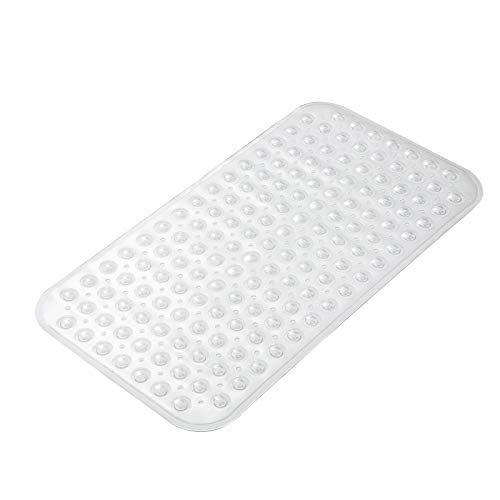
AmazerBath Bath Tub Mat — Best Medium Size
Not every tub wants forty inches. The AmazerBath, at 27.6 by 15 inches in clear, is the medium-format answer for smaller tubs, apartment baths and shower bases where an extra-long mat would ride up the curved ends and lift its own suction free. Fit is a safety property in itself: a mat that lies perfectly flat, every cup engaged, grips better than a longer mat bunched at both ends. This one covers the central standing zone completely and leaves the tub’s ends bare, which suits bathers who stand in one place and step out carefully.
Its specification follows the proven pattern — suction cups beneath, drain holes through, machine washable — in the clear finish that keeps a small bathroom looking uncluttered. For a single-person household, a guest tub used by one visitor at a time, or a child’s bath where an adult kneels at the side and the child sits in one spot, the medium size is not a compromise but the correct tool. Buy the mat that fits the surface you own; this is the pick that makes that principle easy to follow.
- Format: medium in-tub suction mat
- Size from listing: 27.6 x 15 inches
- Surface from listing: drain holes, clear finish
- Underside from listing: suction cups
- Care from listing: machine washable
Strengths
- Lies perfectly flat in smaller tubs where long mats bunch and lift
- Complete suction-and-drain specification at a medium footprint
- Clear finish keeps compact bathrooms visually open
Trade-offs
- Turning zone at the tub’s far end stays uncovered
- One standing zone, so restless bathers can step beyond it
- Clear material shows residue between washes
Best for: apartment tubs, small bathrooms and single-spot bathers.
Not suited for: long tubs or households wanting end-to-end coverage.

SlipX Solutions Natural Rubber Bath Mat — Best Natural Rubber
The SlipX mat represents the older school of slip resistance: natural rubber, 14 by 22 inches in white, with a soft grippy top and a listing that speaks of durable coverage and reliable slip resistance in tub and shower. Natural rubber grips by nature — its wet friction is intrinsic to the material rather than engineered through cups alone — and it brings a weight and a drape that synthetic mats imitate. This is a compact mat, sized for a standing spot in a tub or a shower, and its material suits bathers who find suction mats fiddly: lay it down, and the rubber does the work.
The compact footprint is also its boundary. At 14 by 22 it protects the spot it covers completely and nothing beyond it, so it suits disciplined standers, smaller showers, and households pairing a mat with grab rails that handle the entry and exit moments. Its listing notes machine washing, and rubber rewards a gentler interpretation of that — a cool wash and air drying keep natural rubber supple for years, where heat and harsh detergents shorten its life. For buyers who distrust suction as a concept, this is the material-first alternative with a long track record behind the brand name.
- Format: compact natural rubber mat
- Size from listing: 14 x 22 inches
- Material from listing: natural rubber
- Surface from listing: soft, grippy, textured top
- Colour from listing: white
Strengths
- Natural rubber’s intrinsic wet grip, without relying on cups alone
- Weight and drape make it feel planted the moment it is laid
- Simple, proven design with no mechanisms to fail
Trade-offs
- Smallest coverage in the group — one standing spot only
- Natural rubber prefers cool washing and air drying
- White shows bathroom staining sooner than grey or black
Best for: compact showers and buyers who trust material grip over suction systems.
Not suited for: full-length tub coverage or restless, turning bathers.

Rubbermaid Safti-Grip Bath Mat Large — Best Commercial Grade
The Rubbermaid Safti-Grip comes from a commercial products line, and it reads like it: 28 by 16 inches in white, suction-backed, non-slip, with a textured surface, specified for commercial and residential use in shower stalls, bathtubs and bathrooms. Commercial design priorities are instructive — durability over decoration, grip that survives daily use by strangers, and a surface that can be cleaned hard and often. In a home, that translates to the mat you buy for a bathroom where safety is not a preference but a requirement: an elder’s daily shower, a rental property, a household managing recovery from an injury or an operation.
Its textured top gives wet feet a mechanical grip that smooth mats cannot, and the suction backing anchors it with the assumption that the person standing on it may lean, shift and grab for support. The white commercial finish is unapologetically functional; it will show its workload and expects to be washed for it. If the other picks in this guide are bathroom accessories with safety features, this one is safety equipment that happens to live in a bathroom — and for the households that need that distinction, it is the first name on the list.
- Format: commercial-grade suction mat
- Size from listing: 28 x 16 inches
- Surface from listing: textured, non-slip
- Underside from listing: suction-backed
- Colour from listing: white
Strengths
- Commercial design standards for grip and durability
- Textured surface gives feet mechanical purchase, not just friction
- Built for daily hard use and frequent cleaning
Trade-offs
- Functional white finish prioritises duty over décor
- Mid-length coverage leaves long tubs partly bare
- Firmer feel than the comfort-oriented mats in this guide
Best for: elders’ bathrooms, rentals, recovery periods and any high-stakes shower.
Not suited for: buyers furnishing a spa-styled bathroom around softness and looks.

Yimobra Bathtub Mat Non Slip — Best Open-Flow Design
The Yimobra closes the group with a surface idea: 35 by 16 inches in black, with secure suction cups and a diamond open-flow design that is soft underfoot and machine washable. Open-flow means the surface is a pattern of raised diamonds with channels between them, so water under the shower runs through the mat’s landscape instead of sheeting across a flat top. A foot lands on the raised texture with water already escaping sideways — the two conditions for grip, contact and drainage, delivered by geometry rather than by material alone.
Black is the boldest finish in the group and the most forgiving of family evidence; it also makes the mat’s presence unmistakable, which is itself a small safety feature for bathers with poor eyesight who benefit from seeing exactly where the secure surface begins and ends. The 35-inch length covers the standing and turning zones of a standard tub, sitting between the medium AmazerBath and the extra-long pair in coverage. For a modern bathroom with dark fixtures, or a household that wants its safety mat to look intentional rather than clinical, the Yimobra is the design-led pick that does not sacrifice the specification.
- Format: long in-tub mat with open-flow surface
- Size from listing: 35 x 16 inches
- Surface from listing: diamond open-flow design, soft underfoot
- Underside from listing: secure suction cups
- Colour from listing: black
Strengths
- Open-flow channels shed water while the diamonds grip
- High-contrast black helps bathers see the safe zone clearly
- Near-full tub length with a soft feel underfoot
Trade-offs
- Black shows pale soap residue between washes
- Textured channels need a rinse to clear trapped hair
- Suction still requires a smooth tub surface
Best for: standard tubs in modern bathrooms and bathers who benefit from visible footing.
Not suited for: pale, spa-toned bathrooms where black would dominate.
How Do the Six Slip-Resistant Mats Compare at a Glance?
| Pick | Size from listing | Grip mechanism | Best setting |
|---|---|---|---|
| TEESHLY Bath Tub and Shower Mat 40×16 | 40 x 16 in | Suction cups + drain holes | Standard and long tubs |
| YINENN Bath and Shower Safety Mat | 40 x 16 in | Suction cups + drain holes | Tubs and long stalls, white rooms |
| AmazerBath Bath Tub Mat | 27.6 x 15 in | Suction cups + drain holes | Small tubs and shower bases |
| SlipX Solutions Natural Rubber Bath Mat | 14 x 22 in | Natural rubber grip | Compact showers, single standing spot |
| Rubbermaid Safti-Grip Bath Mat Large | 28 x 16 in | Suction backing + texture | High-stakes and commercial-style use |
| Yimobra Bathtub Mat Non Slip | 35 x 16 in | Suction cups + open-flow diamonds | Standard tubs, modern bathrooms |
How Do You Install a Suction Mat So It Actually Holds?
Technique decides whether suction works, and most failures are installation failures. Start with a clean, wet tub floor — rinse away bath oils and cleaner residue, because cups seal to porcelain, not to film. Lay the mat where feet will land, then press it down firmly across its whole area, working from the centre outward so each cup expels its air and takes hold; kneeling on it briefly is the traditional finishing move. Test with a firm hand-push before the shower runs. A mat installed this way on a smooth tub resists the sideways forces of a shifting bather; the same mat dropped loosely onto a soapy floor is decoration.
Know your surface. Suction needs smooth, non-porous finishes — standard porcelain, enamel and smooth acrylic qualify. Heavily textured anti-slip tub floors, some refinished surfaces and stone-resin bases defeat cups by leaking air beneath them; on those surfaces, the heavy rubber philosophy of the SlipX, or a mat chosen for weight and material, is the honest recommendation. Test any new mat dry-footed first, in daylight, before trusting it mid-shower.
Why Does Coverage Length Matter More Than Almost Anything?
Slips rarely happen at the calm centre of a shower. They happen at the transitions: the step over the tub wall with one foot wet and one dry, the turn to reach a shelf, the lean for a dropped bottle, the first step toward the taps. Each of those moments moves the foot somewhere a small mat is not. That is why the extra-long picks lead this guide — the TEESHLY Bath Tub and Shower Mat 40×16 and the YINENN exist to put a grippy surface under the transitions, not just under the standing. Where a tub is genuinely small, a perfectly fitted medium mat like the AmazerBath still beats a long mat bunched into waves, because a raised fold is a trip edge wearing a safety label.
Measure before you buy: the flat floor of the tub, end to end where the curve begins, and its width between the walls of the base. Match the mat to those numbers with an inch or two to spare, and the coverage question answers itself. Write the numbers down before you shop — memory is an optimist in a showroom, and it will happily swear the tub is longer than it is, right up until the mat arrives and climbs the curve at both ends of the tub.
How Do You Keep a Safety Mat Grippy Month After Month?
Grip is a maintenance state, not a purchase. Soap film, bath oil and skin cells coat both faces of a mat — the top loses its texture’s bite, the cups lose their seal — and the decline is gradual enough to go unnoticed until a foot travels. The countermeasures are the ones these picks were chosen for: rinse the mat after use, lift it to dry so film does not set, and machine wash it on a regular rhythm to strip what rinsing leaves. While it washes, wipe the tub floor beneath; a clean mat on a filmed floor is half a solution.
Inspect as you clean. Cups that have flattened, torn or gone stiff no longer seal; a mat at that stage should be replaced, not persevered with, because its failure will announce itself at the worst moment. Rubber mats ask for the same inspection of their edges and surface texture. Safety equipment has a service life, and honouring it is part of owning the equipment.
What Else Belongs in a Slip-Resistant Bathroom Besides the Mat?
The mat is the floor layer of a system. Grab rails at the tub entry and within reach of the standing zone handle the moments a mat cannot — a genuine loss of balance needs something to hold, not something to stand on. Lighting matters more than it is credited: a bather who can see the mat’s edge, the tub wall and the water level judges each step better. A shower seat transforms the risk profile entirely for anyone with significant mobility limits, reducing standing time to the entry and exit. And habits bind it together: no rushing, both hands free when stepping in, bath products kept within reach so nobody leans across a wet surface at full stretch.
None of this diminishes the mat. It places the mat correctly — as the foundation layer that makes every other measure easier, and the one purchase in the system that takes ten minutes to install and starts working the same evening.
What Mistakes Undermine a Slip-Resistant Mat?
Buying by photograph instead of by measurement is the first, producing mats that bunch, climb or leave the turning zone bare. The second is installing on a dirty floor and concluding suction does not work. The third is never washing the mat, letting film quietly delete the grip that justified the purchase. The fourth is using a mat as a substitute for rails where rails are genuinely needed — a category error that no mat in this guide, however commercial its pedigree like the Rubbermaid Safti-Grip Bath Mat Large, is designed to forgive. And the fifth is leaving a mat sealed to the tub for months, which adds a hygiene failure to the safety story: lift, rinse, dry and wash, and the mat remains what it was bought to be.
How Do Children Change the Slip-Resistant Calculation?
Children do not stand still in a bath; they pivot, splash, sit, stand and launch. A child’s bath argues for the longest coverage the tub will take, because the child’s feet will visit every inch of it, and for a mat whose surface stays grippy when coated in bubble bath — the most lubricious substance in the house. The extra-long TEESHLY and YINENN were chosen with exactly this household in mind. The adult kneeling at the tub side has a stake too: a mat that keeps the child planted makes the whole bath calmer and shorter, which is its own safety outcome.
Teach the mat’s boundary early. Children who learn that the mat is where feet belong, and the bare tub beyond it is slippery, carry the habit to every bathroom they meet — grandparents’ houses, swimming pools, school trips. A visible mat like the black Yimobra makes that lesson concrete for small bathers in a way a clear mat cannot, one of the quieter arguments for its high-contrast finish.
What About Bath Mats for Bathing Dogs and Other Pets?
A dog in a tub is a four-legged slip risk with claws, and households that bathe pets indoors will recognise the scramble. A long suction mat protects the dog’s footing and the tub’s finish at once, and the machine-washable picks here shrug off the hair and mud that pet baths produce. Choose the grey TEESHLY or the black Yimobra for a pet bathroom, since both hide the evidence between washes, and rinse the mat immediately after a pet bath — dog shampoo and shed hair build the fastest film of any use in this guide. The mat that serves the dog will serve the family unchanged; just keep its wash rhythm honest.
How Does a Mat Behave in a Walk-In Shower With a Low Threshold?
Walk-in showers remove the tub wall from the risk equation and add a different one: a large, open wet floor where the bather moves freely and the mat must define the safe zone. Here the extra-large mats laid at the shower head’s landing area, or the Rubbermaid positioned where the bather stands longest, do the work. Because walk-ins are often chosen for accessibility, the mat should be paired with the rails and seating the room was designed around, and its edges should sit where a foot arriving from dry floor meets it gradually — never curled, never floating on a film of water. A mat in a walk-in also dries faster than its tub-bound cousins, since the open room airs it from above all day.
How Should You Store a Suction Mat Between Uses?
Storage is where suction mats are quietly ruined. Rolled tightly for months, a mat takes a curl that lifts its edges and breaks its cups’ contact; stored flat and wet against the tub, it grows the film this guide keeps warning about. The kind routine is simple: after the last shower, drape the mat over the tub wall or a rail, cups outward, and let it dry in that posture; for longer storage, lay it flat or roll it loosely with the cups facing out. A mat stored dry and flat returns to service with its grip intact, while a mat stored damp and curled needs a wash, a flattening day under its own weight, and a forgiving bather.
Why Do Some Baths Feel Slipperier Than Others?
Bathers notice that one tub feels treacherous and another merely smooth, and the difference is chemistry as much as surface. Bath oils, moisturising shower gels and conditioner are formulated to leave a film on skin, and they leave the same film on porcelain, where it turns a wet floor into a skating surface. Hard water adds mineral roughness in some homes and a soapy scum in others, depending on what it meets. A household that loves bath oil needs its mat more, not less, and should wash it more often, because the film that makes skin feel silk is precisely the film that defeats suction cups. This is also why a mat can feel secure in a plain shower and uncertain in a long bath: the bath loads the water with everything the shower rinses away.
The practical response is sequencing. Put the mat’s grip to work in a rinsed tub, add oils after you are settled rather than before you step in, and give the mat its wash on the rhythm your products demand. The picks in this guide were chosen with drainage and washability prominent exactly because the modern bathroom’s chemistry is against them.
How Do You Test a New Mat Before Trusting It?
Trust should be earned in daylight. Install the mat on a clean floor, press every cup home, then stand on it dry and shift your weight deliberately — forward, back, and in the turning motion of reaching for a shelf. Run the shower briefly and repeat the test wet, with a hand on the wall. A good mat does not creep, lift at the corners or slide as a unit; a mat that moves in the test will move in service, and the remedy is reinstallation on a cleaner floor, a different size, or a different grip philosophy such as the rubber SlipX. Five minutes of testing converts a purchase into a verified safety device, and it is the step most households skip.
Repeat a lighter version of the test monthly, when the mat is washed. Grip that survives the test survives the month; grip that has faded gets a wash, a reinstall, or a replacement decision while the stakes are still low.
What Should Landlords and Hosts Consider When Fitting a Rental Bathroom?
A rental or guest bathroom carries a duty to strangers who do not know the room’s habits. The commercial logic of the Rubbermaid Safti-Grip suits this exactly: durable, washable, visibly serious about grip. Pair it with a note-free obviousness — a mat already installed, lying flat, in the place feet expect it — because a guest will not go hunting in a cupboard for safety equipment. Hosts should wash the mat between guests as they wash the towels, and inspect it as they inspect the rest of the room; the mat’s condition is part of the property’s condition, and a curled, filmed mat in an otherwise polished rental tells its own story.
How Does Body Weight and Bathing Style Affect Mat Choice?
A mat experiences bathers differently. A heavier bather loads suction cups more favourably in one way — weight seals cups — and more demandingly in another, since a shift of weight carries more force for the cups to resist. A bather who sits in the tub and rises using the sides needs grip at the rising zone, which is usually toward the taps, and that argues for coverage that reaches it. A showerer who washes hair with eyes closed and head tilted is, for a minute at a time, a person balancing without visual reference, and deserves the widest, most textured surface in this guide. Read your own household’s bathing styles honestly — the teenager’s long showers, the grandparent’s careful rises, the child’s pivots — and let the most vulnerable style choose the mat. Safety equipment is correctly specified by its hardest user, never its average one.
Why Do Drain Holes Belong in Every Serious Safety Mat?
Standing water is the enemy twice over. On top of a mat, a sheet of water separates the foot from the texture it is meant to grip — the beginnings of a hydroplane at bathroom scale. Beneath a mat, trapped water lubricates the suction interface and feeds the film that loosens cups over days. Drain holes answer both problems with no moving parts: water arriving on the surface escapes downward, water beneath escapes outward, and the mat’s two working faces stay in contact with what they are meant to touch. It is telling that five of the six designs in this guide, across brands and philosophies, converge on drainage as a feature. When independent manufacturers agree on a detail, the detail is usually load-bearing.
How Do You Handle a Mat in a Bathroom Shared by Many People?
Shared bathrooms — family homes, houseshares, gyms at home — multiply both the water and the wear. The mat in such a room should be the most washable and the most durable available, which in this guide points to the extra-long machine-washable pair or the commercial Rubbermaid, and its wash rhythm should be owned by the household rota rather than left to whoever notices first. A second mat in rotation is worth more in a shared house than anywhere else, because the primary mat’s drying intervals are the scarcest resource in the building. Fit the rota to the laundry that already exists, and the mat’s grip becomes a utility the house maintains the way it maintains hot water: collectively, routinely, and without drama.
What Is the Difference Between a Bath Mat and a Shower Mat, Really?
The terms blur in listings, but the surfaces differ. A tub is long and narrow with curved ends, rewarding the long formats that dominate this guide. A shower stall is squarer and fully tiled or tray-based, rewarding medium and compact mats that lie within the tray’s flat area. A mat bought for one and used in the other usually disappoints in a specific way — too long, it climbs; too small, it leaves the turning zone bare. The picks here span both worlds deliberately: the YINENN and Rubbermaid declare stall use in their listings, the SlipX suits a compact base, and the long trio serve tubs. Buy for the surface in front of you, measure it, and let the listing’s own words about setting confirm the match.
How Does Temperature Affect Grip and Comfort?
Rubber and vinyl both change character with temperature. In a cold bathroom, a mat can feel stiff when first laid and its cups seal less eagerly until the shower’s warmth relaxes the material — one more reason to install before the water runs and to press the cups home deliberately. Under a hot shower, materials soften slightly and conform better, which is why a mat that felt marginal in a dry test often performs once the room warms. None of the picks here is sensitive enough for this to drive a choice, but it explains the common experience of a mat improving during the first shower and argues for judging a new mat after a full use, not after a cold thirty seconds.
How Do You Talk About Bathroom Safety Without Spoiling the Bathroom?
Many households resist safety equipment because it looks like a hospital corridor, and the resistance is understandable — a bathroom is also the room of candles, plants and long soaks. This guide’s picks were chosen partly to answer that resistance. The clear YINENN and AmazerBath all but disappear against a white tub. The black Yimobra reads as a design accent in a modern room. The grey TEESHLY looks like a textile rather than a device. Only the Rubbermaid wears its function openly, and it does so for the households that want function worn openly. Safety that fits the room’s dignity is safety that stays installed, and an installed adequate mat outperforms a superior mat that someone removed for a dinner party and never replaced.
That principle extends to the step-out side, where wooden and fabric mats carry the comfort story. Build the whole room as one system — grippy within the tub, dry and warm beyond it — and nobody in the house experiences safety as an aesthetic tax.
What Should You Do the First Week a New Mat Is in Service?
Treat the first week as commissioning. Install the mat with the full press-down routine, test it dry and wet, and note where feet actually land during real showers — households are often surprised to find the standing zone is six inches from where they assumed, and a mat can be repositioned once, early, at no cost. Lift it after each day’s last shower and look underneath: a well-fitted mat leaves a mostly dry floor with drainage patterns, while puddles in one corner reveal a slope or a cup zone that needs attention. Wash it at the week’s end even if it looks clean, to set the rhythm and to strip any manufacturing residue from its working faces.
By the second week the mat should have disappeared into the routine — present underfoot, absent from thought. If it has not, if it creeps or curls or demands daily negotiation, that is information: refit it, resize it, or change its grip philosophy while the purchase is fresh. Safety equipment earns trust quickly or not at all, and the first week is when you find out which kind you bought.
Final Recommendation
For most standard tubs, start with coverage: the TEESHLY in grey or the YINENN in clear, chosen by your bathroom’s palette, both giving forty inches of suction-and-drainage protection. Smaller surfaces take the AmazerBath; material purists and compact showers take the SlipX; high-stakes bathrooms take the Rubbermaid without a second thought; and the Yimobra Bathtub Mat Non Slip serves anyone who wants open-flow drainage and a mat that looks like a design decision. Install it pressed and clean, wash it before it needs it, and pair it with a rail where balance is a real concern. Do those things and the mat disappears into the background of a safer routine — which is the highest compliment safety equipment can earn, felt only in the showers that end, uneventfully, with both feet exactly where you intended them to be.
Frequently Asked Questions
Do suction cup mats work on textured tubs?
Poorly, and honesty matters here. Suction needs a smooth surface to seal against; heavy texture leaks air under the cups and the mat can shift. On textured or refinished tubs, choose by weight and material instead — the natural rubber SlipX is the pick in this guide for such surfaces — and test any mat carefully before relying on it.
How often should I replace a slip-resistant bath mat?
Replace it when inspection says so: cups that no longer seal after a wash, a surface whose texture has worn smooth, rubber that has stiffened or cracked, or any tear. With regular washing and airing, the picks here serve for a long period, but a safety mat’s life ends at the first sign its grip is compromised — not at a date on a calendar.
Can I use these mats in a shower stall as well as a tub?
Yes, with attention to fit. The YINENN is listed for stall and tub floors, the Rubbermaid for shower stalls as well as tubs, and the compact SlipX suits small stall bases. Measure the stall’s flat floor and choose the size that lies flat within it; a mat folded up a stall wall grips worse than a smaller mat lying true.
Can I cut an extra-long mat to fit my tub?
We would not recommend it. Cutting a suction mat removes the cups and drain holes along the cut edge, leaves a raw border that curls and lifts, and can void whatever confidence you had in its coverage. The sizes in this guide — 40, 35, 28, 27.6 and 22 inches of working length — exist so that some pick already fits nearly every standard surface. Measure first, choose the honest fit, and let the mat arrive as its manufacturer intended it to lie.
Are longer mats always safer than shorter ones?
Only when they lie flat. A 40-inch mat in a 40-inch flat tub floor is the safest option in this guide; the same mat in a short tub climbs the curved ends, lifts its cups and creates raised edges. Fit first, length second — the AmazerBath exists precisely for surfaces where medium is the safe answer.
Should I take the mat out when guests use the bathroom?
Quite the opposite: guests are the bathers who need it most, because they do not know your tub’s habits, its slopes or its slippery spots, and they will not mention a near-slip out of politeness. Leave the mat installed, clean and pressed down, and let it do its work invisibly. If you use a clear mat, guests may not even register its presence — which is the ideal outcome for safety equipment in a home that also cares about how the room feels.
Will a bath mat damage my tub’s finish?
Suction mats are designed for standard tub finishes and are used on them widely. Sensible care protects any finish: lift the mat regularly rather than leaving it sealed for months, keep grit from being trapped beneath it, and avoid dragging a gritty mat across the surface. Refinished tubs deserve extra caution — check the refinisher’s guidance and favour the lighter rubber options if in doubt.
My mat keeps sliding even though it has suction cups. What is wrong?
Almost always the interface, not the mat. Cups cannot seal through bath-oil residue, cleaner film or a textured floor, and they cannot hold if they were never pressed home individually. Strip the tub floor clean, rinse it, lay the mat on the damp surface and press across its whole area from the centre outward, then test before showering. If it still travels on a genuinely smooth, clean floor, the cups themselves have aged — flattening and stiffening with time — and the mat has reached the end of its service as safety equipment.
What is the best pick for an elderly parent’s bathroom?
The Rubbermaid Safti-Grip for its commercial grip and texture, or the extra-long TEESHLY where the tub is long and turning is the risk — in either case paired with grab rails, which no mat replaces. Install it pressed firmly to a clean floor, wash it on a schedule someone owns, and check its cups monthly.
A final thought on proportion: a slip-resistant mat costs less than a single visit to have a sprain examined, and it asks for ten minutes of installation and a wash a month. Few purchases in a home offer that exchange rate between money, effort and consequence avoided. If this guide has a single hope, it is that the mat is bought before the slip that would have made it feel urgent — because afterwards, every household buys one, and the only thing the timing changes is whether there was a fall first.
Related Guides
Complete the bathroom’s safety and comfort story with the rest of this series: move on to Best Wooden Bath Mats for the step-out side of the tub, and keep the wider home fresh with Best Air Purifiers for Construction Dust and Best Self-Cleaning Water Coolers for Home.


