What's inside
- Key Takeaways
- Quick Picks
- How Did We Choose the Best Plastic and Vinyl Bathroom Rugs?
- How Do the Six Waterproof Approaches Compare?
- Which Bathrooms Gain Most From Waterproof Rugs?
- How Should Plastic and Vinyl Mats Be Cleaned and Stored?
- How Do Plastic Surfaces Compare With Fabric Over a Whole Year?
- What About the Floor Under a Waterproof Rug?
- How Do You Choose Between Sealing, Shedding, and Drying?
- What Mistakes Do Buyers Make With Plastic and Vinyl Rugs?
- Final Recommendation
- Frequently Asked Questions
- Related Guides
As an Amazon Associate I earn from qualifying purchases. This post may contain affiliate links at no extra cost to you.
cottageverdict.com is reader-supported. When you buy through links on our site, we may earn an affiliate commission.
Where to buy: All six picks below are sold on Amazon. Use a linked name to reach its listing, check price on Amazon, and check whether the product is a true plastic surface or a fabric face over a waterproof backing, because those are different tools wearing similar names.
The best plastic and vinyl bathroom rugs make a promise no textile can: water does not get in. Where a cotton or chenille rug manages water by absorbing it and then drying, a plastic or vinyl construction refuses the transaction entirely, shedding water from a non-porous surface that can be wiped, rinsed, or even hosed back to clean in under a minute. For rented bathrooms you cannot renovate, laundry rooms that double as wash spaces, and households whose freshness strategy is a spray bottle rather than a washing machine, that refusal is exactly the point. This guide compares six waterproof answers, and it is careful about one distinction shoppers constantly blur: a rug with a waterproof plastic backing under a fabric face is not the same object as a rug whose walking surface is plastic, and each kind earns its place differently.
True plastic and vinyl surfaces, rubber mats and in-tub pebble mats among them, give up softness entirely and gain total indifference to water in exchange. Fabric-faced rugs with waterproof TPR or rubber backings split the difference: your feet meet something textile and absorbent, while the floor beneath meets a sealed barrier that keeps moisture off the boards or tiles and keeps the rug itself from soaking through. Both families belong in this guide because bathrooms ask both questions, sometimes in the same room: what do I stand on inside the tub, and what do I stand on outside it?
Honesty about the trade belongs up front. Plastic and vinyl will never feel like a spa rug, and nobody’s bare feet have ever written poetry about a suction-cup mat. What these surfaces offer instead is certainty: no reservoir, no laundry, no slow damp, and a clean that is finished when you say it is. Households that value that certainty, landlords furnishing a rental, parents hosing down a kids’ bathroom, anyone with a floor they must protect absolutely, will find this the most practical category in the whole bath-rug family.
A final framing note: waterproof does not mean maintenance-free. Plastic surfaces still collect soap film, hair, and grit, and an unrinsed vinyl mat becomes unpleasant on exactly the schedule a neglected fabric one does. The difference is that the reset takes sixty seconds and a cloth rather than a wash cycle and a drying day. Keep that small ritual and these are the longest-serving, least demanding floor coverings a wet room can own.
The category also asks for a small mental adjustment worth making before the box arrives: judge these surfaces the way you judge a good raincoat rather than a good sweater. Nobody faults a raincoat for lacking the softness of knitwear, because its job begins exactly where knitwear’s job ends. Plastic and vinyl rugs begin where textiles end, at the point where water stops being a comfort problem and becomes a custody problem, and judged on that job they are not the austere option at all. They are the competent one.
Key Takeaways
- True plastic and vinyl surfaces absorb nothing; water is wiped or rinsed away in under a minute.
- A waterproof TPR or rubber backing under a fabric face protects the floor while keeping a textile feel underfoot.
- In-tub mats are a separate tool: suction cups grip smooth tubs only, and textured tubs defeat them entirely.
- These are the natural picks for rentals, laundry rooms, and floors that must stay absolutely dry.
- Plastic still needs rinsing; soap film and grit build on any surface left unattended.
- Comfort is the honest price: expect firm, practical footing rather than plush softness.
Quick Picks
| Pick | Badge | Why it made the list |
|---|---|---|
| PURRUGS Bathroom Rug 20×30 Beige TPR | Waterproof-backed all-rounder | An absorbent face sealed by a waterproof TPR backing, in the size most vanities want. |
| PURRUGS Bathroom Rug 24×36 Light Grey TPR | Larger waterproof-backed mat | The same sealed construction stretched wider for tub fronts and bigger landings. |
| PURRUGS Bathroom Runner 24×60 Beige TPR | Waterproof-backed runner | Sixty inches of fabric face over a waterproof barrier for double vanities and long floors. |
| Mecko Ultra Thin Bath Mat 16×24 | Ultra-thin quick-dry mat | A door-clearing, fast-drying thin mat that suits tile floors and tight spaces. |
| Rubber Bath Mat Quick Dry Grey 17×27 | True rubber surface | A genuine rubber mat that rinses clean and dries almost on contact with air. |
| Pebble Bathtub Mat Non Slip 35×16 | In-tub suction mat | A pebble-textured mat with suction cups and drain holes, made for inside smooth tubs. |
How Did We Choose the Best Plastic and Vinyl Bathroom Rugs?
We began by sorting the category into its two honest halves and refusing to judge one by the other’s standards. Fabric-faced rugs with waterproof backings were judged on how completely the backing seals, how well the face absorbs, and whether the pair survives machine washing without the backing cracking or peeling. True plastic and rubber surfaces were judged on drainage, on how they grip their floor or tub, and on how completely a rinse restores them. A guide that called both kinds simply waterproof and ranked them together would mislead everyone, so each review below states plainly which half its pick belongs to.
Floor protection was the second filter, because it is the reason many shoppers arrive here at all. A waterproof backing earns its keep in the rentals and older homes where a slow drip or a soaked-through rug can mark a floor the tenant does not own or the owner cannot easily repair. We favoured backings described as fully waterproof rather than merely water-resistant, and constructions where the barrier wraps the rug’s whole footprint rather than a central patch, since water migrates to edges with the persistence of a tax inspector.
Third came the reset test: how fast can an ordinary person return this surface to genuinely clean? True plastic wins it outright, a rinse and a wipe, but the fabric-faced picks were held to a close standard, machine washable, quick to dry, with backings that tolerate the cycle. Finally, we kept one in-tub mat in the six because no outside-tub rug answers the inside-tub question, and its listing is admirably honest about the smooth-tub limitation that shoppers most need to hear before ordering.
Geography played a quiet role as well. These categories thrive where water is a daily adversary rather than an occasional guest: humid climates, coastal homes, houses full of children and dogs and sporting kit. A guide written for a dry climate would rank softness higher and sealing lower; this one is written for the homes that search for it, and those homes, statistically, have a floor they are worried about and a laundry basket that is already full.
We also screened for the failure mode unique to this category: the backing that is waterproof for a month. Thin sprayed barriers and brittle vinyls can pass a first splash test and then crack at the fold lines, quietly converting a sealed rug into a ordinary one while its owner still trusts it. Flexible, substantial backing materials, TPR chief among them, were favoured precisely because their waterproofing is a property of the material rather than of a coating, and properties outlast coatings in every laundry room on earth.

PURRUGS Bathroom Rug 20×30 Beige TPR — Waterproof-backed all-rounder
This is the pick for the shopper who wants plastic’s protection without plastic’s feel. The walking surface is a proper absorbent bath-rug face, soft and thirsty in the ordinary way, and beneath it sits a waterproof TPR backing that seals the arrangement: water taken up by the face stays in the rug, to be dried or washed out later, instead of migrating through to the floor. In a rental bathroom with a wooden floor of unknown history, that seal is the whole purchase, and it is why this construction, rather than a bare vinyl sheet, opens the list.
TPR, thermoplastic rubber, is the sensible modern backing for this job. It flexes instead of cracking, grips instead of skating, and tolerates machine washing in a way that older stiff vinyl backings never forgave. The listing describes the rug as machine washable, non-slip, super absorbent, and quick dry, a combination that reads like a wish list but describes the division of labour accurately: face absorbs, backing seals and grips, thin overall build dries fast. The 20×30 size is the category’s workhorse footprint, wide enough for a full landing at a vanity or tub side without crowding a smaller room.
Beige is a considered choice for a protective rug. It hides the pale dust of a working bathroom, coordinates with the wood tones common in the older floors this rug is often bought to protect, and looks like a textile choice rather than a defensive measure, which matters when the bathroom is also the one guests use. Nobody visiting will read this rug as equipment; it simply looks like a tidy beige bath mat, while quietly doing a job its plush cousins cannot.
Care follows the backing’s rules: wash it as the label directs, dry it gently rather than baking the TPR, and let it dry fully before it returns to the floor so the seal meets a dry surface. Check the backing’s edges now and then, since the seal’s integrity lives at the perimeter. Treated that way, this is the most house-proud pick in the guide, the one that lets a careful tenant or a floor-anxious owner stop thinking about water damage entirely.
It also makes a quietly excellent housewarming or first-flat gift, the sort of purchase new occupants rarely think of until the first overflow teaches them. A sealed rug under the vanity of a first bathroom prevents the exact class of small disaster that eats deposits and weekends, and it does so while looking like nothing more defensive than a nice beige mat.
- Size: 20 x 30 inches
- Face: absorbent fabric surface
- Backing: waterproof TPR, non-slip
- Care: machine washable, quick dry
- Colour in listing: beige
Strengths
- Waterproof seal protects vulnerable floors while the face stays textile-soft.
- Flexible TPR grips well and survives washing better than stiff vinyl.
- Standard footprint suits most vanities and tub sides.
Trade-offs
- The face still absorbs, so it needs washing and drying like a fabric rug.
- TPR dislikes high dryer heat; gentle drying is part of the deal.
- Not a true plastic surface for anyone wanting a hose-it-off mat.
Best for: rentals, wooden bathroom floors, and guest bathrooms. Not suited for: shoppers wanting a fully non-absorbent walking surface.

PURRUGS Bathroom Rug 24×36 Light Grey TPR — Larger waterproof-backed mat
Everything the first pick does, this one does across more floor. The 24×36 footprint is the size a standard tub front actually asks for, covering the full exit arc with margin, and the step from a smaller mat to this one is felt immediately by anyone who has ever landed half on a rug and half on wet tile. The construction is the same partnership, absorbent face above, waterproof TPR barrier below, machine washable and quick to dry, scaled up without changing its character, which is rarer in this category than it should be; many rugs that work small turn floppy or uneven when enlarged, and this one simply covers more ground with the same discipline.
Light grey suits the larger canvas. Across thirty-six inches, beige can read as a warm field that dominates a cool-toned room, while light grey recedes against white suites and grey tile, letting the bigger rug protect more floor without announcing itself. It also hides the mid-tone evidence of a working bathroom, hair and dust and dried splashes, with the same diplomacy at the larger scale, which matters because a bigger rug is a bigger visual commitment every time you open the door.
The protective case strengthens with size, too. A larger sealed footprint means a larger area of vulnerable floor that never sees standing water, and in the classic problem layout, a long tub against a wooden or laminate floor, this rug covers the splash zone and the drip line in one piece. Two smaller mats would leave a seam exactly where bath water sheets off a climbing child; one sealed mat leaves nothing to chance along that line.
Its costs are the honest costs of scale: a bigger wash load, a longer drape to dry, and a footprint that will overwhelm a genuinely small bathroom. Measure before you upgrade, and if the room takes it, this is the version of the waterproof-backed idea that most family bathrooms should default to, with the 20×30 reserved for tighter quarters and the runner below for the long rooms.
Grandparents hosting small grandchildren will recognise this size instinctively. The margin it adds around a tub exit is exactly the margin a lifted, dripping, wriggling child requires, and the sealed underside means the enthusiastic bath can be as wet as it likes without the floor joining in. Family bathrooms are where waterproof backing stops being a specification and becomes a philosophy.
- Size: 24 x 36 inches
- Face: absorbent fabric surface
- Backing: waterproof TPR, non-slip
- Care: machine washable, quick dry
- Colour in listing: light grey
Strengths
- Full tub-front coverage with the seal intact across the whole footprint.
- One unbroken barrier along the splash zone; no seams to leak through.
- Light grey recedes visually despite the generous size.
Trade-offs
- Too large for compact bathrooms; measure the landing first.
- Bigger wash load and longer drying drape than the standard size.
- Same gentle-drying rule for the TPR backing.
Best for: family tub fronts and larger splash zones on vulnerable floors. Not suited for: small ensuites or pedestal-sink bathrooms.

PURRUGS Bathroom Runner 24×60 Beige TPR — Waterproof-backed runner
Length is where floor protection usually fails, because long bathrooms get served by runners chosen for looks while the floor beneath them quietly takes the water. This runner closes that gap: sixty inches of absorbent face carried on a continuous waterproof TPR backing, so the whole lane in front of a double vanity, or along a tub and vanity sharing one wall, sits over a sealed barrier. In a primary bathroom built over wooden joists and a ceiling you care about, that continuous seal is not a luxury; it is the difference between a rug and an insurance policy you can stand on.
The runner format changes the water map of the room. Splashes at two sinks, drips carried along the lane, the slow creep of a wet footprint trail from tub to door: all of it lands on the face, none of it reaches the floor. The listing’s quick-dry and machine-washable notes matter at this scale, because sixty inches of rug that dries slowly would trade a floor problem for a freshness problem. Its build stays comparatively thin for its size, which keeps both the wash load and the drying drape manageable for a runner.
Beige returns here as the long-room choice, warming the extended field and coordinating with the wood cabinetry that long primary bathrooms often feature. A runner is the most visible textile in the room, and this one’s plain, warm finish lets it behave like flooring, calm and continuous, rather than like an announcement. Guests read it as a runner; only the owner knows it is also a waterproof membrane with a soft top.
Commit honestly to its one demand: it is a big textile to wash, best handled alone in the machine and draped with both ends supported to dry. Households with small washers should measure their drum against sixty inches of wet rug before ordering, and if the fit is doubtful, two of the smaller sealed mats above will protect nearly as well with an easier laundry life. Where the machine can take it, though, this is the most complete floor-protection purchase in the guide.
Renovators phasing a bathroom project will find a second use for it: as the protective layer during the weeks when a new floor is in but the rest of the room is still a building site. A sealed runner that can be shaken, washed, and returned nightly keeps grout and boards safe from the dust-and-water mixture of ongoing work, then simply stays on as the finished room’s rug when the tools leave.
- Size: 24 x 60 inches
- Face: absorbent fabric surface
- Backing: waterproof TPR, continuous seal
- Care: machine washable; wash alone
- Colour in listing: beige
Strengths
- Continuous waterproof barrier along a full double-vanity lane.
- Covers splash zones at two sinks and the drip line between them.
- Thin-for-its-size build keeps washing and drying realistic.
Trade-offs
- A large wash load; small machines may struggle with it wet.
- Needs a long supported drape to dry evenly.
- Overkill for single-sink bathrooms.
Best for: double vanities over wooden floors and long primary bathrooms. Not suited for: compact bathrooms or small-capacity washers.

Mecko Ultra Thin Bath Mat 16×24 — Ultra-thin quick-dry mat
The Mecko belongs to the modern school of thin synthetic mats that behave more like a technical surface than a rug. Its listing leads with the ultra-thin build, made to fit under doors, and with quick drying on tile floors, and those two traits define its whole personality. There is almost nothing here to absorb and hold: the surface takes water, spreads it across a wide flat area, and gives it back to the air with a speed that plush textiles cannot approach. In the plastic-and-vinyl conversation it represents the minimalist pole, a mat that protects by drying rather than by sealing.
That thinness solves the door problem that quietly ruins more bathroom setups than any other. A mat that slides under a swinging door without bunching can live in the exact spot it is needed, in front of the sink in a small tiled bathroom, instead of being exiled to wherever the door permits. Lying completely flat also means lying completely in contact, which is how a mat this light still manages its non-slip brief: no curled edges, no folded corners, the whole underside in conversation with the tile at all times.
Light grey keeps the small footprint visually quiet, and easy care is the mat’s home language: it asks for a rinse or a wash, a shake, and a short airing, then returns to duty. Households that rotate two thin mats, one working while one dries, get an always-dry floor with almost no effort, and the pair together still weigh less than a single plush rug. It is the pragmatic heart of this guide, the pick for people who think in systems rather than in softness.
Its limits are plain: minimal cushion, modest capacity, and a scale suited to one person’s landing. A family shower rush will overwhelm it, and feet seeking warmth on a cold morning will find efficiency instead. But for tile floors in tight bathrooms, for laundry-room sinks, and for anyone whose door has rejected every thicker candidate, the Mecko’s thin, quick, tile-friendly design is exactly the tool the room was asking for.
There is a rental-deposit argument folded into its thinness, too. A mat that never soaks through and dries before it can mark anything leaves the bathroom exactly as it found it, month after month, which is the whole ambition of a careful tenant. Few objects this inexpensive protect something as expensive as a deposit with so little effort.
- Size: 16 x 24 inches, ultra-thin profile
- Surface: quick-dry synthetic, per listing
- Backing: non-slip underside
- Care: easy care, quick to wash and dry
- Colour in listing: light grey
Strengths
- Fits under doors that defeat every thicker rug.
- Dries faster than any absorbent construction in this guide.
- Lies perfectly flat, keeping full underside contact on tile.
Trade-offs
- Minimal cushioning; a working surface, not a comfort landing.
- Small capacity saturates under family shower traffic.
- Not a sealed barrier; protection comes from drying, not blocking.
Best for: small tiled bathrooms, tight doors, and laundry-room sinks. Not suited for: large families or comfort-first shoppers.

Rubber Bath Mat Quick Dry Grey 17×27 — True rubber surface
Here is the genuine article: a mat whose walking surface is rubber itself, non-porous from top to bottom, asking nothing of absorbency because it intends to shed every drop. Step out of the shower onto it and the water sits on the surface in beads and runnels, ready to be shaken off over the tub or wiped away with the bath towel you were about to launder anyway. The listing’s language, quick dry, easy clean, durable, thin, describes the rubber life accurately: there is nothing to saturate, so there is nothing to wait for.
Rubber’s grip story is equally direct. A rubber mat on a bathroom floor holds by material honesty, the compound’s natural friction against tile, and its thin build keeps that contact flush along the whole 17×27 footprint. In front of a bathtub or a sink it behaves like part of the floor that happens to be removable, which is precisely what a laundry room, a utility bathroom, or a hard-worked family wash space needs. When it gets grubby, and rubber shows soap film honestly, the reset is a rinse, a wipe, and a minute of air; no cycle, no detergent decisions, no drying day.
Grey is the only sensible uniform for a mat with this job description, and the plain finish suits the rooms it serves. Do not buy it to charm a guest bathroom; buy it for the bathroom that hosts muddy dogs, post-football showers, hair-dye sessions, and the other beautiful messes of a real house, where a textile rug would be a recurring casualty. It will outlast several fabric rugs in that service and ask for almost nothing in return.
Comfort, stated plainly one more time, is firm and cool. Feet that want a landing should look at the fabric-faced picks above; feet that want certainty, in a room where water flies and floors matter, will find this mat’s honesty refreshing. It also travels well between roles, ending its bathroom years, if it ever does, as a mat under a pet’s bowls or a plant stand, still shedding water exactly as it did on the first day.
Workshops and garages with a utility sink make an honourable second career for it as well, anywhere a person stands in one wet place and wants the floor’s fate settled. Rubber does not care which room it is in; that indifference, carried from room to room across years, is the deepest value this unglamorous category offers.
- Size: 17 x 27 inches, thin profile
- Surface: rubber, non-porous throughout
- Backing: rubber’s natural friction on tile
- Care: rinse or wipe clean; dries almost immediately
- Colour in listing: grey
Strengths
- Absorbs nothing; the fastest, simplest reset in this guide.
- Durable rubber shrugs off hard use that destroys textiles.
- Thin, flush build grips tile and clears doors easily.
Trade-offs
- Firm, cool surface with no cushioning at all.
- Shows soap film and asks for regular wiping to look its best.
- Utilitarian looks; not a decorative choice.
Best for: utility bathrooms, laundry rooms, and messy family service. Not suited for: guest bathrooms or anyone seeking softness.
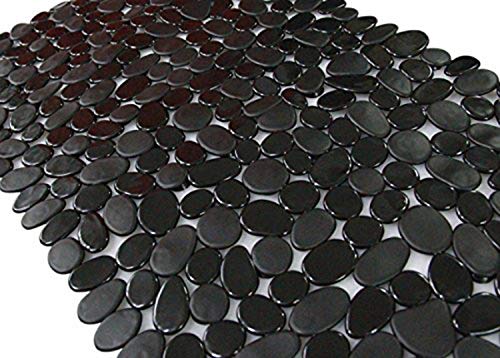
Pebble Bathtub Mat Non Slip 35×16 — In-tub suction mat
The last pick changes rooms entirely: it goes inside the tub. A pebble-textured plastic mat, thirty-five inches long, that anchors itself with suction cups and lets water escape through drain holes, it answers the one question no outside-tub rug can, which is what a bather stands on while the shower runs. The pebble surface gives wet feet a textured landscape to grip, the cups hold the mat against the tub floor, and the holes keep water from pooling on top of the mat and turning its own surface into the hazard it was bought to prevent.
The listing carries an honesty that this guide wants to underline in bold: it is made for smooth, non-textured tubs only. Suction cups seal against smooth surfaces; against a textured or refinished tub floor they cannot seal, and a mat that cannot seal will shift exactly when trusted. Check your tub with a fingertip before ordering: if the floor of it feels grained, pebbled, or roughened by design, this entire product family is not for you, and no amount of pressing on the cups will change that physics. On a smooth tub, by contrast, pressed down cup by cup onto a clean surface, it holds with real conviction.
Its aftercare is the in-tub ritual: rinse it after use, lift it regularly so the tub floor beneath gets cleaned and dried, and let the mat itself dry over the tub edge rather than living permanently in a damp tub. A mat left in place for months becomes the thing it was meant to prevent, a film-holder against the porcelain. Treated as equipment that is deployed and stowed, it serves for years, and its black finish keeps it looking deliberate in a white tub rather than apologetic.
Choose it when the risky surface in your bathroom is the tub itself: for children who stand through showers, for anyone who finds a wet enamel floor treacherous, for the household whose outside-tub rugs are already sorted. It completes this guide’s map of the wet room, floor outside the tub served by five picks, floor inside it served by this one, each surface with a plastic answer fitted to its physics.
One placement tip from long use: mark the mat’s outline mentally against a grout line or the tub’s edge, so that when it is lifted for cleaning it goes back to exactly the same rectangle. A mat replaced a few inches adrift leaves a crescent of its usual territory exposed, and bathers’ feet, creatures of habit, will find that crescent with unerring aim.
- Size: 35 x 16 inches, in-tub format
- Surface: pebble-textured plastic with drain holes
- Anchoring: suction cups; smooth tubs only
- Care: rinse after use; lift and dry regularly
- Colour in listing: black
Strengths
- Textured standing surface inside the tub, where no other pick works.
- Drain holes stop water pooling on the mat itself.
- Suction anchoring holds firmly on smooth tub floors.
Trade-offs
- Will not seal on textured or refinished tubs; check before buying.
- Must be lifted regularly so the tub beneath stays clean.
- Firm plastic feel underfoot while showering.
Best for: smooth tubs, standing showers, and children’s bath time. Not suited for: textured tub floors, where suction cannot seal.
How Do the Six Waterproof Approaches Compare?
| Pick | Kind | Water strategy | Reset | Best room |
|---|---|---|---|---|
| PURRUGS Bathroom Rug 20×30 Beige TPR | Fabric face, TPR seal | Absorb above, block below | Machine wash | Rentals, guest baths |
| PURRUGS Bathroom Rug 24×36 Light Grey TPR | Fabric face, TPR seal | Absorb above, block below | Machine wash | Family tub fronts |
| PURRUGS Bathroom Runner 24×60 Beige TPR | Fabric face, TPR seal | Continuous lane barrier | Machine wash alone | Double vanities |
| Mecko Ultra Thin Bath Mat 16×24 | Ultra-thin synthetic | Dry faster than water arrives | Rinse or wash | Small tile bathrooms |
| Rubber Bath Mat Quick Dry Grey 17×27 | True rubber surface | Shed everything | Wipe or rinse | Utility and laundry rooms |
| Pebble Bathtub Mat Non Slip 35×16 | In-tub plastic | Drain through holes | Rinse and lift | Inside smooth tubs |
Which Bathrooms Gain Most From Waterproof Rugs?
Rentals lead the list, because the renter’s dilemma is precise: the bathroom must work daily, the floor belongs to someone else, and any improvement must leave without a trace. A waterproof-backed rug protects the landlord’s floor from the tenant’s showers while asking for no installation, no adhesive, and no apology, and a true rubber or vinyl mat in a rough utility space can simply be hosed down on moving day and taken along. Landlords furnishing their own properties reach the same conclusion from the other side: surfaces that tenants can reset with a cloth survive tenancies that textiles do not.
Laundry rooms and utility bathrooms come next. These are rooms where water arrives from several directions at once, machines, sinks, wet coats, the dog, and where a textile rug becomes a permanently damp liability. A plastic or rubber surface treats that chaos as its native climate. Children’s bathrooms make the third case: bath water in a kids’ room is not a spill risk but a daily certainty, often in quantities that suggest the bath was a naval exercise, and a sealed or sheddable floor covering converts the clean-up from laundry to a single pass with a mop or cloth.
Finally, any bathroom built over a floor worth protecting, original wood in an old house, new laminate in a renovation, the ceiling of a beloved room below, argues for the sealed half of this guide on pure economics. The cost of one waterproof-backed rug is trivial against the cost of one water-damaged floor, and unlike most insurance, you get to stand on it every morning.
There is a fifth case, easy to overlook: the home being prepared for sale or for a new baby, any season when a household wants a bathroom that can be returned to spotless in minutes rather than maintained in hours. Plastic and vinyl are the surfaces of transitions, the ones that let a room change occupants, purposes, or standards without a laundry backlog. When life is in motion, the wipe-clean floor covering is the one that keeps up.
How Should Plastic and Vinyl Mats Be Cleaned and Stored?
The routine is short enough to write on the mat itself: rinse, wipe, dry, occasionally inspect. True plastic and rubber surfaces want a rinse after heavy use and a wipe with a cloth when soap film dulls them, which in a hard-working bathroom means a minute a week. Let them dry standing or draped rather than flat in a puddle of their own rinse water, a small absurdity that households commit surprisingly often. Fabric-faced waterproof rugs follow the laundry path instead: wash as directed, dry gently and fully, and return them to a dry floor so the seal starts its work from a dry meeting.
Storage follows the materials. Vinyl and rubber mats roll loosely rather than folding, since a hard crease can become a permanent line or a crack in cold conditions; keep them out of prolonged direct sun, which ages plastic compounds, and out of the freezing garage if they are expected back in service. In-tub mats store best hung or stood where air reaches both faces. None of this is demanding, which is rather the point of the category: the maintenance is measured in minutes per month, and the households that spend those minutes get years of indifference to water in return.
One more cleaning distinction is worth drawing, between the daily and the weekly tool. Daily, a true plastic surface wants nothing but the shake or the rinse it gets as part of the shower routine itself. Weekly, it wants the cloth: a deliberate wipe that removes the soap film before the film becomes the surface. Households that confuse the two, rinsing daily and never wiping, watch their mat slowly dull and conclude the material has aged, when in fact only its cleaning has been incomplete. The cloth, once a week, is the entire secret.
How Do Plastic Surfaces Compare With Fabric Over a Whole Year?
Run the calendar honestly and the categories trade their advantages by season. In winter, when bathroom windows stay shut and drying slows everywhere, plastic’s indifference to water looks like genius: nothing to saturate, nothing to smell, a wipe and the matter is closed. Fabric fights back in the same season with the one thing plastic never offers, warmth underfoot on a cold morning, and many households discover that their true preference is seasonal rather than absolute. A sealed fabric-faced rug for the cold months and a true plastic mat for the humid ones is not indecision; it is a wardrobe, and bathrooms deserve wardrobes as much as people do.
Cost over the year tilts toward plastic in hard service. A textile rug in a family bathroom may be washed a hundred times, fade, thin, and ask for replacement while a rubber mat in the same room has merely been rinsed and looks much as it did at purchase. In gentle service the arithmetic reverses in spirit if not in money, because the fabric rug’s comfort is a daily dividend that plastic never pays. The mature conclusion this guide keeps reaching is that the categories are complements wearing rival costumes, and the well-run wet room usually ends up owning both, deployed where each is strongest.
Environmental conscience deserves a sentence in the comparison, since shoppers raise it often. A long-lived plastic mat replaced rarely can be the lighter footprint over a decade, while a short-lived textile replaced yearly accumulates its own cost in water, energy, and manufacture. Longevity is the greenest property either category can offer, which is one more reason this guide keeps steering you toward the construction your household will actually keep, clean, and use for years.
What About the Floor Under a Waterproof Rug?
A sealed rug creates a protected microclimate, and like every microclimate it deserves a weekly inspection. Water that arrives at the rug’s edges, from a dripping bath side or a wandering shower spray, can slip underneath from the side even when nothing passes through the rug itself, and under a sealed backing that sideways water has nowhere to evaporate to. The fix is the same lift this whole guide family keeps prescribing: once a week, raise the rug, let the covered floor dry in the open, and glance at the boards or grout while you are there. A waterproof rug plus a weekly lift is total protection; a waterproof rug never lifted is a lid on a question you have stopped asking.
That inspection habit pays its largest dividend in older houses, where a slow plumbing weep under a vanity can run for months behind a sealed rug before announcing itself anywhere visible. Catching it at the damp-patch stage is the difference between a washer replaced on a Saturday and a floor replaced over a month. In this sense the rug is not merely protection but a monitoring station, provided its owner actually reads it. Set the lift on an existing rhythm, bin day, laundry day, and the habit will keep itself.
New flooring deserves a gentler introduction to the category. Freshly laid vinyl, laminate, and sealed wood all benefit from a rug, but adhesives and finishes cure over their first weeks, and an impermeable backing pressed onto a curing floor can trap the very vapours the floor is trying to release. Follow your flooring maker’s curing guidance before sealing any large area, then deploy the waterproof picks with confidence for the decades after.
How Do You Choose Between Sealing, Shedding, and Drying?
Three verbs organise this whole category, and naming your bathroom’s verb is the fastest route to the right pick. Sealing is for floors that must not get wet: the sealed fabric-faced rugs exist for them, and the question they answer is not comfort but custody of the boards beneath. Shedding is for rooms that get thoroughly wet and must be reset instantly: true rubber and vinyl answer there, in utility spaces and hard-worked family bathrooms where a cloth and sixty seconds should restore order. Drying is for small, tight rooms where water volume is modest but space is precious: the thin quick-dry mats answer there, protecting by disappearing moisture rather than by blocking or shedding it.
Most real bathrooms contain two of the verbs in different corners. The vanity over old boards wants sealing; the shower exit in the same room may want shedding; the little ensuite wants drying. Shoppers who insist on one verb for the whole house end up with one room perfectly served and two rooms politely annoyed. Let each zone have its verb, and the category stops looking like a compromise and starts looking like a toolkit, which is what it has been all along.
If you must choose only one to begin, begin where the water does the most damage rather than where it lands most often. Damage follows value: the floor you cannot afford to replace outranks the corner you merely dislike mopping. Protect the irreplaceable first, and let the merely inconvenient wait for the second purchase; that ordering has never once been regretted by a household that followed it.
What Mistakes Do Buyers Make With Plastic and Vinyl Rugs?
The first is buying a fabric-faced rug while expecting a plastic surface, then feeling cheated when the face absorbs water as faces do. Read listings for where the waterproofing lives: on the walking surface, or beneath it. The second is the reverse error, buying a true rubber mat for a comfort role and resenting its firmness daily. The third is ordering a suction-cup mat for a textured tub, against the listing’s own warning, and concluding that suction mats do not work; they work exactly where physics allows, and the fingertip test on your tub floor settles the question before money moves.
Fourth, owners neglect the rinse because the category advertises itself as effortless, and soap film quietly builds until the surface looks tired and feels slick, the two failures plastic was bought to avoid. Fifth, a waterproof-backed rug gets tumble-dried hot like a towel, and its backing, the entire point of the purchase, ages in a season. The care label on a sealed rug is not boilerplate; it is the warranty on the seal. Read it once, follow it always, and the category’s promise holds for years.
A sixth mistake belongs to the in-tub corner of the category: leaving a suction mat in the tub permanently because removing it feels like effort. A mat that lives in a damp tub collects film on its underside and against the porcelain, and the household ends up cleaning two surfaces where it once cleaned one. Lift it, rinse it, drape it; the thirty seconds are the entire maintenance budget of the product, and they are what the product’s convenience was priced on.
Final Recommendation
Decide first which half of the category your bathroom is asking for. If the floor needs protection and your feet still want a textile, the PURRUGS family is the answer at three scales: the 20×30 for ordinary rooms, the 24×36 for family tub fronts, and the sixty-inch runner where a double vanity stretches over boards you intend to keep. If the room needs a surface that simply refuses water, take the rubber mat for utility spaces or the Mecko where thinness and drying speed rule. And if the treacherous surface is inside the tub, the pebble mat, on a smooth tub only, finishes the room. Plastic and vinyl will never be the softest chapter of the bath-rug story, but for the bathrooms that need certainty more than softness, they are the chapter that ends the argument, one dry floor at a time.
Start with the room whose floor you worry about in the rain of an ordinary Tuesday, not the room that photographs best. One sealed or sheddable surface in the right place will teach you more about this category in a week than a season of reading, and the rest of the house’s wet corners will queue up for their own answers soon enough.
Frequently Asked Questions
Is a rug with a waterproof backing the same as a vinyl rug?
No, and the difference decides whether you will be happy. A waterproof-backed rug feels like fabric underfoot and absorbs water into its face, while the backing stops that water reaching the floor. A true vinyl or rubber rug feels like plastic underfoot and absorbs nothing at all. Choose by which surface your feet expect to meet.
Can waterproof-backed rugs go in the washing machine?
The PURRUGS picks in this guide are described as machine washable, which is one of their chief virtues. Wash as the label directs and dry gently rather than at high heat, because heat is what ages TPR and rubber backings. A backing cared for that way keeps its seal through years of cycles.
Why will my suction-cup tub mat not stick?
Almost certainly because the tub floor is textured, refinished, or carrying a film of soap and cleaner residue. Suction needs a smooth, clean surface to seal against. Scrub the tub floor, rinse it thoroughly, press the mat down cup by cup, and if the floor itself is grained by design, choose a different in-tub strategy altogether.
Do plastic bath mats smell when they are new?
Some plastic and rubber products carry a manufacturing scent at first opening. Airing the mat in a ventilated space for a day before use generally clears it. If a strong scent persists after airing and a rinse, that is a product-quality signal worth acting on while returns are still simple.
Are waterproof rugs a good idea over heated floors?
Thin ones can be, but a sealed backing over a heated floor traps warmth against both the barrier and the boards, and some flooring makers advise against impermeable coverings on heated installations. Check your flooring guidance first; where it discourages sealed rugs, the thin quick-dry Mecko is the safer representative of this category.
How long do plastic and vinyl bath mats last?
Longer than textiles in the same service, as a rule, because there is no pile to wear and nothing to saturate. Their enemies are heat, hard creases in storage, and neglected soap film rather than water itself. Rinsed weekly and stored rolled, a good rubber or vinyl mat serves for years.
Can I cut a vinyl runner to fit an awkward bathroom?
Some plain vinyl and rubber mats can be trimmed with strong scissors, but a fabric-faced rug with a sealed backing should not be cut, because the cut edge breaks the seal that is the product’s whole purpose. Measure carefully and choose the size that fits whole; the three PURRUGS sizes in this guide exist so that most rooms never need the scissors.
Will a waterproof backing damage my floor over time?
A sound backing on a cured floor, lifted weekly, is protective rather than harmful; the damage stories in this category almost always trace back to water trapped from the edges under a rug that was never lifted, or to a backing laid on a floor finish that had not finished curing. Keep the weekly lift, respect curing times on new floors, and the backing remains what it was bought to be: the floor’s bodyguard.
Related Guides
Waterproofing is one approach to the wet room; these guides cover its neighbours. Browse Best Affordable Cotton Percale Sheet Sets (King) when the bedroom needs the same practical value thinking, Best Area Rugs to Lighten a Room for floors that need brightening rather than sealing, and Best Baby Rugs for the family rooms where easy cleaning matters most. For the colour questions a plain plastic palette raises, see Best Bath Mats by Color.



[…] is one side of bath-rug ownership; the guides below cover the rest. See Best Plastic and Vinyl Bathroom Rugs for the fully waterproof end of the spectrum, Best Area Rugs That Don’t Shed for […]