What's inside
- Key Takeaways
- Quick Picks
- How Did We Choose Bath Rugs That Behave on Tile?
- How Do the Six Bath Rugs for Tile Compare?
- Which Tiles Are the Hardest for a Bath Rug to Grip?
- How Do You Keep Grout Lines Healthy Under a Bath Rug?
- Do Bath Rugs Work on Heated Tile Floors?
- How Should You Test a New Bath Rug’s Grip on Your Tile?
- What Size Bath Rug Suits a Tiled Bathroom’s Layout?
- How Do You Wash Bath Rugs Without Ruining Their Grip on Tile?
- Can a Bath Rug Make a Tiled Bathroom Feel Warmer Without Heating?
- What About Small Mosaic Tiles and Old Bathroom Floors?
- How Should Bath Rugs on Tile Be Arranged for Children and Guests?
- When Does a Tiled Bathroom Need a Runner Instead of Mats?
- A Note on Natural Stone and Other Delicate Tiles
- What Mistakes Do People Make With Bath Rugs on Tile?
- Final Recommendation
- Frequently Asked Questions
- Related Guides
As an Amazon Associate I earn from qualifying purchases. This post may contain affiliate links at no extra cost to you.
cottageverdict.com is reader-supported. When you buy through links on our site, we may earn an affiliate commission.
Where to buy: the names linked in this guide open Amazon listings, where you can check price on Amazon and confirm dimensions and backing types against your own tiles before ordering. The best bath rugs for tile floors are chosen by a surface that gives nothing away. Tile is cold in the morning, hard under a heel, and — in its polished and glazed forms — genuinely slippery when wet, which means a bath rug on tile has three jobs at once: warm the foot, cushion the step, and refuse to move on a floor that offers it almost no natural friction.
That triple job explains why backing technology dominates this category in a way it never does on wood or vinyl. A rug that would sit obediently on a timber floor can skate across glazed porcelain the first time a wet foot turns on it. The six picks below were chosen for the way their undersides negotiate with tile specifically: full rubber grip sheets, rubberised layers, textured rubber undersides and thin rubber bodies that lie in close contact with the glaze.
Tile has a second personality trait that shapes the choice: grout. Water that escapes a rug does not vanish; it sits in grout lines, cools there, and wicks back under edges. Rugs for tile therefore need to absorb decisively at the step-out point and dry in a way that does not leave the floor beneath them damp for hours, because a rug that keeps tile wet is quietly working against the room it serves.
Cold is the third trait, and the pleasant one to solve. Anyone who has crossed a tiled bathroom at dawn in January knows that a good rug does not merely decorate the floor — it changes the room’s climate at foot level. The picks that follow range from deep chenille to memory foam to ultra-thin quick-dry mats, so that every kind of tile, traffic and taste can find its negotiation settled.
Key Takeaways
- On tile, the underside is the product: full rubber grip and rubberised layers hold where plain fabric backs skate.
- Polished and glazed tiles are the strictest test; a rug that holds there will hold on any bathroom floor.
- Grout lines hoard escaped water, so decisive absorption at the step-out matters more on tile than elsewhere.
- A rug must dry without leaving the tile beneath it damp for hours, or it works against its own room.
- Cold tile rewards pile depth and foam; warm-climate tile rewards thin, quick-drying surfaces instead.
- Lay every new rug on clean, dry tile and test the towel turn during its first week, not its first month.
Quick Picks
| Pick | Badge | Why it earns its place |
|---|---|---|
| GORILLA GRIP Bathroom Rug Rubber Grip | Best Grip on Glazed Tile | A 24×17 chenille rug whose dense tufted face sits on a rubberised underside built to hold fast on smooth, wet tile. |
| Mecko Ultra Thin Bath Mat 16×24 | Best Thin Mat for Tile | An ultra-thin 16×24 mat in light grey whose listing names tile floors outright — close contact, quick drying, door-friendly. |
| MontVoo Faux Suede Bath Mat Rubber Backing | Best Smooth-Finish Mat | A dark grey 16×24 mat with a faux suede face over a rubber backing — the tailored, wipe-clean option for modern tiled rooms. |
| OLANLY Chenille Bath Rug 30×20 Grey | Best Plush Landing on Tile | Thirty by twenty inches of soft chenille over a water-shedding rubberised layer — the warm, generous landing tile floors ask for. |
| Bcoimo Chenille Bath Rug 30×20 Grey | Best High-Absorbency Chenille | A 30×20 microfiber chenille in grey that pitches absorbency and quick drying together, on a rubber backing made for hard floors. |
| GORILLA GRIP Memory Foam Bath Rug Beige 24×16 | Best Cushion on Cold Tile | A beige memory foam mat, 24×16, with a textured rubber underside — foam’s warmth and spring, anchored properly for tile. |
How Did We Choose Bath Rugs That Behave on Tile?
We began with the floor’s least forgiving version: smooth, glazed tile, wet. Any rug whose underside could not plausibly hold there was excluded, however lovely its surface, because a bath rug that travels on the commonest bathroom floor is a hazard wearing a welcome mat’s clothing. Listings were read for backing construction first — rubber sheets, rubberised coatings, textured undersides — and only then for pile, colour and softness.
Absorption was judged with grout in mind. On a sealed wood floor, escaped water sits visibly and can be mopped; on tile it hides in the lines and returns as cold damp under the rug’s edge. We favoured surfaces that take a step’s water completely at the point of landing — chenille’s dense tufting, absorbent thin mats that spread moisture for fast evaporation — over surfaces that merely slow the water on its way to the grout.
Drying behaviour came third, and it is the criterion most guides skip. A rug on tile lives over an impermeable floor, so all its moisture must leave through its own top surface and edges. Constructions that breathe — chenille loops, quick-dry thin builds, waffle-like textures — reset between showers; sealed, foam-heavy builds need active hanging to avoid becoming a damp lid on a cold floor. Each review below says which kind its pick is.
Finally we kept the set honest about tile’s variety. Large-format matte tiles, small glossy mosaics, heated floors and cold slabs ask different things, and the six picks divide those territories among themselves rather than pretending one rug negotiates every glaze equally well. The comparison table names each pick’s home ground so you can match it to the tile actually under your feet.
One more consideration quietly shaped the final six: how a rug behaves at the tile’s edge cases — the threshold where tile meets a wooden hallway floor, the step down into a sunken shower room, the border where a heated zone ends. Rugs that lie flat and stay flat across those transitions were favoured, because a bath rug’s territory in a real home rarely ends as neatly as the tiling does, and its corners live exactly where the floors change their minds.

GORILLA GRIP Bathroom Rug Rubber Grip — Best Grip on Glazed Tile
Start with the underside, because on glazed tile it decides everything. This GORILLA GRIP carries a rubberised underside across its whole footprint, so the rug meets the tile with continuous contact rather than a few hopeful dots, and the step-out turn — that sideways twist toward the towel — meets resistance instead of a skating rink. On polished porcelain, which defeats more bath rugs than any other surface, that full-contact grip is the difference between a rug and a rumour of one.
The face above it is a dense chenille, tufted closely enough to feel substantial at 24×17 and to take a shower exit’s water without passing the surplus straight through to the grout. The size is the compact tub-side classic: one person’s full landing, a child’s two-footed arrival, the exact patch of tile where water and weight arrive together. Bigger bathrooms will want it paired or will graduate to the wider picks below, but the patch it covers, it covers with authority.
It is worth noting what the listing adds beyond the bathroom: an OEKO-TEX certification for the materials, which households with crawling babies and floor-sitting toddlers reasonably count as part of a bath rug’s specification. The rug is also sold as machine washable, and rubberised undersides ask the usual courtesy in return — moderate temperatures, a full dry — if the grip is to survive the years it is capable of.
Choose this pick when your tile is glossy, your household’s exits are energetic, or anyone in the home cannot afford a rug that moves. It is the safety-first answer in this guide, and on tile, safety-first is not a cautious choice; it is simply the correct order of priorities wearing a soft grey chenille coat.
It also earns a mention as the rug most likely to be bought twice. Households that prove its grip on one glossy floor tend to standardise on it for the ensuite and the downstairs shower room as well, because a rug whose behaviour is known is worth more than a marginally softer stranger in a room where someone will eventually step out half asleep.
- Footprint: 24 x 17 inches, a compact tub-side landing
- Face: dense chenille surface with a close tufted finish
- Underside: rubberised layer in full contact with the floor
- Colour in the listing checked: grey
- Certification note: OEKO-TEX certified, per the API title
- Care route: machine washable at moderate temperatures
Strengths
- Full-contact rubberised grip holds on polished tile
- Dense chenille keeps surplus water out of the grout
- Compact size suits the classic single tub exit
Trade-offs
- Small footprint leaves long tubs half-served
- Rubberised underside wants gentle wash temperatures
- Grey is the safe choice, not the decorative adventure
Best for: glossy tiled bathrooms where the rug absolutely must not travel.
Not suited for: long bathrooms needing continuous coverage along a walking line.

Mecko Ultra Thin Bath Mat 16×24 — Best Thin Mat for Tile
Thin mats and tile have a natural understanding: the mat’s whole body lies in intimate contact with the floor, so there is no air gap, no leverage, and nowhere for a slide to begin. The Mecko presses that advantage at 16×24 inches, and its listing says the quiet part aloud by naming tile floors among its intended homes. In a category full of rugs that merely tolerate tile, one designed with it in mind earns attention.
Quick drying is its second tile-specific virtue. A thin mat holds little water in total, spreads what it takes across its area, and releases it to the room between showers — which means the tile beneath it spends the day dry rather than sealed under a damp blanket. For grout, that daily dryness is the whole game: lines that dry fully between uses stay pale and sound, while lines kept perpetually damp are where bathrooms begin to smell like bathrooms.
Light grey is a thoughtful shade for tile rooms, most of which are pale themselves; the mat defines its territory without a dark rectangle shouting against white porcelain. At 16×24 it is a station mat — shower door, basin front, the small ensuite’s single landing — and its thinness lets it live under doors that swing low over tile, a common fitting in tiled rooms where the floor’s build-up raised the surface toward the door’s arc.
Ask no more of it than its format promises. It will not cushion a heel or warm a winter morning the way chenille does, and a family tub will out-volume it by the second bather. Within its brief — grip, dryness, obedience on tile — it is close to flawless, and it pairs with the plusher picks here the way a hand towel pairs with a bath sheet.
- Footprint: 16 x 24 inches, a precise station size
- Build: ultra-thin body that lies flush to the floor
- Tile note: listing names tile floors as a home surface
- Surface job: absorbent and quick-drying across its area
- Colour in the listing checked: light grey
- Care route: machine washable; dries quickly on a rail
Strengths
- Flush contact grips tile without any drama
- Dries fast enough to keep grout lines honest
- Thin profile slips under low-swinging doors
Trade-offs
- No cushioning for cold-morning comfort seekers
- Station size only; not a main tub landing
- Light grey shows dark hair between washes
Best for: tiled ensuites, shower doors and basins wanting grip plus fast drying.
Not suited for: family tubs where warmth and volume capacity lead the brief.

MontVoo Faux Suede Bath Mat Rubber Backing — Best Smooth-Finish Mat
Not every bathroom wants pile. In a sleek tiled room of large-format porcelain and frameless glass, a shaggy rug can look like a guest from another house, and the MontVoo’s faux suede face is the tailored alternative: smooth, matte, close-cropped, presenting as a deliberate design object rather than a soft accessory. Its absorbency works through the surface rather than above it, taking a step’s water into the mat’s body instead of holding it in loops.
The rubber backing beneath does the tile work, holding the mat’s smooth discipline in place on glazed floors where a fabric-backed mat would wander. Because the face has no pile to trap grit, the mat also suits bathrooms that double as dressing rooms, where powder, hair and cosmetics fall daily — a shake or a wipe resets it in seconds, a rhythm pile cannot match.
Dark grey at 16×24 is the mat’s chosen register: quiet, architectural, sized for a basin or a shower exit in a room that values order. It dries quickly for the same reason it cleans quickly — there is nowhere in a smooth, thin construction for water to hide — and it passes under doors without negotiation, which in tiled bathrooms with their raised floors is a practical mercy.
Cold mornings are its honest weakness: a smooth thin mat offers tile’s temperature only slightly softened, and bare feet seeking a warm landing should look to the chenille and foam picks instead. But for the modern tiled bathroom whose owner values a floor that looks composed at all hours, this is the pick that speaks the room’s own language.
- Footprint: 16 x 24 inches, a tailored station size
- Face: faux suede, smooth and matte in finish
- Underside: rubber backing for grip on hard floors
- Profile: thin enough to fit beneath doors
- Colour in the listing checked: dark grey
- Care route: quick-drying build; shake or wipe between washes
Strengths
- Smooth face suits sleek, modern tiled bathrooms
- No pile to trap powder, hair or cosmetics
- Rubber backing holds position on glazed tile
Trade-offs
- Minimal warmth or cushion on cold tile
- Station size cannot serve a wide tub exit
- Dark grey shows pale dust and powder plainly
Best for: contemporary tiled bathrooms wanting a composed, wipe-clean mat.
Not suited for: cold-climate bathrooms where the morning landing must feel warm.
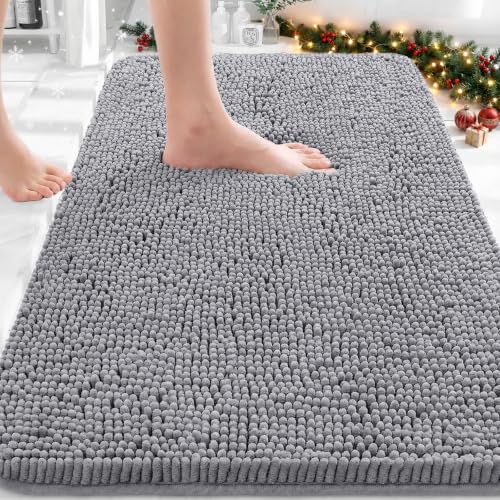
OLANLY Chenille Bath Rug 30×20 Grey — Best Plush Landing on Tile
Where the GORILLA GRIP pick leads with its grip, this OLANLY leads with its welcome: a broad 30×20 field of chenille, soft and absorbent, sized to receive the whole step-out with margin on every side. On cold tile that margin is luxury with a function, because a foot that lands half on a rug’s edge gets neither warmth nor grip, and this rug’s territory is generous enough that half-landings rarely happen.
Beneath the pile, a rubberised layer that sheds water quickly keeps the arrangement honest on tile. The layer’s job is double: it anchors the rug against the glaze, and it refuses to hold the day’s moisture against the floor, so the tile under the rug dries rather than stews. Pile above, discipline below — it is the classic tile pairing, executed at a family-friendly size.
Grey again, and unapologetically: on the pale tiles most bathrooms wear, a mid-grey chenille reads as softness made visible, hiding the mixed evidence of a busy room while keeping the floor’s palette calm. The rug is sold as machine washable for the tub, shower and floor circuit, and its pile will repay the usual courtesies — a shake outside the room’s air, air for drying — with years of loft.
If your bathroom’s tile is matte or textured, where grip is easier, this is arguably the first pick in the guide: the safety contest relaxes and the comfort contest takes over, and few rugs here are more comfortable. Save the ultra-grip and ultra-thin specialists for the glossy floors that need them, and let this one be the warm heart of an ordinary tiled bathroom.
A final household it serves beautifully is the one with a dog washed in the family tub. The landing after a dog bath is the wettest event a bathroom hosts, and a broad chenille field that can take the shake-off zone entirely — dog, owner, and the radius of enthusiasm between them — turns a flood-management exercise back into a bath.
- Footprint: 30 x 20 inches, a generous single landing
- Face: chenille pile, extra soft to the touch
- Underside: rubberised layer that sheds water quickly
- Colour in the listing checked: grey
- Best stations: floor, tub side and shower exit
- Care route: machine washable, per the maker’s listing
Strengths
- Broad plush landing forgives the half-turn and the reach
- Water-shedding underside keeps tile beneath it drier
- Soft chenille transforms cold tile at dawn
Trade-offs
- Deep pile needs ventilation to dry completely
- Too wide for narrow shower cubicles
- Shaggy surface holds debris until shaken out
Best for: matte and standard tiled family bathrooms wanting warmth first.
Not suited for: polished-glass tile where maximum grip must outrank comfort.

Bcoimo Chenille Bath Rug 30×20 Grey — Best High-Absorbency Chenille
The Bcoimo enters the same 30×20 territory as the OLANLY with a slightly different accent: its listing speaks the language of microfiber, absorbency and quick drying in one breath, and the combination matters on tile. Microfiber chenille splits its fibres finer than standard chenille, presenting more surface to a wet foot, so the rug drinks quickly at the landing — and quick drinking is what keeps water out of grout lines in the seconds when it would otherwise escape.
Quick drying is claimed with equal emphasis, and on tile the claim carries structural logic: a rug that gives its moisture back to the room promptly leaves the floor beneath it dry for most of the day, which is when grout stays healthy. Households whose bathrooms steam up and stay steamy should still hang it after the morning rush, as every rug here deserves, but its resting state trends drier than a deep traditional pile’s.
The rubber backing is specified for the non-slip job on hard floors, tile included, and at this width the backing’s coverage matters: a 30-inch rug has leverage when a wet foot lands near its far edge, and a full backing resists the pivot that a partial one would allow. Lay it on clean dry tile, press the corners, and it settles into the stillness a good bath rug should have.
Between this and the OLANLY, the choice is temperament: the OLANLY woos with softness, the Bcoimo with thirst and pace. Busy bathrooms with back-to-back showers, where the rug must drink repeatedly and recover between performances, will feel the Bcoimo’s argument in the second week; quieter bathrooms may never need its pace and can take the softer pick with a clear conscience.
It is also the pick most likely to convert a sceptical partner, because its virtues announce themselves within one busy morning rather than across a season of theory: the second shower’s exit is as dry as the first, the floor beyond stays clean, and nobody has performed any special ritual to achieve either. Pace, in a working bathroom, is a form of kindness.
- Footprint: 30 x 20 inches, matching the wide single format
- Face: chenille in microfiber, soft to the touch
- Underside: rubber backing for a non-slip hold
- Absorbency pitch: high, with quick drying alongside
- Colour in the listing checked: gray
- Care route: machine washable, per the maker’s listing
Strengths
- Microfiber chenille drinks fast at the landing point
- Quick-dry character protects grout between showers
- Full rubber backing resists the edge-pivot slide
Trade-offs
- Pace-focused build feels less plush than the OLANLY
- Needs hanging in steamy, fan-poor bathrooms
- Grey chenille shows lint until shaken regularly
Best for: busy tiled bathrooms with sequential showers and no drying patience.
Not suited for: slow, single-bather households that rank softness above all else.

GORILLA GRIP Memory Foam Bath Rug Beige 24×16 — Best Cushion on Cold Tile
Cold tile’s most eloquent critic is the heel at 6 a.m., and memory foam is its answer. This GORILLA GRIP mat puts a foam core under a soft cover at 24×16, compressing beneath the foot and rebounding after, so the landing on a January slab feels like a decision the house made in your favour. Beige warms the arrangement further, visually at least, against the white and grey tiles it will mostly serve.
Foam on tile has one historical weakness — smooth foam bottoms can glide on glaze — and this mat’s textured rubber underside is the maker’s reply, giving the core a grippy foundation that suits hard bathroom floors. The texture also keeps the mat’s lighter weight from becoming a liability when a wet foot lands with sideways intent. It is the correct way to build a foam mat for tile, and the difference is felt in the first week.
The listing adds two quiet assurances: machine washable, and fade resistant. Foam asks for the gentle end of washing and a patient dry, since a core releases water slowly; in exchange, the fade resistance suits the sunlit tiled bathrooms where foam mats often live by a window and where lesser covers bleach into patchiness by summer’s end.
Choose it for the vanity as much as the tub: standing on foam through a long morning routine, on tile that would otherwise ache through slippers, is where this mat quietly becomes the household’s favourite object. For the high-volume tub exit, chenille still drinks better; for the standing, cushioning, warming work of a tiled bathroom, foam has no rival in this set.
- Footprint: 24 x 16 inches, a compact cushioned size
- Core: memory foam beneath a soft absorbent cover
- Underside: textured rubber for grip on hard floors
- Colour in the listing checked: beige
- Durability note: fade resistant, per the API title
- Care route: machine washable gently; allow a full dry
Strengths
- Foam cushion defeats cold tile’s dawn discomfort
- Textured rubber underside anchors foam properly
- Fade resistance suits sunlit tiled bathrooms
Trade-offs
- Foam dries slowest of the six picks here
- Compact size serves one station at a time
- Beige shows dark hair and grit honestly
Best for: vanities and tub sides on cold tile where standing comfort rules.
Not suited for: high-volume family exits needing chenille’s thirst and pace.
How Do the Six Bath Rugs for Tile Compare?
| Pick | Format | Surface or build | Care route |
|---|---|---|---|
| GORILLA GRIP Bathroom Rug Rubber Grip | Chenille rug, 24×17 | Dense chenille, rubberised underside | Wash moderately; dry fully |
| Mecko Ultra Thin Bath Mat 16×24 | Thin mat, 16×24 | Ultra-thin absorbent body for tile | Washable; dries very quickly |
| MontVoo Faux Suede Bath Mat Rubber Backing | Smooth mat, 16×24 | Faux suede face, rubber backing | Shake or wipe; wash as needed |
| OLANLY Chenille Bath Rug 30×20 Grey | Chenille rug, 30×20 | Soft pile, water-shedding rubberised layer | Machine washable; ventilate |
| Bcoimo Chenille Bath Rug 30×20 Grey | Chenille rug, 30×20 | Microfiber chenille, rubber backing | Machine washable; hang in steam |
| GORILLA GRIP Memory Foam Bath Rug Beige 24×16 | Foam mat, 24×16 | Memory foam, textured rubber underside | Gentle wash; patient full dry |
Which Tiles Are the Hardest for a Bath Rug to Grip?
Glazed porcelain and polished ceramic sit at the top of the difficulty table: their surfaces are engineered to be smooth, stain-proof and easy to clean, which makes them equally resistant to being gripped. A rug that performs there — full rubberised contact, a body that lies flush — has passed the category’s strictest examination, and the first pick in this guide was chosen with exactly that examination in mind.
Matte and textured tiles are kinder hosts. Their micro-texture gives backings something to hold, and most decent rugs stay put on them, which is why the comfort-led picks in this set are recommended for matte floors without hesitation. Mosaic tiles sit between the two: the glaze is smooth, but the grout lines interrupt any slide every inch or so, and a flexible rug that settles into the mosaic’s rhythm can grip surprisingly well.
Large-format tiles deserve a specific warning because they minimise grout lines — the very interruptions that stop slides — across wide, polished fields. A bathroom floored in big glossy slabs is, for rug purposes, a skating rink with plumbing, and it deserves the strongest undersides in this guide plus a first-week testing routine conducted with genuine attention.
How Do You Keep Grout Lines Healthy Under a Bath Rug?
Grout fails by staying wet, and a bath rug’s whole moisture discipline exists to prevent exactly that. The routine is unglamorous: a rug that absorbs decisively at the landing, a floor mopped of escapees rather than left to air-dry into the lines, and a rug lifted or hung daily so the tile beneath completes its own drying. Any one of the three habits helps; together they keep grout pale and sound for years beyond its usual bathroom lifespan.
Choose rug sizes that end decisively. A rug whose edge sits exactly where water lands will wick that water under itself all day; a rug that covers the landing completely, or stops well short of it, keeps the wet zone and the dry zone separate. This is why the step-out measurement matters more on tile than on any other floor — the grout map underneath your rug is drawn by those inches.
If grout has already darkened beneath an old rug, treat the floor before the new rug arrives: clean the lines, let the whole floor dry for a full day, and only then lay the replacement on a surface that is starting from dry. A new rug over damp grout inherits the old rug’s problem on its first morning, through no fault of its own construction.
Do Bath Rugs Work on Heated Tile Floors?
Beautifully, with two adjustments to habit. Underfloor heating dries a rug from beneath at a pace no airing rail matches, which makes even the deeper chenille picks practical in heated bathrooms, and the dawn experience — warm tile, warm rug — is the one genuinely luxurious arrangement this category can offer. Foam and chenille both thrive in it.
The adjustments concern the undersides. Sustained heat ages rubber and rubberised layers faster than room temperature does, so on heated floors the monthly underside inspection this guide recommends elsewhere becomes genuinely important: look for cracking, stiffness or a backing that has begun to leave residue, and retire the rug when the underside, not the face, says so.
Thermostats also deserve a thought: the warmest settings under a rug’s footprint can dry a pile to stiffness over a season. Most households run the bathroom zone at a comfort setting rather than its maximum, which serves feet and backings alike. Heated tile plus a well-backed rug is a partnership, and like most partnerships it lasts longest at moderate temperatures.
How Should You Test a New Bath Rug’s Grip on Your Tile?
Give the rug its examination under honest conditions during the first week, while returning it is still a errand rather than a grievance. Lay it on tile that is clean and completely dry, press it down across its whole area, and use the bathroom normally — but notice, each time, the step-out and the towel turn. A rug that has not moved by a millimetre in seven days of real use has told you its character.
Then test the recovery: after a shower has wet both rug and floor, does the rug still hold when the second person steps out? Some undersides grip dry tile superbly and glaze over when a film of water gets beneath them; the picks here were chosen to avoid that betrayal, but your own floor is the only examiner whose verdict counts, and a week is enough for it to speak.
If a rug creeps despite passing its dry test, clean the tile beneath it once with a degreasing wash — soap film from years of mopping is a common hidden culprit — and retest before condemning it. Floors accumulate invisible lubricants, and more than one good rug has been returned for its floor’s sins. If it still travels on a clean floor, believe it, and choose a stronger underside from this guide.
What Size Bath Rug Suits a Tiled Bathroom’s Layout?
Tile telegraphs size errors more than other floors, because the grout grid makes every misalignment visible and a rug that ends mid-tile-field looks accidental in a way the same rug on wood does not. Work with the grid: centre the rug on the tub’s length or the vanity’s span, let its edges fall where they may relative to grout lines, and prefer the size that covers the wettest territory completely over the size that matches a tile multiple by coincidence.
For the standard tub on tile, the 30×20 chenille format in this guide covers the landing and the turn; for the shower cubicle, a 24-inch class mat at the door; for the basin, a compact mat or the thin specialists. Long tiled bathrooms with a double vanity deserve a runner’s continuous line, and households with that geometry should read this guide’s wide picks as stations along a route a runner would unite.
Leave the toilet’s base and the door’s swing out of the rug’s territory entirely. On tile, a rug edge lifted by a swinging door becomes a slide waiting for a foot, and a rug bunched against porcelain never lies flat enough to grip. White space of bare tile around a well-placed rug is not wasted floor; it is the frame that lets the rug do its one job properly.
How Do You Wash Bath Rugs Without Ruining Their Grip on Tile?
The grip you depend on lives in the underside’s chemistry, and laundry is where that chemistry is spent. Moderate temperatures preserve rubberised layers; high heat hardens and cracks them. Gentle cycles preserve chenille’s tufting and foam’s resilience; violent agitation spends both. The rule for every pick in this guide is the same: wash as cool and as calmly as the soil allows, which at a sensible washing frequency is always enough.
Drying decides the rest. Air, moving if possible, until the underside is as dry as the face — the underside is always last, and rugs returned to tile with damp backs grip poorly and smell by the weekend. Never leave a washed rug folded on itself overnight; the crease it learns in a night can take a week of service to forget.
Inspect the underside at every wash, briefly, the way you would glance at a tyre. Cracking, powdering, patches polished smooth — each is the backing reporting its remaining life honestly. A rug retired for its underside while its face still looks new has not failed early; it has simply spent its safety budget, which was the part you could not afford to overdraw.
Can a Bath Rug Make a Tiled Bathroom Feel Warmer Without Heating?
Yes, within the honest limits of insulation. A chenille or foam rug interrupts the foot’s contact with a material that conducts heat away eagerly, and the perceived warming is immediate and real: the same room, the same air temperature, a different morning. Deep pile adds a small acoustic softening as well, and tiled bathrooms — all hard surfaces, all echoes — sound calmer for it in a way visitors notice without naming.
Colour temperature assists. The beige foam pick in this guide warms a white-tiled room visually before a foot ever lands, and warm-toned towels complete the suggestion. None of this replaces heating in a genuinely cold house, but in the large middle territory of bathrooms that are merely chilly at dawn, the right rug closes most of the gap at a tiny fraction of a heating bill.
Layer the effect where it matters: the rug at the step-out, the mat at the vanity, and bare tile left only where nobody stands still. Warmth in a bathroom is a map of standing places, and rugs are how you draw it. Draw it completely, and the room’s climate at foot level becomes a designed thing rather than a weather event.
What About Small Mosaic Tiles and Old Bathroom Floors?
Older bathrooms often wear small tiles — hexagons, penny rounds, little squares — set in generous grout, and they are kinder to rugs than their modern large-format successors in one way and harder in another. Kinder, because the grout grid interrupts slides constantly; harder, because the surface is subtly uneven, and a stiff rug can bridge across the crowns and rock at its corners instead of settling into full contact.
Flexible constructions win on such floors: chenille rugs whose bodies drape into the mosaic’s rhythm, thin mats that follow every contour. The foam pick can work if its underside is soft enough to settle, but test its corners during the first week, since a rocking foam mat on mosaic is a toe-catcher in waiting. A night or two under a stack of towels often persuades a new rug to learn an old floor’s shape.
Old grout also holds more water by volume, which raises the value of the drying habits this guide repeats: hang the rug, let the floor finish its drying, and never let a rug sit for a week on a mosaic floor that never fully dries beneath it. Heritage bathrooms reward this rhythm with decades of extra grout life, which matters in rooms where retiling is a project nobody schedules for fun.
How Should Bath Rugs on Tile Be Arranged for Children and Guests?
Children experience a tiled bathroom as a water park with rules, and the rug arrangement should assume enthusiasm. Cover the tub exit with the strongest grip in this guide, extend coverage toward the basin where small people migrate with wet hands, and accept that the family rug will be washed oftener than any other textile in the house — which is an argument for owning its replacement in advance rather than an argument against the arrangement.
Guests need the opposite emphasis: a rug that is dry, still and silent about the household’s logistics. The rotation habit serves both audiences from the same cupboard — the workhorse rug takes the children’s week, the rested rug takes the guest weekend, and neither audience ever meets the other’s version of the bathroom. Two rugs, honestly rotated, outperform one expensive rug asked to be both.
In both cases, check the corners. Small feet and unfamiliar feet find lifted edges that residents have unconsciously learned to avoid, and a corner that curls is a defect to fix the day it appears — by retraining the rug flat under weight, or by retiring it — rather than a quirk to warn visitors about at the door.
When Does a Tiled Bathroom Need a Runner Instead of Mats?
When the room’s wet stations line up along one wall — long tub, double basin, shower at the far end — separate mats leave cold gaps exactly where people walk between stations, and on tile those gaps are also the slippery ones. A runner unites the route: one gripped, absorbent line from the first station to the last, with no bare-tile negotiations in between. The moment a bathroom’s floor plan reads as a corridor, the runner stops being a style choice.
Tile raises the runner’s stakes in both directions. Its grip must hold along five feet of leverage, so full backings matter even more than they do for mats; and its drying must be thorough, because a runner covers more grout for more hours than any mat. Households choosing a runner for tile should build the hanging habit into the bathroom’s furniture from the start — a rail, a wide tub rim, somewhere the runner can spend its off-duty hours breathing.
None of the six picks here is a full runner, deliberately: this guide’s territory is the mat-sized negotiations most tiled bathrooms actually face. But the principles transfer intact — underside first, absorption at the landing, drying without mercy — and a reader who has absorbed them will choose a runner for a long tiled room more wisely than any single product recommendation could choose it for them.
A Note on Natural Stone and Other Delicate Tiles
Everything in this guide assumes glazed ceramic or porcelain, the great majority of bathroom floors. Natural stone — marble, travertine, slate — plays by stricter rules: it is porous, it can react to some rubber compounds over long contact, and it stains in ways glaze never will. On stone, the safest rug is one whose maker explicitly blesses stone contact, lifted and aired more often than this guide’s already brisk rhythm, with the floor beneath inspected for any shadow of transfer at every wash.
Slate adds texture that grips generously, making it the friendliest of the natural floors for rugs, while polished marble is the least forgiving surface in the entire bathroom world — slippery, reactive and expensive to apologise to. Households with marble should treat the grip question as a consultation with the stone’s installer as well as a shopping decision, because the cost of a mistake is measured in refinishing, not in returns.
None of this should frighten a stone owner away from rugs; a cold marble floor needs one more than any other. It should simply promote the underside inspection from a habit to a ritual, and favour the picks here whose makers describe their backings in plain material terms over those whose undersides are a mystery wrapped in a photograph.
What Mistakes Do People Make With Bath Rugs on Tile?
Buying a rug for its face and never reading its underside. On tile, that is buying a car for its paint. Turn every candidate over, in the listing photographs and in your hands, and let the backing’s construction make the decision the surface merely decorates.
Laying a new rug on a floor still damp from mopping. Water trapped beneath a backing defeats grip from the first hour and teaches the rug to travel before it has had a fair trial. Dry tile, dry rug, then the marriage; every successful placement in this guide assumes that order.
Choosing a rug that ends exactly at the wettest line. An edge at the drip line wicks water underneath all day, keeping grout damp and the rug’s underside slick. Cover the landing fully or stop well short of it — the middle position is the only wrong one.
Scrubbing grout aggressively while the rug lives on top of it. Harsh treatments and gritty residues left under a rug become a lubricant layer and a scratch risk together. Clean the floor on a rug-free day, rinse it honestly, dry it completely, and only then return the rug to a surface that deserves it.
Ignoring the first week’s evidence. A rug that creeps in week one is not settling in; it is reporting a mismatch between its underside and your glaze. Believe the report while returns are easy, and move up this guide’s grip ladder rather than hoping time will argue with physics.
Assuming all tiles grip alike because they look alike. Two bathrooms in the same house can wear porcelain of entirely different glazes, and a rug that is furniture in one can be a sled in the other. Test each room separately, and let each room’s verdict stand even when it contradicts its neighbour’s.
Final Recommendation
Match the rug to your glaze before anything else. Polished and large-format tile should take the GORILLA GRIP chenille or the flush-lying Mecko; matte and ordinary tile can enjoy the OLANLY’s plush landing or the Bcoimo’s thirsty pace; sleek modern rooms will speak the MontVoo’s smooth language; and cold slabs anywhere will forgive almost anything for the beige foam’s cushion. Every pick here was chosen for a tile it understands.
Then keep the partnership healthy: dry tile at laying, a hung rug after busy mornings, an underside inspected at every wash. Do those small things and the rug stops being an object on your bathroom floor and becomes part of the floor itself — the warm, planted, dry part, which is the only part your feet will remember. On tile, that quiet transformation is what the best bath rugs are actually for.
Frequently Asked Questions
Why does my bath rug slide on tile but not on my old vinyl floor?
Vinyl offers a microscopically grippy, slightly yielding surface that forgives mediocre backings; glazed tile offers neither quality. The rug has not changed — the examination has. Move up to a full rubberised underside from this guide, lay it on clean dry tile, and the same household traffic will meet a rug that stays where it was put.
Can I use a rug pad under a bath rug on tile?
Usually the rug’s own backing should do the work, and adding a pad can raise edges and complicate washing. If a beloved rug creeps on your glaze, a thin washable gripper sheet beneath it is a reasonable trial — but treat persistent sliding as the rug’s resignation letter and replace it with a stronger underside rather than stacking fixes.
How do I stop water pooling in the grout under my rug?
Absorb more at the landing, dry more beneath the rug. Choose a size that covers the step-out completely, hang the rug after the morning’s showers so the tile completes its drying, and mop escapees rather than letting them sit in the lines. If pooling persists, the rug is too small for its station, and the wider picks in this guide exist for exactly that diagnosis.
Are thin mats warm enough on winter tile?
They remove the shock of the glaze and grip superbly, but they do not insulate like pile or foam. Households in cold climates usually run a thin mat at the shower door, where grip rules, and a chenille or foam rug at the tub and vanity, where warmth rules — assigning each construction the station it serves best.
Will a rubber backing damage or stain my tiles?
Quality rubberised backings rest on glazed tile without marking it, and tile is far less reactive than some wood finishes. The real risk is trapped moisture, not chemistry: lift and dry beneath the rug regularly, and both surfaces stay innocent. On natural stone tile, which is porous and more delicate, check the stone maker’s guidance before using any backed rug.
How often should I lift the rug to dry the tile beneath?
In a daily-shower bathroom, a brief lift or hang after the morning rush is the gold standard; in practice, most households manage it a few times a week and after every bath, which involves the most water. The tile should feel dry to a palm whenever you check — if it never does, the bathroom needs more ventilation as much as it needs a better rug.
Should I choose a light or dark rug for a white tiled bathroom?
A mid-tone grey is the peace treaty most white bathrooms sign: it defines the rug’s territory, hides the week’s mixed evidence, and neither glares like a dark slab nor soils like a white one. Go darker only when the room has other dark anchors — a vanity, a frame, a door — and lighter only when you accept the washing rhythm a pale rug on tile honestly demands.
Related Guides
Tile bathrooms usually belong to whole-home projects, so continue with Best Long Bath Rugs if your tiled room runs long, Best Area Rugs for Small Spaces for the tight rooms that share the same measuring discipline, and Best Area Rugs with Pet Stain Protection when the household’s animals use the bathroom too. The hygiene companion to this guide is Best Bath Mats for Cleanliness.



[…] continue the work: Best Area Rugs with a Leaf Pattern, Best Gender-Neutral Baby and Toddler Rugs, Best Bath Rugs for Tile Floors, Best Area Rugs for Dark Hardwood […]