What's inside
- Key Takeaways
- Quick Picks
- How Did We Choose These Baby Rugs?
- The Six Baby Rugs in Detail
- How Do the Six Baby Rugs Compare?
- Plush or Thin: Which Surface Does a Baby Actually Need?
- How Do You Keep a Nursery Rug Fresh Through the Spit-Up Months?
- Where Does the Rug Belong in the Nursery’s Layout?
- What Mistakes Do New Parents Make with Baby Rugs?
- The Night-Feed Floor: Designing for Three in the Morning
- Babies, Siblings, and the Family Dog: One Rug, Many Citizens
- Is a Baby Rug a Good Baby-Shower Gift?
- What Textures Does a Baby Meet on a Rug, and Why Do They Matter?
- From Nursery to Toddler Bedroom: The Rug’s Second Year
- Day One: Unrolling, First Wash, and Placement
- What Does Owning Each Kind of Rug Actually Cost in Effort?
- Colour in the Nursery: What Pink, Rainbow, and Blush Each Do
- How Do You Baby-Proof the Rug Itself?
- A Note for Grandparents’ Houses and Second Homes
- What Does the Floor Feel Like to the Adult in the Room?
- How Do You Choose Between Two Rugs You Like Equally?
- Final Recommendation
- Frequently Asked Questions
- Related Guides
As an Amazon Associate I earn from qualifying purchases. This post may contain affiliate links at no extra cost to you.
cottageverdict.com is reader-supported. When you buy through links on our site, we may earn an affiliate commission.
Where to buy: every rug below links to its Amazon listing, where you can check price on Amazon and confirm the size and shade available. Nursery rugs in soft pinks sell in waves, so a favourite round in stock is worth securing when you see it.
Before a single rug is described, the safety frame that governs this whole guide to baby rugs: a baby rug is a supervised play surface, full stop. It is the soft territory where tummy time, rolling, sitting practice, and crawling expeditions happen while an adult is present — and it is not, under any circumstances, a place for a baby to sleep. Babies under twelve months should never sleep on a play rug or on a thick, plush rug, and a crib should contain nothing but a firm mattress with a fitted sheet: no pillows, no loose blankets, no soft extras of any kind. Keep the rug on the floor beside the crib for waking, watched hours, choose it for that job, and it will serve your family beautifully and safely.
With that line drawn, baby rugs are one of the nursery’s great pleasures, because the floor is where a baby’s life actually happens. Long before the chair, the table, or the bookshelf matter, the rug is the landscape: the surface a baby studies at tummy-time eye level, the grip their knees learn to trust, the softness a parent kneels into a dozen times a day. The best baby rugs balance three things that pull against each other — softness for comfort, a surface practical for movement and cleaning, and a look that makes the room feel like the gentle place its smallest resident deserves.
The six picks below lean into the soft, pretty end of the category, in the pinks and rounds that dominate real nurseries, but they divide by construction in ways that matter. Two are full shag rugs — a pink plush rectangle and a rainbow shag — best for supervised play with older babies and toddlers and for the bedrooms they grow into. Three are round: a washable fluffy circle, a bow-print ultra-thin round that washes and lies dead flat, and a boho blush round with a vintage soul. Between them sits an alphabet play round with a brown bear, for parents who want the floor to join the games. Every pick is non-slip, and washability is flagged honestly in each review, because spit-up is this category’s weather.
Key Takeaways
- A baby rug is for supervised play only — babies under twelve months never sleep on one, and cribs stay bare, firm, and pillow-free.
- Softness serves comfort, but movement serves development: low and thin rugs grip best for crawling, plush rugs pamper sitters and parents’ knees.
- Washability is the nursery’s survival feature, because milk and spit-up arrive on a schedule no one controls.
- Round rugs soften a nursery’s geometry and define a play zone without corners to curl or catch.
- Non-slip backing is non-negotiable where adults carry babies across the room at three in the morning.
- Buy for the next stage as well as this one — a rug that suits a toddler’s bedroom outlasts the nursery-only purchases around it.
Quick Picks
| Pick | Badge | Why it earns its place |
|---|---|---|
| Pink Fluffy Rug 4×6 Girls Bedroom | Softest pink classic | A plush, washable pink shag with non-slip backing — the archetypal soft nursery floor, sized for the play zone and beyond. |
| KICHOWUA Rainbow Shag Rug 4×6 | Happiest colour statement | A rainbow shag that turns the floor into the room’s celebration, for babies growing into toddlers who live in colour. |
| OLANLY Round Rug 4ft Washable | Best round soft spot | A fluffy pink circle that machine-washes, softening the corner beside the crib into the room’s favourite place to land. |
| Poowe Round Alphabet Baby Rug | Best play-learning round | Alphabet print and a brown bear on a soft round mat, giving tummy time and first games a cast of letters to grow into. |
| Wonnitar Bow Print Round Rug 4ft Pink | Best thin washable round | An ultra-thin bow-print circle that lies flat, washes easily, and grips — the practical parent’s pretty rug. |
| Lahome Sylvie Boho Round Rug 4ft Pink | Prettiest boho nursery round | Blush and green boho patterning on a washable round, for nurseries styled with a vintage hand. |
How Did We Choose These Baby Rugs?
The safety frame was the first filter and it was absolute: every pick is presented and assessed as a supervised play surface, with a non-slip backing, and nothing here is treated as bedding or a sleep aid in any sentence of this guide. Within that frame we weighed the nursery’s real physics. Adults cross this floor carrying a baby, often in the dark, often half asleep — so grip mattered. Babies meet this floor face-first during tummy time and knee-first while crawling — so surface character mattered, and we are honest in each review about where plush helps and where a thinner surface serves movement better.
Cleaning reality did the next round of judging. A nursery rug will be washed or it will be replaced, so washable picks were favoured and every pick’s care route is stated plainly. We then spread the six across the shapes and moods nurseries actually take: rectangular shags for the main floor, rounds for corners and crib-side zones, one print that plays along with learning games, and palettes from classic pink through rainbow to boho blush. What we did not do is rank by softness alone, because the softest rug in the world is the wrong purchase if it cannot be cleaned or if a crawling baby cannot get purchase on it — the reviews keep all three ledgers open at once.
The Six Baby Rugs in Detail
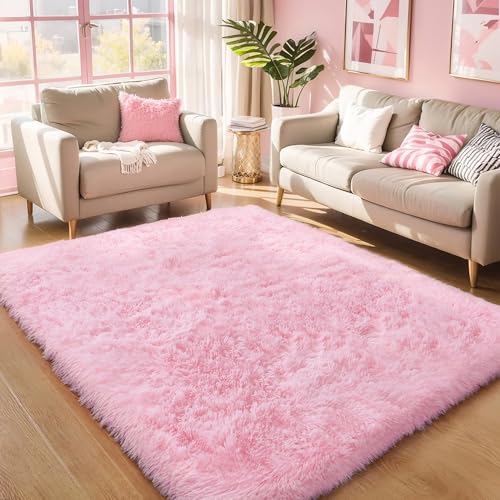
Pink Fluffy Rug 4×6 Girls Bedroom — Softest pink classic
This is the rug most people picture when they picture a nursery floor: a plush pink shag, 4×6, soft enough that the room’s comfort is obvious from the doorway. Its honest role in the baby year is as the supervised play and lounging surface for the hours when an adult is on the floor too — tummy time with a parent alongside, sitting practice with cushions of the human kind nearby, story time sprawled at full length. The shag’s deep softness is a gift to the adults as much as the baby; nobody who has knelt on a hard floor beside a play gym for forty minutes needs that explained.
Two features keep the prettiness practical. The backing is non-slip, so the rug stays where the room’s geography put it, and the rug is washable — a plush rug that can actually be cleaned is the difference between a nursery staple and a six-month romance. Be clear-eyed about the shag’s one compromise: a learning crawler gets less grip in deep pile than on a thin rug, so many families run this as the lounging and play surface while a baby’s serious crawling practice happens on any firmer floor nearby, then watch the rug come into its own as the child sits, stands, and toddles across it.
- Size: 4 x 6 ft
- Construction: plush shaggy pile
- Backing: non-slip
- Care: washable per listing
- Setting: supervised play, lounging, girls’ bedrooms as they grow
Strengths
- Deep plush softness for floor play and parents’ knees
- Washable, which plush nursery rugs too often are not
- Classic pink that anchors a traditional nursery palette
Trade-offs
- Deep pile gives a new crawler less grip than thin rugs
- Shag holds crumbs until vacuuming or washing evicts them
- Never a sleep surface — supervised play only, like every pick here
Best for: supervised lounging and play in a classic pink nursery, and the bedroom that follows it. Not suited for: being a baby’s main crawling-practice track.

KICHOWUA Rainbow Shag Rug 4×6 — Happiest colour statement
Where the pink classic whispers, the KICHOWUA celebrates. Its rainbow shag lays the whole spectrum across a 4×6 in soft, fuzzy bands, and the effect on a room is immediate: the floor becomes the party. For a baby, those strong colour bands are genuinely engaging visual territory during supervised floor time — high-contrast colour at exactly the distance a baby studies the world. For the toddler this baby becomes, the rainbow is a sorting game, a colour-naming lesson, and a stage for every performance, all before breakfast.
The construction follows the same honest pattern as its pink sibling: plush shag for softness, non-slip backing for a rug that stays assigned to its post. Rainbow is also a shrewd decorating strategy for a room that must serve siblings or changing tastes, because a rug containing every colour coordinates with whatever the room becomes next — the pink phase, the dinosaur phase, the everything-is-purple phase. Treat its deep pile with the same understanding as the first pick: supreme for lounging, sitting, and play with an adult present; less grippy for a crawler’s apprenticeship than a thin surface.
- Size: 4 x 6 ft
- Construction: fluffy shaggy pile in rainbow bands
- Backing: non-slip
- Care: follow listing care; vacuum and shake routine
- Setting: playrooms, nurseries, girls’ bedrooms
Strengths
- Full-spectrum colour engages babies and delights toddlers
- Rainbow coordinates with every later room phase
- Plush softness for supervised play and lounging
Trade-offs
- The celebration palette will dominate a calm room
- Deep shag shares the crawling-grip compromise
- Multi-colour pile shows light and dark debris equally
Best for: joyful nurseries and playrooms, siblings sharing a floor, colour-first families. Not suited for: a serene, muted nursery scheme or a crawler’s main practice surface.

OLANLY Round Rug 4ft Washable — Best round soft spot
A round rug changes a nursery’s emotional geometry. Rectangles organise a room into lanes; a circle creates a place — and the OLANLY’s four-foot pink circle, soft and fluffy, placed beside the crib or under the nursing chair, becomes the place where the room’s tender business happens. It is machine washable, which at this size is effortless: the whole rug lifts, washes, and dries without the logistics of a room-sized piece, so the soft spot can be kept genuinely fresh through the spit-up months.
Round is also the forgiving shape for small nurseries, because it defines a play zone without demanding the floor’s full rectangle or fighting the furniture’s angles. The fluffy surface suits supervised sitting and lounging play and gives a baby a soft island for tummy time with an adult right there; as with the shags, a determined crawler will do their serious mileage on a grippier surface and return here for the comfort breaks. Parents consistently report that the round rug becomes the photograph spot, the story spot, and the spot the dog is forever trying to claim — the surest sign a piece of nursery gear has been fully adopted.
- Size: 4 ft round
- Construction: soft fluffy shaggy circle
- Backing: non-slip character for bedroom floors
- Care: machine washable
- Setting: crib-side zones, nursing corners, small nurseries
Strengths
- Circle shape creates a defined, gentle play place
- Machine washable at an easy, quick size
- Soft landing for supervised play and story time
Trade-offs
- Four feet covers a zone, not a room
- Fluffy pile shares the crawler-grip compromise
- Round shape leaves corners of a rectangular zone bare
Best for: crib-side soft spots, small nurseries, and nursing corners. Not suited for: covering a whole playroom floor.

Poowe Round Alphabet Baby Rug — Best play-learning round
The Poowe puts a curriculum in a circle and a bear in charge of it. Just under forty inches across, this round play mat prints an educational alphabet around a brown bear design, in soft tones that keep the learning gentle. For a baby, it is a soft, non-slip surface for supervised floor time with something definite to look at — a friendly face at the centre of the world. For the toddler arriving a year later, the same circle is a letter track to walk, point at, and begin the long, playful business of recognising symbols.
Its smaller footprint is a feature for the homes that need it most: the nursery corner in a parents’ bedroom, the play patch in a living room, the grandparent’s designated baby territory. A round mat this size moves rooms in one hand and stores on a hook, which makes it the pick most likely to travel — to the garden room in summer, to the kitchen floor where a baby can watch lunch happen from a safe, soft post. It is the gentlest introduction to the idea that a rug can be both furniture and game.
- Size: about 39.4 in round
- Design: alphabet print with brown bear
- Construction: soft area rug, non-slip
- Care: follow listing care; spot-clean routine
- Setting: corners, travel between rooms, grandparents’ houses
Strengths
- Alphabet and bear give floor time a friendly focus
- Portable size serves small spaces and second homes
- Soft, grippy surface for supervised baby play
Trade-offs
- Smallest coverage in this guide
- Letter content is wasted on the youngest babies at first
- Round mat will be outgrown as a main play zone
Best for: small nurseries, portable play spots, and letter-curious toddlers. Not suited for: anchoring a whole room’s play territory alone.

Wonnitar Bow Print Round Rug 4ft Pink — Best thin washable round
The Wonnitar is the pragmatist’s entry in a guide full of romantics. It is a four-foot round in light pink with a bow print and boho floral touches — pretty, certainly — but its specification is the story: ultra-thin, soft, washable, and non-slip. Thin is a crawling baby’s friend, because a low surface gives knees and palms the purchase that deep pile denies, and it is a parent’s friend every wash day, because an ultra-thin round goes through the machine and dries with a speed the fluffy picks cannot match. If the nursery’s rug will be washed weekly — and during the spit-up and weaning months, it may be — this is the construction that keeps that schedule sane.
The bow print earns its place by being charming at exactly the right volume: visible in the room’s scheme, gentle enough to sit under a patterned quilt or beside printed curtains without a duel. Lying dead flat is another quiet virtue, because a rug under a feeding chair or beside a crib gets crossed hundreds of times, and an edge that never curls is an edge nobody ever trips on at three in the morning. For first-time parents who want one rug that does the practical things perfectly and the pretty things well, the Wonnitar is the guide’s easiest recommendation.
- Size: 4 ft round
- Design: bow print with boho floral, light pink
- Construction: ultra-thin and soft, non-slip
- Care: washable, fast-drying build
- Setting: crawling zones, feeding-chair territory, nurseries
Strengths
- Thin surface grips for crawling practice
- Washes and dries faster than any fluffy pick
- Lies flat under chairs and midnight crossings
Trade-offs
- Little cushioning on a hard floor
- Bow print commits to a sweet, feminine scheme
- Round four-foot zone only, like its round siblings
Best for: crawling-stage babies and wash-weekly households. Not suited for: anyone whose first priority is plush cushioning.

Lahome Sylvie Boho Round Rug 4ft Pink — Prettiest boho nursery round
The Sylvie is for the nursery that was styled, not assembled. Lahome’s round rug pairs blush pink with soft green in a boho pattern that feels vintage and composed — the kind of floor piece that makes visitors ask where the room came from. At four feet round, washable, and non-slip, it takes the crib-side or reading-corner post and turns it into the room’s most considered square metre. In a sunroom nursery or a room with plants and natural wood, its palette does the work of three accessories at once.
Boho styling sometimes comes with delicate handling instructions; this one does not, and the washable build is the reason it belongs in a baby guide rather than a décor editorial. Babies are gloriously indifferent to styling, and the rug that survives them must be cleaned on their schedule, not its own. The Sylvie’s soft, low character suits supervised floor play and the long story-time years that follow, and its colours — blush rather than bubblegum — let it graduate into a girl’s bedroom, a dressing corner, or a reading nook without looking like a nursery leftover.
- Size: 4 ft round
- Design: boho pattern in blush pink and green
- Construction: soft, non-slip round rug
- Care: washable
- Setting: styled nurseries, sunrooms, reading corners
Strengths
- Boho blush palette elevates a styled nursery
- Washable build respects baby reality
- Colours graduate gracefully into later rooms
Trade-offs
- Patterned design may duel with busy bedding
- Zone-sized coverage, like all the rounds here
- Light blush field shows spills sooner than mid-tones
Best for: design-led nurseries and boho room schemes. Not suited for: covering a main playroom floor or a mud-heavy household’s only rug.
How Do the Six Baby Rugs Compare?
| Pick | Size and shape | Surface | Care | Standout strength |
|---|---|---|---|---|
| Pink Fluffy Rug 4×6 Girls Bedroom | 4 x 6 ft rectangle | Plush shag | Washable | Deepest softness |
| KICHOWUA Rainbow Shag Rug 4×6 | 4 x 6 ft rectangle | Rainbow shag | Listing care routine | Colour celebration |
| OLANLY Round Rug 4ft Washable | 4 ft round | Fluffy circle | Machine washable | Soft crib-side spot |
| Poowe Round Alphabet Baby Rug | About 39 in round | Soft printed mat | Spot-clean routine | Letters and portability |
| Wonnitar Bow Print Round Rug 4ft Pink | 4 ft round | Ultra-thin soft | Washable | Crawling grip and fast washes |
| Lahome Sylvie Boho Round Rug 4ft Pink | 4 ft round | Soft patterned | Washable | Boho nursery style |
Plush or Thin: Which Surface Does a Baby Actually Need?
The nursery’s softest instinct — deepest pile, maximum plush — deserves a respectful challenge, because a baby’s floor life has two different physical phases. In the lounging phase, which includes tummy time with an adult alongside, sitting practice, and story time, softness is comfort and comfort is king; the shag picks shine here, and so do the knees of every adult in the room. In the movement phase — the crawl apprenticeship, with its thousand push-ups and belly flops — a baby needs friction more than cushioning, and a thin, grippy surface like the Wonnitar’s lets small palms and knees purchase instead of skating.
Most households solve this without choosing a side. The plush rug takes the lounging post beside the crib or under the play gym, and crawling practice happens wherever the floor is firmest — which may be the thin round rug, a hallway, or the kitchen’s open stretch — with the baby migrating between territories all day. What matters is that no one mistakes the plush rug for a sleep surface in either phase: softness is for supervised play, the crib’s firm bare mattress is for sleep, and the whole household, grandparents included, should be able to recite which is which.
How Do You Keep a Nursery Rug Fresh Through the Spit-Up Months?
Plan for the wash before the first spill, because the first spill is coming this week. The washable picks in this guide — the pink fluffy, the OLANLY round, the Wonnitar, and the Sylvie — can go through a normal cycle; shake them outside first, because a baby rug collects a surprising amount of dry evidence. Dry every rug completely before it returns to the floor, since a rug put down damp will smell musty within days and undo the entire exercise. For the picks on a spot-clean routine, blot milk and spit-up the moment they land, because dairy left in pile overnight announces itself to the whole landing by morning.
Rotation is the luxury that makes the system effortless: a second, inexpensive round rug lets one be in the wash while the other holds the post, and the four-foot rounds in this guide are sized and priced in effort for exactly that partnership. Keep a small stack of cloths in the nursery itself, not downstairs, because the distance to the cloth decides whether a spill is a ten-second blot or a soaked-in event. Freshness in a nursery is not a product; it is a rhythm, and the washable, quick-drying constructions here exist to make that rhythm easy to keep.
Where Does the Rug Belong in the Nursery’s Layout?
Beside the crib, not under it, and within the orbit of the feeding chair — that triangle is the nursery’s working territory. The crib stands on its own firm footing, the rug covers the floor where the baby plays and the parent kneels, and the chair’s rocking or gliding path should cross the rug’s edge without catching it, which the flat-lying thin picks manage best. Leave the door’s swing clear, and think about the three-in-the-morning route from door to crib to chair: that path should be predictable underfoot, grippy, and free of curled edges, because the person walking it is carrying the room’s most precious cargo in the dark.
As the baby grows, the rug’s post migrates with the play. The tummy-time zone becomes the sitting and stacking zone, then the crawling circuit’s home straight, then the toddler’s reading and puzzle territory, often without the rug moving an inch — the room reorganises around it. Choosing a design that can survive those migrations, like the rainbow’s every-colour diplomacy or the Sylvie’s graduating blush, is how a nursery rug avoids becoming a nursery leftover at the first birthday.
What Mistakes Do New Parents Make with Baby Rugs?
- Letting a baby nap on a soft rug because it looks peaceful, when sleep belongs on the crib’s firm, bare surface every single time.
- Adding pillows or loose blankets to the crib to match the nursery’s softness, undoing the safe sleep space the room depends on.
- Buying deep shag as a crawling surface and wondering why the baby’s knees skate instead of grip.
- Choosing a rug that cannot be washed for the room where milk lands daily.
- Placing the rug half under the crib, where it can neither be cleaned properly nor define a play zone.
- Skipping the grip check, so the rug travels under a parent carrying the baby across the room at night.
The Night-Feed Floor: Designing for Three in the Morning
Every nursery has two shifts, and the night shift has its own design brief. The adult crossing the room in the dark, carrying a baby, needs a floor that is predictable: a rug that has not travelled since bedtime, edges that lie flat enough to cross barefoot without thought, and a surface warm enough that the feeding chair’s territory feels humane in February. This is where the non-slip backings in this guide earn their keep most honestly — not in the showroom test, but in the thousand dark crossings of the first year, none of which anybody remembers individually and all of which together are the room’s real safety record.
The night shift also explains the nursery’s preference for rugs that lie flat straight from the roll and stay that way. A corner that curls is a daylight nuisance; at night, under a tired adult’s foot, it is a genuine hazard wearing a small disguise. The ultra-thin Wonnitar and the well-backed rounds behave best here, and a new rug should be given its first week of daylight crossings — with books on any stubborn corner — before it is trusted with the night route. Design the nursery for its tiredest user, and its freshest user will be delighted with the result.
Babies, Siblings, and the Family Dog: One Rug, Many Citizens
Few nursery rugs serve only the baby. An older sibling treats the new rug as annexed territory for their own games, and the family dog regards any soft floor as a planning application for a nap site. Plan for the whole citizenry and the rug survives them all: a washable build handles the dog’s contributions and the toddler’s juice diplomacy, a size that fits the sibling’s play beside the baby’s mat means the older child is a participant rather than an exile, and a design with enough going on — the rainbow’s bands, the Poowe’s letters — gives the sibling something to do at floor level while the baby does theirs.
Supervision rules extend naturally to the mixed floor. The baby’s play on the rug is watched play, and an older child’s rougher games belong at the rug’s far end or in another room entirely, not because the rug is fragile but because babies are. Households that set that geography early — gentle zone here, expedition zone there — find the rug becomes the family’s peace treaty: the one piece of floor where everyone’s version of play is welcome, at the speed of its smallest citizen.
Is a Baby Rug a Good Baby-Shower Gift?
It is one of the most useful ones, because it is infrastructure the parents will use daily for years, in a category where most gifts are outgrown by the second month. The rounds in this guide are the gift-sized picks: a four-foot circle fits any nursery’s play zone without the giver needing the room’s measurements, and the OLANLY and Sylvie suit parents whose style the giver knows only approximately, since both palettes sit gently in most rooms. The Wonnitar is the connoisseur’s gift — the one experienced parents give, because they know the wash rhythm is coming.
Give it with its purpose attached, kindly: a note saying this is for tummy time and floor play beside the crib travels the safety frame into the household without a lecture, and helps grandparents and visitors read the room correctly from the first visit. A rug given that way is used properly, washed confidently, and remembered at the child’s third birthday as the present that was on the floor for everything — which is more than the silver keepsakes can claim.
What Textures Does a Baby Meet on a Rug, and Why Do They Matter?
A baby reads the world through skin before anything else, and a rug is one of the largest texts they are given. The shag picks offer a deep, uniform softness that reads as comfort and warmth — the texture of being held, translated into flooring. The thin Wonnitar offers information instead: a baby on a low, stable surface feels their own weight and movement clearly, which is part of how the movement learning happens. The printed Poowe adds the visual texture of letters and a bear’s face, engaging the eyes at the distance where a baby’s vision is sharpest during floor time.
None of these textures is the correct one; they are a sequence. The youngest babies need comfort and a kind surface for the adults holding the whole enterprise together. Growing babies need information and grip. Toddlers need a stage. The wise nursery rug purchase recognises which texture its household needs this season — and the wisest recognises that the rounds in this guide, being movable, let a family run two textures in one room and let the baby vote with their crawling.
From Nursery to Toddler Bedroom: The Rug’s Second Year
The room changes faster than the rug does. The crib gives way to a toddler bed, the feeding chair retires, and the floor’s centre of gravity shifts from the parent’s orbit to the child’s own projects. A rug chosen with the second year in mind — the rainbow that becomes a colour game and a stage, the pink classic that anchors a girl’s bedroom, the Sylvie that graduates to a reading corner — simply changes jobs, while a rug bought only for the newborn aesthetic faces retirement at the moment the room gets interesting.
This is the practical argument for the guide’s bias toward real construction over novelty: grip that still grips, a surface that still washes clean, edges that still lie flat. A baby rug’s first year is supervised and gentle; its second is a toddler’s full-contact era of jumping, dragging, and building. The picks that survive both are the ones whose beauty was in their build as much as their print, and they are the ones still on the floor, doing story time, when the baby who once lay on them is the one turning the pages.
Day One: Unrolling, First Wash, and Placement
A nursery rug’s first day sets its habits. Unroll it in the morning and let it relax in daylight, with the room’s ordinary traffic — not a baby’s session — doing the flattening work; books on a stubborn corner are the traditional tool. Vacuum it before first use to lift the loose fibres every new rug carries from manufacture, and if it is one of the washable picks and you prefer to begin from a known state, a first gentle wash is a reasonable christening, provided it is dried completely before it takes its post. Test the grip with your own foot, firmly, in socks, because that is the exact interface the night shift will use.
Placement deserves one calm decision rather than a week of drifting. Put the rug where the play will actually happen — beside the crib, in the feeding chair’s orbit — and then leave it there, because a baby’s geography learning starts with the room staying the same. Check the door swing, check the chair’s glide path, and check that the rug’s edge does not sit precisely where a parent steps out of the chair holding the baby. Those three checks, done once, are the difference between a rug that feels installed and one that feels parked.
What Does Owning Each Kind of Rug Actually Cost in Effort?
Deep shag is bought with vacuuming. The pink and rainbow picks need a regular pass to lift what their pile collects, plus their washes, and they repay it in comfort every single day. Thin washable rugs are bought with laundry instead — a lighter vacuum burden, a brisker wash cycle — and repay it in crawling grip and in the calm of knowing any disaster is one cycle from undone. The printed Poowe asks for spot care and gentle handling of its design, repaying with portability and charm. None of these currencies is unreasonable; the mistake is buying one kind while budgeting for another, which is how good rugs end up resented in real households.
Count the adults’ effort honestly when you choose. A household with a large machine and a line in the garden can run any pick in this guide happily. A flat with a small washer and a drying rack should weight the thin, fast-drying Wonnitar and the compact rounds more heavily, because a rug that takes two days to dry indoors will quietly stop being washed, and a nursery rug that stops being washed stops being a nursery rug in every way that matters.
Colour in the Nursery: What Pink, Rainbow, and Blush Each Do
Colour in a nursery works on the adults as much as the baby, and it is honest to admit it: the baby will love any kind floor, while the parents live with the palette at every feed and every dawn. Classic pink, the first pick’s territory, gives the traditional nursery its softness and pairs with white furniture and grey textiles without a single difficult decision. Rainbow is the energy choice — it wakes a plain room up, hides a multitude of small marks inside its bands, and suits households whose style runs joyful rather than serene. Blush and green, the Sylvie’s boho register, is the grown-up’s pink: quieter, more vintage, and the easiest of the three to carry into later rooms and other furniture.
For the baby’s own visual world, contrast matters more than hue in the early months, which is why the rainbow’s strong bands and the Poowe’s printed bear earn genuine engagement points during supervised floor time. As vision matures across the first year, the whole palette becomes scenery for play rather than the play itself. Choose the colour story the adults can love at three in the morning and the baby will thrive on the floor it colours — that ordering of priorities is not selfish, it is simply how nurseries actually work.
How Do You Baby-Proof the Rug Itself?
A rug in a baby’s room should be the safest object in it, and a short audit makes it so. Run a hand across the surface and edges: there should be nothing to pull loose, no tassels to work free, no appliqué to peel, and no long fibres a baby can harvest — one more reason this guide’s picks are prints and low or even surfaces rather than textured novelties. Check that the rug cannot bunch under a crawling baby’s push, because a rug that rucks up becomes a trip line for the adults and a frustration for the crawler. Vacuum a new rug thoroughly before its first session, since manufacturing fluff is nobody’s idea of a first snack.
Then keep the audit running as a habit rather than a ceremony. Weekly, when the rug is lifted for its shake or wash, glance at the backing for wear and at the edges for curl. A rug that passes those glances for two years is doing its job invisibly, which is the highest praise nursery equipment ever earns. The moment grip fades or an edge starts to lift permanently, the rug retires to a less critical post — a reading corner for an older child — and a fresh one takes the baby’s territory.
A Note for Grandparents’ Houses and Second Homes
Many babies keep two addresses in their first year, and the second address needs a rug strategy of its own. A grandparent’s house does not need a full nursery — it needs one safe, soft, grippy place on the floor where the baby can be put down for play during a visit, in a room that returns to adult life when the visit ends. The rounds in this guide were practically designed for that post: the Poowe rolls or leans in a cupboard between visits, the OLANLY defines a temporary baby territory in a living room corner, and both wash back to readiness after the weekend’s adventures.
The safety frame travels with the baby, and it is worth stating plainly in the second home too: the rug is for supervised play, and sleep happens in a proper travel cot or crib with its firm, bare mattress, wherever the baby is staying. A household that keeps those two ideas straight can offer a baby a second floor as welcoming as the first, and the rug becomes part of the visit’s pleasure — the soft circle where the generations meet at floor level, which is where babies have always preferred to receive their grandparents.
What Does the Floor Feel Like to the Adult in the Room?
Nursery guides rarely spare a paragraph for the adult’s body, which is strange, because the adult spends the baby’s first year at floor level more than at any other time in their life. Hours of kneeling beside a play gym, sitting cross-legged for floor feeds and games, lying alongside a baby for tummy-time solidarity — the rug is the adult’s furniture through all of it. The plush picks repay those hours directly, and many parents report that the nursery’s soft floor changed their own willingness to get down and play, which quietly changes how much floor play the baby gets. Comfort, in a nursery, is contagious in the best direction.
There is a standing desk’s worth of ergonomics in the choice, too. A thin rug over a hard floor is honest about its limits for long adult sits, and households running the Wonnitar for the baby’s crawling benefit often add a cushion for the supervising adult at the rug’s edge — a small, sensible hybrid. Judge the floor as a two-species habitat and it will serve both species well: grip and information for the small citizen, cushioning and warmth for the large one, and a wash routine that keeps the whole shared country fresh.
How Do You Choose Between Two Rugs You Like Equally?
When the heart is tied, let the laundry decide. Put both candidates through the household’s real tests on paper: which one fits your machine, dries in your space, and survives your honest estimate of how often it will actually be washed? The rug whose care routine matches the household’s rhythm will look better at month six than the prettier rug whose routine was quietly abandoned at month two. Then let the floor decide: which surface suits the stage your baby is entering — the grip of the thin Wonnitar for the crawling season, the plush of the shags for the lounging and story years?
And if the tie survives both tests, choose the one that serves two rooms or two stages, because versatility is the tiebreaker that keeps paying out. The rainbow serves siblings and every later colour scheme; the Sylvie serves the nursery and then the reading corner; the OLANLY serves the crib-side now and a dressing area later. A baby rug bought with its second job already in mind is rarely regretted, whichever of the finalists it was.
Final Recommendation
Choose by the job the rug will do most. For the classic soft nursery floor with an adult always in attendance, the pink fluffy is the archetype and the rainbow its joyful sibling. For a defined crib-side place that washes without ceremony, take the OLANLY round; for a crawling baby and a weekly wash rhythm, the Wonnitar’s thin, flat, washable build is the guide’s most practical mind at work. The Poowe suits small spaces and travelling play, and the Sylvie is the choice when the nursery’s style matters as much as its softness.
Whichever circle or rectangle you unroll, keep the household’s one rule bright and simple — the rug is where we play together, the crib is where the baby sleeps, bare and firm and safe — and the floor will give your family what the best nursery floors give: a soft, clean, grippy little country where a baby learns the world one supervised adventure at a time, and where you will find, years later, that half your favourite photographs were taken.
Frequently Asked Questions
Can my baby sleep on a thick, soft rug if I am watching?
No. Supervision does not make a soft surface a safe sleep surface. Babies under twelve months should always be placed to sleep on a firm, flat, bare sleep space — a crib or similar with a fitted sheet and nothing soft in it. Move a baby who falls asleep during floor play to their crib; the rug resumes its proper job when they wake.
Is a shag rug suitable for tummy time?
For supervised tummy time with an adult right there, a soft rug is a comfortable stage, but a baby pushing up and learning to pivot gets better purchase on a thinner surface. Many families do tummy time on the thin rug or a firmer floor area and keep the shag for lounging, sitting, and story time, where its softness is the whole point. Watch the baby rather than the label: a baby who is happily pushing, pivoting, and progressing is on the right surface, whichever pick in this guide it happens to be.
How often will a nursery rug need washing?
During the milk-heavy months, expect a wash every week or two for the main play rug, plus immediate attention to any spill. The washable picks here are chosen for that rhythm. A second small round in rotation means the post is never left bare on laundry day.
Is pink the only direction for a girl’s nursery rug?
Not remotely, and this guide’s own shelf proves it: the rainbow serves a girl’s room with every colour at once, the Poowe’s brown bear works in any nursery, and the wider series covers neutral woodland designs for rooms avoiding pink entirely. Pink is a beloved tradition, not a rule — choose the palette the household loves walking into, because the adults’ affection for the room is part of the atmosphere the baby grows up in.
What size rug does a nursery actually need?
Most nurseries need a zone, not a wall-to-wall: a 4×6 rectangle or a four-foot round covers the play territory beside the crib and under the feeding chair’s orbit. Measure that territory rather than the room, and leave the crib standing on its own bare floor outside the rug’s border. If the room is large and the budget allows one upgrade, spend it on the main rectangle’s quality rather than on covering every corner — babies live in one territory at a time, and a superbly washable, grippy main rug beats a roomful of compromise.
Do I need a rug pad under a baby rug?
The picks here carry non-slip backings designed to grip hard floors directly. On very smooth floors, or if a corner still travels after the floor beneath is cleaned of dust, a thin pad adds security. Keep any pad thin and fully under the rug so no edge lifts to catch a crawling knee or a parent’s toe. Never let a pad tempt you into building up a thick, soft stack under a baby — the play surface should stay stable and predictable, and all sleeping stays in the crib regardless of how inviting the floor arrangement looks.
When should a baby rug be replaced?
When its backing loses grip, its edges stop lying flat, or its surface no longer comes clean in the wash — the three failures that matter in a nursery. A rug that still grips, lies flat, and washes fresh can serve through toddlerhood and retire to a reading corner with honour.
Can a baby rug go in a living room instead of a nursery?
Happily, and in many homes that is where the baby’s day actually happens. The rounds suit living room corners particularly well because they define a baby territory without rearranging the room, and the rainbow and pink rectangles anchor a play zone in an open-plan space with cheerful confidence. The same rules apply wherever the rug lands: supervised play on it, sleep in the crib, and a grip check on the actual floor it will serve.
What should I do the first time the rug gets a major spill?
Blot, do not rub, and get the rug into its wash sooner rather than later — milk and formula reward speed and punish postponement. If the pick is a spot-clean design, work the area with a damp cloth and patience, then let it dry completely before the next play session. Treat the first spill as the rehearsal it is: afterwards you will know your rug’s wash rhythm, your machine’s opinion of it, and your drying spot, and every later incident becomes routine.
Related Guides
The nursery connects to the rest of this series in every direction: Best Gender-Neutral Baby and Toddler Rugs widens the palette beyond pink, Best Bath Rugs for Tile Floors handles the room where baby baths happen, Best Egyptian Cotton Sheet Sets looks after the grown-ups’ bed, and Best Baby Quilts covers the nursery’s other beloved textile.


