What's inside
- Key Takeaways
- Quick Picks
- How Did We Choose Egyptian Cotton Sets Worth Your Trust?
- How Do the Six Egyptian Cotton Sets Compare?
- Sateen or Percale: Which Weave Suits Egyptian Cotton for You?
- How Should Egyptian Cotton Sheets Be Washed and Kept?
- How Does Egyptian Cotton Age Compared With Ordinary Cotton?
- How Do You Build a Bed Around Egyptian Cotton Sheets?
- Which Bedrooms Gain Most From the Upgrade?
- What Mistakes Do Egyptian Cotton Shoppers Make?
- Final Recommendation
- Frequently Asked Questions
- Related Guides
As an Amazon Associate I earn from qualifying purchases. This post may contain affiliate links at no extra cost to you.
cottageverdict.com is reader-supported. When you buy through links on our site, we may earn an affiliate commission.
Where to buy: Each set below is sold on Amazon. Use a linked name to open its listing, check price on Amazon, and confirm the size first, because this shortlist is mostly king with one queen set included deliberately and labelled as such.
The best Egyptian cotton sheet sets are built on a fibre before they are built on a weave. Egyptian cotton is prized for its long staple, the unusual length of its individual fibres, and length is destiny in a yarn: longer fibres spin into smoother, stronger threads with fewer loose ends, which is why a well-made Egyptian cotton sheet feels silky without trying, resists the fuzzing and pilling that age lesser cottons, and keeps its composed surface through years of weekly washing. This guide compares six sets that put that fibre to work, most of them in a sateen weave that shows the fibre’s lustre at its best, and it treats the category’s famous numbers with deliberate care: where a listing itself states a thread count, we report it as part of that set’s description, and where it does not, we describe the sheet in the qualitative terms the fibre honestly earns.
That restraint matters, because Egyptian cotton has suffered more from its own marketing than any fibre in bedding. The name has been stretched over blends, over short-staple crops grown far from the Nile, and over thread counts inflated by counting plies rather than threads. A careful shopper learns to ask three plainer questions: is the set 100% Egyptian cotton, is the staple long, and does the weave suit the way I sleep? The six picks below answer those questions in their listings with unusual clarity, which is precisely how they earned their places.
Weave is the second decision, and this guide’s centre of gravity is sateen. Sateen floats its yarns across the surface, producing the smooth, faintly luminous hand that most people picture when they picture luxury sheets, and it flatters long-staple fibre by letting those smooth yarns lie uninterrupted. Percale, the plain weave, gives the same fibre a crisper, cooler, more tailored character. Neither is better; they are temperatures of personality. Sateen drapes and glows, percale stands and breathes, and the reviews below say plainly which temperament each set has, so a crisp-sheet loyalist does not accidentally buy a silky one.
Sizing, finally, is stated rather than assumed. Five of these sets are king, because the Egyptian cotton shopper is so often dressing the household’s principal bed, and one is a queen set included for the many bedrooms where queen is the principal bed and no apology is needed. Pocket depths are given where listings give them. Measure your own mattress before ordering, as with any sheet, and let the fibre do the rest.
A word about expectations, set honestly before the reviews: Egyptian cotton will not transform a poor mattress, silence a snoring household, or make a hot room cool. What it does, it does at the surface where your skin actually lives, and it does it every night for years, which is why its devotees speak of it with an loyalty usually reserved for mattresses themselves. Judge it by that surface, kept over time, and it will not disappoint you.
Key Takeaways
- Long staple is the real luxury: longer fibres spin smoother, stronger yarns that resist pilling and age gracefully.
- Ask for one hundred percent Egyptian cotton in the listing; the name alone has been stretched over blends.
- Sateen shows the fibre’s silkiness and drape; percale shows its crisp, cool side. Choose by temperament.
- Thread counts in this guide are reported only where the set’s own listing states them.
- Pocket depth still decides fit: sixteen inches serves most modern mattresses, eighteen serves the deepest.
- White dominates this category because it launders like a hotel sheet and lets the fibre’s surface speak.
Quick Picks
| Pick | Badge | Why it made the list |
|---|---|---|
| Egyptian Cotton Sheet Set King Sateen White | Hotel sateen benchmark | A king sateen set in white that aims squarely at the silky hotel-style bed. |
| Shilucheng Egyptian Cotton Sheets King White | Cooling sateen value | Sateen with a sixteen-inch pocket, pitched as naturally cooling and breathable. |
| LANE LINEN Egyptian Cotton Sheets King Sateen | High-count sateen | A silky sateen whose listing states a 1000 thread count and a snug sixteen-inch fit. |
| Egyptian Cotton Sheet Set Queen 800TC Sateen | The queen-size option | An 800 thread count sateen set for queen beds, with a fifteen-inch snug pocket. |
| LBRO2M Egyptian Cotton Sheets Long Staple | Long-staple specialist | A set that leads with long-staple fibre, a stated 1000 thread count, and fade resistance. |
| TWK Egyptian Long-Staple Sheets King | Deepest pocket, mineral tone | Long-staple king sheets with a stated 1200 thread count and an eighteen-inch pocket. |
How Did We Choose Egyptian Cotton Sets Worth Your Trust?
We started with fibre honesty, the filter this category most desperately needs. A set had to describe itself as one hundred percent Egyptian cotton in its listing, not as Egyptian-blend, Egyptian-style, or any of the other courteous evasions. From that pool we looked for the long-staple signal, stated outright in two listings and implied by the sateen quality of the others, because staple length is the physical basis of every virtue the fibre claims: smoothness, strength, and the slow, graceful ageing that makes an old Egyptian cotton sheet feel better than a new ordinary one.
Second, we read the numbers the way an auditor reads them. Thread count is a real measurement with a real meaning, the number of yarns in a square inch of cloth, and it is reported in this guide exactly where a listing states it and nowhere else. We did not reward the highest number with the highest rank, because beyond a certain density a weave stops gaining softness and starts losing air, and because a shopper comparing a stated count on one set with silence on another should understand that the silence is not an admission; it is simply a listing that chose other words. Judge the fibre and the weave first, and let stated counts refine, not replace, that judgement.
Third came the ordinary sheet virtues, applied without discount for the glamorous fibre: pocket depth stated and sufficient, piece counts plain, colours honest. A long-staple sheet that pops its corner is a long-staple annoyance. Finally, we favoured sets whose descriptions sounded like bedding rather than like perfume advertising, cool, breathable, snug, fade resistant, because in this category more than most, the plain-spoken listing is the one whose product tends to match its prose.
We also kept a deliberate balance of temperaments in the final six: dense and formal beside light and cooling, white beside mineral, king beside one honest queen. A guide that ranked six near-identical sets would be a shelf, not a guide. The differences below are real, fibre claims, stated counts, pockets, colours, and they map onto real differences in sleepers and rooms, which is the only ranking logic this category can honestly support.
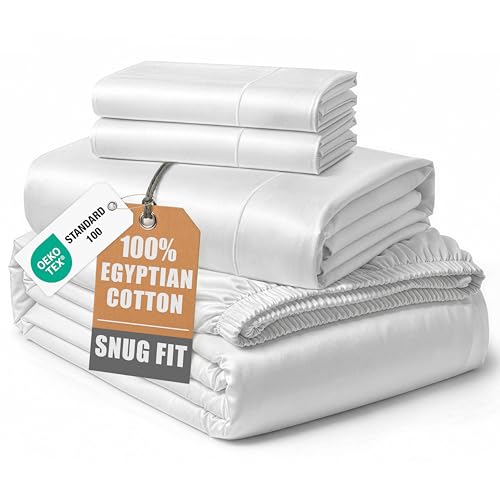
Egyptian Cotton Sheet Set King Sateen White — Hotel sateen benchmark
This set states its ambition in its own listing language: a hotel-style sateen weave in white, four pieces, king size, intended for guests and everyday use alike, promising a silky hotel-style bed. That is the correct ambition for Egyptian cotton in sateen, and the set earns the opening place in this guide by being the category’s benchmark, the plain, well-executed version of the idea against which the more specialised picks below define themselves. If a shopper wants to know what Egyptian cotton sateen is for, this is the set that answers without ornament.
Sateen’s floated yarns give the surface its characteristic low lustre and its smooth, draping hand, and long-staple fibre is what keeps that surface smooth after the fiftieth wash rather than the fifth. Lesser cottons in sateen can pill where the floats rub, because short fibres work loose; the whole point of the Egyptian staple is that its yarns hold together. Expect the bed to look composed and faintly glowing in lamplight, and expect the sheet to feel cool and slick at first touch, warming quickly to the sleeper, the classic sateen embrace that percale people find too close and sateen people find perfect.
White, again, is the working colour of the category, and for a guest-and-everyday brief it is the only sensible one: the set that hosts visitors on Saturday can be laundered back to brightness on Sunday without colour anxiety. Four pieces is the classic king arrangement. The listing does not make a pocket-depth claim its headline, so measure your mattress and read the listing’s fit details carefully if your bed is unusually deep; standard and moderately deep kings are this set’s home ground.
Choose it as the reference purchase: the couple dressing a principal bed for the first time in Egyptian cotton, the host whose guest room is also a point of pride, the sleeper who knows they are a sateen person and wants the honest article. It does not chase the highest stated numbers or the deepest pockets in this guide; it simply executes the central idea beautifully, which is what benchmarks are for.
Newlyweds and new homeowners furnishing a first proper bed together could do worse than start exactly here, because a benchmark set teaches its owners what they like. Live with honest sateen for a season and you will know whether your next set should be denser, deeper-pocketed, or crisper, knowledge that no amount of listing-reading can substitute for and that makes every later bedding purchase in the household a better one.
- Size: king, four-piece set
- Fibre: 100% Egyptian cotton per listing
- Weave: sateen, silky hotel style
- Use in listing: guests and everyday
- Colour in listing: white
Strengths
- The category’s central idea, executed plainly and well.
- Sateen surface shows long-staple fibre at its silkiest.
- White launders back to brightness for guest duty.
Trade-offs
- Pocket depth is not the headline; very deep mattresses should verify fit.
- Sateen’s warmth will not suit the hottest sleepers in summer.
- Four pieces only, in the classic arrangement.
Best for: principal beds and guest rooms wanting the classic hotel sateen. Not suited for: crisp-percale loyalists or extra-deep mattresses without a fit check.

Shilucheng Egyptian Cotton Sheets King White — Cooling sateen value
Shilucheng’s set makes an interesting promise for a sateen: naturally cooling and breathable. Sateen’s reputation runs warm, because its floated surface drapes close, so a sateen that advertises airiness is claiming the weave has been kept light enough to let the fibre breathe. For the large class of sleepers who love sateen’s hand but sleep warm, that claim is exactly the door they have been waiting at, and the set backs it with practical specifications: a sixteen-inch deep pocket, four pieces, king size, white, in one hundred percent Egyptian cotton.
The hotel framing appears here too, luxury-hotel language in the listing, and as always in this guide we translate that into the testable version: a smooth sateen surface, a fit that dresses a modern deep mattress and stays, and a white that can be laundered on the hotel rhythm. On those testable terms the set is well built for its tier. The sixteen-inch pocket in particular moves it out of the decorative class and into the working class of king bedding, where sheets are judged at 3 a.m. by whether they are still on the bed.
There is a value argument folded into this pick that deserves naming. Egyptian cotton’s prestige often carries a prestige markup, and sets like this one, plainly specified, white, four pieces, no theatrical extras, are where the fibre’s actual virtues can be had without paying for the theatre around them. A household furnishing a principal bed on a real budget should shortlist it beside the benchmark above and decide between them on pocket depth and on how much the cooling claim matters to the warmer sleeper in the bed.
Care follows the white sateen liturgy: wash warm, dry without baking, and let the surface’s smoothness return as it cools rather than chasing it with heat. Sateen shows its quality in how little fuss it needs; a set that comes off the line or out of a gentle dry already composed is a set whose yarns were spun from fibre long enough to lie flat and stay there.
Apartment sleepers in warm buildings, where the heating is generous and the windows barely open, are a natural audience for this pick’s cooling brief. City bedrooms run warm in every season, and a sateen that breathes is the difference between keeping the weave you love and retreating to a crisper cloth you merely tolerate. Comfort kept is value kept.
- Size: king, four-piece set
- Fibre: 100% Egyptian cotton per listing
- Weave: sateen, naturally cooling and breathable per listing
- Pocket: 16-inch deep pocket
- Colour in listing: white
Strengths
- Cooling, breathable positioning for warm sleepers who love sateen.
- Sixteen-inch pocket dresses modern deep king mattresses.
- Plain specification keeps the fibre’s value free of theatre.
Trade-offs
- Still a sateen; the very hottest sleepers may prefer percale’s airiness.
- White only in this listing.
- Four pieces; pillow-rich beds need extra cases.
Best for: warm sleepers and value-focused principal beds. Not suited for: crisp-sheet loyalists or beds deeper than its pocket.

LANE LINEN Egyptian Cotton Sheets King Sateen — High-count sateen
LANE LINEN states its number outright: a 1000 thread count, in the listing’s own words, woven in a silky sateen from one hundred percent Egyptian cotton, king size, with a sixteen-inch deep pocket described as a snug fit. In a category full of fog, that directness is refreshing, and this guide reports the figure exactly as the listing gives it, as one fact among the set’s facts rather than as a verdict. What the number should mean to a shopper is density: a closely woven cloth with a substantial, smooth hand, the kind that drapes over a mattress edge with visible weight and settles onto the bed like something tailored.
Density has a temperament, and it is worth describing honestly so the right sleeper chooses it. A high-count sateen feels luxurious in the specific way of fine hotel bedding at its most formal: smooth, quiet, faintly heavy, with a surface that holds its composure through the night. It is less airy than a lighter weave, by the same physics that makes it denser, so it suits sleepers who run cool, rooms that run cool, and anyone whose ideal sheet has presence. Warm sleepers in warm climates should weigh the Shilucheng’s cooling brief or a percale against it, not because this set is lesser but because density is a climate decision.
The listing’s language about elevating a master suite is, for once, a fair description of what a white, dense, silky king set does to a room: it makes the bed look expensive in the calm way, without pattern or colour, purely through surface. Paired with the sixteen-inch snug pocket, the effect survives the night, which is where lesser luxury goes to wrinkle. A made bed that still looks made at dawn is the master-suite look in its only honest form.
Choose this set when the brief is the full formal experience, fibre, density, drape, and fit in one purchase, and when the bed’s climate can enjoy a substantial sheet. It is the connoisseur’s pick of the six, the one whose pleasures are real but specific, and specific pleasures, correctly matched to their sleeper, are what this entire category exists to deliver.
Anniversary and milestone gifting is this set’s quiet second career. A dense white sateen in a king size is the bedding equivalent of the good crystal: unmistakably serious, useful every day, and impossible to mistake for a token gesture. Givers who know the recipient’s bed size can hardly do better in the whole catalogue of household gifts.
- Size: king, four-piece set
- Fibre: 100% Egyptian cotton per listing
- Weave: silky sateen; 1000 thread count as stated in listing
- Pocket: 16-inch deep pocket, snug fit
- Colour in listing: white
Strengths
- Dense, stated-count sateen with a formal, tailored drape.
- Snug sixteen-inch fit keeps the composed surface composed.
- Master-suite presence achieved through surface alone.
Trade-offs
- Density sleeps warmer than lighter weaves.
- Substantial cloth makes a heavier wash load.
- Its formality may feel like too much for a casual room.
Best for: cool sleepers and formal master suites. Not suited for: hot climates or anyone wanting an airy, lightweight sheet.

Egyptian Cotton Sheet Set Queen 800TC Sateen — The queen-size option
Most of this guide is king, because most of its shoppers are dressing king beds, but the queen bed remains the commonest principal bed in the country, and it deserves its own honest entry rather than a footnote. This set is that entry: Egyptian cotton in a sateen weave, queen size, with a thread count the listing states as 800, a fifteen-inch snug-fit deep pocket, and a description that reaches for the words buttery soft and hotel luxury. We include it without apology and with its size in its name, so no shopper mistakes it for a king set wearing a disguise.
The stated 800 count places it, in density terms, just below the LANE LINEN king set above, and the same climate logic applies in miniature: a substantial, smooth, draping sateen that suits cool and moderate sleepers and gives a queen bed the formal, composed surface that makes a smaller room feel finished. Queen beds live in smaller rooms, where the bed is an even larger share of what the eye sees, so the surface quality of its sheets carries more decorative weight per inch than on any king. This set understands that assignment.
Its fifteen-inch pocket is the correct standard for queen mattresses, which tend to run slightly less mountainous than their king counterparts, and the snug-fit language suggests the same stay-dressed discipline the guide has praised throughout. Buttery is a word this guide normally taxes heavily, but for a long-staple sateen at this density it is a fair attempt at the hand: smooth, yielding, without a hint of the papery stiffness that cheap sateen can carry out of the packet.
Choose it for the queen principal bed, the guest room that hosts the people you most want to impress, or the smaller master bedroom whose proportions a king would swallow. It is also the natural gift set of the six, since queen is the size most likely to be right in someone else’s house, and a set with this surface makes the giver look discerning in the extreme. Just confirm the recipient’s bed is truly a queen; bedding is the one gift where a size error is also a storage problem.
Small-space households benefit from its proportions in a subtler way: a queen bed dressed in a genuinely luxurious sheet gives a compact bedroom the feeling of a boutique hotel room, where the bed is the room and everything about it is considered. No other single purchase upgrades a small room’s nightly experience as completely, because no other surface in the room is touched for eight hours at a stretch.
- Size: queen, full set
- Fibre: Egyptian cotton per listing
- Weave: sateen; 800 thread count as stated in listing
- Pocket: 15-inch snug-fit deep pocket
- Colour in listing: white
Strengths
- A true queen option with the fibre and weave of the king picks.
- Stated 800 count gives a substantial, buttery sateen hand.
- Surface quality carries a small room’s whole scheme.
Trade-offs
- Queen only; king shoppers must look elsewhere in this guide.
- Dense sateen sleeps warmer than percale or lighter weaves.
- White only, like most of this category.
Best for: queen principal beds and impressive guest rooms. Not suited for: king beds, obviously, or very hot sleepers.

LBRO2M Egyptian Cotton Sheets Long Staple — Long-staple specialist
LBRO2M leads with the words this guide cares about most: long staple. Its listing describes one hundred percent Egyptian cotton sheets built from long-staple fibre, with a stated 1000 thread count, a sixteen-inch deep pocket, and a cluster of practical promises, super soft, breathable, fade resistant, cozy for all seasons, in king size and white. That is the complete brief for the fibre written by someone who understands it: the staple is the quality, the count is a specification, and the fade resistance is the long-term promise that the first two make plausible.
Fade resistance deserves its moment, because it is where long-staple economics become visible. All cotton fades and softens across years of washing, but yarns spun from longer fibres hold their surface, and their colour, with noticeably more grace, because there are fewer fibre ends at the surface to fray, fuzz, and let the light scatter differently. A white set expresses this as staying bright rather than going grey-linen tired; the same physics in a coloured set would express it as staying true. Either way, the sheet you buy is the sheet you still have in year three, which is the entire financial argument for the fibre in one sentence.
The all-seasons positioning is also credible in a way it is not for every dense sateen. Breathability is claimed alongside the softness, and a long-staple yarn can deliver both because its smoothness lets the weave stay open at a microscopic level while feeling sleek at the surface. Sleepers who keep one set on the bed across the calendar, rather than rotating weights by season, should put this pick near the top of their comparison and judge the others against its balance.
It closes its case with the standard king virtues done right: sixteen inches of pocket, four pieces, white. Nothing about it is theatrical, and that restraint, in a listing that could easily have reached for theatre, is itself evidence about the product. The long-staple specialist of the six, for the shopper who came to this guide asking the fibre question first and every other question second.
There is a patience argument for it as well. Bedding bought on the fibre’s merits tends to be kept, washed, and appreciated for years, while bedding bought on a whim tends to be replaced on one. A household trying to buy less and better, in bedding as in everything, will find this set’s plain, durable excellence easier to live with than any novelty weave that dazzles for a month.
- Size: king, four-piece set
- Fibre: 100% Egyptian cotton, long staple per listing
- Count: 1000 thread count as stated in listing
- Pocket: 16-inch deep pocket
- Colour in listing: white
Strengths
- Long-staple fibre named as the headline quality.
- Fade resistance promises a surface that stays true for years.
- Breathable, all-season balance in a substantial sheet.
Trade-offs
- Dense cloth sleeps warmer than a light percale.
- White only in this listing.
- Four pieces, the classic count.
Best for: fibre-first shoppers and one-set-all-year households. Not suited for: hot sleepers wanting the airiest weave available.

TWK Egyptian Long-Staple Sheets King — Deepest pocket, mineral tone
TWK closes the list by combining the guide’s three recurring virtues at their fullest stretch: long-staple Egyptian cotton, named in the listing; the highest stated count in the guide, 1200 thread count as the listing gives it; and the deepest pocket, eighteen inches, sized for the modern mattresses that defeat standard king sheets. It also breaks the category’s white uniform with a mineral tone, a soft, stony neutral that gives a king bed a contemporary calm and hides the week’s small evidence better than white ever will. For the shopper whose brief is everything, fibre, density, depth, and a colour with a point of view, this is the set that was specified for them.
The eighteen-inch pocket deserves first attention, because it decides whether the rest matters. Pillow-top and hybrid kings wearing toppers routinely defeat sixteen-inch pockets at the corners, and a sheet with this much fibre quality deserves better than a nightly escape. Eighteen inches dresses those beds with fabric to spare, and the listing’s luxury hotel-style language, soft and comfy, natural, suggests the set intends to be lived in at that scale rather than merely admired. Measure before you buy, as always: on a standard-depth mattress, the spare fabric will wrinkle, and this set’s virtues are best spent on the deep beds that need them.
The mineral colour is a considered risk worth endorsing. Egyptian cotton’s market is a sea of white, and a household that wants the fibre without the hotel-white look has historically had to choose between them. A stony neutral keeps the sateen’s smooth presence, coordinates with the grey, oak, and linen palettes of current bedrooms, and forgives the interval between washes with a grace white cannot imitate. It is the set most likely to make a room look designed rather than merely well-kept.
On the stated count, this guide keeps its discipline: 1200 is the listing’s figure, reported as such, and the shopper should read it as density and presence rather than as a score. What can be said from the fibre outward is that long-staple yarns are what allow a dense weave to stay smooth instead of boardy, and that is the combination this set is selling. For deep-mattress owners who want the fullest expression of the category in a colour that suits their room, it is the natural final word of the six.
Renovators finishing a principal suite will recognise its role instantly: the bedding that makes the new room look inhabited by intention rather than by leftovers. Against fresh paint and new flooring, a mineral-toned long-staple set reads as the final deliberate choice, the one that tells the eye the project is complete. Few textiles are asked to carry a room’s debut; this one can.
- Size: king set
- Fibre: 100% Egyptian long-staple cotton per listing
- Count: 1200 thread count as stated in listing
- Pocket: 18-inch deep pocket
- Colour in listing: mineral
Strengths
- Deepest pocket in the guide for pillow-top and topper beds.
- Long-staple fibre with the guide’s densest stated weave.
- Mineral tone escapes the all-white category with grace.
Trade-offs
- Too deep for standard mattresses; spare fabric will wrinkle.
- Dense weave is the warmest hand in this guide.
- Coloured set asks for like-colour washing.
Best for: deep king mattresses and design-led master bedrooms. Not suited for: standard-depth beds or the hottest sleepers.
How Do the Six Egyptian Cotton Sets Compare?
| Pick | Size | Weave | Stated count | |
|---|---|---|---|---|
| Egyptian Cotton Sheet Set King Sateen White | King | Sateen | Not stated in listing | Standard king fit |
| Shilucheng Egyptian Cotton Sheets King White | King | Sateen | Not stated in listing | 16 inch |
| LANE LINEN Egyptian Cotton Sheets King Sateen | King | Sateen | 1000, as listed | 16 inch |
| Egyptian Cotton Sheet Set Queen 800TC Sateen | Queen | Sateen | 800, as listed | 15 inch |
| LBRO2M Egyptian Cotton Sheets Long Staple | King | Sateen family | 1000, as listed | 16 inch |
| TWK Egyptian Long-Staple Sheets King | King | Sateen family | 1200, as listed | 18 inch |
Sateen or Percale: Which Weave Suits Egyptian Cotton for You?
The fibre is the same; the personality is not, and choosing between the weaves is the most consequential decision in this category after the fibre itself. Sateen, the weave of most sets in this guide, floats its yarns so the surface lies smooth and faintly luminous, draping over the body and over the mattress edge with a liquid quality. It feels like the luxury end of a hotel, it photographs like silk’s respectable cousin, and it sleeps a degree warmer because that draping surface stays in gentle contact with the skin. Sleepers who run cool, who love a bed that feels embracing, and who make the bed as a visual act will be sateen people for life.
Percale takes the same long-staple yarn and weaves it plain, one over and one under, producing a matte cloth with body and a whisper of crispness. It stands slightly away from the skin, lets air move, and feels like a freshly ironed shirt in the best sense. Hot sleepers, summer sleepers, and anyone who finds sateen clingy will find percale’s version of Egyptian cotton more breathable and, to their hand, more honest. Neither weave wastes the fibre; they spend it on different pleasures, and a household can rationally own both, sateen for winter’s embrace and percale for summer’s air, which is what many long-staple loyalists quietly do.
The mistake to avoid is buying by the photograph. Sateen photographs glossier and therefore sells harder in a thumbnail, while percale’s virtues are almost entirely tactile and climatic. Decide by how you sleep, warm or cool, still or restless, in air conditioning or under an open window, and let the thumbnail go. The right weave in Egyptian cotton is a decade-long pleasure; the wrong one is a beautiful sheet that lives in the cupboard.
One more consideration belongs to couples, who are most of this category’s market: two sleepers rarely share a weave temperament exactly. The workable compromises are known and honourable, sateen with a light duvet for the cooler partner, percale with an extra throw folded at the foot for the warmer one’s opposite, or alternating sets by season so each temperament gets its months. What does not work is one partner silently enduring the other’s weave for years; bedding is too nightly for martyrdom, and this fibre is too good to be resented.
How Should Egyptian Cotton Sheets Be Washed and Kept?
Long-staple cotton asks for respect rather than ceremony. Wash in warm water with a moderate detergent, keep the load to the set itself so the large pieces can move and rinse freely, and avoid the harsh treatments that shorten fibre life: the fibre’s length is its strength, and every aggressive cycle spends a little of it. Whites can take the brighter end of ordinary laundering; the mineral TWK set should travel with like colours, especially in its first washes.
Drying is where sateen’s surface is won or lost. Remove the set while it is just short of bone dry and smooth it onto the bed or fold it immediately, and the floated yarns will settle into their composed, faintly glowing finish without an iron. Leave it cooled in a heap and the same surface sets into creases that only pressing will fully forgive. Line drying in moving air is the connoisseur’s method and costs nothing but a fine day; the sheets come in smelling like weather and lying like water.
Rotation is the long game. Two sets in alternation rest each other’s fibres, halve each set’s annual washes, and mean the bed is never dressed in a hurry with a set pulled damp from the line. Egyptian cotton’s whole promise is longevity with grace, and rotation is how a household collects on that promise in full. Store the resting set folded inside one of its pillowcases, away from direct light, and the pair will serve like a small wardrobe for the bed, season after season.
One more habit separates the households whose sateen glows for years from those whose dulls early: wash the sheets as their own load, away from towels and anything with zips or hooks. Towel lint migrates onto sateen’s smooth face and roughens it by accumulation, while hardware snags the floated yarns that give the weave its finish. A sheets-only cycle is a small scheduling discipline with an outsized effect on the surface you paid for, and it costs nothing but a separate trip to the machine.
How Does Egyptian Cotton Age Compared With Ordinary Cotton?
Ageing is where the fibre’s premium quietly repays itself, and it repays in texture before it repays in anything else. An ordinary cotton sheet typically travels from smooth to tired along a familiar road: the surface fuzzes, small pills gather where bodies turn, the hand goes papery at the centre, and the sheet begins to feel like a memory of itself within a couple of years of weekly washing. A long-staple sheet travels the same road at a fraction of the speed. Its yarns, spun from fibres long enough to lock together, keep their surface intact, so the sheet softens without fuzzing, thins without pilling, and at year three still presents the composed face it had at month three.
Hotels understand this arithmetic in their bones, which is why the fibre haunts the better end of that industry: a sheet that survives commercial laundering while staying smooth is cheaper per night than a sheet replaced twice as often, however humble its purchase price. The household version of the same arithmetic is the rotation advice this guide keeps giving, two sets alternating, each resting, each washed half as often, the pair of them out-serving any single set at any price. Longevity is not a mood in bedding; it is a schedule, and long-staple cotton is the fibre that rewards the schedule most.
There is an aesthetic dividend as well. A bed dressed in sheets that have aged gracefully looks like a bed in a house that is cared for, the deep compliment guests pay without knowing why. Egyptian cotton’s graceful ageing is, in the end, why the fibre has kept its reputation through a century of rivals and revolutions in textile marketing: it is the rare luxury that becomes more itself with use instead of less.
How Do You Build a Bed Around Egyptian Cotton Sheets?
A great sheet is a foundation, and foundations reward restraint in everything built on them. Because sateen already brings a low lustre and a smooth face, the layers above it want texture rather than shine: a matte duvet cover in linen or percale, a woven throw with visible structure, pillows that mix one smooth sham with one textured case. The bed then reads as composed rather than slippery, and the sheet’s surface, glimpsed at the turned-down top edge, becomes the room’s quiet luxury note instead of its only one. Households that dress the whole bed in satin finishes discover that luxury, repeated everywhere, reads as glare; contrast is what makes the fibre look expensive.
Colour discipline helps at king scale. With white sheets, the duvet and throw carry the room’s colour story and can change with seasons while the foundation stays constant, which is the economical structure hotels use and the reason white dominates this category beyond mere tradition. The mineral TWK set inverts the arrangement slightly, giving the foundation itself a soft colour, and then the layers above it should go quieter, creams and naturals that let the stony tone lead. Either way, one voice leads and the others accompany; a bed where every textile is shouting is a bed nobody photographs twice.
Finally, make the bed like the sheet deserves once in a while, even if daily life usually settles for speed. A smooth fitted corner, the flat sheet’s top edge folded back over the duvet to show the sateen’s face, pillows plumped and squared: two unhurried minutes that return the entire purchase to view. Egyptian cotton is bought for how it feels at midnight, but it is kept, washed, and re-bought for how it looks at nine in the morning, and the made bed is where those two pleasures meet.
Which Bedrooms Gain Most From the Upgrade?
The principal bedroom gains most, for the arithmetic reason that its sheets are slept in three hundred nights a year, and any improvement in surface and longevity is multiplied by that attendance. The guest room gains differently: its sheets are slept in rarely but judged completely, by visitors who experience the bed as the household’s whole standard of care compressed into one night. A long-staple set in the guest room is therefore a reputation purchase, and its graceful ageing matters there too, because guest bedding is washed after every visit and must survive that rhythm while looking unworn.
Hot-climate and warm-building households gain a subtler benefit when they choose their weave correctly within the fibre: the Shilucheng’s cooling sateen brief, or a percale elsewhere, lets them keep Egyptian cotton’s surface quality without surrendering the night to warmth. And households furnishing a first home gain the compounding benefit, a set bought young, in the fibre that ages slowest, which may still be serving, smooth and composed, when the furniture around it has been replaced twice. Few purchases in a new home can honestly promise that horizon.
The bedroom that gains least is the one where sheets are an afterthought changed in a rush and washed like rags; even this fibre cannot survive being treated as disposable, and its premium is wasted there. Egyptian cotton rewards the households that meet it halfway, with rotation, a sheets-only wash, and a pocket that fits, and it is honest of this guide to end its survey by saying so.
What Mistakes Do Egyptian Cotton Shoppers Make?
The first is buying the name without the fibre: sets that borrow Egyptian glamour for a blend, or for cotton with no staple claim at all. Read for one hundred percent and for long staple, in the listing, in words. The second is worshipping the largest number on the page. A stated count is a density fact, not a quality verdict, and this guide has deliberately ranked sets by fibre, weave, and fit while reporting counts only where listings state them. A shopper who buys the biggest number for a hot bedroom has purchased a beautiful mistake.
Third, buyers ignore the pocket until the first night, because glamorous fibre makes fit feel like a clerical detail; on a king mattress it is the whole experience. Fourth, households wash a fine sateen like gym kit, hot and hard and often, then blame the fibre when the surface tires early. Fifth, percale people buy sateen for its photograph, and sateen people buy percale for its reputation, and both keep the wrong set for years out of inertia. Know your weave temperament before you spend on the fibre; the fibre will reward whichever weave is truly yours.
A sixth mistake is subtler and sadder: buying one magnificent set and no spare, so the magnificent set is washed weekly without rest and the household dreads sheet-changing day because the bed stands bare for hours. The fibre’s longevity is designed for rotation; a single set denied a partner will still outlast ordinary cotton, but it will not show you the decade-long grace that two alternating sets reveal. Buy the second set while the first is young, ideally its twin, and the pair becomes the bed’s permanent wardrobe.
Final Recommendation
Start with the benchmark sateen if you want the category’s classic experience, or the Shilucheng if you want it with a cooling brief and a certain sixteen-inch fit. Choose the LANE LINEN when density and formality are the pleasure you are buying, the LBRO2M when the long-staple fibre itself is your first question and fade-resistant longevity your second, and the TWK when your mattress is deep and your room wants mineral rather than white. Queen beds should take the queen set without a backward glance; it is not the consolation prize but the correct size, with the same fibre and nearly the same density as its king relations. Buy the fibre honestly, match the weave to your sleeping temperature, measure the pocket, and rotate two sets if you can. Egyptian cotton kept that way does not merely last; it improves, and a sheet that improves with the years is the rarest bargain in the whole house.
If you are buying your first set in this fibre, buy it for the bed you sleep in most, not the bed you show most. A month of nights will teach your hands what the category means, and every later purchase, for guests, for children, for the holiday house, will be made with that knowledge in your fingers rather than in a listing’s adjectives.
Frequently Asked Questions
What makes Egyptian cotton different from regular cotton?
The length of its fibres. Egyptian cotton is grown and processed for long staple, and longer fibres spin into smoother, stronger yarns with fewer loose ends. The result is a sheet that feels silkier, resists pilling and fuzzing, and keeps its surface composed through far more washes than short-staple cotton typically manages.
Is a higher thread count always better?
No. Thread count describes density, and density is a preference with a climate attached: denser sateens feel more formal and sleep warmer, while lighter weaves breathe better. This guide reports counts only where a listing states them, and ranks sets by fibre, weave, and fit, which are the qualities that decide how a sheet actually sleeps.
How can I tell if a set is really Egyptian cotton?
Read the listing for the plain claims: 100% Egyptian cotton, and ideally long staple, stated in words. Vague phrases that borrow the aura without making the claim, or blends that lead with another fibre, are telling you what the product is by what they decline to say. Every set in this guide makes the plain claim.
Do Egyptian cotton sheets pill over time?
Far less readily than short-staple cotton, because pilling begins with loose fibre ends working free, and long-staple yarns have fewer ends and hold them better. Gentle washing and drying protect the advantage; harsh cycles spend it. A well-kept long-staple sateen should stay smooth for years of weekly use.
Sateen or percale for a hot sleeper?
Percale, as a rule: its plain weave stands off the skin and moves air, while sateen drapes close and sleeps warmer. A hot sleeper determined to try sateen should choose a set with a cooling, breathable brief, like the Shilucheng in this guide, and keep the bedroom’s other layers light.
Will these sheets fit a mattress with a topper?
Measure the mattress and topper together as one depth. Sixteen-inch pockets, offered by several sets here, cover most combinations; the eighteen-inch TWK set exists for the deepest stacks. A pocket that must stretch to its limit will creep at the corners, so choose depth with a little grace in hand.
How long should a good Egyptian cotton set last?
Years of weekly service, and longer in rotation, because the fibre’s long staple resists the fuzzing and surface breakdown that retire ordinary sheets. Judge yours by its surface rather than its birthday: when the centre finally loses its smoothness despite gentle care, the set has given its full account and earned its replacement.
Do Egyptian cotton sheets need ironing?
Rarely, if they are handled well: remove them from the dryer just short of dry, smooth them onto the bed or fold them at once, and sateen’s surface settles into its composed finish. Line drying achieves the same with even less effort. Ironing remains an option for the formal-minded, not a requirement of the fibre.
Related Guides
Complete the bed and the rooms around it with these neighbouring guides. Start with Best Area Rugs for Small Spaces if the bedroom floor is next on the list, see Best Area Rugs with Pet Stain Protection for the floors beneath a hard-working family bed, and Best Back Door Rugs for the hardest-working floors in the house. For the layer that finishes the bed in cooler months, read Best Affordable Down Blankets.



[…] decisions travel together, and these guides continue the thread. Compare weaves and fibres in Best Egyptian Cotton Sheet Sets, borrow pattern thinking from Best Area Rugs with a Leaf Pattern when the bedroom floor joins the […]