What's inside
- Where to buy the six garden clogs
- Quick Picks
- How these picks were chosen
- Six clogs, one doorway: the comparison
- How do you pick a garden clog that fits your gardening?
- Clog care: the ten-second religion
- The garden’s other footwear, and the house’s
- A year in clogs: the seasons at the back door
- Clogs beyond the garden gate
- The back door as a designed place
- Working gardeners: allotments, market gardens and long days
- What a garden clog cannot do, in fairness
- Common mistakes when buying garden clogs
- Final recommendation
- Frequently asked questions
As an Amazon Associate I earn from qualifying purchases. This post may contain affiliate links at no extra cost to you.
As an Amazon Associate, cottageverdict.com earns from qualifying purchases.
Nobody buys the best garden slippers for their looks, and that is their freedom. A garden clog lives by the back door, gets slipped on for the dawn watering and the midnight slug patrol, stands in wet grass, mud, potting compost and hose spray, and is expected to rinse clean under a tap and be ready again by breakfast. Every pick in this guide belongs to the same practical species — moulded garden clogs in EVA or plastic, waterproof by material rather than by coating, washable by design — because that is what the listings actually sell when the keyword says slippers and the garden says otherwise.
The species has a recognisable silhouette: a closed toe that keeps soil and stones away from your toes, a slip-on back or low heel cup, a sole with enough tread for a wet path, and holes or vents that let water and air move through. Within that silhouette, the six listings below divide by audience and emphasis. Two come from Amoji in different models, the AM161 and the YY161, which are not the same shoe in two colours and are reviewed as separate products. Three listings — NITTI, Beslip and Gaatpot — put arch support in their titles; that phrase is the listings’ own claim, and this guide reports it as such, in the makers’ words, without converting it into any promise about feet, posture or health. One pick, from Amazon Essentials, strips the idea to its plainest form: a lightweight EVA clog, unisex, tan, done.
Sizing needs a word of caution before the reviews. Several of these listings are sold in specific sizes named right in the title — a women’s eleven, a forty-two, a dual-sized unisex range — so the size in the listing you open is part of the product, not a detail to assume. Garden clogs are also worn with everything from bare feet in July to thick socks in November, and the same clog cannot be perfect for both. Read each review’s stated size carefully, think about your sock calendar, and the clog that arrives will be the clog you pictured.
Where to buy the six garden clogs
The black AM161 from Amoji opens the list, a plastic and rubber garden clog whose listing ranges across yard, beach and shower duty in a women’s eleven and men’s nine sizing.
Its sibling follows in navy: the Amoji YY161, a separate model with its own shorter listing, sized at women’s twelve and men’s ten, for the larger-footed gardener.
NITTI’s women’s clog takes the third spot, an EVA design in which the listing claims arch support alongside a slip-resistant outsole and an easy-to-clean slip-on build.
Beslip’s black clog speaks to both women and men, its listing claiming moderate arch support over a cushioned, textured sole in breathable waterproof EVA, sized forty-two.
Amazon Essentials keeps things elemental with a tan unisex EVA clog, lightweight by its own description, sized women’s nine and men’s seven.
Gaatpot’s white clog closes the set, a unisex EVA design whose listing leads with an arch claim and all-day comfort language across beach, yard and gardening work.
Quick Picks
| Pick | Best for | Listing’s own headline |
|---|---|---|
| Amoji Garden Clogs AM161 Black | The all-duty back-door clog | Plastic rubber, yard to beach, 11 W / 9 M |
| Amoji Garden Clogs YY161 Navy | Larger sizes, same idea | Separate model, navy, 12 W / 10 M |
| NITTI Womens Garden Clogs Arch Support Waterproof | Women wanting the arch claim | EVA, slip-resistant outsole, easy-clean |
| Beslip Garden Clogs Waterproof EVA Black | Shared household clog | Moderate arch claim, cushioned sole, size 42 |
| Amazon Essentials EVA Garden Clogs Tan | Simple, light, unisex | Lightweight EVA, tan, 9 W / 7 M |
| Gaatpot Garden Clogs Arch Support White | White unisex all-day claim | EVA, arch in title, 7-8 W / 5.5-6.5 M |
How these picks were chosen
The first requirement was material honesty. A garden slipper that absorbs water becomes a cold, heavy sponge by October, so every pick here is a moulded clog in EVA, plastic or rubber per its own listing — materials that shed water instead of drinking it, and that a hose or a tap can return to cleanliness in seconds. Fabric slippers, however charming indoors, were excluded on sight; the garden is a wet workplace and its footwear should be plumbed accordingly.
The second screen was the clog architecture itself: closed toe, slip-on entry, a sole described with some intent. Within that architecture, variety was deliberately preserved. The list holds two models from one maker to show how a brand’s own range differs, three listings that raise the arch support claim in their titles so readers who shop by that phrase can compare its presentations, and one deliberately plain unisex clog for buyers who want the category without garnish. Every claim quoted in the reviews is the listing’s; where a listing is brief, the review says what is present and declines to furnish the rest from imagination.
Sizing transparency formed the final filter, because garden clogs are bought by households and shared by doorways. Listings that name their size in the title — most of these do — were favoured, since a buyer can match feet to product before ordering rather than after. Dual sizing, where a clog is labelled with both a women’s and a men’s number, is reported exactly as listed. A clog is a tool, and like any tool it only works when the handle fits the hand — or in this case, when the last fits the foot that does the dawn watering.
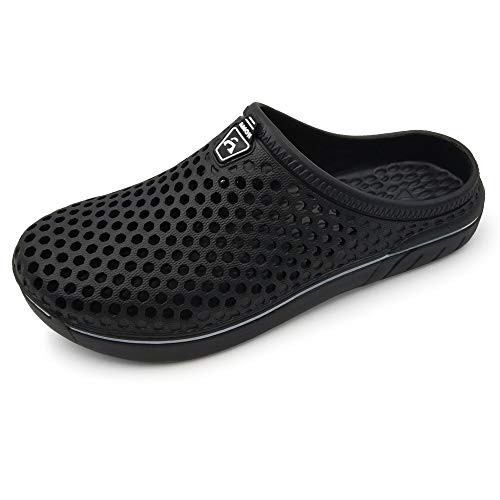
Amoji Garden Clogs AM161 Black
The AM161 is Amoji’s fuller statement of the garden clog idea. Its listing describes garden shoes that double as shower slippers and sandals, for yard and gardening work, beach and water use, in plastic and rubber, pitched as comfortable house and indoor summer wear for women and men as well — a clog with a wide brief and no shyness about it. The named size on this listing is women’s eleven, men’s nine, in black. Read it as the generalist of the guide: the clog that lives by the door and gets used for the garden first and everything wet second.
- Model: AM161, per the listing
- Materials as listed: plastic, rubber
- Colour: black
- Size on this listing: 11 Women / 9 Men
- Stated settings: yard, gardening, beach, water, shower, house, indoor summer
Strengths
- Widest stated range of uses in this guide
- Plastic and rubber build rinses clean in seconds
- Black hides the garden’s evidence between rinses
Trade-offs
- A generalist clog is tuned for breadth, not one specialty
- Named size is one specific fit; check your number first
- No arch language in this listing for buyers shopping by it
The daily rhythm of this clog is its real review. Morning: slipped on barefoot for the watering round, hose spray rolling off it. Midday: kicked off at the door, stood in the sun, dry by instinct of its materials. Evening: on again over socks for the last check of the greenhouse, comfortable enough that the wearer forgets the change of footwear entirely. A product that slots into a rhythm that completely is doing design work no specification sheet captures, and the AM161’s listing — house, indoor, summer, yard, beach — reads like a maker who understands the clog’s actual biography.
Black is the pragmatic colour for the role, forgiving of compost and clay alike, though it will warm in direct summer sun more than the paler picks below. Gardeners whose clogs live on a sunny step may prefer the tan or white options for that small thermal reason. Gardeners whose clogs live in a shaded porch will never notice, and will enjoy a clog that looks respectable enough, in a pinch, for the corner shop run that every gardener eventually makes in them.
One more duty belongs in this clog’s record: the allotment or community garden run, where the footwear travels in the car and works on unfamiliar ground. A black plastic and rubber clog is unbothered by being thrown in a boot, rinsed at a communal tap and driven home damp in a bag. Gardeners whose plots are not outside their own door need exactly that portability, and a generalist model with no delicate claims to protect is the easiest travelling companion the category offers.
Best for: households wanting one clog for garden, yard and wet errands generally. Not suited for: buyers who need the arch claim in writing or a different size than listed. A back-door staple in black is easy to justify, and Check price on Amazon confirms the AM161 model number on the listing.

Amoji Garden Clogs YY161 Navy
Same maker, different model, and the difference matters. The YY161’s listing is a terser affair: garden clogs and shower sandals for yard, gardening, beach and water, in plastic and rubber, for house and indoor wear, in navy, sized women’s twelve and men’s ten. Where the AM161 listing lingers over comfort and summer framing, this one states the essentials and stops. Treat the two as cousins rather than twins — the YY161 is the larger-sized, navy expression of the Amoji clog idea, and shoppers should choose between them by model, size and colour, not by assuming one is merely the other’s repaint.
- Model: YY161, per the listing
- Materials as listed: plastic, rubber
- Colour: navy
- Size on this listing: 12 Women / 10 Men
- Stated settings: yard, gardening, beach, water, shower, house, indoor
Strengths
- Larger stated size serves feet the AM161 listing does not
- Navy offers a cooler-looking alternative to black
- Same wash-and-go material logic as its sibling
Trade-offs
- Shorter listing gives fewer stated details to shop by
- Size is specific; smaller feet should look to the AM161
- No comfort or arch claims in the title to compare
Why would a maker field two such similar clogs? Because doorways differ. The household with a larger-footed gardener, or a preference for navy kit, or simply a second back door at the far end of a long garden, needs the variant. There is also the two-clog household system to consider: one pair stationed at the house door, one at the shed or greenhouse, so the gardener is never clogless at either end of the plot. Siblings from one maker make that system easy to size and replace, since the fit language stays consistent across the pair of purchases.
Navy deserves its sentence as a working colour: dark enough to forgive soil, distinct enough to tell apart from a partner’s black pair at a glance, and handsome in the way of all navy tools. On the beach and water duties the listing names, the colour holds its own visually where black can look heavy. The YY161 will not be the guide’s most described clog — its listing forbids that — but description length is a property of marketing, not of the shoe, and the shoe’s stated brief is complete: clog, navy, large size, wet work welcome.
Households should also consider the diplomacy of the second model. When two gardeners share one plot, identical clogs in identical sizes breed the morning mix-up that ends with both people in the wrong fit. A navy YY161 beside a black AM161 ends the confusion at a glance, each gardener’s pair recognisable from across the kitchen. Makers rarely advertise domestic peace as a feature, but a colour-and-model distinction across a household’s clogs delivers it daily.
Best for: larger feet, navy loyalists and two-door garden systems. Not suited for: smaller sizes or shoppers who want detailed claims before buying. If the bigger Amoji is your fit, Check price on Amazon and verify the YY161 model on the page.
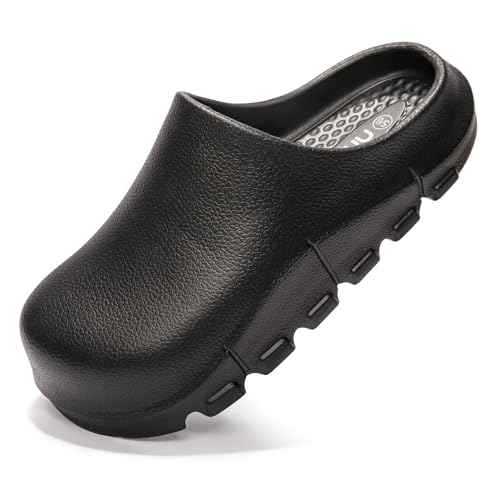
NITTI Womens Garden Clogs Arch Support Waterproof
NITTI’s listing makes its claim in the first three words after the product name: garden clogs with arch support. That phrase is the maker’s own description of its design, reported here exactly as listed — this guide neither extends it into a health promise nor translates it into advice about anyone’s feet. Around that headline, the listing builds a coherent gardener’s brief: lightweight waterproof EVA, an easy-to-clean slip-on design, and a slip-resistant outsole for outdoor and everyday wear, aimed at women. Of the six picks, this is the one whose listing works hardest to describe the sole’s intentions.
- Audience per listing: women
- Material: EVA, waterproof, per the listing
- Listing claim: arch support
- Outsole: described as slip-resistant in the listing
- Design: slip-on, easy to clean
Strengths
- Slip-resistant outsole is stated, a wet-path virtue
- EVA keeps the clog light through a long gardening day
- Easy-clean claim matches the hose-it-off reality
Trade-offs
- Women’s framing narrows the household sharing
- Arch language is a listing claim, not a fitting service
- No size named in the title, so check the page carefully
The slip-resistant outsole is the detail this reviewer would underline for anyone whose garden involves slopes, wet decking or a mossy path to the compost heap. Garden falls rarely make dramatic stories, but they end gardening days and occasionally gardening seasons, and a sole designed against slipping is the clog’s contribution to preventing them. The listing pairs that grip with lightness, which matters more than it sounds: a clog worn for three hours of weeding is footwear, not an accessory, and weight is felt by the hour.
On the arch phrase, a buyer’s note rather than a verdict: listings that raise it are describing a shaped footbed as the maker intends it, and shoppers who seek that shaping will find the claim stated here, in the Beslip moderate version, and in the Gaatpot title — three presentations to compare on the full listing pages, where footbed photographs usually settle what words cannot. What no listing can do is fit a particular foot, and gardeners with specific footwear needs should treat every claim in this guide as a starting question for the product page, not as an answer.
Early-morning gardeners will appreciate one more consequence of the lightweight EVA brief: quiet. A light moulded clog on a path at dawn makes almost no sound, which matters in gardens where the blackbirds are still deciding whether the day is safe. Heavy boots announce; clogs slip in and out of the garden’s early hours like staff. It is a small, unlisted quality, and anyone who has watered at sunrise while a household sleeps will understand it is not a trivial one.
Best for: women gardeners who want grip stated and weight kept low. Not suited for: households wanting one unisex clog for every foot. A listing that names its sole’s intentions deserves a close look, so Check price on Amazon and study the outsole photos there.

Beslip Garden Clogs Waterproof EVA Black
Beslip writes the most specification-dense title in this guide, and it rewards a slow read. Garden clogs for women and men, described as comfy shoes with moderate arch support — again, the listing’s own claim, in the maker’s chosen word moderate — then lightweight, breathable, waterproof, a cushioned sole, a textured outsole, EVA, slip-on sandals for indoor and outdoor wear, in black, size forty-two. Nearly every phrase answers a question a clog buyer actually asks, and the moderation in the arch claim is a small lesson in honest marketing that this guide is happy to acknowledge.
- Audience per listing: women and men
- Material: EVA, waterproof, breathable as listed
- Listing claim: moderate arch support
- Sole: cushioned, with a textured outsole, per the listing
- Size on this listing: 42; colour: black
Strengths
- Textured outsole and cushioning both stated plainly
- Unisex framing suits the shared back-door clog
- Breathability addresses the summer clog’s stuffiness
Trade-offs
- Size forty-two is one specific fit, as listed
- Black EVA warms on a sun-baked step
- Dense title still leaves fit feel to the imagination
The shared-clog scenario is where this pick lives. Many households keep exactly one pair of garden clogs by the door, worn by whoever is on watering duty, and a unisex black EVA clog with a cushioned sole is the natural citizen of that doorway. The breathable claim matters in that shared life more than any other: a clog worn by rotation through a summer day needs to air between wearers, and ventilation is the difference between a household tool and a household argument. Textured grip underfoot completes a brief that seems written by someone who has actually kept a door-side clog.
Cushioning, like the arch phrase, is reported here as the listing’s description of its sole, and gardeners will feel its relevance on the hard surfaces gardens contain — patios, paths, greenhouse concrete — where a thin sole transmits every edge by the end of a potting session. A cushioned EVA clog turns those surfaces from a countdown into a non-issue for ordinary gardening durations. Pair that with the rinse-clean material and the Beslip reads as the guide’s most completely considered everyday option, provided the forty-two is your household’s number or the listing’s other sizes suit.
The indoor-outdoor wording in Beslip’s title also deserves a nod, because the modern gardener’s round rarely stays outdoors: seeds are started on windowsills, tools live in utility rooms, and the harvest is carried straight to the kitchen sink. A clog welcome on both sides of the door — cleanable enough for the kitchen trip, grippy enough for the wet path — collapses two footwear changes into none. Shared households feel that convenience multiplied by every trip, every day, all season.
Best for: shared doorways, hard-surfaced gardens and specification readers. Not suited for: buyers far from the listed size or wanting a women’s-specific design. Density of honest detail is rare in this category, and Check price on Amazon lets you read the full claim set on the listing itself.

Amazon Essentials EVA Garden Clogs Tan
After four listings of claims and sub-claims, the Amazon Essentials clog arrives like a shrug in the best sense: unisex adults’ lightweight EVA garden clogs for men and women, tan, sized women’s nine and men’s seven. That is nearly the whole title, and there is a real argument that it is enough. A garden clog is a moulded shoe for wet work; EVA is the category’s standard material; lightweight is the trait every gardener feels; unisex tan is a colour and fit policy that offends no doorway. Buyers fatigued by marketing adjectives may find this the most restful listing in the guide.
- Audience per listing: unisex adults, men and women
- Material: EVA, described as lightweight
- Colour: tan
- Size on this listing: 9 Women / 7 Men
- Additional claims in title: none beyond the essentials
Strengths
- Plain specification, honestly stated, easy to decide on
- Tan hides dust and suits garden clothing generally
- Unisex dual sizing suits partner-shared doorways
Trade-offs
- No grip, cushioning or arch language to shop by
- Tan shows dark mud more than black does
- One listed size; other feet must check the page
There is a philosophy-of-tools point here worth making once. Garden clogs succeed or fail in the first ten seconds of each use — the slip-on moment, barefoot, half awake, carrying a watering can in the other hand. Every pick in this guide passes or fails that moment on fit and familiarity, not on feature lists. A simple, light, correctly sized EVA clog passes it daily for years, which is why the category’s plainest offering earns its place without apology. The Essentials clog is the control group of this guide: the baseline against which every extra claim elsewhere must justify itself.
Tan also turns out to be the gardener’s camouflage of choice for a reason nobody lists: it is the colour of dry soil, so a tan clog between rinses looks merely employed, while a white clog looks besieged and a black one looks scorched by noon. Households whose clogs live visibly by a smart front door — not every garden door is a back door — may find tan the only colour that negotiates successfully with the neighbours’ aesthetic standards and the compost heap at once.
Gift buyers, briefly: a pair of garden clogs is among the safest presents for a known gardener, because the category forgives approximate sizing better than fitted shoes and the product is useful from the first morning. The tan Essentials pair, with its unisex calm, is the easiest of the six to give without a colour argument, and its plainness leaves the recipient’s own garden style entirely in charge. Wrap it with seeds rather than ribbon and the present explains itself.
Best for: minimalists, shared doorways and anyone buying the category pure. Not suited for: shoppers who want stated grip or footbed claims. Simplicity is a specification too, and Check price on Amazon shows the tan colourway without adornment.

Gaatpot Garden Clogs Arch Support White
Gaatpot closes the list in white, with a title that juggles its claims enthusiastically: men’s and women’s garden clogs with arch in the headline — the listing’s claim, reported as such — in a size range of seven to eight women’s and five-and-a-half to six-and-a-half men’s, unisex, for gardening, beach and slip-on sandal duty, in lightweight EVA, with comfort language that promises an all-day feel. White is the brave colour of the guide: glorious when clean, honest about every speck of the garden when not, and possessed of one genuine functional virtue — it stays the coolest of all these clogs in direct sun.
- Audience per listing: unisex adults, men and women
- Material: EVA, described as lightweight
- Listing claim: arch, with all-day comfort language
- Colour: white
- Size on this listing: 7-8 W / 5.5-6.5 M
Strengths
- White reflects summer heat on sun-exposed steps
- Unisex range sizing suits smaller shared feet
- Beach and garden duties both named in the listing
Trade-offs
- White demands rinsing to look like itself
- Range sizing may fit less precisely than a single size
- Comfort language is the maker’s framing, not a measurement
The size range deserves a practical note. A clog listed across a span — seven to eight, in this case — is making a peace treaty with in-between feet, and garden clogs are among the few shoes where that treaty works, because the clog’s job tolerates a little room, especially over socks. Gardeners whose feet fall in the stated span, and who have been ill-served by the tyranny of exact sizes, may find this the most wearable listing here. Gardeners who like a precise, locked-in fit should prefer the single-size listings and accept their stricter arithmetic.
White’s maintenance bargain should be entered knowingly. The same hose that rinses mud from any clog in this guide restores the Gaatpot to brightness in the same ten seconds, so the colour’s cost is not effort but frequency: white asks to be rinsed after the muddiest jobs rather than weekly. In exchange it offers the only clog here that looks genuinely fresh at a garden party, on a beach path, or in the holiday photograph where the gardener, mid-watering, becomes part of the scene. Some households will pay the rinsing gladly; others will choose black and never think of this paragraph again, and both are right.
White also has a party trick at the beach the listing names: sand shows against it honestly, which sounds like a flaw until the alternative — sand hiding inside a dark clog until the car ride — is considered. A white clog tells its wearer exactly when to rinse, and the rinse is ten seconds at the beach tap. Gardeners and beachgoers who prefer information to surprise will find the colour’s honesty a feature wearing a disguise.
Best for: smaller unisex feet, sun-baked doorways and white-clog optimists. Not suited for: mud-heavy plots whose owners rinse rarely. A bright clog by the door is a small daily cheer, and Check price on Amazon shows the white finish in the listing photos.
Six clogs, one doorway: the comparison
| Clog | Material as listed | Colour | Claim that leads its title |
|---|---|---|---|
| Amoji AM161 | Plastic, rubber | Black | Breadth of uses |
| Amoji YY161 | Plastic, rubber | Navy | Larger size, same brief |
| NITTI | EVA | Women’s line | Arch claim, slip-resistant sole |
| Beslip | EVA | Black | Moderate arch claim, textured sole |
| Amazon Essentials | EVA | Tan | Lightweight simplicity |
| Gaatpot | EVA | White | Arch claim, range sizing |
How do you pick a garden clog that fits your gardening?
Start at the door it will live by
A clog’s address determines its life. The house-door clog serves quick, frequent, light duties — watering, herbs, the bin run — and should prioritise slip-on ease and a fit that works barefoot. The shed-door clog serves long sessions and should prioritise sole and cushioning claims. Gardeners with one door should buy for the longer session and accept the compromise; gardeners with two doors have the luxury of the two-clog system, and the two Amoji models or a Beslip-plus-Essentials pairing will furnish it coherently.
Read the size in the title as part of the product
Repeated because it is the category’s chief trap: these listings name their sizes, and the sizes differ — women’s eleven here, forty-two there, a seven-to-eight range elsewhere. A clog that arrives a size wrong is not a bargain at any discount; it is a doorstop with ambitions. Measure the foot that will do the gardening, in the socks that season demands, and let that number lead the shopping. The few minutes of honesty outperform any feature comparison in this guide.
Take the arch phrase for exactly what it is
Three listings raise arch support in their titles, with different intensities — a headline claim, a moderate claim, a single word. All three are makers describing their footbeds, and this guide reports them in that spirit. Shoppers who value a shaped footbed can compare the three on their listing pages, where photographs and fuller descriptions live. Shoppers with specific needs for their feet should consult sources qualified to advise on them; a clog listing, however detailed, is a product description and not a consultation, and treating it as either more or less than that keeps everyone honest.
Match the colour to your rinsing personality
Black forgives, tan camouflages, navy compromises, white celebrates and demands. The garden will test whichever you choose within a week, and the clog that suits its owner is the one whose cleaning rhythm matches the household’s real habits. A white clog owned by a daily rinser stays glorious; owned by a weekly rinser it becomes a grey clog with a past. Choose the colour your future self — tired, muddy, holding a hose — will still be glad to see by the door.
Clog care: the ten-second religion
EVA and plastic clogs ask for the easiest care routine in all of footwear: rinse, shake, stand to dry. The rinse matters most when it is immediate, because compost and clay release willingly when fresh and set like grout when given a day. A brush kept with the hose handles the tread, where mud compacts into the pattern and quietly deletes the grip the maker designed. Ten seconds at the end of a session is the entire liturgy, and clogs kept to it look and perform like new for seasons.
Storage is the second half of the religion. Clogs live best where air reaches them — a boot tray, a porch rack, a hook by the door — rather than sealed in a box where yesterday’s damp becomes tomorrow’s smell. Sunlight, the gardener’s friend, is the clog’s slow adversary in storage: a pair left permanently on a blazing step will age faster than a pair kept in shade. The doorway compromise is a shaded spot within arm’s reach, and nearly every house has one waiting to be claimed.
Retirement, when it comes, is usually honest: a sole worn smooth, a strap or heel cup torn, a crack at a flex point. Garden clogs rarely die young, and a pair that has served three seasons of dawns has repaid its purchase many times over in dry feet and saved trainers. Replace like with like if the fit was loved — the listings in this guide are stable enough in their models that a second AM161 or YY161 is a knowable quantity — and let the veterans descend to painting duty, the clog’s honourable retirement.
The garden’s other footwear, and the house’s
A clog covers the garden’s wet middle ground, but a full household runs a small system of thresholds: boots for the deep winter digging, clogs for the daily rounds, and clean floors waiting where the garden ends. The route from back door to bathroom crosses floors that deserve their own defence, which is why hard-wearing floor coverings get compared in Best Durable Area Rugs and deep-pile comfort earns its own treatment in Best Shag Flokati Rugs. At the end of that route stands the bath itself, where the soaking end of a gardener’s day is furnished according to guides like Best Enameled Steel Bathtubs. Each covers a different threshold of the same house, and the clog stands at the outermost one, where the weather gets in.
A year in clogs: the seasons at the back door
Spring tests a clog’s versatility first. The ground is soft, the rain is frequent, and the gardener is in and out forty times a day with seed trays, fleece and hope. A clog that slips on over bare feet for one trip and over socks for the next, that rinses free of the season’s endless mud, becomes practically a uniform. This is also the season of the long evening — light until nine, one more row always possible — and the clog worn since breakfast is still being worn, forgotten, at dusk. Footwear that can be forgotten is footwear that fits a life.
Summer changes the specification without changing the shoe. Heat makes breathability and light colours matter; water — hoses, paddling pools, the children’s games — makes the waterproof material a daily fact rather than a precaution. The clog now lives half its life wet and is none the worse, which is the entire reason the category abandoned absorbent materials. Gardeners learn to keep the pair in shade between rounds, because EVA left in fierce sun greets bare feet with a warmth nobody ordered, and that tiny habit is the season’s only clog lesson.
Autumn returns the mud with interest and adds the leaf-mould, the slippery path, the early dark. Grip earns its keep now, and the listings that stated their soles — NITTI’s slip-resistant outsole, Beslip’s textured one — speak directly to the season. Winter, finally, sorts the gardeners: the keen ones still clog for the compost run and the greenhouse check, over thick socks, accepting cold toes as the price of speed; the rest retire the pair to its hook, rinsed and ready, where it waits out the frost in better condition than the gardener’s resolve. A clog that serves three seasons fully and the fourth partially has nothing to apologise for.
Clogs beyond the garden gate
The listings themselves keep escaping the garden — beach, shower, house, indoor — and lived experience agrees with them. The same moulded shoe that handles the herb bed handles the caravan awning, the boat deck’s rinse-down, the stable yard’s dry end and the market gardener’s wash station. Anywhere the floor is wet, the work is standing, and the footwear must rinse, the garden clog is already the local solution wearing a different name. Buyers who garden seriously often end up owning the category twice: the honest pair at the door, and the travelling pair that lives in the car for every wet errand life invents.
There is a modest sustainability footnote worth stating plainly. A moulded clog is a single-material object that lasts for seasons, replaces a procession of ruined trainers and soaked slippers, and asks for water rather than detergent across its whole life. It will not save the planet from the back door, but it is the kind of purchase — durable, repairable by a rinse, bought once — that a thoughtful household can feel straightforwardly good about. In a guide full of disposable neighbours, the clog is the permanent citizen, and its longevity is part of its brief.
The back door as a designed place
Every clog in this guide implies a small piece of household design: the station where outdoor life is put on and taken off. Houses that design that station — a tray for the wet pair, a hook for the dry one, a brush within reach, a mat that can take the drips — find that the whole garden-to-house transition becomes cleaner and faster, and the floors beyond the door stay innocent of the plot. Houses that leave the station to chance get the muddy footprint trail that no rug review can fully forgive. The clog is the station’s central actor, but the station deserves its own thought, once, from anyone who gardens daily.
Children’s feet complicate the station happily. A household where small gardeners join the rounds needs the same system at lower altitude: their clogs on the low hook, their rinsing done as a game at the hose, their muddy triumphs contained at the door. The unisex and range-sized listings in this guide serve the adult end of that system; the principle scales down without alteration. A family that gardens together tracks mud together, and the back door that is ready for both facts is a small masterpiece of domestic planning.
Working gardeners: allotments, market gardens and long days
Amateur dawn rounds are one thing; a working gardener’s day is another, and the clog’s claims get audited by hours. On an allotment or a market garden, footwear is changed less often than tasks, and the clog that goes on at seven is the clog crossing wet grass, concrete wash areas, polytunnel humidity and the van ride home. Lightness stops being a comfort word and becomes an energy budget: a light EVA clog, of the kind NITTI, Beslip, Essentials and Gaatpot all describe, spends less of the wearer across a ten-hour day than any heavier alternative that offers the same rinse-clean service.
Professional settings also sharpen the grip question into a safety policy rather than a preference. Wet concrete at a wash station is the slipperiest common surface in horticulture, and a stated outsole intention — slip-resistant, textured — is the difference between a considered purchase and a hopeful one for anyone whose workplace includes it. The listings that make those statements have been flagged throughout this guide for exactly that reader. The clog remains a humble object, but in a working garden it is also personal protective equipment in spirit, and it deserves to be chosen with the same seriousness as gloves or eye protection.
Finally, the working gardener teaches the rest of us the replacement rhythm: buy the clog that fits, wear it without sentiment until the tread smooths, then replace it before the smooth sole meets the wet season. A clog retired on schedule costs little and risks nothing; a clog retired by a fall costs both. Households can borrow that discipline at domestic scale and find, as the professionals do, that footwear planned is footwear that never becomes a story.
What a garden clog cannot do, in fairness
Honesty about limits protects every pick in this guide from the wrong buyer. A clog is not a digging boot: it offers no ankle support for a spade’s leverage, no steel toe for the dropped slab, no insulation for the frozen ground. It is not a hiking shoe, a ladder shoe or a chainsaw-day shoe, and the gardener whose tasks include those should own the proper footwear alongside it, as most experienced gardeners quietly do. The clog’s kingdom is the daily round — watering, weeding, harvesting, checking, carrying — and within that kingdom it is close to perfect. Asking it to reign beyond its borders is how good products collect bad reviews.
Nor is a clog a fitted shoe, and the looseness that makes it perfect for the door makes it wrong for long walks on rough ground. The listings that gesture at beach and everyday wear are describing short, forgiving journeys, and readers should hold them to that scale. Understood this way — a specialist for the wet, brief, frequent journeys of a gardener’s day — every clog in this guide is honestly described by its maker, and the buyer’s only remaining work is the fit, the sole and the colour, in that order.
Common mistakes when buying garden clogs
Treating the two Amoji models as one product. The AM161 and YY161 differ in model, listing detail, colour and stated size. Ordering the navy while picturing the black’s fuller description is how a household ends up surprised by its own doorstep delivery.
Reading a listing’s arch claim as a medical promise. The phrase belongs to the makers, describing their footbeds. It is a reason to compare product pages, never a reason to expect treatment of anything, and this guide has reported it in quotation marks of the mind throughout.
Ignoring the size printed in the title. A forty-two is a forty-two. Garden clog listings wear their sizes openly, and the buyer who orders by colour alone will garden in the wrong shoe until pride surrenders to a reorder.
Buying fabric slippers for a wet workplace. The garden soaks, sprays and splashes. Moulded EVA and plastic exist in this category precisely because they rinse; a textile slipper in the same role becomes a cold sponge with a bow on it.
Leaving clogs in standing sun or standing water. The two storage sins of the category. Shade and air keep a clog young; a blazing step or a flooded tray ages it in a single season. Ten seconds of placement thought per day is the whole price of longevity.
Final recommendation
Buy the clog your doorway describes. The all-duty household starts with the Amoji AM161, adding the YY161 where larger feet or a second door call for it. Women who want the sole’s intentions stated should read NITTI closely; shared doorways and hard surfaces point to the Beslip’s dense, moderate brief; minimalists and tan loyalists will be happiest with Amazon Essentials; and the white Gaatpot rewards smaller feet and faithful rinsers. Every pick here is a washable moulded clog, because that is what a garden actually needs — the rest is fit, colour and the claims you personally shop by, compared above with the listings’ own words.
Before the final word, a buying sequence worth adopting: choose the family first (you have — clogs, moulded, washable), then the size by measurement, then the sole by your garden’s surfaces, then the colour by your rinsing character, and only then let brand and model settle the rest, using the six listings above as the shortlist they were built to be. Shoppers who reverse that sequence — colour first, hope later — are the ones writing the disappointed reviews that make this category look harder than it is.
One last scene, because it decides more purchases than any specification: the first frosty morning of the year, the greenhouse thermometer to check, the path shining, the household asleep. The gardener reaches for the clog by the door without turning on a light, because the hand knows where it lives and the foot knows how it fits. Whatever pair earns that reach — black, navy, tan or white, claimed or plain — is the right pair, and the six listings above are simply the candidates for the honour, auditioning in order.
Keep the audition honest by bringing your real foot to it: measure in the evening, when feet are at their gardening size, and in the sock of the season you are buying for. A clog chosen by a morning measurement in bare feet will spend the winter feeling borrowed. The listings give their sizes openly; the least a buyer can do is meet them with an equally honest number.
And if two pairs make the final audition — as they often do, one for each door or one for each gardener — there is no rule that says a household must choose only once. The two-clog system described earlier in this guide exists because gardens have two ends and gardeners have two feet in two places across a day. Buying the second pair is not indecision; it is infrastructure, and it is usually the purchase owners describe, a season later, as the one that finally made the garden feel equipped, organised, and quietly ready for whatever the weather, the season, or the slug population decided to do next, at dawn or at dusk, in any month of the gardening year, from the first seed tray of spring to the last leaf-mould barrow of a dark, dripping November afternoon, when only the keen are still out there and the clog earns its keep one final, muddy, honourable time before the quiet of winter settles, soft and complete, over the sleeping beds, the bare trees, and the empty, waiting paths that spring, in its own good time, will fill with gardeners, seedlings, wheelbarrows, and the first early bees of the year again, as it always, patiently and without fail, does for those who wait, trowel in hand, clog by the door.
Frequently asked questions
Are garden clogs and garden slippers the same thing?
In the listings, effectively yes: the products sold under garden slipper searches are moulded clogs in EVA, plastic or rubber, built to slip on, shed water and rinse clean. The two Amoji listings even carry both vocabularies at once, naming garden shoes, slippers and sandals in a single title. Buy the architecture — closed toe, slip-on, washable — and let the label fall where it likes.
What does the arch support wording in some titles mean for a buyer?
It means the maker describes its footbed as shaped for arch support — NITTI and Gaatpot in headline terms, Beslip in a moderate formulation. This guide reports those claims as the listings’ own descriptions and draws no health conclusions from them. Buyers who shop by that phrase should compare the three listings’ full pages, where the footbeds can be seen, and treat the wording as product description rather than personal advice.
How should garden clogs fit — snug or loose?
Clogs are worn loose by design, with room for toes, socks and quick exits, but loose is not sloppy: the heel should stay in conversation with the foot on a slope, and the toes should never reach the front on a downhill path. The stated sizes in these titles are the starting point; the sock you garden in is the adjustment. When between sizes, most gardeners favour the larger for winter sock room.
Can these clogs double as shower or beach footwear?
Several listings say so themselves: both Amoji models name shower and beach duties, and Gaatpot names the beach. Moulded EVA and plastic are indifferent to water, which is the whole point of the materials. The beach and shower are, in effect, the garden’s cousins — wet, gritty, barefoot places — and a clog that serves one usually serves the others without complaint.
How long will a pair of garden clogs last?
Seasons, with the ten-second rinse as their only real demand. The failure points, when they come, are worn tread, a torn heel area or a crack at a flex point. Rinsing promptly, storing in shade and air, and keeping tread clear of compacted mud are the whole longevity programme, and it is measured in seconds per session.
Fit the clog to the foot, the colour to your rinsing habits, and the model to your door — then go and water something.


