What's inside
- Key Takeaways
- Quick Picks
- How Did We Choose These Bathroom Chairs and Benches?
- What Should You Look for in a Chair That Lives in Water?
- The Six Picks in Detail
- How Do the Two Families Compare?
- How Does a Bathroom Chair Change the Shower Itself?
- Which Bathroom Users Get the Most from Each Family?
- How Should You Set Up a Shower Chair Safely?
- What Is the Difference Between a Shower Chair, a Bath Bench and a Transfer Bench?
- How Do You Clean Bathroom Chairs and Benches Properly?
- What Mistakes Do People Make When Buying Bathroom Chairs?
- Final Recommendation
- Frequently Asked Questions
- Related Guides
As an Amazon Associate I earn from qualifying purchases. This post may contain affiliate links at no extra cost to you.
cottageverdict.com is reader-supported. When you buy through links on our site, we may earn an affiliate commission.
Where to buy: every chair and bench below links to its Amazon listing, where you can check price on Amazon and confirm the stated weight capacity, seat height range and footprint against your own shower or tub. In this category more than most, the listing’s dimensions are the purchase — a bench that does not fit inside your tub is not a bargain at any tier, so measure the space first and shop second.
The best chairs for the bathroom solve a problem nobody thinks about until the moment it arrives: a wet room is a slippery room, and standing in it — soaping, rinsing, shaving a leg, washing a child’s hair, or simply steadying yourself after a long soak — asks more of balance than the same acts on dry land. A shower chair or bench turns that negotiation into a seat. Some people buy one after an injury or for an ageing parent; just as many buy one because sitting down to wash your feet, let conditioner work, or enjoy a steam is simply more pleasant than standing. Both reasons are good ones, and this guide serves them with the same shortlist.
The six picks divide into two families that look similar in photographs and behave very differently in a wet room. The first family is the medical-style shower chair: aluminium legs, a moulded seat with drainage, non-slip rubber feet, and in two cases here a backrest and arms. The second family is the wooden bench — teak or bamboo — which earns its place by draining, drying and looking like furniture rather than equipment. Which family suits you depends on whether your priority is maximum seated support or a bench that lives beautifully in the shower every day, and the detailed reviews below keep that distinction in front of every other consideration. Everything here is written as general household guidance; anyone choosing equipment for a specific mobility need should take advice from a qualified professional who knows their situation.
How to use this guide: find your family first. If anyone in the household will rely on the seat for confidence — if the words back, arms or capacity brought you here — read the first three reviews closely and let the wooden benches go. If nobody needs support and the seat is about comfort, storage and the look of the room, start at the fourth review and read down. Readers genuinely torn between the families should buy for the need, not the photograph: support can be dressed up with towels and good light, but a beautiful bench cannot grow a backrest when somebody needs one.
Key Takeaways
- Three picks are aluminium shower chairs with backs — the Medline at a 550 lb stated capacity, the Drive Medical with padded arms at 350 lb, and the tool-free Vaunn.
- Three picks are wooden benches: two teak designs with storage shelves and one bamboo stool, each around a 300 lb stated capacity.
- Non-slip feet and drainage are the safety core of the category; check both on any listing you consider.
- Seat height adjustability matters most on the chair family, where legs must meet the floor squarely inside a tub or stall.
- Teak tolerates permanent residence in a wet shower; bamboo suits benches that dry out between uses.
- Measure your tub or stall floor before ordering — fit failures are this category’s commonest disappointment.
Quick Picks
| Pick | Badge | Why it earned its place |
|---|---|---|
| Medline Heavy Duty Shower Chair 550 lb | Best Heavy-Duty Support | A backed bath bench with non-slip rubber feet and a 550 lb stated capacity, the strongest support figure in this guide. |
| Drive Medical Shower Chair with Padded Arms | Best Arm Support | Padded arms and a back with adjustable height, for sitters who use armrests to lower and raise themselves. |
| Vaunn Adjustable Shower Chair Spa Bench | Best Tool-Free Assembly | An aluminium chair that assembles without tools and offers a removable back, adapting from bench to backed chair. |
| EcoDecors 18 Inch Teak Shower Bench | Best Teak Bench | Solid teak with a storage shelf and a 300 lb stated capacity, sized at 18 inches for standard showers. |
| Teak Shower Bench Stool with Storage Shelf | Best Storage Design | A teak stool with a full storage shelf and non-slip feet, doubling as the shower’s bottle organiser. |
| Bamboo Shower Stool Bench with Shelf | Best Bamboo Option | A curved bamboo seat on an A-shaped frame with shelf and non-slip feet, holding 300 lbs per its listing. |
How Did We Choose These Bathroom Chairs and Benches?
Safety architecture came first, and it is mostly a story of feet and water. A bathroom chair must not skate on wet tile or tub enamel, so non-slip feet were a requirement rather than a preference, and every pick here states them or builds its stability into an A-shaped or wide-legged frame. Drainage came next: a seat that pools water is uncomfortable and unhygienic, so moulded seats with drainage paths and slatted wooden benches that shed water naturally both scored well, while anything resembling a flat, sealed cushion was excluded from a wet-room list.
Capacity honesty was the second filter. Each listing here states a figure — from the wooden benches’ 300 lb class up to the Medline’s 550 lb — and we have reported those figures as the listings give them, because in this category the stated capacity is a safety parameter, not a marketing flourish. Buyers should choose with generous headroom above the sitter’s weight, the same principle as any load-bearing household equipment, and should re-check the figure on the live listing before ordering, since it is the single most important number on the page.
We also read the listings the way a sceptical relative would, looking for the details makers include when they expect their product to be lived with rather than merely photographed. Replaceable feet, drainage you can see, shelves with open slats, assembly that does not require a workshop — these are the fingerprints of equipment designed by people who have cleaned a bathroom. Listings that hid their capacity, their dimensions or their materials behind lifestyle language were set aside, however attractive the photography, because a wet room is the least forgiving place in the house for vagueness.
Finally, we balanced the two families deliberately. A guide listing only medical-style chairs would fail the reader who wants a bench that belongs in a renovated shower, and a guide listing only teak would fail the reader who needs a back and arms today. Six picks, two families, three of each — the shortlist is built so that the real decision, support versus furniture, is the one the reader gets to make.
What Should You Look for in a Chair That Lives in Water?
Begin underneath, with the feet. Rubber feet on a shower chair are doing the work that tyres do on a wet road: they are the entire grip budget. Look for feet that are wide, angled to meet the floor fully when the legs are splayed, and replaceable, because rubber hardens with age and a chair whose feet have gone smooth has quietly stopped being the chair you bought. On wooden benches, non-slip feet or pads matter just as much; teak’s natural water tolerance does not extend to staying put on wet tile by goodwill alone.
Seat design is the second inspection. On the chair family, moulded seats with drainage holes or slots keep the sitter from sitting in a puddle and make rinsing the chair itself trivial. Height adjustability should be tool-free and positive — push-button leg locks that click into place — because a chair adjusted in a wet room, possibly by the person who will sit in it, must be verifiable by feel. On benches, the equivalent questions are slat spacing, edge finishing and whether the seat’s shape sheds water toward the drain rather than holding it against the sitter.
Weight of the chair itself is the overlooked fourth item, because somebody will move it — for cleaning, for a guest, for the plumber. A chair light enough for its own user to lift and reposition gets repositioned correctly; a chair that needs a second person tends to stay wherever it was last left, including in positions nobody chose. The aluminium family wins this point naturally, and among the wooden benches the bamboo’s lightness is a practical virtue alongside its price tier, especially in homes where the bench commutes between the shower and the bathside.
Materials close the checklist. Aluminium frames dominate the chair family because they do not rust in permanent damp and keep the chair light enough to lift out for cleaning the tub. Among woods, teak’s natural oils have made it the traditional shower timber for generations; bamboo is lighter and often gentler on the budget, asking in return to dry out between uses rather than live permanently soaked. Neither family forgives being left in standing water against a wall — drainage and airflow are the maintenance, and they are mostly a matter of where the chair rests between showers.
The Six Picks in Detail

Medline Heavy Duty Shower Chair 550 lb — Best Heavy-Duty Support
Medline is a name from the world of care equipment rather than home décor, and this chair shows it in the best way: the specification leads with a 550 lb stated capacity, a back for support, and non-slip rubber feet, and lets everything else follow. That capacity figure is the highest in this guide by a wide margin, and it changes who the chair can serve — larger sitters who find standard shower chairs’ limits uncomfortably close get genuine headroom here, and households buying for more than one potential user get a chair that does not need re-checking against each person who might sit in it.
The back deserves its own sentence, because in the shower-chair family a backrest is the dividing line between a perch and a seat. With a back, a sitter can lean, rest and wash at a human pace; without one, every shower is a balance exercise with soap. Medline’s framing of the chair around safe, comfortable baths and showers is the right register — this is equipment for making a daily routine feel ordinary again, and its plain white, clinical looks are part of that honesty. It will not beautify a designer bathroom, and it is not trying to.
Choose it when support is the whole question: the heavier sitter, the post-surgery household member who needs a backed seat while strength returns, the family bathroom that must serve grandparents without a second thought. Its compromises are aesthetic and spatial — a backed heavy-duty chair occupies more tub than a stool and stores less discreetly — but those are the right compromises for its purpose, and buyers who need what it does will not trade its capacity figure for prettier legs.
There is a household-planning point in the Medline’s favour that rarely gets said aloud: needs change faster than bathrooms do. A chair bought for a visiting parent this year becomes the chair a household member uses after a knee operation next year, and equipment bought with headroom serves both without a second purchase or a worried re-reading of specifications. Buying the strongest chair in a category is sometimes extravagance; in support equipment, where the users rotate and the loads vary, it is closer to foresight.
- Stated capacity: up to 550 lb per the listing
- Back: included for seated support
- Feet: non-slip rubber
- Type: heavy-duty shower chair and bath bench
- Maker’s world: care and medical supply
Strengths
- Highest stated capacity in the guide by a wide margin.
- Backrest turns a perch into a genuine seat.
- Non-slip feet specified as a headline feature.
Trade-offs
- Clinical looks will not flatter a styled bathroom.
- Backed frame takes more tub space than a stool.
- Heavier-duty build is more chair than small sitters need.
Best for: larger sitters and households wanting maximum stated support. Not suited for: small tubs or buyers prioritising bathroom aesthetics.

Drive Medical Shower Chair with Padded Arms — Best Arm Support
The Drive Medical chair answers a specific and under-discussed moment: sitting down and standing up. For many sitters, the shower itself is manageable — it is the descent onto a wet seat and the rise from it that concentrates the risk and the effort. This chair’s padded arms exist for exactly those two moments, giving hands something comfortable to press against in both directions, and its back completes a seat that supports the whole routine rather than just the middle of it. The listing states a 350 pound capacity and adjustable-height seating, which together cover a wide band of households.
Padded arms in a wet room raise an obvious question, and the design answers it by keeping the padding where hands go rather than where water pools; the arms are handholds first and upholstery second. Drive Medical, like Medline, comes from the care-equipment world, and the chair’s white, functional styling reflects a design brief written by people who think about transfers and stability before colour palettes. In a family bathroom that must quietly serve a parent or a recovering partner, that seriousness is reassuring rather than drab.
Its natural rival in this guide is the Medline: the Drive trades some capacity headroom for the arms, and that is the honest axis on which to choose. A sitter who mainly needs a high ceiling of support should take the Medline; a sitter whose challenge is the mechanics of getting down and up should take the arms. Households unsure which description fits should watch one shower routine and count how often hands search for something to hold — the chair that answers that search is this one.
Guests reveal the value of arms in a way daily users stop noticing. A visitor using your shower — a parent staying for the weekend, a friend recovering from a sports injury — does not know the room’s balance points the way you do, and padded arms give an unfamiliar sitter an obvious, confidence-building way to manage the seat. Households that host ageing relatives regularly often find the armed chair quietly becomes the house’s most appreciated piece of bathroom equipment, precisely because it asks nothing of the guest’s pride: it simply helps, without announcing why it is there.
- Stated capacity: supports 350 pounds per the listing
- Arms: padded, for sitting and rising support
- Back: included
- Height: adjustable seating
- Colour verified: white
Strengths
- Padded arms directly help sitting down and standing up.
- Back plus arms make a complete supported seat.
- Adjustable height suits different sitters and tubs.
Trade-offs
- Lower stated capacity than the Medline.
- Arms add width that tight stalls must accommodate.
- Functional styling, like its care-equipment sibling.
Best for: sitters who use armrests to lower and raise themselves. Not suited for: the largest sitters, who need the Medline’s capacity headroom.

Vaunn Adjustable Shower Chair Spa Bench — Best Tool-Free Assembly
The Vaunn’s charm is logistical. It assembles without tools — a claim that sounds like marketing until you picture the actual alternatives: hunting for a screwdriver with a newly delivered chair in a small bathroom, or assembling equipment for a parent in their home with whatever their kitchen drawer holds. Tool-free assembly also means tool-free adjustment and disassembly, so the chair can be reconfigured, deep-cleaned or stored flat-ish without a hardware hunt. For a product that often arrives in a household at a stressful moment, that ease is a genuine feature, not a footnote.
The removable back is the second half of its flexibility. With the back fitted, the Vaunn is a backed shower chair in the Medline and Drive pattern; with it removed, it becomes a spa-style bench that takes less visual and physical space, suiting smaller showers and sitters who prefer an open perch. The aluminium frame keeps the whole thing light enough to lift in and out of a tub for cleaning — a task that happens weekly in real bathrooms and that quietly decides whether a chair stays hygienic or becomes a chore to be postponed.
Vaunn positions the chair in spa language as much as care language, and that dual identity is its market: households that want support available without the bathroom announcing it. Its compromises follow from its lightness — verify the stated capacity on the listing against your sitter, since this design’s virtues are ease and adaptability rather than maximum load — but for the wide middle of buyers, the combination of no-tools setup, removable back and aluminium lightness is the most liveable package in the chair family.
Rental homes sharpen the Vaunn’s argument further. A tenant cannot always fix grab rails or modify a bathroom, but a chair that arrives, assembles by hand and leaves no trace answers the same need within the rules of a lease. When the tenancy ends, the chair breaks down and travels with its owner instead of being abandoned as a fixture. Equipment that respects the realities of renting — no tools, no holes, no permanence — serves a large share of households that the fixed-installation world quietly ignores.
- Assembly: tool-free per the listing
- Back: removable — chair or bench configurations
- Frame: aluminium, lightweight
- Height: adjustable
- Positioning: shower chair and spa bench in one
Strengths
- Tool-free assembly, adjustment and breakdown.
- Removable back adapts the chair to different sitters.
- Light aluminium lifts out easily for tub cleaning.
Trade-offs
- Check the stated capacity — ease, not maximum load, is its brief.
- No padded arms for sit-to-stand assistance.
- Spa styling may read as less heavy-duty than it is.
Best for: households wanting flexible, easy-handling seated support. Not suited for: sitters needing padded arms or the highest capacity figures.

EcoDecors 18 Inch Teak Shower Bench — Best Teak Bench
Crossing to the wooden family changes the conversation from support to residence. The EcoDecors bench is solid teak, 18 inches across, with a storage shelf beneath the seat and a stated capacity of 300 lb — a specification written for a bench that lives in the shower permanently and earns its floor space every day, as seat, as footrest for shaving, and as the shelf where bottles stop migrating around the tub rim. Teak is the traditional material for this life because its natural oils tolerate constant wetting in a way few timbers do, and a solid-teak bench from a maker specialising in it is the category’s reference point.
The 18 inch size is a considered middle. It is wide enough to sit on properly and to set a foot on securely, narrow enough to fit the floor of a standard shower stall or across a tub without dominating either. The shelf beneath is not decoration: in a walk-in shower, the bench-plus-shelf combination replaces the corner caddies and window-ledge bottle colonies that make real showers look untidy in photographs and feel untidy in use. Households renovating a bathroom often discover that this bench, bought as an accessory, reorganises the whole room’s daily routine.
Teak asks for honesty about maintenance. Left alone, it silvers gracefully and remains sound; buyers who want the original warm tone will oil it occasionally, and either path is legitimate. What teak does not forgive is being treated like plastic — dragged across tile, or left with soap film building in the grain un-rinsed for months. Rinse it when you rinse the shower, let it dry in the room’s ordinary airflow, and it will outlast several generations of the plastic furniture it replaces.
EcoDecors, as a maker, specialises in teak bathroom goods rather than dabbling in them, and specialisation shows in the small decisions: a bench proportioned for showers rather than saunas, a shelf placed where bottles actually stand, a finish that assumes daily wetting. When a category’s whole reputation rests on one material behaving well for years, buying from the specialist is a rational shortcut — the maker’s other products live or die by the same timber, so the timber gets chosen properly.
- Material: solid teak wood
- Size: 18 inch bench
- Stated capacity: 300 lb per the listing
- Storage: shelf beneath the seat
- Use: inside shower and outdoor settings
Strengths
- Solid teak tolerates permanent shower residence.
- Shelf reorganises bottles and daily clutter.
- 18 inch footprint fits standard stalls and tubs.
Trade-offs
- No back or arms — it is a bench, not a support chair.
- 300 lb stated capacity is the wooden family’s ceiling here.
- Warm tone needs occasional oiling if you want to keep it.
Best for: walk-in showers wanting a permanent, handsome working bench. Not suited for: sitters who need a backrest or arm support.
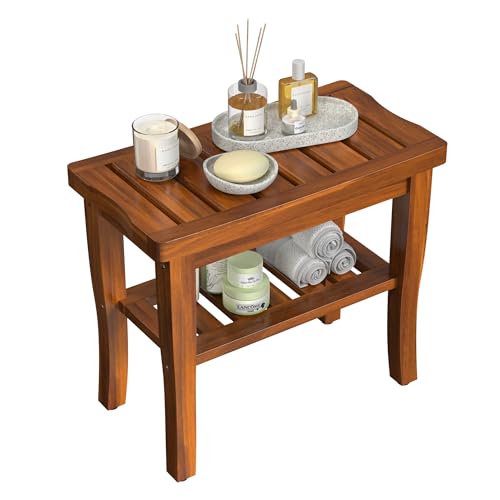
Teak Shower Bench Stool with Storage Shelf — Best Storage Design
This second teak entry earns its place beside the EcoDecors rather than behind it by leaning harder into the storage half of the brief. Its listing describes a teak wood shower bench stool with a storage shelf, non-slip feet and a waterproof positioning for indoor and outdoor shower use — a bench conceived as the shower’s piece of furniture, the place where the shampoo, the razor and the foot being shaved all live at once. Where the EcoDecors is the classic reference design, this stool is the organiser’s version of the same idea.
The non-slip feet deserve emphasis because wooden benches are sometimes assumed to be stable by weight alone. In a wet stall, weight helps but grip decides, and feet specified for the job turn a handsome stool into a trustworthy one. The shelf’s openness matters too: an open slatted shelf drains and dries, while a closed box in a shower becomes a damp cupboard within a week. Buyers comparing the two teak picks should look at exactly this — shelf design and foot design — because the timber itself is a shared virtue and the details are where the two benches part company.
In smaller households the stool also moonlights. A teak bench is as happy beside a bath with towels folded on it, or on a porch, as inside the shower, and furniture that can migrate between roles justifies its footprint in homes where every object must. Its limits are the wooden family’s shared ones: no back, no arms, and a stated capacity in the 300 lb class that buyers should confirm on the listing — support-seekers belong in the aluminium half of this guide, while organisation-seekers will find this the most useful object in their shower.
Compare the two teak benches as you would compare two kitchen knives from the same steel: the material is settled, so the decision lives in balance and intent. The EcoDecors is the reference all-rounder; this stool is the storage-led alternative, and households should choose by counting their shower’s bottles honestly. Two bottles and a razor — take the classic bench. A family’s worth of shampoos, conditioners, scrubs and children’s bath toys looking for a home — the shelf-led stool will change how the whole shower feels by the second morning.
- Material: teak wood
- Storage: full shelf beneath the seat
- Feet: non-slip per the listing
- Positioning: waterproof, indoor or outdoor shower use
- Form: bench stool
Strengths
- Storage shelf is the design’s centre, not an afterthought.
- Non-slip feet specified for wet floors.
- Teak build migrates happily to bathside or porch duty.
Trade-offs
- Bench format — no back or arms for support sitters.
- Shelf invites clutter if the household lets it.
- Confirm the stated capacity on the listing before ordering.
Best for: showers short on storage and long on bottles. Not suited for: anyone needing seated back or arm support.
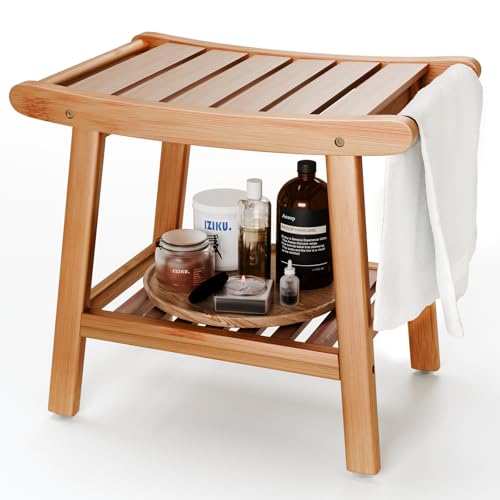
Bamboo Shower Stool Bench with Shelf — Best Bamboo Option
Bamboo is teak’s lighter, quicker-growing cousin in the bathroom, and this stool makes the material’s case well: an ergonomically curved seat, an A-shaped frame that splays for stability, a storage shelf, non-slip rubber feet and a stated capacity of 300 lbs. The curved seat is the detail to notice — a flat plank is a perch, while a seat shaped to the sitter stays comfortable through a long hair wash or a slow morning routine — and the A-frame is honest engineering, widening the footprint exactly where a stool needs width, at the floor.
The material bargain should be understood clearly. Bamboo is a grass, laminated into boards, and it handles bathroom humidity and regular shower use happily provided it dries between sessions; it is the right choice for a bench that lives beside the shower or in a stall that airs out daily. Teak remains the pick for a bench that will sit under running water in a steamy room for a decade without a thought. Most real bathrooms fall into the bamboo pattern — used daily, aired daily — which is why this stool, at the gentler end of the wooden family’s pricing tiers, will be the right answer for a large share of readers.
Its shelf and curved seat also make it the wooden pick most likely to be borrowed by the rest of the house: a stool this shape ends up holding plants, towels and laundry baskets whenever it is not in the shower. That versatility, plus the natural finish that suits the pale, plant-friendly bathrooms currently in fashion, rounds out the guide’s wooden family with its most adaptable member.
A note on bamboo’s sustainability story, since it influences many buyers in this family: bamboo is among the fastest-growing materials used in furniture, and a household choosing it for a bathroom stool is making a defensible environmental trade — accepting a somewhat shorter service life than solid teak in exchange for a rapidly renewable material at a gentler tier. Neither choice is the virtuous one in all lights; a teak bench kept for twenty years has its own strong case. The honest framing is lifespan versus renewal speed, and households will weight those differently.
- Material: natural bamboo
- Seat: ergonomic curved design
- Frame: A-shaped for stability
- Feet: non-slip rubber
- Stated capacity: holds 300 lbs per the listing
Strengths
- Curved seat is kinder than a flat plank for long routines.
- A-shaped frame puts stability where it belongs.
- Shelf plus light weight make it the adaptable household stool.
Trade-offs
- Bamboo wants to dry between uses — not a permanent-soak timber.
- No back or arms, as with all the wooden picks.
- Laminated construction differs from solid teak longevity.
Best for: aired bathrooms wanting a light, curved, shelf-equipped bench. Not suited for: permanently wet stalls, where teak is the safer timber.
How Do the Two Families Compare?
| Pick | Family | Back / arms | Stated capacity |
|---|---|---|---|
| Medline Heavy Duty Shower Chair 550 lb | Aluminium chair | Back | 550 lb |
| Drive Medical Shower Chair with Padded Arms | Aluminium chair | Back and padded arms | 350 lb |
| Vaunn Adjustable Shower Chair Spa Bench | Aluminium chair | Removable back | See listing |
| EcoDecors 18 Inch Teak Shower Bench | Teak bench | Neither | 300 lb |
| Teak Shower Bench Stool with Storage Shelf | Teak bench | Neither | See listing |
| Bamboo Shower Stool Bench with Shelf | Bamboo bench | Neither | 300 lbs |
There is a budget reading of the table too, stated qualitatively because tiers move: the aluminium chairs cluster at the accessible end, with the heavy-duty Medline asking a little more for its capacity, while the wooden benches spread upward from bamboo through the teak designs, priced as furniture rather than equipment. Households deciding between families on cost alone should remember that the chair family’s value is measured in confidence per shower and the bench family’s in years of daily pleasure — different currencies, both real.
The table states the guide’s whole argument in six rows: support lives in the aluminium family, where backs, arms and the highest capacities are; furniture virtues live in the wooden family, where shelves, timber and permanence are. Neither family is the upgraded version of the other. They are answers to different questions, and the most common buying error in this category is asking one family to do the other’s job.
How Does a Bathroom Chair Change the Shower Itself?
Something unexpected happens in households that install a shower seat for practical reasons: the shower gets longer, slower and more enjoyable for everyone, including the people the seat was never bought for. Sitting under warm water is a different pleasure from standing under it — closer to a bath’s surrender, with a shower’s freshness — and a bench sturdy enough to trust becomes the room’s favourite spot for everything from conditioning treatments to the simple luxury of sitting down while the bathroom steams. Partners borrow it. Teenagers colonise it. The chair bought for safety ends up justifying itself as pleasure, which is perhaps why the wooden family exists at all: it is the market admitting that a shower seat is furniture for a ritual, not only equipment for a need.
That dual life has a buying implication worth stating. If a seat will be used daily by the whole household — and experience says it will — then comfort, looks and cleanability deserve nearly the same weight as the support specification that prompted the purchase. Buy only for the stated need and the household inherits a chair it tolerates; buy for the need and the daily ritual together, and the bathroom gains an object it would replace immediately if it ever wore out. The six picks here were chosen to survive exactly that widening of purpose.
Which Bathroom Users Get the Most from Each Family?
Picture three households and the shortlist resolves itself. In the first, a grandfather is moving in, and the family bathroom must quietly become a room he can use with confidence: that household belongs to the aluminium family, choosing between the Medline’s capacity and the Drive’s arms by watching how he already manages chairs at the table. In the second, a couple is renovating a small ensuite and dreams in spa photographs: that household belongs to the wooden family, and its only real argument is teak versus bamboo, settled by whether the bench will live under the water or beside it. In the third, a household is recovering from a broken ankle and needs something this week that will not embarrass the bathroom afterwards: that is the Vaunn’s exact brief, or a wooden bench that graduates to permanent furniture when the cast comes off.
The pattern underneath the pictures is that bathroom seating is bought at turning points — a move, a renovation, a recovery — and turning points reward equipment that can change roles when the moment passes. Chairs with removable backs, benches that migrate to the porch, stools that become plant stands: the picks in this guide were favoured partly because none of them becomes useless when the household’s needs move on, as household needs reliably do.
How Should You Set Up a Shower Chair Safely?
Set the chair on the flattest part of the tub or stall floor, with every foot planted and none resting on a curved slope or a drain cover. Adjust the legs to equal length unless your floor genuinely demands otherwise — a chair that rocks before anyone sits in it will rock more under way — and press down hard on the seat with both hands, then push it sideways, before the first shower. That ten-second test, repeated whenever the chair is moved, is the household version of a safety inspection, and it catches the loose leg lock and the worn foot while they are still trivia.
Lighting and routine complete a safe setup in ways equipment lists rarely mention. A chair used at the same point in a familiar routine — same position, same reach to the same shelf — becomes safer with repetition, because the sitter’s hands learn the room. Households introducing a chair for a parent or a recovering partner should run the first uses unhurried and in good light, letting the new routine establish itself before it is ever performed tired, rushed or in the dark. Equipment provides the grip; habit provides the rest, and the two together are what actually keep a wet room friendly.
Position matters as much as adjustment. The sitter should be able to reach the taps and the showerhead’s controls from the seat without leaning far, because leaning is what seats exist to prevent. Keep toiletries on the chair’s shelf or within the same easy reach, and think about the path in and out: the chair should help with the step over the tub edge by being a stable thing to hold, not become an obstacle in the doorway of the stall. Anyone setting up a chair for another person’s specific needs should have that person test the arrangement in daylight, dry, before it is trusted wet.
What Is the Difference Between a Shower Chair, a Bath Bench and a Transfer Bench?
The vocabulary of this category confuses buyers because the objects overlap, so a plain glossary earns its place. A shower chair, in the pattern of the Medline, Drive and Vaunn picks, is a four-legged seat — often backed, sometimes armed — that stands inside a shower stall or tub and is sat on in place. A bath bench or stool, in the pattern of the wooden picks, is a lower, backless seat that may live in a stall, across a tub, or beside the bath as much as in it; its virtues are simplicity and furniture character rather than support hardware.
A transfer bench is the third term, and it is deliberately not in this guide’s shortlist: it is a longer bench that straddles the tub wall, letting a sitter slide across from outside rather than step over. Households whose real problem is the tub wall itself should know the term and shop for it specifically, ideally with professional guidance, rather than expecting a standard chair to solve a transfer problem it was not designed for. Naming the categories correctly is the cheapest safety measure in this whole article, because it stops a buyer purchasing a handsome answer to the wrong question.
How Do You Clean Bathroom Chairs and Benches Properly?
The aluminium chairs clean like the equipment they are: a shower’s own spray, a soft brush for the seat’s drainage slots, and a periodic check that the leg locks are free of the soap residue that can make push-buttons reluctant. Rubber feet deserve a wipe and a look — grit embedded in a foot can scratch a tub’s surface, and a foot that has split or hardened should be replaced before it becomes the reason a chair moves. None of this needs products beyond a mild bathroom cleaner, and all of it fits inside the time it takes a bath to run.
Timber benches clean differently: rinse, don’t soak in cleaners. Soap film is the enemy of both looks and grip, and a bench rinsed at the end of each shower accumulates almost none. Teak can take an occasional gentle scrub along the grain; bamboo prefers a wipe and prompt drying. What both timbers dislike is neglect punctuated by aggression — months of film followed by harsh chemicals — so the kind routine is the frequent, mild one. A bench that is part of the shower’s daily rinse stays a pleasure; a bench cleaned quarterly becomes a project, and projects in wet rooms tend to lose.
What Mistakes Do People Make When Buying Bathroom Chairs?
The measurement mistake leads the field: benches ordered for tubs they do not fit, chairs too wide for stall doors, seats set at heights nobody checked against the sitter’s legs. Every dimension that matters is on the listing and every one of them is checkable with a tape measure in two minutes, which makes this the most preventable disappointment in home equipment. The second mistake is buying a bench when the need was a chair — choosing teak’s beauty when the sitter actually needs a back and arms — or the reverse, installing clinical equipment where a simple bench would have served and been loved.
A related error is placing the chair once and never reconsidering it. Bathrooms change — a new bath mat alters the floor’s grip, a different showerhead changes where the water lands, a sitter’s needs evolve across a recovery — and a chair positioned for last season’s room may be subtly wrong for this season’s. The ten-second stability test described earlier is worth repeating whenever anything in the room changes; it costs nothing and it is the difference between equipment that is maintained and equipment that is merely owned.
Neglect is the third error, and it is slow. Rubber feet harden, leg locks gather soap residue, bamboo left permanently sodden eventually shows it. A monthly minute — feet checked, locks clicked through, timber rinsed and aired — keeps a bathroom chair the chair it was on delivery day. The final mistake is treating capacity as a challenge rather than a ceiling: stated figures are limits to stay comfortably inside, with headroom, never numbers to approach.
A final scenario deserves its own paragraph, because it is the one readers most often write to guides about: the small bathroom that must do everything. In a compact room, choose the pick that folds into the room’s other duties — the Vaunn that breaks down without tools, the bamboo stool that holds towels between showers, the teak bench whose shelf replaces a cabinet the room has no wall for. Small bathrooms punish single-purpose objects and reward furniture that moonlights, and every pick in this guide was checked against that standard as well as against the water.
Final Recommendation
Decide which family you are in and the shortlist collapses kindly. If the chair is about support, take the Medline for maximum stated capacity, the Drive Medical if padded arms answer the sit-and-stand question, or the Vaunn if tool-free flexibility matters most. If the bench is about living well in the shower, take the EcoDecors for classic solid teak, the shelf-led teak stool for storage, or the bamboo stool for a lighter, curved and adaptable seat. Buy the one that matches the shower you actually take — support where support is needed, timber where pleasure is the point — and check its feet on the first wet morning like you mean it.
Frequently Asked Questions
Can a shower chair be used in a bathtub as well as a stall?
Generally yes, provided the chair’s footprint fits the tub’s flat floor area. One practical refinement: in a tub, position the chair toward the tap end if the sitter wants the shower stream from above and behind, or toward the far end if they prefer to sit out of the direct spray while washing. Small placements like this are discovered across the first week of use, and adjustable chairs earn their keep precisely because they can be re-set as the household learns its own preferences. The legs should be adjusted so all four feet plant squarely — tubs narrow toward the base, which is exactly why measuring before ordering matters. Benches sized around 18 inches are designed with tubs in mind, while wider chairs belong in stalls. When in doubt, the tub’s floor dimensions, not its rim dimensions, are the ones to compare against the listing.
How do I stop a wooden shower bench from going mouldy?
Mould follows standing moisture and soap film, so the routine is drainage and rinsing. Think of the bench as you would a wooden chopping board in a kitchen: it thrives on being used, rinsed and aired daily, and it sulks only when left wet and forgotten in a corner. Households that shower daily are, without knowing it, already performing the perfect maintenance schedule — the bench dries in a room that is regularly warm and ventilated, which is all the care the material has ever asked for. Let the bench shed water freely, rinse soap residue off when you rinse the shower, and give the room its ordinary airflow between uses. Teak tolerates this life almost indefinitely; bamboo asks additionally to dry out rather than stay wet for days. A bench that is rinsed and aired as part of the shower routine rarely needs anything stronger.
What seat height should a shower chair be set to?
The general household guidance is a height at which the sitter’s feet rest flat on the floor with knees comfortably bent, roughly level rather than jacked up or dangling, and from which rising feels like standing from a dining chair rather than climbing out of a beanbag. Set it a notch at a time across the first few showers; the right height announces itself by disappearing, because a correctly set seat is one the sitter stops thinking about entirely. The sitter should also be able to rise without hauling on fixtures. Adjustable chairs exist precisely because that height differs per person and per tub, so set it with the actual sitter, in the actual shower, and re-check it if a different household member becomes the main user.
Are weight capacities on shower chairs reliable?
They are the maker’s stated limits and should be treated as ceilings with headroom, not as targets. Choose a chair whose stated figure sits comfortably above the sitter’s weight — the Medline’s 550 lb and the wooden benches’ 300 lb class mark the ends of this guide’s range — and re-confirm the figure on the live listing at ordering time, because it is the one number in this category that should never be guessed.
Should I choose a chair with a back or a backless bench?
Choose the back when the seat’s job includes rest: long showers, sitters who tire, anyone who will lean while washing their legs or waiting out a hair treatment in comfort. Choose the backless bench when the seat’s job is a perch — a foot up for shaving, a short sit, a place for bottles — and when the room’s look matters, since benches disappear into a bathroom’s design in a way backed chairs never quite do. Many households end up owning one of each across different bathrooms, which is the market’s way of saying the question has two right answers.
Can a teak bench stay in the shower all the time?
Yes — permanent residence is teak’s traditional role, and the EcoDecors and the teak stool here are built for it. Give the bench the shower’s ordinary rinsing, let the room breathe between uses, and oil it only if you want to preserve the original colour rather than let it silver. Bamboo, by contrast, prefers to dry between sessions, so place it where the bathroom’s airflow reaches it.
Related Guides
Bathrooms lead to the rest of the house’s seating more naturally than you might expect. Readers planning further ahead may enjoy Best Big and Tall Drafting Stools for another capacity-led category, Best Desk Chairs for High School Students for the study end of the house, and Best Chairs for Long Reading Sessions for sitting as pure pleasure. And for the room this guide began in, Best Bathroom Storage and Vanity Cabinets covers the shelves and cupboards that keep it all in order.


