What's inside
- Key Takeaways
- Quick Picks
- How Did We Choose These Baby Quilts?
- Where Does a Baby Quilt Actually Get Used in the First Year?
- Should You Choose a Pieced Heirloom Quilt or a Muslin Quilt?
- How Do the Six Baby Quilts Compare?
- How Do You Wash and Care for Baby Quilts?
- How Do You Choose a Baby Quilt as a Gift?
- What Mistakes Do Baby Quilt Buyers Make?
- How Does a Quilt’s Job Change with the Seasons?
- What Makes a Baby Quilt Photograph Well?
- How Does a Baby Quilt Grow Up with the Child?
- How Do You Set Up a Floor-Play Space Around a Quilt?
- What Should You Check When a Baby Quilt Arrives?
- Final Recommendation
- Frequently Asked Questions
- Related Guides
As an Amazon Associate I earn from qualifying purchases. This post may contain affiliate links at no extra cost to you.
cottageverdict.com is reader-supported. When you buy through links on our site, we may earn an affiliate commission.
Where to buy: each linked name opens that quilt’s Amazon page, where you can check price on Amazon and confirm the size, fabric and care instructions against your own nursery plans. Before any of that, this guide opens with the guidance that matters more than any fabric in it, because the best baby quilts are bought by people who know exactly where a quilt belongs in a baby’s first year — and where it does not. That knowledge takes thirty seconds to read and a whole childhood to be grateful for, so it stands here at the front, ahead of every pattern and palette, where a careful household would want it.
Safe sleep comes first, and it is not a footnote. Standard safe-sleep guidance is clear and consistent that babies under twelve months should sleep in a bare crib or bassinet — no quilts, no blankets, no soft bedding of any kind in the sleep space — because loose fabric and a sleeping infant are a dangerous combination that no warmth or beauty can justify. So the quilts in this guide are not crib bedding for a sleeping baby, and nothing in these reviews — not a photograph’s implication, not a product name containing the word crib, not a listing’s cheerful staging — should be read that way by anyone. Their real first-year jobs are supervised ones: the layer under a baby during awake tummy time on the floor, the cover draped over a car seat or stroller on a chilly walk with an adult right there and watching, the photographed backdrop of a newborn session, and the gift that waits — folded in the nursery, rich with intention — until the child is a toddler old enough for a quilt on a bed of their own. Bought with that map in mind, a baby quilt is one of the most useful and longest-lived gifts in the nursery. Bought as sleep bedding for an infant, it is a misunderstanding this guide refuses to sell. Everything that follows — the fabrics, the sizes, the palettes, the prices you will check — is arranged inside that map, and readers who keep it in view will find that every recommendation in the guide makes a warmer kind of sense: these are quilts for the hours when the baby is awake, accompanied and busy becoming a person, and for all the years of bedtimes that come safely after.
Within that honest frame, the category divides into two families with different virtues, different laundry habits and different ideas about what the word keepsake is allowed to mean. The pieced heirloom quilts — cotton squares joined by a maker’s hand or a careful production line — are the keepsakes: photographed at the christening, dragged everywhere by the toddler, stored carefully for the grandchild. The muslin quilts are the workers: layers of breathable cotton gauze that soften with every single wash, sized generously for floor play and stroller duty, and light enough to live in the bag that goes everywhere the baby goes. The six picks below cover both families at several sizes and temperaments, and each review states the job its quilt is actually for, in the order a careful household will use it across the years.
A word about claims, because baby products attract them the way muslin attracts softness. This guide makes no medical or developmental promises for any quilt — nothing here treats, prevents or improves anything about a baby’s health. What a good baby quilt genuinely offers is comfort, warmth during supervised awake time, a clean and familiar surface for play, and an object beautiful enough to carry a family’s memories. That is a full and honourable job description, and it needs no borrowed lab coat. Readers managing any health question about their baby should take it to their clinician, whose advice outranks every sentence in every buying guide ever written — this one included, happily.
Key Takeaways
- Babies under twelve months sleep in a bare crib — every quilt here is for supervised awake time, strollers, gifts and later toddlerhood.
- Stephan Baby’s pieced crib quilt is the heirloom pick, built to be kept long after the nursery years have passed.
- Muslin dominates the working end: BuLuTu, HardNok and Knirose trade on breathable layers that soften with every washing.
- Chumia’s thirty-by-forty floral is the gift-size pick, a boho patchwork made for presenting and photographing.
- MONOBLANKS’ white scalloped quilt is the classic neutral — the one that matches every nursery ever painted.
- Size decides the job: smaller quilts gift and photograph, larger muslins cover floor play and toddler beds.
Quick Picks
| Pick | Badge | Why it earns its place |
|---|---|---|
| Stephan Baby Heirloom Pieced Crib Quilt | Best Heirloom Quilt | A pieced denim-dot quilt from a baby-gift house, made to be photographed now and kept for decades. |
| MONOBLANKS Baby Quilt White Scalloped | Best Classic White | An embossed, scalloped white quilt that behaves in every nursery and every photograph. |
| Chumia Pink Floral Boho Baby Quilt | Best Boho Gift Quilt | A thirty-by-forty pink floral patchwork in vintage farmhouse spirit, sized for giving. |
| BuLuTu Muslin Baby Quilt Crib Blanket | Best Large Muslin | Two layers of cotton muslin at forty-seven by fifty-nine inches, with a sheep pattern and machine-washable manners. |
| HardNok 6-Layer Muslin Baby Blanket Garden | Best Layered Muslin | Six layers of organic cotton blend muslin in a woodland garden print, gift-boxed and shape-retaining. |
| Knirose Organic Baby Blanket Flounce Edge | Best Organic Muslin | A large reversible muslin cotton blanket with a flounce edge, in a floral design for girls’ nurseries. |
How Did We Choose These Baby Quilts?
Safety framing came before selection, not after. Any quilt considered for this guide had to make sense inside the bare-crib rule — sized and weighted for supervised floor play, stroller walks, photo sessions and the toddler years, rather than marketed as a way to dress an infant’s sleep space. Listings whose language encouraged putting loose bedding in a sleeping baby’s crib were passed over regardless of their beauty. The six that remain can each be described honestly as what they are: quilts for the awake, accompanied hours of a baby’s life and for the years that follow.
Fabric came next, and the guide leaned toward cotton in its two great nursery forms. Pieced cotton quilts earned their places on construction — real joined squares, finishes that will survive being kept — because an heirloom that cannot survive its own childhood is a poor heirloom. Muslin quilts were judged on their layers and their hand: the number of gauze layers a maker states, the size those layers are cut to, and the softness trajectory muslin is famous for, arriving pleasant and becoming beloved across a year of washes. Synthetics were not excluded on principle, but in this pool the cotton quilts were simply the stronger, more verifiable products.
Size honesty governed the middle of the selection. Baby quilts are sold at dimensions ranging from receiving-blanket small to toddler-bed generous, and listings photograph them all identically — draped, adorable, scaleless. Every review below prints its quilt’s dimensions in the spec list and interprets them: which quilts are gift-and-photo sized, which cover a play mat’s worth of floor, which will still fit the child when the child is three and the quilt has been promoted to the bed. A buyer who knows the size knows the job, and most disappointment in this category is a size surprise wearing a prettier costume.
Finally, we chose for the gift table as well as the nursery floor, because a large share of baby quilts are bought by people who will never wash one: grandparents, friends, colleagues at the shower. Giftability — presentation, neutrality or charm, the absence of any need for the giver to know the nursery’s exact palette — is a legitimate virtue in this category, and the Chumia and MONOBLANKS picks carry it openly. The working muslins, meanwhile, are the picks experienced parents buy for themselves, and the guide says which is which so both audiences can shop the same list without translation.
Where Does a Baby Quilt Actually Get Used in the First Year?
The floor is the first answer. Tummy time and early play happen on the ground, and a quilt spread over carpet or boards gives the baby a clean, soft, familiar territory whose edges define the play space for supervising adults. The larger muslins shine here — enough area for a rolling baby and a parent’s knees, light enough to shake out and wash without planning the day around laundry. A quilt used daily on the floor should be the household’s easiest washer, which is why the working muslins rather than the heirloom pieced quilts take this duty in most homes.
The stroller and the car seat are the second station — as a cover draped over the baby’s legs or the seat’s canopy on a cold walk, with an adult present and attentive, never as bedding left with a sleeping infant unattended. The photograph is the third: newborn and milestone photography runs on beautiful textiles, and a pieced heirloom or a white scalloped quilt under a sleeping-for-the-camera baby (posed, supervised, awake-or-feigned) becomes the image a family keeps for a century. The fourth station is the gift table itself, where the quilt’s job is to be a promise — of the toddler bed it will cover, the reading chair it will share, the grown child who will be shown the photographs.
And then, past the first birthday, the quilt comes into its inheritance. On a toddler bed it is the first real bedding a child chooses and recognises; on the reading chair it is the shared cover of a thousand story times; in the car it is the travel blanket of record. The quilts that survive to this promotion share two traits: construction that tolerated the first year’s washing, and a design the family has not tired of — which is why the classics and the gentle prints outlast the loud novelties in real nurseries, however the novelties photograph in the shop.
Should You Choose a Pieced Heirloom Quilt or a Muslin Quilt?
The pieced quilt is an object with a past tense built in. Its joined squares, its deliberate pattern, its maker’s name — Stephan Baby has built a house on exactly this register — announce that it was made to be kept. Heirloom quilts are photographed more than they are washed, gifted more formally, and stored more carefully, and their value compounds in memory rather than in service. A family that buys one is buying a future heirloom at the moment of maximum sentiment, and there is nothing foolish in that; the foolishness would be expecting it to also be the floor quilt, the stroller quilt and the everyday washer. Heirlooms hate rotation duty.
Muslin is the opposite philosophy: a fabric that improves under exactly the treatment heirlooms fear. Cotton muslin’s gauze weave is breathable in summer, layerable in winter, and famously softens with every wash, so the quilt that begins as a good tummy-time mat ends the year as the softest object in the house. Layer counts tune the warmth — two layers for summer lightness, six for a cooler room’s substantial drape — and the generous sizes in this guide’s muslin picks suit the floor years and the toddler bed after. Muslin’s trade is delicacy of appearance: it wrinkles, it relaxes, it looks lived-in quickly, because it is. Households that want the nursery’s textiles crisp should buy the pieced and the classic; households that want them soft should buy muslin and never look back.
Most nurseries end up owning both, acquired in the order this guide lists the virtues: the heirloom arrives as a gift, heavy with meaning, and the muslin is bought by the parents in the third week, heavy with laundry. That division of labour is not a failure of either quilt. It is the category working as designed, and the wisest shoppers plan for it — registering for the muslin workhorse while welcoming the heirloom, rather than pretending one beautiful object will serve every station of a baby’s first year.

Stephan Baby Heirloom Pieced Crib Quilt — Best Heirloom Quilt
Stephan Baby describes this quilt with the word heirloom in its name, and for once the word is a description rather than a wish. The Denim Dot design pieces a classic baby palette into a proper joined quilt — the kind of object that appears in the newborn photographs, hangs over the nursery chair through the toddler years, and is still in the family’s linen press when the baby it celebrated is choosing quilts of their own. The denim-and-dot register is its quiet genius: blue without being a gender announcement shouted in pastel, patterned without a single licensed character to date it.
Its jobs follow the heirloom script laid out in this guide’s opening: the photographed layer, the chair’s drape, the toddler bed’s eventual top, and the supervised floor for short, special sessions rather than daily duty. A family that treats it as the nursery’s ceremonial quilt will find it ages like one — cotton piecing keeps its structure, the design stays in taste, and the object accumulates the patina that makes heirs of quilts. What it should not be asked to do is the muslins’ daily washing rotation; heirloom piecing can be washed with care, but a quilt washed weekly is a workhorse, and this one was born to a higher station. Buy it as the keepsake, gift it as the keepsake, and let it be kept.
- Form: pieced crib quilt
- Design: Denim Dot, classic joined-square construction
- Role: heirloom gift, photography, nursery chair, toddler bed
- Maker: Stephan Baby, a baby-gift house
- Buying note: check price on Amazon; a keepsake purchase, not a daily washer
Strengths
- Genuine pieced construction worthy of the heirloom name.
- Denim-dot palette sidesteps dated characters and loud pastels.
- Carries from newborn photographs to toddler bed without ageing out.
Trade-offs
- Too precious in role for daily floor-and-laundry rotation.
- Blue-leaning palette will not suit every nursery’s scheme.
- Heirloom positioning costs more than the working muslins.
Best for: grandparents and gift-givers buying the quilt a family keeps. Not suited for: parents shopping for an everyday wash-and-wear floor quilt.
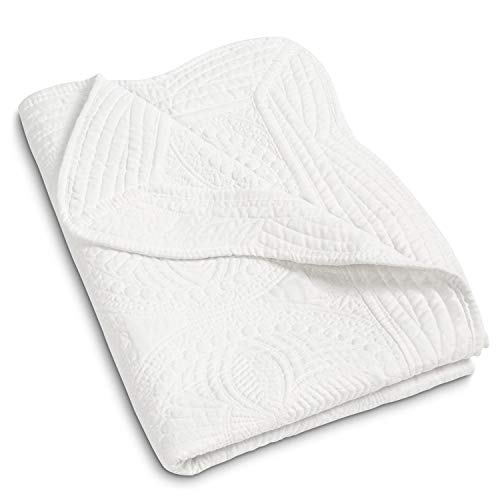
MONOBLANKS Baby Quilt White Scalloped — Best Classic White
White is the nursery’s oldest decision and still its most reliable. MONOBLANKS’ quilt pairs that white with two quiet ornaments — an embossed texture across the face and a scalloped edge — and the result is a quilt that behaves in every context a baby quilt is asked to enter: under a newborn in a photograph, over a stroller on a bright morning, across the foot of a toddler bed in a room painted any colour at all. The maker describes it as lightweight and suited to four seasons, and its register is exactly that — a classic layer rather than a statement.
The scalloped edge deserves its sentence, because edges are where baby quilts show their breeding. A scallop is harder to finish than a straight bind and reads instantly as care; in photographs it frames the baby the way a mount frames a print. The embossed face gives white its texture, so the quilt reads as an object rather than as blankness. The honest caution is the colour itself: white in a baby’s world is a commitment to prompt washing, and this quilt will show every chapter of the weaning story until it is laundered. Households at peace with that rhythm gain the most versatile quilt in this guide; households that are not should take the same classicism in the Chumia’s forgiving florals or the muslins’ gentle prints.
- Form: baby quilt with embossed face and scalloped edge
- Colour: white
- Character: lightweight, four-season per the maker
- Role: photography, stroller cover, classic nursery layer
- Buying note: check price on Amazon; white rewards prompt washing
Strengths
- Scalloped, embossed finish photographs beautifully.
- White matches every nursery palette ever chosen.
- Lightweight build suits year-round supervised use.
Trade-offs
- White displays every mark until the next wash.
- Classic restraint may feel plain beside patterned rivals.
- Not the warmest option for cold-room floor play.
Best for: classic nurseries, photographers and gift-givers who refuse to guess a palette. Not suited for: households that want a quilt to hide the evidence between washes.
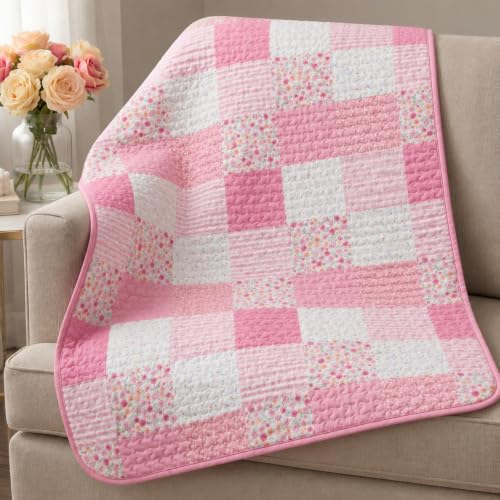
Chumia Pink Floral Boho Baby Quilt — Best Boho Gift Quilt
Thirty by forty inches is the gift size of the baby-quilt world — large enough to be a real quilt, small enough to present beautifully — and Chumia fills it with a pink floral patchwork in vintage farmhouse spirit. The boho register is the point: soft florals, a retro patchwork rhythm, and a femininity that arrives as charm rather than as sugar. Chumia positions it for nurseries, crib bedding displays, toddler girls and shower décor, and of those roles the honest first-year ones are the display, the photograph and the gift — with the toddler bed waiting at the end of the first year to give the quilt its long second act.
As a shower gift this is the pick that photographs the giver’s taste kindly: it says the nursery was thought about, the palette was chosen rather than defaulted, and the object will still be in the room when the child is three. The patchwork face carries the farmhouse-boho rooms that dominate current nursery taste, and the floral print forgives the small marks of toddler service better than any white quilt can. Its limits are its size and its specificity — thirty by forty will not cover a play area or a growing toddler completely, and a pink floral is a commitment a household either loves or does not. For the nursery it matches, no pick in this guide gives more delight per inch.
- Form: quilted baby blanket, patchwork style
- Size: 30 x 40 inches
- Design: pink floral boho, vintage farmhouse patchwork
- Role: shower gift, nursery display, photography, toddler layer
- Buying note: check price on Amazon; gift-size dimensions by design
Strengths
- Boho floral patchwork lands exactly on current nursery taste.
- Gift dimensions present and photograph beautifully.
- Print forgives toddler-era marks better than plain colours.
Trade-offs
- Small size limits floor-play and toddler-bed coverage.
- Pink floral is a whole-hearted palette commitment.
- More decorative in spirit than the working muslins.
Best for: shower gifts and boho nurseries for girls. Not suited for: buyers needing a large everyday play quilt or a neutral palette.

BuLuTu Muslin Baby Quilt Crib Blanket — Best Large Muslin
BuLuTu’s quilt is the working muslin at full size: two layers of cotton muslin cut to forty-seven by fifty-nine inches, a pound and a half of breathable drape with a sheep pattern scattered across it, and machine-washable manners stated plainly by the maker. The dimensions are the review’s headline — this is the largest quilt in the guide, big enough to define a tummy-time territory with room for a parent’s knees, to cover a toddler completely, and to serve later as the light bed layer of the preschool years. Two-layer muslin is the summer weight of the family: airy, quick to wash, quick to dry, and soft in the way that makes muslin the fabric babies’ blankets return to across generations.
The sheep pattern keeps the working brief from becoming a dull one — a gentle, storybook motif that suits boys’ and girls’ rooms without shouting. In service this is the quilt that lives out of the drawer: floor in the morning, stroller at noon, the bag for the grandparents’ house by the weekend. Its two layers will not warm a cold room’s floor session the way the six-layer HardNok below will, and households in cool climates should read the layer count as the thermostat it is. For the warm and temperate majority, the BuLuTu is the guide’s most practical square footage — the quilt a family uses daily while the heirloom watches from the chair, exactly as the category intends.
- Form: muslin baby quilt / crib blanket
- Size: 47 x 59 inches; about 1.5 pounds per the maker
- Fabric: 2-layer cotton muslin, sheep pattern
- Care: machine washable per the maker
- Buying note: check price on Amazon; the largest footprint in this guide
Strengths
- Generous size covers floor play and toddlers completely.
- Two-layer muslin breathes through warm nurseries and summers.
- Machine-washable honesty suits its daily working role.
Trade-offs
- Two layers run cool for cold floors and winter rooms.
- Large size is more quilt than a gift occasion usually wants.
- Muslin’s relaxed look wrinkles where pieced quilts stay crisp.
Best for: parents buying the everyday floor-and-toddler workhorse. Not suited for: cold-climate nurseries needing maximum layered warmth.

HardNok 6-Layer Muslin Baby Blanket Garden — Best Layered Muslin
Six layers change muslin’s character entirely. HardNok’s blanket stacks six layers of an organic cotton blend muslin into a forty-three-inch square with a shape-retaining interlocking weave, a woodland Garden print in neutral tones, and a kraft gift box that announces its intentions before the fabric is even touched. Where two-layer muslin is a summer veil, six-layer muslin is a quilt in the full sense — cushioned enough to take the hardness out of a wooden floor during tummy time, warm enough for a cool nursery’s supervised hours, and still breathable in the way that makes muslin rather than fleece the fabric of this guide’s working half.
The shape-retaining weave answers muslin’s one habitual vice, which is relaxing into a parallelogram after a season of washing; a blanket that keeps its square keeps its dignity on the bed and its coverage on the floor. The Garden print — woodland, neutral, gentle — suits the nurseries that find pink too committed and white too brave, and the gift box makes this the muslin a giver can present with the same ceremony as the heirloom. Its boundaries are honest ones: six layers wash and dry more slowly than two, and the forty-three-inch square, while generous for play, will be outgrown as a full cover sooner than the BuLuTu’s larger rectangle. As the layered, cushioned, presentable muslin, it has no rival in this list.
- Form: 6-layer muslin baby blanket / toddler quilt
- Size: 43 x 43 inches
- Fabric: organic cotton blend muslin, interlocking weave
- Design: Garden woodland print, neutral; kraft gift box
- Buying note: check price on Amazon; layered warmth for cooler rooms
Strengths
- Six layers cushion hard floors and warm cool nurseries.
- Shape-retaining weave keeps the blanket square through washes.
- Neutral woodland print and gift box suit any recipient.
Trade-offs
- Thicker stack dries more slowly than two-layer muslin.
- Square format covers less length than the BuLuTu rectangle.
- Warmth is wasted in hot climates and summer nurseries.
Best for: cooler nurseries, hard floors and gift-givers wanting muslin with presence. Not suited for: hot climates or families needing the fastest laundry turnaround.

Knirose Organic Baby Blanket Flounce Edge — Best Organic Muslin
Knirose closes the list at the soft, pretty end of the muslin family: a large fifty-by-forty-three-inch blanket in one hundred percent muslin cotton per the maker, reversible between its floral faces, and finished with a flounce edge that gives a working fabric a dressed edge. The size is the practical headline — among the largest here, enough for bassinet-side draping during supervised hours, stroller coverage, floor play and the toddler bed — while the reversible floral design is the aesthetic one, two looks alternating with the laundry cycle so the nursery sees a change without a second purchase.
The flounce edge deserves the same respect this guide paid the scallop: edges are where a blanket declares whether it was finished or merely cut. A flounce on muslin is a small extravagance that photographs tenderly and feels gentle against everything it touches. Knirose positions the blanket across bassinet, bed, stroller and snuggling, and the supervised reading of that list is the correct one — it is a blanket for accompanied hours and for the toddler years, in a breathable weave that suits girls’ nurseries in its floral register. Households wanting organic muslin at a generous size, with the prettiest finish in the working family, have arrived at their pick.
- Form: organic muslin baby blanket / toddler quilt
- Size: 50 x 43 inches
- Fabric: 100% muslin cotton per the maker, reversible floral
- Finish: flounce edge
- Buying note: check price on Amazon; large size suits toddler promotion
Strengths
- Large reversible format gives two looks and years of coverage.
- Flounce edge finishes muslin with unusual tenderness.
- All-muslin-cotton build breathes through warm rooms.
Trade-offs
- Floral register commits to a girls’-nursery palette.
- Muslin softness comes with muslin’s relaxed, wrinkled charm.
- Flounce edge asks for a gentler wash than plain binds.
Best for: girls’ nurseries wanting organic muslin at a generous, lasting size. Not suited for: buyers wanting a crisp, tailored or gender-neutral working quilt.
How Do the Six Baby Quilts Compare?
| Pick | Family | Size | Primary job |
|---|---|---|---|
| Stephan Baby Heirloom Pieced Crib Quilt | Pieced heirloom | Crib-quilt class | Keepsake, photographs, toddler bed |
| MONOBLANKS Baby Quilt White Scalloped | Classic | Lightweight class | Photography and universal nurseries |
| Chumia Pink Floral Boho Baby Quilt | Patchwork gift | 30 x 40 in | Shower gift and boho display |
| BuLuTu Muslin Baby Quilt Crib Blanket | Muslin, 2-layer | 47 x 59 in | Daily floor play workhorse |
| HardNok 6-Layer Muslin Baby Blanket Garden | Muslin, 6-layer | 43 x 43 in | Cushioned play and cool rooms |
| Knirose Organic Baby Blanket Flounce Edge | Muslin, reversible | 50 x 43 in | Large soft coverage, girls’ nursery |
The table divides exactly as the nurseries do: three quilts bought to be looked at and kept, three bought to be used and washed. Neither half is the serious half. A nursery’s textile life needs its ceremony and its labour both, and the households that thrive are the ones that stop asking one quilt to provide them simultaneously. Read the primary-job column as a rota rather than a ranking and the right two purchases — one from each half — announce themselves.
How Do You Wash and Care for Baby Quilts?
Baby textiles live in the laundry, so care is not a footnote but a feature, and the first rule is to wash any quilt before its first use against a baby’s skin, in the household’s chosen gentle detergent, following the maker’s label. Muslin rewards the routine most visibly — it softens across the first washes from pleasant to beloved — and asks only for ordinary gentleness in return: a mild cycle, no scorching dry, and the patience to let its relaxed texture be its character rather than a problem to iron away. Pieced and embroidered quilts prefer the same mildness with one addition: turn them or bag them so their faces and edges are not abraded by the load’s rougher citizens.
The heirloom’s care is a philosophy as much as a method. Wash it when it needs it rather than on a rota, dry it away from harsh direct sun that fades cotton’s memory of its colours, and store it — when its years of service pause — clean, folded in a breathable place rather than sealed in plastic. A quilt stored dirty stores its stains permanently; a quilt stored sealed stores its smells the same way. The working muslins, by contrast, should never be stored at all in their prime years: they belong in the drawer nearest the floor where the baby plays, in constant, honourable rotation.
How Do You Choose a Baby Quilt as a Gift?
Decide first which of the two gifts you are giving. The keepsake gift — Stephan Baby’s heirloom, the white scalloped classic — says the occasion matters and the object will be kept; it suits grandparents, christenings and the friends who will be in the child’s life at eighteen. The useful gift — a muslin with presence, like the gift-boxed HardNok or the reversible Knirose — says the parents were thought of, and it suits showers, colleagues and every giver who suspects, correctly, that the nursery already owns three beautiful things and nothing washable. Both gifts are honourable; confusing them is the only error, and it usually takes the form of an heirloom bought for a household that needed a workhorse.
Palette is the giver’s second decision, and the coward’s way out is also the kind one: unless the nursery’s colours are known, white, neutral woodland and denim-dot all survive any room, while pink florals and strong themes should be reserved for nurseries whose taste is a known country. Include the washing instructions in your head if not on the card — a giver who can say “it softens beautifully, wash it gently” has given information worth more than a ribbon. And time the heirloom without anxiety: a quilt that arrives after the birth, chosen with the baby’s actual name and palette in view, loses nothing to the one that arrived at the shower in a guess.
What Mistakes Do Baby Quilt Buyers Make?
The gravest mistake is the one this guide opened with: treating a quilt as crib bedding for a sleeping baby under twelve months. Loose bedding stays out of the infant sleep space entirely — the quilt’s first-year life is supervised, awake and accompanied, and any listing or habit that suggests otherwise should be corrected on the spot. Second is buying by photograph without reading dimensions, then receiving a gift-sized quilt for a floor-play job or a toddler-sized muslin for a photo session. The sizes are printed in every review above because they are the purchase.
Third is expecting one quilt to be both heirloom and workhorse, and wearing out a keepsake in the laundry rota while the washable muslin sits folded as “too nice to use” — the precise inversion of both objects’ purposes. Fourth is overdressing the stroller: a quilt draped for a walk must leave the baby visible and the air moving, with an adult in attendance, and should come off indoors rather than becoming a travelling cocoon. Fifth is storing the outgrown quilt without washing it, sealing a year of small memories into permanent stains. Wash it, fold it, keep it — the toddler who dragged it will want it found, someday, exactly as it was.
How Does a Quilt’s Job Change with the Seasons?
Winter promotes the layered quilts. Floor play on cold boards wants the HardNok’s six layers between the baby and the house’s chill, and the heirloom comes down from its chair for the season’s photographs against the tree and the firelight. Stroller walks add the quilt as the attended outer layer, tucked around legs that kick it off on schedule. Summer reverses the cast: the two-layer BuLuTu becomes the house’s hardest worker — a breathable floor territory that does not cook its occupant, a light shade-and-drape for the stroller, a picnic and garden surface that washes the day’s grass out without ceremony — while the layered quilts rest, aired and folded, against the autumn.
Spring and autumn are the muslin family’s finest hours, when a single quilt at mid-weight answers the day’s whole temperature argument. They are also the photographer’s seasons, and the classic quilts earn their keep then — the white scalloped against blossom and first grass, the denim-dot pieced quilt in the soft outdoor light that flatters cotton. A household that rotates its quilts by season discovers the same pleasure as the cover-drawer households in the pillow guides: the nursery renews itself four times a year out of objects it already owns, and each quilt returns to service rested, washed and briefly surprising again.
What Makes a Baby Quilt Photograph Well?
Texture photographs; flatness disappears. The pieced quilt’s seams, the scalloped edge, the embossed white face — these give a camera the small shadows and rhythms that make a textile read as an object rather than as a background colour. That is why the classics dominate newborn photography: they frame the baby with evidence of care. Colour discipline matters at the same level — a quilt in a gentle palette keeps the photograph about the child, while a loud novelty print stages a competition the baby, being asleep for most of the session, cannot win.
The working muslins photograph differently: honestly. A muslin under a baby on the floor, mid-play and mid-laugh, produces the documentary images families actually frame — less composed than the heirloom portraits, more alive. The wise household wants both albums and therefore both quilts, and resists judging either by the other’s standard. The heirloom portrait will hang in the hall; the muslin snapshot will be the phone’s wallpaper; the child, grown, will ask about the stories behind each with equal appetite.
How Does a Baby Quilt Grow Up with the Child?
The toddler promotion is the quilt’s second birth. The object that defined the floor becomes the bed’s top layer, and the child — who has opinions now — often insists on the familiar one over any newer, larger replacement. This is the moment the early choices are audited: the muslins sized generously are still covering their owners, while the gift-sized quilts retire to the chair and the dolls’ bed with honour. A quilt that reaches the school years usually does so as a reading and comfort object rather than as bedding — the cover shared on the sofa, the layer claimed for forts and dens, the textile whose smell and softness are a child’s shorthand for home.
Adolescence exiles most nursery objects, and the wise family lets the quilt be exiled to a drawer rather than to a charity bag, because the exile is reliably temporary. The young adult furnishing a first flat retrieves stranger things than a baby quilt; the new parent, a generation later, retrieves this one with ceremony. That long arc is the entire argument for the heirloom tier’s existence and for washing the working quilts kindly — a muslin that survives to become a grandchild’s floor quilt has outperformed every prediction made at its purchase. None of this can be guaranteed at the till, but it can be allowed for, and allowing for it costs nothing but the decision to buy cotton, buy honest construction, and keep the quilt clean and kept.
How Do You Set Up a Floor-Play Space Around a Quilt?
The quilt is the territory, and the territory deserves a moment’s architecture. Choose the room’s warmest, draught-free corner rather than its traffic lane; a play space crossed by every journey to the kitchen teaches a baby that the world is mostly ankles passing. Lay the quilt over the floor’s own surface without a slippery underlayer that lets the whole arrangement skate, and keep the space’s population small — the baby, one or two soft objects, and the supervising adult whose presence is the entire safety system. Hard or small objects have no citizenship in this territory, whatever their educational ambitions.
Rotate the quilt’s orientation and, weekly, its identity — the second muslin takes the floor while the first takes the wash — because familiarity for the baby lives in the routine and the softness, not in one unwashed object accumulating the month. When the session ends, the quilt’s shake-out at the door is the household’s small closing ceremony, and its fold back into the drawer keeps the floor a floor between sessions. A play space run this way costs nothing beyond the quilts themselves and returns, daily, the calmest square metres in a house with a baby in it — which is to say, the calmest square metres in the world that household currently knows.
What Should You Check When a Baby Quilt Arrives?
Unfold it fully and read it the way you would read a letter. Seams should run true, with no loose threads long enough to wrap around anything small; edges — scalloped, flounced or bound — should be finished all the way around, because an unfinished edge unravels into exactly the kind of thread a household with a baby does not need. Hold muslin to the light and its weave should read even, without thin patches that will become holes by the tenth wash. Check the size against the listing’s promise with a tape, because the whole architecture of this guide rests on dimensions being what they claim to be, and a quilt that arrives smaller than its description has failed its first and easiest test.
Then wash it before anything else touches the baby, and watch how it behaves: muslin that softens is keeping its promise, colours that bleed into the rinse are announcing their future, and any quilt that emerges from a gentle first wash already tired should be returned while returning is easy. The first wash is the product’s honest interview, and households that conduct it before the gift is given or the nursery is photographed save themselves the particular sorrow of discovering a flaw at the moment the object was meant to shine. A quilt that passes — true seams, even weave, honest size, a softer hand after washing — has earned its place in the rotation, and can be folded into the drawer with confidence. Keep the receipt and the listing’s stated dimensions together until that first wash is done; together they are the household’s quiet insurance that what arrived is what was promised, which in this category is the difference between a quilt and a story about one.
Final Recommendation
Buy the pair of virtues rather than a single compromise: one quilt to keep and one quilt to use. For keeping, the Stephan Baby heirloom is this guide’s clearest voice, with the white scalloped MONOBLANKS as the classic alternative for nurseries of unknown palette. For using, choose your muslin by climate — the BuLuTu’s two airy layers and generous rectangle for warm rooms and daily floors, the HardNok’s six cushioned layers for cool rooms and hard boards, the Knirose when organic cotton and a pretty finish matter together. The Chumia stands between the families as the gift that delights on sight. And through every choice, hold the opening rule where it belongs, ahead of every fabric and photograph: bare crib for the sleeping baby, quilt for the accompanied hours — a rule that costs nothing and protects everything.
There is a photograph every family seems to own: a baby on a quilt, mid-kick, entirely pleased with the arrangement of the universe. Nobody in that photograph is thinking about layer counts or scalloped edges, and that is the final measure of a purchase made well — the object disappears into the life it was bought to serve. Choose the safe frame first, the honest fabric second and the size for the job third, and the quilt in your family’s version of that photograph will still be in the house, soft and kept, when the baby in it is old enough to ask where it came from.
Frequently Asked Questions
Can my baby sleep under one of these quilts?
Not in the first year. Safe-sleep guidance keeps quilts and all loose bedding out of the crib or bassinet for babies under twelve months. These quilts are for supervised awake time — floor play, stroller walks with an adult present, photographs — and they come into their own as bed coverings once your child is a toddler. When in doubt about any sleep arrangement, follow your paediatrician’s guidance over any product listing, including the ones linked here.
What size baby quilt should I buy?
Match the size to the job. Around thirty by forty inches suits gifts, photographs and display. The mid-forties suit cushioned floor play. The largest muslins here — forty-seven by fifty-nine and fifty by forty-three — cover a rolling baby with a parent alongside and later promote to toddler-bed duty. A quilt bought for the floor should be measured against the play space, not against the crib it will never dress during sleep.
Is muslin really better than regular cotton for babies?
Muslin is different rather than simply better. Its gauze weave breathes, layers tune its warmth from two layers to six, and it softens with washing in a way few fabrics match — ideal for the quilts in daily supervised service. Pieced cotton quilts hold structure, pattern and heirloom character that muslin cannot. Most nurseries use both, which is why this guide refuses to crown either family and instead assigns each its proper work.
How many baby quilts does a nursery need?
Two working quilts and one keepsake is the rhythm most households settle into: two muslins rotating through floor, stroller and laundry so one is always clean, and the heirloom reserved for photographs, chairs and eventual toddler-bed honour. A single quilt forces a choice between using it and keeping it clean at exactly the moments both are wanted. Gift-givers can help most by asking which side of that rota their gift is meant to fill.
When can a quilt move onto my child’s bed?
Once your child has passed the infant sleep stage and moved to a toddler bed — generally after the first year, following your own clinician’s guidance for your child — a quilt becomes ordinary bedding and these picks come into their longest service. The larger muslins and the heirloom were sized with that promotion in mind. The quilt that spent year one on the floor and in photographs then begins the years on the bed, which is the full arc this category promises.
How do I keep a white baby quilt white?
Wash it promptly, wash it gently, and forgive it gracefully. Marks treated before they dry, a mild detergent, and drying away from scorching heat will keep the MONOBLANKS-style white honest through a babyhood of honest use. What will not work is saving the white quilt from service entirely — a classic kept in its wrapping has been preserved at the cost of every photograph and floor session it was bought for. White quilts are meant to be washed often and loved anyway; their brightness is renewable in a way that a childhood is not.
Should I register for a baby quilt or hope for one as a gift?
Register for the working muslin and welcome the heirloom. Registries exist to steer generosity toward need, and the need in the first three months is washable square footage for the floor — the BuLuTu or the HardNok, in the size your space wants. The keepsake quilts arrive best as unregistered gifts, chosen by grandparents and close friends whose taste and sentiment are the point of the object. A household that registers for both tiers usually receives both intentions tangled; a household that registers for the worker and leaves the keepsake to love ends up, happily, with exactly one of each.
Related Guides
The nursery’s quilt has cousins across the house, and the gift table points to most of them. Best Backpacking Sleeping Quilts is the trail-grown branch of the family, for readers whose other baby is a backpack. The wider world of giving is gathered in Best Baby Blankets for Gifts, the natural companion for shower season. Underfoot in the nursery and beyond, Best 8×10 Rugs covers the large soft foundations a play space is built on. And for the bedroom the toddler will graduate into, Best Affordable Bedroom Rugs for a King Bed scales the same soft-floor thinking up to the parents’ room.



[…] quilt family branches from the cabin sofa to the nursery and beyond. Best Baby Quilts takes the handmade conversation into the nursery, where soft constructions and safety come first. […]