What's inside
- Key Takeaways
- Quick Picks
- How Did We Choose These Animal Rag Quilts and Their Alternatives?
- What Exactly Is a Rag Quilt?
- Why Do Cabin and Animal Motifs Belong Together?
- How Do the Six Options Compare Honestly?
- How Do You Style Patchwork and Cabin Throws at Home?
- How Should You Wash Cotton Throws and Rag Quilts?
- What Mistakes Do Buyers Make in This Category?
- Which Animals and Motifs Suit Which Rooms?
- How Do You Choose a Throw’s Size and Weight?
- How Do Quilts and Throws Work as Gifts?
- How Can You Tell a Pieced Quilt from a Printed Imitation?
- Final Recommendation
- Frequently Asked Questions
- Related Guides
As an Amazon Associate I earn from qualifying purchases. This post may contain affiliate links at no extra cost to you.
cottageverdict.com is reader-supported. When you buy through links on our site, we may earn an affiliate commission.
Where to buy: the linked names open each throw’s own Amazon page, where you can check price on Amazon and look closely at the stitching and the reverse side before ordering anything. True animal rag quilts are the subject of this guide, and its first duty is honesty about them. This guide begins with a confession that shapes everything after it, so read the next section before the pretty pictures — the product named in this guide’s title barely exists in the place most people shop for it, and pretending otherwise would waste your money and your trust in equal measure, neither of which this guide is willing to spend.
Shoppers searching for the best animal rag quilts usually carry a clear picture in mind: a handmade quilt, often for a child’s room or a cabin sofa, built from squares whose seams sit proudly on the outside and fray into soft fringe with every wash, with animals appliquéd, printed or pieced across its face in flannel and cotton. It is a real and beloved object, made by hand in kitchens and craft rooms, given at births and weddings, and repaired rather than replaced when its seams eventually tire. It is also, honestly, an object that the large marketplaces scarcely sell. Search the big catalogues carefully and you will find rag quilts without animals, animal quilts without any rag construction at all, and a wide meadow of cabin-style throws that borrow the look of both traditions. This guide refuses to blur those categories. What follows is the truthful map: the closest well-made pieced and patchwork throws with cabin and wildlife-adjacent character that can actually be bought, examined and verified, plus one prose-only description of the genuine handmade article, so you know exactly what it looks like and where such things are actually found.
That honesty is not a disappointment to be managed or softened; it is the most useful thing a guide can offer here. A buyer who understands the difference between a true rag quilt — exposed seams, clipped and frayed, usually honest cotton flannel — and a pieced cotton throw with a cabin palette can shop both markets with open eyes: the marketplace of handmade goods where the real rag quilts live, and the catalogue world where their well-made cousins wait at friendlier prices and with faster delivery. The five linked picks below are those cousins, chosen for piecing quality, cotton content, reversibility and the rustic, animal-adjacent warmth that draws people to this search in the very first place.
The prose-only pick, described in its own review without a link or a product code, is the genuine article: the handmade animal rag quilt as made by independent quilters. It carries no link because no verified listing in our pool is one, and inventing a product to complete the set would be exactly the dishonesty this guide exists to avoid. Read its review as a field guide — the seams, the fabrics, the animals, the places such quilts are sold — and the other five reviews as the practical alternatives for everyone who wants the look and the cotton comfort this month rather than after a commission queue. Neither path is the consolation prize. The catalogue throws are genuinely good at the jobs they were made for, and the handmade quilt is genuinely unmatched at its own; the only failure available in this category is confusing the two, and after this guide, that failure is optional. Keep the definitions from this guide beside you while you shop, and the category’s considerable charms — cotton, patchwork, fringe and fur, real or appliquéd — can be enjoyed without a single parcel ever disappointing the hands that open it.
Key Takeaways
- No linked pick is a true rag quilt, and this guide says so wherever it matters — they are pieced and patchwork cotton throws in the cabin family.
- Donna Sharp’s Driftwood is the strongest pieced cotton throw here: reversible, machine washable, and genuinely quilted rather than printed to look quilted.
- The two Woolrich throws are the cabin-patchwork heart of the list, in a bold Sunset Red and a calmer Winter Hills Tan.
- A real animal rag quilt — exposed frayed seams, appliquéd animals — is handmade territory, covered in the prose-only review.
- Greenland Home’s Oxford is the plain, honest cotton throw for buyers who want the texture without the patchwork theatre.
- Comfy Cubs’ muslin throw is the soft outlier: not patchwork at all, but the gentlest cotton layer in the list.
Quick Picks
| Pick | Badge | Why it earns its place |
|---|---|---|
| Donna Sharp Driftwood Pieced Cotton Throw Quilt | Best Pieced Cotton Throw | Real pieced cotton construction, reversible, in a driftwood palette that suits cabin and coastal rooms alike. |
| Woolrich Luxury Quilted Throw Cabin Patchwork | Best Bold Cabin Patchwork | The classic lodge patchwork in Sunset Red, sized generously for sofas at fifty by seventy inches. |
| Woolrich Luxury Quilted Throw Cabin Patchwork Alt | Best Neutral Cabin Patchwork | The same cabin patchwork architecture in Winter Hills Tan, for rooms that want the texture quieter. |
| Greenland Home Oxford Cotton Throw Blanket | Best Simple Cotton Throw | A plain tan all-cotton throw with quilted substance and no pattern to argue with the room. |
| Comfy Cubs Muslin Quilted Throw Blanket | Best Soft Muslin Layer | A breathable quilted muslin throw in Pacific Blue that drapes where patchwork stands. |
| The Handmade Animal Rag Quilt | The Genuine Article (Prose-Only) | Exposed frayed seams and appliquéd animals from independent quilters — described in full, sold elsewhere. |
How Did We Choose These Animal Rag Quilts and Their Alternatives?
We started by looking for the real thing, and the looking is part of this guide’s evidence. True rag quilts — seams out, clipped, frayed — appear in the big catalogues mostly as generic flannel throws, and animal rag quilts specifically, with wildlife or farm animals as their subject, effectively do not exist there as verifiable, well-specified products. Faced with that empty shelf, a guide has three choices: invent products, mislabel neighbours as the real thing, or tell the truth and curate the neighbours honestly. We chose the third, and the How We Chose section is where the choice is documented rather than buried.
The neighbours were then judged on the qualities that draw rag-quilt lovers in the first place. Pieced or patchwork construction came first — a quilt built from joined pieces carries the handmade visual grammar that a printed pattern only imitates. Cotton content mattered, because the rag tradition is a cotton tradition and the hand of these throws should honour it. Cabin and wildlife-adjacent character mattered: palettes and motifs that live comfortably in the rooms where an animal quilt would hang or drape. Reversibility and washability were the practical virtues, because a throw bought for a sofa’s daily life must survive that life.
Each linked pick is reviewed under its own true description. The Donna Sharp is a pieced throw and is called one. The Woolrich pair are quilted patchwork throws and are called that. The muslin is a quilted blanket of a different family entirely and says so. Not one of them is described as a rag quilt, because none of them has the exposed, frayed seams that define the form — and the prose-only review exists to keep the definition vivid, so that readers who want the genuine construction know precisely what to hunt for in the handmade market and what it should look like when they find it.
The final filter was availability with verifiable detail: real dimensions, stated materials, a maker whose other work can be examined. A guide that recommends unbuyable ideals helps no one pack a sofa for winter. These five can be bought, examined on arrival against their descriptions, and returned if the reality disappoints — a modest standard that the phantom animal rag quilts of search results cannot meet, because they cannot be bought at all.
What Exactly Is a Rag Quilt?
A rag quilt is built inside-out on purpose. Its squares — traditionally cotton or flannel, often with a soft batting between layers — are sewn together with the seam allowances facing outward, exposed on the quilt’s face. Those exposed allowances are then clipped at intervals, and washing does the rest: the clipped edges fray and bloom into a soft, chenille-like fringe that frames every square. The back stays smooth; the front becomes a landscape of seams. The result is rustic, forgiving and extraordinarily tactile, which is why the form belongs to cabins, nurseries and farmhouse bedrooms — rooms where a quilt is meant to be touched.
The animal connection is handmade logic. A quilter making a rag quilt for a child or a lodge can appliqué a bear, a moose, a fox or a barnyard hen onto selected squares before assembly, or choose animal-print flannels as some of the squares themselves. Because each quilt is one maker’s project, the animals are personal — a grandparent’s owl, a hunter’s deer, a nursery menagerie’s worth of farm animals — and no catalogue could stock the variety that individual makers produce. This is precisely why the form resists mass retail: the genuine article is a commission, a craft-fair find or a family heirloom, and its absence from the big catalogues is a fact about production, not a conspiracy of search results.
Knowing the construction protects buyers in both markets. In the handmade market, it lets you recognise the real thing — seams out, fringe blooming, squares that are genuinely separate pieces — and distinguish it from printed imitations. In the catalogue market, it clarifies what the neighbours offer instead: pieced tops with hidden seams and bound edges, which are more tailored, more washable and more uniform, trading the rag quilt’s fringe for a cleaner finish. Neither is the fake of the other. They are cousins in the cotton family, and this guide’s reviews keep their names straight so your expectations arrive before your parcel does.
Why Do Cabin and Animal Motifs Belong Together?
The cabin interior has always decorated itself with the wildlife outside its windows. Bears, moose, deer, trout and loons migrate from the forest into the textiles — woven, printed, appliquéd — because a lodge room is a story about the place it stands in, and the animals are that place’s characters. Patchwork suits the story doubly: its squares echo the cabin’s own construction from joined pieces of timber, and its traditional palettes of red, tan, brown and forest green are the colours of the building’s materials. When shoppers search for an animal quilt, this is usually the room they are furnishing, whether or not a child is involved.
Children’s rooms run the same logic in a softer key. Farm animals and woodland creatures are the first taxonomy a child learns, and a quilt covered in them is a picture book that also keeps off the chill. The handmade rag quilt’s fringe adds a sensory dimension adults underestimate — small fingers find those frayed seams the way they find the satin edge of a blanket, and many a rag quilt has become a child’s comfort object through its texture as much as its pictures. The catalogue throws in this guide cannot replicate the fringe, but their patchwork faces carry the animal-adjacent storytelling — the palettes, the lodge motifs, the pieced-together warmth — into rooms at a scale and price the handmade market rarely reaches.

Donna Sharp Driftwood Pieced Cotton Throw Quilt — Best Pieced Cotton Throw
Donna Sharp’s Driftwood is the pick that comes closest to the handmade spirit by the honest route: it is genuinely pieced, square by square, from cotton, in a contemporary driftwood palette of weathered neutrals. Piecing matters more than any other word in its description, because a pieced top has real seams, real joins and the slight, human irregularity of rhythm that a printed patchwork imitation cannot fake. At fifty by sixty inches it is a true throw — a sofa’s length, a reading chair’s companion — and it reverses to a second face, which doubles its styling life and halves the boredom that settles on a single-sided throw by February.
The maker states it is machine washable, and for a cotton throw in family service that sentence is worth more than a page of styling. Driftwood’s palette deserves its own praise: where cabin patchwork shouts in reds, this throw murmurs in greys, taupes and washed tones that suit coastal rooms and modern farmhouse interiors as readily as a lodge. It is not a rag quilt — its seams are hidden, its edges bound, its finish tailored — and it is not animal-themed in any literal sense. It earns the top place in this guide by being the best-made cotton throw in the family the search is really about: pieced, natural-fibred, and honest about its construction.
- Form: pieced cotton throw quilt
- Size: 50 x 60 inches
- Design: contemporary driftwood palette, reversible
- Care: machine washable per the maker
- Buying note: check price on Amazon; examine the reverse face in the listing photos
Strengths
- Genuine pieced construction with real seams and joins.
- Reversible face doubles the styling options in one purchase.
- Muted driftwood palette suits modern rooms beyond the cabin.
Trade-offs
- No frayed rag seams and no animal motifs — a cousin, not the article.
- Contemporary palette may feel cool in a traditional red-and-pine lodge.
- Throw size covers a lap and a sofa, not a bed.
Best for: buyers who want real pieced cotton craftsmanship in a calm, modern palette. Not suited for: shoppers whose heart is set on frayed seams or a menagerie.

Woolrich Luxury Quilted Throw Cabin Patchwork — Best Bold Cabin Patchwork
If the Driftwood murmurs, the Woolrich in Sunset Red declares. This is the classic cabin patchwork throw from a brand whose name is practically a synonym for lodge textiles: joined patchwork squares in the red-led palette of pine, rust and dusk, quilted through for substance, and sized at a generous fifty by seventy inches — ten inches longer than the standard throw, a difference your feet will notice and approve on the first cold evening. Woolrich describes it as an all-season, lightweight and breathable layer, and that is the right expectation: this is a sofa and foot-of-bed throw with real presence, not a winter duvet in disguise.
The cabin patchwork style is the closest visual relative the rag quilt has in catalogue land. The squares, the joined construction, the palette drawn from the woods — all of it speaks the same dialect, with the seams tucked inside and the edges finished rather than frayed. In a lodge, a den or a living room built around wood and leather, Sunset Red is the accent that makes the room’s story legible from the doorway. Its boldness is also its boundary: this throw leads a room, and quieter interiors will find it taking over conversations they did not invite it into. For the room that wants the full cabin statement, nothing else in this guide states it as fluently.
- Form: quilted patchwork throw, cabin lifestyle design
- Size: 50 x 70 inches
- Colourway: Sunset Red
- Character: lightweight, breathable all-season layer per the maker
- Buying note: check price on Amazon; the longer length suits tall sitters
Strengths
- Authentic cabin patchwork presence from a lodge-textile house.
- Generous seventy-inch length covers feet and lap together.
- All-season weight layers over sofas and beds without bulk.
Trade-offs
- Bold red palette dominates quiet rooms without asking.
- Patchwork is a finished, tailored construction — no rag fringe.
- Animal character is atmospheric rather than literal motifs.
Best for: lodges, dens and wood-rich living rooms wanting the full cabin statement. Not suited for: minimalist or pale interiors, or hunters of actual frayed seams.
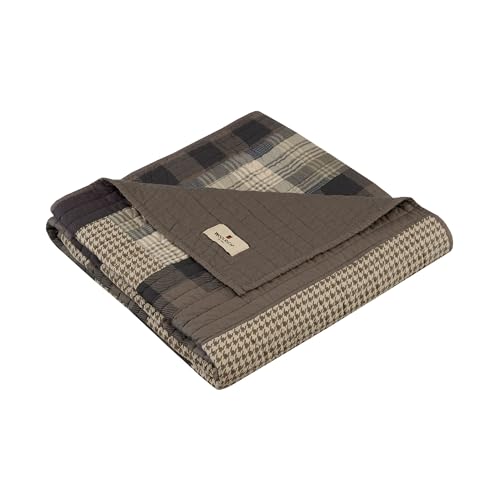
Woolrich Luxury Quilted Throw Cabin Patchwork Alt — Best Neutral Cabin Patchwork
Winter Hills Tan is the same Woolrich cabin patchwork architecture — fifty by seventy inches, quilted, all-season — translated into the quiet register: tans, creams and soft browns that read as texture before they read as pattern. Where Sunset Red enters a room like a story, Winter Hills settles into one like furniture. For the many households that love the cabin idea but live in beige-and-oak reality, this colourway is the bridge: the patchwork grammar, the lodge warmth, none of the chromatic commitment that red demands of its neighbours.
The neutral palette also travels better between rooms and seasons. The tan throw works on a cream sofa in January, a leather chair in June, and the foot of a guest bed whenever the house fills, without any of those settings feeling like a compromise. Its patchwork still gives a plain room the joined, handmade-adjacent rhythm that flat throws lack — the eye reads the squares even when the colours whisper. Buyers deciding between the two Woolrich colourways should decide by the room’s existing courage: red for rooms that can answer back, tan for rooms that prefer their comfort without a headline. Both are the same honest construction wearing different weather.
- Form: quilted patchwork throw, cabin lifestyle design
- Size: 50 x 70 inches
- Colourway: Winter Hills Tan
- Character: lightweight, breathable all-season layer per the maker
- Buying note: check price on Amazon; pairs calmly with cream and leather
Strengths
- Cabin patchwork texture in a go-anywhere neutral palette.
- Same generous seventy-inch length as its red sibling.
- Moves between rooms and seasons without clashing.
Trade-offs
- Too quiet for rooms wanting a bold lodge focal point.
- Light tans show soil sooner in heavy family service.
- Still a tailored patchwork, not a frayed rag construction.
Best for: neutral living rooms and guest beds wanting cabin texture without colour commitment. Not suited for: buyers seeking the dramatic red statement or genuine rag fringe.
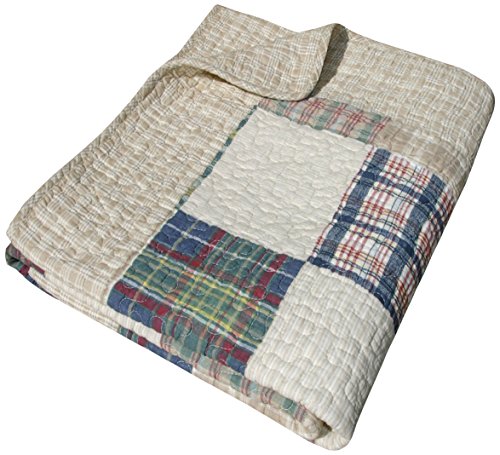
Greenland Home Oxford Cotton Throw Blanket — Best Simple Cotton Throw
The Oxford is this guide’s plain-spoken pick: a one-hundred-percent cotton throw from Greenland Home, fifty by sixty inches, in an even tan, with quilted substance and no pattern whatsoever. Its presence in a patchwork-heavy list is deliberate. Many shoppers who arrive via animal and rag searches discover, on reflection, that what their room actually needs is not another motif but a warm, natural-fibred layer with a handmade-adjacent texture — and the Oxford’s quilted cotton delivers exactly that, at the unfussy end of the family’s price and personality range.
All-cotton construction is the specification that matters here. Cotton breathes in summer, layers in winter, washes without a negotiation, and ages by softening rather than by pilling into embarrassment. The tan colourway is the diplomat of the list — it will sit on any sofa, under any patchwork, beside any animal the household later acquires, including the genuine handmade rag quilt this guide keeps pointing toward. Think of the Oxford as the underlayer of the whole aesthetic: the quiet cotton ground on which louder, more characterful pieces can stand. Rooms are built from such grounds, and throws like this are bought twice by households that learn the lesson once.
- Form: cotton throw blanket with quilted substance
- Size: 50 x 60 inches
- Material: 100% cotton per the maker
- Colour: tan
- Buying note: check price on Amazon; the plain face suits layering
Strengths
- All-cotton build breathes, washes and softens gracefully.
- Pattern-free tan layers under every other pick in this guide.
- Honest, unfussy value in a family of showier throws.
Trade-offs
- No patchwork, no motifs, no cabin theatre at all.
- Plain tan can read as a backdrop rather than a feature.
- Throw dimensions only; not a bed covering.
Best for: layering households and anyone wanting pure cotton substance without pattern. Not suited for: shoppers who came for animals, patchwork or fringe.

Comfy Cubs Muslin Quilted Throw Blanket — Best Soft Muslin Layer
Comfy Cubs built its name on muslin for babies, and this throw — forty-six by sixty-eight inches of quilted cotton muslin in Pacific Blue — is that fabric grown to adult sofa scale. Muslin behaves unlike anything else in this guide: where patchwork stands with quilted structure, muslin drapes, pools and breathes, its gauze weave softening with every wash in the way parents already trust from the nursery. The quilting keeps the layers together and gives the throw its gentle puff; the colour, a calm blue, walks the throw out of the cabin palette entirely and into coastal, nursery-adjacent and plain modern rooms.
Its inclusion here is as the softness candidate. A household furnishing a reading corner for a grandparent, a sofa for a household that runs warm, or a layering stack where every other piece is structured patchwork will find the muslin’s drape is the missing texture. It arrives in a gift box per the listing, which suits its natural role as a present — new-home, new-baby-for-the-parents, the friend who is always cold in other people’s houses. What it is not is patchwork, cabin or animal in any sense, and its delicacy asks for gentler service than the Woolrich pair would tolerate. Bought as the soft layer among stronger personalities, it earns its place; bought as a cabin statement, it would be miscast, and this guide declines to miscast it.
- Form: quilted muslin cotton throw blanket
- Size: 46 x 68 inches
- Colour: Pacific Blue
- Character: lightweight, breathable, softens with washing
- Buying note: check price on Amazon; gift-boxed per the listing
Strengths
- Muslin drape and breathability unlike any patchwork pick.
- Softens with every wash in the trusted nursery manner.
- Calm blue suits modern and coastal rooms the cabin picks cannot.
Trade-offs
- No patchwork or cabin character whatsoever.
- Gauze weave asks for gentler handling than quilted cotton.
- Narrower than the other throws at forty-six inches wide.
Best for: warm households, reading corners and gift-givers wanting the softest cotton layer. Not suited for: lodge styling or rough family-room service.
The Handmade Animal Rag Quilt — The Genuine Article (Prose-Only)
Here is what the real thing looks like, described carefully so you can recognise it anywhere. The quilt is built from squares of cotton or flannel, each square a small sandwich of top fabric, soft middle and backing, sewn together with the seams facing out. Those outward seams are clipped every few millimetres, and after its first proper wash the clipped edges bloom into fringe — soft, uneven, irresistible to fingers — so the quilt’s face is a grid of plush ridges with the squares settling between them. Onto chosen squares, or across a central panel, the maker has appliquéd the animals: a bear in brown flannel, a red hen, a grey owl, each cut by hand and stitched down with the slight wobble that proves a person, not a production line, was driving.
No verified catalogue listing in our pool is this object, which is why this review carries no link and no product code, and why the pick is positioned in this guide as a field guide rather than a purchase. Genuine animal rag quilts are found where handmade goods live: independent quilters selling through craft marketplaces, local quilt shops taking commissions, craft fairs in the autumn, and family cedar chests. Expect the honest economics of handmade work — a price that reflects days of cutting, clipping and sewing, a wait if the quilt is commissioned, and sizing that follows the maker’s patterns rather than a retail standard. Expect also the virtues no catalogue throw in this guide can fully imitate: the fringe’s texture, the chosen animals’ personality, and the knowledge of whose hands made it.
For many readers the practical answer is both-and rather than either-or: a catalogue cousin from this list on the sofa this winter, doing daily service and washing without anxiety, while the genuine article is commissioned, saved for or inherited in its own time and kept for the bed or the chair where heirlooms live. The two purchases are not rivals. The throw is furniture; the rag quilt is a family document that happens to keep you warm. This guide’s promise is simply that you will never mistake one for the other after reading it — and that the five linked picks, judged as what they truly are, are good enough at their own jobs to deserve their places.
- Form: handmade rag quilt — exposed seams, clipped and frayed
- Fabrics: cotton or flannel squares, often with appliquéd animals
- Where found: independent quilters, craft marketplaces, commissions, fairs
- Positioning: heirloom and nursery centrepiece; handmade pricing applies
- Buying note: prose-only by design — no verified pool listing exists for a true animal rag quilt
Strengths
- The genuine frayed-fringe texture no catalogue throw replicates.
- Animals chosen and appliquéd by a maker, personal to the recipient.
- Heirloom character that appreciates in meaning with the years.
Trade-offs
- Cannot be ordered from this guide or delivered by the weekend.
- Handmade pricing reflects days of skilled work, as it should.
- Fringe sheds lint in its first washes and asks for patient care.
Best for: nurseries, heirloom gifts and anyone whose heart is set on the real construction. Not suited for: shoppers who need a washable sofa throw delivered this week.
How Do the Six Options Compare Honestly?
| Pick | Construction | Size | Character |
|---|---|---|---|
| Donna Sharp Driftwood Pieced Cotton Throw Quilt | Pieced cotton, reversible | 50 x 60 in | Contemporary driftwood calm |
| Woolrich Luxury Quilted Throw Cabin Patchwork | Quilted patchwork | 50 x 70 in | Bold Sunset Red cabin |
| Woolrich Luxury Quilted Throw Cabin Patchwork Alt | Quilted patchwork | 50 x 70 in | Neutral Winter Hills calm |
| Greenland Home Oxford Cotton Throw Blanket | Quilted cotton, plain | 50 x 60 in | Pattern-free tan ground |
| Comfy Cubs Muslin Quilted Throw Blanket | Quilted muslin | 46 x 68 in | Soft Pacific Blue drape |
| The Handmade Animal Rag Quilt | Exposed frayed seams, appliqué | Maker’s pattern | The genuine article |
The table is the guide in miniature: five buyable cousins arranged by temperament, and one genuine article that stands outside the catalogue entirely. Shoppers who read the construction column before the character column will choose well, because construction is what arrives in the parcel. Character can be layered, lit and arranged after the fact; seams cannot.
How Do You Style Patchwork and Cabin Throws at Home?
Patchwork is a pattern with a pulse, and it styles best against calm. Drape the Sunset Red Woolrich over a plain sofa and the room organises itself around it; drape it over a patterned sofa and the two patterns hold a loud conversation nobody enjoys. The neutral Winter Hills and the plain Oxford exist for busier rooms — texture without argument. Folding matters more than owners expect: a patchwork throw folded to show its squares in a neat band across a sofa’s arm reads as intentional, while the same throw balled into a corner reads as laundry awaiting a decision.
Layering is where this family shines. The Oxford as the ground layer over a sofa’s back, a Woolrich folded at its foot, and a cushion or two in the palette’s quieter tones builds the stacked, collected look that cabin style actually is — accumulated, not purchased in a single themed afternoon. Beds take the same approach at larger scale: a throw across the foot, squares aligned, over plain bedding. And when the genuine handmade rag quilt eventually joins the household, give it the place of honour alone on a chair or a bed’s top, because fringe is a texture that crowds badly; it wants air around it the way a painting wants a wall.
Seasonal rotation keeps the family honest and the rooms awake. Winter takes the Woolrich pair and the Oxford layered under them; spring promotes the Driftwood’s washed neutrals; summer belongs to the muslin alone, draped where a heavier throw would be resented; autumn, the patchwork season by temperament, brings the cabin colours back with the first fire. A household that rotates discovers it owns more variety than it bought, because each throw reads differently against each season’s light and company. Store the resting throws folded in a breathable place, aired before they are put away, and the rotation becomes one of the small domestic pleasures rather than a chore with a deadline.
Construction remains the buyer’s best protection throughout this family, and it is worth stating the hierarchy plainly before the care questions begin. A pieced quilt is joined from real pieces and can be verified by touch. A patchwork-style quilted throw is a manufactured cousin with genuine quilting and finished seams. A printed throw imitates the look on a single cloth and should be priced and judged as an imitation, however pretty. The five linked picks in this guide occupy the first two tiers honestly; the third tier was excluded on purpose, because a guide about quilts that recommends a photograph of a quilt has stopped being a guide and become a decoration itself.
Size, the second protection, is simpler and more often ignored. A throw’s length decides whether it is furniture or covering: sixty inches dresses, seventy inches envelops. Households that buy the shorter size for a tall family’s sofa spend years watching feet negotiate with an edge, and the negotiation is entirely avoidable with a tape measure and thirty seconds of honesty about who sits there. Width matters at the bed’s foot, where a throw should span with drape rather than perch. Neither number appears in the styled photographs that sell these products, which is exactly why this guide prints them in every single review.
How Should You Wash Cotton Throws and Rag Quilts?
The catalogue throws follow their makers’ labels, and cotton rewards the gentle version of every choice: cool or warm water, a mild cycle, and drying that stops short of scorching. Pieced and patchwork constructions appreciate being washed inside a large laundry bag or with similarly soft company, because their seams work for a living and hard companions — zips, hooks, denim — pick fights with them. The Donna Sharp’s stated machine washability makes it the family’s easiest citizen; treat the others with the same courtesy and they will repay it in years.
The handmade rag quilt, when one joins the house, has its own first-wash ceremony. The initial washes release the clipped lint that creates the fringe, so wash it alone, expect the machine’s filter to have opinions, and shake it outdoors between cycles. A mesh bag or a trip to a commercial machine protects home plumbing during the blooming stage. After the fringe has fully opened, ordinary gentle washing resumes — and the fringe, paradoxically, becomes the most forgiving surface in the house, since a texture made of a thousand small frays cannot be ruined by one more.
What Mistakes Do Buyers Make in This Category?
Believing a search result’s title is the first and most expensive mistake: listings borrow the words rag and animal freely, and buyers who do not read the construction receive a printed throw where a fringed quilt was imagined. This guide’s entire structure — the confession up front, the prose-only genuine article, the cousins labelled as cousins — exists to prevent that one disappointment. Second is buying patchwork for a room that cannot host pattern, then blaming the throw for the argument it starts with the sofa. Third is washing a new throw hot and hard on day one, before its seams have settled into their life, and shrinking the geometry the maker squared so carefully.
Fourth is commissioning the handmade article in a hurry. A rag quilt made to a deadline by an unhappy maker is a poor relative of one made in its own time; if the genuine article is the goal, order it for next season and let this winter’s catalogue cousin carry the sofa. Fifth is forgetting that throws are touched more than they are seen — a household that buys by photograph alone may end up with beauty it does not enjoy holding, which is why the muslin’s softness and the cotton’s honest hand earned their places in a list that could have been all patchwork and palettes.
Which Animals and Motifs Suit Which Rooms?
The lodge canon runs bear, moose, deer, pine and trout, and it suits the rooms it was invented for: timber walls, stone fireplaces, leather and plaid. In such rooms a patchwork in the cabin palette — the Woolrich pair’s home ground — reads as the local dialect, and a handmade rag quilt with a great appliquéd bear becomes the room’s altarpiece. Suburban living rooms borrow the canon at their own risk; a moose needs architecture to lean on, and in a room of pale sofas and chrome the safer borrowings are the palette and the patchwork rather than the literal animal. That is the Driftwood’s whole argument: the cabin’s colours and joins, translated for rooms that cannot host a moose.
Nurseries and children’s rooms run a gentler menagerie — farm animals for the youngest, woodland creatures as they grow — and here the handmade article’s custom nature shines, because a maker can appliqué the exact owl of the exact storybook. Catalogue throws support such rooms as grounds and layers rather than as the menagerie itself: the muslin for softness against small skin, the Oxford as the washable workhorse beneath everything, the patchwork as the room’s warm pattern. Guest rooms, finally, want the animal note at its most diplomatic — texture and palette suggesting the countryside without committing a visiting adult to sleeping under a cartoon bear, which is Winter Hills Tan’s precise and honourable station in life.
How Do You Choose a Throw’s Size and Weight?
Throw sizes look interchangeable in a listing and behave very differently on a sofa. Fifty by sixty inches — the Driftwood and the Oxford — is the classic lap-and-legs throw for one seated person, and folded across a sofa’s back it dresses without overwhelming. Fifty by seventy, the Woolrich pair’s measure, adds the length that tall sitters and two-person sofas spend gratefully: feet covered without the lap’s surrender, a bed’s foot dressed with drape to spare. The muslin’s forty-six by sixty-eight trades width for length, which suits its draping nature — it pools along a body rather than spreading across a bench. Measure your sofa’s seat depth and your own seated length before choosing; a throw is one of the few purchases where ten inches is the whole review.
Weight follows season and household. The all-season quilted throws in this guide are middleweights by design — warm over a lap in a cool room, innocent in summer’s air conditioning — and households in genuinely cold houses should layer them over a heavier blanket rather than asking any single throw to be a duvet. Layering is not a compromise here but the family’s native grammar: cotton over wool, patchwork over plain, muslin over everything in July. A stack of three honest throws, rotated and combined, out-serves one heroic blanket in every month of the year, and each layer can be washed on its own schedule — a practical mercy that anyone who has wrestled a single sodden king-size blanket out of a domestic machine will recognise instantly.
How Do Quilts and Throws Work as Gifts?
Few household objects carry meaning as efficiently as a quilt, which is why the category’s gift logic deserves care. A catalogue throw is the right gift for warmth with no homework attached — the muslin arrives gift-boxed, the patchwork throws arrive ready to drape, and none of them requires the recipient to know anything, store anything special or wait for anything. Housewarmings, hosts, grandparents and the friend with the cold flat are all served by this tier, and the giver’s taste is expressed in the palette: red for the bold household, tan for the careful one, driftwood for the modern one, blue muslin for the gentle one.
The handmade rag quilt is a different order of gift — the kind given at births, weddings and retirements, where the object is expected to outlive the occasion and testify about it. Such gifts succeed when they are commissioned with the recipient inside the decision: the animals chosen for the child’s own story, the colours matched to a room the giver has actually seen, the maker’s name passed on with the quilt so its provenance survives. A surprise heirloom is a gamble; a commissioned one is a collaboration. And the honest giver notes the timeline without embarrassment — a card that says the quilt is being made, accompanied perhaps by a catalogue cousin to keep the recipient warm meanwhile, is a more loving parcel than a rushed imitation of the real thing.
How Can You Tell a Pieced Quilt from a Printed Imitation?
The test takes ten seconds and one fingertip. Run a finger across a square’s boundary: on a pieced quilt you will feel the seam — a slight ridge where two real fabrics were joined — and the fabrics on either side will differ subtly in weave, hand or the way they take the light. On a printed imitation the boundary is flat ink; the squares are a photograph of patchwork printed on a single cloth, and the fingertip slides across the supposed joins without meeting anything at all. Neither object is a crime — printed throws are light, cheap and washable — but they are different objects at different honest prices, and a buyer paying pieced prices deserves pieced goods.
The reverse side tells the same story from behind. A pieced top’s back shows the construction’s evidence — seam allowances, the quilting stitches passing through real layers — while a print’s back is simply the cloth’s other face. Reversibility, which the Driftwood offers, is only possible when both faces are genuinely made. When shopping photographs, look for the listing that shows a corner lifted, a reverse displayed, a seam in close-up; makers proud of construction photograph it. The listing that shows only a styled sofa at a distance may be selling either object, and in this category the difference between them is the entire purchase.
Final Recommendation
Choose with your eyes open and this category rewards you twice — once in the buying and once in the using. For real pieced cotton craftsmanship in a palette that suits modern rooms, take the Donna Sharp Driftwood. For the full cabin statement, take the Woolrich in Sunset Red; for the same grammar whispered, take Winter Hills Tan. The Greenland Home Oxford is the plain cotton ground every layered room needs, and the Comfy Cubs muslin is the soft drape for warm houses and gentle corners. And if the search that brought you here was truly for frayed seams and appliquéd animals, honour it properly: find a maker, commission the genuine article, and let it arrive in its own season. A home that holds both the honest throw and the handmade heirloom has not compromised at all — it has understood the family completely.
One last word belongs to the search itself. The phrase that brought you here names an object the big shops barely stock, and the internet will happily sell you a dozen imitations wearing its name. You now own the knowledge that separates them: seams out and frayed means rag, squares joined and finished means patchwork, a single printed cloth means an imitation of both. Shop with those definitions in hand and every market — catalogue, craft fair or commission — becomes legible. The right quilt is out there in one of those markets; it simply refuses to be all of them at once. Buy the cousin for the sofa’s daily work, commission the heirloom for the room’s memory, and let each be judged by the standards of its own kind — that fairness, extended to a whole category of beautiful and frequently mislabelled things, is the real purchase this guide has been trying to hand you.
Frequently Asked Questions
Are any of these actually rag quilts?
No linked pick is. A rag quilt has exposed seams that are clipped and frayed into fringe; the five linked products are pieced, patchwork or quilted cotton throws — close cousins in the same rustic family, reviewed under their true constructions. The genuine article is described in the prose-only review, with guidance on where handmade animal rag quilts are actually found.
Why is the handmade option not linked?
Because no verified listing in our checked pool is a true animal rag quilt, and this guide links only products it can verify. Rather than invent a product or mislabel a neighbour, we describe the genuine article in full — its construction, fabrics, animals and the marketplaces and makers where it is sold — so readers can pursue it accurately.
Which pick is best for a cabin living room?
The Woolrich pair owns that room: Sunset Red for the bold lodge statement, Winter Hills Tan for the same patchwork character in a neutral register. Both are generously sized at fifty by seventy inches. Layer either over the plain Greenland Home Oxford if the sofa needs a ground layer, and the room has the full cabin textile story in two purchases.
Can these throws go on a bed?
As foot-of-bed layers and accent throws, yes — that is one of their best roles, adding pattern and cotton weight across the bed’s lower third. As full bed coverings, no: at fifty to seventy inches they are throw-sized by design. A household wanting the patchwork look across a whole bed should shop bed quilts in the same makers’ lines rather than asking a throw to be a quilt.
How do I commission a real animal rag quilt?
Start with independent quilters on craft marketplaces and local quilt shops, and search by construction words — rag quilt, exposed seam, frayed — plus your animal. Discuss fabrics early, since flannel frays most generously, agree the size and the animals before cutting begins, and allow the maker’s honest timeline. Expect handmade pricing and a first wash that sheds lint as the fringe blooms; both are signatures of the genuine process.
Can a rag quilt or patchwork throw be hung on a wall?
Yes, and in cabin and nursery rooms a hung quilt is often the room’s best art — textile warmth, pattern and story at a scale no framed print matches. Hang from a sleeve or clips that distribute the weight across the top edge rather than pinning corners, which distort the squares and tear at seams over time. Keep any quilt out of direct sunlight, which fades cotton unevenly and can leave a permanent window-shaped memoir on the fabric. Rotate hung quilts with the seasons if the collection allows it; the rest does the fibres good, and the room enjoys the small ceremony of a new face. A handmade animal rag quilt hung where small hands can reach its lowest fringe will be touched daily — which, depending on the household, is either the point or the reason to hang it one foot higher.
Related Guides
The quilt family branches from the cabin sofa to the nursery and beyond. Best Baby Quilts takes the handmade conversation into the nursery, where soft constructions and safety come first. The binding-and-layer world of blankets continues in Best Acrylic Blankets with Satin Binding, a different fibre family with its own traditions. On the floor beneath the cabin sofa, Best 5×7 Ivory Cream Area Rugs covers the pale foundations that let patchwork colours sing. And for rooms where texture does the decorating quietly, Best Acoustic Rugs explores the thick end of the rug world and what it does to a room’s sound and feel.


