What's inside
- Key Takeaways
- Quick Picks
- How We Chose These Picks
- At a Glance: Capacity, Materials and Hardware
- How Much Headroom Above Your Weight Should You Buy?
- What Actually Fails First on a Standard Chair?
- How Should You Set Up a Wide Chair at a Desk?
- How Do You Measure Your Body for a Wide Seat?
- What Should You Know About Gas Lifts and Tilt Mechanisms?
- Foam, Leather or Mesh: Which Sit Surface Ages Best?
- How Does a Heavy-Duty Chair Change a Whole Home Office?
- What Does Assembly and the First Week Owe You?
- Which Mistakes Do Heavy-Duty Chair Buyers Keep Making?
- What Does a Full Workday Feel Like Across These Tiers?
- How Should You Care for a Chair Built This Heavy?
- Who Should Skip the Heavy-Duty Category Entirely?
- How Should You Read a Heavy-Duty Listing Before Trusting It?
- What Desk Heights and Monitor Positions Suit a Bigger Chair?
- Final Recommendation
- What Changes When Two People Share One Heavy-Duty Chair?
- How Do Heavy-Duty Chairs Behave on Different Floors?
- Frequently Asked Questions
- Related Guides
As an Amazon Associate I earn from qualifying purchases. This post may contain affiliate links at no extra cost to you.
cottageverdict.com is reader-supported. When you buy through links on our site, we may earn an affiliate commission.
Where to buy: every chair below links to its Amazon listing, where you can check price on Amazon and confirm the stated capacity, the seat material and the arm style before ordering, because heavy-duty chairs are expensive to return and worth measuring twice.
Finding the best comfortable heavy-duty office chairs starts with an uncomfortable truth about ordinary task chairs: most are built around a modest weight limit, a narrow seat pan and a gas lift that was never asked to work hard. Sit beyond that design envelope for eight hours a day and the failures arrive in a predictable order — foam that packs down to the plywood by spring, casters that crack at the stem, a tilt mechanism that develops a lean, armrests that wobble loose. A heavy-duty chair is not simply a bigger chair. It is a chair whose frame, base, lift, wheels and cushion were all specified for the load, and this guide reads the six listings below through exactly that lens.
The capacities printed on these listings run from 400 lb to 700 lb, and that spread matters more than the headline numbers suggest. A rating is a ceiling, not a target: a chair rated well above your weight works further inside its comfort zone, so its foam compresses less per hour and its mechanism cycles with less strain. Seat width travels with capacity in this group, because a reinforced frame under a narrow pan would solve the wrong problem. Two of the six use mesh rather than padded upholstery, two hide inflatable lumbar bladders inside the backrest, and one builds its whole case on a steel frame with 5D flip arms. None of them is the right answer for everybody, which is why each review below names the sitter it suits and the sitter it will disappoint.
One language note before the picks. Several listings use phrases about lumbar support and back comfort in their titles. Those phrases describe features — a shaped cushion, an adjustable pad, an inflatable bladder — and this guide treats them that way. A chair can support a working posture and feel kind across a long day; it cannot treat anything, and anyone with persistent pain should talk to a clinician rather than a furniture listing.
Key Takeaways
- Stated capacities here run 400 lb, 500 lb and 700 lb — buy headroom above your weight, not a chair rated exactly at it.
- Two picks breathe through mesh backs and seats; four use padded PU leather or foam upholstery.
- Inflatable lumbar support appears twice, on the 500 lb wide-seat chair and the 700 lb metal-base chair.
- Flip-up arms show up on three models, which helps a wide chair slide closer to the desk.
- The OFIKA entry is the steel-frame specialist, with 5D flip arms and dual rubber casters.
- Wheel and base construction deserve as much attention as the cushion in this weight class.
Quick Picks
| Pick | Badge | Why it earns its place |
|---|---|---|
| 400 lb Executive Office Chair with Flip-Up Arms | The tidy executive | Breathable PU leather, flip-up armrests and a 400 lb rating in a chair that still looks boardroom-calm. |
| Heavy-Duty 400 lb Office Chair with 3D Foam Cushion | Cushion-first 400 | A wide, soft 3D modelling foam seat carries the comfort argument while the rating matches the first pick. |
| 500 lb Big and Tall Office Chair, Extra Wide Seat | Wide with air lumbar | An extra-wide seat, adjustable lumbar support, thick armrest pads and upgraded wheels at a 500 lb rating. |
| 700 lb Big and Tall Office Chair with Metal Base | Top rating, metal base | The highest stated capacity in the guide, on a metal base with quiet rubber wheels and flip-up arms. |
| OFIKA 700 lb Heavy-Duty Office Chair, Steel Frame | Steel-frame flagship | A sturdy steel frame, 5D flip arms and dual rubber casters aimed at buyers who read spec sheets closely. |
| DUMOS 500 lb Heavy-Duty Mesh Office Chair | The breathable 500 | Mesh ventilation, 4D armrests and a wide seat for heavy sitters who run warm at a desk. |
How We Chose These Picks
Capacity came first, and only capacities the listings themselves print were allowed into the argument. Every chair here states its rating in its title — 400, 500 or 700 pounds — so no review below has to guess at the single most important number in the category. Chairs that merely called themselves big and tall without printing a figure were left out, however plush their photographs looked.
Structure came second. In this class the base, the lift and the casters carry the consequences of every sit-down, so the guide favours listings that talk about their hardware: a metal base, a steel frame, upgraded wheels, dual rubber casters, quiet rubber wheels. A thick cushion on an unspecified base is a promise with the evidence missing, and the reviews say so when a listing leans on foam while staying quiet about what holds it up.
Comfort features came third, and they were sorted by kind rather than counted. Adjustable lumbar support, an inflatable bladder, a shaped 3D foam pan and a mesh back solve different problems for different bodies, so each pick below is presented as an answer to a particular sitter’s day. Readers who care less about maximum capacity and more about posture mechanics across long computer sessions may also want our companion guide to Best Computer Chairs for Posture and Comfort, where the emphasis shifts from load ratings to lumbar geometry. This guide stays on the heavy-duty brief: strength first, then the comfort that strength makes possible.

400 lb Executive Office Chair with Flip-Up Arms — The tidy executive
This is the entry point to the guide and, for many buyers, the sensible ceiling as well. The listing pairs a 400 lb rating with breathable PU leather upholstery and flip-up armrests, a combination aimed at the home office that doubles as a meeting background. The executive silhouette is deliberate: a high back, padded arms and a black finish that reads as furniture rather than equipment. If your current chair is a standard task model that has started to creak, this is the smallest step up that still changes every load-bearing part of the experience.
The flip-up arms deserve more credit than they usually get. A wide chair with fixed arms often cannot tuck under a desk, so the sitter ends up perched forward, away from the backrest they paid for. Arms that rotate up and out of the way let this chair slide in close, and they also make side entry easier for anyone who transfers from a mobility aid or simply prefers to sit down sideways first. Breathable PU leather is the listing’s answer to the usual vinyl complaint — it will not breathe like mesh, but it wipes clean in seconds, which matters in a working room that also hosts coffee.
Consider this chair the diplomat of the group. It asks the least of your room — no extreme width, no industrial hardware on show — while quietly upgrading every component that a standard chair would eventually surrender. For a first heavy-duty purchase after a failure, that balance is often exactly right: enough rating to restore confidence, enough restraint to keep the office looking like an office. Buyers who later discover they live in their chair eighteen hours a day can step up a tier with this model still serving honourably as the household’s second desk chair.
- Stated capacity: 400 lb, per the listing title
- Upholstery: breathable PU leather in black
- Armrests: flip-up design for close desk tuck-in
- Format: big and tall executive computer chair
- Where to buy: the 400 lb Executive Office Chair with Flip-Up Arms listing on Amazon — check price on Amazon
Strengths
- Flip-up arms solve the wide-chair-under-desk problem neatly
- Executive styling suits client-facing video calls
- PU leather wipes clean after spills and dust
Trade-offs
- Lowest capacity in this guide, so heavier sitters should step up
- Padded upholstery sleeps warmer than either mesh pick
- The listing leads with looks, so hardware detail is thinner here
Best for: buyers under the 400 lb line who want a heavy-duty chair that still presents as a calm executive seat. Not suited for: anyone close to the rating, who should buy the headroom of a 500 lb model instead.
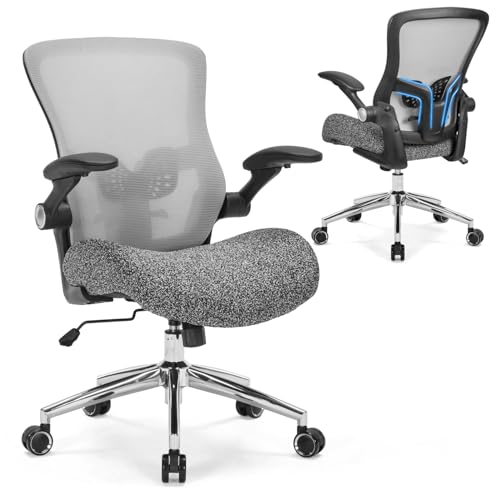
Heavy-Duty 400 lb Office Chair with 3D Foam Cushion — Cushion-first 400
Where the first pick argues from silhouette, this one argues from the seat pan. Its listing headline is a wide and soft 3D modelling foam cushion, and that focus makes sense: in a chair rated at 400 lb, the cushion is where the rating becomes a feeling. A pan shaped in three dimensions spreads pressure across the thighs instead of concentrating it at the front edge, and a wide profile gives larger sitters room to shift position across the day rather than being held in one moulded pose.
Adjustable seat height is the other named feature, and it matters more in this class than brands admit. Heavier sitters compress foam further, which effectively lowers the seated position; a generous height range lets you restore the geometry — feet grounded, knees near level — that the cushion’s shape was designed around. As a home office desk chair it keeps the executive task format of the first pick, so the honest choice between the two is arms versus cushion: flip-up convenience on one side, a more engineered seat on the other.
There is also a posture dividend to a pan that holds its shape. When a seat compresses unevenly, the pelvis tilts without asking permission, and the backrest’s support lands in the wrong county by lunchtime. A moulded cushion that keeps its geometry keeps the whole sitting stack aligned — hips level, back in contact, feet honest on the floor. None of that is a medical promise; it is simply what happens when the foundation of a chair behaves like a foundation instead of a cushion that gave up in March.
- Stated capacity: 400 lb, per the listing title
- Seat: wide 3D modelling foam cushion
- Adjustment: adjustable seat height
- Format: executive computer task chair for heavy people
- Where to buy: the Heavy-Duty 400 lb Office Chair with 3D Foam Cushion listing on Amazon — check price on Amazon
Strengths
- Shaped foam pan targets pressure spread, not just softness
- Wide seat suits sitters who change position often
- Height range compensates for deeper foam compression
Trade-offs
- Shares the guide’s lowest rating tier at 400 lb
- No flip-up arms are named, so desk clearance needs measuring
- Foam-forward listings say less about base construction
Best for: sitters whose main complaint about their current chair is a seat that feels thin by midday. A poor fit for: buyers who need arms that clear a low desk apron or a keyboard tray.

500 lb Big and Tall Office Chair, Extra Wide Seat — Wide with air lumbar
Stepping to a 500 lb rating changes the shopping question from survival to comfort, and this chair spends its budget accordingly. The listing names an extra-wide seat, adjustable lumbar support, thick armrest pads and a heavy-duty base with upgraded wheels. Read together, that is a chair designed for long occupancy: width for posture changes, lumbar adjustment for the lower back’s curve, padded arms because elbows carry real weight across an eight-hour day, and wheels specified as an upgrade rather than an afterthought.
The lumbar system is described in the listing alongside back-comfort language, and the honest translation is mechanical: a support element you can position beats a fixed bulge moulded where the average spine might be. Big and tall spines are not average, so adjustability is the feature, full stop. The thick armrest pads make a similar point at a smaller scale. On many chairs the arms are hard plastic ledges; here they are treated as load-bearing furniture, which your forearms will notice during long calls.
Think of this model as the guide’s long-haul seat. Its specification reads like a list of answers to complaints gathered over years: the seat is wide because narrow seats exile larger sitters to the front edge; the wheels are upgraded because standard casters are where heavy chairs go to die; the arm pads are thick because elbows are bony and desks are long. If your work involves settling in for multi-hour stretches of writing, analysis or calls, the accumulation of those answers is the product being sold.
- Stated capacity: 500 lb, per the listing title
- Seat: extra-wide executive profile
- Support: adjustable lumbar support element
- Hardware: heavy-duty base with upgraded wheels
- Where to buy: the 500 lb Big and Tall Office Chair, Extra Wide Seat listing on Amazon — check price on Amazon
Strengths
- Extra width plus adjustable lumbar suits varied postures
- Thick armrest pads treat elbows as load points
- Upgraded wheels acknowledge how casters fail first
Trade-offs
- Extra-wide footprint needs a measured desk bay
- Padded build runs warmer than the mesh alternatives
- Arm style is fixed rather than flip-up
Best for: heavier sitters who work long, mostly stationary days and want width everywhere — seat, arms and support. Not the right match for: compact desks where an extra-wide chair cannot tuck or turn freely.

700 lb Big and Tall Office Chair with Metal Base — Top rating, metal base
Two chairs in this guide claim 700 lb, and this one builds its identity around the base. A metal base at this rating is not a styling choice; it is the structural answer to the spider-leg flex that makes lesser chairs feel uncertain during a lean. The listing adds an extra-wide padded seat, flip-up arms, an inflatable lumbar support and quiet rubber wheels, which together read as a deliberate spec: strength underneath, adjustability in the back, silence at the floor.
Inflatable lumbar support deserves a plain explanation. A small air bladder inside the backrest can be pumped up or softened, so the support meets your spine at the firmness you choose rather than the firmness a foam mould assumed. For sitters whose preference changes between morning focus and afternoon fatigue, that dial-a-feel quality is genuinely useful. Quiet rubber wheels complete the picture for shared spaces — a heavy chair rolling on hard casters announces every movement, while rubber treads keep a home office civilised during calls.
The ownership experience at this tier is defined by absence: absence of flex when you lean for a dropped pen, absence of sink when you return from lunch, absence of the small negotiations lesser chairs demand all day. That absence costs weight and money, and the listing does not pretend otherwise. For the sitter who has already paid once for a chair that failed, paying properly the second time is not extravagance; it is the cheaper of the two available strategies, and this model is its clearest expression in the guide.
- Stated capacity: 700 lb, per the listing title
- Base: metal, with quiet rubber wheels
- Support: inflatable lumbar bladder in the backrest
- Arms: flip-up, over an extra-wide padded seat
- Where to buy: the 700 lb Big and Tall Office Chair with Metal Base listing on Amazon — check price on Amazon
Strengths
- Highest capacity tier with a base material to match
- Inflatable lumbar lets firmness change through the day
- Rubber wheels roll quietly on hard floors
Trade-offs
- Metal-base builds are heavy to unbox and reposition
- Padded seat is the warm option at this rating
- Bladder systems add a pump bulb some sitters dislike
Best for: the heaviest sitters in the guide, and anyone whose previous chair failed at the base or lift. Poorly suited to: small rooms where a chair this size must be moved often.

OFIKA 700 lb Heavy-Duty Office Chair, Steel Frame — Steel-frame flagship
OFIKA’s listing reads like an engineer’s reply to the category: a 700 lb rating, a sturdy steel frame, 5D flip arms, adjustable lumbar support, a thick padded seat and dual rubber casters. The 5D arm claim is the headline for adjusters — arms that move in more planes let a wide chair fit both a broad-shouldered sitter and a narrow desk, and because they flip, the chair still tucks away at night. Dual rubber casters spread rolling load across paired wheels, a small detail with outsized value on floors that dent.
Between the two 700 lb chairs, the choice is philosophical. The metal-base model above centres its story on the inflatable back and quiet wheels; the OFIKA centres its story on frame and arms. Buyers who fidget with arm position — typing, writing, gaming, leaning — will feel the OFIKA’s advantage hourly. Buyers whose backs demand changing support through the day will feel the other chair’s bladder more. Neither is a compromise pick; both are complete, and the spec box below exists so you can choose by hardware rather than by photograph.
One more OFIKA trait deserves emphasis: adjustability compounds. Arms that move in several planes, lumbar support that repositions, a seat at the right height — each setting is small, but together they let a very large chair fit a specific body with unusual precision. That precision is what separates a chair bought by the numbers from a chair tuned by its owner, and it rewards the buyer willing to spend the first evening with the adjustment levers rather than treating setup as a one-time event.
- Stated capacity: 700 lb, per the listing title
- Frame: sturdy steel construction
- Arms: 5D flip arms with adjustable lumbar support
- Casters: dual rubber casters under a thick padded seat
- Where to buy: the OFIKA 700 lb Heavy-Duty Office Chair, Steel Frame listing on Amazon — check price on Amazon
Strengths
- Steel frame answers the category’s main failure mode
- 5D flip arms offer the guide’s widest arm adjustment
- Dual casters spread floor load and roll smoothly
Trade-offs
- Feature density means a longer, fussier assembly
- Padded upholstery again trades airflow for cushion
- Arm complexity adds parts that need periodic tightening
Best for: spec-driven buyers at the top weight tier who adjust their chair constantly and value frame engineering. Not suited for: minimalists who want the fewest moving parts possible.

DUMOS 500 lb Heavy-Duty Mesh Office Chair — The breathable 500
Every padded chair in this guide carries the same asterisk: foam insulates. For heavy sitters in warm rooms, that asterisk becomes the whole review by July. The DUMOS answers with mesh — a 500 lb heavy-duty mesh chair with a wide seat, comfortable lumbar support, 4D armrests and 360-degree swivel rolling wheels. Mesh suspends rather than stuffs, so air moves through the back and the seat stays closer to room temperature across a long afternoon.
The trade is feel. A suspended mesh pan has a firmer, more hammock-like sit than deep foam, and some sitters love the definition while others miss the sink. The 4D armrests help the chair fit different desk heights and shoulder widths, and the wide seat keeps the mesh option from being the narrow consolation prize it is in lesser lineups. If heat has ended more of your workdays than cushioning ever has, this is the heavy-duty chair in the guide that was clearly specified with your afternoons in mind.
There is a secondary benefit to mesh that rarely makes the listings: it forgives irregular days. A chair that stays at room temperature is equally pleasant for a twenty-minute email check and a six-hour project, whereas deep foam can feel like a commitment on short sits in summer. Households sharing one desk between homework, admin and a day job often find the mesh chair is the one nobody complains about, which in a shared home office is a genuine specification in its own right.
- Stated capacity: 500 lb, per the listing title
- Material: heavy-duty mesh back and seat format
- Armrests: 4D adjustable, with lumbar support
- Movement: 360-degree swivel on rolling wheels
- Where to buy: the DUMOS 500 lb Heavy-Duty Mesh Office Chair listing on Amazon — check price on Amazon
Strengths
- Mesh airflow suits warm rooms and long summers
- 4D arms fit varied desks and shoulder widths
- Wide seat keeps the breathable option full-sized
Trade-offs
- Suspended mesh feels firmer than deep foam pans
- Mesh shows dust and needs a vacuum pass occasionally
- No flip-up arm trick for very tight desk bays
Best for: heavy sitters who run warm and have watched padded chairs turn into radiators by mid-afternoon. A poor fit for: anyone who equates comfort strictly with the deepest possible cushion.
At a Glance: Capacity, Materials and Hardware
| Chair | Listing capacity | Sit surface | Hardware note |
|---|---|---|---|
| 400 lb Executive Office Chair with Flip-Up Arms | 400 lb | Breathable PU leather | Flip-up armrests |
| Heavy-Duty 400 lb Office Chair with 3D Foam Cushion | 400 lb | 3D modelling foam | Adjustable seat height |
| 500 lb Big and Tall Office Chair, Extra Wide Seat | 500 lb | Extra-wide padded seat | Heavy-duty base, upgraded wheels |
| 700 lb Big and Tall Office Chair with Metal Base | 700 lb | Extra-wide padded seat | Metal base, quiet rubber wheels |
| OFIKA 700 lb Heavy-Duty Office Chair, Steel Frame | 700 lb | Thick padded seat | Steel frame, dual rubber casters |
| DUMOS 500 lb Heavy-Duty Mesh Office Chair | 500 lb | Mesh | 4D armrests, swivel wheels |
How Much Headroom Above Your Weight Should You Buy?
Treat the printed rating as the chair’s maximum, then shop as though it were a bridge limit. A sitter well under the ceiling loads the lift, the foam and the casters at a fraction of their design stress on every sit-down, and that margin is what turns a two-year chair into a five-year chair. Dynamic load matters too: nobody lowers themselves into a chair at laboratory gentleness after a long day, and the small drop of a real sit-down briefly multiplies the force the base must absorb.
Practical translation: if you sit near a tier boundary, buy the next tier up. The price difference between the 400 lb and 500 lb classes here is usually smaller than the cost of replacing a failed chair early, and the wider seats in the higher tiers tend to suit the same buyers anyway. Weight also distributes differently — two sitters at the same scale reading can load a chair very differently depending on height and build — which is another reason the honest shopper buys margin rather than arithmetic equality.
What Actually Fails First on a Standard Chair?
Ask anyone who has killed an ordinary office chair and the story rarely starts with the frame snapping. It starts with a caster stem cracking, a lift that sinks an inch overnight, foam that stops recovering, or arm pads that split at the seam. Heavy-duty specification is really about reordering those failure points: stronger casters, a base that does not flex, foam dense enough to keep its shape under greater compression. That is why this guide keeps returning to hardware words in the listings — metal base, steel frame, upgraded wheels — because those are the parts whose failure ends a chair’s life.
Your own inspection can mirror that logic. When a chair arrives, sit and shift deliberately: roll across a floor joint, lean to each side, rise and sit again. A well-built heavy-duty chair feels boring during all of it, and boring is the compliment. Squeaks in week one become wobbles by month six, so the unboxing week is when an exchange is painless and worth insisting on.
How Should You Set Up a Wide Chair at a Desk?
Start with the floor. Heavy chairs on hard casters can mark softwood and laminate, so a chair mat rated for substantial weight earns its keep; on carpet, larger wheels roll with less digging. Set seat height so your feet rest fully — a wide, deep pan can tempt shorter-legged sitters to perch forward, which abandons the backrest entirely. Flip-up arms, where fitted, should be used actively: arms down for reading and calls, arms up when you need to pull in close for focused typing.
Then give the chair its turning circle. An extra-wide chair in a bay sized for a standard task chair will clip the desk legs all day, loosening its own arms and annoying its owner in equal measure. Measure the bay, compare it with the listing’s footprint, and remember that comfort in this category is partly architectural. Readers furnishing a whole room rather than a single desk sometimes pair a serious work chair with softer seating for reading hours; our roundup of Best Mid-Century Modern Chairs for Comfort covers that lounge end of the room, where capacity matters less and upholstery matters more.
How Do You Measure Your Body for a Wide Seat?
Seat shopping by photograph fails because chairs photograph at their most flattering angle and bodies do not come in listing sizes. Measure instead. Sit on a hard dining chair with a tape across your thighs at their widest point, then add breathing room on both sides; that total is the minimum pan width that will feel generous rather than containing. Next, measure from the back of your knee to your back while seated — the seat depth you want ends a couple of fingers short of that line, so the front edge never presses into the calf when your back is properly against the backrest.
Height deserves the same treatment. Your desk’s underside, your thigh thickness and your preferred foot position form a triangle that a stated seat-height range either fits or does not. Heavier foam compression lowers the real seated height below the catalogue figure, which is why the adjustable range on the 3D foam pick matters in practice. Write your three numbers down before ordering anything in this guide; the listings that match them will choose themselves far more honestly than any badge can.
What Should You Know About Gas Lifts and Tilt Mechanisms?
The gas lift is the silent partner in every capacity claim. It raises you, holds you and absorbs the small shock of every sit-down, and in a heavy-duty chair it works at pressures a standard lift never sees. Listings rarely print lift classes, so the shopper’s proxy is the company the lift keeps: chairs that specify metal bases, steel frames and serious casters are telling you the whole load path was considered, while a chair that specifies nothing below the cushion is asking you to trust the part you cannot see.
Tilt behaviour changes with load as well. A mechanism tuned for a lighter sitter can feel locked solid under a heavier one, or give way too eagerly if its tension range tops out early. When your chair arrives, spend the first session adjusting tension in small turns and testing the recline with your feet grounded; the right setting lets you lean back with intent rather than either wrestling the chair or falling through its range. That ten-minute ritual is the difference between a chair that feels custom and one that feels merely large.
Foam, Leather or Mesh: Which Sit Surface Ages Best?
Each surface in this guide ages along a different curve. PU leather looks immaculate on day one and asks only for a damp cloth, but its enemy is flex fatigue at the seat’s front edge, where repeated compression can eventually crease the finish. Shaped foam like the 3D cushion spreads that flex across a moulded form, and density is its destiny: a well-made dense pan softens slowly and evenly, while a cheap one develops a personalised crater exactly where you sit most.
Mesh ages by tension rather than by compression. A good weave holds its suspension for years and never develops a crater, though it can gradually relax at the centre of the pan, changing the sit from defined to hammocky. None of these curves is a scandal; they are simply different maintenance stories. Leather wants wiping and occasional conditioning of your expectations, foam wants rotation of your sitting habits where possible, and mesh wants a vacuum and a check that its frame bolts stay snug as the seasons change.
How Does a Heavy-Duty Chair Change a Whole Home Office?
A chair in this class is a piece of architecture. It occupies more floor, turns through a wider arc and asks the desk, the mat and the doorway to accommodate it, so buying one is a small room-planning exercise disguised as a furniture purchase. The payoff is that everything else can relax: a desk no longer needs to double as a leaning post, a footrest becomes an option instead of a rescue, and the room’s traffic lanes can be arranged around a chair that stays where it is parked instead of migrating on failing casters.
The same whole-room thinking applies when a home office shares a small flat with a compact kitchen. Readers setting up a first proper workspace in a rental often end up solving two tight-space puzzles in the same month, which is why our guide to Best 20-Inch Electric Ranges takes the same measure-first approach to a 20-inch cooking slot that this guide takes to a desk bay. In both rooms, the honest sequence is identical: measure the opening, read the stated dimensions, and only then fall in love with a particular model.
What Does Assembly and the First Week Owe You?
Expect a heavier box and a two-person lift for the top-tier chairs; steel frames and metal bases do not travel light. Build the chair on the floor it will live on, because carrying an assembled wide chair through a doorway is a puzzle nobody enjoys twice. Keep the hex key. Heavy-duty chairs reward a bolt check at the end of week one, once the parts have settled under real load, and again at the change of seasons — five minutes with a key is the cheapest warranty in furniture.
Use the first week as a structured trial rather than a first impression. Day one judgments are dominated by the contrast with your old chair; by day five your body has data about the lumbar position at hour six, the arm pads during a long call, and the casters over your particular floor joint. If something is wrong, that is the week when exchanges are simple. If everything is boringly right, you have bought the thing this category exists to sell: a chair you stop thinking about entirely.
Which Mistakes Do Heavy-Duty Chair Buyers Keep Making?
The classic error is buying the rating and ignoring the seat. A 700 lb chair with a pan too narrow or too deep for your body will be strong, durable and quietly miserable. The second error is treating all mesh as flimsy and all foam as supportive; in this guide the mesh pick carries the same 500 lb statement as a padded rival, while foam quality varies enormously between a shaped 3D cushion and a flat slab. The third error is skipping the floor question until the casters have engraved it — wheel material and floor surface should be decided together, on day one.
A fourth mistake is subtler: assuming the chair must do every job in the house. A heavy-duty desk chair is tuned for upright work at a surface. It will recline a little, but it is not a reading lounger, a gaming cockpit or a nap pod, and judging it as one produces unfair reviews and real returns. Buy the chair for the eight hours it was designed around, and let other furniture handle the other hours.
What Does a Full Workday Feel Like Across These Tiers?
Imagine the same Tuesday spent in each class. In a 400 lb chair that fits you properly, the morning is unremarkable in the best way: the seat takes your weight without a creak, the backrest meets you when you lean into a document, and the arms hold a notebook during a call. The tier shows its limits only at the margins — a long afternoon of shifting and perching asks more of the foam, and a sitter near the rating will feel the chair working nearer its ceiling, the way a car feels different at the top of its range than in the middle of it.
The 500 lb tier is where the day flattens out. There is simply more chair around you: more width to change position in, more cushion depth before the pan’s structure makes itself known, more caster under every roll to the printer. The 700 lb chairs add a different sensation again — a kind of structural silence. Nothing flexes, nothing ticks, nothing asks to be babied when you drop into the seat with a laptop in one hand and a mug in the other. People who have broken chairs before describe that silence as the actual product, and they are not wrong.
How Should You Care for a Chair Built This Heavy?
Care scales with construction. Upholstered models want a weekly wipe and a monthly pass over the seams where dust collects; mesh wants the vacuum’s upholstery brush and a check that pet hair has not matted into the weave’s lower edge. Casters deserve the most attention and get the least: hair and grit wound around a caster axle act like a brake and a file at once, so flip the chair once a season, clear the wheels, and spin each one by hand to confirm it still rolls freely.
Keep the chair out of punishing sun where you can, since upholstery finishes and foam both age faster under daily ultraviolet through a south-facing window. If your floor is hard, a mat protects both the surface and the wheels; if your floor is carpet, expect rolling to feel heavier and give the casters a firmer push rather than rocking the chair sideways, a motion that stresses the base arms sideways in a way they were not designed to enjoy.
Who Should Skip the Heavy-Duty Category Entirely?
Honesty cuts both ways: not every large sitter needs this class, and not every buyer in this class is large. If your weight sits comfortably inside a standard chair’s stated limit and your complaint is purely about lumbar shape or arm height, a posture-focused chair may serve you better than a reinforced one — capacity you never use buys width you may not want. Equally, a petite sitter in a household where the chair is shared with a much larger partner should shop for the larger body first; the smaller sitter can adapt with a cushion, while the larger sitter cannot adapt to a frame beyond its rating.
Renters in walk-up buildings should also weigh the logistics honestly. A steel-frame flagship is a wonderful chair and a miserable staircase companion, and if your lease or your knees make furniture churn a fact of life, the mid-tier chairs deliver most of the comfort with noticeably less iron to haul. The right purchase is the one that survives your building as gracefully as it survives your workday.
How Should You Read a Heavy-Duty Listing Before Trusting It?
Read the listing the way an insurer reads a claim: grateful for specifics, suspicious of adjectives. A trustworthy heavy-duty listing prints its capacity as a number, names its base or frame material, and describes its wheels as though they matter — because the seller knows buyers in this class have been disappointed before. A listing that offers only words like sturdy, premium and ergonomic, with no figures attached, is asking adjectives to do the work of engineering.
Photographs deserve the same discipline. Look for the underside: the base’s shape, the lift’s housing, the way the arms attach. Zoom in on the caster stems. Check whether the chair is shown with a person whose build resembles yours, or only floating in a white void at a flattering three-quarter angle. Then read the questions section on the listing, where owners ask the things brochures avoid — whether the lift still holds after a year, whether the arms loosen, whether the seat stayed firm through a summer of daily use.
Finally, plan the return before you need it. Heavy chairs are among the most awkward parcels in home shopping, so confirm how a return would physically happen while you are still cheerful about the purchase. Keep the box until the trial week ends. A chair that cannot be sent back without a engineering project deserves a longer, more careful first week than one with a painless exit, and knowing which situation you are in changes how honestly you judge those first days.
What Desk Heights and Monitor Positions Suit a Bigger Chair?
A larger chair changes the geometry around it. The seat often sits a touch higher and considerably wider, so the monitor that was perfect at your old chair may now float low or crowd close; raise the screen until its top third meets your natural sightline when your back is actually resting on the backrest, not perched in your typing crouch. Keyboard position follows the arms: with padded or 5D arms set correctly, your forearms should arrive at the desk roughly level, shoulders dropped rather than shrugged.
Foot position closes the loop. If the deeper, higher seat leaves your feet light on the floor, a simple footrest restores the grounded feeling that keeps you from sliding forward — the slide that quietly cancels every lumbar feature you paid for. Recheck all three points after the first week, because foam settles, settings drift as bolts bed in, and the chair you tuned on delivery day is not quite the chair you own on day eight.
Final Recommendation
Most buyers should start at the 500 lb tier, where this guide’s two strongest all-rounders live: the extra-wide padded chair with its adjustable lumbar and thick arm pads for foam loyalists, and the DUMOS mesh chair for anyone who works in a warm room. Sitters who need the ceiling should choose between the two 700 lb designs by temperament — inflatable lumbar and quiet wheels on the metal-base model, steel frame and 5D arms on the OFIKA. The two 400 lb chairs remain honest picks for buyers comfortably under their rating who prefer an executive look or a shaped foam seat. Whichever tier you choose, measure your desk bay before the box arrives, because the best comfortable heavy-duty office chairs only feel comfortable in a room that gives them space to work.
What Changes When Two People Share One Heavy-Duty Chair?
Shared chairs live harder lives than the brochures imagine. Two sitters means two heights, two lumbar preferences and twice the sit-down cycles, so the adjustable models in this guide earn an extra point in a household where a partner borrows the good chair for evening admin. Agree on a reset ritual — height back to the marked notch, arms back to the agreed width — or accept that the first five minutes of every session will be spent re-tuning instead of working.
Sharing also argues for the middle tiers. A chair bought with headroom for the larger partner automatically carries margin for both, and features like flip-up arms or inflatable support adjust in seconds between users in a way that a fixed moulded back never can. Keep the adjustment key and any pump bulb in the desk drawer rather than the packaging in the attic; shared furniture only stays tuned when the tools for tuning it live within arm’s reach of the seat itself.
How Do Heavy-Duty Chairs Behave on Different Floors?
On hardwood and laminate, the wheel material writes the review. Hard plastic casters concentrate a heavy load onto small, unforgiving contact patches and can track marks into softer finishes over a season of rolling; the rubber and dual-rubber wheels named on several listings here spread that contact and roll with a duller, kinder sound. A mat remains the belt-and-braces answer, and at these weights it should be a rigid or heavy-duty mat rather than a thin sheet that curls at the edges and becomes a trip hazard in its own right.
On carpet the problem inverts: the chair stops wanting to roll at all. Pile swallows small wheels, so every trip to the printer becomes a tug, and tugging sideways is precisely the motion that loosens arm assemblies over time. Larger wheels help, a low-pile carpet helps more, and a mat designed for carpet restores the glide entirely. Whichever floor you have, decide its pairing with the chair before delivery day; retrofitting floor protection after the first scratches appear is a small but genuine regret that this category’s buyers mention often.
Frequently Asked Questions
Does a higher weight rating automatically mean a more comfortable chair?
No. The rating describes structural capacity, while comfort comes from seat width, cushion design, lumbar placement and arm fit. A higher tier often brings a wider seat as a side benefit, but a 400 lb chair with the right pan shape can easily out-sit a stronger chair whose dimensions fight your body.
Are mesh chairs really strong enough at these capacities?
The mesh pick in this guide states a 500 lb rating in its own listing, the same figure as a padded rival here. Mesh strength lives in the frame and the suspension weave rather than in foam density, so judge it by the stated capacity and frame construction, not by an assumption that fabric means fragile.
What does inflatable lumbar support actually do?
It places a small air bladder inside the backrest that you can firm up or soften with a pump. The benefit is adjustability through the day: more presence during upright morning work, less during a relaxed afternoon. It is a comfort feature described in listing language, not a medical device or a treatment.
Why do the wheels matter so much on a heavy-duty chair?
Casters carry concentrated load at five small contact points and absorb every roll over a floor joint or rug edge. Upgraded, dual or rubber wheels spread that stress and roll more smoothly under weight, which is why several listings here name their wheels explicitly instead of treating them as invisible hardware.
How long should a heavy-duty chair realistically last?
Longevity follows the load margin more than the calendar. A chair used well inside its rating, on suitable wheels, with its bolts checked seasonally, should serve for years of daily work; the same chair used at its ceiling on the wrong floor will age in dog years. Foam is usually the first consumable, mesh tension the second, and the lift the third — all replaceable in principle, though in practice most owners replace the chair when the second item on that list fades.
Can a chair this wide fit through a normal doorway?
Most arrive unassembled, so the box and the parts pass through standard doors easily; the assembled chair is the wide object, and it usually travels room to room on its casters. Measure any narrow hallway turn if you plan to move the finished chair between rooms regularly.
Related Guides
Heavy-duty seating connects to several neighbouring questions on this site. If your workday is long but your frame is average, the posture-focused picks in Best Chairs for All-Day Computer Work approach comfort from lumbar geometry rather than load rating. And if furnishing a whole home has you comparing rooms at once, note that compact appliances raise the same measure-twice discipline — a theme our kitchen guides return to often. Start with the chair that fits your body and your bay, and the rest of the room can be planned around it.


