What's inside
- Key Takeaways
- Quick Picks
- How We Chose These Picks
- Glide, Rock, Swivel, Recline: Which Motions Does a Nursery Actually Need?
- Six Nursery Gliders, Reviewed for the Night Shift
- Setting Up the Chair Corner: What a Feeding Station Needs
- Six Chairs, Six Motion Recipes: The Comparison
- What Do Parents Regret After Buying a Nursery Glider?
- The 3 A.M. Test: What the Chair Must Do in the Dark
- Two Parents, One Chair: Sharing the Night Shift
- Keeping the Chair Clean in the Splash Zone
- Twins, Toddlers and the Chair’s Wider Family Life
- Gift-Buying a Glider: Notes for Grandparents and Friends
- Final Recommendation
- Frequently Asked Questions
- Related Guides
As an Amazon Associate I earn from qualifying purchases. This post may contain affiliate links at no extra cost to you.
cottageverdict.com is reader-supported. When you buy through links on our site, we may earn an affiliate commission.
Where to buy: each glider below links to its Amazon listing, where you can check price on Amazon and confirm the upholstery colour, whether an ottoman is included, and the motion the chair actually offers — glide, rock, swivel, recline — before ordering. Nursery chairs are bought for years of nightly use, so the listing’s dimensions deserve a tape measure’s attention against your room.
The best glider chairs for babies are chairs for adults, and this guide will keep saying so, because the distinction organises everything else. A nursery glider is where a parent sits — at 3 p.m. for a feed, at 3 a.m. for the feed after that — holding a baby who appreciates motion and a parent who appreciates a chair that provides it without effort. The baby never sits in the chair alone; the parent sits in it ten thousand times. So this is a guide about adult comfort in a small, quiet room: the smoothness of a glide, the height of an arm under a feeding elbow, the fabric’s behaviour under the nursery’s honest traffic of milk, and whether the chair can hold its place in the home after the nursery years end.
The motion vocabulary matters, so let us define it once. A glider moves on a fixed base in a flat, horizontal slide — forward and back along a straight track, which is why gliders feel stable and why they can sit close to a wall. A rocker moves on curved rails in an arc, tipping as it travels, and needs clearance behind it. Many nursery chairs blend the two, and several in this guide add a swivel, a recline, or both. The six below include the classic wooden hoop glider with its matching ottoman, two upholstered glider recliners, an electronic power recliner with a wide swivel, a teddy-fabric glider rocker, a corduroy nursing chair with side pockets and a stated capacity, and a swivel rocker recliner in white — a range that covers most of what a nursery can ask a chair to do.
One boundary, stated early and kept throughout: this guide makes no claims about infant sleep safety, because a chair is not a sleep surface for a baby and nothing here should be read as suggesting otherwise. Babies sleep in cots and bassinets built and certified for that purpose. The glider’s job is narrower and, at 3 a.m., more precious: to give the adult holding the baby a smooth, quiet, supportive place to sit while the baby drifts off in their arms — after which the baby goes to their own safe sleep space, and the parent, often, stays in the chair a moment longer than strictly necessary.
Key Takeaways
- These are adult chairs for feeding, soothing and sitting with a baby — never a sleep surface for the baby.
- Glide, rock, swivel and recline are different motions; the six chairs here combine them in genuinely different ways.
- The Storkcraft is the classic: a hoop glider with matching ottoman, storage pockets and GREENGUARD Gold certification as listed.
- The Babyletto Kiwi is the electronic option — power recline, 270° swivel, water- and stain-resistant fabric as listed.
- Two listings state certifications (GREENGUARD Gold on Storkcraft and Evolur; CertiPUR-US on the Babyletto) — repeated here as the listings state them.
- The Yaheetech nursing chair is the only listing here printing a capacity figure: 300 lb, as listed.
Quick Picks
| Pick | Badge | Why it earns its place |
|---|---|---|
| Storkcraft Premium Hoop Glider and Ottoman | The classic nursery pair | A solid wood hoop glider with a matching gliding ottoman and storage pockets. |
| Evolur Raleigh Upholstered Glider Recliner | Glide, rock and swivel | An upholstered manual glider recliner that rocks and swivels a full 360°. |
| Babyletto Kiwi Electronic Power Recliner and Swivel Glider | The powered option | Electronic recline with a 270° swivel and water- and stain-resistant fabric. |
| SAETSFEG Teddy Upholstered Glider Rocker | Soft teddy finish | A padded glider rocker in grey teddy fabric with a high backrest. |
| Yaheetech 360° Swivel Nursing Chair | Pockets and corduroy | A corduroy glider with side pockets, high backrest and a stated 300 lb capacity. |
| CANMOV Swivel Rocker Recliner Nursery Glider | White and reclining | A manual reclining swivel rocker glider in white for nursery and beyond. |
How We Chose These Picks
We chose these chairs by imagining the nursery’s real timetable rather than its photograph. The chair will be used in darkness, half-asleep, one-handed, with a baby in the other arm — so the first filter was the motion’s character: a glide or rock that starts easily, runs smoothly and, above all, runs quietly, because a chair that creaks at the top of its travel will be cursed nightly by someone holding a nearly-asleep baby. The second filter was the adult’s body across a long feed: arm height that supports a feeding elbow without lifting the shoulder, a back tall enough to rest a head against during the contact nap that follows, and a seat that neither swallows nor perches.
Third came the room’s future. A nursery chair serves its intense purpose for a handful of years and then must emigrate — to a bedroom, a reading corner, a living room — or be sold with its dignity intact. The upholstered chairs here were chosen partly for that second life: none of them screams “nursery” once the cot leaves, and the classic Storkcraft, the outlier in wooden-framed form, has been emigrating to porches and spare rooms for generations of parents. Fourth, the listings’ own statements were respected as always: certifications are reported where the listing prints them, the one capacity figure is reported where it appears, and fabric claims — stain resistance on the Babyletto, teddy and corduroy textures elsewhere — are discussed as the listings present them, no further.
Finally, we weighted the supporting details that nightly use promotes to headlines: side pockets for the cloth, the phone, the water bottle; an ottoman that glides with the chair rather than sitting dumbly in front of it; a recline for the parent who will inevitably spend one hard night in this chair and be grateful it goes back. Those details separate the six below from the wider market more honestly than any silhouette contest could.
Glide, Rock, Swivel, Recline: Which Motions Does a Nursery Actually Need?
Start with the glide, the motion this category is named for. A glider’s flat, linear travel is the steadiest of the nursery motions: it does not tip, it does not wander across the floor, and it can be placed close to a wall because nothing swings behind it. Babies who are soothed by rhythm generally accept a glide’s metronome happily, and parents feeding in the chair appreciate that a bottle or breast stays at a constant height through the motion, rather than rising and falling on a rocker’s arc. If you buy one motion only, the glide is the nursery’s foundation.
The rock adds sway. A rocker’s arc is the motion of a cradle and of arms themselves, and some babies — and many parents — find it the more natural rhythm. Its costs are floor clearance behind the chair and a slight tippiness at the extremes of travel that a glide never has. The swivel, by contrast, is for the parent entirely: it lets you turn toward the cot, the door, the side table or the window without standing, which at 3 a.m. with a sleeping baby in your arms is not a luxury but the whole design brief. The recline is the nursery’s insurance policy — rarely used nightly, priceless on the nights of teething, illness and cluster feeding when the chair becomes the parent’s bed in all but name.
The six chairs combine these motions differently, and the combination is the real product. The Storkcraft glides and pairs its glide with a gliding ottoman. The Evolur glides, rocks and swivels through a full circle while reclining manually. The Babyletto powers its recline and swivels 270°. The CANMOV rocks, swivels and reclines. The Yaheetech swivels a full 360° as a nursing chair with a glider’s character, and the SAETSFEG keeps to the glider-rocker essentials in a soft finish. None of these is the complete set of motions in a budget form; choosing is deciding which two or three your nights will actually use. Parents furnishing the wider house for a new arrival will also find the framed, still seating in our guide to Best Comfy Swivel Chairs relevant once the nursery chair’s second life begins.
Six Nursery Gliders, Reviewed for the Night Shift

Storkcraft Premium Hoop Glider and Ottoman — The classic nursery pair
The hoop glider is the nursery chair of record — the design that furnished a generation of night feeds — and Storkcraft’s Premium version presents it in its complete form: a solid wood framed glider in natural finish with beige upholstery, a matching ottoman that glides in sympathy, storage pockets in the arms, and GREENGUARD Gold certification stated in the listing. The hoop name comes from the enclosed arm shape, and the whole chair has a deliberate, crafted look that upholstered chairs trade away for softness: this is furniture you can see the making of.
The ottoman is the design’s genius and deserves its sentence. A fixed footstool in front of a glider fights the chair — your feet rest on it while the chair travels without them — but a gliding ottoman moves with you, so the whole body rides one motion from shoulders to heels. Parents who have used both describe the difference as the difference between being rocked and being rocked while your feet argue. The storage pockets answer the nursery’s small logistics — the muslin, the dummy, the phone — and the stated certification addresses the room’s air-quality anxieties in the listing’s own terms. As the only wooden-framed chair here, it is also the easiest to wipe down and the one whose second life on a porch or in a spare room is easiest to picture.
- Form: hoop glider with matching gliding ottoman
- Frame: solid wood craftsmanship, per the listing
- Certification as listed: GREENGUARD Gold Certified
- Details per the listing: convenient storage pockets
- Buying route: sold through the Storkcraft Premium Hoop Glider and Ottoman Amazon listing — check price on Amazon
Strengths
- The gliding ottoman completes the motion in a way fixed footstools cannot.
- Solid wood frame wipes clean and suits a second life beyond the nursery.
- Storage pockets keep the night’s small equipment inside the chair’s reach.
Trade-offs
- No swivel or recline — the classic does one motion and does it purely.
- The firmer, framed sit will not suit parents wanting an armchair’s embrace.
- Two pieces — chair and ottoman — claim more floor than a single upholstered chair.
Best for: parents who want the traditional glider-and-ottoman arrangement, complete and certified as listed.
Not suited for: small nurseries with no room for an ottoman, or parents set on swivel and recline.
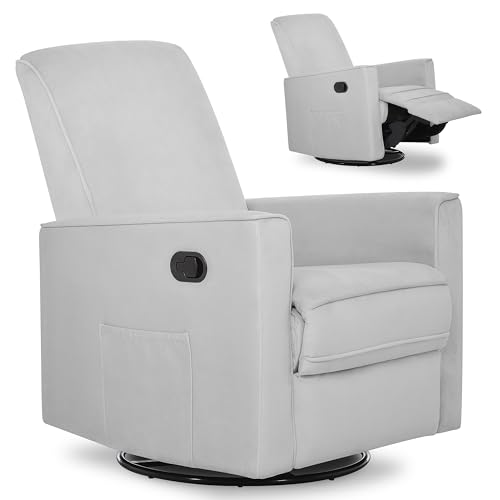
Evolur Raleigh Upholstered Glider Recliner — Glide, rock and swivel
The Raleigh is the maximalist manual chair: an upholstered glider recliner that, per its listing, rocks and swivels a full 360° with a smooth glide, carries GREENGUARD Gold and FSC certifications as listed, and presents itself in grey for the nursery and the living room alike. Three motions in one chair is a genuine engineering pile-up, and its purpose is adaptability — the parent who glides for feeds, rocks for soothing and swivels for everything else does not have to choose their motion in advance, because the chair declines to choose either.
The upholstered form is the other half of the proposition. Where the Storkcraft is a framed chair with cushions, the Raleigh is a soft chair entire — the kind that reads as living-room furniture from the day it arrives, which matters for nurseries carved out of a main room and for the chair’s second life afterwards. Grey is the diplomat’s colour for that double duty. The manual recline keeps the mechanism simple and silent, with no motor to hum at the wrong moment. For parents who want one chair to answer every motion the nursery might request, and who prefer their furniture upholstered, this is the guide’s most complete manual answer.
- Motions per the listing: glide, rocking, 360° swivel, manual recline
- Certifications as listed: GREENGUARD Gold and FSC Certified
- Form: upholstered glider recliner, grey
- Rooms named in the listing: nursery and living room
- Buying route: sold through the Evolur Raleigh Upholstered Glider Recliner Amazon listing — check price on Amazon
Strengths
- Three motions plus recline cover every nursery scenario in one chair.
- Fully upholstered form moves to the living room without translation.
- Manual mechanisms keep the night’s operations silent and simple.
Trade-offs
- No ottoman included; the recline must do the feet’s work alone.
- A mechanism-rich chair has more moving parts to keep smooth over years.
- The full swivel needs clearance planning in a small nursery.
Best for: parents who want every manual motion in one upholstered chair with a living-room future.
Not suited for: minimalists, or nurseries too small for a swivelling chair’s turning circle.

Babyletto Kiwi Electronic Power Recliner and Swivel Glider — The powered option
The Kiwi replaces effort with a button. Babyletto’s chair is an electronic power recliner and swivel glider: the recline travels at a motor’s pace — which is to say smoothly, silently and without the parent shifting their weight or reaching for a lever while holding a baby — and the swivel runs to 270° per the listing. Its stated certifications are GREENGUARD Gold and CertiPUR-US, and its fabric is described as water- and stain-resistant, in a colour the listing calls Beach. For the nursery, that fabric claim may be the most practical sentence in this entire guide: feeding chairs live in the splash zone, and a surface that resists water and stains is a surface that survives the year.
Power deserves its honest trade-offs in the same breath. An electronic chair needs a socket within reach, which fixes the nursery’s layout around an electrical fact; it costs what motors cost; and its recline, however smooth, moves at the motor’s chosen speed rather than yours. Against that, the one-handed, no-effort recline at 3 a.m. — baby in one arm, button under the other thumb, chair descending like a lift — is the single most luxurious interaction any nursery chair offers, and parents recovering from birth, for whom core strength and sudden movements are real considerations, may find it not a luxury at all but the chair’s whole point. The Kiwi is this guide’s technological answer, and it knows exactly whose nights it is for.
- Motions per the listing: power recline, swivel glider with 270° swivel
- Certifications as listed: GREENGUARD Gold and CertiPUR-US Certified
- Fabric as listed: water- and stain-resistant
- Colour as listed: Beach
- Buying route: sold through the Babyletto Kiwi Electronic Power Recliner and Swivel Glider Amazon listing — check price on Amazon
Strengths
- One-handed powered recline is the easiest motion in this guide to operate while holding a baby.
- Water- and stain-resistant fabric answers the nursery’s daily reality directly.
- The 270° swivel covers the nursery’s useful turning range generously.
Trade-offs
- Needs a power outlet within reach, which fixes the chair’s position in the room.
- Motor pace is the motor’s choice; impatient recliners cannot hurry it.
- The powered specification sits at the guide’s premium end as a tier.
Best for: parents who value effortless recline — especially after a difficult birth — and spill-resistant fabric.
Not suited for: nurseries without a conveniently placed socket, or buyers who prefer purely manual furniture.

SAETSFEG Teddy Upholstered Glider Rocker — Soft teddy finish
The SAETSFEG is the chair as a soft object: a nursery rocking chair in grey teddy upholstery, a glider rocker with a padded seat and a high backrest, presented as a comfy side chair for living room, bedroom and offices as well as the nursery. Teddy fabric — the short, curled, sheepskin-like pile that has taken over soft furnishings — changes a chair’s emotional register entirely. Where the Storkcraft is crafted and the Kiwi is technological, this chair is cuddly, and in a room whose whole purpose is comfort at antisocial hours, cuddly is a legitimate engineering specification.
The high backrest is the functional headline under the softness: it gives a tired parent’s head somewhere to go during the long contact nap, which is when nursery chairs earn their keep or fail to. The padded seat suits the chair’s second identity as a general side chair — the listing’s living-room and office pitch is credible precisely because a teddy accent chair is a fashion object in its own right this decade. Its motion set is the simplest here, glider-rocker without swivel or recline, and the review should not dress it up: this is the chair for parents whose priority is a soft, high-backed, gently moving seat at an uncomplicated specification, and who will trade the motion catalogue for the fabric’s embrace every night of the week.
- Form: glider rocker accent chair, padded seat
- Upholstery: teddy fabric, grey, per the listing
- Back: high backrest
- Rooms named in the listing: nursery, living room, bedroom, offices
- Buying route: sold through the SAETSFEG Teddy Upholstered Glider Rocker Amazon listing — check price on Amazon
Strengths
- Teddy upholstery makes it the cosiest-feeling chair in the guide.
- The high backrest supports a resting head during long holding sessions.
- Its accent-chair looks give it an easy second life anywhere in the home.
Trade-offs
- No swivel or recline — the motion set is deliberately simple.
- Pile fabrics hold crumbs and need a vacuum’s regular attention in a nursery.
- No pockets or ottoman; the supporting kit must come from elsewhere.
Best for: parents who prioritise softness and a headrest, and rooms that will keep the chair as an accent afterwards.
Not suited for: parents wanting swivel or recline, or anyone wary of pile fabric near baby food.

Yaheetech 360° Swivel Nursing Chair — Pockets and corduroy
Yaheetech calls this a nursing chair outright, and equips it like one: a 360° swivel rocking chair in beige corduroy with a high backrest and armrests, side pockets, and — alone in this guide — a capacity figure printed in the listing, 300 lb. Corduroy is a thoughtful nursery fabric that the market underuses: its ribbed pile is warm, grippy rather than slippery under a feeding arm, and forgiving of the small marks of daily life, while the beige tone keeps a small room feeling uncluttered. The side pockets repeat the Storkcraft’s small wisdom in an upholstered dialect — the things a feeding parent needs should live in the chair, because the chair is where the parent is marooned, happily, for the duration.
The full-circle swivel is the motion headline: turn to the cot, turn to the door, turn to the partner bringing tea, without the chair travelling an inch across the floor. In a compact nursery that is the most space-efficient mobility there is. The listing positions the chair across living room, bedroom and nursery, and the corduroy’s current fashionability makes that plausible — this is a chair that can graduate to a reading corner without a costume change. For parents who shop with a capacity figure in hand, it is also, with the Storkcraft’s certification, one of the guide’s two fully-answered specification questions.
- Motion per the listing: 360° swivel rocking / glider nursing chair
- Capacity as printed in the listing: 300 lb
- Upholstery: corduroy, beige
- Details per the listing: side pockets, high backrest and armrests
- Buying route: sold through the Yaheetech 360° Swivel Nursing Chair Amazon listing — check price on Amazon
Strengths
- The guide’s only printed capacity figure, stated plainly in the listing.
- Side pockets keep feeding supplies in the chair where the parent is.
- Corduroy is warm, grippy and currently handsome in any room.
Trade-offs
- No recline and no ottoman; upright feeding is its whole posture.
- Corduroy’s ribs collect lint and crumbs that a smooth fabric sheds.
- Beige shows the nursery’s traffic sooner than grey would.
Best for: compact nurseries, parents who shop by stated capacity, and anyone who feeds best with supplies in reach.
Not suited for: parents planning to recline through hard nights, or beige-averse households with toddlers already mobile.

CANMOV Swivel Rocker Recliner Nursery Glider — White and reclining
The CANMOV gathers the manual motions into a white upholstered form: a swivel rocker recliner chair, sold as a nursery glider and rocking chair with manual reclining. White is the boldest colour decision in this guide — the colour of the styled nursery photograph — and it should be chosen with the same honesty the Babyletto’s stain resistance invites from the other direction: white upholstery in a working nursery is a commitment to prompt wiping and washable throws, rewarded by a chair that makes a small room look twice its size and photographs like a magazine’s idea of new parenthood.
Mechanically it is the Raleigh’s sibling in spirit: rock, swivel and recline in one manual chair, without the glide in its listing’s vocabulary. The recline gives the hard nights their answer, the swivel gives the small room its mobility, and the rock gives the soothing rhythm. For parents whose nursery palette is light — white furniture, pale walls, the Scandinavian calm that baby catalogues sell — this is the chair that completes the room rather than arguing with it, and its manual mechanisms keep it silent and socket-free. Choose it for the look, keep it for the motions, and budget it a washable throw from day one.
- Motions per the listing: swivel, rocker, manual recline; nursery glider
- Colour as listed: white
- Form: upholstered recliner chair
- Settings named in the listing: nursery
- Buying route: sold through the CANMOV Swivel Rocker Recliner Nursery Glider Amazon listing — check price on Amazon
Strengths
- Rock, swivel and recline in one manual, socket-free chair.
- White upholstery brightens small nurseries like nothing else here.
- The recline answers the hard nights without any powered complexity.
Trade-offs
- White is the least forgiving colour a feeding chair can wear.
- No glide in the motion set, for parents who specifically want the flat track.
- No ottoman or pockets; the chair travels light and equips light.
Best for: light, styled nurseries and parents wanting the manual motion trio in white.
Not suited for: households that know their chair will be wiped rarely and used constantly.
Setting Up the Chair Corner: What a Feeding Station Needs
The chair is half the station. The other half is a small table within arm’s reach — for the water bottle that breastfeeding makes essential, the phone, the snack that is dinner — placed on the side of the parent’s free hand, and a light that can be dimmed to almost nothing, because nursery lighting at 3 a.m. should wake nobody fully, including the parent. A small cushion or rolled towel kept in the chair tunes the feeding arm’s height on the nights the chair’s own arms are not quite right, and a basket on the floor takes the muslins and the finished bottles out of the chair’s pockets and into a system.
Position the chair before the baby arrives and live with it for a week of evenings: you are testing the turn toward the cot, the reach to the table, the draught from the window, and the view — because the parent will spend hundreds of hours looking at whatever this chair faces, and a chair facing a wall is a small cruelty no specification sheet mentions. Leave clearance honestly: a swivel chair needs its circle, a rocker needs its arc behind, and a glider needs the least room of all, which is why small nurseries so often end up gliding. The laundry of nursery life — muslins, covers, the chair’s own throw — cycles constantly, and homes planning that rhythm alongside the chair will find the compact machines in our guide to Best Small Front-Load Washers sized for exactly the small-space laundry corners nurseries create.
Six Chairs, Six Motion Recipes: The Comparison
| Chair | Motions the listing names | Statement the listing prints | Form |
|---|---|---|---|
| Storkcraft Premium Hoop Glider and Ottoman | Glide, with gliding ottoman | GREENGUARD Gold Certified | Solid wood hoop frame |
| Evolur Raleigh Upholstered Glider Recliner | Glide, rock, 360° swivel, manual recline | GREENGUARD Gold and FSC Certified | Upholstered, grey |
| Babyletto Kiwi Electronic Power Recliner and Swivel Glider | Power recline, 270° swivel glide | GREENGUARD Gold and CertiPUR-US; water- and stain-resistant | Upholstered, Beach |
| SAETSFEG Teddy Upholstered Glider Rocker | Glider rocker | None printed in the title | Teddy fabric, grey |
| Yaheetech 360° Swivel Nursing Chair | 360° swivel rock / glide | 300 lb capacity | Corduroy, beige |
| CANMOV Swivel Rocker Recliner Nursery Glider | Swivel, rock, manual recline | None printed in the title | Upholstered, white |
Read the middle column as the guide’s honesty ledger: three chairs print certifications, one prints a capacity, two print neither — and all six are here because their motions and forms earn their places, with the printed statements recorded exactly as far as the listings take them and no further.
What Do Parents Regret After Buying a Nursery Glider?
The regrets are remarkably consistent, and they are almost never about the chair’s looks. The first is motion mismatch: a rocker bought for a parent who turns out to glide, a fixed chair bought for a parent who needed to swivel toward the cot a hundred times a night. The cure is to notice, before ordering, how you soothe — in arms, most parents discover their own rhythm in the first week — and to weight the swivel heavily if the nursery’s layout puts the cot anywhere but directly ahead. The second regret is arm height. A feeding parent’s elbow lives on that arm for hours a day, and an arm that sits too low lifts the shoulder into an ache that no amount of glide smoothness compensates; cushions can correct a small mismatch, but the chair’s own arms should be close to right.
Third, the white-chair regret and its cousins: upholstery chosen for the photograph meeting the nursery’s reality. Every fabric in this guide has been discussed on those terms — choose the one whose maintenance matches your honesty. Fourth, buying the chair too late to enjoy the choosing: a glider assembled in the baby’s first week, by a parent running on broken sleep, gets judged by standards no chair could meet, so order in the calm of the third trimester if you can. Fifth, forgetting the chair’s second life and buying a design so nursery-specific that the household resents it for a decade afterwards; every chair here was chosen partly for its ability to emigrate gracefully. And a final, gentle one: expecting the chair to settle the baby by itself. The chair serves the arms that do the settling — which is why our last internal recommendation in this guide points to the other great support act of early parenthood, the chairs in Best Power Lift Recliner Chairs, for the grandparents whose visits will take a shift in a chair of their own.
The 3 A.M. Test: What the Chair Must Do in the Dark
Every nursery chair should be judged by a single imagined scene. It is 3 a.m. You are holding a baby who has just finished feeding and is performing the evening’s most delicate negotiation — asleep, but only just, and only while the motion continues. You are operating one-handed, in near-darkness, on four hours of broken sleep. In that scene, the chair’s specifications rearrange themselves by importance. Silence is first: a glide or rock that creaks at its turning point is not a minor flaw but a nightly sabotage, which is why smooth, quiet mechanisms outrank every aesthetic consideration in a real nursery. Second is startability — the motion must begin from a gentle push of the foot or a shift of weight, because the other arm is occupied and will be for some time.
Third is the arm under your feeding elbow, which by 3 a.m. has held its position through several feeds and will mutiny if the chair’s arm sits at the wrong height. Fourth is everything within reach — the water, the muslin, the phone with its dimmed screen — because standing to fetch any of them restarts the negotiation from the beginning. And fifth, almost never listed on any product page, is the chair’s behaviour when you finally stand: a glider that stays where it is, a swivel that does not spin away as you rise with the baby, a recline that returns without a clunk. Parents shopping in a showroom at noon should run this scene mentally before falling for any chair, because the chair that passes the 3 a.m. test in imagination usually passes it in fact.
Two Parents, One Chair: Sharing the Night Shift
Nursery chairs are usually bought by one parent and used by two, plus a rotation of grandparents, and the sharing changes what “the right chair” means. Bodies differ: the arm height that suits a taller partner may strand a shorter one’s elbow, and the seat depth that cradles one may swallow the other. The adjustable elements in this guide — a recline that resets the back angle, a cushion that shortens the seat — are how a single chair serves several sitters, and households where both parents will feed should weight them accordingly and test the chair, where possible, with both bodies before the baby arrives to chair the meeting.
Grandparents deserve a specific thought, because their visits often include a night shift generously offered and physically real. An older sitter needs a chair they can rise from without a struggle — arms at a height that gives leverage, a seat that is not so deep or low that standing becomes a project — and a motion that starts gently rather than demanding a practised push. The Storkcraft’s firm, framed sit and the upholstered chairs’ supportive arms each serve that sitter in different ways; what does not serve them is the household assuming any chair will do. The kindest nurseries brief the chair like equipment: here is how it glides, here is where the pockets keep things, here is the cushion for your elbow. Two minutes of briefing, and the night shift becomes a gift instead of an ordeal.
Keeping the Chair Clean in the Splash Zone
A feeding chair lives where milk lands, and its cleaning story should be planned with the same honesty as its purchase. The daily habit is a wipe kept within reach — a cloth that lives in the chair’s pocket, so the small spill is dealt with in the moment rather than discovered, set, in the morning. The weekly habit is a vacuum with an upholstery tool along the seams and, on pile fabrics like the teddy and corduroy in this guide, through the ribs where the nursery’s lint collects. The monthly habit is the honest inspection: cushions lifted, the seat’s valley checked for the lost dummy, the coin, the evidence, and the mechanism given a slow test glide to catch any developing squeak while it is still a tightening job rather than a repair.
Fabric strategy matters more than cleaning heroics. A washable throw over the chair’s seat and arms takes ninety percent of the traffic and goes in the machine without ceremony — the single highest-value accessory a nursery chair can be given, and the reason the white CANMOV can be owned sanely. Where the listing states a water- and stain-resistant fabric, as the Babyletto’s does, the throw becomes optional rather than essential. And when the chair eventually emigrates to its second room, a deep clean on moving day — vacuum, wipe, a day of air — is what turns “the old nursery chair” into “the reading chair,” a renaming every chair in this guide has earned by then.
Twins, Toddlers and the Chair’s Wider Family Life
Two variations of family life test a nursery chair beyond the standard brief. Twins double the chair’s hours and halve the parent’s margin for a chair that almost works: the motion must start one-handed every time, the arms must support feeding positions that change by the hour, and the chair’s durability stops being an abstraction. Parents of twins should weight the most complete motion sets — the Raleigh’s manual catalogue or the Kiwi’s powered ease — and the easiest-cleaning fabrics, because the chair will not get a quiet week in its first year.
The toddler variation arrives later and from the side. The chair that soothed the baby becomes, to a two-year-old, a vehicle: something to climb, to rock with intent, to occupy with a picture book in imitation of the parent. This is mostly a joy and partly a supervision note — a glider’s moving base and a recliner’s mechanism deserve the same respect as any moving furniture around a climbing child, and the chair’s pockets will be emptied and refilled with treasure according to laws no parent controls. Households that chose a chair with a second life in mind will find the toddler years are where it starts paying: the reading corner the family gathers in at bedtime is usually built around the chair that used to run the night shift.
Gift-Buying a Glider: Notes for Grandparents and Friends
A nursery glider is one of the grandparent gifts that lands perfectly — substantial, useful from the first night, and remembered for years — provided the giver respects two rules. The first is consultation: motion preference is personal, the nursery’s dimensions are fixed facts, and a chair chosen by surprise is a chair that may not fit the room or the parent. Ask, or give the promise of the chair and shop it together; the choosing is part of the gift’s pleasure. The second rule is timing: a glider delivered in the third trimester is equipment, calmly assembled and tested, while the same chair delivered in the baby’s first week is a project handed to people with no hands free.
Givers choosing from this guide for a couple they love can navigate by household: the Storkcraft for traditionalists and for homes where the chair will one day sit on a porch; the Kiwi for the couple whose birth plan suggests an easier recline will be genuinely valued; the Yaheetech for the small flat whose nursery is a corner of a bedroom. Include the washable throw with any of them. It is a small addition that tells the parents the giver understands what the chair’s life will actually be like — and grandparents who signal that understanding tend to be invited onto the night-shift rota, which is, of course, the real gift flowing the other way.
Final Recommendation
For the classic nursery, complete as tradition intended, the Storkcraft remains the answer: a gliding chair and a gliding ottoman moving as one, pockets where the night’s kit belongs, solid wood that will wipe clean and emigrate gracefully. For the most complete manual chair, the Evolur Raleigh gathers glide, rock, swivel and recline into one upholstered form with a living-room future, and for the most effortless nights the Babyletto Kiwi’s powered recline and stain-resistant fabric justify their premium in the currency new parents actually hold — sleep, and the ease of getting what little there is.
The remaining three divide the softer virtues: the SAETSFEG for the parent who wants to be hugged by their chair, the Yaheetech for the compact nursery that needs pockets, corduroy and a stated capacity, and the CANMOV for the light, bright room that wants the manual motion trio in white. Whichever you choose, set it up before the baby comes, face it toward something worth looking at, and keep its pockets stocked — because the chair you are really buying is not furniture for a baby, but the small, smooth, quiet headquarters from which you will run the first year of a person’s life.
Frequently Asked Questions
What is the difference between a glider and a rocking chair?
A glider slides flat, forward and back on a fixed base, so it feels steady, keeps a feeding position level and can sit close to a wall. A rocker travels in an arc on curved rails, tipping gently as it moves, and needs clearance behind it. Many nursery chairs blend both motions; the choice is rhythm and room — glide for stability and tight spaces, rock for the cradle-like sway.
Is a nursery glider safe for my baby to sleep in?
A glider is a chair for an adult holding a baby, not a sleep surface for a baby, and this guide makes no sleep-safety claims for any chair in it. Babies should sleep in a cot, bassinet or other space designed and certified for infant sleep. The glider’s role ends at the holding: it keeps the adult comfortable and the motion smooth while the baby falls asleep in their arms, before the transfer to the baby’s own sleep space.
Do I need an ottoman with a glider?
Not need — but the right ottoman transforms the chair. A gliding ottoman, like the Storkcraft’s, travels with the chair so your feet ride the same motion; a fixed footstool fights the glide. Chairs with a recline, like the Raleigh, Kiwi and CANMOV, build the foot support into the chair itself. Parents who feed for long stretches usually end up wanting one of those three answers; the bare chair alone is the economy option.
How much room does a nursery glider need?
The chair’s footprint plus its motion’s clearance: a pure glider needs the least, since nothing swings behind it; a rocker needs space for its arc; a swivel needs its turning circle kept clear of the cot and walls. In a small nursery, measure the chair’s listed dimensions, mark the footprint on the floor, and walk the night’s route — chair to cot to door — inside the tape before ordering.
How do I stop a glider from squeaking?
Start by locating the sound: glide slowly and listen for where in the travel the noise lives, then check that base’s fasteners, because a settling frame working a fraction loose is the commonest cause and a quarter-turn the commonest cure. Dust and nursery grit in a glider’s track is the second cause, answered by a vacuum and a wipe of the mechanism. If the squeak survives both, consult the maker’s guidance for your specific chair rather than spraying lubricant at random — the right product in the wrong joint makes a quiet chair into a stained one.
What fabric is best for a nursery chair?
The fabric your household will actually maintain. A listed water- and stain-resistant finish, like the Babyletto’s, forgives the most; corduroy and teddy are warm and grippy but collect the nursery’s crumbs in their pile; smooth upholstery wipes fastest; white anything is a commitment. There is no universal best — there is the honest match between a fabric’s demands and a tired parent’s real habits at 3 a.m.
When should we buy the nursery chair?
Earlier than feels necessary — ideally in the third trimester, while there is still time and energy to assemble it calmly, test its motion, position it in the room and live with the corner for a few evenings before it matters. A chair that arrives after the baby is assembled by exhausted people and judged by exhausted standards. Buying early also lets both parents, and any grandparent who will take a shift, learn the chair’s motions before the night they are needed.
Glider or a regular armchair with a footstool?
For the nursery specifically, the motion is the point: a still armchair asks the parent to provide all the rhythm with their own body, for hours, nightly, which is a tax that accumulates across a year of feeds. A glider or rocker mechanises that rhythm so the parent’s arms can simply hold. Once the nursery years pass, the glider becomes the household’s moving reading chair — but during them, the comparison is not close, and parents who try to save the difference usually spend it later on the chair they should have bought first.
Will a nursery glider be useful after the baby years?
Yes, if you choose with the second life in mind — as this guide did. Upholstered gliders and recliners move to bedrooms, reading corners and living rooms without translation; the wooden hoop glider emigrates to porches and spare rooms; a teddy accent chair is a fashion piece anywhere. The chair that serves a decade is the one bought as furniture first and nursery equipment second.
Related Guides
For the mothers at the centre of the nursery story — and the chairs chosen with their comfort designed in from the start — our guide to Best Designer Chairs for New Mothers continues the conversation this page began.
A last word, from the far side of the nursery years, where every parent who has run the night shift eventually stands. The glider you choose will hold some of the most tired and most tender hours of your life, and long after the cot is gone the household will find reasons to keep it — a reading corner, a sick child’s headquarters, the chair a teenager claims for phone calls of state. Buy it as the decade-long furniture it will become, test it by the 3 a.m. standard, and stock its pockets before the first night. The baby will not remember the chair at all, which is exactly as it should be: the chair was never for the baby. It was for you, holding the baby — and that is reason enough to choose it well.
So choose it the way the parents who love theirs did: by the motion your arms already make when you imagine soothing, by the arm your elbow will live on, by the fabric your real habits can maintain, and by the room it will still be serving when the nursery is a memory and the chair is simply the best seat in the house at bedtime-story hour.
One practical promise to end on: whichever chair arrives, give it one full evening of testing before the baby does — sit in it with a book, run every motion it owns, set the table and the lamp where your hands expect them, and adjust until the corner disappears from your attention. A feeding station that has been rehearsed is a feeding station that works at 3 a.m. without a single decision left in it, and decisions are the one thing the night shift never has to spare. Rehearse the corner, stock the pockets, dim the lamp — then let the chair do what the six chairs in this guide were each, in their different ways, built to do: hold you, quietly and smoothly, through the longest and shortest nights of your life, until the morning the chair’s job quietly changes and it becomes, simply and honourably, the family’s favourite place to sit with a book while somebody small climbs up beside you with a picture book of their own and the whole long, lamplit evening still ahead of you both, together in the chair that started everything, back when everything was just beginning for your whole growing family, night after night.



[…] film, chairs for the gathering — will find the nursery-and-home side of seating in our guide to Best Glider Chairs for Babies and Nurseries a gentler indoor […]