What's inside
- Key Takeaways
- Quick Picks
- How Did We Choose These Chairs for 3-Month-Old Babies?
- How Do You Know Whether Your Baby Is Ready for a Floor Seat?
- Why Is a Bouncer the Right Chair for a Baby Who Is Not Yet Steady?
- How Do the Six Baby Seats Compare?
- How Should You Use a Baby Seat Day to Day?
- What Mistakes Do Parents Make When Buying a First Baby Seat?
- How Do the Three Floor Seats Differ in Practice?
- What About Travel, Grandparents and Second Homes?
- How Should You Keep a Baby Seat Clean?
- What Should You Check When the Seat Arrives?
- How Do These Seats Fit Into the Baby’s Whole Day?
- What Do the Age Ranges on the Listings Really Mean?
- How Should Twins, Siblings and Hand-Me-Downs Change the Choice?
- How Do You Choose Between the Two Bouncers?
- Final Recommendation
- Frequently Asked Questions
- Related Guides
As an Amazon Associate I earn from qualifying purchases. This post may contain affiliate links at no extra cost to you.
cottageverdict.com is reader-supported. When you buy through links on our site, we may earn an affiliate commission.
Where to buy: each linked seat below leads to its Amazon listing, where you can check price on Amazon and confirm the age and weight guidance, the harness type and the fabric care instructions before ordering. Always read the manufacturer’s own guidance for the individual seat; it governs over any general description, including this one.
The best chairs for 3-month-old babies are not one kind of object, and honesty about that is where this guide begins. At around three months, babies divide into two groups for seating purposes. Some are beginning to hold their heads up steadily and are fascinated by the upright world; they are candidates — always on the floor, always supervised — for the supported floor seats in this guide’s first family. Others are not there yet, and for them the right “chair” is a bouncer: a reclined seat that cradles the whole body, asks nothing of the neck, and lets the baby watch the room from a safe incline. This guide contains three floor seats, two bouncers and one plush support seat, and it will keep the families separate in every table and heading, because choosing between them is not a matter of taste. It is a matter of what your particular baby can already do.
The condition that governs the floor seats deserves its own sentence, stated the way the manufacturers state it: a baby should only use a supported floor seat once they can hold their head up steadily on their own, and the seat should be used on the floor, for supervised awake time, and never as a place to sleep. Babies fall asleep in seats the way adults fall asleep in armchairs — suddenly and against everyone’s plans — and the rule of the house should be that a sleeping baby is moved to their proper flat sleep surface, every time, without negotiation with your own tiredness. This guide makes no promises about development: a floor seat does not teach sitting, and a bouncer does not teach anything either. They are places to be, comfortably and safely, while awake — and being somewhere pleasant, watching the household happen, is a perfectly respectable ambition for a three-month-old.
With that framing fixed, the buying questions become practical. Harnesses and seat geometry, because a seat’s job is to keep a wiggly baby where they were put. Washable fabrics, because a seat for this age group will be washed with a frequency that would shock your pre-baby self. Portability, because these seats earn their keep by moving from kitchen to bathroom doorway to grandparents’ living room. And an exit plan, because every seat here has an age or weight boundary on its listing, and knowing yours in advance turns the seat’s retirement into a plan rather than a surprise.
Key Takeaways
- Two families: floor seats for babies who already hold their heads up steadily; bouncers for younger or not-yet-steady babies, who need a reclined cradle instead.
- Floor seats are for supervised, awake time on the floor only — never on tables or sofas, and never for sleeping.
- A baby who falls asleep in any of these seats should be moved to their flat sleep surface.
- Machine-washable pads are not a luxury in this category; they are the difference between a clean seat and a retired one.
- The Ingenuity Keep Cozy converts from bouncer to rocker and carries the longest stated age range here, up to 40 lbs per its listing.
- No seat in this guide promises any developmental benefit; they are comfortable, supervised places to sit and watch the world.
Quick Picks
| Pick | Family | Badge | Why it is here |
|---|---|---|---|
| Fisher-Price Sit-Me-Up Floor Seat Pacific Pebble | Floor seat | Best Classic Floor Seat | The benchmark supported floor seat, with two removable activity toys and a machine-washable pad. |
| Fisher-Price Sit-Me-Up Floor Seat Rainbow Showers | Floor seat | Best for Toy Variety | The same trusted frame with clacker toys and a flower teether in a brighter fabric story. |
| Bright Starts Learn-to-Sit Floor Seat | Floor seat | Best Two-Position Seat | Two positions that adjust as the baby grows, listed for 4 to 12 months, with sensory toys included. |
| Bright Starts Playful Paradise Baby Bouncer | Bouncer | Best Bouncer for Youngest Babies | A reclined bouncer with soothing vibration and toys, listed from newborn to 6 months. |
| Ingenuity Keep Cozy 3-in-1 Bouncer Rocker | Bouncer / rocker | Best Long-Life Seat | Bouncer, rocker and toddler seat in one, listed from birth to 30 months and up to 40 lbs. |
| Plush Animal Sit Up Floor Seat for Babies | Plush floor seat | Best Soft Support Seat | A cotton-filled plush animal seat with a non-slip bottom, listed for 3 to 24 months. |
How Did We Choose These Chairs for 3-Month-Old Babies?
We chose by family first and features second. For the floor seats, the requirements were a supportive seat geometry that surrounds the baby rather than perching them, a wide and stable base meant for floor use, toys that detach so the seat can be plain when plain is wanted, and fabrics that come off and go through a washing machine. For the bouncers, the requirements were a properly reclined cradle, a harness, soothing motion or vibration that the baby or a gentle push provides, and listing guidance that honestly covers the youngest babies rather than implying a newborn belongs in an upright seat.
We read every listing’s age and weight guidance and report it as stated: the Learn-to-Sit’s 4 to 12 months, the Playful Paradise bouncer’s 0 to 6 months, the Keep Cozy’s birth to 30 months and up to 40 lbs, the plush seat’s 3 to 24 months. Where a listing’s range and the head-control condition could be misread together, we have followed the stricter reading: the condition governs, whatever the box’s lower number says, because a range describes sizes and the condition describes readiness. We also favoured seats from makers with long histories in this exact category, on the principle that infant furniture is a field where iteration matters.
How Do You Know Whether Your Baby Is Ready for a Floor Seat?
Watch the head, because the head is the whole question. A baby ready for a supported floor seat holds their head up steadily when upright — during tummy time they lift and turn it with control, and when you hold them against your shoulder the head does not loll or tire after a moment. That steadiness is the manufacturer’s condition for seats like the Sit-Me-Up and the Learn-to-Sit, and it typically arrives somewhere around the three-to-four-month neighbourhood, earlier for some babies and later for others, with both being ordinary. If you are unsure, the answer is to wait and use the bouncer; a floor seat bought this month will be just as good next month, and the bouncer is not a consolation prize but the correct seat for the stage your baby is in.
Readiness also has a session length. The first sits should be short — a few minutes of novelty while you sit on the floor beside the seat — and lengthened only as the baby shows they are enjoying the arrangement. A baby who slumps sideways, fusses persistently or tires should come out, without the session being treated as a failure of anything. Floor seats are furniture for awake, contented time; the moment contentment leaves, the furniture’s job is done for now. And the seat lives on the floor: not on the sofa, not on the table for a photograph, not on any raised surface from which a determined wiggle could travel.
Why Is a Bouncer the Right Chair for a Baby Who Is Not Yet Steady?
Because it asks nothing. A bouncer’s recline supports the head, back and body along their whole length, so a baby with a still-developing neck can be upright enough to see the room without holding any part of themselves up. The gentle motion — the baby’s own kicks translated into a bounce, or a vibration unit’s hum — is the entertainment and the soothing in one, and the harness keeps the smallest passenger centred while it happens. For the first months, the bouncer is also the parent’s tool: a safe place to put the baby down, at floor level, in the room where life is happening, with both of your hands suddenly available for the kettle.
The same sleep rule applies with full force: bouncers are so effective at soothing that babies fall asleep in them constantly, and the guidance remains to move a sleeping baby to their flat sleep surface. Treat the bouncer as a front-row seat for the waking show, in the room with you, and it will be among the hardest-working objects of the baby’s first half year.
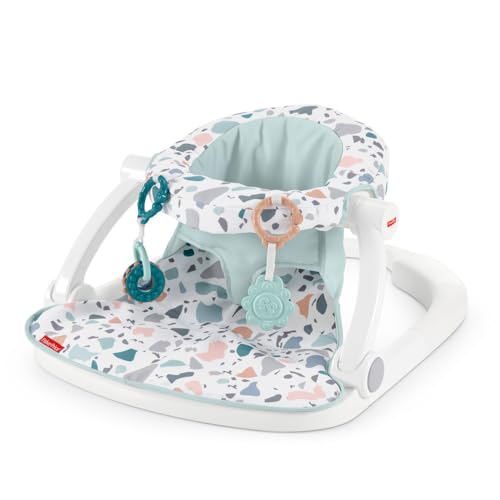
Fisher-Price Sit-Me-Up Floor Seat Pacific Pebble — Best Classic Floor Seat · Floor Seat
The Sit-Me-Up is the design that defined this category, and the Pacific Pebble version is its calm, neutral expression. The seat’s wide base sits flat on the floor, the soft seat supports the baby in an upright posture surrounded by the frame, and two removable activity toys attach at the front for the baby to bat at. The pad is machine washable, which at this age is less a feature than a survival trait. For a baby who meets the head-control condition, this is the straightforward, proven way to give them a seat at floor level in the middle of family life.
Its virtues are the virtues of a mature design: everything is where experience says it should be. The toys come off when the baby wants to watch rather than play, the seat folds or stores more gracefully than its photograph suggests, and the whole object can travel to another house without a strategy meeting. It does not recline, it does not bounce, and it is not for a baby who cannot yet hold their head steadily — the bouncer picks below exist for that baby, and this seat will be waiting when the condition is met.
- Family: supported floor seat — head-control condition applies
- Toys: two removable activity toys
- Pad: machine washable
- Use: floor only, supervised awake time
- Finish: Pacific Pebble neutral fabric
Strengths
- The category’s benchmark design, refined over many iterations.
- Removable toys let the seat be busy or calm as the moment wants.
- A washable pad keeps it in service through every kind of mess.
Trade-offs
- Only suitable once the baby holds their head up steadily.
- It does one job; younger babies need a bouncer as well.
- The upright posture suits short, supervised sessions, not lounging.
Best for: babies who meet the head-control condition and are ready for a first upright seat. Not suited for: younger babies, sleeping, or any raised surface.

Fisher-Price Sit-Me-Up Floor Seat Rainbow Showers — Best for Toy Variety · Floor Seat
Rainbow Showers is the same Sit-Me-Up architecture wearing a brighter print and carrying a different toy pairing: clacker toys and a flower teether, where the Pacific Pebble carries its own two activity toys. The choice between the two Fisher-Price picks is therefore honestly about the baby’s current fascinations and the household’s tolerance for colour. A baby who is deep in a grabbing-and-mouthing phase will get more from the teether within reach; a household that prefers its baby gear quiet will pick the Pebble and never think about it again.
Everything said about the classic applies unchanged: the head-control condition, the floor-only rule, the washable pad, the supervised sessions. That sameness is worth stating in a guide, because fabric variants can look like different products in a catalogue, and parents deserve to know when they are choosing between two designs and when they are choosing between two moods of one design. Here it is moods — pick the one whose toys match the baby in front of you.
- Family: supported floor seat — head-control condition applies
- Toys: clacker toys and a flower teether
- Pad: machine washable
- Use: floor only, supervised awake time
- Finish: Rainbow Showers print
Strengths
- The teether suits babies in the mouthing-everything stage.
- Same proven frame and washable practicality as the classic.
- Cheerful print photographs beautifully for the family album.
Trade-offs
- Functionally identical to its sibling; the premium is in the print.
- Head-control condition and floor-only rule apply in full.
- Clackers make noise, which some households will hear about.
Best for: steady-headed babies who are ready for toys within grabbing range. Not suited for: households seeking a second, different seat rather than a variant.

Bright Starts Learn-to-Sit Floor Seat — Best Two-Position Seat · Floor Seat
The Learn-to-Sit answers the floor seat’s built-in obsolescence with two positions: a more supported arrangement for the younger baby and a second position as the baby grows, across a listed range of 4 to 12 months. The name should be read as the maker’s branding rather than a promise — no seat teaches sitting — but the two-position design genuinely extends the seat’s useful window, because the posture that supports a four-month-old is not the posture a nine-month-old wants to be held in. Sensory toys are included, and the seat is built to be portable between rooms.
Note the listing’s starting age of four months, a month beyond this guide’s title, and treat it as the maker quietly enforcing the same head-control condition this guide states outright: this is a seat for babies who arrive at it steady. Within its range it is the floor seat for the parent who hates buying the same category twice. The second position also suits the older baby who still enjoys a defined seat for snack-free play at floor level while the household cooks, reads or folds the endless laundry around them.
- Family: supported floor seat — head-control condition applies
- Positions: two, adjusting as the baby grows
- Listed range: 4 to 12 months
- Toys: sensory toys included
- Finish: Purple Paradise, unisex listing
Strengths
- Two positions stretch the seat’s working life across most of the first year.
- The later starting age aligns honestly with the head-control condition.
- Portable enough to follow the household from room to room.
Trade-offs
- Not for the youngest three-month-olds; the listing starts at four months.
- The name overpromises; the seat supports sitting, it does not teach it.
- Two positions mean one more mechanism to keep clean.
Best for: families wanting one floor seat to cover the whole sitting season. Not suited for: a baby who has only just reached three months.

Bright Starts Playful Paradise Baby Bouncer — Best Bouncer for Youngest Babies · Bouncer
For the baby who is not yet steady — which at exactly three months is a great many babies — the Playful Paradise is this guide’s starting point. It is a reclined bouncer listed from newborn to 6 months, with soothing vibration and a toy bar, cradling the baby at an incline that asks nothing of their neck. The baby’s own movements set it gently bouncing, the vibration settles the moments when bouncing is not enough, and the whole arrangement sits on the floor in the room where you are, which is where a young baby most wants to be: near the voices, watching the ceiling’s slow theatre, part of the household.
Its boundaries are as clear as its virtues. The listed range ends at 6 months, and a bouncer must be retired when the baby can sit up, push up or exceed the maker’s guidance, because a reclined cradle and an ambitious baby are a combination the design does not contemplate. And it is an awake-time seat that babies will nonetheless fall asleep in, so the household rule stands: asleep means moved to the flat sleep surface. Within those honest limits, for the first months, this is the hardest-working chair in the guide.
- Family: reclined bouncer — no head-control condition
- Listed range: newborn to 6 months
- Soothing: vibration plus the baby’s own bouncing motion
- Toys: included toy bar
- Use: floor only, supervised; move a sleeping baby to their sleep surface
Strengths
- The correct seat for babies who cannot yet hold their heads steadily.
- Vibration gives it a soothing tool the floor seats do not have.
- Light and portable; follows the parent around the house.
Trade-offs
- The shortest service life here; the range ends at 6 months.
- Must be retired once the baby pushes or sits up, per guidance.
- Vibration needs batteries, and dead batteries arrive at the worst hour.
Best for: the youngest babies and any baby not yet steady in the neck. Not suited for: older, stronger babies approaching the sit-up stage.

Ingenuity Keep Cozy 3-in-1 Bouncer Rocker — Best Long-Life Seat · Bouncer / Rocker
The Keep Cozy is the bouncer that refuses to be a six-month purchase. It begins as a vibrating bouncer for the newborn, converts to a rocker, and ends as a toddler seat, across a listing that runs from birth to 30 months and up to 40 lbs — by far the longest stated service in this guide. The Pink Burst finish pooled here is one of its colourways. For a family buying one seat to span the whole era this guide covers and beyond, the arithmetic is compelling: the bouncer months, the rocking months and the small child’s own chair, in a single frame that the child already knows.
Each mode carries its own moment of care. The bouncer mode obeys the bouncer rules: reclined, supervised, asleep means moved. The rocker mode suits the older baby who generates the motion. The toddler seat mode is a small chair for a child who climbs in under their own power, and at that point the seat’s job changes from holding a baby to hosting a person. Follow the maker’s mode guidance as the child grows, keep the harness story straight for each stage, and the Keep Cozy will be in photographs from the first month to the second birthday.
- Family: bouncer, converting to rocker and toddler seat
- Listed range: birth to 30 months, up to 40 lbs
- Soothing: vibration in bouncer mode, with toy bar
- Modes: three, changed as the child grows
- Finish: Pink Burst variant pooled here
Strengths
- The longest stated service life in the guide, by a wide margin.
- One familiar object carries the child through three stages.
- Bouncer mode is fully suitable for the youngest babies.
Trade-offs
- Mode changes must follow the maker’s guidance as the child grows.
- A jack of three trades is bulkier than a dedicated bouncer.
- The long range can tempt families to stretch a mode past its moment.
Best for: families who want to buy the whole seating story once. Not suited for: households that prefer the lightest possible dedicated bouncer.

Plush Animal Sit Up Floor Seat for Babies — Best Soft Support Seat · Plush Floor Seat
The plush seat is the softest interpretation of the floor-seat idea: an animal-shaped, cotton-filled support that surrounds the baby in upholstery rather than in a frame, with a non-slip bottom to keep it planted on the floor. Its listing runs from 3 to 24 months, the widest span of any floor seat here. The appeal is tactile and visual — it reads as a cuddly object rather than equipment, photographs like a toy, and gives a baby who meets the head-control condition a nest-like place to sit among soft surfaces.
The honest cautions match its softness. A plush surround supports a baby who can already hold themselves reasonably steady; it is not the structured support of the Fisher-Price frame, and the head-control condition applies with at least the same force. Cotton filling and floor life mean it will need cleaning attention, and its shape makes it the bulkiest seat here to store. Chosen for the right baby — steady, supervised, on the floor, in short awake sessions — it is the seat most likely to be kept afterwards as a cushion with a history.
- Family: plush supported floor seat — head-control condition applies
- Listed range: 3 to 24 months
- Fill: cotton, in an animal-shaped surround
- Base: non-slip bottom
- Use: floor only, supervised awake time
Strengths
- The softest, most nursery-friendly object in the guide.
- A long listed range, from 3 months into toddlerhood.
- The non-slip bottom keeps the softness where it was placed.
Trade-offs
- Plush support is gentler than a frame’s; the baby must be steady.
- Bulky to store and slower to clean than a plastic-framed seat.
- No toys or harness structure of the framed seats’ kind.
Best for: steady babies whose families want a soft, nursery-styled seat. Not suited for: babies still working on holding themselves upright.
How Do the Six Baby Seats Compare?
| Pick | Family | Listed range | Head control needed? | Standout feature |
|---|---|---|---|---|
| Fisher-Price Sit-Me-Up Floor Seat Pacific Pebble | Floor seat | See listing | Yes | Benchmark design, washable pad |
| Fisher-Price Sit-Me-Up Floor Seat Rainbow Showers | Floor seat | See listing | Yes | Clackers and flower teether |
| Bright Starts Learn-to-Sit Floor Seat | Floor seat | 4–12 months | Yes | Two positions |
| Bright Starts Playful Paradise Baby Bouncer | Bouncer | 0–6 months | No | Vibration soothing |
| Ingenuity Keep Cozy 3-in-1 Bouncer Rocker | Bouncer / rocker | Birth–30 months, up to 40 lbs | No, in bouncer mode | Three modes, longest life |
| Plush Animal Sit Up Floor Seat for Babies | Plush floor seat | 3–24 months | Yes | Soft cotton-filled surround |
The table is the guide in miniature. Read the head-control column first, because it sorts the six into seats your baby can use today and seats that wait for a steadier month. Read the range column second, because it prices the seat in time: the bouncer’s intense six months, the floor seats’ sitting season, the Keep Cozy’s long career. Everything else — toys, prints, softness — is preference, and preference is a fine thing to shop by once the first two columns have done their work.
How Should You Use a Baby Seat Day to Day?
Place the seat on the floor, in the room where you will be, within your sight and mostly within your reach. Buckle the harness where the seat has one, every time, including the times the baby seems too sleepy or too small to need it — habits are what safety is made of, and the one time it matters will not announce itself. Keep sessions in floor seats short and cheerful at first, and end them when the baby has had enough rather than when the timer in your head says a respectable duration has passed. Rotate the seat’s company: a seat near the kitchen while you cook, a seat at the bathroom door’s safe distance while you shower with the door open, a seat in the living room for the evening’s floor-level society.
Keep the seat’s world clean in the ordinary way. Wash the pads on the maker’s instructions and your household’s evidence — after illness, after a major mess, and regularly in between — and let everything dry fully before the next sitting, because a damp pad is an unwelcoming one. Inspect the harness stitching, the frame’s joints and the bouncer’s vibration unit in the same glance you give the washing. And hold the sleep rule as the house’s constitution: these seats are for the waking day, and a baby asleep in one is a baby to be moved, gently and without exception, to their flat sleep surface.
What Mistakes Do Parents Make When Buying a First Baby Seat?
The first is buying by the photograph of an older baby: choosing an upright floor seat for a three-month-old who cannot yet hold their head steadily, because the catalogue baby looked so content. The second is treating the seat as a container — a place to park the baby while life happens elsewhere — rather than as furniture for shared, supervised time in the same room. The third is using a seat on a raised surface for a moment’s convenience, which converts a floor product into a falling risk, and the fourth is letting the seat become a nap place because the baby sleeps so peacefully in it; peaceful is precisely the problem the sleep rule exists for.
Fifth, parents stretch the ranges: keeping a baby in a bouncer past the point where they can push or sit up, or in a floor seat past its stated limits, because it still seems to fit. The listings’ boundaries are the makers’ engineering judgements, and they end where they end for reasons. Sixth, they buy the seat with the most attachments and discover that a three-month-old’s favourite entertainment is a face — yours — six inches away. Toys are a garnish in this category. The seat’s real work is position and safety, and it should be bought on those terms.
How Do the Three Floor Seats Differ in Practice?
They share a job and divide on philosophy. The two Sit-Me-Up seats are framed support: the baby sits within a structure whose geometry does most of the holding, which is why they suit the newest steady heads. Between them, the difference is the toy bar and the print — Pacific Pebble’s calm removables against Rainbow Showers’ clackers and teether — and that is a smaller difference than a catalogue page suggests. The Learn-to-Sit trades a little of that framed certainty for time: its second position follows the baby toward the older end of its 4-to-12-month range, so it is the seat for the household that wants the category bought once. The plush seat abandons the frame entirely for a filled surround, gaining softness and nursery charm, and asking in return for a baby who is already genuinely steady, since upholstery persuades where a frame insists.
In a real week, the differences feel like this. The Sit-Me-Up is the seat you reach for without thinking, wash without planning, and lend without anxiety. The Learn-to-Sit is the seat you adjust one Sunday, with a small sense of ceremony, as the baby graduates within it. The plush seat is the one that lives in the nursery rather than the kitchen, coming out for floor play in the soft room. None of these is the wrong answer; they are answers to slightly different households wearing the same category name.
What About Travel, Grandparents and Second Homes?
These seats travel better than most baby equipment, because they are light, have no installation, and work on any floor. The bouncers fold or flatten the most willingly and are the classic grandparent-house purchase: a Playful Paradise kept at the other house means the baby has their familiar reclined place in both homes, and familiarity is half of a young baby’s contentment in a strange room. The Keep Cozy is the one to buy once and carry, since its career is long and its modes travel with it.
Brief every house the seat visits on the same three rules, kindly and in advance: floor only, supervised only, and a sleeping baby gets moved. Grandparents raised babies in an era of different furniture and different guidance, and the rules land best as the seat’s instructions — which they are — rather than as a lecture. A seat that arrives with its rules understood is a seat that will be used exactly as safely in the second home as in the first, and the baby gets the benefit of both households without the risk of either’s improvisation.
How Should You Keep a Baby Seat Clean?
At this age the seat lives in the splash zone of every bodily event, so buy with the washing machine in mind and then use it without ceremony. The Sit-Me-Up pads are machine washable, and the household rhythm that works is a wash after any major incident and a routine wash on the laundry cycle of the baby’s own clothes, with everything dried fully before the next sitting. Bouncer fabrics and the Keep Cozy’s covers should be treated by their own labels; where a cover does not remove, a thorough surface clean and complete air-drying is the routine. The plush seat needs the most patience here — filled objects dry slowly, and a damp core put away in a cupboard will announce itself later.
Between washes, the daily habit is a once-over: crumbs and dribble wiped while they are fresh, the harness checked for twists, the floor under the seat swept because the seat’s stability assumes a clean, level surface. Inspect the frame’s joints and the vibration unit’s battery compartment on wash day. None of this is specialised; it is the same care you would give anything a baby spends their waking hours in, applied on the schedule the baby themselves will enthusiastically enforce.
What Should You Check When the Seat Arrives?
Unbox it on the floor where it will serve, and run the arrival checks while returns are still simple. Assemble or unfold it fully and confirm every part the listing promised is present, including the toy attachments and any battery cover for a vibration unit. Sit the frame or bouncer empty and press around its base: it should sit level and unrocking on your floor, because the floor is part of the product’s design. Work the harness through its full adjustment, open and close every buckle with one hand — the hand that will be holding the baby is the other one — and wash the pad or cover before first use, both for the factory’s residues and to learn how it comes off while the stakes are low.
Then introduce the seat the way you would introduce anything to a three-month-old: briefly, at a good moment, with you on the floor beside it and no audience expectations. A bouncer can be used from the first day it arrives. A floor seat waits for the head-control condition regardless of the delivery date, and storing it visibly for a few weeks is not a waste — it is the nursery equivalent of a wrapped present, and babies have never once complained about the timing of their furniture.
How Do These Seats Fit Into the Baby’s Whole Day?
A three-month-old’s day has four venues: being held, the floor itself for tummy time and free movement, their sleep surface, and — for variety — a seat. The seat’s share should be the smallest of the four, and that is not a criticism of the seats in this guide; it is their correct proportion. Floor time is where the baby’s own work happens, in their own time, and this guide repeats its refusal to let any product claim credit for that work. The seat contributes something different: a change of view, a front-row place at the household’s theatre, a few minutes in which the baby watches a parent cook or a sibling build a tower from a new and thrilling altitude of eight inches.
Bought with that proportion in mind, a seat is easy to choose well, because it does not have to be everything. It has to be safe on the floor, comfortable for short and happy sessions, washable against the inevitable, and honest about its boundaries. Every pick in this guide meets that description within its family, and the families themselves — bouncer for the not-yet-steady, floor seat for the steady — cover the whole of the third and fourth months without a gap. The rest of the day belongs to the floor, the arms and the cot, exactly as it should.
What Do the Age Ranges on the Listings Really Mean?
They are sizing guidance from the maker, and they reward a careful reading. A lower bound like the Learn-to-Sit’s four months is the maker’s judgement about the smallest baby the design serves — and in this category it quietly encodes the head-control condition, which is why this guide treats the condition as governing even where a listing opens at three months, as the plush seat’s does. An upper bound is an engineering boundary: the Playful Paradise’s six months, the Keep Cozy’s 30 months and 40 lbs. A baby can reach an upper bound by size, by strength or by new abilities — the first push-up in a bouncer ends its career regardless of what the calendar says — and the maker’s guidance, read whole, always includes those ability triggers alongside the numbers.
The practical habit is to note your seat’s boundaries somewhere you will see them — a phone reminder at the range’s far edge is the modern way — and to plan the succession as calmly as the first purchase. The families in this guide succeed each other naturally: bouncer first for most babies, floor seat when steadiness arrives, the Keep Cozy sidestepping the succession altogether by converting. A household that knows its seats’ exit dates in advance never has the small, avoidable panic of discovering a boundary already crossed.
How Should Twins, Siblings and Hand-Me-Downs Change the Choice?
Twins double everything except the parent’s hands, which makes the bouncer’s value double in a specific way: it is the extra pair of arms, twice. Two bouncers, or a bouncer and a Keep Cozy, let both babies be safely down, in the room, at once — and the floor seats follow the same arithmetic once both heads are steady, which they will be on two different schedules that must each be respected individually. Siblings change the placement rather than the product: a seat’s floor position should be outside the toddler motorway, and an older child should be given the job of toy-bringer rather than seat-rocker, because a bouncer rocked by an enthusiastic four-year-old exceeds its design brief.
Hand-me-downs are this category’s tradition, and the checks are the ones this guide has repeated: frame sound, harness complete and stitching intact, pad present and washable, and the maker’s guidance still available for the exact model. A seat that passes those checks serves its second baby as honourably as its first. A seat with a missing harness part or a cracked frame has completed its service, whatever its sentimental value, and should retire to make room for a whole one.
How Do You Choose Between the Two Bouncers?
The Playful Paradise and the Keep Cozy begin from the same reclined place and diverge on time. The Playful Paradise is the specialist: lighter, simpler, dedicated to the first six months, and content to be retired or handed on when those months close. The Keep Cozy is the generalist with a future: it asks you to manage its modes as the child grows, and in exchange it stays in the household’s service into the third year. Choose the specialist if you value lightness now and expect a sibling, a cousin or a friend’s baby to inherit it soon. Choose the generalist if storage is easier than shopping in your house and the idea of one familiar seat from the first month to the toddler years appeals. Both are correct bouncers for a three-month-old today; the difference is entirely about the household they will grow old in, and that is a question only your household can answer.
Final Recommendation
Let your baby’s neck make the decision, and the rest is shopping. If your three-month-old is not yet holding their head up steadily, start with the Playful Paradise bouncer for now, or the Keep Cozy if you want the same bouncer beginning with a rocker and a toddler seat folded into its future. When the steadiness arrives — and it will, on its own schedule — the Sit-Me-Up in whichever print suits your house is the classic floor seat, the Learn-to-Sit is the one that adjusts across the season, and the plush animal is the soft option for a baby who is already a confident sitter. Whichever you choose, keep it on the floor, keep it supervised, keep it for waking hours, and move the sleeping baby every single time; a seat chosen and used that way will earn its place in the first-year photographs for the right reasons.
Frequently Asked Questions
Can my 3-month-old use a floor seat if they cannot hold their head up yet?
No — wait, and use a bouncer meanwhile. The floor seats in this guide are for babies who can hold their heads up steadily on their own, which is the manufacturers’ condition as well as this guide’s. Some babies meet it at three months and many meet it a little later; both are ordinary. The bouncer is not a lesser seat, it is the correct seat for that stage.
How long at a time can a baby sit in these seats?
Short, supervised sessions are the pattern: begin with a few minutes and let the baby’s contentment set the length, ending when they tire, slump or fuss. These seats are for awake variety during the day, not for long stretches, and no seat here should become the place the baby spends the day. Floor time, being held and their sleep surface remain the main venues of a three-month-old’s life.
Can a baby sleep in a bouncer if they fall asleep there?
Babies fall asleep in bouncers all the time, because bouncers are soothing — and the guidance is to move them to their flat sleep surface when they do. Make it a household reflex rather than a decision you remake each time, especially at the exhausted hours when decisions are worst. The seat is for the waking show; sleep has its own furniture.
Are these seats safe on a sofa or table for a quick photograph?
No. Floor seats and bouncers are floor products, designed around a level surface at ground height, and a baby’s wiggle on a raised surface is a fall waiting for its moment. Take the photograph on the floor — the light is fine down there, the baby is at their most relaxed, and the picture will not come with a story you would rather not tell.
When must a bouncer be retired?
When the baby reaches the maker’s stated age or weight boundary, or can sit up, push up or lean in ways the reclined design does not contemplate — whichever arrives first. The Playful Paradise lists its range to 6 months; the Keep Cozy avoids the early retirement by converting to a rocker and then a toddler seat, with each mode following its own guidance.
Do these seats help a baby learn to sit?
This guide makes no such claim, and you should be suspicious of any seat that does. A floor seat supports a baby who is already developing steadiness, giving them an upright view of the room during supervised awake time. Sitting itself develops on the baby’s own timetable, mostly on the floor and in your arms. Buy the seat for comfort, position and safety, and let development keep its own counsel.
Can these seats be used outdoors?
On a level patio or a firm patch of ground, in shade, with the usual supervision, a bouncer or floor seat works as it does indoors — the floor rule is about level and lowness, not about postcode. Keep the seat out of direct sun, off grass soft enough to tilt it, and within the same arm’s-reach culture as indoors. A garden session is a pleasure of this age; treat the seat’s boundaries as travelling with it.
What if my baby dislikes the seat?
Then believe the baby, shorten the sessions, and try again in a week; taste at three months is a moving target and a refused seat is often next month’s favourite. Check the mundane causes first — a twisted harness strap, a toy in the eyeline that has become an adversary, a room too warm — before concluding anything about the product. And if a particular seat never wins them over, the category is wide and the baby’s verdict is the one that counts.
Should I buy the floor seat now or wait until the baby is steady?
Either works. Buying now means the seat is washed, assembled and waiting the week steadiness arrives, which new parents often appreciate. Waiting means you buy with fresher evidence about your baby’s size and preferences. The bouncer, by contrast, is a buy-now product for a not-yet-steady baby, because its whole service window is the present tense.
What clothing suits a baby in a floor seat or bouncer?
Whatever the baby is already wearing, with two small checks: bulky outfits can bunch behind a small back and change how the harness sits, so smooth the fabric before buckling, and long dresses or sleepsuits with feet can tangle at the seat’s front edge. In warm rooms, remember that a seat’s padding insulates the baby’s back; a baby who feels hot to the touch at the neck is telling you the session, or the layer count, wants adjusting.
Can a seat be shared between home and childcare?
It can travel, and many do, but a childcare setting will have its own rules and often its own equipment; ask before assuming. If the seat does commute, the harness and condition checks in this guide should be run at each end of the journey, because transport is when small parts wander and straps twist. A labelled bag for the toys keeps the set together.
Do I need both a bouncer and a floor seat?
Not necessarily, and certainly not at once. Most households sequence them: the bouncer covers the early months, the floor seat joins when steadiness arrives, and by then the bouncer’s retirement is in sight. The Keep Cozy collapses the sequence into one purchase. Buy for the baby in front of you today, and let the next stage’s shopping happen when the next stage is actually visible.
How do I store a seat between babies?
Washed, fully dry, with its toys and any loose parts gathered into the seat itself and a note of the model and its listed range tucked alongside. Store it assembled if space allows, since reassembly years later is where small parts go missing. When it comes out for the next baby, run the arrival checks again from the beginning; time in a cupboard is a journey too, and the seat should be inspected like a new arrival.
What is the single most important rule in this guide?
If the whole article had to fold into one line, it would be this: the right seat, on the floor, supervised, for waking time — and a sleeping baby always moved to their flat sleep surface. Every product judgement here is secondary to those habits, and a modest seat used that way serves a baby better than the finest seat used casually.
Are the toys on these seats removable for washing?
On the Fisher-Price seats the activity toys detach, which is the design to look for: toys that come off can be washed on their own schedule and removed entirely when the baby wants a calmer seat. Toy bars on the bouncers likewise move aside for getting the baby in and out. Anything that cannot be removed can still be wiped, and at this age wiped often is the operative phrase.
Which seat suits a small flat?
The bouncers, for their lightness and small footprints, and the Keep Cozy if you want to avoid a second purchase in a home where storage is the scarcest resource. Floor seats earn their space by folding or nesting where the design allows; measure the cupboard as honestly as the nursery before choosing the plush seat, whose charm is partly its bulk.
Related Guides
Seats for much bigger students fill Best Chairs for a Classroom, the long-session gaming world is in Best Gaming Chairs for Computer Gamers, film-night recliners gather in Best Chairs for Home Movies, and the next stage of baby seating is covered by Best Booster Chairs for Babies.



[…] youngest sitters in this batch are covered by Best Chairs for 3-Month-Old Babies, tall-desk specialists appear in Best Big and Tall Drafting Stools, homework headquarters are […]