What's inside
- Key Takeaways
- Quick Picks
- How Did We Choose These Kids’ Desk Chairs?
- How Do the Six Picks Compare Side by Side?
- What Height Should a Kids’ Desk Chair Be?
- Mesh, Padding, or Wood: Which Seat Suits Your Child?
- How Do You Set Up a Study Corner That a Child Will Actually Use?
- What Mistakes Do Parents Make When Buying a Kids’ Desk Chair?
- How Long Should a Child Sit at a Desk in One Stretch?
- What About Casters, Floors, and the Noise Nobody Mentions?
- Sharing One Chair Between Siblings: Does It Work?
- How Do You Clean and Maintain a Children’s Desk Chair?
- When Should a Child Move Up to a Teen or Adult Desk Chair?
- What Should You Check in the Listing Before You Order?
- How Does a Desk Chair Affect the Homework Battle?
- Should You Let Your Child Choose the Chair?
- A Note on Buying Second-Hand Children’s Desk Chairs
- Final Recommendation
- Frequently Asked Questions
- Related Guides
As an Amazon Associate I earn from qualifying purchases. This post may contain affiliate links at no extra cost to you.
cottageverdict.com is reader-supported. When you buy through links on our site, we may earn an affiliate commission.
Where to buy: the five linked picks below lead to their Amazon listings, where you can check price on Amazon and confirm the current colour, the height range in the listing, and what arrives in the box before you order. The sixth pick is covered in prose only, because the classic wooden school chair it represents is sold by many small makers in shifting sizes, and judging it in person at a local shop serves a family better than any single listing could.
Finding the best kids’ desk chairs sounds simple until you watch a seven-year-old actually do homework. Feet dangle. The chair rolls away mid-sentence. A child who cannot plant both soles flat on the floor fidgets, and the fidgeting gets blamed on concentration when the real culprit is furniture scaled for somebody twice their size. A proper children’s desk chair closes the gap between the seat and the floor, supports a back that is still growing, and adjusts often enough that one purchase can follow a child through several school years rather than one.
This guide separates two kinds of purchase that parents often blur together. Three picks are chairs on their own, ready to slide under a desk you already own. Two picks — the Rengue and the Xaperexi — are complete desk-and-chair sets, and we say so plainly wherever they appear, because a family with a good desk already would be paying for a second one. The final pick is the old-fashioned wooden school chair, still the right answer in some homes, discussed without a link so you can hunt for a well-made one locally.
What matters most is fit, and fit for a child is a moving target. Seat height decides whether feet rest flat and knees bend at a comfortable angle. Seat depth decides whether a smaller child can lean back without the front edge pressing behind the knees. A mesh back matters in warm rooms and during long reading stretches. Wheels matter too, in both directions: they let a child pull in close to the desk, and they let a restless child scoot, spin, and occasionally launch. Every pick below is judged against the homework session as it really happens — spelling lists, maths worksheets, a chapter book, and a parent calling that tea is ready.
Key Takeaways
- Feet flat on the floor is the first test of any children’s desk chair; dangling legs cause most of the wriggling parents blame on attention.
- Two picks here, the Rengue and the Xaperexi, are full desk-and-chair sets rather than chairs alone, so read those sections as workstation purchases.
- Adjustable height earns its keep because children grow in spurts, and a chair set correctly in September can be wrong by spring.
- Mesh backs suit warm bedrooms and long study sessions; padded backs suit children who lean back to read.
- An armless chair tucks fully under the desk, which matters in small bedrooms where floor space is shared with everything else.
- Measure your existing desk’s underside height before choosing, because a chair’s arms and back must clear it.
Quick Picks
| Pick | Badge | Why it earns its place |
|---|---|---|
| Kids Desk Chair Ergonomic Mesh Swivel | Best Overall | A breathable mesh swivel chair with adjustable height that suits the widest range of children and desks. |
| GIANTEX Kids Desk Chair Adjustable | Best Armless Space-Saver | No arms to collide with the desk edge, a mesh back, and lumbar shaping in a chair that parks neatly away. |
| VIVO Children Height Adjustable Desk Chair | Best for Younger Children | A lower, simpler chair designed around smaller children at the start of their school years. |
| Rengue Kids Desk and Chair Set | Best Tilting-Top Set | A complete set whose desktop tilts for drawing and reading, with a lamp and drawer built into the plan. |
| Xaperexi Kids Desk and Chair Set | Best Set with a Bookstand | Another full set, this one organised around a bookstand and a widened desktop for open textbooks. |
| A Fixed-Height Wooden School Chair | Best Traditional Prose-Only Pick | The sturdy, wheel-free classic for families who prefer wood, stillness, and furniture that can be handed down. |
Check price on Amazon for each linked pick from its row above or its detailed section below; the wooden chair sits at a mid tier in most local shops, though prices vary widely with the timber used.
How Did We Choose These Kids’ Desk Chairs?
We began with the posture question, because everything else is decoration. A children’s desk chair has to let its owner sit with feet supported, hips slightly above or level with the knees, and a backrest meeting the lower back rather than floating behind the shoulder blades. Picks that adjusted in height scored well, because adjustability is how one chair serves a child at six and again at ten. Picks with a fixed height had to justify themselves some other way, and the wooden school chair does so through stability and simplicity.
Next came the desk relationship. A chair does not work alone; it works against a desktop height, an underside clearance, and the habits of the child using it. We favoured chairs that roll close, tuck away, and keep their arms — where arms exist — low enough to slide beneath a typical children’s desk. For the two sets, we judged the partnership instead: whether the chair and desk heights adjust together, whether the desktop suits both writing flat and reading raised, and whether storage is designed in rather than promised vaguely.
Materials and cleaning formed the third pass. Homework chairs absorb pencil shavings, glue-stick residue, spilt squash, and the mysterious stickiness that appears on any surface a child touches daily. Mesh can be vacuumed and wiped. Smooth frames forgive more than upholstered ones. We also weighed assembly honestly: a parent building a chair at ten in the evening before the school term starts deserves clear parts, sensible fixings, and a finished chair that does not rock on its casters.
Finally, we considered the room around the chair. Children’s bedrooms are rarely study-only spaces. A chair may need to double for reading in a corner, for a sibling’s turn at the desk, or for a parent squeezing in to help with fractions. Compact footprints, armless profiles, and sets that consolidate desk and storage into one footprint all earned credit for respecting the rest of the room’s life.

Kids Desk Chair Ergonomic Mesh Swivel — Best Overall
This grey mesh swivel chair is the straightforward answer for most families: a proper little task chair, scaled down from the office world rather than styled up from a toy. The mesh back is its headline virtue. Children run warm, homework sessions stretch longer as school years advance, and a breathable back keeps a child settled through a full evening of work in a way that a vinyl or heavily padded back rarely manages in a heated bedroom. Air moves, the child stays, the spelling list gets finished.
The height adjustment does the quiet essential work. Set correctly, a child sits with feet flat, thighs roughly level, and forearms able to reach the desktop without shoulders creeping toward ears. Because the adjustment is a simple lift mechanism, resetting it as your child grows takes seconds — do it at the start of each term and the chair keeps fitting long after a fixed chair would have been outgrown. The swivel and casters let the chair pull in close to the desk, which sounds trivial until you have watched a child work from a chair stranded eight inches from the page, leaning like a rower.
There are honest limits. Casters on a hard floor make this chair lively, and a child in a spinning mood will spin; a rug under the desk or locking the chair’s position by placing it against the desk at session’s start are the usual household answers. The mesh, while cool, offers less cushion to lean into for a child who reads curled sideways. And grey, the listing colour, is sensible rather than exciting — some children care about that more than parents expect, so involve yours in the decision if motivation is part of the purchase.
- Form: swivel task chair on casters
- Back: breathable mesh
- Adjustment: seat height lifts to match growing legs
- Colour in listing: grey
- Arms: check the listing images for the current configuration before ordering
Strengths
- Mesh back keeps children cooler through long homework sessions.
- Height adjustment lets one chair serve several school years.
- Casters and swivel make pulling in close to the desk effortless.
Trade-offs
- Wheels invite spinning in children so inclined.
- Mesh gives less lean-back cushioning than a padded back.
- The sober colour may not thrill a child choosing their first study corner.
Best for: most families buying a first real desk chair for a child roughly in the middle primary years. Not suited for: toddlers, or a desk with very low underside clearance that a chair back cannot pass under.

GIANTEX Kids Desk Chair Adjustable — Best Armless Space-Saver
The GIANTEX makes one decision very well: it leaves the arms off. That single omission changes how the chair lives in a room. Without arms, the chair slides completely beneath the desk at the end of a session, returning the floor to the bedroom. Without arms, there is nothing to bang against the desktop edge, nothing to trap small fingers against a desk side, and nothing forcing a wider gap between chair and work. In a box room or a shared children’s bedroom, that tidiness is worth more than many padded extras.
It is not a stripped chair, though. The listing describes adjustable height with lumbar support shaping in its mesh back, and that combination suits the child who works in shorter, focused bursts and then pushes the chair away to play. The armless profile also lets a child sit slightly sideways — one leg tucked, book on knee — in the informal postures children actually adopt for reading, without an armrest dictating where elbows must go. Parents helping alongside can pull the chair out and perch without negotiating armrests either.
The compromise is real and worth naming: no arms means no arm support during long typing or writing stretches, and older children doing extended computer work may miss somewhere to rest forearms between tasks. The chair also asks the desk to do more of the ergonomic work, since posture support comes from the back and seat alone. And like its mesh rival above, it rolls — plan the floor surface accordingly if your child treats every wheeled object as transport.
- Form: armless swivel task chair
- Back: mesh with lumbar shaping
- Adjustment: seat height adjusts for growth
- Profile: tucks fully under most children’s desks
- Colour in listing: grey
Strengths
- Armless design parks completely under the desk, freeing floor space.
- Mesh back with lumbar shaping supports proper sitting without bulk.
- Easy for a parent to pull out and share during homework help.
Trade-offs
- No armrests for children doing long keyboard sessions.
- Posture support depends more on correct height setting by an adult.
- Casters still reward a rug or mat on slippery floors.
Best for: small bedrooms, shared rooms, and children who move between desk work and floor play all evening. Not suited for: an older child whose study is mostly long computer sessions needing arm support.

VIVO Children Height Adjustable Desk Chair — Best for Younger Children
VIVO builds desk equipment for adults, and this children’s chair benefits from that heritage: it is a small workstation chair rather than a novelty seat. The listing presents it as a multifunctional chair for school writing, study, or play, and that breadth suits the younger end of this guide, where a desk is as likely to host colouring and sticker books as formal homework. The height adjusts, which matters enormously at this age, because the difference between a five-year-old’s leg length and a seven-year-old’s is the difference between dangling and planted feet.
The chair’s appeal for younger children is its manageability. It is sized so a small child can move it, climb into it without a scramble, and sit deep enough in the seat to actually use the backrest — a detail many scaled-down chairs get wrong by copying adult seat depth. A child who can reach the backrest gets support from it; a child perched on the front edge of a too-deep seat gets none, however impressive the chair’s shaping looks in photographs.
Its limits arrive with growth. A chair optimised for younger children will be outgrown sooner than the two mesh chairs above, so think of it as the right chair for the early school years rather than a decade-long purchase. It is sold as chair only — the listing says so — which is a virtue for families with a desk and a confusion risk for anyone skimming; you are buying the seat, not a workstation. Check the listing’s stated age and size guidance against your child’s height before ordering, as with any children’s furniture.
- Form: compact children’s desk chair, chair only
- Adjustment: height adjusts to suit smaller children
- Intended uses in listing: school writing, study, or play
- Colour in listing: grey
- Maker background: a desk-equipment brand’s children’s model
Strengths
- Sized so younger children can use the backrest properly.
- Height adjustment keeps feet supported through early growth spurts.
- Light and manageable enough for a small child to move alone.
Trade-offs
- Will be outgrown sooner than chairs aimed at older children.
- Chair only — no desk included, despite workstation language.
- Less suited to a tall nine- or ten-year-old’s longer legs.
Best for: children starting school who need a first desk chair that truly fits a small body. Not suited for: families wanting one chair to last from age five to twelve.
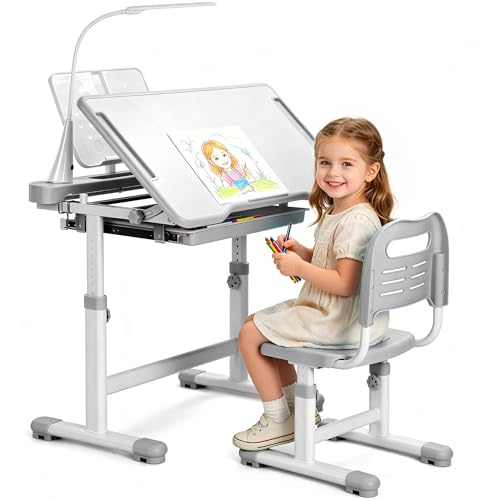
Rengue Kids Desk and Chair Set — Best Tilting-Top Set
Read this pick correctly: the Rengue is a set. The box contains a height-adjustable children’s study desk and its chair, planned together, and that changes both the price conversation and the room conversation. You are not adding a chair to a desk; you are installing a study station. For a child moving into their first proper homework years, or a room being set up from empty, that completeness is the appeal — desk height and chair height are designed to adjust in step, so the fit problem this guide keeps returning to is solved by the pairing itself.
The desktop tilts, up to the angle given in the listing, and a tilting top genuinely changes two activities. Drawing and painting sit more naturally on a raised surface, sparing the hunch over a flat page. Reading a book propped on the tilt keeps the text closer to eye level. The set also builds in an LED light with several modes and brightness levels, a storage drawer, and a metal hook for a school bag — small inclusions that, together, mean the station arrives ready rather than needing a weekend of accessorizing before it works.
Now the cautions, because sets demand them. If your child already has a desk you like, this pick asks you to replace it, and the sensible answer may be a chair alone from earlier in this guide. A tilting desktop is wonderful for art and reading and less wonderful for a wobbly cup of water or a construction of small bricks; children use desks for everything, so consider your child’s actual mix. The light and its settings add a fiddle factor for younger children, and the whole station claims a fixed footprint in the room — measure the wall it will live against before it arrives, not after.
- Form: desk-and-chair set — both pieces included
- Desktop: tilts for drawing and reading
- Lighting: built-in LED with modes and brightness levels per listing
- Storage: drawer and a metal bag hook
- Adjustment: desk and chair heights adjust together
Strengths
- Desk and chair are designed to fit each other and adjust in step.
- Tilting desktop genuinely helps drawing, painting, and propped reading.
- Drawer, hook, and lamp arrive included rather than bought separately.
Trade-offs
- Replaces an existing desk rather than complementing it.
- Tilted tops suit art better than water cups or brick constructions.
- The full station needs a planned, measured footprint in the room.
Best for: setting up a first study corner from scratch, especially for a child who draws as much as they write. Not suited for: homes with a good desk already, where only the chair needs replacing.

Xaperexi Kids Desk and Chair Set — Best Set with a Bookstand
The Xaperexi is also a set — desk and chair together — but it organises itself around a different centrepiece: a bookstand. That choice speaks to a particular kind of homework, the kind where a child copies from a textbook, follows a workbook, or practises reading with the book held upright and open at the right page. A bookstand keeps the source material vertical, visible, and off the writing surface, so the page being copied and the page being written can coexist without a wrestling match for desk space.
The desktop is described in the listing as widened, and width is the quiet luxury in children’s desks. A wide top holds the bookstand, the exercise book, the pencil case, and the inevitable water bottle without anything migrating to the floor. A storage drawer keeps the small clutter — rulers, rubbers, hair clips, trading cards — corralled beneath the top rather than spread across it. Height adjustment across the set lets the station track growth, which matters for a purchase that asks more of a family’s budget and floor space than a chair alone.
Compare it honestly with the Rengue before choosing between the two sets. The Rengue’s tilt and lamp suit the artist-reader; the Xaperexi’s bookstand and width suit the copier and the textbook worker. Neither is better in the abstract. The Xaperexi’s cautions mirror the set logic too: it replaces rather than supplements a desk, its footprint must be planned, and a bookstand earns its place only if your child’s homework actually involves books — a tablet-based school routine may leave it as handsome clutter.
- Form: desk-and-chair set — both pieces included
- Centrepiece: bookstand for upright textbooks and workbooks
- Desktop: widened surface per listing
- Storage: drawer beneath the desktop
- Adjustment: heights adjust as the child grows
Strengths
- Bookstand keeps source books upright and off the writing area.
- Wide desktop fits book, workbook, and pencil case simultaneously.
- Drawer storage keeps small homework clutter contained.
Trade-offs
- A full set, so it duplicates any desk you already own.
- The bookstand helps book-based homework more than tablet-based work.
- Station footprint needs measuring before purchase.
Best for: children whose homework means copying from textbooks and workbooks at a dedicated study station. Not suited for: rooms where the desk already exists and only seating is missing.
A Fixed-Height Wooden School Chair — Best Traditional Prose-Only Pick
Every schoolroom of a certain era had these: a solid wooden chair, four straight legs, a shaped seat, a back of horizontal slats, and no moving parts whatsoever. We include the type without a link because quality varies enormously between makers and the best way to judge one is to sit your child in it, check the joints with your hands, and look at the timber. It sits at a mid tier in most furniture shops, rising toward premium for hardwood and hand-finished examples.
The wooden chair’s virtues are the virtues of stillness. It does not roll, spin, tilt, or adjust, and for some children — particularly younger ones whose homework is short and whose wheeled chairs become vehicles — that stillness is precisely the point. Wood also repairs well: a wobble can be re-glued, a scratched seat sanded, and a good chair handed down to a sibling or kept for grandchildren in a way that a gas-lift chair will never manage. Paired with a cushion, it can serve at the family table as readily as at a desk.
Its limitation is in its name: fixed height. A wooden chair fits a child for a window of growth, not a span of years, unless you pair it with a booster cushion early and accept a slightly high seat later. It also offers no back shaping beyond its slats, so long sessions need a cushion and sensible breaks. Buy it for the years it fits, in a size measured against your child and your desk, and it will repay you in sturdiness; buy it hoping it will adapt, and it will quietly disappoint.
- Form: four-legged wooden school chair, no casters
- Adjustment: none — fit is by choosing the right size
- Back: horizontal slats, cushion optional
- Tier: mid in most shops, premium for hardwood
- Buying route: judge in person where possible
Strengths
- Completely still — no rolling or spinning distractions.
- Repairable, hand-down quality in a well-made example.
- Doubles at the family table without looking out of place.
Trade-offs
- Fixed height fits a growth window, not years of change.
- Needs a cushion for longer sitting sessions.
- Quality varies widely between makers, so inspection matters.
Best for: younger children, wobble-prone homework routines, and families who value repairable wood furniture. Not suited for: anyone wanting one purchase to adjust from age five through twelve.
How Do the Six Picks Compare Side by Side?
| Pick | Type | Adjustment | Standout trait | Watch out for |
|---|---|---|---|---|
| Kids Desk Chair Ergonomic Mesh Swivel | Chair only | Seat height | Breathable mesh back | Caster spinning |
| GIANTEX Kids Desk Chair Adjustable | Chair only, armless | Seat height | Tucks fully under desk | No arm support |
| VIVO Children Height Adjustable Desk Chair | Chair only, younger fit | Seat height | Seat depth suits small children | Outgrown sooner |
| Rengue Kids Desk and Chair Set | Desk-and-chair set | Desk and chair heights | Tilting top and LED light | Replaces existing desk |
| Xaperexi Kids Desk and Chair Set | Desk-and-chair set | Set heights | Bookstand and wide top | Bookstand may go unused |
| A Fixed-Height Wooden School Chair | Chair only, wood | None | Stillness and repairability | Fits a limited growth window |
What Height Should a Kids’ Desk Chair Be?
Forget the number on a product page for a moment and use the child as the measuring instrument. Seated properly, your child should place both feet flat on the floor with knees bent at roughly a right angle, sit back so the backrest touches the lower back, and rest forearms on the desktop with shoulders relaxed rather than hunched. If feet dangle, the chair is too high or the desk-chair pairing is wrong; if knees ride above hips, the chair is too low and writing becomes a crouch. Test any adjustable chair at both ends of its range in the shop of your imagination: will it fit this year’s legs and still have travel left for next year’s?
Desk height and chair height are a pair, and changing one without the other is where most families go astray. A standard adult desk is often too high for a child even with the chair at maximum, which is why the two sets in this guide exist and why a footrest box — a sturdy crate or a low step — under a younger child’s feet is a respectable interim fix. Whatever combination you choose, recheck the fit at the start of each school term. Growth spurts do not send warning letters, and a chair that fit in September can be quietly sabotaging posture by Easter.
Mesh, Padding, or Wood: Which Seat Suits Your Child?
Mesh earns its place in warm rooms and long sessions. It breathes, it vacuums clean, and it does not hold the day’s heat. Its weakness is lean-in comfort: a child who reads sideways, curled against the backrest, may find mesh less forgiving than padding. Padded seats and backs suit readers and loungers, and they feel welcoming at the start of a session, but they hold warmth and show the evidence of spilt drinks more readily. Read the care instructions in any listing before assuming a cover can be removed and washed.
Wood is the third temperament entirely. A wooden seat is firm, cool, and honest; it asks for a cushion during long sessions and rewards you with decades of service. Children differ here more than product pages admit. If your child does homework in twenty-minute bursts, almost any well-fitting chair works. If yours settles in for an hour with a novel after the worksheets are done, cushioning and back shape climb the priority list quickly. Match the material to the session length you actually observe in your house, not the one you hope to encourage.
How Do You Set Up a Study Corner That a Child Will Actually Use?
Begin with light, because no chair fixes a gloomy corner. Place the desk where daylight falls across the work without shining in the child’s eyes, and give the corner a lamp for winter afternoons — or choose a set with lighting built in. Keep the chair’s rolling territory clear: casters that constantly bump a bed leg or a toy box teach a child to abandon the desk for the kitchen table. A small rug under the chair zone both steadies casters and defines the study patch of the room in a way children respond to surprisingly well.
Then stock the corner so leaving it is rarely necessary. Pencils, paper, a water bottle, and the current reading book within reach mean the session survives its own momentum; a child who gets up for a sharpener will find six other things to do on the way back. A drawer, like those in the two sets, or a simple box on the desk keeps those supplies corralled. Finally, let the child arrange something — the position of the lamp, a drawing pinned above the desk, the choice of cushion. Ownership of the corner is half of its use.
What Mistakes Do Parents Make When Buying a Kids’ Desk Chair?
The classic error is buying an adult chair in a cheerful colour and calling it a children’s chair. Adult seat depth alone defeats a small child, who ends up perched on the front edge with the backrest a rumour behind them. The second error is buying for the age on the box rather than the child in front of you; children of the same age vary enormously in height, and the tape measure is a better guide than the birthday. Measure your child’s lower leg, compare it with seat heights in listings, and let arithmetic overrule marketing.
Third, families forget the desk. A wonderful chair under a too-high desk produces the same dangling feet as a bad chair, and arms that cannot pass under the desktop force the child to sit too far from the page. Fourth, sets get bought by households that needed only a chair — an expensive duplication — while other households buy a chair alone and discover their wobbly old desk was the real problem all along. Decide which piece is actually failing before spending on either. Finally, do not skip the termly height check; the best adjustable chair set wrong is just a wrong chair with potential.
How Long Should a Child Sit at a Desk in One Stretch?
No chair, however well fitted, turns a young child into a desk worker for hours at a time, and parents sometimes buy furniture to solve a problem that is really about session length. Primary-school children generally work best in focused stretches broken by movement — stand up, fetch a drink, look out of the window, then return. The chair’s job is to make the seated stretches comfortable and properly supported, not to make endless sitting acceptable. If homework regularly runs long, splitting it around tea or a short run outside does more for both posture and temper than any upgrade in this guide.
This is also where the differences between these picks soften. In twenty-minute bursts, the wooden chair, the mesh chairs, and the set chairs all serve perfectly well once the height is right. In the longer sessions of the later primary years — project work, exam revision creeping earlier each generation, an engrossing book — the breathable mesh backs and the adjustable fits pull ahead, because small discomforts compound over an hour in a way they never do over fifteen minutes. Buy for the sessions your child actually faces this year, and expect the right answer to change as school demands grow.
Watch how your child sits when nobody is correcting them, because that unobserved posture is the truthful one. Sliding down until the seat edge carries the shoulder blades, sitting on one foot, kneeling on the chair facing backwards over the backrest — each habit points at a fit issue or a session that has run past its natural length. A chair set to the correct height quietly removes most of these workarounds. The rest are a child’s body asking for a break, and the wise response is a break, not a lecture about sitting up straight delivered for the fourth time that evening.
What About Casters, Floors, and the Noise Nobody Mentions?
Four of the five linked picks roll, and rolling has a household cost that product photographs never show: sound and floor wear. Casters crossing a hard bedroom floor at homework time are audible through a ceiling, and repeated rolling along the same track in front of a desk can dull a floor finish or fray the same strip of carpet. A low rug or a chair mat under the desk zone solves both problems at once, which is why we keep returning to it — it is the cheapest accessory in this entire guide and the one that protects the most expensive surface involved, the floor itself.
Carpet changes the calculation in the opposite direction. Deep pile resists small casters, so a child ends up dragging rather than rolling the chair, and the chair that felt lively on a showroom floor feels stubborn at home. If your child’s room has thick carpet, expect rolling to be muted and treat that as a feature: the chair stays where it is put, spins less, and still pulls in with a tug. On laminate or boards, expect the opposite and plan the rug. Either way, check caster type in the listing details if your floor is delicate, and never let a child stand on a wheeled chair to reach a shelf — that rule outranks every other in this section.
Sharing One Chair Between Siblings: Does It Work?
In many homes the desk chair serves two or three children across an evening, and adjustability stops being a growth feature and becomes a nightly one. The mesh chairs in this guide reset in seconds, and families who share successfully usually turn the adjustment into a ritual: each child knows their setting, or a parent marks the lift post with a small sticker at each child’s correct height. It sounds fussy and takes ten seconds in practice, and it prevents the quiet injustice of the younger sibling always doing homework in a chair set for the elder.
The sets complicate sharing, because the desk height adjusts too and siblings’ homework often overlaps in the early evening. A set works best as one child’s own station; siblings then need a second seat — which is where the wooden chair earns a return appearance, pulled up to the family table or a second small desk while the set’s owner occupies the main station. Think through your household’s actual evening geography before deciding that one premium station solves everyone’s seating. Sometimes a chair for each child, each more modest, is the genuinely better purchase.
How Do You Clean and Maintain a Children’s Desk Chair?
Homework chairs live hard lives at close quarters with glue, felt tips, biscuit crumbs, and drinks carried in from the kitchen against all house rules. Mesh backs forgive most of it: a vacuum with a brush attachment lifts crumbs and pencil shavings, and a damp cloth handles the rest. Frames wipe clean with ordinary household cleaners. The maintenance that actually matters is mechanical — every few months, turn the chair over, tighten any fixings that have worked loose, clear the hair and carpet fibre wound around the casters, and test the height lift. Five minutes, twice a term, keeps a chair feeling new.
Wooden chairs ask for different care and reward it differently. Keep them out of prolonged direct damp, touch up scratches if they bother you, and re-glue a loosening joint early, while it is still a small job. The sets add their own small routines: drawer runners that appreciate being kept free of pencil-shaving grit, a tilting desktop hinge that should be checked for tightness, and a lamp whose cable should stay clear of the chair’s rolling path. None of this is burdensome, but all of it belongs in the honest cost of ownership, and a chair that receives it will outlast several school uniforms.
When Should a Child Move Up to a Teen or Adult Desk Chair?
The signal is fit, not age. When an adjustable children’s chair reaches the top of its height range and your child’s knees still sit high, or when the seat has become visibly narrow and short for them, the chair has done its service. This typically arrives somewhere in the later primary or early secondary years, varying enormously with the child. At that point the teen desk chairs in this same batch — built larger, with mesh backs and longer sessions in mind — become the natural next step, and the outgrown children’s chair passes to a sibling or sells easily, because every family behind yours on the same road needs one.
Resist moving a child up early as a money-saving shortcut. An adult chair’s deep seat and high back do not merely look oversized on a nine-year-old; they actively prevent the feet-flat, back-supported posture this whole guide is built around, and the child compensates with perching and slumping that no amount of reminding will undo. The children’s chair years are short. Buy the right size for them, let it be outgrown honestly, and hand it on in good condition — that is the economical route, even though it never feels like it at the till.
What Should You Check in the Listing Before You Order?
Children’s furniture listings reward careful reading, because the photographs often show a range of sizes or configurations and the details decide which one reaches your door. Confirm the seat height range in numbers, not adjectives, and set it against your child’s lower-leg measurement and your desk’s height. Check whether arms are present in the version you are buying, since the same chair family may be sold both ways. For the two sets, confirm exactly what the box contains — desk, chair, lamp, drawer fittings — and whether the chair can also be bought or replaced separately later, because children are harder on chairs than on desks.
Then look at the unglamorous lines: assembly requirements, the tools included or needed, and the stated age or size guidance. Treat age guidance as a rough map and measurements as the territory. If a listing gives a weight capacity, respect it with margin, especially for chairs that will be shared, climbed on, and occasionally used by a parent perching to help with long division. Finally, photograph your desk’s underside clearance before ordering anything with arms or a tall back. Thirty seconds with a tape measure has saved more returns than any review ever written, including this one.
How Does a Desk Chair Affect the Homework Battle?
It would be pleasant to claim that the right chair ends homework resistance, and it would also be untrue. What a well-fitted chair genuinely does is remove one layer of friction from an evening ritual that has enough friction already. A child who is physically comfortable settles faster, stays seated longer, and spends less of the session negotiating with their own body. Parents notice the difference as a quieter first ten minutes rather than a transformed child, and quieter first ten minutes, compounded across a school year, are worth having.
The chair also works as a signal. A specific seat, at a specific desk, used for schoolwork and not for gaming or eating, becomes part of the boundary between school time and home time that children — especially younger ones — rely on adults to build. That is another argument for the dedicated station where space allows, and for keeping the desk chair at the desk rather than letting it migrate around the house. Furniture teaches routines quietly. Choose a chair that fits, put it in a corner with light, and let the routine do the persuading that no parent enjoys doing nightly.
Should You Let Your Child Choose the Chair?
Within limits, yes — and the limits are the parent’s job. A child consulted about colour and style owns the study corner a little more, and ownership, as this guide has noted, is half of use. A child allowed to choose the mechanism, the size, or the presence of wheels is being handed decisions their judgement is not yet built for. The workable division is simple: adults shortlist chairs that fit the child, the desk, and the room; the child picks a favourite from the shortlist. Everyone’s expertise is respected, and nobody ends up doing long division in a chair shaped like a racing car seat that fits nothing in the house.
There is a second, quieter benefit to involving them. Sitting in the chair, adjusting it, and learning why feet belong flat on the floor teaches a child to notice their own posture years before an office job makes the lesson urgent. Children who have set their own chair height tend to notice when it needs resetting, and some will even do it themselves after a growth spurt, usually announced with great pride. A desk chair is a small purchase, but it is often the first piece of furniture a child is trusted to operate and maintain as their own. Let it be that, and the homework corner gains a caretaker as well as a user.
A Note on Buying Second-Hand Children’s Desk Chairs
Children outgrow good chairs quickly, which makes the second-hand market for them unusually healthy, and a used mesh task chair from a careful home can be excellent value. Inspect any candidate as you would a wooden one: sit your child in it, test the height lift through its full travel, check casters for wobble and cracks, and look underneath for loose or missing fixings. A lift mechanism that sinks slowly under weight has reached the end of its life, whatever the seller says, and replacement parts for children’s models are rarely worth hunting down. Buy second-hand for the frame and the fit; walk away from anything whose adjustment no longer holds, because adjustment is the entire point of the category.
Final Recommendation
For most families, start with the mesh swivel chair that adjusts: the Kids Desk Chair Ergonomic Mesh Swivel fits the widest range of children, desks, and homework styles, and it will keep fitting as legs lengthen. Choose the armless GIANTEX where floor space is precious, the VIVO where the child is young and small, and a set — Rengue for the artist, Xaperexi for the textbook copier — only when the desk itself needs replacing or creating. Keep the wooden school chair in mind for the child who needs stillness more than features. Above every feature list stands one test, and it costs nothing: feet flat, back supported, shoulders down. A chair that passes that test on your child, at your desk, this term, is the right chair — measure honestly, adjust termly, and let the homework corner in your home become the place where the day’s schoolwork quietly gets done and the evening can begin.
Frequently Asked Questions
At what age does a child need a proper desk chair?
Once homework becomes a regular seated activity — for most children, the first couple of school years — a chair that fits beats the kitchen chair or the bed. Before that, short craft sessions tolerate almost any seat. Judge by session length and your child’s size rather than by a birthday.
Are wheels a good idea on a child’s desk chair?
Wheels help a child pull in close and move the chair independently, and they also enable spinning and scooting. On a rug or mat, most families find the balance favourable; on bare hard floors with a lively child, an armless chair still rolls, so consider the wooden pick if stillness matters more than mobility in your home.
Is a desk-and-chair set better than buying the chair alone?
A set guarantees the desk and chair heights were planned together, which solves the commonest fit problem, and sets like the Rengue and Xaperexi add storage and extras in one purchase. If your existing desk is sound and correctly sized, a chair alone is the better spend. The set is the answer when you are furnishing the corner from nothing.
How often should I readjust an adjustable chair?
Check the fit at the start of each school term and after any visible growth spurt. The adjustment itself takes under a minute on the chairs in this guide. Feet drifting off the floor, or knees rising above hip level, are your signals that the setting has been outgrown.
Does my child need a footrest as well as a chair?
Only when the pairing of desk and chair leaves feet dangling despite the chair being set correctly for the desktop — a common situation with younger children at taller desks, and one worth fixing promptly rather than leaving for a growth spurt to solve eventually on its own schedule. A sturdy box, a low step, or a purpose-made footrest restores the feet-flat position without forcing the seat too low for writing. Treat it as a bridge measure: as legs lengthen, the footrest retires, usually within a year or two, and the chair alone takes over.
Can a kids’ desk chair be used at the family dining table?
The wooden school chair moves between desk and table most gracefully, since it has no casters and a dining-appropriate profile. Wheeled chairs at a table tend to drift and swivel during meals, which most families tire of quickly. If one chair must do both jobs, wood is the peacemaker.
Related Guides
Chairs for children connect naturally with the rest of this batch. When the desk chair is sorted, the play corner usually follows, and our guide to Best Chairs for a Kids’ Play Room covers the soft seating side of a child’s room. Families furnishing several rooms at once may also want Best Salon Chairs and Ceramic Shampoo Bowls for a home salon corner, and anyone setting up a study for an adult in the same house should read Best Chairs for All-Day Computer Work before buying. For younger siblings not yet at desk age, Best Bouncy Chairs for Fourth Graders rounds out the children’s seating picture.


