What's inside
- Key Takeaways
- Quick Picks
- How Did We Choose These Picks for the Best Car Booster Chairs for Kids?
- Comparison Table
- How Do You Know a Child Is Ready for a Booster at All?
- How Do You Check Belt Fit on Your Own Child?
- What About Expiry Dates, Second-Hand Seats and Crash History?
- What Mistakes Do Families Make with Booster Seats?
- High-Back, Backless or Convertible: Which Form Fits Your Family?
- How Do Boosters Behave in Different Cars?
- How Do You Teach a Child the Buckling Routine?
- What Changes on Long Journeys?
- How Do You Keep a Booster Clean, Complete and in Service?
- How Do You Read a Booster Listing Without Being Misled?
- Final Recommendation
- Frequently Asked Questions
- Related Guides
As an Amazon Associate I earn from qualifying purchases. This post may contain affiliate links at no extra cost to you.
cottageverdict.com is reader-supported. When you buy through links on our site, we may earn an affiliate commission.
Where to buy: each linked booster below leads to its Amazon listing, where you can check price on Amazon and confirm the manufacturer’s weight and height limits, the seat’s expiry information and its care instructions before ordering. One pick is discussed in prose only, because the simplest backless boosters are best chosen in person against your own car’s seat and your child’s belt fit.
Choosing the best car booster chairs for kids is really choosing how a seatbelt will meet a small body. A booster does not restrain a child by itself; it raises and positions the child so the vehicle’s own lap-and-shoulder belt crosses the strong parts of the body — low on the hips, centred on the shoulder — instead of the soft abdomen and the neck. Every pick in this guide should be judged against that single job, because a booster that positions the belt well, in your car, with your child, is worth more than any feature list.
Two responsibilities sit with the adult, and this guide will return to them more than once. First, the law: child passenger rules differ by state and by country, setting different ages, weights and heights for booster use, and it is the caregiver’s job to check the current rules where they drive — nothing here is legal advice, and no product page overrides your local law. Second, the calendar: car seats and boosters carry expiry dates, printed or moulded into the shell, because plastics and foams age. A booster past its date, or one with an unknown crash history, should be retired however tidy it looks.
With those foundations laid, the genuine differences between boosters are practical ones. High-back models add side support, belt guides and a headrest that helps a sleepy child stay in position; backless models are light, portable and ideal for older children, carpools and grandparents’ cars. Some convert between the two. Some latch rigidly to the vehicle’s anchors so the booster itself stays put when unoccupied; others rely on the belt alone. The five linked picks below cover those philosophies from established child-seat makers, and the prose-only sixth discusses the plain backless cushion on its own terms.
Key Takeaways
- A booster’s real job is belt positioning: lap belt low on the hips, shoulder belt centred on the chest and shoulder.
- Check your state or country’s current child passenger law yourself; requirements vary and product listings do not settle them.
- Every booster has an expiry date — find it on the shell before the seat goes into service, especially on hand-me-downs.
- High-back boosters help younger or sleepier children stay positioned; backless boosters suit older children and shared-car duty.
- The two Safety 1st picks convert from high-back to backless, stretching one purchase across two stages.
- Diono’s rigid-latch models stay fixed in the car, which keeps an unoccupied booster from becoming a loose object.
Quick Picks
| Pick | Badge | Why it earns its place |
|---|---|---|
| Safety 1st Grand 2-in-1 Booster Car Seat | Best Straightforward Convertible | High-back protection that converts to a belt-positioning booster across a wide stated weight range. |
| Evenflo GoTime LX Booster Car Seat | Best Tall Range | Two modes and the highest stated upper weight in this group, for children who booster for longer. |
| Diono Everett NXT High Back Booster | Best Rigid-Latch Fit | Rigid latch connectors and a slim, lightweight frame from a maker known for narrow seats. |
| Safety 1st Grow and Go 2-in-1 Booster | Best for Three-Across Puzzles | Slim, foldable and light, with comfort wings, aimed at crowded back seats. |
| Diono Airi Travel High Back Booster | Best Travel Booster | A folding high-back design built for trips, rentals and three-across travel days. |
| A Plain Backless Booster Cushion, Discussed Generically | Prose-Only Staple | The budget-tier classic for older children, carpools and spare-car duty. |
How Did We Choose These Picks for the Best Car Booster Chairs for Kids?
We limited the field to dedicated boosters from established child-seat manufacturers whose listings state their modes and weight ranges plainly, because in this category the maker’s instructions are not marketing garnish — they are the operating manual for a safety device. Models whose listings left the mode conversions or limits vague were set aside. We also favoured range: between them, the five linked seats cover children from the start of booster readiness through the tall, late-booster years, in both high-back and backless forms.
Belt fit thinking shaped the shortlist. High-back models earned their places with proper shoulder-belt guides and headrests that keep a sleeping child’s head and torso aligned, because a child slumped sideways out of the belt’s path is a positioning failure even in an excellent seat. Convertible designs scored for longevity, rigid-latch designs for the way they anchor the booster itself, and the slim designs for solving the three-across geometry that decides real family life more often than any crash-test headline.
Finally, we weighed the unglamorous logistics: weight, because boosters get carried between cars; cleanability, because childhood happens to upholstery; and foldability, because a booster that travels gets used on trips where an unfamiliar rental car’s belt geometry is exactly when positioning help matters. Price appears nowhere in that reasoning, deliberately — the right booster is the one whose fit you can verify in your own car.
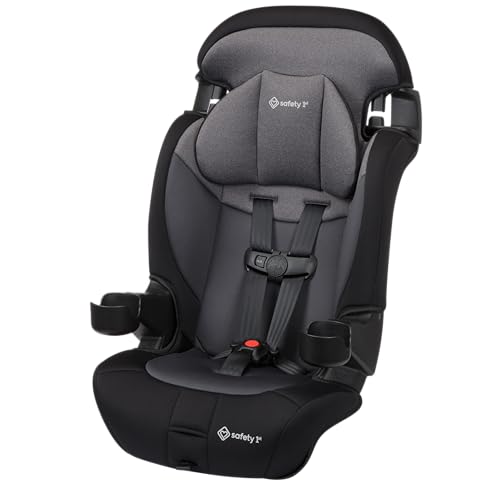
Safety 1st Grand 2-in-1 Booster Car Seat — Best Straightforward Convertible
The Grand 2-in-1 is the archetype of the modern convertible booster: a high-back seat for the earlier booster years that converts to a backless belt-positioning booster when the child is older and the headrest support is no longer needed. Its listing states the high-back mode for children of 40–65 pounds and the belt-positioning mode for 40–100 pounds, and those figures should be read alongside the height guidance in the manual, because children outgrow seats by torso height as surely as by weight. Treat the numbers as the manufacturer’s boundaries, not as targets to stretch.
In high-back form, the Grand’s job is guidance in both senses: the backrest routes the shoulder belt through its guide so the belt crosses the chest correctly, and the side structure gives a drowsy child something to lean against that keeps the belt’s geometry intact. This matters on real journeys. Children fall asleep at motorway speeds, and a child folded forward or slumped sideways has quietly left the position the belt was arranged for. A supportive high-back is less a comfort feature than a way of keeping the safety arrangement true while the passenger is unconscious.
The conversion to backless form extends the seat’s working life into the carpool years, when lightness and simplicity take over as virtues. As with every convertible, keep the removed backrest and its instructions together somewhere safe; a seat passed to a younger sibling later will want its other half back. The Grand’s colourway here is a muted, car-friendly tone that hides the archaeology of family travel well, and the seat’s overall brief — one purchase, two stages, no exotic mechanisms — makes it the easiest recommendation in this guide for a first booster.
- Modes: high-back booster converting to backless belt-positioning booster
- Stated range: 40–65 lbs high-back; 40–100 lbs belt-positioning, per listing
- Restraint: uses the vehicle’s own seatbelt in both modes
- Role: first booster that adapts as the child grows
Strengths
- Two stages in one seat stretches the purchase across years.
- High-back belt guide helps correct shoulder-belt routing early on.
- Supportive sides keep sleeping children better positioned.
Trade-offs
- No rigid latch, so the unoccupied seat should be belted in place.
- Backless conversion parts must be stored carefully for later reuse.
- Width is family-car friendly rather than three-across slim.
Best for: families buying a first booster and wanting it to last through both stages. Not suited for: households needing the narrowest possible seat in a three-across row.
Check price on Amazon.

Evenflo GoTime LX Booster Car Seat — Best Tall Range
Children do not leave boosters on a schedule set by birthdays; they leave when the vehicle’s belt fits them properly without one, which for many children arrives later than impatience suggests. The GoTime LX answers that reality with the widest stated range in this group — 40 to 120 pounds across its two modes, converting from high-back to no-back booster as the child grows. For tall, long-torso children who will booster well into the later primary years, an upper limit with genuine headroom avoids a forced second purchase near the finish line.
Evenflo’s design language here is straightforward family engineering: a high-back with belt guidance for the younger phase, a clean conversion for the older phase, and fabrics chosen for cars that also carry sports kits, dogs and the occasional ice cream. The Quincy Blue colourway in this listing is dark enough to forgive most of that. What matters more is how the seat behaves in the second row of a real car — whether its base sits flat on sculpted vehicle cushions, whether its belt path stays accessible when neighbouring seats are occupied, and whether the child can buckle independently, because a booster a child can use correctly alone is a booster that gets used correctly on the school run’s busiest mornings.
There is also a quieter benefit to a long-range seat: continuity of habit. Children build their buckling routine on one set of guides, one buckle position, one familiar geometry, and every seat change resets some of that learning at exactly the age when adults start supervising less closely. A booster that stays in the family for the whole booster era keeps the routine stable, and the adult’s verification glance stays calibrated to a seat they know intimately. When the GoTime eventually converts to its backless form, even that change happens within a familiar shell, which makes it a gentler graduation than a wholesale swap to an unknown cushion.
Independence deserves emphasis. The booster years coincide with children wanting to manage their own buckling, and a seat whose belt path is intuitive — lap belt under the armrests, through the guides, buckle reachable — supports that learning safely. Adults still verify the fit every trip: belt snug, low on the hips, shoulder strap centred, no twists. The GoTime LX’s generous range simply means that this routine, once learned on this seat, can continue on the same seat for an unusually long stretch of childhood.
- Modes: high-back converting to no-back booster
- Stated range: 40–120 lbs across modes, per listing
- Restraint: vehicle seatbelt, routed through the seat’s guides
- Role: long-service booster for children who booster longer
Strengths
- Highest stated upper weight here suits tall, older booster riders.
- Convertible design covers both booster stages in one shell.
- Child-manageable belt path encourages correct independent buckling.
Trade-offs
- Larger range means a larger seat; check three-across plans carefully.
- Unoccupied seat needs belting or storing to keep it from sliding.
- Upper limits still require the manual’s height guidance to be respected.
Best for: families with tall children who will use a booster for years, and anyone tired of outgrowing seats. Not suited for: the tightest three-across arrangements or frequent flying, where a travel booster serves better.
Check price on Amazon.

Diono Everett NXT High Back Booster — Best Rigid-Latch Fit
Diono built its reputation on narrow steel-framed seats that fit where other seats cannot, and the Everett NXT carries that thinking into the booster years: a slim-fit, lightweight high-back booster whose distinguishing feature is rigid latch. Instead of resting loose on the vehicle cushion, the Everett connects directly to the car’s latch anchors with rigid arms, so the booster itself is fixed in place — it does not slide when the child climbs in, and it does not become an unsecured object in the car when the child is not riding.
That fixed relationship pays off in belt geometry. A booster that stays exactly where you positioned it keeps its belt guides in a consistent relationship with the vehicle’s belt anchorages, trip after trip, which removes one whole category of “it shifted since Tuesday” fit drift. The slim profile compounds the benefit in real back seats: adult passengers or neighbouring child seats gain precious inches, and the child can reach the buckle without excavating it from beneath a wide booster base — a small ergonomic fact that decides whether buckling is a calm routine or a daily wrestling match.
The listing’s “8 years” framing refers to the seat’s service-life span, and it underlines the expiry theme of this guide: even a durable booster has a retirement date, printed by the manufacturer, after which it should leave service regardless of appearance. Within that life, the Everett suits families who keep one car for years and value a booster that installs once and stays installed. If your life involves moving boosters between cars daily, rigid latch is a feature you will connect and disconnect constantly; weigh that honestly against the backless portability at the end of this guide.
- Modes: high-back booster
- Attachment: rigid latch connectors to vehicle anchors
- Profile: slim-fit, lightweight frame
- Service life: manufacturer-stated span; check the expiry label on the shell
Strengths
- Rigid latch keeps the booster fixed and correctly positioned.
- Slim fit eases three-across layouts and buckle access.
- Unoccupied booster stays secured rather than sliding loose.
Trade-offs
- High-back only; no backless conversion for the carpool stage.
- Rigid latch suits cars with accessible anchors best.
- Less convenient for daily swapping between several vehicles.
Best for: one-car families wanting an install-once booster, and crowded back seats needing slim geometry. Not suited for: carpool-heavy households that move a booster between cars every day.
Check price on Amazon.

Safety 1st Grow and Go 2-in-1 Booster — Best for Three-Across Puzzles
The Grow and Go approaches the crowded back seat as its design brief. The listing describes a 19-inch-wide, slim, lightweight and foldable booster with ComfortWings — the padded side wings that give a child lateral support without the bulk of a full touring seat — converting from high-back to backless across a stated 40–100 pound range, with cup holders and an easy-clean design. Foldability in a high-back booster is rarer than it should be: a seat that folds travels in a boot, stores in a hallway cupboard and visits grandparents without dominating the luggage.
Three-across is a geometry problem before it is a shopping problem. Vehicle cushions curve, buckles sit at fixed points, and three child seats must coexist with three belt paths that adults can actually reach. A slim booster earns its keep not merely by fitting between its neighbours but by leaving the buckle stalks accessible; a seat that technically fits while burying the buckle under its base will be cursed daily and eventually used carelessly. The Grow and Go’s narrow footprint and light weight make the test-fitting process itself easier — you can try positions, swap sides and experiment in minutes rather than wrestling a heavy seat through configurations.
The easy-clean design and cup holders sound like lifestyle garnish until you have owned a booster through a winter of muddy boots and a summer of juice boxes; then they read as maintenance features. Covers and surfaces that wipe or wash clean keep the seat in service and in favour, because a booster banished for smelling of old milk protects nobody from the garage shelf. As with its Grand sibling, store the backrest carefully when the seat converts to backless duty, and keep the instruction booklet with it — the next child to use this seat deserves its full configuration and its full instructions.
- Modes: high-back converting to backless
- Stated range: 40–100 lbs, per listing
- Width: 19 inches per listing; foldable for storage and travel
- Details: ComfortWings side support, cup holders, easy-clean surfaces
Strengths
- Slim footprint genuinely helps three-across arrangements.
- Folding design stores and travels unusually well for a high-back.
- Light weight makes position experiments and car swaps easy.
Trade-offs
- No rigid latch; belt the empty seat or store it when unoccupied.
- Wing support is lighter than a full deep-sided touring booster.
- Cup holders consume a little of the width the slim design saves.
Best for: three-across families, small cars and households that store the booster between uses. Not suited for: buyers wanting rigid-latch anchoring or the deepest side support for long sleepy motorway runs.
Check price on Amazon.

Diono Airi Travel High Back Booster — Best Travel Booster
Travel is when booster discipline goes to die: the rental car is unfamiliar, the grandparents’ car has deep soft cushions, the taxi ride is “only short.” The Airi exists for exactly those moments — a foldable high-back booster with a slim, three-across-friendly fit that packs down for the journey and then provides proper belt guidance in a strange car. A high-back that travels is a meaningful step beyond the usual travel compromise of a bare backless cushion, because the shoulder-belt guide and head support come along in the luggage.
Folding high-backs solve a real packing problem. A rigid high-back booster is mostly air and awkward angles; it will not share a suitcase gracefully and it mocks car boots already full of holiday gear. A design that folds flat changes the calculation enough that the booster actually gets taken, which is the entire point — the safest booster is the one present in the rental car at the far end, correctly routing a belt whose anchor points you have never seen before. Practise the fold and the belt routing at home first, in daylight, rather than debuting both at an airport kerb at midnight.
Consider also who the Airi quietly serves at home: the family whose second car is small, whose booster lives in the boot between school runs, or whose hallway has no room for a rigid high-back standing in state. A folding seat collapses the storage problem that makes other households abandon high-backs early, and in that sense its travel engineering doubles as domestic engineering. Grandparents, in particular, are the unsung beneficiaries — a booster that arrives folded in a parent’s luggage, unfolds for the visit and leaves with the family solves the grandparent-car problem without asking anyone to store child equipment permanently in a car that mostly carries one adult and a week’s shopping.
Two travel cautions belong with this pick. First, expiry and condition checks matter doubly for a seat that gets folded, carried and stored between trips; inspect the shell, guides and belt path before each journey, and retire the seat at its printed date even if it looks fresh from a life of occasional use. Second, destination rules differ — states and countries set their own child passenger requirements, and a booster that satisfies your home rules may not match the letter of the law where you land. Check before you fly; the checking is quick, and it is the adult’s job, not the airline’s or the rental desk’s.
- Modes: high-back booster, folding for travel
- Profile: slim fit, designed to sit three-across
- Role: trips, rental cars, grandparents’ cars and taxis
- Checks: inspect shell and guides before each trip; note expiry date
Strengths
- High-back belt guidance that actually travels with the family.
- Folding form fits luggage and boots that defeat rigid boosters.
- Slim profile suits unfamiliar rental-car back seats.
Trade-offs
- Occasional-use seats still expire on the manufacturer’s schedule.
- Folding mechanism adds a pre-trip inspection habit to maintain.
- Home-car families may prefer a fixed, latch-anchored everyday seat.
Best for: travelling families who refuse to leave belt guidance at home. Not suited for: buyers wanting a single install-and-forget booster for one car only.
Check price on Amazon.
A Plain Backless Booster Cushion, Discussed Generically — Prose-Only Staple
The simplest booster of all — a moulded backless cushion with belt guides and a pair of armrests — remains the right answer for a particular stage: the older child who sits upright reliably, in a car whose head restraints support their head, on journeys where portability is king. Backless boosters live in hall cupboards and grandparents’ boots, appear for carpools and cousin visits, and cost so little as a tier that keeping a spare is normal family logistics. We cover the type in prose because fit is everything and the differences between basic cushions are minor beside the question of how one sits in your car.
The conditions matter more than the cushion. The child’s ears should stay below the top of the vehicle’s head restraint, the lap belt must ride low across the hips under the guides, and the shoulder belt must cross the chest without slipping toward the neck or the arm. If any of those fail — in a low-backed bench seat, say — the child still needs a high-back booster whatever their age. Bought in the budget tier from any established maker, checked against its expiry date and used within those conditions, a plain backless booster is honest equipment doing a simple job well.
- Form: backless belt-positioning cushion with belt guides
- Tier: budget; commonly kept as a spare for carpools and visitors
- Conditions: vehicle head restraint must support the child’s head
- Checks: lap belt low on hips, shoulder belt centred, expiry date valid
Strengths
- Lightest, simplest and most portable booster form there is.
- Ideal spare for carpools, grandparents and unexpected passengers.
- Encourages older children to manage their own buckling routine.
Trade-offs
- No side support or headrest for sleeping children.
- Depends entirely on the vehicle’s own head restraint and belt geometry.
- Easy to use too early; younger children still need a high-back.
Best for: older, upright-sitting children and spare-seat duty in a second car. Not suited for: younger booster riders, sleepy long-distance passengers or vehicles with low seat backs.
Comparison Table
| Pick | Modes | Stated range | Defining feature |
|---|---|---|---|
| Safety 1st Grand 2-in-1 Booster Car Seat | High-back to backless | 40–100 lbs across modes | Straightforward two-stage conversion |
| Evenflo GoTime LX Booster Car Seat | High-back to backless | 40–120 lbs across modes | Longest service range in the group |
| Diono Everett NXT High Back Booster | High-back | See manual for limits | Rigid latch, slim fit |
| Safety 1st Grow and Go 2-in-1 Booster | High-back to backless | 40–100 lbs | 19-inch slim, foldable |
| Diono Airi Travel High Back Booster | High-back, folding | See manual for limits | Travel-ready high-back |
| Plain Backless Booster Cushion (prose-only) | Backless | Varies by maker | Portable spare-seat staple |
How Do You Know a Child Is Ready for a Booster at All?
Readiness is a bundle of thresholds, not a birthday. The child should meet the previous seat’s limits — most children ride in a harnessed seat until they outgrow it by height or weight — and meet the booster’s minimums in the manufacturer’s manual. Just as important is maturity: a booster relies on the vehicle’s belt, which only protects a child who sits upright, centred and still for the whole journey, every journey. A child who leans out of position to reach toys, slumps sideways in sleep without support, or unbuckles for sport is telling you the harnessed seat still has work to do.
Readiness also has a physical rehearsal available to any family: the driveway trial. Before the first real journey, sit the child in the new booster in the parked car, route the belt together, and simply observe for ten minutes of ordinary fidgeting. Does the belt stay where you put it? Does the child stay where the belt put them? Driveway answers are cheap and honest, and a failed rehearsal costs nothing but information — far better than discovering the same facts at motorway speed with a child who has decided the shoulder belt belongs behind their back.
The law forms the floor beneath all of this, and it is a floor that moves. States set different minimums for booster use and different points at which a child may graduate to the belt alone; other countries differ again. This guide deliberately states no jurisdiction’s rules, because the only version that counts is the current one where you drive, checked by you. Read your state or national guidance, read the seat manual, and where the two suggest different timings, the more protective reading is the wiser one. Manufacturers’ minimums are engineering boundaries; legal minimums are society’s floor; your child’s actual readiness is the third test, and all three should pass.
How Do You Check Belt Fit on Your Own Child?
Run the same five checks every time a child changes seats, cars or boosters. The booster sits flat on the vehicle cushion, against the seat back. The lap belt lies snug and low, touching the tops of the thighs and riding on the hip bones — never up on the soft stomach. The shoulder belt crosses the centre of the chest and shoulder, touching neither the neck nor slipping toward the upper arm. The belt lies flat with no twists, and the child can sit with knees bending naturally at the edge of the booster and back resting against the seat behind.
Then repeat the check with the child asleep, or at least slumped in honest imitation, because that is the posture the belt will actually meet on a long drive. If sleep collapses the fit, the answer is more support — a high-back with better side structure — not a lecture delivered to an unconscious passenger. Recheck fit after growth spurts, after changing cars, and whenever a booster moves between vehicles, since belt anchor positions differ enough between models to change the geometry on the same child. Fit is a property of the combination — child, booster, car — never of the booster alone, which is why no review, including this one, can certify it from a desk.
What About Expiry Dates, Second-Hand Seats and Crash History?
Every booster carries a service life set by its manufacturer, expressed as an expiry date or a years-from-manufacture limit, stamped or labelled on the shell. Materials age: plastics become brittle through heat cycles in parked cars, foams compress, and standards evolve. A booster beyond its date should be retired even if it has lived a gentle life in a spare car, and the date is the first thing to check on any seat offered by friends or family, however generous the offer.
Crash history is the second gate. Manufacturers give guidance on which collisions require a seat’s replacement, and a booster whose history you simply do not know — a kerbside find, an anonymous second-hand listing — cannot pass that gate, because the question is unanswerable rather than answered. This is why the prose-only backless cushion in this guide is framed as a budget-tier new purchase: at that tier, a new seat with a known history and a full service life is the rational buy, and the second-hand market’s small savings purchase a large unknown. When you retire a seat, follow local guidance on recycling or disposal so it is not rescued back into service by someone who does not know its story.
What Mistakes Do Families Make with Booster Seats?
Graduating too early is the perennial error — moving a child to a booster, or out of one, because of age, peer pressure or a sibling queue rather than fit and readiness. The second mistake is belt routing by vibes: lap belts riding on stomachs, shoulder belts tucked behind backs or under arms for “comfort,” each quietly dismantling the positioning the booster exists to create. A belt worn wrong is not a partially worn belt; it is a different and worse arrangement, and adults set the standard by correcting it every single time.
A subtler mistake hides in the shopping itself: choosing by the child’s current size with no headroom for the growth that will certainly happen. A booster bought at the very edge of its minimums is fine — minimums are there to be met — but one bought near the top of its range, because it was the model in stock that afternoon, becomes a second purchase waiting to happen. The long-range picks in this guide exist precisely to break that pattern. Measure the child, read the manual’s height guidance as carefully as its weights, and buy the seat whose ceiling your child will reach last, not first.
Administrative mistakes matter too. Ignoring the expiry date, losing the manual, using a booster in a seating position whose belt type the manufacturer forbids, or leaving an unlatched booster unbelted so it slides around the car — each is a small neglect with a plausible bad day attached. And the subtlest error is assuming the booster that fit beautifully in one car transfers its fit to another; the combination rule means every new car earns a fresh five-point check, including rentals, grandparents’ cars and the neighbour’s carpool run.
High-Back, Backless or Convertible: Which Form Fits Your Family?
Think of the three forms as answers to three different households. The dedicated high-back suits the family with one main car and a younger booster rider: maximum guidance, maximum sleep support, installed once and used daily. The dedicated backless suits the family whose booster problem is logistics — multiple cars, frequent carpools, children old enough to sit like furniture rather than weather. The convertible suits the family buying time: it begins life as the first kind and ends as the second, and for a first booster purchase it is usually the wisest money in the category, because it removes the guess about when the transition will feel right.
The transition itself deserves a sentence of its own. Children move from high-back to backless when the vehicle’s seat and head restraint can take over the support role — head supported, belt geometry still correct — and when sleep has stopped being an every-journey event. Some families keep the high-back for long trips and use the backless form for the school run, which is a perfectly coherent system provided both configurations pass the belt-fit check in the car where each is used. Flexibility is a virtue only when each configuration is verified; an unverified configuration is just a rumour with a buckle.
Households with several children will also think in cascades. A convertible bought for the eldest becomes, backrest restored, the next child’s first booster — provided its expiry date still has years to run and its history is entirely your own family’s. This is the legitimate face of hand-me-downs: known history, known age, complete parts, manual in the drawer. Planning purchases with the cascade in mind — choosing service lives that span the sibling gap — turns the booster shelf from a pile of expired plastic into a small, well-run fleet.
How Do Boosters Behave in Different Cars?
The same booster is three different products in three different cars. In a modern family SUV with flat cushions and well-placed buckles, almost anything fits and almost any child can buckle independently. In a small hatchback with deeply sculpted rear seats, booster bases can perch on the bolsters and tilt, belt stalks hide at punishing angles, and the slim picks in this guide stop being a preference and become the whole game. In an older car with long, floppy belt stalks, the buckle can sink beside the booster base, and an adult’s fingers will do the buckling long after the child wants independence.
Trucks and vehicles with upright rear benches change the sleep equation — there is little recline to support a drowsy child, so high-back side support earns more of its keep. Vehicles whose rear head restraints are fixed or absent set a hard boundary for backless use: without support behind the child’s head, the high-back is not optional. And any seating position with a lap-only belt is not a booster position at all, because a booster requires a lap-and-shoulder belt to do its work; check the manual for the positions the manufacturer approves and treat centre seats with individual suspicion until their belt type is confirmed.
The practical ritual that emerges from all this is test-fitting as a way of life. When the booster is new, fit it in every car it will serve. When a car changes, fit again. When a grandparent buys a different car, the booster visits for a fitting before the first school pickup, not during it. Families who treat fit as a property of combinations — as this guide keeps insisting — stop having booster surprises, because they have scheduled the discovering for calm moments in driveways rather than stressful ones at kerbsides.
How Do You Teach a Child the Buckling Routine?
The booster years are when car safety becomes partly the child’s own skill, and teaching it well is a genuine safety feature. Build the routine in the same order every time: sit back, belt low, belt flat, shoulder strap centred, tug to snug. Young children learn it as a chant; older ones as a checklist they can recite to a grandparent, which is the real test of whether the lesson landed. Praise the check, not just the click — the sound of the buckle is the beginning of the routine’s verification, not its end.
Independence should arrive in stages supervised longer than pride prefers. The child buckles; the adult visually verifies, every trip, until the habit has survived sleepovers, excitement, bulky winter coats and the school-run rush without a single lapse — and then the adult keeps glancing anyway, because verification costs two seconds. Winter coats deserve a specific mention: thick padding between child and belt introduces slack the belt cannot manage, so coats come off or open in the car, with blankets over the belt for warmth on cold mornings if needed.
Siblings and carpools multiply the teaching surface. A child who knows the routine becomes its ambassador in other people’s cars, which is worth more than any leaflet — provided the adults in those cars hold the same standard. A short conversation with regular carpool drivers about belt position and the no-belt-behind-the-back rule aligns the whole network. Children rise to the seriousness they are trusted with, and few trusts are better placed than the one that says: your belt, your check, every ride.
What Changes on Long Journeys?
Distance rewrites the booster’s job description. On a twenty-minute school run, an upright child and a correct belt are easily kept; across four hours of motorway, the same child will sleep, slump, fidget, shed shoes and attempt to recline at angles the seat never imagined. This is the strongest practical argument for high-back boosters in the younger years: the headrest and side wings are not padding for its own sake but a way of keeping the belt’s geometry honest while the passenger is asleep and unable to hold a position. Plan long trips around that reality — the seat that wins the driveway test at noon must also win it at dusk with a sleeping occupant.
Comfort management is safety management at distance. A child who is miserable migrates out of position; a child with a drink in reach, a blanket over the belt rather than under it, and scheduled stops has reasons to stay arranged. Build the stops into the plan and use them for a quiet belt re-check disguised as a stretch. Wriggle room can be designed in: a pillow for the head that does not interfere with the belt path, feet supported rather than dangling where the car’s layout allows, and entertainment that does not require leaning across the cabin to retrieve. Every one of those small arrangements defends the single arrangement that matters — the belt, low and centred, for the whole journey.
How Do You Keep a Booster Clean, Complete and in Service?
Boosters live hard lives at ankle height, and their maintenance is mostly housekeeping with consequences. Crumbs and grit accumulate in belt guides and buckle slots, where they can interfere with smooth belt movement; a vacuum and a soft brush during the car’s regular clean keeps the mechanism honest. Covers should be washed exactly as the manual directs — some foams and fabrics are surface-clean only — and the harness-era habit of never immersing or ironing webbing applies equally to the vehicle’s belt the booster works with: no harsh chemicals on any belt, ever, because webbing strength is not a place for experiments.
Completeness is the second discipline. Convertible boosters shed parts by design, and the shed parts — backrest, belt-positioning clips, the manual itself — need a labelled home, ideally a single bag or box that lives with the seat’s records. When the seat moves to a sibling or a second car, everything travels together; a booster missing its belt guide clip is not a slightly incomplete booster but a different product from the one the manufacturer tested. Keep a note of the purchase date and the expiry date where you will actually see them — a phone reminder set a month before expiry turns retirement from a discovery into a plan.
Finally, inspect the shell itself once in a while with adult eyes. Sun-faded plastic, stress whitening around the belt path, cracked guides or a base that has warped from years on a sculpted cushion are all retirement conversations, not character marks. A booster is inexpensive safety equipment with a defined life; the families who get full value from the picks in this guide are the ones who treat that life as something to manage — clean, complete, inspected and retired on schedule — rather than something to assume.
How Do You Read a Booster Listing Without Being Misled?
Booster listings mix three kinds of statement, and separating them is a learnable skill. The first kind is specification: modes, weight and height ranges, dimensions, attachment method. These come from the manufacturer and belong in your comparison table — the ranges quoted throughout this guide are of this kind, and they should always be confirmed against the manual of the exact model you buy, because listings occasionally lag revisions. The second kind is aspiration: photographs of improbably serene children in immaculate cars. Enjoy them and discount them entirely; no booster delivers serenity, and the car in the photograph is never the car in your street.
The third kind is the one to hunt for: verifiable owner testimony about fit. Which vehicles the seat suited, whether the buckle stayed reachable beside a neighbouring seat, how the cover survived washing, whether a tall child’s head stayed within the headrest at the highest setting. A listing whose questions-and-answers accumulate that kind of specific, vehicle-named detail is giving you the closest thing to a test-fit you can get without a driveway, and the picks in this guide were favoured partly because their makers’ ecosystems generate it. Read for your own car’s name the way you would listen for it in a roll call.
One more reading habit protects you at the point of purchase: confirm you are buying the current model from a reputable seller, with its manual, registration card and all conversion parts in the box. Child seats are a category where old stock, missing components and grey-market variants genuinely matter, because the manual and the parts are part of the product. Register the seat with the manufacturer when it arrives, so recall notices — rare, but real in this category — reach you directly rather than through a news story you might miss.
Final Recommendation
For most families, start with a convertible high-back and let the child, the car and the calendar — not enthusiasm — decide when it sheds its backrest: the Safety 1st Grand for the classic two-stage path, the Evenflo GoTime LX if your child will booster long and tall. Choose the Diono Everett NXT when the booster will live in one car and you value it staying exactly where you put it, the Grow and Go when three-across geometry rules your back seat, and the folding Airi when travel keeps pulling your family into unfamiliar cars. Whichever you bring home, do the unglamorous things that make it work: read the manual, check the law where you drive, note the expiry date, and run the belt-fit check with your own child in your own car. A booster is a promise a belt makes to a small body, and your five careful minutes are what keep that promise true.
Frequently Asked Questions
When can my child stop using a booster?
When the vehicle’s belt fits correctly without one — lap belt low on the hips, shoulder belt centred, knees bending at the seat edge, back against the seat, and the child able to hold that position for the whole trip — and when your local law permits it. For many children that point arrives later than they hope, sometimes considerably later; the belt-fit check, not the birthday, decides.
Are high-back boosters safer than backless ones?
A high-back adds a shoulder-belt guide, side support and a headrest, which help younger or sleeping children stay in correct belt position. A backless booster used correctly by an older child, in a seat with proper head support, does its positioning job well. The right choice depends on the child’s maturity, sleep habits and the vehicle — not on a universal ranking.
Can I use a booster that a friend has given me?
Only if you know its full history: within its expiry date, never involved in a collision beyond what the manufacturer allows, complete with its manual and all parts. If any of those is unknown, decline kindly and buy new — at the backless tier especially, a new seat costs little and answers every question. A seat from your own family’s older child, with dates and history you personally know, is the one honourable exception to second-hand caution.
Why does my unoccupied booster need belting in?
An unlatched booster resting loose on the seat can slide or be thrown forward in a sudden stop or collision, endangering other occupants. Belt it in place when empty, choose a rigid-latch model that stays fixed, or store it securely in the boot — any of the three beats leaving it loose.
Do booster rules differ when we travel?
Yes, they can differ more than families expect. Child passenger laws are set by states and countries and they differ in ages, sizes and requirements. Check the rules for your destination before travelling, and remember rental cars and taxis are not automatically exempt where you are going. This guide offers general information only, not legal advice for any jurisdiction.
Where do I find the expiry date on a booster?
Manufacturers mould or print it on the seat shell — commonly underneath or on the back — and state the service life in the manual. If you cannot find a date or the seat’s age is unknown, treat that as your answer and retire the seat; a booster whose birthday nobody knows has no verifiable service life left to trust.
Related Guides
Outfitting the rest of the family vehicle and home? Keep the driver’s own workspace in order with Best Carpet Mats for Office Chairs, let young crafters at home loose on the materials in Best Blanket Bindings and Satin Trim, and see the living-room end of the chairs category in Best Black Leather Chairs for a TV Room — plus the infant bathing staple covered in Best Baby Bathtubs for Infants.


