What's inside
- Key Takeaways
- Quick Picks
- How Did We Choose These Salon Chairs and Shampoo Bowls?
- What Does a Hydraulic Pump Actually Do All Day?
- Why Does the Bowl’s Tilt Matter More Than Its Size?
- How Do the Six Salon Picks Compare?
- How Should You Plan the Plumbing for a Backwash Row?
- How Do You Keep Salon Chairs Looking New?
- What Mistakes Do Salon Owners Make When Buying Furniture?
- How Should You Lay Out a Row of Styling Stations?
- What Does Comfort at the Backwash Actually Consist Of?
- How Should a Home Salon or Barber Corner Choose?
- How Should You Test a Styling Chair in Its First Week?
- What Is a Sensible Maintenance Rhythm for the Whole Fleet?
- Which Styling Chair Suits Which Service Menu?
- How Do Colour and Finish Choices Age in a Working Salon?
- What Should You Confirm Before the Order Leaves the Warehouse?
- How Does the Wash-and-Cut Journey Feel From the Client’s Chair?
- Final Recommendation
- Frequently Asked Questions
- Related Guides
As an Amazon Associate I earn from qualifying purchases. This post may contain affiliate links at no extra cost to you.
cottageverdict.com is reader-supported. When you buy through links on our site, we may earn an affiliate commission.
Where to buy: each linked chair and shampoo station below leads to its Amazon listing, where you can check price on Amazon and confirm the pump type, bowl material, dimensions and what plumbing hardware is included before you commit. Salon furniture is freight, not stationery; read the delivery and returns notes on the listing as carefully as the specification.
Shopping for the best salon chairs and ceramic shampoo bowls forces a distinction that many product pages blur, so this guide will keep it sharp from the first line. A styling chair is where the client sits to be cut, coloured and finished: it swivels, it pumps up and down on a hydraulic base, and it never touches water. A backwash unit is where the client reclines to be shampooed: it is plumbed into your water supply and drainage, its bowl is ceramic or porcelain, and it does not swivel anywhere. They are different machines bought for different stations in the salon, and a good salon needs both. Three of the picks below are styling chairs and three are backwash units, and every pick is labelled with its class wherever it appears, so you can shop for the station you are actually equipping.
The pairing matters because the two purchases interact. A backwash unit fixes the client’s reclined position, so its bowl height and neck rest decide comfort at the sink; a styling chair adjusts to the stylist, so its pump range and seat padding decide comfort across an eight-hour book of appointments. Salons that buy these thoughtfully, as a matched workflow rather than two unrelated bargains, end up with chairs that agree with each other: similar upholstery families, compatible heights, and a floor plan where the client moves from wash to cut without the furniture fighting the journey.
One more framing note concerns installation. The styling chairs assemble with hand tools and patience. The backwash units connect to water and waste lines, and that work belongs to a licensed plumber in most jurisdictions, both for code compliance and because a slow leak behind a shampoo station is the most expensive puddle in the beauty business. Budget the plumbing visit alongside the unit, confirm your floor’s drainage position before ordering, and treat any listing photograph showing a backwash floating in a styled void as the fiction it is: behind every serene shampoo bowl is a trap, a supply line and a shutoff valve you will be glad exists.
Key Takeaways
- This guide covers two product classes: picks one to three are hydraulic styling chairs; picks four to six are plumbed backwash units with ceramic bowls.
- For a styling chair, judge the hydraulic pump’s lift range and the seat’s padding first; swivel and style come after.
- For a backwash unit, judge the bowl’s tilt and the neck rest first, because the client’s neck is where the design succeeds or fails.
- Ceramic and porcelain bowls clean to a true shine and shrug off colour chemicals better than plastic shells.
- Backwash installation is a plumbing job; arrange the professional fitting before the unit arrives, not after.
- Match upholstery families across your styling chairs and backwash seats so the salon reads as one room.
Quick Picks
| Pick | Class | Badge | Why it is here |
|---|---|---|---|
| Amofree Hydraulic Salon Styling Chair | Styling chair | Best Everyday Styling Chair | A hydraulic pump with a stated 6.1-inch height adjustment, 360-degree swivel and a thick padded PU seat for all-day cutting. |
| OmySalon Heavy Duty Salon Styling Chair | Styling chair | Best Heavy-Duty Styling Chair | The reinforced workhorse of the styling trio, built for busy chairs and heavier clients. |
| Tythical Salon Chair for Hair Stylist | Styling chair | Best Reclining Styling Chair | A green-and-gold styling chair whose back reclines, suiting braiding, treatments and salons with a look to maintain. |
| Backwash Shampoo Station with Ceramic Bowl | Backwash unit | Best Straightforward Backwash | A complete wash station with a ceramic bowl and integrated seat for a first plumbed shampoo point. |
| Backwash Station with Tilting Porcelain Ceramic Sink | Backwash unit | Best Tilting Bowl | A porcelain ceramic sink that tilts to meet the client’s neck, with a dedicated neck rest. |
| OmySalon Backwash Shampoo Unit Ceramic Bowl | Backwash unit | Best Backwash with Footrest | A ceramic-bowl wash unit whose adjustable footrest supports the client’s legs through longer treatments. |
How Did We Choose These Salon Chairs and Shampoo Bowls?
We judged the two classes by different scorecards, because they fail in different ways. A styling chair fails at the pump, which starts to sink under load mid-afternoon, or at the seat, whose padding packs down until the client is sitting on the board beneath. So for styling chairs we weighted the hydraulic specification, the stated build class and the thickness and material of the seat pad, and we preferred designs whose bases are wide enough to stay planted when a client leans to one side to find a phone. Swivel smoothness matters too: a chair that rotates in a controlled arc keeps capes untangled and stylists unhurried.
A backwash unit fails at the neck and at the plumbing. The bowl’s rim and neck rest decide whether a client relaxes or endures, and the unit’s connections decide whether your floor stays dry. So for backwash units we weighted bowl material — ceramic and porcelain over plastic, for their cleanability and chemical resistance — bowl adjustability, neck support and the completeness of the station: seat, leg support and bowl arriving as one considered object rather than a bowl in search of furniture. We also favoured units whose seats are upholstered in wipeable material, because a shampoo station lives in a permanent mist of water and product.
Across both classes we ignored staged photography and read the listings for the unglamorous nouns: pump, tilt, footrest, swivel, load. Where a listing stated a figure — a lift range, a recline angle — we report it as the listing’s figure. Where it did not, we describe the design qualitatively rather than inventing a number, and we suggest you treat any salon furniture listing that promises everything in superlatives as a prompt to measure twice.
What Does a Hydraulic Pump Actually Do All Day?
The pump is the styling chair’s engine room. A foot pedal drives a hydraulic ram that raises the seat; a release lets it descend in a controlled glide. Across a working day a busy chair may cycle hundreds of times, lifting clients of every size to the height each stylist’s elbows prefer. Two qualities follow from that workload. The lift range must be wide enough to serve both a tall stylist cutting a child’s hair and a short stylist finishing a long bob without standing on tiptoe. And the ram must hold its height under load indefinitely, because a chair that sinks a centimetre every ten minutes re-teaches the stylist’s shoulders to hunch, one appointment at a time.
The Amofree below states a 6.1-inch adjustment range, which is the kind of concrete figure worth shopping by: measure your stylists’ preferred working heights, subtract your shortest client’s seated height, and you will know quickly whether a given chair’s range covers your salon’s reality. Heavy-duty pumps, like the one under the OmySalon styling chair, trade a little pedal lightness for load tolerance, and in a chair that serves larger clients all day that trade is correct. Whichever chair you buy, bleed and test the pump on arrival day, while returns are still simple, by sitting in it at full height with your heaviest colleague and a stopwatch’s worth of patience.
Why Does the Bowl’s Tilt Matter More Than Its Size?
At the backwash, the client reclines and offers the back of the neck to the bowl’s rim. Necks vary in length and curvature more than any other dimension in the transaction, and a fixed bowl fits the statistical neck while troubling both neighbours. A tilting bowl rotates to meet the neck that actually arrived, closing the gap where water escapes down a client’s back and letting the neck rest share the load with the rim. That is why the tilting porcelain unit below earns its badge: the adjustment is not a luxury flourish but the mechanism by which one station serves a whole appointment book.
Ceramic earns its place for different reasons. A glazed ceramic or porcelain surface is non-porous, so tint and toner rinse off it instead of ghosting into it; it tolerates the salon’s chemical shelf without softening; and it can be disinfected to a standard a plastic bowl only approaches. It is also honestly heavy and honestly breakable if struck during installation, which is one more reason the fitting belongs to professionals with padded blankets and insurance. Once installed and levelled, though, a ceramic bowl asks almost nothing of you for years: wash, rinse, shine.

Amofree Hydraulic Salon Styling Chair — Best Everyday Styling Chair · Styling Chair
The Amofree is the styling trio’s all-rounder: a hydraulic chair with a stated 6.1-inch height adjustment, a full 360-degree swivel and a thick padded seat in PU upholstery. Nothing about it is theatrical, and that is its recommendation. It is the chair you buy four of, in a row, knowing each will do the same job the same way for whichever stylist draws it. The pump’s range suits the middle of the profession — most stylists, most clients — and the swivel lets the stylist walk the cut around the head rather than walking themselves around the chair.
The seat deserves a word, because “thick padded” is doing real work in the listing. Clients sit in a styling chair for the longest uninterrupted stretches in the salon, through colour processing waits and finishing, and a seat that stays kind for an hour is a seat clients remember kindly. PU upholstery wipes clean of tint splashes and hair dye’s ambient mist, and it does not harbour cut hair the way woven fabric does. For a home barbershop or a first salon fit-out, this is the styling chair against which the other two should justify their differences.
- Class: styling chair — no plumbing, no bowl
- Pump: hydraulic, stated 6.1-inch height adjustment
- Rotation: 360-degree swivel
- Seat: thick padded PU upholstery
- Intended settings: salon, barbershop and home studio, per the listing
Strengths
- A stated lift range you can plan stylists’ stations around.
- Thick seat padding suits long colour appointments.
- Neutral design multiplies gracefully across a row of stations.
Trade-offs
- The back does not recline, so treatment work needs another chair.
- PU upholstery will not age like leather over many years.
- Its middle-of-the-road specification may under-serve very tall stylists.
Best for: new salons and home studios equipping several cutting stations at once. Not suited for: stylists who need a reclining back for braiding or treatment services.
OmySalon Heavy Duty Salon Styling Chair — Best Heavy-Duty Styling Chair · Styling Chair
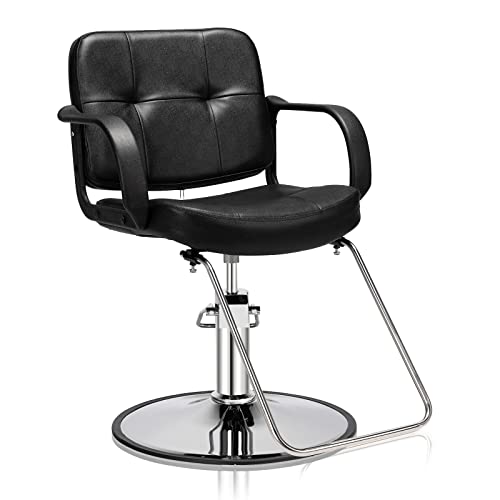
Where the Amofree is the all-rounder, the OmySalon styling chair is the reinforced option, sold on its heavy-duty construction for stylists whose chairs take punishment: high client turnover, larger clients, and the general leaning, swivelling and bag-dumping of a busy floor. A heavy-duty frame and pump are not about any single heroic lift; they are about the ten-thousandth lift feeling like the first. In a salon where a chair earns money every hour it stands, that durability is the specification that pays.
The chair keeps the class essentials — hydraulic height adjustment and a full swivel for hairdressing work — and its maker supplies a wide range of salon equipment, which matters when you want the styling row and the backwash row to speak the same design language; note that this company’s backwash unit appears later in this guide for exactly that reason. Buy this chair for the station nearest the door, the one every walk-in lands in, and let the gentler chairs live deeper in the salon where life is calmer.
- Class: styling chair — no plumbing, no bowl
- Build: heavy-duty frame and hydraulic pump
- Rotation: swivel base for cutting work
- Uses listed: hairdressing, tattoo, beauty and spa settings
- Pairing: same maker as the backwash pick below
Strengths
- Reinforced construction suits the busiest chair in the building.
- Confident choice for larger clients who worry about salon chairs.
- Matches the OmySalon backwash unit for a coordinated fit-out.
Trade-offs
- Heavier build makes the chair harder to move for cleaning days.
- The utilitarian look will not carry a boutique salon’s styling alone.
- No recline, so it stays a cutting and finishing chair only.
Best for: high-turnover salons and barbershops whose chairs never rest. Not suited for: delicate, design-led studios where furniture doubles as décor first.

Tythical Salon Chair for Hair Stylist — Best Reclining Styling Chair · Styling Chair
The Tythical is the styling trio’s character actor: a green-and-gold chair, hydraulic and swivelling like the others, but with a reclining back that the first two picks do not offer. Recline in a styling chair is not about naps; it is about services. Braiding, weaving, eyelash and brow work at the chair, and long treatments all ask the client to lean back at an angle a fixed back cannot give, and a stylist who offers those services from a fixed chair ends up improvising with cushions. This chair builds the angle in, and wraps it in a colour scheme that photographs like a boutique.
The listing places it across salons, barbershops, tattoo and shampoo settings, and the honest reading is that it is a styling chair with benefits, not a backwash substitute: it has no bowl and no plumbing, whatever the marketing collage suggests. Treat it as the chair for the treatment corner or the senior stylist’s station, where its look and its recline both earn. The hydraulic pump and 360-degree swivel keep it a real working chair rather than a prop, which is the line this category too often crosses.
- Class: styling chair — no plumbing, no bowl
- Back: reclining, for treatment and braiding angles
- Pump: hydraulic with 360-degree swivel
- Finish: green upholstery with gold-tone frame, per the listing
- Settings listed: salon, barbershop, tattoo and spa
Strengths
- The only reclining back among the three styling picks.
- A distinctive finish that can anchor a small salon’s identity.
- Still a proper hydraulic swivel chair underneath the styling.
Trade-offs
- The bold colourway will clash with some existing fit-outs.
- Recline mechanisms add a joint that needs periodic checking.
- It cannot wash hair, despite appearing in shampoo contexts in photos.
Best for: stylists offering braiding, treatments or lash work from the chair. Not suited for: salons needing a uniform row of identical neutral chairs.
Backwash Shampoo Station with Ceramic Bowl — Best Straightforward Backwash · Backwash Unit
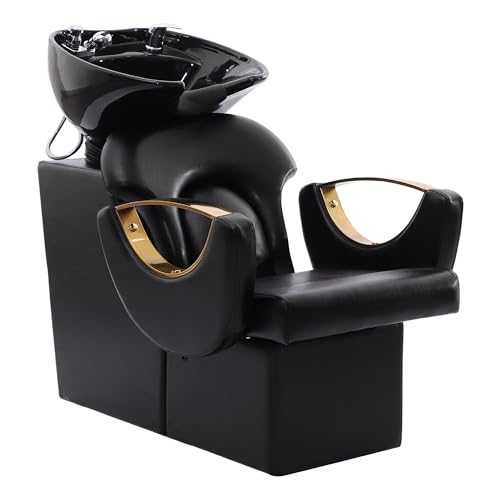
Crossing to the wet side of the salon, this station is the uncomplicated way to add a plumbed shampoo point: a backwash chair with a ceramic bowl, sold as a complete unit for barbershops and salons. The client reclines into the seat, the neck meets the bowl, and the stylist works standing behind with both hands free. As a first backwash — for a salon graduating from a sink-and-chair improvisation — a complete station like this removes the guesswork of matching a separate bowl to a separate chair and hoping their heights agree.
The ceramic bowl is the specification to underline. It will be tinted, toned and disinfected for years, and ceramic’s glazed surface is the material that survives that regime without staining or dulling. Plan the installation properly: the unit needs supply and waste connections, positioned before the chair is fixed, and a plumber’s hour at install is cheaper than a flooring repair in year two. Once plumbed, the station’s daily routine is rinse, wipe, shine — the bowl rewards thirty seconds of care with a permanently clean first impression for the next client.
- Class: backwash unit — plumbed, with ceramic bowl
- Bowl: ceramic, fixed station design
- Seat: integrated backwash chair with leg support
- Installation: requires water supply and drainage connection
- Settings listed: salon and barbershop wash points
Strengths
- A complete station removes bowl-to-chair matching guesswork.
- Ceramic bowl resists colour staining and disinfects thoroughly.
- The simplest route from no backwash to a proper wash point.
Trade-offs
- A fixed bowl cannot tilt to meet shorter or longer necks.
- Plumbing costs and positioning are on the buyer to arrange.
- Once installed, the station’s location is effectively permanent.
Best for: salons installing their first dedicated shampoo station. Not suited for: renters who need furniture they can unplug and take with them.

Backwash Station with Tilting Porcelain Ceramic Sink — Best Tilting Bowl · Backwash Unit
This station answers the fixed bowl’s weakness directly: its porcelain ceramic sink tilts, and it carries a dedicated neck rest, so the two surfaces that touch the client both adjust to the client. In practice the tilt is the difference between a wash the client describes as relaxing and one she describes as fine, and salons live on the distance between those adjectives. The stylist sets the bowl’s angle at the start of the service, the neck rest takes the weight the rim would otherwise carry, and water stays where water belongs.
Porcelain ceramic shares the fixed unit’s virtues — a glazed, non-porous surface that releases colour and disinfects cleanly — with the tilting mechanism as its extra moving part. That mechanism deserves a calm inspection on delivery and a place in your quarterly maintenance round: check its travel, its hold at angle, and the seals around the bowl’s connections, since a tilting bowl moves against its plumbing on every adjustment. Bought with that small discipline in mind, this is the backwash for salons whose clientele spans teenagers to grandmothers, because one station genuinely fits the range of necks that range implies.
- Class: backwash unit — plumbed, with tilting bowl
- Bowl: porcelain ceramic sink with tilt adjustment
- Neck support: dedicated neck rest
- Installation: requires water supply and drainage connection
- Seat: integrated backwash chair
Strengths
- Tilting bowl adapts one station to many different clients.
- The neck rest relieves the rim pressure clients remember.
- Porcelain surface cleans and disinfects to a high standard.
Trade-offs
- The tilt mechanism needs periodic checks as part of maintenance.
- Costs more effort to install level than a fixed bowl.
- Adjustment adds seconds to each service’s setup.
Best for: salons serving a wide age range of clients at one wash point. Not suited for: buyers who want the simplest possible plumbing installation.

OmySalon Backwash Shampoo Unit Ceramic Bowl — Best Backwash with Footrest · Backwash Unit
The third backwash pick completes the set by attending to the other end of the client: it pairs its ceramic bowl with an adjustable footrest, so the legs are supported through the recline instead of dangling or bracing against a fixed bar. Anyone who has endured a long treatment wash — a deep-conditioning session, a careful toner — knows the legs become the complaint after the neck is satisfied. An adjustable rest lets the stylist set the client’s whole posture once, and the service proceeds without the small shifts and sighs that interrupt it.
Coming from the same maker as the heavy-duty styling chair above, this unit is the natural partner for a coordinated fit-out: buy the OmySalon styling chairs for the floor and this unit for the wash wall, and the upholstery language and build philosophy agree across the room. The ceramic bowl keeps the maintenance story simple, and the footrest’s adjustment is mechanical and quick. As with both backwash picks before it, the purchase decision is really a plumbing decision: confirm your water and waste positions, book the professional install, and the unit will repay the planning every working day.
- Class: backwash unit — plumbed, with ceramic bowl
- Bowl: ceramic, station design
- Leg support: adjustable footrest
- Installation: requires water supply and drainage connection
- Pairing: same maker as the heavy-duty styling pick
Strengths
- Adjustable footrest completes the client’s reclined posture.
- Ceramic bowl keeps the wet side easy to keep pristine.
- Coordinates with the OmySalon styling chair for one-room fit-outs.
Trade-offs
- The bowl itself is fixed; neck fit relies on the seat’s recline.
- The footrest is one more mechanism to keep clean and adjusted.
- Permanent plumbing makes relocation a project, not an afternoon.
Best for: salons offering longer wash-and-treatment services. Not suited for: temporary or touring setups that cannot plumb in.
How Do the Six Salon Picks Compare?
| Pick | Class | Key mechanism | Standout feature |
|---|---|---|---|
| Amofree Hydraulic Salon Styling Chair | Styling chair | Hydraulic pump, swivel | Stated 6.1-inch lift and thick padded seat |
| OmySalon Heavy Duty Salon Styling Chair | Styling chair | Hydraulic pump, swivel | Reinforced heavy-duty build |
| Tythical Salon Chair for Hair Stylist | Styling chair | Hydraulic pump, swivel, recline | Reclining back in a green-and-gold finish |
| Backwash Shampoo Station with Ceramic Bowl | Backwash unit | Fixed ceramic bowl | Complete first wash station |
| Backwash Station with Tilting Porcelain Ceramic Sink | Backwash unit | Tilting porcelain bowl | Tilt plus dedicated neck rest |
| OmySalon Backwash Shampoo Unit Ceramic Bowl | Backwash unit | Fixed ceramic bowl, adjustable footrest | Leg support for longer services |
The table encodes the guide’s central discipline: no pick in the top half can do the bottom half’s job. A styling chair, however luxurious, has no bowl; a backwash unit, however comfortable, cannot swivel a client into the light for a precision cut. Salons shopping on a staged budget should buy in workflow order — the wash point that makes colour services possible, then the styling chairs that multiply capacity — and use the table to check that each purchase fills a gap rather than duplicating a strength.
How Should You Plan the Plumbing for a Backwash Row?
Start from the drain, because gravity is the least negotiable partner in the project. A backwash bowl must empty at a fall your waste line can sustain, and the unit’s position is largely chosen by where that line already runs or can be run without heroic flooring work. Supply lines are more forgiving, but their valves should be reachable without moving the unit: the day a hose connection weeps, you will want a shutoff you can reach in seconds, in the dark, with wet hands. Ask your plumber to fit isolation valves per station even in a one-bowl salon; in a row of three, they are the difference between closing one wash point and closing the salon.
Then plan the human geometry. The stylist stands behind the bowl and needs elbow room, a dry floor zone and a trolley’s parking place that is not in the client’s drip path. Clients approach the backwash from the side, sit, and recline backwards, so the floor in front of the unit must be clear and the unit’s footrest must not become a shin trap in a dim treatment room. Finally, test with water before the first client: run each bowl at full flow, check the trap’s behaviour, tilt the tilting bowl through its range under pressure, and only then declare the row open. Every salon’s most expensive leak is the one discovered by a customer.
How Do You Keep Salon Chairs Looking New?
Cut hair is an abrasive that migrates everywhere, so the daily habit is removal: brush down seats and bases at close of business, and lift cushions weekly to clear the seam where hair collects and moisture follows. PU upholstery wants a wipe with a damp cloth and mild cleaner; solvents and bleach sprays will cloud and crack it over a season. Hydraulic pumps ask for almost nothing beyond keeping the ram’s exposed shaft clean, since grit on the shaft is what scores the seals that keep the chair at height. Bases should be checked for the slow loosening that swivel work produces, and castors or glides cleared of the hair wheels they inevitably grow.
At the backwash, the bowl’s shine is a daily thirty-second job: rinse away product, wipe with a non-abrasive cleaner, dry. Colour that is allowed to dry on ceramic usually still lifts; colour allowed to dry for a week becomes a project. Neck rests and footrest pads live in the splash zone and deserve the same wipe-down as the bowl, both for hygiene between clients and because shampoo residue left on upholstery is what eventually stiffens and cracks it. Keep a small kit at the wash wall — cloth, mild cleaner, a spare neck-rest cover if your unit takes one — and the standard will keep itself.
What Mistakes Do Salon Owners Make When Buying Furniture?
The classic error is buying a styling chair to do a backwash’s job, or the reverse, usually because a listing photograph showed a reclining chair beside a sink and the imagination filled in plumbing that does not exist. The second error is ordering backwash units before confirming drainage positions, then discovering the bowl must sit where the floor cannot serve it. Third is under-buying the pump: a light-duty chair in the busiest station will announce its inadequacy within the year, in sinking and squeaks, and replacing it costs more than the heavy-duty chair would have.
Fourth, owners mix upholstery families across purchases made months apart, ending with a room of almost-matching blacks that read as a mistake rather than a scheme; buy the row together, or keep the receipts and colour names. Fifth, they forget the client’s whole body at the wash — neck celebrated, legs ignored — when a footrest or leg support would have completed the recline. And sixth, they skip the water test at installation, because the salon is opening on Friday and the plumber has left; run the bowls anyway. Water is patient, and it will find the untested joint during your busiest Saturday instead.
How Should You Lay Out a Row of Styling Stations?
A styling station is a small workplace with three occupants across a day: the client in the chair, the stylist orbiting it, and the next client arriving while the first is still caped. Give each chair a turning circle that does not borrow from its neighbour’s, because a swivel chair’s promise is only kept when the chair can actually swivel without its footrest greeting the next station’s trolley. Mirrors should be centred on the chair’s resting position, not its pumped height, and the pump pedal must be reachable from behind without the stylist performing a small dance around the base. These sound like trivialities until a Saturday afternoon, when a badly laid-out row taxes every service by a minute and the book runs late by an hour.
Electrical planning belongs in the same conversation. Dryers, straighteners and clippers converge on the styling station, and a row of chairs fed by one overloaded socket strip is a tripping hazard wearing a fire risk as a coat. Have outlets placed at each station during fit-out, keep cables out of the swivel arc, and decide where the trolley parks before the first client does it for you. The chairs in this guide will serve any layout competently; no chair can rescue a layout that was never drawn.
What Does Comfort at the Backwash Actually Consist Of?
Clients describe a good backwash in negatives: nothing dug in, nothing ran down, nothing ached. Achieving those negatives is a chain of small fittings. The neck rest must meet the neck’s curve rather than its vertebrae, which is why the tilting bowl and the padded rest on the picks above matter. The seat’s recline must support the lower back at the angle the bowl demands, because a client sliding slowly downward through a long wash arrives at the bowl’s rim in entirely the wrong place. The footrest — adjustable on the OmySalon unit — completes the posture so the client is resting on the furniture rather than holding herself in it with her legs.
Water temperature and pressure are the stylist’s half of comfort, and they argue for decent plumbing again: a thermostatic mixer that holds temperature when another tap opens elsewhere in the building is the unglamorous hero of the wash experience. Add a hand towel placed where it can be reached without dripping across the client, a dry floor maintained by habit rather than by hope, and the backwash becomes what it should be — the part of the appointment clients secretly come for, delivered by furniture that was chosen with their necks in mind.
How Should a Home Salon or Barber Corner Choose?
The home studio inverts the commercial priorities. Volume drops, so a heavy-duty pump matters less; space shrinks, so one excellent chair matters more; and the furniture lives among domestic objects, so its appearance carries further. For a home cutting corner, the Amofree’s neutral competence or the Tythical’s boutique colour both work, chosen by whether the room wants a tool or a statement. The backwash decision is harder at home, because plumbing a ceramic station into a spare room is a building project, not a purchase. Many home stylists therefore wash at a properly fitted utility sink and invest their furniture budget in the styling chair, which is a legitimate allocation as long as it is chosen honestly rather than disguised — clients forgive a home sink; they do not forgive a chair that sinks.
If the home salon does take the plumbing step, the straightforward ceramic station is the proportionate choice: one complete unit, professionally fitted, serving a book of neighbours and regulars for years. Keep the isolation valve accessible, keep the bowl’s shine as your shopfront, and let the chair row — even a row of one — match its upholstery family so the room reads as a salon that happens to be at home, not a home that happens to contain a chair.
How Should You Test a Styling Chair in Its First Week?
Delivery day is your cheapest quality-control department. Assemble the chair fully, then pump it to maximum height and sit in it with the heaviest person available while a colleague watches the ram for creep over ten unhurried minutes; a sound pump holds, a doubtful one confesses early, while returns are still a formality. Work the swivel through full circles in both directions and listen: a smooth, silent rotation is the standard, and any grinding at this age will not improve with use. Sit as a client sits — lean left for an imaginary phone, push against the footrest, rise using the arms if fitted — and check the base stays planted through all of it.
Through the first week, keep the packaging and watch two things: the pedal’s return, which should stay springy and complete, and the upholstery’s seams at the seat’s front edge, where clients slide in and out. A salon that runs this small gauntlet on every chair builds a fleet it can trust, and discovers its lemons while the warranty, rather than the appointment book, absorbs the cost.
What Is a Sensible Maintenance Rhythm for the Whole Fleet?
Daily, the work is seconds: brush hair from seats and bases, wipe the backwash bowls and neck rests, and leave every pump at mid-height so no ram sits fully extended overnight under a forgotten load. Weekly, lift the styling seats’ cushions where the design allows, clear the hair that has migrated into seams and castors, and run a hand over every bolt the swivel works against. Monthly, test each pump under load as you did on delivery day, tilt each tilting bowl through its full travel while water runs, and inspect every hose connection and trap at the wash wall with a dry hand and a torch — dry is the finding you want, and anything else gets the plumber before it gets worse.
Annually, stand back and audit like a client. Sit in every chair. Recline at every bowl. The fleet that a salon maintains on this rhythm rarely surprises its owner, and the small faults — a slowing pump, a weeping joint, a seam giving up — are caught in the cheap chapter of their stories. Salon furniture is bought in a day and paid for over years of small attentions; the salons that understand that are the ones whose chairs still feel new when the lease comes up for renewal.
Which Styling Chair Suits Which Service Menu?
Read your own appointment book before you read any catalogue. A cut-and-finish salon lives on speed and consistency: chairs that pump predictably, swivel freely and wipe clean between clients, which is the Amofree’s brief exactly, multiplied across the row. A salon whose money is in colour needs seats that stay kind through long processing-adjacent sits and a backwash row that can keep pace, shifting the budget’s centre of gravity toward the bowls. A braiding or treatment-led practice needs the Tythical’s recline at its main chair and should treat the fixed-back chairs as the supporting cast. A barbershop with a heavy walk-in trade needs the OmySalon’s reinforced build at the door chair, where the day’s punishment concentrates.
The mistake is buying one chair to be all four, or buying four chairs for a menu you do not offer. Furniture follows the book: list your ten most-booked services, note what each asks of the chair and the bowl, and the picks above will sort themselves with very little argument. Salons that shop this way rarely return furniture, because the furniture was chosen by the work, not by the photograph.
How Do Colour and Finish Choices Age in a Working Salon?
Black PU is the industry’s default for a reason: it hides the ambient evidence of the trade, matches everything and photographs neutrally. The Tythical’s green and gold make the opposite bet — that a memorable chair is marketing, that clients will photograph themselves in it and carry your salon’s look out into the world on their phones. Both bets can win. What loses is the middle path of almost-coordinated purchases, a black chair here and a brown one there, accumulating into a room that looks accidental. Commit to a family — maker, colour, finish — and let every later purchase ask permission from the first.
At the wash wall, white ceramic is its own argument: it shows the salon’s cleanliness standard at a glance, which is precisely why it must be kept shining. A white bowl allowed to dull accuses its owner; a white bowl kept bright is the most persuasive hygiene statement in the building, made silently, to every client who leans back over it.
What Should You Confirm Before the Order Leaves the Warehouse?
Salon furniture travels as freight, and freight has its own customs. Confirm whether delivery is to the door, into the building or merely to the kerb, because a ceramic backwash unit is not a parcel one person charms up a staircase. Confirm the returns window and who pays freight on a return; a styling chair with a creeping pump is returnable in principle, but the practical cost of sending it back decides whether the warranty is real. Photograph every carton as it arrives, open the bowl’s packaging first and inspect the ceramic before the driver leaves if the carrier allows it, and keep all packaging until the water test described earlier has been passed.
Finally, confirm the small print of the object itself: the pump’s stated range against your stylists’ needs, the bowl’s material named as ceramic or porcelain rather than a photograph’s impression, the footrest and neck rest’s presence on the exact variant you ordered, and the fitting kit’s contents against your plumber’s list. Ten minutes of confirmation at the ordering stage is the cheapest insurance in this entire guide, and the salons that make a habit of it are the ones whose fit-outs arrive complete, on schedule, and ready to earn.
How Does the Wash-and-Cut Journey Feel From the Client’s Chair?
Walk your own salon as a client before you finalise any purchase. You are greeted, gowned, and led to the backwash, where you sit, lean back and surrender your neck to the bowl: at that moment the salon’s furniture budget becomes physical sensation. If the rim presses, if your legs dangle, if water finds your collar, no styling chair downstream, however splendid, fully refunds the experience. Then you are walked, towel-turbaned, to the styling chair, pumped to height, and swivelled toward the mirror; a chair that rises smoothly and turns without a lurch continues the feeling of being handled competently, and a chair that sinks or grinds quietly taxes the haircut that follows.
This is why this guide has insisted on judging the two classes separately and then together. Separately, because their mechanisms share nothing. Together, because the client experiences them as one continuous act of trust, and the salon that equips both ends of that act with the same care is the salon whose chairs — styling and backwash alike — get recommended in the sentence clients actually use: you just relax there, they say, and relaxation, in this trade, is a furniture specification.
Final Recommendation
Equip the two stations as the separate machines they are. For cutting, the Amofree covers most salons’ everyday needs with a stated lift range and a kind seat; step up to the OmySalon heavy-duty chair for the station that never rests, and give the Tythical to the stylist whose services recline and whose corner of the salon can carry its colour. For washing, the straightforward ceramic station is the right first plumbed bowl, the tilting porcelain unit is the connoisseur’s answer to the problem of necks, and the OmySalon backwash completes longer treatments with its footrest. Plumb them professionally, test them with water before a client ever reclines, and your salon’s two hardest-working pieces of furniture will repay you in the only currency that matters here: clients who relax completely in your chairs, at both ends of the service.
Frequently Asked Questions
Can a reclining styling chair replace a backwash unit?
No. A reclining styling chair like the Tythical gives the client a comfortable lean for braiding or treatments, but it has no bowl, no water supply and no drainage. Washing hair requires the plumbed station. Salons that blur this line end up washing at a utility sink, and clients can tell the difference within seconds of leaning back.
Why choose ceramic over a plastic shampoo bowl?
Ceramic and porcelain are glazed and non-porous, so colour and toner rinse away instead of staining, disinfectants do their work on a surface that does not absorb them, and the bowl keeps its shine for years. Plastic bowls are lighter and cheaper to ship, but they scratch, ghost with colour and age visibly in a way clients notice at close range.
Do I really need a plumber for a backwash unit?
In most places, yes — connecting to supply and waste lines is regulated work, and even where it is not, a professional install buys you correct falls, sealed joints and isolation valves. The cost is modest against the price of the unit and trivial against the price of a leak. Styling chairs, by contrast, are ordinary assembly with hand tools.
How much lift range does a styling chair need?
Enough to place each client’s head at the working height of your shortest and tallest stylists. The Amofree’s stated 6.1 inches covers a typical range; salons with an unusually tall team or a children’s clientele should measure their extremes before ordering. Judge by your own tape measure applied to your own staff, not by a showroom sit.
What should I check when a backwash unit is delivered?
Inspect the ceramic bowl for chips and cracks before signing anything, since ceramic’s one weakness is transit damage. Check that the neck rest, footrest and any tilt mechanism move as described, confirm the included fittings against the listing, and keep the packaging until the unit is plumbed and water-tested. A bowl that survives delivery and testing will serve for years.
What flooring belongs under styling chairs and backwash units?
Under styling chairs, a hard, smooth floor that hair sweeps off in seconds and that a swivel base will not chew; under backwash units, the same hardness plus an honest relationship with water — sealed, slip-resistant when wet, and coved or sealed at the wall line so the inevitable splash has nowhere to hide. Rugs have no business in either zone. Choose the floor for the worst hour of the wettest Saturday, and every ordinary day will feel easy by comparison.
Should the backwash seat match the styling chairs exactly?
It should belong to the same family without pretending to be the same object. A shared upholstery colour and material is enough for the room to read as designed; the backwash seat itself is shaped for reclining and will never match a styling chair’s silhouette, and clients read that difference as function, not as a failure of coordination.
What is the first upgrade a growing salon should make?
Whichever station your appointment book queues at. If clients wait for the bowl, a second backwash or a tilting upgrade to the existing one relieves the true bottleneck; if stylists wait for a free chair, another styling station earns. Furniture money spent anywhere else is decoration, and decoration can wait until the workflow is fed.
Can one person assemble and install everything in this guide?
The styling chairs, yes, with time and a second pair of hands for the heaviest bases. The backwash units, no — not because the unit itself is beyond a competent person, but because its connections to the building’s water and waste are the regulated, insured part of the job. Assemble what is yours to assemble, plumb nothing that is not, and the division of labour will match both the law in most places and the risk in all of them.
How many backwash units does a salon need per styling chair?
Colour-heavy salons feel the pinch first: a common working rhythm is one wash point supporting three or four styling chairs, because washing is brief compared with cutting and processing. Salons built around treatments and long washes need proportionally more. Watch your own appointment book’s bottlenecks for a month before adding a second unit; the queue at the bowl, not a formula, is the evidence.
Is second-hand salon furniture a sensible saving?
For styling chairs, sometimes: a heavy-duty chair with a sound pump, honest upholstery and a base that sits flat can serve a start-up well, provided you test the pump under load before money changes hands and budget for reupholstery if the seat’s padding has packed down. For backwash units, be warier. A used ceramic bowl may carry hairline cracks that only announce themselves under hot water and load, and its fittings will meet your plumbing as strangers. If you buy used, buy the bowl from someone who will let you fill it, tilt it if it tilts, and leave it full while you drink a coffee and watch the floor beneath stay dry.
How long should salon chairs and bowls last?
A heavy-duty styling chair in daily commercial use should give years of service with the maintenance rhythm described above, its pump and upholstery being the eventual wear items rather than the frame. A ceramic bowl, once installed undamaged, is effectively the permanent part of the salon; seats, rests and footrest pads around it will be refreshed first. That longevity is the real argument for buying the bowl carefully and plumbing it professionally the first time.
Related Guides
Seating for a crowd is handled in Best Chair Risers for Chairs That Sit Too Low, the clipper-side classics are gathered in Best Barber Chairs, practice seating appears in Best Chairs for Playing Guitar, and the eat-and-meet furniture for a busy room is covered by Best Cafeteria Chairs and Tables.


