What's inside
- Key Takeaways
- Quick Picks
- How Did We Choose These Picks for the Best Chairs and Ottomans?
- Comparison Table
- How Do You Arrange a Chair and Ottoman in a Real Room?
- How Should You Care for Faux Leather So It Lasts?
- What Mistakes Do People Make When Buying Chair and Ottoman Sets?
- Chair and Ottoman or a Sofa: Which Should a Room Choose?
- What Jobs Will Your Ottoman Actually Do?
- How Do You Read a Furniture Listing Before Trusting It?
- How Do Two Sets Share One Room Without Crowding It?
- Faux Leather, Fabric or Hide: Choosing the Upholstery Honestly
- What Should the First Month with a New Set Teach You?
- What Completes a Chair and Ottoman Corner?
- Final Recommendation
- Frequently Asked Questions
- Related Guides
As an Amazon Associate I earn from qualifying purchases. This post may contain affiliate links at no extra cost to you.
cottageverdict.com is reader-supported. When you buy through links on our site, we may earn an affiliate commission.
Where to buy: each linked set below leads to its Amazon listing, where you can check price on Amazon and confirm the upholstery material, dimensions and assembly requirements before ordering. One pick is discussed in prose only, because a genuine leather chair and ottoman is a considered, premium-tier purchase best made with swatches in hand rather than from a screen.
The best chairs and ottomans understand something a lone armchair cannot: rest is a posture, not a seat. A chair supports your back; an ottoman completes the arrangement by raising your legs, levelling your circulation and turning sitting into reclining’s civilised cousin. Bought as a matched set, the two pieces also solve the proportion problem that haunts separately sourced pairs — the ottoman that sits an inch too high, the footstool in a leather tone half a shade wrong for the chair. The sets in this guide were chosen as partnerships first and furniture second.
An honest word about materials belongs at the front. Every linked set here is upholstered in faux leather — PU leather in the listings’ own language — and this guide will not pretend otherwise. Modern PU has real virtues: it wipes clean, it resists the stains of tea and toddlerhood, it keeps a matched pair affordable as a tier, and its appearance at conversational distance is convincing. It also has a known lifespan shorter than hide’s, and it will not develop leather’s patina. The prose-only final pick covers the genuine leather route for readers whose budget and patience run to it; the five linked sets serve everyone who wants the chair-and-ottoman life now, in rooms that work for a living.
What separates the sets is intent. One is a pair of chairs with ottomans for a room that seats two. One is a wingback reading throne. One hides storage in its ottoman, aimed at small rooms where every cubic inch must earn rent. One is a compact modern accent for bedrooms and balconies. And one swivels, because some readers conduct their evenings in rotation — book, window, conversation, fire. Read for the room you actually have, and measure it: these are substantial pieces, and the delivery-day tape measure is a poor substitute for the planning one.
Key Takeaways
- A matched set guarantees the ottoman’s height and tone suit the chair — the two failures of separately bought pairs.
- All five linked sets are faux leather (PU); the guide says so plainly and judges them as such.
- The Yaheetech pick is a set of two chairs with ottomans — seating for a couple or a waiting room, not a single chair.
- Storage inside the ottoman is the small-room superpower; check for it if your space is tight.
- Measure the pair’s combined footprint, including the gap your legs will want between chair and ottoman.
- Genuine leather exists in this category only at the premium tier, discussed prose-only at the end.
Quick Picks
| Pick | Badge | Why it earns its place |
|---|---|---|
| Yaheetech Accent Chairs with Ottoman Set of 2 | Best Pair for Two | Two faux leather chairs with ottomans, wooden legs and a small-space brief. |
| Furniliving PU Leather Accent Chair with Ottoman | Best Reading Wingback | A tufted high-back wingback built for bedrooms, dressing rooms and long chapters. |
| Traditional Faux Leather Chair with Storage Ottoman | Best Hidden Storage | Rolled arms, nailhead trim and an ottoman that swallows blankets and clutter. |
| MOJAY Modern Accent Chair with Ottoman | Best Compact Modern | A clean-lined PU armchair and ottoman sized for bedrooms, balconies and receptions. |
| HNY Swivel Lounge Chair with Ottoman | Best Swivel Lounge | A wide, armless swivel chair with matching footstool for rooms lived in rotationally. |
| A Genuine Leather Club Chair with Ottoman, Discussed Generically | Prose-Only Premium | The hide-upholstered heirloom route, bought slowly and kept for decades. |
How Did We Choose These Picks for the Best Chairs and Ottomans?
Partnership came first: each set had to be designed as a pair, with the ottoman’s height falling in the useful band relative to the chair’s seat — level with it or a touch below, so legs rest along a gentle line rather than propping upward or dangling short. Sets whose ottoman was visibly an afterthought, a cube in a vaguely similar fabric, were set aside. So were sets whose listings disguised their upholstery; every linked pick here states its faux leather plainly, and that plainness counted in its favour, because a buyer who knows what they are getting can care for it correctly.
Construction signals came second. Solid wood legs, high-density foam and frames described in load-bearing language matter more in a chair-and-ottoman pair than in almost any other furniture, because the ottoman leads a double life — footrest by evening, extra seat when guests arrive, coffee table under a tray on weekends — and it must survive all three without developing a wobble or a sag. We favoured sets whose descriptions acknowledged that workload rather than presenting the ottoman as sculpture.
Finally, we spread the picks across the rooms these sets actually serve: the shared living room, the reading bedroom, the small apartment, the modern balcony corner and the swivelling lounge. A guide that recommended five wingbacks would be a catalogue, not a guide; the differences below are differences of life, not of upholstery shade.

Yaheetech Accent Chairs with Ottoman Set of 2 — Best Pair for Two
Read the listing’s arithmetic carefully, because it is this pick’s whole charm: the set contains two accent chairs and their ottomans — a complete seating arrangement for two people, not one chair with accessories. The listing describes water-resistant faux leather, high-density foam and solid wood legs, aimed at living rooms, waiting rooms and small spaces. For a couple furnishing a first living room, or a small business dressing a reception corner, a matched pair bought in one decision has an obvious economy of effort: no second hunt, no tone-matching gamble, and symmetry delivered by the manufacturer rather than achieved by luck.
The small-space brief deserves respect rather than suspicion. These are accent chairs, not sprawling loungers; their footprint is scaled for apartments, bedrooms and the corners of larger rooms where a full armchair would bully the furniture around it. Two such chairs with their ottomans can hold a conversation area in a studio flat that a sofa would consume entirely, and they rearrange in minutes when the room changes jobs — a flexibility that couples in small homes use weekly and mention rarely, because it has become invisible to them.
There is a staging virtue to a matched pair that single chairs cannot offer: symmetry is the cheapest interior design ever sold. Two identical chairs flanking a window, a fireplace or a low bookcase give a room a composed, intentional face even when everything else in it is inherited and improvised, and the ottomans, docked neatly before each chair, complete the geometry. Landlords furnishing a rental and sellers staging a home both exploit this ruthlessly, because a paired arrangement photographs as a decision. Buying the pair as one set is how a household gets that composure without a designer’s invoice. Faux leather that shrugs off a splash, wipes clean after a toddler’s yoghurt or a dog’s wet return from the garden, and asks for no conditioning ritual is upholstery matched to how these rooms are actually lived in. The black colourway in this listing is the forgiving choice for that life. Expect the foam to feel firm at first — high-density foam beds in over weeks — and expect to assemble legs and keep the Allen key; the set’s tier makes some home assembly the honest trade for its completeness.
- Contents: 2 accent chairs + 2 ottomans
- Upholstery: water-resistant faux leather, black
- Build: high-density foam, solid wood legs
- Settings: living room, waiting room, small spaces
Strengths
- A complete matched pair in one purchase.
- Compact scale suits apartments and secondary rooms.
- Wipe-clean upholstery suits busy, real households.
Trade-offs
- Accent scale will not satisfy sprawl-sized loungers.
- Firm foam needs a breaking-in period.
- Home assembly is part of the tier’s bargain.
Best for: couples, small living rooms and reception corners needing two complete seats. Not suited for: anyone wanting one large, deep lounge chair for solo sprawling.
Check price on Amazon.
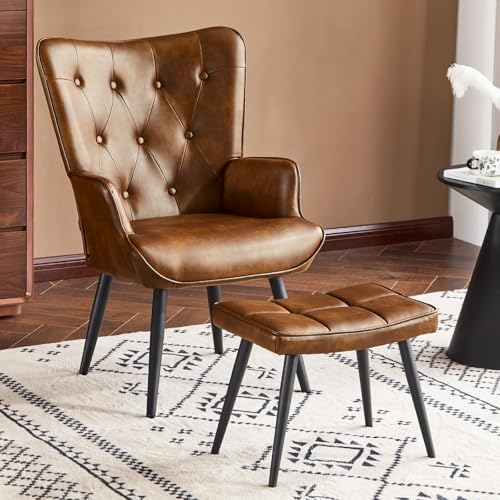
Furniliving PU Leather Accent Chair with Ottoman — Best Reading Wingback
The wingback is the oldest reading technology in this guide: a high back that holds your shoulders, wings that block the draught and frame the head, and a posture that keeps a book at eye level for a chapter rather than a page. Furniliving’s version pairs that silhouette — tufted buttons, a high backrest, an upholstered reading-chair brief — with a matching ottoman, in brown PU leather aimed at bedrooms, dressing rooms and home offices. The ottoman is what converts the wingback from a chair you sit in to a chair you stay in; raised feet are the difference between reading until the tea cools and reading until the book ends.
Consider the rooms the listing names, because they share a quality: they are rooms of one person at a time. A bedroom reading chair is a private instrument, and the wingback’s enclosure — the sense of being held in a small architectural space — suits solitary rituals: morning coffee before the house wakes, the last chapter at night, the dressing-room pause while deciding whether the day requires courage or merely shoes. The tufting and the brown tone lean traditional, pairing naturally with wood, wool throws and lamplight rather than with chrome and glass.
The wingback’s wings deserve one defence against the modern suspicion that they are decoration. They were engineered, in draughty centuries, to do three jobs at once: to shield the sitter’s head and shoulders from the room’s cold currents, to reflect the fire’s warmth back into the chair’s enclosure, and to give a dozing reader’s head somewhere to land that is not their own chest. Central heating retired the first two jobs, but the third is immortal, and anyone who has napped in a wingback with a book sliding slowly south will testify that the wings still earn their silhouette every single Sunday.
Practical notes are few and honest. PU leather in a bedroom faces gentler hazards than in a family room — fewer spills, more sunlight, depending on the window — and sunlight is the one to plan around, since prolonged direct sun is unkind to any upholstery and faux leather especially; a chair placed for the view should be rotated occasionally so its fading, if it comes, arrives evenly. Assembly is the usual leg-and-frame ritual. What you are buying is a silhouette and a posture, both centuries-proven, in a material that keeps the pair within an ordinary furniture budget.
- Form: wingback armchair with matching ottoman
- Upholstery: PU leather, brown, tufted-button back
- Back: high backrest for reading posture
- Settings: bedroom, dressing room, home office
Strengths
- Wingback posture genuinely serves long reading sessions.
- Enclosed silhouette suits private, one-person rooms.
- Traditional styling pairs with wood and warm textiles.
Trade-offs
- Traditional look will not blend into minimalist schemes.
- PU leather dislikes prolonged direct sunlight.
- High back dominates a small room’s sightlines.
Best for: readers furnishing a bedroom or study corner of their own. Not suited for: bright sun-trap rooms or contemporary glass-and-chrome interiors.
Check price on Amazon.

Traditional Faux Leather Chair with Storage Ottoman — Best Hidden Storage
Every small home has a category of objects that are homeless by nature: the throw that lives on the chair, the magazines migrating across the floor, the remote controls practising their disappearing act. This set’s ottoman answers with the oldest trick in furniture — a hollow interior. The listing describes a traditional faux leather armchair at a generous 41.3 inches with rolled arms, nailhead trim and wood legs, in caramel, with an ottoman that opens for storage. The chair reads as classic club furniture; the ottoman works a second job as the room’s lost-property office.
Storage changes how a set should be judged. An ottoman that opens will be opened daily, so its lid’s hinge and the ease of lifting it with one hand while holding a mug in the other become real specifications, and the interior’s capacity should be measured against your actual clutter — a winter’s worth of throws is a different volume from a evening’s worth of toys. The caramel tone and nailhead trim place this set in the warm, traditional register: it will furnish a den, a library corner or a living room built around wood and lamplight, and it will look faintly costumed in a white Scandinavian box, which is information, not criticism.
One more household will recognise itself in this set: the home whose living room doubles as a guest room. A substantial chair for the evening, an ottoman that hides the guest bedding by day and releases it at night, and a room that converts without a single piece of furniture being carried anywhere — that is small-space choreography of a high order, and it is available only because the ottoman was designed hollow. Hosts in one-bedroom flats should read this pick as infrastructure, not indulgence.
The chair itself is the largest presence in this guide, and its scale is the point for the right sitter: rolled arms at a height that supports a forearm properly, a seat that accommodates a tall frame without negotiation, and proportions that let the ottoman’s storage be genuinely capacious rather than a token drawer. Measure your doorway and the room’s traffic path before ordering — a 41-inch chair does not thread through a cottage doorframe on optimism — and if the measurements pass, this is the set that gives a small room both its best seat and a piece of its storage furniture in a single footprint.
- Form: traditional armchair + storage ottoman
- Upholstery: faux leather, caramel, nailhead trim
- Details: rolled arms, wood legs, 41.3-inch chair per listing
- Settings: living room, den, apartment
Strengths
- Ottoman storage genuinely reduces visible clutter.
- Generous scale suits taller, larger sitters.
- Classic styling anchors traditional rooms.
Trade-offs
- Largest footprint here; measure doors and rooms first.
- Traditional trim will not suit minimalist décor.
- Storage lid is one more mechanism to treat kindly.
Best for: small homes needing storage and a substantial traditional chair. Not suited for: tight doorways, tiny rooms or stark modern interiors.
Check price on Amazon.

MOJAY Modern Accent Chair with Ottoman — Best Compact Modern
The MOJAY set is the modernist at the table: clean lines, no tufting, no nailheads, a PU leather armchair and ottoman whose listing names the rooms plainly — bedroom, balcony, reception, living room. Where the wingback encloses and the traditional chair anchors, this chair accents: it is the piece that gives a plain room a composed corner without importing a whole furniture era. On a balcony or in a bright bedroom, that lightness of visual weight is the feature; the set furnishes without crowding, and its ottoman is proportioned as a footrest first rather than a storage chest or a spare seat.
Modern accent chairs live or die on their sitting geometry, because there is no deep cushioning to forgive a wrong angle. Expect a firmer, more upright sit than the loungers here — the posture of conversation, coffee and a laptop rather than of a Sunday afternoon surrender. For many rooms that is precisely right: a chair used for morning dressing, for guests, for the balcony’s half-hour of sun should hold its sitter pleasantly upright and release them without a struggle. Judge this set by whether your room needs a seat or a nest; it is unambiguously a seat, and a good-looking one.
Balcony duty, which the listing also claims, deserves a condition rather than a dismissal: PU leather and foam are indoor materials, and a covered balcony that stays dry can host them happily through a season, while an open balcony’s rain and hard sun will age the set at several times the indoor rate. If the balcony is the plan, treat the set as you would good outdoor cushions — under cover when not in use, indoors for the winter — and the compact MOJAY will repay the courtesy with years of morning coffees taken at exactly the height a small railing view deserves.
The reception mention in the listing is worth taking seriously as a use case. A small professional space — a studio, a salon’s waiting corner, a home office that receives clients — needs seating that reads intentional, wipes clean between visitors and does not ask guests to sink into someone else’s favourite chair. A matched modern pair of chair and ottoman does that work with a composure that a miscellaneous spare chair never achieves. Assembly follows the category’s pattern, and the PU surface’s easy cleaning is, in this setting, not a convenience but the whole maintenance department.
- Form: modern armchair with matching ottoman
- Upholstery: PU leather, clean-lined
- Posture: upright, conversational sit
- Settings: bedroom, balcony, reception, living room
Strengths
- Clean modern lines suit bright, minimal rooms.
- Compact presence furnishes without crowding.
- Wipe-clean surface suits reception and guest duty.
Trade-offs
- Upright sit is not a lounger’s embrace.
- No storage in the ottoman.
- Firm cushioning will not please sink-in sitters.
Best for: modern bedrooms, balconies and small professional waiting corners. Not suited for: readers wanting a deep, soft chair to disappear into.
Check price on Amazon.

HNY Swivel Lounge Chair with Ottoman — Best Swivel Lounge
The HNY set adds motion to the formula: a brown PU leather lounge chair, a generous 33 inches wide per the listing, armless and oversized in its seat, that swivels — with a matching ottoman as its footrest. The armless design is the detail to understand. Without arms, the chair sits more like a chaise’s head: you can sit across it, curl sideways into it, drape legs over where an arm would forbid it, and the wide seat becomes a small territory rather than a fitted garment. For readers, knitters, guitarists and anyone whose sitting is a verb with many forms, that freedom is the product.
Swivel changes the chair’s relationship to the room. A fixed chair faces its one appointed view; a swivel chair holds a conversation with the whole space — toward the fire for warmth, toward the window for the weather, toward the door for the arriving voice, toward the television for the evening. In open-plan rooms, where one chair must serve several centres of attention, the swivel is not a gimmick but the mechanism that lets a single seat be the room’s best seat from every direction. The ottoman, being light furniture, migrates to wherever the chair’s current facing demands, and the pair’s choreography becomes a household habit within a week.
Consider the wide seat’s social physics as well. A 33-inch armless chair is, in practice, a chair and a half: a child climbs in beside the reader, a cat annexes the unoccupied third, a couple shares it for the length of a song. Furniture that invites company without surrendering comfort is rarer than furniture that merely seats one correctly, and households that entertain informally — the friend who perches, the grandchild who colonises — will find this chair becoming the room’s most requested seat precisely because it refuses to define how many it is for. That ambiguity, in a living room, is hospitality built into the frame.
Two honest cautions accompany the pleasures. A swivel base on hard floors should be checked for its floor-friendliness and given a rug or mat if the base’s design suggests it — the floor-protection guides elsewhere in this category exist for exactly such interfaces. And an armless wide chair offers no leverage for sitters who use chair arms to stand; households with elderly members should test the sit-to-stand honestly rather than discovering it at a family gathering. Within those notes, the HNY is the set for the reader whose evenings refuse to face one way.
- Form: swivel lounge chair with matching ottoman
- Upholstery: PU leather, brown
- Seat: 33-inch wide, armless, oversized per listing
- Settings: living room, bedroom
Strengths
- Swivel serves every centre of an open-plan room.
- Wide armless seat allows many sitting postures.
- Ottoman pairing completes the lounge arrangement.
Trade-offs
- No arms to help sitters stand up.
- Swivel base needs a floor-friendly check on hard floors.
- Rotational freedom tempts chaotic placement in small rooms.
Best for: open-plan living, restless sitters and multi-posture readers. Not suited for: sitters who need arms for standing, or very formal fixed arrangements.
Check price on Amazon.
A Genuine Leather Club Chair with Ottoman, Discussed Generically — Prose-Only Premium
Above the faux leather field sits the material the others imitate: a genuine leather club chair with a matching ottoman, bought at the premium tier from furniture makers who sell by swatch and specification rather than by listing photograph. Hide brings what PU cannot — a surface that ages into patina instead of wearing out, that breathes against the sitter, that can be conditioned, repaired and re-cushioned across decades, and that carries a chair from purchase to heirloom. It also brings hide’s honest costs: a price tier several steps above every set above, a weight that makes delivery a planned event, and a care rhythm of conditioning and sunlight sense that synthetic upholstery never asks for.
We discuss it in prose because the purchase should be slow. Leather is graded, and the grades — full-grain at the top, corrected and split leathers below — decide whether the patina story is true for a given chair; a swatch in daylight tells more than a gallery of photographs. Buy this chair when the room is settled, the measurements are certain and the intention is twenty years, and the premium becomes arithmetic rather than extravagance. For every other circumstance, the faux leather sets above are not a compromise to apologise for but the correct tool, honestly labelled.
- Form: club chair with matching ottoman, genuine hide
- Tier: premium; swatch-led, furniture-maker purchase
- Care: conditioning rhythm; keep from prolonged direct sun
- Horizon: decades, with re-cushioning possible
Strengths
- Patina improves the chair instead of wearing it out.
- Repairable and re-cushionable across a long life.
- The definitive version of the classic club silhouette.
Trade-offs
- Premium tier by a wide margin over faux leather sets.
- Heavy delivery and deliberate, slow purchasing process.
- Leather grades vary; uninformed buying disappoints.
Best for: settled rooms and twenty-year intentions. Not suited for: first homes, tight budgets or anyone who rearranges furniture seasonally.
Comparison Table
| Pick | Contents | Upholstery | Defining feature |
|---|---|---|---|
| Yaheetech Accent Chairs with Ottoman Set of 2 | 2 chairs + 2 ottomans | Faux leather, black | Complete pair for two people |
| Furniliving PU Leather Accent Chair with Ottoman | Chair + ottoman | PU leather, brown | Tufted wingback reading posture |
| Traditional Faux Leather Chair with Storage Ottoman | Chair + storage ottoman | Faux leather, caramel | Hidden storage, rolled arms |
| MOJAY Modern Accent Chair with Ottoman | Chair + ottoman | PU leather | Compact modern accent |
| HNY Swivel Lounge Chair with Ottoman | Swivel chair + ottoman | PU leather, brown | Wide armless swivel seat |
| Genuine Leather Club Chair + Ottoman (prose-only) | Chair + ottoman | Genuine hide | Heirloom premium route |
How Do You Arrange a Chair and Ottoman in a Real Room?
Begin with the gap. An ottoman shoved hard against the chair is a footstool for a statue; an ottoman a body’s length away is a trip hazard with upholstery. The working distance lets your heels rest near the ottoman’s far edge with knees in a gentle bend — for most sitters, the ottoman’s near edge sits roughly a hand’s span from the chair’s front, adjusted by leg length and by whether the household’s true posture is upright-with-feet-up or the full horizontal sprawl. Live with a placement for three evenings before judging it; the right gap is discovered by ankles, not by eyes.
Then consider the pair’s traffic. The chair and ottoman together form an island, and islands need channels: a path around them that does not require a sideways shuffle, especially the path from door to sofa that guests will take in the dark. In small rooms, the storage ottoman earns a second look here, because it can dock against the chair — nested as one footprint — when the room needs its floor back, then roll out for the evening. Angle the island toward the room’s life rather than its wall: a chair angled forty-five degrees into a corner holds a conversation; the same chair flat against the wall holds a waiting room.
How Should You Care for Faux Leather So It Lasts?
PU leather’s care is simpler than hide’s but not imaginary. Dust it weekly with a dry or barely damp cloth, because grit is an abrasive and upholstery’s shine is removed one dusty wipe at a time by owners who skip the dry pass. Clean spills promptly with a mild soap solution and dry the spot rather than leaving it to air; the material is water-resistant, not a boat hull, and standing moisture at seams is how coatings begin to lift. Keep the set out of prolonged direct sun and away from radiator heat, the two forces that dry the coating toward cracking, and rotate cushions and ottoman positions so wear distributes across the pair rather than engraving one sitter’s habits into one spot.
What not to do matters equally. Solvent cleaners, leather conditioners meant for hide, and steam are all wrong tools here — the first two attack the coating’s chemistry, the third its bond. A small tear should be covered or repaired with a vinyl repair kit promptly, because PU’s failure mode is peeling from an edge, and an edge sealed early stays sealed. Treated this way, a faux leather set gives years of handsome service; treated as indestructible, it will demonstrate its mortality at the seams first and the sitting surfaces soon after.
What Mistakes Do People Make When Buying Chair and Ottoman Sets?
Buying the photograph instead of the dimensions is the founding error: a set that composes beautifully in a warehouse-scale listing image arrives in a cottage living room like a ship in a bottle shop. Measure the room, the doorway and the pair’s combined footprint, and tape the footprint on the floor for a day if the room is tight. The second mistake is ottoman height blindness — accepting a set whose ottoman towers above the seat or sulks far below it, turning leg support into leg negotiation. Matched sets exist to prevent exactly this, so verify the pairing’s proportions in the listing’s dimensions rather than assuming the word “set” guarantees them.
Material confusion is the third error, and the one this guide has worked hardest to prevent: paying faux-leather money is fine, but paying it while believing you bought hide guarantees disappointment on a schedule. Read the upholstery line, believe it, and choose accordingly. And the final mistake is single-purpose thinking — forgetting that the ottoman will be sat on by guests, stood on by someone changing a light bulb despite all advice, and used as a coffee table by everyone. A set bought for the life it will actually lead, rather than the portrait it will sit for, is a set still earning its room in five years.
Chair and Ottoman or a Sofa: Which Should a Room Choose?
The sofa is the default answer to seating, and for households that sprawl communally it remains the right one. But the chair-and-ottoman set wins a specific and common argument: the room that needs a personal seat more than a communal one. A sofa shares its comfort democratically, which means no one on it gets the exact posture they want; a chair and ottoman is a monarchy of one, adjusted to a single sitter’s body and habits, and for the person who reads, works or recovers in that seat daily, the monarchy serves better. Couples solve the politics elegantly with two sets — the Yaheetech pair in this guide exists for exactly that treaty — each partner reigning over a correctly proportioned seat rather than negotiating a shared one.
Space argues the second half of the case. A chair and ottoman can separate: the ottoman docks, the chair angles into a corner, and the pair’s footprint flexes with the room’s other duties in a way a sofa’s fixed rectangle never can. In a room that hosts exercise in the morning, guests at noon and cinema at night, that modularity is not a compromise but the design brief. The sofa wins where bodies pile together — film nights with children across laps, naps of genuine horizontal intent — and honest rooms admit which life they lead. Many homes, of course, end with both: the sofa for the crowd, and in the corner by the light, one perfect chair with its ottoman, which is the seat everyone quietly prefers.
What Jobs Will Your Ottoman Actually Do?
Count them honestly before choosing, because the ottoman is the hardest-working shape in furniture. Footrest is the job on the label. Then comes spare seat, the role it plays at every gathering that exceeds the chair count. Then coffee table, under a tray, for the mug and the book and the remote in their evening triangle. Then, in storage models, the room’s soft archive. Then the child’s stage, the cat’s throne, the laundry’s temporary landing strip, and the footstool of last resort for the high shelf — a use no guide endorses and every household commits. A piece asked to do all this should be judged like staff, not sculpture: frame strength, a top that tolerates weight and trays, upholstery that forgives.
That job list explains several of this guide’s judgements. It is why the storage ottoman’s hinge matters, why the traditional set’s scale is a virtue rather than excess, and why the compact modern ottoman — proportioned as a footrest first — is recommended for rooms where the other jobs are already staffed by a coffee table and a sofa. It also explains the one question to ask of any set not in this guide: what does the maker think the ottoman is for? If the listing’s photographs show it only being looked at, believe them, and expect a beautiful object that resents being used. The sets above were chosen because their makers clearly expect the ottoman to work for its living.
How Do You Read a Furniture Listing Before Trusting It?
Furniture listings reward a detective’s habits. Dimensions first, always, and read them as three separate numbers rather than a general impression of size — width decides the doorway, depth decides the room’s channel, seat height decides whether your feet reach the floor or the ottoman does the reaching. Then materials, in the listing’s own words: this guide has repeated “faux leather” and “PU” at every opportunity because those words, honestly printed, are the difference between a purchase and a misunderstanding. A listing that says only “leather” in its title and “PU” in its fine print is telling you something about its intentions; believe the fine print and price the chair accordingly.
Photographs need the same scepticism. Look for a person in the chair — their knees and shoulders give the scale that a white background conceals — and for the chair photographed in a room rather than a void, because rooms reveal proportion honestly. Assembly language is the third tell: “minimal assembly” usually means legs, “assembly required” can mean an afternoon, and either is acceptable if you know which you are buying before the box arrives. Finally, read owner accounts for the two facts listings never state: how the foam feels in month three, and whether the upholstery’s seams are holding where sitters actually sit. The picks in this guide survived that reading; apply it to anything else you consider, and the category holds few surprises.
How Do Two Sets Share One Room Without Crowding It?
Pairs of chairs obey the etiquette of conversation. Place them at an angle to each other rather than in a row — a gentle forty-five degrees turns two seats into a dialogue, while a straight row makes a waiting room, which is why the Yaheetech’s waiting-room listing is a warning as much as a use case. Give the pair a shared anchor: a small table between them for the lamp and the drinks, so the ottomans are free to be ottomans. And let each set keep its own territory — the ottomans docked with their own chairs at rest — because a room where the furniture has drifted into a common pool reads as unsettled even when every piece is handsome.
Colour does the diplomacy. Two matched sets, like the Yaheetech pair, bring their own order; two different sets in one room need a treaty — a shared tone family, a rug that contains them both, or textiles that marry the browns and blacks into one story. The mistake to avoid is the near-match: two faux leathers half a shade apart will argue forever in daylight. Either match exactly, by buying the pair as a pair, or contrast deliberately, with a textile thrown across each that makes the difference look chosen. Rooms forgive boldness and precision equally; what they never forgive is approximation.
Faux Leather, Fabric or Hide: Choosing the Upholstery Honestly
Since every linked set in this guide wears faux leather, the comparison deserves one clear-headed section. Fabric is the rival most buyers cross-shop, and its virtues are real: it breathes in summer, offers texture and pattern, and forgives small abrasions by hiding them in its weave. Its costs are absorption — spills become stains with a sense of permanence — and the slow traffic-polish that high-use seats develop. For a household with pets that shed and children who spill, fabric asks for either a performance weave or a forgiving temperament.
Faux leather inverts the ledger. It refuses spills, releases pet hair at a wipe and presents a smooth, tailored face that suits the classic silhouettes in this guide. Its costs are thermal — it can feel cool in winter and warm in summer against bare legs — and temporal: its coating has a service life measured in years of good appearance rather than decades. Hide, the prose-only tier, keeps faux leather’s wipeability at a gentler level, adds breathability and the patina dividend, and asks the premium and the care rhythm in exchange. None of the three is the correct answer in the abstract; the correct answer is the one whose costs your household is genuinely willing to pay, chosen with the costs named — which is why this guide has named them at every pick rather than once.
What Should the First Month with a New Set Teach You?
Week one is assembly and adjustment: legs re-torqued after the first sittings, the ottoman’s gap tuned by ankle rather than by eye, the chair’s angle to the light settled by actually reading in it at the hour you read. Expect the foam to feel firmer than the room’s old furniture and to be right to do so — new high-density foam is a promise about year three, not a first impression, and it softens toward its working character across the first fortnight of evenings.
The month as a whole reveals the set’s true job description in your house. You will learn whether the ottoman is a footrest or a table, whether the chair is yours alone or the household’s contested throne, whether the storage — if you chose it — fills with the throws it was bought for or with the archaeology of everything homeless. None of these discoveries are failures; they are the room telling you its habits, and the sets in this guide were chosen to absorb such lessons gracefully — a wipe here, a rearrangement there — rather than to demand the household conform to the furniture. Judge the purchase at the month’s end by a simple measure: is there now a place in the room that everyone, including the cat, understands to be the good seat? If yes, the set has done what furniture is for.
What Completes a Chair and Ottoman Corner?
A chair and ottoman are two-thirds of a place; the remaining third is services. Light is the first: a lamp positioned over the shoulder the reader favours, at a height that puts the page or the knitting in brightness and the sitter’s eyes in shade, transforms any of these chairs from furniture into a reading instrument. The second is a surface within arm’s reach — the small table that holds the mug, the glasses and the book’s next volume — because a chair that requires its sitter to rise for tea is a chair in an unfinished room. The third is a throw, both for warmth and for the upholstery’s sake: a textile layer takes the daily abrasion that would otherwise be the coating’s, and it is washable in a way no chair is.
Sound and softness finish the corner. A rug beneath the pair quiets the room, protects the floor from legs and swivel bases alike, and draws the boundary that tells the household this patch of floor is a place, not a passage. Against the wall, one piece of art at the seated eye-line — lower than standing pictures hang — rewards the sitter’s resting gaze. None of this needs buying at once, and the corner assembled gradually, piece by piece as its habits declare themselves, usually ends better composed than the one ordered complete in a single ambitious evening. The set is the foundation; the corner is the home you build on it.
Final Recommendation
Choose the partnership that matches your room’s real life. Two people furnishing together should take the Yaheetech pair and be done — matched, compact and wipe-clean. A solitary reader deserves the Furniliving wingback’s enclosure; a small home with homeless blankets should claim the storage ottoman’s hidden room; a bright modern corner belongs to the MOJAY; and the restless evening, lived in rotation, belongs to the HNY swivel. If the room is forever and the budget is patient, the genuine leather route waits at the top of the hill, worth its slow climb. Whichever set you unbox, measure first, mind the ottoman’s height, and keep the faux leather out of the sun — because a chair with its ottoman, rightly chosen, is not two pieces of furniture but one complete place, and a home is mostly the sum of such places, each one quietly inviting you to sit down and stay awhile.
Frequently Asked Questions
How high should an ottoman be compared with the chair seat?
Level with the seat or slightly below is the comfortable band: your legs should rest along a gentle, near-horizontal line with knees soft and heels supported rather than dangling off the ottoman’s far edge. Test the pairing the way you will use it — shoes off, legs up, book in hand — because five minutes in the showroom posture of polite sitting tells you nothing about the second hour of a novel, which is the shift the ottoman was hired to work. An ottoman higher than the seat forces legs upward and tires them; one far lower leaves feet dangling toward it. Matched sets are designed into this band, which is their core advantage over improvised pairings.
Is faux leather a poor choice for a chair set?
It is a different choice, not a poor one. PU leather wipes clean, resists stains, keeps a matched pair affordable and looks convincing in real rooms at real distances. Its limits are lifespan and sun sensitivity: it will not outlast hide or develop patina. Buy it knowingly, care for it as this guide describes, and it earns its place honestly for years.
Can an ottoman really serve as extra seating?
Yes, within reason — a well-built ottoman seats a guest for an evening comfortably, which is why frame strength matters in a set and why the ottoman’s top should be flat and firm rather than deeply crowned. Guests will also, inevitably, use it as the room’s overflow table and occasional step; a set bought with those honest expectations, rather than with a showroom’s fiction of pure footrest duty, is a set that will not disappoint anyone in its first year. It is not a dining chair substitute for long meals, and it should not be stood on. Treat it as a footrest that can pinch-hit as a seat, and it will serve both roles well.
How much assembly do these sets usually need?
Typically legs and minor fittings — the category’s standard bargain at these tiers, and an hour’s unhurried work for most sets once the parts are laid out and identified. Keep the tools provided rather than substituting your best Allen keys, since the supplied ones are sized to be exactly as strong as the bolts deserve, and keep them afterwards in the ottoman or a drawer of the room: the set’s legs will want a confirming tighten at the end of their first week, and the right key in the right room is the difference between a two-minute job and a permanent wobble. Keep the tools provided, tighten in stages, and re-check the leg bolts after the first week of use, when new furniture settles. Two people make the larger traditional chair’s assembly markedly easier.
What room size suits a chair and ottoman set?
Any room that can hold the pair’s footprint plus a walking channel around it, with the channel measured honestly — the width a person carrying a laundry basket or a sleeping child actually needs, not the width a person sidling sideways can survive. Compact sets like the MOJAY and the Yaheetech pair work in bedrooms and studios precisely because their combined footprint respects that channel; the large traditional chair needs a room that can absorb its presence without surrendering the passage. When in doubt, tape decides. Compact sets like the MOJAY and the Yaheetech pair work in bedrooms and studios; the large traditional chair needs a room that can absorb its presence. Tape the footprint on your floor before ordering if the answer is not obvious.
How do I stop a swivel chair marking my floor?
Check the base’s underside for pads or a finished ring, place the chair on a rug or low mat if the base is bare metal, and lift — never drag — when repositioning the set across the room. A rug under a swivel chair also damps the rotation’s enthusiasm a little, which most households count as a second benefit. The floor-protection principle is the same one that governs chair legs: a soft, replaceable interface between furniture and floor.
Related Guides
The household’s smallest members start with Best Baby Yarns for Blankets, the stable yard is served by Best Blankets for High-Withered Horses, larger sitters are looked after in Best Chairs for Big Guys, and the soft finish for any new chair is waiting in Best Faux Mink Blankets.


