What's inside
- Key Takeaways
- Quick Picks
- How Did We Choose These Picks?
- How Do the Six Stools Compare for Different Players?
- How High Should a Guitar Stool Be, Really?
- Why Do Armrests Cause More Damage Than Discomfort?
- How Do You Set Up a Practice Corner Around the Stool?
- Which Stool Suits Which Instrument Best?
- What Should Teachers and Parents Look For in a Practice Stool?
- How Do You Care for a Stool That Lives Among Instruments?
- How Does a Session Unfold Differently on the Right Stool?
- Which Mistakes Do Guitarists Make When Choosing a Seat?
- Should a Guitar Stool Swivel or Stay Fixed?
- What Does Padding Actually Do Across a Year of Practice?
- How Much Should a Practice Stool Cost You in Attention?
- What If You Play Standing Most of the Time?
- Final Recommendation
- Frequently Asked Questions
- Related Guides
As an Amazon Associate I earn from qualifying purchases. This post may contain affiliate links at no extra cost to you.
cottageverdict.com is reader-supported. When you buy through links on our site, we may earn an affiliate commission.
Where to buy: all six picks below link to their Amazon listings, where you can check price on Amazon and confirm the seat height range, the footrest design and whether a guitar holder is built in before you order. There are no prose-only picks in this guide.
Every guitarist has a story about a chair that fought the instrument. The armrest that catches the guitar’s lower bout every time you shift. The dining chair whose seat edge cuts circulation twenty minutes into practice. The sofa so deep and soft that the guitar ends up played somewhere around your chin. The best chairs for guitars are the ones that disappear: no arms in the way, a seat height that suits the instrument in your hands, and a footrest that lets your leg do the quiet work of holding the guitar at a playable angle.
That disappearing act has three ingredients. The first is clearance — arms either absent or folded away, because a guitar body needs the space where an armrest wants to live. The second is height: classical players traditionally sit lower with one foot raised, electric players often sit higher with the guitar on a strap or resting lower on the thigh, and a stool that adjusts between those worlds serves a player whose repertoire crosses them. The third is stability, because a stool that swivels when you reach for a pedal or a page turn will eventually cost you a dinged finish or a lost take.
The six picks below are all stools rather than conventional chairs, which is deliberate. Guitar stools — many of them shared DNA with drum thrones — are built armless, height-adjustable and compact. Two of them add backrests for long sessions, one builds the guitar’s own stand into the frame, and the rest keep the formula simple and portable. What separates them is how each player actually practises: seated classical position, standing-height electric work, teaching, gigging, or a bedroom corner where the stool must fold away when the music stops.
A note on honesty before the list: a stool will not fix technique, and no seat makes practice enjoyable if the guitar itself is set up badly. What the right seat does is remove the small physical negotiations — the numb leg, the hunched shoulder, the armrest collision — that quietly shorten sessions. Players practise longer in chairs that stop arguing with them, and longer practice is the entire point.
Key Takeaways
- Armrests are the enemy of guitar bodies; every pick here is armless or keeps arms out of the playing zone.
- Adjustable height matters because classical and electric postures want different seat levels.
- A footrest or foot ring is not decoration — it sets the thigh angle the guitar rests on.
- One pick builds a guitar holder into the stool, ending the lean-it-against-the-amp habit.
- Backrests divide the list: glorious for long sessions, unnecessary for short daily practice.
- Drum-throne DNA means these stools also serve drummers and other seated musicians.
Quick Picks
| Pick | Badge | Why it earns its place |
|---|---|---|
| Liquid Stands Guitar Stool with Backrest | Best All-Round Guitar Stool | An adjustable throne with a backrest, built for players who practise in long stretches. |
| EASTROCK Portable Guitar Stool with Stand | Best With Built-In Guitar Holder | The frame holds the guitar between songs, and the whole stool folds for travel. |
| EASTROCK Guitar Stool with Backrest | Best Backrest and Footrest Pairing | Back support plus a dedicated footrest for acoustic, electric and bass players. |
| PYLE Drum Throne Guitar Stool Foldable | Best Foldable for Small Studios | A padded throne with backrest and footrest that folds down when space is reclaimed. |
| STRICH Guitar Stool Height Adjustable | Best for Mixed Ages and Shared Studios | Height adjustment wide enough to serve younger students and adult players alike. |
| Liquid Stands Guitar Stool Adjustable Height | Best Backless Padded Throne | A straightforward cushioned seat with height adjustment and nothing to snag a strap. |
How Did We Choose These Picks?
The first filter was the silhouette. Any seat whose arms could not leave the playing zone was excluded before comfort was even discussed, because an armrest collision is not a comfort issue — it is a finish-damage issue. That single rule is why this guide contains stools rather than the padded desk chairs guitarists so often try first and abandon.
Next came the footrest question. A guitarist’s thigh is the guitar’s main support, and the thigh’s angle is set by where the foot lands. Stools with a proper footrest or an adjustable foot ring scored ahead of bare thrones for most players, while the pure thrones stayed in the list for electric players who play with a strap and drummers who need the ring for pedals instead.
Height range was read carefully in each listing. The span between a stool’s lowest and highest settings decides whether it can serve a classical posture on Monday and a standing-desk-height electric session on Friday. Where a listing aimed itself at both guitarists and drummers, that dual citizenship was treated as a strength for shared studios and a neutral fact for solo players.
Portability separated the gigging picks from the studio picks. Folding frames and lighter builds suit teachers who carry a stool between rooms and players who rehearse in borrowed spaces. Heavier, backrest-equipped stools were judged as furniture for a fixed music corner, where their stability is the point and their weight is irrelevant.
Finally, we looked for the small kindnesses: a built-in holder that gives the guitar a home, rubber feet that protect floors and grip them, padding shaped for hours rather than minutes. A stool is a simple object, and in simple objects the details are the whole product.
One more consideration shaped the final order: honesty about audience. Several of these stools are sold to drummers and guitarists in the same listing, and rather than treating that as dilution, we treated it as evidence about the design’s centre of gravity. A stool a manufacturer trusts under a drummer’s full kit has been engineered for movement and load; a stool aimed only at gentle sitting may not have been. Where a listing spoke to both, the review says so, so shared-studio buyers can use the information and solo guitarists can weigh it as they please.
We also resisted ranking these six into a single ladder. The guide names a best all-round stool because most readers want one answer, but the differences that matter — a holder, a footrest, a fold — are categorical rather than incremental. A travelling teacher and a classical player at home are not buying better and worse versions of one stool; they are buying different tools that share a silhouette, and the reviews are written to keep that distinction visible.

Liquid Stands Guitar Stool with Backrest — Best All-Round Guitar Stool
Liquid Stands built its name on the unglamorous equipment around instruments, and this stool shows that heritage: an adjustable drum-throne-style seat with a backrest, aimed at guitarists and drummers in equal measure. The backrest is the headline. Most guitar stools ask your spine to hold itself for the whole session; this one offers somewhere to lean during the pauses — between songs, while a student plays, while you listen back to a take — and those pauses are where long practice days are won or lost.
The seat adjusts in height, which lets the same stool serve a low classical posture in the morning and a higher electric position in the evening. Because the design descends from drum thrones, the base is built to stay planted under a moving player; guitarists shift less than drummers, but the stability is welcome when you lean for a capo or reach across a music stand.
Who should skip it? Players in tiny rooms where a backrest’s silhouette crowds the corner, and purists who find any backrest encourages slouching mid-piece. The counter-argument is honest: a backrest used between pieces, not during them, supports the habit of practising longer without supporting bad posture while you play. Used that way, this is the most complete single stool in the guide.
It also suits teachers. A teaching stool hosts hours of sitting while students play, demonstrate and repeat, and the teacher’s comfort across a full afternoon of lessons is a professional concern, not an indulgence. The backrest earns its keep in that room more than in any other.
- Format: height-adjustable stool with backrest, throne-style seat
- Audience in listing: guitarists and drummers, adults and younger players
- Arms: none — full clearance for guitar bodies
- Best environment: a fixed practice corner or teaching studio
Strengths
- Backrest supports the pauses that make long sessions sustainable.
- Height adjustment spans classical and electric playing postures.
- Throne-derived base stays steady under a shifting player.
Trade-offs
- Backrest adds bulk in the smallest practice corners.
- Heavier commitment than the folding picks for travelling players.
- No built-in guitar holder, so the instrument still needs a stand.
Best for: committed players and teachers with a permanent practice space.
Not suited for: players who rehearse in borrowed rooms and carry everything in.

EASTROCK Portable Guitar Stool with Stand — Best With Built-In Guitar Holder
The most dangerous moment in a guitar’s day is the pause — the kettle, the doorbell, the phone call — when the instrument gets leaned against an amplifier, a wall or a sofa arm. This EASTROCK answers that moment directly: its frame includes a built-in guitar holder, per the listing, so the stool and the stand are the same object. Sit, play, park the guitar in its cradle without standing up, and resume. It is a small idea executed exactly where it is needed.
The rest of the design serves movement. The frame folds, the seat is cushioned, and rubber feet protect floors while keeping the stool honest on smooth surfaces. EASTROCK positions it for concerts, travel and practice, and that touring brief shows in the priorities: everything collapses, nothing rattles loose in transit, and setup at the far end takes moments rather than an Allen key session.
As a seat, it is the straightforward member of this list — a padded stool at playing height with the holder as its party trick. Players wanting a backrest for marathon sessions should look at the other EASTROCK below or the Liquid Stands above. Players wanting one object that replaces two, in rooms where floor space is rationed, will find this the cleverest purchase in the guide.
The holder also changes habits for the better in shared spaces. A guitar parked in a cradle is a guitar nobody trips over, knocks with a vacuum cleaner, or finds lying across the practice chair when they sit down. Households with children or dogs will understand the value of that sentence immediately.
- Format: folding portable stool with integrated guitar holder
- Seat: cushioned, per the listing
- Feet: rubber, for floor protection and grip
- Best environment: small rooms, travel, teaching on the move
Strengths
- Built-in holder gives the guitar a safe home between songs.
- Folding frame travels and stores without drama.
- Replaces two pieces of equipment in tight practice corners.
Trade-offs
- No backrest for players who practise in long unbroken stretches.
- The holder suits standard guitar shapes; unusual bodies need a test fit.
- Portable build is lighter-duty than the fixed studio stools.
Best for: gigging and travelling players, and anyone short on floor space.
Not suited for: players who want back support above all else.

EASTROCK Guitar Stool with Backrest — Best Backrest and Footrest Pairing
EASTROCK’s second entry pairs the two supports a seated guitarist actually uses: a backrest behind and a footrest below. The listing addresses acoustic, electric and bass players explicitly, and that breadth makes sense once you watch the footrest work. The raised foot sets the thigh angle; the thigh holds the guitar; the guitar’s neck rises to where the fretting hand wants it. Classical players live by this geometry, but an acoustic strummer and a bassist holding a long-scale instrument benefit from the same physics.
The backrest here is a working one rather than a lounge feature — present for the lean-back between attempts, absent from the playing itself because it sits behind the sitter rather than wrapping the sides. Nothing intrudes on the guitar’s body or the strumming arm’s swing, which is the entire design brief for this category stated in one sentence.
Compared with its folding sibling above, this stool is the stay-at-home option: more support, more presence, less interest in being carried anywhere. A practice room that hosts daily sessions will use its comforts constantly, while its sibling earns its keep in motion. Choosing between the two EASTROCKs is really choosing between a stool that travels and a stool that hosts.
Bass players should pay this pick particular attention. The longer neck and heavier body of a bass punish a low, soft seat quickly, and the combination of a firm stool, a footrest to anchor the instrument’s angle and a backrest for the pauses addresses the bassist’s specific complaints more directly than most guitar-first designs bother to.
- Format: stool with backrest and dedicated footrest
- Audience in listing: acoustic, electric and bass guitar players
- Arms: none — strumming arm swings free
- Best environment: a settled home practice space
Strengths
- Footrest sets the thigh angle that classical and acoustic posture relies on.
- Backrest supports breaks without touching the playing position.
- Explicitly suited to bass as well as guitar.
Trade-offs
- Less portable than the folding EASTROCK above.
- No integrated holder for the guitar itself.
- Fixed-room presence will crowd the very smallest corners.
Best for: acoustic and classical players, and bassists, practising at home daily.
Not suited for: teachers and performers who carry their stool to the music.
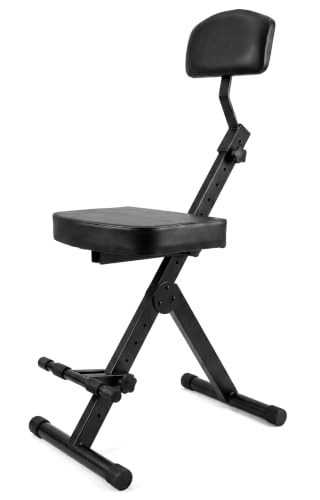
PYLE Drum Throne Guitar Stool Foldable — Best Foldable for Small Studios
PYLE’s throne is the pragmatist of the list: a padded, adjustable music stool with a backrest and footrest that folds for storage or transport. It comes from the drum world — the listing calls it a drum throne first — and that origin is a recommendation rather than a caveat. Drum thrones are engineered for adults who sit, move and lean on them for hours under stage conditions, and the guitarists who borrow the design inherit all of that overbuilding.
The fold is the feature that decides its home. A bedroom studio that must return to being a bedroom, a classroom corner, a church hall music cupboard — these are the places a folding throne with this much support earns its keep. Most folding stools trade the backrest away; this one keeps it, which is why it stands out among portable options for players whose sessions run long.
Padding is cushioned on both seat and back, per the listing, and the height adjusts to suit the player. Set against the Liquid Stands backrest model, the PYLE is the lighter, more mobile interpretation of the same idea; set against the backless thrones, it is the comfort upgrade. Its natural buyer is the player whose practice space is negotiated daily with the rest of the household.
One honest note about folding mechanisms generally: they reward a second of care. Open the frame fully, confirm the locks before sitting, and the stool will feel as solid as its fixed rivals. Treat it casually and any folding stool will remind you, with a small shift mid-song, that it has moving parts.
- Format: foldable throne with padded seat and backrest
- Includes: footrest, per the listing
- Adjustments: height adjustable for different players and instruments
- Best environment: shared rooms and studios that pack away
Strengths
- Keeps a backrest despite folding — rare among portable stools.
- Drum-throne engineering suits long, active sitting.
- Footrest included for proper thigh and guitar angle.
Trade-offs
- Folding joints need a deliberate lock-check before each use.
- No built-in guitar holder in the frame.
- Utilitarian throne styling will not flatter every room.
Best for: players whose practice corner must fold away after each session.
Not suited for: a permanent studio wanting the heaviest, most planted feel.

STRICH Guitar Stool Height Adjustable — Best for Mixed Ages and Shared Studios
The STRICH stool’s listing speaks to kids and adults in the same breath, and its design follows through: a height-adjustable, foldable guitar seat with an adjustable footrest, portable enough to move between the rooms where music actually happens in a family home. That breadth of audience is its identity. This is the stool for households where a parent practises after bedtime and a child has a lesson on Saturday, and one seat must fit both bodies honestly.
Adjustable footrests matter more in this mixed company than in any solo setup. A child’s feet dangling from an adult-height stool destroy posture faster than any other single factor, and a footrest that travels with the seat height solves it at both ends of the range. Teachers running a small studio from home will recognise the same value across a day of different-sized students.
The foldable, portable frame keeps the stool from claiming territory. In family homes, equipment that cannot be put away becomes furniture the whole household must negotiate, and musical instruments already claim enough of that budget. The STRICH’s willingness to disappear is a genuine feature for its intended audience.
Purists after a single perfect posture may prefer a stool tuned to one player. But shared reality is the norm in most musical households, and a stool that adjusts generously, folds willingly and serves the drummer in the family as readily as the guitarist covers more real life than a specialist seat used by one person alone.
- Format: height-adjustable folding guitar seat
- Footrest: adjustable, per the listing
- Audience in listing: younger players and adults, guitarists and drummers
- Best environment: family homes and multi-student teaching spaces
Strengths
- Wide height range fits children and adults on one stool.
- Adjustable footrest keeps smaller players’ posture honest.
- Folds and carries between rooms without complaint.
Trade-offs
- No backrest for long adult practice sessions.
- Generalist tuning means no single posture is its speciality.
- No holder for parking the guitar between players.
Best for: musical households and teachers seating many different players.
Not suited for: a solo adult wanting back support and a fixed setup.

Liquid Stands Guitar Stool Adjustable Height — Best Backless Padded Throne
The second Liquid Stands entry strips the formula to its essentials: a padded seat, height adjustment, a base built for musicians, and nothing else competing for your attention. The listing describes a comfortable padded chair for professional musicians that doubles as a drum throne, and mentions support suited even to double bass players — a hint that the seat’s height range reaches the taller settings some other stools only gesture toward.
Backless thrones have a real philosophy behind them. With nothing to lean on, the player sits actively, weight centred, free to turn toward a bandmate, a student or a mixing desk without furniture choreography. Electric guitarists who play semi-standing — perched at height with one foot down — often prefer exactly this: a seat that is a resting place between phrases rather than a chair that holds them.
The padded seat is the comfort story, and for sessions in the thirty-to-sixty-minute range that most daily practice actually lasts, a good cushion on a well-judged height is genuinely sufficient. The backrest models in this guide justify themselves across two-hour sessions and teaching days; this throne justifies itself every ordinary day, in the smallest footprint of any pick here.
It is also the natural second stool. Studios and teaching rooms that already own a featured chair often need one more honest seat for a student, a duo partner or a visiting player, and a backless adjustable throne fills that role without duplicating the main chair’s cost or bulk.
- Format: backless padded throne with height adjustment
- Audience in listing: guitarists, drummers and other seated musicians
- Arms: none, and no backrest — total freedom to turn
- Best environment: compact studios, duo and teaching rooms
Strengths
- Smallest footprint of the six picks when space is tight.
- Height range reaches settings suited to taller instruments and players.
- Active, centred sitting that suits semi-standing electric playing.
Trade-offs
- Nothing to lean on during breaks in long sessions.
- No footrest bar highlighted, so classical posture needs a separate footstool.
- No guitar holder integrated into the frame.
Best for: electric players who perch, and studios needing a versatile second seat.
Not suited for: classical players wanting footrest and back support in one piece.
How Do the Six Stools Compare for Different Players?
| Pick | Backrest | Defining feature | Watch out for |
|---|---|---|---|
| Liquid Stands Guitar Stool with Backrest | Yes | Complete studio stool for long sessions | Bulkiest of the Liquid Stands pair |
| EASTROCK Portable Guitar Stool with Stand | No | Built-in guitar holder, folding frame | Holder fit varies with unusual guitar shapes |
| EASTROCK Guitar Stool with Backrest | Yes | Backrest plus footrest for home practice | Stays home; not a travelling stool |
| PYLE Drum Throne Guitar Stool Foldable | Yes | Folds away without losing its backrest | Check the folding locks before sitting |
| STRICH Guitar Stool Height Adjustable | No | Wide height range for kids and adults | Generalist rather than specialist |
| Liquid Stands Guitar Stool Adjustable Height | No | Padded throne, minimal footprint | Classical players need a separate footstool |
How High Should a Guitar Stool Be, Really?
Forget the number on the box for a moment and think in angles. Seated with your playing foot on its rest, your thigh should slope gently — level or dropping slightly toward the knee — so the guitar settles into the lap rather than sliding off it. If the thigh climbs toward the knee, the guitar migrates and your right arm spends the session holding it in place instead of playing it. If the seat is far too low, knees splay, the back rounds, and the fretting hand’s angle suffers quietly for an hour before the shoulder complains.
Classical posture is the most specific: one foot raised on a footstool or the stool’s own rest, guitar resting on the raised thigh, neck angled upward. That geometry usually wants a lower seat than electric playing, because the raised foot is doing part of the height work. Electric players with the guitar on a strap can sit higher — even perch — since the strap carries the instrument and the seat is mostly a rest between phrases. Acoustic strummers live between the two, which is why adjustable stools dominate this guide: the repertoire changes, so the chair must.
The practical test takes thirty seconds in any showroom or at home. Sit, place your feet as you play, and mime both hands’ positions. Your strumming forearm should meet the guitar’s top without lifting the shoulder, and your fretting hand should reach the first position without straightening the elbow fully. Any stool in this list can be dialled to that test; a fixed dining chair almost never passes it.
Why Do Armrests Cause More Damage Than Discomfort?
An armrest meets a guitar at exactly the wrong height: the lower bout, the widest and most resonant part of an acoustic body, and the edge where finish meets binding. Each shift of the player’s weight presses that bout against a fixed obstacle. The first result is a dull knock mid-practice; the hundredth result is a worn patch, a crack risk on a cherished instrument, and a player who has unconsciously started holding the guitar away from their body to avoid it — trading tone and posture for furniture clearance.
Electric guitars suffer differently but similarly. A solid body’s lower edge against an armrest limits how the instrument can angle, and players compensate by rotating the guitar flat, which changes the picking hand’s relationship to the strings. Teachers see the results as technique problems — a collapsed wrist, a shoulder that will not drop — that vanish the day the student changes chairs. Flip-up arms, found on some office chairs, solve the collision only while flipped, and they return the moment a tired player forgets.
This is why the guide’s stools are unapologetically armless. The absence is not a missing feature; it is the feature. Everything else — padding, backrest, footrest, holder — is refinement on top of a clear space where the guitar needs to be.
How Do You Set Up a Practice Corner Around the Stool?
Arrange the corner so that everything a session needs lives within one seated reach: the guitar in its holder or stand, picks and capo on a small surface, the tuner clipped or nearby, music on a stand at eye height rather than flat on a table. Every stand-up interrupts the mental thread practice is building, and a corner that keeps the player seated keeps the session alive. The EASTROCK with its built-in holder understands this instinctively; other stools achieve it with a separate stand placed deliberately close.
Light deserves a thought. A stand light or a lamp angled over the fretting shoulder prevents the hunched lean toward sheet music that undoes a good chair’s work. Flooring matters too: stool feet on a rug stay put and stay quiet, while hard floors let a throne creep during energetic playing — rubber feet, present on several picks here, exist precisely for that creep.
Finally, give the corner a clock’s honesty. Players practise longer in corners that feel complete, and they practise more honestly with a timer visible than with a phone that invites everything except practice. The stool is the corner’s anchor, but the corner is what turns a seat into a habit.
Which Stool Suits Which Instrument Best?
Acoustic guitars are the divas of seating: wide bodies, resonant tops and a playing position that wraps the player’s arm over the lower bout. They need the clearest space and the most considered thigh angle, which pushes acoustic players toward the footrest-equipped picks — the EASTROCK backrest model above all — and toward seat heights a touch lower than electric players choose, so the big body can settle without lifting the strumming shoulder.
Electric guitars forgive more. A solid body is thinner, often played on a strap even while seated, and the seated electric player is frequently perched high, half-standing over pedals and a desk of recording gear. Backless thrones like the second Liquid Stands suit that posture beautifully, because the player is resting rather than reclining, and the freedom to swivel toward an amp or a screen matters more than a backrest.
Bass guitar is the quiet test of any stool. The instrument is longer and heavier, its neck reaches further, and a soft or low seat lets the whole arrangement sag until the fretting wrist bends to compensate. Firm padding, a stable base and a footrest to anchor the angle are the bassist’s three requirements, and they map directly onto the backrest-and-footrest picks in this guide.
Classical guitar remains the specialist case, with its raised-foot geometry and angled neck. No stool in this list is a classical-only design, yet the adjustable models with footrests can reproduce the posture faithfully, which is what matters. A classical player who also plays steel-string or electric — a common combination — is exactly the player adjustable stools were invented for.
What Should Teachers and Parents Look For in a Practice Stool?
Teaching rearranges the priorities. A teacher sits through other people’s playing all day, demonstrates in bursts, and leans in to correct a hand position a dozen times an hour. Back support stops being a luxury in that room, and a stool that adjusts in seconds between a small child’s lesson and an adult’s becomes the studio’s hardest-working object. The STRICH’s wide range and the Liquid Stands backrest model divide this audience between them: range first, or comfort first.
Parents buying for a young player should think about feet before anything else. A child whose feet dangle will swing them, slump, and develop a relationship with practice that is mostly discomfort. The correct stool height lets both feet rest — one on the floor or footrest — with the guitar supported by the thigh rather than clutched. Because children grow, adjustability is not a feature here; it is the entire purchase, the thing that lets one stool serve three school years.
Durability in a teaching or family setting also means cleanability and indifference to knocks. Stools get carried, folded, bumped by instrument cases and borrowed by drummers. Simple frames with few cosmetic pretensions age most gracefully in that traffic, and a stool that still works perfectly while looking slightly lived-in is a better household citizen than a delicate one demanding protection.
Finally, consider buying the stool before upgrading the instrument. Families often reverse this, putting a better guitar into the hands of a child who still practises on a kitchen chair at the wrong height. The stool is the cheaper purchase and, for a young player’s posture and enthusiasm, frequently the more consequential one.
How Do You Care for a Stool That Lives Among Instruments?
Stools in music rooms collect a specific grime: rosin-like dust from strings and cases, the felt-and-metal debris of capos and picks, and the slow polish of denim on padding. A weekly wipe of the seat and a shake-out of the base keeps most of it at bay. Vinyl and synthetic paddings tolerate a damp cloth; that small routine also reveals loose fittings while they are still a tightening job rather than a repair.
The height mechanism deserves a twice-yearly minute. Whether a stool adjusts by threaded post, gas lift or pin, grit is its enemy and a clean, dry mechanism outlives a neglected one by years. Folding stools add hinges to the same logic: keep them clean, open and close them deliberately, and store the stool folded only when it is dry, since trapped damp is unkind to both padding and metal.
Rubber feet are consumables in disguise. They harden, crack and eventually let metal meet flooring, and replacements are cheap compared with refinishing a floor or a landlord’s goodwill. Check them when you check the mechanism. A stool that grips quietly is also safer mid-performance, when a player’s weight shifts with the music and nobody is thinking about furniture at all.
Keep the stool’s territory clear of cables where you can. Pedalboard leads and charger cords love to wrap around stool bases, and the resulting tug travels straight to whatever the cable connects — often the guitar itself. A practice corner with cables routed behind the stool rather than beneath it protects the instruments the stool was bought to serve.
How Does a Session Unfold Differently on the Right Stool?
Minute one to ten is warm-up, and on the right stool it is unremarkable, which is the compliment. Scales and exercises need a centred, repeatable posture, and a stool set correctly the day before returns the player to yesterday’s geometry without a fresh negotiation each morning. Consistency of position is a hidden practice tool: the hands learn distances that stay learned.
The middle of the session is where repertoire work happens and where discomfort usually files its first report — a leg going sleepy, a shoulder creeping upward. On a well-chosen stool those reports arrive later and quieter, because the thigh angle is right, the seat edge is not pressing where it should not, and the feet have somewhere honest to be. Players often misread this as improved stamina; it is improved furniture, and it compounds across months.
The end of a session is where the holder and the backrest have their say. A player who can lean back for a moment, listen to a playback, and park the guitar safely without rising is a player who ends practice deliberately rather than in a fumble of stands and cables. Rituals matter to habits, and a stool that supports a clean ending helps the next session begin. It is a modest claim, but modest claims are the ones furniture can honestly make.
Which Mistakes Do Guitarists Make When Choosing a Seat?
The first is buying the chair they sit in for everything else. The office chair with fixed arms, the beloved recliner, the kitchen chair borrowed nightly — each imposes a compromise the player then mistakes for their own physical limitation. A numb leg gets blamed on age; it was the seat edge. A sore shoulder gets blamed on technique; it was the armrest lifting the guitar. Dedicated stools cost little compared with the instruments they protect, yet players routinely buy them last.
The second mistake is choosing height by habit rather than by instrument. A player who owns both a classical guitar and an electric needs adjustability, full stop; a fixed stool will be wrong for one of them every single day. Relatedly, ignoring the footrest — treating it as a drummer’s accessory — leaves the thigh angle to chance, and the thigh angle is half the posture.
Third, players overlook where the guitar sleeps during the session. Leaning it against furniture between songs is the habit behind most cosmetic damage and the occasional catastrophic fall. A holder, whether built into the EASTROCK’s frame or standing separately beside another stool, is not an accessory purchase. It is insurance that happens to be convenient.
Lastly, drummers’ thrones frighten guitarists off for no good reason. The shared design exists because seated musicians’ needs converge: height, stability, no arms, hours of tolerance. A guitarist who refuses throne-shaped stools on principle is refusing the most refined seat their activity has, refined by the very players who sit longest.
Should a Guitar Stool Swivel or Stay Fixed?
Swivel is the throne tradition: drum stools rotate because drummers must reach around a kit, and guitar stools inherited the habit. For guitarists, a gentle swivel helps turn toward a music stand, a bandmate or a recording screen without lifting and reseating. In teaching rooms it is close to essential, since the teacher’s attention rotates constantly between the student’s hands, the music and the clock.
Fixed bases have their defenders, and classical players often lead them. A posture built on precise angles — raised foot, angled neck, set distances — can feel undermined by a seat that rotates a few degrees under a weight shift, and some players find themselves unconsciously bracing against the movement. Recording players add another argument: a swivel under load can creak at exactly the wrong moment, and microphones are unforgiving critics of furniture.
The honest answer is that the base should match the session’s character. Mobile, social, teaching-centred playing benefits from rotation; solitary, posture-critical, recorded playing benefits from stillness. Several stools in this guide sit on throne-style bases descended from the drum world, so try the rotation with your own guitar in hand before deciding it does not matter — the test takes a minute and settles the question for your body rather than for players in general.
What Does Padding Actually Do Across a Year of Practice?
New padding impresses everyone; month-six padding tells the truth. Foam compresses where the sitter’s weight concentrates, and a seat that began plump can develop a personalised hollow that quietly tilts the pelvis. Quality thrones resist this with denser foam, which feels firmer on day one and far better on day two hundred. When comparing stools, press the seat hard with a thumb: the padding that pushes back evenly is the padding that will still be working next winter.
Seat shape matters alongside depth. A round throne distributes weight for a centred sitter; a shaped or saddle-leaning seat can suit players who sit toward the front edge, as many guitarists do when the guitar occupies the lap’s centre. Front-edge sitters should beware thin front lips on cheap seats, because the pressure lands precisely where the padding is thinnest, and the resulting leg numbness is the classic complaint that sends players chair-shopping in the first place.
Covers write the final chapter. Vinyl wipes clean of the dust and spills of a music room and tolerates years of denim; fabric breathes better in warm rooms but holds dust and needs vacuuming. Neither is wrong — but the player who practises in a hot attic room and the player in a cool studio are, once again, buying different stools that happen to share a silhouette.
How Much Should a Practice Stool Cost You in Attention?
The best measure of a practice stool is how completely it leaves your mind. A stool that demands daily readjustment, squeaks through recordings, or needs its locks checked with genuine anxiety is taxing the exact attention practice runs on. This is why the guide favours simple, proven mechanisms over novelty: threaded posts, honest hinges and throne bases with decades of stage use behind the design. Boring engineering is a feature in a music room.
Setup attention is a one-time tax worth paying properly. Dial the height with your guitar in hand, not by eye; mark the setting if the mechanism allows it, so a borrowed stool or a helpful cleaner does not reset your posture unknowingly. Teachers with several stools sometimes colour-code the settings per student, a small system that saves the first five minutes of every lesson.
After that, the stool should vanish from your thoughts for months at a time. If it does not — if some small irritation keeps surfacing — believe the irritation. Small discomforts in daily equipment do not stay small; they steer behaviour, shortening sessions and souring habits. Replacing a nearly-right stool is not extravagance. It is the same decision as changing strings before they go dead, made on a longer clock.
What If You Play Standing Most of the Time?
Plenty of electric and acoustic players perform standing and only sit to practise slowly, learn parts or record. For them the stool is a perching place rather than a chair, and the priorities invert: higher settings matter more than low ones, a quick height change matters more than deep padding, and a backrest becomes mostly irrelevant. The backless thrones in this guide serve that player best, set high enough that sitting and standing are neighbouring postures rather than different countries.
There is still a posture to protect. Perching with the guitar on a strap concentrates weight through one foot if the player is careless, and a foot ring or bar gives the other foot a home. Even standing players benefit from the stool’s presence as a metronome for position — the place the body returns to between takes. Buy the simpler stool, set it high, and let it be the practice room’s comma rather than its full stop.
Final Recommendation
For a single stool that covers the most players most completely, take the Liquid Stands with backrest: adjustable, stable and kind across long sessions. Classical and acoustic players who practise at home should look hard at the EASTROCK backrest model for its footrest pairing, while travelling players and small rooms are best served by the EASTROCK with the built-in holder or the folding PYLE. Families and teachers will get the most life from the STRICH’s wide adjustment, and electric players who perch should choose the backless Liquid Stands throne without a second thought. Whichever you choose, set its height by your thigh and not by habit, park the guitar somewhere safer than a lean, and let the chair’s highest compliment be the one every good practice seat earns: an hour later, you will realise you never once thought about the thing you are sitting on.
Frequently Asked Questions
Can I just use my office chair for guitar practice?
You can, and most players start there, but fixed armrests usually collide with the guitar’s body and force a rotated, shoulder-lifting posture. Flip-up arms help only while you remember them. A dedicated armless stool removes the negotiation entirely, which is why players who switch rarely switch back.
Do I need a backrest on a guitar stool?
For daily practice under an hour, a good padded seat at the right height is usually enough. Backrests earn their place across long sessions, teaching days and recording work, where the pauses between playing are when the spine wants support. Judge by your longest typical session, not your average one.
What height suits classical guitar?
Classical posture pairs a lower seat with a raised foot, so the guitar rests on the elevated thigh with its neck angled up. An adjustable stool with a footrest — or a low throne plus a separate footstool — lets you find that geometry precisely. The test is the thigh’s gentle slope and a relaxed fretting shoulder, not a number.
Are drum thrones really suitable for guitarists?
Yes — the overlap is genuine. Both activities need armless, height-adjustable, stable seating for long periods, which is why several listings in this guide address both audiences. Thrones built for drummers are often sturdier than guitar-branded equivalents, since drummers move more violently on them.
Is a built-in guitar holder worth choosing a stool for?
If your practice space is small or shared, it can be the deciding feature, because it replaces a separate stand and ends the risky habit of leaning the guitar against furniture. In a dedicated studio with stands already placed, it is a convenience rather than a necessity. Judge it by your own near-misses: every player who has watched a guitar slide slowly down a wall knows exactly what a built-in holder is worth, and it is considerably more than the small difference it makes to a shopping list.
How do I stop a stool sliding on hard floors?
Choose models with rubber feet, several of which appear in this guide, and consider a low rug under the practice corner. A rug also quiets foot taps and protects the floor from the stool’s base during energetic sessions. Avoid placing any stool where one foot lands on a rug edge and the others on bare floor.
Can a guitar stool double as a piano or keyboard seat?
Often, yes. Keyboard players want a similar recipe — armless, height-adjustable, stable — though bench-style seats suit two-handed keyboard posture for some players. A throne from this guide will serve a keyboard corner respectably, and in small studios one good adjustable stool covering both instruments is a sensible economy. Drummers, keyboardists and guitarists sharing one rehearsal room have quietly standardised on this shape for good reason.
What should I do if my leg still goes numb on a proper stool?
Check the seat’s front edge and your height first: a seat set too high concentrates pressure under the thigh, and a sharply edged cushion adds to it. Lower the stool a notch, confirm your foot rests fully supported, and take standing breaks during long sessions. Persistent numbness deserves a conversation with a clinician rather than another furniture purchase.
Related Guides
Musicians arranging the wider room can continue with Best Chairs for the Head of a Dining Table for the household’s other ceremonial seat, settle in for Best Chairs for Long Board Game Sessions on the evenings the guitar rests, compare arm designs in Best Office Chairs with Articulating Arms, and treat the practice room’s walls with Best Acoustic Blankets.



[…] reading for low, relaxed rooms includes Best Chairs for Playing Guitar for another kind of floor-adjacent sitting, Best Living Room Chairs when the household graduates to […]