What's inside
- Key Takeaways
- Quick Picks
- How Did We Choose These Blankets for High-Withered Horses?
- Why Does Neckline Shape Matter More Than Warmth on a High Wither?
- Which Blankets Clear a High Wither Best? Our Six Picks in Detail
- What Does Denier Actually Tell You About a Turnout Shell?
- How Should Fill Weight Follow Clipping and Climate?
- How Do the Six Compare Side by Side?
- How Should You Measure and Fit a Turnout on a High-Withered Horse?
- Do Neck Covers and Combo Rugs Help or Hurt a High Wither?
- How Should You Read a Blanket Listing Before You Trust It?
- How Should a Blanket Wardrobe Be Rotated Through One Winter?
- How Does a High Wither Change Saddle-Time and Stable Routine Around the Rug?
- What Mistakes Do Owners Make When Blanketing a High-Withered Horse?
- Final Recommendation
- Frequently Asked Questions
- Related Guides
As an Amazon Associate I earn from qualifying purchases. This post may contain affiliate links at no extra cost to you.
cottageverdict.com is reader-supported. When you buy through links on our site, we may earn an affiliate commission.
Where to buy: five of the six blankets for high-withered horses below carry links to their Amazon listings, where you can check the current price and confirm the size run before ordering. The sixth entry, a plain standard-cut turnout discussed as a contrast, has no link on purpose, because its job in this guide is to show what a high-withered horse should usually avoid.
A horse with tall, narrow withers changes the blanket conversation before fabric or fill ever enters it. The best blankets for high-withered horses are the ones cut to climb over that bony ridge behind the shoulders instead of resting on top of it, because a standard neckline settles its front edge exactly where the withers peak, and every step the horse takes then works that edge back and forth across skin that has almost no padding of its own. Owners describe the result in familiar terms: rubbed hair by November, a sore spot by December, and a blanket that keeps sliding sideways no matter how carefully the straps were adjusted in the morning.
Fit, then, is the whole subject of this guide, and everything else is supporting detail. Denier tells you how hard the outer shell works against weather, fencing and pasture mates. Fill weight tells you how much warmth the blanket carries into a cold night. Hardware tells you how the blanket closes and whether it stays closed. But none of those numbers rescue a neckline that loads the withers, and a modest blanket shaped correctly will outperform an expensive one shaped wrongly on this particular conformation. Read the picks below through that lens first, and let warmth and toughness argue about second place.
One boundary deserves stating early. This guide talks about garment fit, weather protection and stable management. It does not diagnose backs, lameness or skin conditions, and a blanket cannot fix a wither problem that belongs to saddle fit, conditioning or an injury. If a horse is sore along the topline, losing hair in a pattern that worries you, or reacting when the withers are palpated, that is a conversation for your veterinarian or an experienced saddle fitter. What a well-chosen turnout can do is remove one avoidable source of pressure and friction from a sensitive area, and that narrower promise is the one this page keeps.
Key Takeaways
- Neckline shape matters more than any other spec on a high-withered horse; look for high-neck, Wug-style or extended-neck cuts.
- Measure the horse, not the wardrobe: centre of chest to centre of tail, in inches, decides the size you order.
- Fill weight is a climate and clipping decision, running from a 100g light layer up to 300g for genuinely cold spells.
- Denier describes shell toughness, with 1200D as the common workhorse grade and 1680D as the heavy-duty step up.
- Fleece padding at the withers softens contact but cannot compensate for a neckline that sits in the wrong place.
- Check the fit again after a week of wear, because blankets settle and horses change shape across a season.
- Two honest rugs — one light, one winter-weight — beat a single compromise blanket almost every year.
Quick Picks
| Pick | Badge | Why it made the list |
|---|---|---|
| Horseware Amigo Bravo 12 Wug Turnout 250g | Best Overall | The Wug neckline was designed around this exact problem, climbing high over the withers so the blanket’s weight hangs from the shoulders instead. |
| Jeffers 1680D High Neck Turnout Blanket 240G | Toughest Shell | A 1680D outer paired with a high neck and midweight fill suits horses that are hard on clothing and live out most of the day. |
| Tough 1 1200D High Neck Turnout Blanket 300g | Warmest Pick | The heaviest fill in this group, wrapped in a high-neck cut, for clipped horses and cold continental winters. |
| Equinavia Arktis Extended Neck Turnout 100g | Best Light Layer | An extended neck with fleece at the withers and only 100g of fill, built for shoulder seasons and unclipped coats. |
| HILASON 1200D Waterproof Winter Turnout Blanket | Best Coverage | A belly-wrap closure system and 300g fill give the most enclosed fit here for horses wintering outdoors. |
| Standard-Cut Turnout Blanket (generic class) | The Cautionary Contrast | Included without a link as the shape to measure the others against; its low neckline is precisely what tall withers punish. |
How Did We Choose These Blankets for High-Withered Horses?
Every candidate had to clear the neckline test first. We looked for blankets whose front panels rise well above the base of the neck — sold as high neck, Wug, extended neck or half-neck designs — because that geometry is what moves the blanket’s front edge off the wither peak. Ordinary V-front and standard-cut turnouts were set aside no matter how attractive their other numbers looked, with one deliberate exception kept in the list as a teaching contrast. A blanket that fails the first test cannot be argued into this guide by a bargain tier or a pretty colour.
After shape came verification. Each linked pick below was confirmed against a live listing through the site’s own product-checking tools, and the details quoted in the spec boxes — denier, fill weight, closure style, size shown — come from those listings rather than from memory or marketing folklore. Where a listing states a single size, we say so, because ordering a turnout in the wrong length is the most common and most avoidable mistake in this category. Sizes, colours and stock move around through the season, so treat the listing as the final word at the moment you buy.
We also weighed how each blanket behaves on the second horse in the conversation: the owner. A rug that takes two people and a step stool to fasten will be fitted carelessly on dark mornings, whatever its design merits, so front closures, overall weight and strap logic all counted in the final ordering. The Hilason’s wrap system is the most involved here and is forgiven because its security is the product; the Equinavia’s quick-release buckle sits at the opposite, friendliest extreme. Neither extreme disqualified a blanket, but both shaped the Best for lines that close each review.
The last filter was range. A guide that recommended six near-identical midweight blankets would fail the reader whose horse is clipped and standing in a January wind, and equally fail the reader whose unclipped veteran only needs a waterproof shell over a thick natural coat in October. So the final six spread across fill weights from 100g to 300g, across shell grades from everyday 1200D to a heavier 1680D, and across closure philosophies from quick-release buckles to a full belly wrap. Between them they cover most of the situations a high-withered horse actually meets between autumn and spring.
Why Does Neckline Shape Matter More Than Warmth on a High Wither?
Picture the withers as a tent ridge. On a horse with low, mutton withers, a blanket’s neckline rests on a broad, gently sloped surface and the load spreads out. On a horse with high withers — many Thoroughbreds, Warmbloods and leaner riding horses — that ridge is tall and narrow, and a standard neckline drapes its front edge directly across the peak. The blanket’s own weight, plus the pull of the chest straps, concentrates along that edge. Walking, grazing with the head down, and rolling all drag the edge a few millimetres at a time, hundreds of times a day.
High-neck designs answer the geometry rather than fighting it. The front of the blanket extends further up the neck, so the edge sits on the sloping shoulder in front of the withers and the fabric arches over the ridge with clearance. The horse’s movement then shifts cloth against muscle and coat on the neck, where there is far more tissue to absorb friction, instead of against the bony crest. Owners often notice the practical side effect first: the blanket stops migrating backwards and sits straighter, because it is no longer being levered off a peak it was never shaped to cross.
Padding plays a supporting role, and it is worth being precise about its limits. Fleece or foam at the wither area, which two of the picks below include, cushions contact and can help a correctly shaped blanket sit kindly. Sewn into a badly shaped one, the same padding simply becomes a thicker thing pressing in the wrong place. When you shop, read for cut first, padding second, and treat any listing that leads with padding while saying nothing about neckline height as a standard blanket wearing a comfort costume.
There is also a sizing interaction that catches people out. A high-withered horse often measures longer than its stablemates of the same height, because the tape travels over more topography. Order by the tape, not by the size of the blanket the horse wore at its previous yard, and if the measurement lands between sizes, the guidance from most makers is to consider how the individual blanket’s cut runs — some high-neck designs sit more generously than their label suggests. The detailed reviews below flag where a listing shows only one size, so you can check availability for your horse’s actual length before falling for a feature list.
Which Blankets Clear a High Wither Best? Our Six Picks in Detail
Six blankets follow, five of them verified listings and one deliberate counterexample. They are ordered by how completely they solve the neckline problem, with warmth and toughness breaking the ties, because that ordering matches how a high-withered horse experiences them: shape first, weather second.
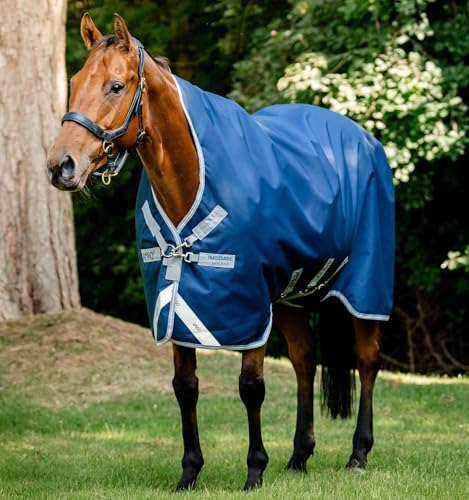
Horseware Amigo Bravo 12 Wug Turnout 250g — Best Overall
The Wug cut is the reference design in this category, and it earns that status by being specific. Rather than a standard neckline with extra padding glued on, the front panels are cut as a half neck that rises over the withers and fastens higher on the chest, so the blanket hangs from the shoulders and the wither ridge sits in open air beneath an arch of fabric. On a tall, narrow wither this is the difference between a blanket the horse wears and a blanket the horse endures, and it shows in how level the rug stays after a day of grazing and rolling.
Around that neckline sits a sensibly midweight package. The 250g fill lands in the versatile middle of the range — enough for a clipped horse through most of a temperate winter, not so much that an unclipped horse cooks on a bright February afternoon. Horseware’s tail cord and leg arches, part of the Bravo 12 design language, help the rear of the blanket move with the horse instead of sawing across the hips. The listing shown is a 78-inch in navy with titanium grey and silver trim; the range of sizes in this line is broad, but confirm your horse’s length is in stock before you commit, because popular sizes sell through early in the season.
Owners moving a horse from a standard rug into the Wug usually report the change in an unglamorous unit: the morning check. The ridge stays unmarked week after week, the rug is found where it was left rather than rotated toward the horse’s stronger rolling side, and the front straps stop needing their weekly re-tightening argument. That ordinariness is the highest praise a turnout can earn on this conformation, because drama in blanketing almost always announces itself on the horse’s skin first.
- Cut: Wug half-neck, designed to clear high withers
- Fill: 250g, midweight
- Size shown: 78 inches
- Colour shown: Navy/Titanium Grey and Silver
- Closure style: front fastenings with leg arches and tail cord
Strengths
- Neckline geometry solves the core problem rather than cushioning it
- Midweight fill covers the widest span of winter conditions
- Stays centred on the horse better than standard cuts in daily wear
Trade-offs
- Sits in a premium tier compared with the other picks here
- Half-neck coverage stops short of a full neck rug in driving rain
- Popular sizes can be scarce by mid-winter
Best for: the high-withered riding horse in regular work whose owner wants one winter blanket that simply fits. Not suited for: a horse needing maximum warmth at 300g, or a buyer shopping strictly at a budget tier.

Jeffers 1680D High Neck Turnout Blanket 240G — Toughest Shell
Some horses treat blankets as a contact sport. They rub on fence rails, invite their field companions to tug at straps, and come in each evening wearing evidence. For that horse, the Jeffers pairs its high neckline with a 1680D outer shell — a noticeably heavier denier than the 1200D that dominates this category — and the combination is the point. The neck clears the withers properly, while the shell shrugs off the abrasion that turns lighter fabrics into repairs by Christmas.
The rest of the specification reads like a working ranch list. A 240g fill keeps it in honest midweight territory. The criss-cross belly surcingles and hind leg straps are the traditional arrangement for keeping a turnout seated on a horse that moves a lot, and the listing describes the shell as waterproof and breathable, which matters for a horse living out around the clock rather than coming in to dry off each night. The size shown is 75 inches in Plymouth Brown, an earthy colour that hides the realities of pasture life gracefully.
- Cut: high neck
- Shell: 1680D, waterproof and breathable per listing
- Fill: 240g, midweight
- Size shown: 75 inches
- Closures: criss-cross belly surcingles, hind leg straps
Strengths
- Heaviest shell fabric in this guide for blanket-wreckers
- High neckline keeps the front edge off the wither peak
- Traditional strap layout that most horse people can adjust blindfolded
Trade-offs
- Heavier in the hand, which some smaller owners notice at rug-changing time
- Single size shown on this listing, so check the run before ordering
- 240g may run warm for an unclipped horse in a mild coastal winter
Best for: a turned-out horse that is rough on clothing, in a climate where midweight is the winter default. Not suited for: a fine-skinned horse in light work that would be better served by the lighter Equinavia below.

Tough 1 1200D High Neck Turnout Blanket 300g — Warmest Pick
When the question is not whether the horse is cold but how cold, fill weight becomes the headline, and this Tough 1 carries the most insulation in the group at 300g. Crucially, it wraps that warmth in a high-neck cut rather than a standard one, so the clipped horse standing in a prairie wind gets the heat without paying for it in wither rubs. Plenty of heavy blankets fail exactly there, piling fill onto a neckline that was drafted for a rounder horse.
One ownership note specific to heavyweight rugs: they take the longest to dry after washing and the most room to store, and they are the blankets most often put away damp by owners in a hurry at season’s end. Give this one a full extra day on the line and store it loosely rather than vacuum-packed, and it will return each winter with its loft — the property you actually paid for — intact.
The shell is 1200D, the category’s everyday grade: respectable toughness for normal turnout, a step below the Jeffers for a horse that actively destroys rugs. The listing shown is a 78-inch in a hunt colourway. Treat this blanket as a specialist rather than a default. Three hundred grams over an unclipped coat in a merely chilly climate produces a sweating horse, and a sweating horse under a waterproof shell is its own problem. Its home is the genuinely cold stable yard — clipped coats, northern winters, elderly horses that feel the frost.
- Cut: high neck
- Shell: 1200D
- Fill: 300g, heavyweight
- Size shown: 78 inches
- Colour shown: Hunt
Strengths
- Maximum warmth here without surrendering the high-neck fit
- Proven, widely stocked design with an accessible tier positioning
- Sensible choice for clipped horses in hard winters
Trade-offs
- Too much blanket for mild climates or thick natural coats
- Shell denier is mid-grade rather than heavy-duty
- Bulk makes it the least pleasant of the six to wash and store
Best for: clipped or cold-sensitive high-withered horses in regions with real winters. Not suited for: an unclipped horse in a temperate zone, who will overheat under 300g.

Equinavia Arktis Extended Neck Turnout 100g — Best Light Layer
Not every blanketing decision is about deep winter. The awkward weeks are the shoulder seasons, when an unclipped horse needs rain kept off its back and a whisper of insulation against a raw wind, and when a midweight rug would leave it damp with sweat by noon. The Arktis answers with only 100g of fill inside an extended-neck design, and it adds the detail this guide keeps asking for: fleece at the withers, cushioning the exact ridge the extended cut is shaped to protect.
The shell is a 1200D ripstop, a weave that resists a small snag becoming a long tear, and the listing notes high-visibility stitching plus a quick-release buckle at the front. That buckle deserves a mention in a fit guide, because front closures are where daily adjustment happens; a buckle you can work with cold fingers in February gets adjusted properly, and a fiddly one gets left at yesterday’s setting. As a light layer this is also the natural first turnout to buy for a young horse being introduced to clothing, since it teaches the routine without the weight and heat of a winter rug.
- Cut: extended neck with fleece at the withers
- Shell: 1200D ripstop, waterproof per listing
- Fill: 100g, lightweight
- Details: high-visibility stitching, quick-release front buckle
- Role: shoulder-season and rain layer
Strengths
- Lightest fill here, ideal over natural coats in autumn and spring
- Wither fleece plus extended neck is a thoughtful fit combination
- Quick-release buckle encourages correct daily adjustment
Trade-offs
- Not a winter blanket for a clipped horse on its own
- Ripstop resists tears but is not the thickest shell in the group
- Owners in cold regions will still need a heavier second rug
Best for: unclipped horses, mild climates, and the rainy shoulder seasons. Not suited for: being the only blanket owned by a clipped horse in a northern winter.

HILASON 1200D Waterproof Winter Turnout Blanket — Best Coverage
The Hilason takes a different route to staying put: wrap more of the horse. Its belly-wrap closure system closes the underside more completely than a pair of surcingles, which reduces the gap through which wind lifts a blanket and through which a rolling horse can work a rug sideways. Combined with 300g of fill, the result is the most enclosed, weather-sealed package in this guide — the blanket for a horse that winters out in exposed country and comes in only for feeding.
There is a management dividend to the wrap design that only appears over a full season. Because the underside closes more completely, the lining stays cleaner against the barrel, and the whole rug seems to collect less of the mud-and-bedding paste that works its way under looser blankets and then dries against the coat. For an owner washing rugs at home rather than sending them out, that difference is felt at the machine, not just in the field. It does not change the fit argument, but it sweetens the ownership of the heaviest, most serious blanket in the group.
Fit details elsewhere are attentive: fleece at the withers, double-stitched seams, and removable leg straps, so a broken strap is a replacement part rather than a repair job. A fair caution belongs here, though. A belly wrap adds fabric and fastenings, and on a high-withered horse the front of any blanket still has to be checked against the ridge by hand on the first fitting — run your palm under the neckline and confirm clearance rather than trusting the word winter on the label. Adjusted carefully, the wrap is an asset; adjusted lazily, no closure system saves a fit.
- Shell: 1200D rip-stop, waterproof per listing
- Fill: 300g poly fill
- Closure: belly wrap system
- Details: fleece withers, double-stitched seams, removable leg straps
- Role: full-winter outdoor coverage
Strengths
- Belly wrap gives the most secure, enclosed fit in this group
- Heavy fill for horses living out through winter weather
- Removable straps and fleece wither pad show practical detailing
Trade-offs
- Most fabric and fastenings to manage of any pick here
- Warmth is excessive for stabled horses in heated barns
- Front fit still needs a careful hand-check over the withers
Best for: horses wintering outdoors in wind and wet, especially broad horses that shift ordinary rugs. Not suited for: a horse that only needs rain protection in a mild climate.
Standard-Cut Turnout Blanket (generic class) — The Cautionary Contrast
Every tack room contains one: a perfectly serviceable standard-cut turnout, midweight, mid-priced, bought because it was there. On a round-barrelled cob it may serve for years without complaint, which is exactly why it earns a place in this guide as the contrast. Its neckline was drafted for a horse whose withers sit low and wide, and on a high-withered horse that same neckline parks its front edge across the ridge, tightens there when the chest straps are done up, and begins its slow sawing work within the first week.
We discuss this class without a link deliberately. There is no single product to point at, and the lesson is about shape rather than brand: if a listing shows a low, scooped neckline and says nothing about wither clearance, assume it belongs to this class whatever its other virtues. Such blankets sit at a budget-to-mid tier across the market. The money question resolves itself quickly, too — a standard rug that rubs is not cheaper than a high-neck rug that fits, once you count the weeks of lost work and the second purchase you will eventually make.
- Cut: standard low neckline
- Fill: varies across the class, typically midweight
- Shell: varies, commonly 600D–1200D
- Wither clearance: not a design goal of the class
- Availability: everywhere, which is the trap
Strengths
- Perfectly adequate on low-withered, round horses
- Widely available at accessible tiers
- Useful as a spare for a different horse in the barn
Trade-offs
- Neckline loads the wither peak on the horses this guide is about
- Tends to slip and twist as it works against the ridge
- Padding add-ons cannot correct the underlying geometry
Best for: the barn’s low-withered horses, as their own correctly shaped option. Not suited for: any horse whose withers stand tall and narrow — the entire subject of this page.
What Does Denier Actually Tell You About a Turnout Shell?
Denier measures the thickness of the individual yarns woven into the outer fabric, and in blanket listings it functions as a rough toughness grade. A 600D shell is a fair-weather garment for a gentle horse in a safe paddock. The 1200D carried by most picks in this guide is the established middle: it survives normal turnout, normal fencing and normal companions for seasons rather than months. The 1680D on the Jeffers is the heavy end of the mainstream range, chosen by owners whose horses have demonstrated, expensively, that lighter fabrics bore them.
What denier does not measure is waterproofing. A shell keeps weather out through its coating or membrane and the integrity of its seams, which is why two blankets with identical denier can perform very differently in a three-day rain. It also says nothing about fit, which returns us to this guide’s refrain: denier decides how long the blanket lives, while the neckline decides how the horse feels while it lives. Buy enough denier for your horse’s behaviour and your fencing, then stop paying for toughness and start paying attention to shape.
Breathability deserves its sentence too, because a waterproof shell that traps sweat against a clipped coat creates a clammy horse on any day the sun comes out. Listings that pair waterproof with breathable, as the Jeffers does, are describing the more comfortable construction for horses that live out full-time. For a stabled horse that comes in nightly, the distinction matters less, since the rug comes off and the coat dries in the barn air regardless.
How Should Fill Weight Follow Clipping and Climate?
Fill is insulation, and insulation only makes sense relative to the coat underneath it and the air around it. An unclipped horse grows its own midweight blanket by November; adding 300g over the top mostly produces sweat at the shoulders on any day above freezing. A fully clipped horse has had that layer removed by human decision, and the wardrobe has to replace it deliberately, which is where the 250g and 300g picks in this guide earn their keep. Partial clips — a trace clip, a blanket clip — land between the two, and their owners live in the 200g–250g middle where the Wug and the Jeffers sit.
Climate then adjusts the answer a band in either direction. Wet cold is more penetrating than dry cold at the same thermometer reading, and wind strips warmth from a standing horse faster than still air does, so an exposed hill pasture argues a step heavier than a sheltered valley yard in the same county. Age and condition argue too: veterans and hard keepers feel winter more than round, young horses in easy work. None of this requires precision instruments. It requires knowing your horse’s clip, your field’s exposure, and whether the animal in front of you runs warm or cold — then picking the fill that matches that horse rather than the one the neighbouring yard bought.
The practical wardrobe that falls out of this logic is two blankets, not one: a light layer in the Equinavia class for the shoulder seasons and warm spells, and a main winter rug in the 240g–300g class for the cold core of the year. Owners who try to make a single midweight do everything usually discover it does the extremes badly — too hot in October, too cold in January — while costing not much less than the honest pair. If budget forces one purchase this season, buy for the coldest month your horse will actually face and manage warm days by removing the rug during daylight hours.
How Do the Six Compare Side by Side?
| Pick | Neckline | Shell | Fill | Defining trait |
|---|---|---|---|---|
| Horseware Amigo Bravo 12 Wug | Wug half-neck | Not stated in listing title | 250g | Purpose-built wither clearance |
| Jeffers High Neck | High neck | 1680D | 240G | Toughest outer fabric |
| Tough 1 High Neck | High neck | 1200D | 300g | Warmest configuration |
| Equinavia Arktis | Extended neck, fleece withers | 1200D ripstop | 100g | Lightest layer |
| HILASON Winter Turnout | Fleece withers, wrap body | 1200D rip-stop | 300g | Belly-wrap enclosure |
| Standard-cut (generic) | Low standard neckline | Varies | Varies | The shape to avoid here |
How Should You Measure and Fit a Turnout on a High-Withered Horse?
Start with the tape on a relaxed horse standing square. Measure from the centre of the chest, around the widest part of the shoulder and barrel, to the centre of the tail, and write the number down in inches — that figure, not the horse’s height and not its stablemate’s rug size, is the size to order. On high-withered horses, resist the temptation to size up in the hope of gaining wither clearance. An oversized blanket slides backwards until its neckline finds the ridge anyway, and then it rubs from a worse position with more fabric in motion. Clearance comes from cut, never from surplus length.
At the first fitting, do the hand test before the horse leaves the yard. Slide your flat hand under the front of the blanket at the withers; you want room for the hand without the fabric pressing it against the ridge, both with the horse’s head up and with its head lowered in a grazing stretch, because grazing is the position that pulls a neckline tightest. Walk the horse a few circles and watch the front edge. It should travel with the shoulder rather than seesawing across the crest, and the blanket should return to centre after a roll rather than camping permanently on one side.
Then build the boring habit that protects the whole investment: look at the withers every day when you rug or unrung, the same way you pick feet. Hair that lies flat and glossy under the neckline means the fit is working. Hair that stands roughed-up, breaks off short, or thins in a stripe across the ridge is the blanket filing an early complaint, and it is far easier to answer in week one — with strap adjustments, a different rug from the wardrobe, or a wither pad as a stopgap — than in week six when the skin itself is involved. Recheck size after any long layoff, too, because a horse returning from time off carries a different topline than the one that was fitted in October.
Do Neck Covers and Combo Rugs Help or Hurt a High Wither?
Sooner or later every owner of a tall-withered horse is offered the combo: a rug with the neck cover permanently attached, promising total weather sealing from ears to tail. The honest answer is that the design cuts both ways on this conformation. A fixed neck piece keeps rain from running down inside the front of the blanket, which is a genuine comfort gain in wet climates, and it removes the gap where a separate neck cover’s straps can create their own pressure line across the crest.
The risk is weight transfer. A long neck cover, especially when saturated with rain, hangs a meaningful load from the front of the rug, and that load travels to the same wither area this entire guide is trying to unload. On a horse whose rug already sits kindly, a combo may behave beautifully. On a horse that has been rubbing under a standard rug, adding a fixed neck can make the original problem heavier rather than better. Detachable neck covers are the safer experiment: fit the rug alone first, confirm the ridge stays clear for a fortnight, and only then add the cover and repeat the hand test.
There is also a warmth argument owners forget. The neck is a large radiator, and covering it changes the horse’s heat balance as surely as adding fill does. A combo over a thick natural coat in a merely damp climate can overheat a horse that was perfectly judged in a neckless rug of the same weight. Match the cover to the same clipping and climate logic as the fill — clipped and cold argues yes, hairy and mild argues no — and let the horse’s comfort, checked by a hand slid under the front of the rug at midday, settle arguments that catalogues cannot.
How Should You Read a Blanket Listing Before You Trust It?
Listings reward a sceptical reading order. Find the neckline language first: the words high neck, Wug, extended neck or half neck should appear in the title or the first lines of the description, because makers who cut for withers say so immediately. A listing that leads with colour, price tier or the word premium while leaving the neck shape to a photograph is telling you where its design effort went. Study that photograph anyway, and look at where the front edge would land on a tall ridge rather than on the round model horse in the picture.
Next, extract the three numbers that cannot be fudged: denier, fill weight and the actual size run. A blanket offered in a single size fits exactly the horses that size fits, and a high-withered horse at the long end of the range may be quietly excluded from a bargain. Check the closure description as well — surcingles, leg straps, belly wraps and front buckle styles all change how a rug behaves on a horse that rolls daily — and note whether straps are removable or replaceable, because that detail decides whether a November breakage is an errand or a write-off.
Last, read for what the listing does not claim. Reputable turnout descriptions talk about waterproof shells, breathable linings and weather protection; they do not promise to correct a horse’s back, cure soreness or replace veterinary care, and this guide has deliberately kept the same discipline. If a seller’s copy crosses into therapy, discount everything else on the page by the same margin. The six entries above were chosen partly because their listings stick to garment facts — fabric, fill, closures, sizes — which is the vocabulary a fit decision should be made in.
How Should a Blanket Wardrobe Be Rotated Through One Winter?
Rotation is the unglamorous discipline that makes any of these blankets last and keeps the horse comfortable between weather systems. A turnout worn for three straight weeks of rain is a saturated, heavy, increasingly grubby garment, and the horse under it benefits from a dry change even when the rug itself is technically still waterproof. Owners with two rugs per horse — the light layer and the winter weight described above — can rotate by weather and by laundry in the same motion, hanging the off-duty blanket somewhere airy rather than folding its dampness into a tack-room corner.
Storage between seasons decides next autumn’s first fitting. A blanket put away dirty stores its stains, weakens its coating and invites the attention of moths and mice; a blanket washed, re-proofed where the maker recommends it, fully dried and stored loose in a breathable bag comes back ready. Note the horse’s size and the rug’s behaviour on a tag tied to the strap — which blanket rubbed, which one stayed centred, which straps were let out to the last hole — because by October nobody remembers February’s details accurately, and the withers will not remind you until the hair starts breaking again.
Finally, expect the wardrobe to age at different speeds. Straps and buckles fail before shells do, shells lose their coating before their fabric tears, and linings compress at exactly the pressure points this guide has been discussing. A blanket whose wither padding has flattened to cardboard is no longer the blanket you fitted, whatever its label claims. Retire pieces honestly, keep the good ones repaired, and the high-withered horse at the centre of all this bookkeeping will go through winter the way it should: dry, warm in the right measure, and unmarked along the ridge.
How Does a High Wither Change Saddle-Time and Stable Routine Around the Rug?
A blanket does not exist in isolation from the rest of the horse’s day, and the withers are where several routines intersect. The rug comes off before work and goes back on after it, which means the ridge is handled, brushed and inspected at least twice daily — an opportunity, if you use it, to catch the earliest signs of pressure while they are still cosmetic. Run the same flat palm you use for the fitting test along the crest each morning. Familiarity with how the area normally feels is what makes an abnormal morning obvious, and no gadget substitutes for that baseline.
Sequencing matters around exercise. A horse brought in steaming from work should not be rugged up hot under a waterproof shell, because trapped heat and moisture against the skin undo the comfort the blanket exists to provide; let the horse cool and dry, or use a breathable stable layer in between, before the turnout goes back on. Equally, a horse turned out straight from a warm stable into a frosty field benefits from having the rug on before it leaves the barn rather than after a chilly walk to the gate. Small choreography, repeated all winter, is most of what good blanketing actually is.
Other people’s hands belong in the routine too. If a yard worker, a sharer or a holiday cover person rugs your horse, the fitting particulars of a high wither are not self-evident to someone used to rounder horses. Leave the instructions where the rug hangs: which hole the chest straps use, that the neckline should sit forward of the ridge rather than hooked behind it, and that a rug found twisted in the morning is worth reporting rather than silently straightening. A thirty-second note on the tack-room board protects the fit you paid for better than any upgrade in denier.
What Mistakes Do Owners Make When Blanketing a High-Withered Horse?
- Buying warmth before shape. A 300g standard-cut rug still rubs; choose the neckline first and the fill second, every time.
- Sizing up for clearance. Extra length slides back onto the ridge and increases movement, which is the opposite of the goal.
- Trusting padding to fix geometry. Wither fleece cushions a good fit; it cannot relocate a badly placed neckline edge.
- Skipping the grazing test. A blanket checked only at rest may bind exactly when the head goes down, which is half the horse’s day.
- Leaving straps at the first setting all season. Horses gain and lose condition; a monthly strap review keeps the front seated where it was fitted.
- Ignoring early hair changes. A roughened stripe of coat over the withers is information, not vanity — act on it while it is still only hair.
Final Recommendation
For most readers, the Horseware Amigo Bravo 12 Wug is the blanket to buy first, because its neckline was designed around this conformation rather than adapted to it, and its midweight fill suits the broadest run of winter weather. Horses that destroy clothing should be pointed at the Jeffers 1680D instead, clipped horses in hard winters at the Tough 1 or the enveloping Hilason, and unclipped horses in wet, mild districts at the featherweight Equinavia. The standard-cut rug already hanging in your tack room can stay there — for a different horse.
Budget honestly across the whole purchase rather than at the till. A correctly cut rug in the size your horse actually measures, plus a light second layer for the shoulder seasons, will cost less over three winters than a sequence of cheap standard rugs replaced as each one rubs, twists or loses its coating — and the horse’s topline keeps the receipts either way. If funds allow only one blanket this year, buy the winter weight in the right cut and manage the mild months by timing turnout and using the stable as the light layer.
Whichever you choose, spend the saved worry on the fitting ritual: tape first, hand test second, daily glance at the ridge thereafter. A high wither is not a flaw to be managed but a shape to be dressed, and once the neckline climbs over it cleanly, the whole winter gets quieter — so measure honestly, buy the cut before the colour, and let that tall ridge carry nothing but sky.
Frequently Asked Questions
What does high neck mean on a horse blanket?
It means the front panels extend further up the neck than a standard cut, so the blanket’s front edge rests on the neck and shoulder in front of the withers instead of across the top of them. Wug, half-neck and extended-neck designs are variations on the same idea, differing in how far the fabric climbs and how it fastens at the chest.
How do I know if my horse’s withers count as high?
Stand the horse square and look along the topline. If the withers form a distinct, narrow peak that rises noticeably above the line of the back — common in Thoroughbreds, many Warmbloods and leaner riding types — blanket necklines will tend to rest on that peak, and a high-neck cut is worth prioritising. If the withers are low and broad, with the neck flowing smoothly into the back, standard cuts usually sit without trouble.
Can a wither pad solve rubs from a standard blanket?
A pad can soften contact and buy time, and as a short-term measure while a better-fitting rug is on order it has its place. It does not change where the neckline edge sits, so the pressure pattern that caused the rub remains. Treat padding as a cushion for a basically sound fit, or as first aid, rather than as a permanent correction for the wrong cut.
Which fill weight should I choose for winter?
Work from the horse rather than the calendar. A clipped horse in a cold region generally needs the 250g–300g end of this guide; an unclipped horse with a full coat in a mild, wet region is often better in 100g, gaining rain protection without cooking under its own insulation. Horses in between — partial clips, changeable climates — are what the 240g–250g midweights exist for.
Why does my horse’s blanket keep slipping to one side?
On a high-withered horse the usual suspect is the neckline levering against the ridge and walking the whole rug around, though uneven strap adjustment and a horse that rolls preferentially on one side contribute too. Check the front fit first with the hand test, level the surcingles, and confirm the size by tape. If a correctly fitted high-neck rug still migrates, look at the horse’s own asymmetry with your vet or physio rather than endlessly swapping blankets.
How often should a turnout be re-proofed or repaired?
Wash and re-proof according to the maker’s guidance, typically at season’s end before storage, and repair strap or shell damage as it appears — a dangling surcingle changes how the front sits. Store the blanket clean and dry, and re-check the wither area of the rug itself for compressed padding or torn lining before the first fitting each autumn.
Can one high-neck blanket be shared between two horses?
Only if both horses genuinely measure the same and share a similar topline, which is rarer than optimistic owners assume. A rug fitted to one horse’s length and shoulder will sit at a different point on another horse’s ridge, and the withers are precisely where a borrowed fit shows itself first. Sharing also defeats rotation, since the blanket cannot rest and dry between wearings. If two horses must share temporarily, do the hand test on the second horse as carefully as on the first and shorten the trial to days, not weeks.
Should a high-withered horse wear a blanket at all?
Plenty of unclipped horses with good shelter, steady forage and no work demands do perfectly well unrugged, and this guide is not an argument that every horse needs clothing. Blanketing becomes necessary when humans remove insulation by clipping, when a horse is elderly, underweight, unwell on veterinary advice, or when weather and workload combine against it. The decision to rug and the decision about which rug are separate questions; this page answers the second for owners who have already settled the first.
Related Guides
Blanketing one horse well usually means rethinking the whole yard’s kit, and our neighbouring guides approach neighbouring problems: start with Best Beach Chairs with Canopy and Cup Holders for a complete change of scenery, then Best Cafeteria Chairs and Tables and Best Car Booster Chairs for Kids for the seating questions waiting back at home, and finish with Best Backpacking Blankets if your own outdoor layers need the same honest fit audit you just gave the horse.


