What's inside
- Key Takeaways
- Quick Picks
- How Did We Choose These Picks?
- Comparison Table
- Down or Synthetic: Which Insulation Survives Your Route?
- How Much Weight Should a Backpacking Blanket Be Allowed?
- How Do You Layer a Blanket With a Sleeping Bag?
- What Are the Most Common Mistakes When Buying Backpacking Blankets?
- How Should You Care for a Trail Blanket at Home?
- How Do You Judge Warmth When Blankets Refuse to Carry Ratings?
- What Changes for Hammock Campers?
- How Should Couples and Groups Share Blanket Warmth?
- What Should a First-Time Buyer Actually Order?
- How Do Travel and Festival Use Stretch the Same Blanket?
- When Is a Blanket the Wrong Tool Entirely?
- How Do You Pack a Blanket So It Arrives Lofted?
- What Do the Numbers on a Stuff Sack Really Tell You?
- How Does Altitude Change the Blanket Equation?
- Why Do Experienced Hikers Keep a Blanket After Upgrading?
- Final Recommendation
- Frequently Asked Questions
- Related Guides
As an Amazon Associate I earn from qualifying purchases. This post may contain affiliate links at no extra cost to you.
cottageverdict.com is reader-supported. When you buy through links on our site, we may earn an affiliate commission.
Where to buy: each of the six blankets below links to its Amazon listing, where you can check price on Amazon and confirm the two numbers that decide everything in this category — packed weight and compressed size — against the maker’s own figures before the blanket earns a place in your pack.
A backpacking blanket lives or dies by arithmetic that a camp blanket never faces. The best backpacking blankets must justify every gram against food, water and shelter already competing for the same litre of pack space, because nobody at mile fourteen has ever been grateful for warmth that weighed like a brick at mile one. That single constraint reshapes the whole category: insulation is measured against compressibility, fabrics are chosen for how they behave damp at dawn, and a blanket that would be merely pleasant at a drive-in campsite becomes either a triumph or a mistake depending on what the scale said at home.
Two insulation families divide the field, and choosing between them is the real decision this guide exists to help with. Down packs smaller and lighter for the warmth it returns, then sulks when it gets wet, losing loft and insulation exactly when conditions turn hostile. Synthetic fills carry a weight penalty yet keep working damp, dry faster and forgive the condensation, drizzle and river crossings that punctuate real trips. Neither answer is universally right; the honest question is which failure mode your typical route can tolerate.
Everything below is organised around that tension. Weights and packed dimensions lead each review, because a blanket’s trail personality is set by them. The detailed sections then cover how each model behaves as a quilt over a sleeping bag, as a stand-alone summer layer, as a poncho around a cold campsite and as the thing you wrap around your shoulders while the stove takes its time. Read the picks through the lens of your own pack list, and the right one usually identifies itself.
Key Takeaways
- Packed weight and compressed volume matter more than any other specification a blanket carries onto a trail.
- Down wins the warmth-to-weight contest dry and loses it wet; synthetics reverse that verdict.
- The iClimb Thinsulate model, at one pound, is the gram-counter’s headline act in this line-up.
- Snap buttons and poncho openings turn a blanket into campsite clothing, multiplying its value per gram.
- A backpacking blanket supplements a sleeping bag in shoulder seasons rather than replacing one in winter.
- Shell fabrics decide how a blanket copes with tent condensation and ground moisture.
Quick Picks
| Pick | Badge | Why it earns its place |
|---|---|---|
| Get Out Gear Down Camping Blanket 650 Fill | Best Down Pick | Genuine 650 fill power down in a packable quilt that upgrades a sleeping bag or stands alone in summer. |
| Wise Owl Outfitters Camping Blanket | Best Campsite Versatility | A woobie-style puffy quilt with poncho ambitions, snap clasps and tie-down loops for camp improvisation. |
| iClimb 3M Thinsulate Ultralight Blanket | Best Ultralight | One pound of branded synthetic insulation for hikers who audit their base weight line by line. |
| ROSE FEATHER Down Camping Blanket | Best Large Down Quilt | A generously sized down blanket, 55 by 79 inches, that doubles as a puffy sleeping-bag alternative in mild weather. |
| Arcocharm Camping Blanket Ultralight | Best Weatherproof Shell | Waterproof, windproof three-season coverage built for hammocks, stadiums and exposed rest stops. |
| covacure Packable Down Alternative Camping Blanket | Best Wet-Weather Synthetic | Down-alternative fill with snap buttons and a waterproof brief, made for damp climates and soggy forecasts. |
How Did We Choose These Picks?
Weight came first, and claims were treated with suspicion until they resolved into numbers. Every candidate had to publish a weight or a fill specification a buyer could sanity-check — a fill power and fill type for down, a named insulation for synthetics, a stated mass for the ultralight contenders. Blankets describing themselves as featherlight while declining to say what they weighed were set aside, because on a trail the scale at home delivers the only review that cannot be argued with.
Packed size formed the second gate. A blanket can be light and still fail the backpacking brief if it compresses badly, ballooning inside the pack and evicting the rain layer. Models here were favoured when their insulation type and shell fabric promised genuine compression: down and fine synthetics in smooth, light shells, rather than bulky fleeces whose warmth is real but whose volume belongs to car camping. Dimensions when open mattered too — a blanket too short to cover shoulders and feet simultaneously is a compromise tall hikers discover at 2 a.m.
Wet-weather honesty separated the finalists. Listings were read for what they admitted about water: waterproof shells, water resistance, down treatments, or silence. Silence scored worst. A blanket destined for British hillsides, Pacific Northwest forests or humid Appalachian summers meets moisture as a certainty, so the selection deliberately spans the strategic answers — hydrophobic-leaning down for weight savers, unapologetic synthetics for the damp-belt majority — instead of pretending one technology serves every itinerary.
Versatility closed the selection. Snaps that convert a quilt into a poncho, loops that lash it under a hammock or over a drafty tent door, shells tough enough for sitting on wet ground: each trick raises the warmth a gram delivers across a whole trip. A blanket used for nine hours a night plus two hours around camp justifies its carriage in a way a sleep-only layer cannot.
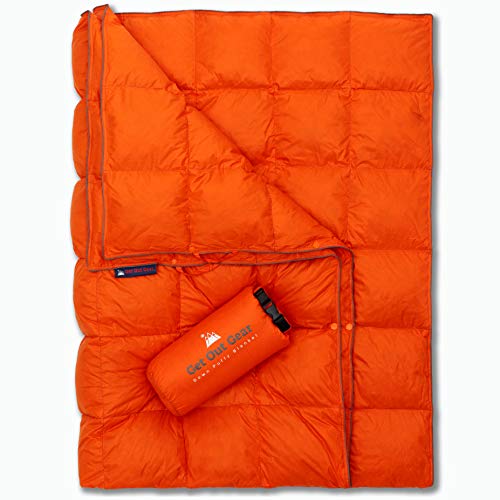
Get Out Gear Down Camping Blanket 650 Fill — Best Down Pick
Here is the reference point against which the synthetics below must argue. The Get Out Gear blanket uses genuine down at 650 fill power, the middleweight sweet spot where loft, compressibility and cost stop fighting one another. Down at this quality traps warmth in a structure of clusters rather than fibres, so the quilt feels airy rather than dense, wraps a sleeper or a sleeping bag without the stiff resistance of synthetic batts, and then crushes down into a fraction of its working volume when the stuff sack drawcord closes. For a hiker extending a three-season bag into colder nights, that compression is the entire proposition.
The waterproof positioning in its verified listing deserves a precise reading: shell fabrics resist the moisture of dew, tent condensation and damp grass, which is the water a careful down user actually encounters. Rivers and downpours remain down’s enemies, and this blanket asks for the standard discipline — a dry bag inside the pack, airing at lunch stops, never storing it compressed at home. Obey those habits in a mostly dry climate and it rewards you with the warmest sleep per gram in this guide. Ignore them in a wet one and the covacure further down becomes the wiser purchase, a trade this review states plainly rather than apologising for later.
- Insulation: down, 650 fill power
- Role: sleeping-bag booster or summer stand-alone quilt
- Shell: water-resistant finish for dew and condensation
- Packing style: high compression in a stuff sack
- Also suited to hammocks, travel and festival camping
- Storage rule: hang or store loose at home, never compressed
Strengths
- Real down loft delivers the guide’s best warmth relative to weight
- Compresses small enough to disappear into a crowded pack
- Drapes softly over a bag without the board-like feel of batts
Trade-offs
- Wet down insulates poorly until thoroughly dried
- Demands dry-bag discipline and loose home storage
- Premium positioning within this line-up’s price tiers
Best for: weight-conscious hikers in dry-to-mixed climates topping up a sleeping bag. Not suited for: trips where rain is a daily appointment rather than a risk.
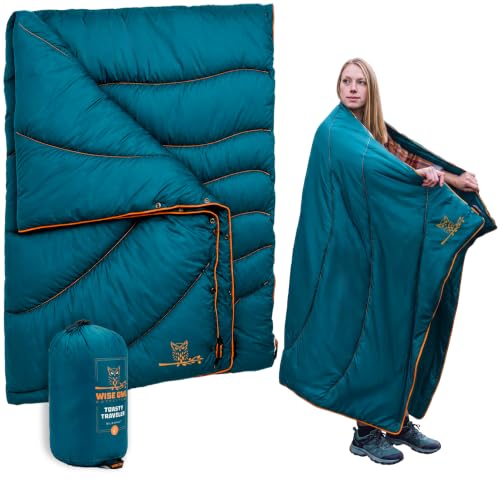
Wise Owl Outfitters Camping Blanket — Best Campsite Versatility
Wise Owl borrowed the woobie — the military poncho liner soldiers have prized for generations — and rebuilt it as a puffy camping quilt, and the ancestry shows in its priorities. Unfolded, it spreads to six and a half by four and a half feet, generous coverage for a sleeper or a pair of laps around a fire. Quick-snap clasps and tie-down loops then start earning their keep: snapped, the blanket becomes a poncho for the cold walk to the water tap; looped, it hangs as a windbreak, an under-hammock layer or a draft-stopper across a tent door. Few items in a pack work this many jobs.
The insulation is synthetic and water-resistant in outlook, which suits the blanket’s improvisational life. A layer destined to be sat on, worn and hung outdoors should not be the one whose fill collapses when damp, and Wise Owl’s design accepts a little extra packed bulk in exchange for that robustness. Around camp it is simply the blanket people reach for, the one that lives outside the tent during waking hours. Backpackers walking short distances to settled camps will love it; through-hikers counting grams for a four-figure mileage will admire it and choose something leaner.
- Open size: 6.5 x 4.5 ft
- Style: woobie-inspired puffy quilt
- Hardware: quick-snap clasps for poncho conversion
- Tie-down loops for hammock and shelter improvisation
- Shell character: water resistant for outdoor camp use
- Best habitat: base camps, short carries, group trips
Strengths
- Poncho conversion multiplies its usefulness beyond sleeping hours
- Loops and snaps invite creative shelter problem-solving
- Synthetic build shrugs off damp grass and morning dew
Trade-offs
- Packs bulkier than the down options here
- Generous size is more blanket than a minimalist wants to carry
- Hardware adds small weight that pure sleep quilts omit
Best for: campers who spend waking hours outdoors and want one layer for all of them. Not suited for: ultralight purists trimming toward a sub-five-kilo base weight.

iClimb 3M Thinsulate Ultralight Blanket — Best Ultralight
One pound. The iClimb’s verified listing leads with that figure because, for its intended buyer, nothing else about a blanket matters until the scale has spoken. The insulation is 3M Thinsulate, a branded synthetic microfibre engineered to trap heat in a thin batt, which is how the blanket stays warm-ish and genuinely tiny in the pack rather than warm and hypothetical. In dark grey, sized and priced as an ultralight specialist, it addresses the hiker who has already sawn the handle off the toothbrush and is auditing the sleep system for the next hundred grams.
Honesty about limits matters here. A one-pound blanket is a summer layer, a bag booster and an emergency wrap; it is not a winter sleep system, and using it as one in cold mountains would be a planning failure rather than a product failure. Within its brief it excels — fast hikers covering long daily distances in mild seasons, bikepackers whose luggage volume is brutally small, travellers who want a real blanket for trains and hostels that vanishes into a daypack afterwards. Synthetic fill also means a wet night degrades it gracefully instead of catastrophically.
- Weight: 1 lb as listed
- Insulation: 3M Thinsulate synthetic microfibre
- Colour: dark grey
- Packing style: ultralight, highly compact
- Season brief: summer layer and sleeping-bag booster
- Audience: gram-counters, bikepackers, fastpackers
Strengths
- The lightest verified option in this guide by a clear margin
- Branded insulation with predictable, even performance
- Damp conditions reduce its warmth gradually, not suddenly
Trade-offs
- Insufficient alone for cold nights in the hills
- Thin batt offers little cushioning or luxury feel
- Compact dimensions may leave tall sleepers under-covered
Best for: ultralight hikers in warm seasons who measure gear in grams. Not suited for: anyone seeking a single blanket for year-round mountain use.

ROSE FEATHER Down Camping Blanket — Best Large Down Quilt
Size is this down blanket’s argument: fifty-five by seventy-nine inches of puffy quilt, large enough to tuck around a sleeper properly or to serve two people on a picnic rug’s worth of grass. Where the Get Out Gear reads as a precision booster for a sleeping bag, the ROSE FEATHER behaves like a portable duvet, and in mild weather it can replace a sleeping bag outright for campers who sleep hot or dislike a bag’s confinement. The verified listing describes a waterproof, packable build aimed at travel as much as trails, and that breadth shows in the proportions.
Down discipline applies with the usual force — keep it dry, air it when the sun appears, store it lofted — and the larger panel simply gives you more blanket to manage in a small tent. In return, couples camping together gain a shared layer that two narrow quilts never quite replicate, and solo campers gain the particular luxury of excess fabric on a cold morning. The blue colourway photographs beautifully against autumn ground, a trivial point until a blanket becomes the backdrop of half a trip’s pictures.
- Open size: 55 x 79 inches
- Insulation: down, puffy quilt construction
- Shell positioning: waterproof and packable
- Role: mild-weather sleeping-bag alternative
- Sharing: sized for two around camp or at picnics
- Care: standard down rules — dry storage, regular airing
Strengths
- Largest down coverage in this line-up
- Can stand alone as the sleep layer in warm conditions
- Doubles naturally as a shared picnic and travel blanket
Trade-offs
- More fabric to keep dry inside a small tent
- Oversized for a solo minimalist’s sleep system
- Down’s wet-weather weakness applies at full scale
Best for: couples and comfort-first campers in mild, mostly dry weather. Not suited for: solo ultralighters who resent every spare inch of fabric.

Arcocharm Camping Blanket Ultralight — Best Weatherproof Shell
Arcocharm built its blanket around the shell rather than the fill: waterproof and windproof, three-season, packable, in a green that belongs outdoors. That emphasis suits a specific and common misery — the exposed rest stop, the hammock afternoon when the breeze finds every gap, the stadium evening — where moving air, not low temperature, steals the warmth. A windproof layer changes the physics of sitting still outside, and this blanket’s ultralight positioning means it can live in a daypack permanently against that moment.
As a sleep layer it plays a supporting role, adding a weatherproof skin over a bag or another blanket and shrugging off the condensation that rains gently inside hard-working tents. Hammock campers will recognise the value immediately: wind strips heat from beneath a hammock, and a windproof wrap answers it. The blanket’s versatility across picnics and sporting events also makes it the easiest pick here to justify to a household that camps six nights a year and sits on cold benches for thirty.
- Shell: waterproof and windproof
- Season brief: three-season use
- Packing style: ultralight, packable
- Colour: green
- Strong roles: hammock wrap, stadium blanket, shell layer
- Also suited to picnics and exposed rest stops
Strengths
- Windproofing solves the chill that insulation alone cannot
- Waterproof shell tolerates wet ground and tent condensation
- Light enough to justify permanent residence in a daypack
Trade-offs
- Shell-first design offers modest insulation by itself
- Weatherproof fabrics can feel less soft against skin
- Works best layered, so cold sleepers still need a warm core
Best for: hammock campers and anyone whose cold comes with a breeze attached. Not suited for: shoppers wanting one thick, lofty blanket to do everything alone.

covacure Packable Down Alternative Camping Blanket — Best Wet-Weather Synthetic
The covacure is the pragmatist’s answer to the down question: a packable puffy quilt, fifty-seven by seventy-eight inches, filled with down-alternative insulation and finished to a waterproof brief, with snap buttons that let it wrap and stay wrapped around a moving person. Synthetic fill keeps a meaningful share of its insulation when damp, dries in hours rather than days and asks for no special storage ritual at home beyond a shelf. For humid climates and trips planned around a forecast that keeps using the word unsettled, those are not minor conveniences; they are the trip going well.
Wearability lifts it further. Snapped around the shoulders it becomes the layer you cook in, filter water in and watch weather from the tent door in, and every hour of waking use is an hour in which its carried weight is paying rent twice. The blue shell and generous cut also make it a credible travel blanket for long-haul journeys where cabin temperatures swing. It concedes the gram contest to down cheerfully and wins the argument about Tuesday’s rain.
- Open size: 57 x 78 inches
- Insulation: down-alternative synthetic fill
- Shell positioning: waterproof, blocks wet weather
- Hardware: snap buttons for wearable wrapping
- Colour: blue
- Home storage: undemanding; no loft-preserving ritual required
Strengths
- Keeps insulating when damp and dries comparatively quickly
- Snap-on wearability earns its weight during waking hours
- Forgiving care suits beginners building their first kit list
Trade-offs
- Heavier and bulkier than down for equivalent warmth
- Synthetic loft gradually flattens across years of compression
- Less luxuriously soft drape than a down quilt
Best for: damp climates, uncertain forecasts and new backpackers wanting low-maintenance kit. Not suited for: dry-climate gram counters chasing the smallest possible stuff sack.
Comparison Table
| Pick | Insulation | Open size / weight note | Standout trait |
|---|---|---|---|
| Get Out Gear Down Camping Blanket 650 Fill | Down, 650 fill | Highly compressible | Warmth-to-weight leader for dry trips |
| Wise Owl Outfitters Camping Blanket | Synthetic puffy | 6.5 x 4.5 ft | Poncho snaps and tie-down loops |
| iClimb 3M Thinsulate Ultralight Blanket | Thinsulate synthetic | 1 lb | Lightest verified option here |
| ROSE FEATHER Down Camping Blanket | Down | 55 x 79 in | Largest down coverage, shareable |
| Arcocharm Camping Blanket Ultralight | Shell-focused fill | Ultralight, packable | Waterproof, windproof outer |
| covacure Packable Down Alternative Camping Blanket | Down alternative | 57 x 78 in | Snaps, waterproof brief, damp-proof fill |
Down or Synthetic: Which Insulation Survives Your Route?
The textbook contrast is simple. Down’s clusters create more still air per gram than any synthetic fibre yet manufactured, so a down quilt reaches a given warmth lighter and smaller. Synthetic batts, built from crimped polyester fibres, carry more mass for the same loft but keep their structure when wet, because the fibres themselves do not absorb water and collapse the way soaked clusters do. A drenched down blanket is a cold, heavy regret; a drenched synthetic is a diminished but functioning blanket that a windy lunch stop can partly restore.
Climate should cast the deciding vote, weighted by trip length. A weekend in a reliably dry range favours down even if one shower passes through, because the blanket can be aired and the trip ends before cumulative damp wins. A week in a maritime climate reverses the logic: condensation alone, night after night, gradually loads any insulation with moisture, and synthetic’s tolerance compounds like interest. Short trips forgive; long wet trips audit.
One refinement separates experienced route-planners from the rest: they ask not how wet the climate is on average, but how many consecutive nights the blanket must survive without a real drying opportunity. A single damp night is an inconvenience any fill shrugs off by morning. Four damp nights in a row, each adding condensation to the last, is a cumulative siege in which down’s loft ebbs steadily while synthetic’s merely dulls. Count the longest wet stretch your itinerary can plausibly impose, then choose the fill that is still working at the end of it, rather than the fill that was superior on the first evening.
Care infrastructure at home is the third factor nobody lists. Down wants loose storage, occasional lofting and patient drying; synthetic tolerates a stuff sack in a cupboard and a hot wash after a muddy festival. Renters with no storage space and beginners with no routines should count those realities as specifications, because the best insulation is the one still performing in year three of your actual life, not the one that won a laboratory comparison.
How Much Weight Should a Backpacking Blanket Be Allowed?
Frame the question as a percentage rather than an absolute. In a considered lightweight kit, a blanket serving as the primary sleep insulation might reasonably occupy a tenth of base weight; as a booster layered over a bag, it should argue for half that. The iClimb’s single pound passes almost any audit. A two-pound puffy quilt must demonstrate — through poncho duty, shared use or genuine cold margins — that it displaces something else or prevents a miserable night, which is simply another kind of weight saving.
Packed volume can disqualify what weight permits. A blanket that compresses to the size of a loaf forces food into worse places or pushes the pack up a size class, and a larger pack weighs more before anything enters it — the quiet spiral gram-counters call weight creep. Test compression at home with the actual stuff sack, inside the actual pack, alongside the rest of the sleep system. Marketing photographs of a hand pressing a quilt flat tell you nothing about the third morning’s reality.
Weight distribution inside one pack matters as much as the total. A blanket is dense, soft ballast: packed against the back panel it stabilises a load, while stuffed at the top it turns the pack into a periscope that catches branches and doorframes. Groups dividing shared kit should weigh each person’s total rather than counting items, because three light-looking soft goods can outweigh one compact tent. The blanket, being divisible in bulk if not in function, is often the balancing item that equalises two walkers’ loads at the trailhead — a small logistics role it performs before it has warmed anyone at all.
Shared carrying changes the arithmetic for couples and groups. One generous blanket split between two packs, or carried by the stronger walker, can deliver more communal warmth per gram than two individual layers, which is the quiet case for the larger down and synthetic quilts in this guide. Groups should also consider who carries the shared layer on the day someone is struggling; warmth, like water, occasionally needs redistributing.
How Do You Layer a Blanket With a Sleeping Bag?
Order matters. A blanket draped over a sleeping bag adds its loft to the bag’s and protects the bag’s insulation from tent condensation, which is why boosters live outside. The same blanket inside the bag compresses under the sleeper’s movement and mostly adds friction. Leave the bag’s hood and draft collar functional — a blanket should supplement the system, not smother its designed closures — and expect the combination to extend comfort meaningfully below the bag’s solo rating, though never by a number anyone should carve into a trip plan for a genuinely cold night.
Feet deserve a specific mention in any layering plan, because they sit at the blanket’s far edge, hold the least circulation of any part of a resting body and complain first. Tucking the blanket’s end beneath the feet, wearing the sleep socks you packed for exactly this purpose, or folding a double thickness at the bottom of the quilt all redirect warmth to where the night is actually lost. Many campers who believe their blanket underperforms discover, after one evening of deliberate foot management, that the insulation was adequate and the geometry was not.
Moisture management is the layering skill. On the coldest nights your breath and body vapour migrate outward and can condense in the outermost layer, which is one more reason the outer layer being synthetic or shell-protected is clever in deep cold. In milder conditions the blanket alone suffices and the bag stays home, saving its loft from compression cycles. Rotating configurations across a season — blanket only, bag only, both — is the mark of a sleep system being used as a system.
What Are the Most Common Mistakes When Buying Backpacking Blankets?
Judging warmth by thickness in a shop photograph leads the list; loft under no compression looks generous on camera and tells nothing about fill quality. Second comes ignoring the packed dimensions and discovering, at the trailhead car, that the new blanket consumes the space allocated to food. Third, buyers choose down for a famously wet range because a review praised its weight, then spend the trip nursing a quilt that never quite dries — a mismatch of product to place that no brand quality could have prevented.
There is a sizing cousin to those errors worth naming separately: buying a blanket sized for a photograph rather than a body. A quilt that reaches a model’s chin in a listing image may reach a six-foot sleeper’s ribs. Check the open dimensions against your own height plus the tuck you expect at the feet, and remember that diagonal sleeping, hammock curves and shared use all consume length that the tape measure promised on paper.
Fourth, people buy a blanket to rescue an inadequate sleeping bag on a winter trip, a role blankets cannot safely play at genuine altitude cold. Fifth, they store a new quilt compressed all year and wonder why its second season feels thinner. And sixth, they overlook the humble stuff sack: a blanket without a compression sack, or carried in one that is not waterproof on a wet route, arrives at camp pre-compromised. Each mistake is cheap to avoid at the ordering stage and expensive to forgive at altitude.
How Should You Care for a Trail Blanket at Home?
Storage decides lifespan more than washing does. Down and quality synthetics alike want to rest uncompressed — a large cotton storage sack, a wardrobe shelf, the top of a cupboard — so their fibres and clusters spend fifty weeks a year lofted for the two weeks that matter. The stuff sack is a transport device, not a home. A blanket stored crushed arrives at its second season measurably flatter, and no amount of shaking fully reverses a year of compression.
Repairs on the trail follow a hierarchy of improvisation. A torn shell leaks fill and invites worse tearing, so it gets patched first — adhesive repair tape from the first-aid kit, a spare buff bandaged around the wound, even a safety pin closing the gap until home. A failed snap or loop is an inconvenience to note, not a crisis. Knowing which damage is urgent and which is cosmetic keeps a small accident from becoming the story of the trip, and a blanket, being all surface and no mechanism, is among the most field-repairable items in the pack.
Wash rarely, and then properly. Trail blankets collect less filth than their owners fear; spot-cleaning shells and airing insulation after each trip handles most of it. When a full wash comes, use a large machine, a gentle cycle and the detergent type the fill requires, then dry longer than seems necessary — down especially hides damp in its clusters long after the shell feels dry. A clean, fully dry, loosely stored blanket is the entire maintenance religion; everything else is commentary.
How Do You Judge Warmth When Blankets Refuse to Carry Ratings?
Sleeping bags speak in temperature ratings, however imperfectly standardised; blankets mostly speak in adjectives. The translation skill is to convert construction into expectation. Fill type and fill power describe down honestly, because a higher fill power lofts more per gram. Fill weight — how much insulation is actually inside — is the figure listings most often omit and the one that separates a genuinely warm quilt from a photogenic one. When a maker publishes fill weight alongside dimensions, you can compare warmth across brands with something approaching rigour; when they publish neither, assume the blanket is a summer layer until evidence suggests otherwise.
Shell fabric quietly modifies whatever the fill promises. A windproof shell preserves loft’s still air on exposed ground, while a highly breathable shell dumps warmth in a breeze but feels pleasanter against skin in a stuffy tent. Baffle construction matters in down quilts: sewn-through seams create cold lines along every stitch, while boxed baffles let clusters expand fully at the cost of weight and price. Most blankets in this class use simpler construction, which is one more reason their honest territory is boosting and mild weather rather than deep cold.
The field test you can run at home is crude and useful. Drape the blanket over your legs on a cool evening outdoors and sit still for twenty minutes; stillness is the real condition, since movement generates the heat that flatters thin insulation indoors. Note where cold arrives first — usually the edges and the feet — and whether the blanket’s size lets you seal those leaks by tucking. A blanket that passes the garden test at a temperature near your planned trip’s lows has told you more than any adjective in its listing.
What Changes for Hammock Campers?
A hammock rewrites the insulation problem because air circulates beneath the sleeper, stripping heat from below in a way a ground mat never permits. Blankets answer in two positions. Draped above as a top quilt, a backpacking blanket behaves much as it does on the ground, with the advantage that a hammock’s cocoon reduces the drafts that plague quilts on open ground. Slung underneath or wrapped around the hammock’s exterior, a windproof model like the Arcocharm fights the convective loss directly, functioning as a poor person’s underquilt with honourable results in mild weather.
Tie-down loops and snaps, decorative on a picnic lawn, become structural here. The Wise Owl’s loops let it hang where you position it rather than where gravity prefers, and snapped configurations stay closed when a sleeper turns. Hammock users should nevertheless respect the ceiling of the approach: in genuinely cold air, a dedicated underquilt with shaped insulation outperforms any flat blanket, and the blanket returns to its proper role as the top layer and camp wrap. Knowing which nights belong to which system is the difference between a versatile kit and an optimistic one.
Condensation behaves differently aloft, too. A sleeper’s moisture has fewer cold surfaces to settle on, but a blanket wrapped tightly around a hammock’s outside can trap damp against the hammock fabric. Air the whole assembly whenever morning sun offers the chance, a two-minute ritual that preserves loft and prevents the slow souring that overtakes neglected camp textiles by a trip’s fourth day.
How Should Couples and Groups Share Blanket Warmth?
Two sleepers under one large quilt share more than fabric; they share a microclimate, and body heat pooled under a single layer is genuinely warmer than the same bodies under separate thin ones. That physics argues for the big down and synthetic quilts when a couple’s sleep system is planned together, with the caveat that every turn by one sleeper drafts the other, and a restless partner can convert a shared blanket into a nightly negotiation. Many couples compromise: shared blanket around camp and for the evening, individual bags or quilts for sleep itself.
Groups gain a different efficiency. One substantial blanket in a communal kit serves as the emergency layer, the vehicle blanket on the drive home, the wrap for whoever underestimated the evening, and the picnic base at lunch. Carried by rotation or by the freshest legs, its weight distributes socially in a way personal gear cannot. Scout troops, festival crews and family camps exploit this constantly, usually with a synthetic like the covacure whose care demands survive being everyone’s property.
Children alter sharing calculations in the direction of redundancy. A child who kicks off a shared blanket at midnight has no reserve, so family systems work better with a dedicated child’s layer plus the communal one. The weight penalty is real and worth paying; few trip memories sour faster than a cold, awake five-year-old at altitude, and few pieces of kit earn gratitude as reliably as the spare blanket produced at exactly that moment.
What Should a First-Time Buyer Actually Order?
Start from your next three trips, not your dream expedition. A beginner whose realistic calendar holds summer valley camps and one autumn weekend needs a forgiving synthetic or a mid-range down quilt, sized generously, and will use it constantly. The same beginner ordering for a hypothetical winter traverse buys a specialist tool that sits in a cupboard while the trips that actually happen go under-equipped. Gear bought for the life you are living gets used, learned from and eventually upgraded intelligently; gear bought for an imagined life teaches nothing.
Budget a place in the pack as seriously as money. Measure the void left by your current sleep system, tent and food, then let that volume veto candidates before affection forms. Beginners consistently overestimate how much a soft item will compress, so choose the blanket that fits the measured space with room to spare. The discipline feels joyless in a shopping basket and wonderful at a trailhead.
Finally, buy the care routine along with the blanket. If loose storage for down does not exist in your home, the synthetic is not the lesser choice — it is the correct one, and choosing it knowingly is expertise rather than compromise. The hikers whose kits look battered and perfect after five seasons are rarely the ones who bought the laboratory winner; they are the ones who matched product to climate, storage and habits, which is the entire argument of this guide in one sentence.
How Do Travel and Festival Use Stretch the Same Blanket?
Off the trail, the virtues reorder themselves. A travel blanket lives in trains, budget flights and hostel bunks, where packed size still matters but the enemies become air-conditioning, unfamiliar bedding and other people’s laundry standards. Down quilts excel as personal cocoons in that world, provided the traveller guards them from rain in transit. Synthetics tolerate being washed in a hostel sink and dried over a railing by morning, a rhythm long-term travellers on damp continents will recognise as decisive.
Festivals reward the blanket that can be sat on, worn and slept under across one muddy weekend, then washed without ceremony on Monday. That is synthetic territory, and the snap-wrapped covacure or the poncho-ready Wise Owl reads as if designed for it. A down blanket at a festival is a jewel at risk; it will survive in careful hands and suffer in the general exuberance, and its owner should decide honestly which sort of festival theirs is.
Stadium and picnic use, humble as it sounds, is where many of these blankets will spend most of their working lives, and there is no shame in optimising for it. The Arcocharm’s windproof shell was practically invented for a cold terrace. A blanket that serves forty evenings a year close to home has outperformed, in honest utility, a specialist quilt used twice — a perspective worth keeping when the ultralight option tempts you toward a narrower tool than your life requires.
When Is a Blanket the Wrong Tool Entirely?
Cold is the obvious boundary. Below the temperatures where a bag’s hood, sealed baffles and under-insulation become survival equipment rather than comfort, a blanket layered hopefully on top is decoration on a planning error. Winter mountaineering, high-altitude autumn and any trip where a failed night carries medical risk belong to rated sleeping systems, full stop. This guide’s picks are honest tools for the three-season world and should be honoured by being kept inside it.
Weight-critical travel on foot over very long distances forms the second boundary. Through-hikers eventually migrate to specialised quilts with footboxes, differential cuts and every seam audited, because at two thousand miles the generalist blanket’s small inefficiencies compound into kilograms of consequence. The blankets here serve the first hundred miles of that journey beautifully, as training, testing and companions, and many hikers keep them for life as car and camp blankets after graduating to specialist sleep gear.
Recognising the boundary is not a criticism of the category; it is what makes the recommendations inside it trustworthy. A guide willing to say where its products stop working is a guide whose enthusiasm elsewhere can be believed — and within their territory, which covers most camping most people actually do, these six blankets cover the ground thoroughly.
How Do You Pack a Blanket So It Arrives Lofted?
Stuff, do not roll, is the first rule for insulated quilts: stuffing distributes compression randomly through the fill, while rolling creases the same lines trip after trip and teaches the insulation to fold rather than loft. Push the blanket into its sack in handfuls, working air out as you go, and let a compression sack’s straps do the final persuading rather than sitting on the bundle and stressing seams. The sack then rides low and central in the pack, close to your back, where dense soft items carry most comfortably.
Waterproofing the packing is a separate decision from waterproofing the blanket. A dry bag or a heavy liner inside the pack protects down absolutely and synthetics sensibly, and it should be treated as part of the sleep system rather than an accessory. River crossings, multi-day rain and the simple accident of a pack set down in a puddle all happen to somebody every season; the hiker whose insulation stayed dry experiences them as anecdotes instead of emergencies.
At camp, unpack early. A quilt released from compression when the tent goes up has an hour to recover loft before it is asked to perform, and a gentle shake accelerates the reunion of fill with air. In the morning, reverse the courtesy: leave the blanket draped over the tent or a branch while you breakfast, so overnight moisture leaves before the stuff sack seals it in for the day’s walk.
What Do the Numbers on a Stuff Sack Really Tell You?
Litres are the honest currency of packed size, and they expose comparisons that adjectives hide. A blanket compressing to a few litres behaves like clothing in the pack; one demanding three times that volume behaves like a second shelter. When a listing omits compressed volume, the insulation type and open dimensions let you estimate it — down at these sizes packs smallest, lofty synthetics largest — but treat the estimate as a ceiling on your enthusiasm rather than a fact.
Weight figures deserve the same forensic reading. Some listings quote the blanket alone, others the blanket in its sack with straps and buckles, and the difference can swallow the margin between two close candidates. Weigh the whole travelling assembly at home on kitchen scales and write the true figure on the sack with a marker. That small act of honesty, repeated across a kit list, is how experienced hikers’ base weights stay honest while everyone else’s mysteriously grow between the spreadsheet and the trailhead.
How Does Altitude Change the Blanket Equation?
Temperature falls predictably as you climb, and nights at altitude routinely undercut the forecast a valley town provided. A blanket chosen for the campsite’s elevation rather than the trailhead’s weather report avoids the classic error. Altitude also dries the air, which flatters down: high, cold and arid is precisely the environment where down’s warmth-to-weight supremacy is unchallenged, provided storms are managed. The same altitude punishes dehydration and poor sleep, so the marginal comfort a blanket adds can matter more to the next day’s legs than its gram count suggests.
Ultraviolet exposure intensifies aloft as well, and shells fade and weaken faster under mountain sun during those virtuous morning airings. Keep airing brief at altitude, favour shade, and remember that a shell’s water resistance degrades with ultraviolet and abrasion long before the fill gives out. A blanket’s working life in the high country is measured in seasons of careful handling, not in years of cupboard time.
Why Do Experienced Hikers Keep a Blanket After Upgrading?
Ask a veteran’s gear cupboard and a pattern emerges: the specialist quilt handles expeditions, while the generalist blanket from their early kit never actually leaves service. It warms the car boot in winter, covers guests on the sofa bed, rides to picnics and beach evenings, and stands ready as the loaner for a friend being introduced to camping — a role no one entrusts to a fragile, expensive specialist. Durability across that second career is where synthetic fills quietly win their long argument with down.
There is also a testing function. New routes, new seasons and new companions all get rehearsed under the forgiving blanket before the expensive system is committed, because its failure modes are gentle and its replacement cost is a shrug. Gear that teaches without punishing has a value no specification table captures, and it is why this guide resists sneering at the versatile middle of the category. The blanket you buy first, chosen well, is rarely the blanket you retire; it is the blanket everything else gets measured against.
Final Recommendation
Match the insulation to your weather before matching anything else. Dry-climate walkers should take the Get Out Gear down quilt for its warmth-to-weight discipline, or the ROSE FEATHER when coverage and sharing matter more than the last gram. Anyone whose routes run wet should start with the covacure’s forgiving synthetic fill, hammock campers and the wind-exposed should add the Arcocharm’s shell, base-camp loungers will get the most life out of the Wise Owl’s poncho tricks, and the ultralight faithful already know the iClimb’s single pound is speaking directly to them. Weigh your current sleep system tonight, write the number down, and let that honest figure — not a photograph of loft — make the final call; a blanket chosen by arithmetic is the one still earning its place in the pack when the trail turns uphill, the light goes, and the temperature follows it down.
Frequently Asked Questions
Can a backpacking blanket replace a sleeping bag entirely?
In warm conditions, yes — summer lowland camping is exactly where large quilts like the ROSE FEATHER shine, freeing campers from a bag’s confinement. As temperatures fall toward a bag’s comfort rating, the blanket’s lack of a hood, draft seals and under-body insulation becomes decisive. Treat replacement as a fair-weather privilege and layering as the cold-weather plan.
How do I stop a quilt sliding off during the night?
Choose adequate width first; most sliding is really under-sizing. Tuck the blanket’s edges beneath the sleeping mat, use any snap or loop systems to close it around you, and layer it over rather than under a bag so friction works in your favour. Restless sleepers in cold conditions remain better served by a bag’s enclosed design.
Is down ever the right choice for a wet climate?
Occasionally — for experienced hikers with rigorous dry-bag discipline, short trips and reliable drying opportunities, down’s weight advantage can still win. The margin for error is thin, though, and one soaked night converts the saving into a liability. Beginners in wet regions should bank synthetic experience first.
What packed size should I aim for?
Let your pack arbitrate. The blanket should compress into the space your food and sleep system leave, typically a modest stuff sack rather than a dominant share of the main compartment. If a candidate forces a larger pack, its true carried weight includes that upgrade — do the honest total before ordering.
How warm is a one-pound ultralight blanket, realistically?
Comfortable as a summer layer for most sleepers and valuable as a booster over a bag in shoulder seasons. It is not a cold-night primary insulation, and the iClimb’s appeal lies in knowing exactly that: minimum weight for a defined, limited job, executed without pretending to be a four-season solution.
Related Guides
The trail eventually leads back indoors, and the guides below follow the same fabrics into very different rooms — a nursery where softness outranks weight, and a living room where a blanket’s job is pure upholstery-grade comfort.
Continue with Best Sand-Free Beach Blankets for the other great outdoor blanket problem, detour through Best Affordable Down Blankets if the down discussion started an indoor project, or read Best Baby Blankets for Gifts for warmth measured in sentiment rather than grams. Pair this guide with Best Battery-Operated Pool Vacuums.



[…] the wider blanket shelf these pieces were drawn from, our guide to Best Backpacking Blankets follows the same stated-facts discipline across the packs-and-trails end of the category, including […]