What's inside
- Key Takeaways
- Quick Picks
- How Did We Choose the Best Blankets for Donations and Shelters?
- At a Glance: How Do the Six Packs Compare?
- What Do Shelters Actually Ask For When You Call?
- How Many Blankets Should a Drive Actually Buy?
- How Do You Run a Blanket Drive That Ends Well?
- How Well Do Bulk Fleece Blankets Survive Institutional Washing?
- How Do Disaster-Relief Blankets Differ From Ongoing Shelter Supply?
- How Do You Build an Outreach Kit Around a Blanket?
- Why Does Fleece Dominate Donation Blankets Instead of Wool or Cotton?
- How Should Blankets Be Handed Over on the Day?
- Which Blanket Suits Which Setting: Shelters, Care Homes, Families and Cars?
- How Should Purchased Blankets Be Stored Before Distribution Day?
- What Are the Most Common Mistakes When Buying Blankets to Donate?
- Final Recommendation
- Frequently Asked Questions
- Related Guides
As an Amazon Associate I earn from qualifying purchases. This post may contain affiliate links at no extra cost to you.
cottageverdict.com is reader-supported. When you buy through links on our site, we may earn an affiliate commission.
Where to buy: each bulk pack below links to its Amazon listing, where you can check price on Amazon and confirm the pack count, the blanket dimensions and the fabric weight before ordering. If you are buying for an organisation, confirm your delivery date against your distribution date with time to spare — a blanket drive has a fixed day, and freight does not care.
The best blankets for donations and shelters are not chosen the way blankets for a home are chosen, and this guide will not pretend otherwise. A blanket bought to be given away will be carried in a backpack, slept under in a hall, washed in an institutional machine, folded by volunteers, stored in a bin, and handed to someone whose name the buyer will never know. Its virtues are therefore practical ones: warmth that survives compression, a size that covers a person properly, fabric that tolerates hard laundering, and a pack format that lets a small budget cover as many people as possible. Softness matters — dignity is partly tactile — but it matters after those things, not before.
We write this guide for the people who actually run these purchases: the church group funding a winter drive, the office collecting for a shelter, the school parent organising a kit assembly, the individual who would rather buy twenty-four blankets than one more thing for their own house. The six packs below are all fleece, all sold in bulk counts from twelve to forty-eight, and they divide the territory honestly — standard throws, a compact size for outreach kits, a warmer sherpa-lined option, and quantities scaled from a small first drive to a large one.
One principle runs through every review and we will state it once, plainly: the person receiving the blanket deserves the same consideration as a customer. New blankets, clean blankets, blankets that will last the season — that is the standard. Everything in this guide is new and made for distribution; nothing here is a way to offload the contents of a linen cupboard at people with no choice in the matter.
Key Takeaways
- The standard donation throw is 50 by 60 inches — large enough to wrap an adult’s shoulders and lap, small enough to carry and store in bulk.
- Pack counts in this guide run from 12 to 48; match the count to your confirmed distribution, not to your optimism.
- Fleece dominates donation buying because it is warm for its weight, cheap to ship, and survives institutional washing that would ruin wool or cotton.
- Call the shelter before you buy. Their storage, laundry and client needs decide the right size and quantity better than any guide can.
- Assorted-colour packs are a quiet dignity feature: recipients can choose a colour, and choice matters.
- Order early enough to inspect one blanket from the pack before distribution day.
Quick Picks
| Pick | Badge | Why it earns its place |
|---|---|---|
| 24 Pack Bulk Fleece Throw Blankets 50 x 60 | Best All-Round Donation Pack | Twenty-four standard-size fleece throws in assorted colours — the default purchase for a first drive. |
| Trail Maker 24 Pack Microfiber Fleece Blankets 30 x 40 | Best for Outreach Kits | A compact 30-by-40 size that folds into care kits, car boots and backpacks for street outreach. |
| Trail Maker 24 Pack Plaid Sherpa Fleece Blankets | Best Warmth Per Blanket | Sherpa-backed throws for cold-climate distribution where warmth outranks compactness. |
| Shimeyao 24 Pack Fleece Throw Blankets | Best Shelter-Focused Pack | A 24-pack described by its maker for shelter donation, in standard size and fresh colours. |
| Buryeah 48 Pack Bulk Fleece Throw Blankets | Best Large-Drive Quantity | Forty-eight double-sided fleece throws for organisations distributing at real scale. |
| Hahafelt 12 Fleece Throw Blankets Bulk | Best Small-Drive Pack | Twelve lightweight throws with inspirational cards, sized for a first or personal-scale effort. |
How Did We Choose the Best Blankets for Donations and Shelters?
We judged these packs by the standards of the distribution table rather than the sofa. First came size honesty: a blanket offered to an adult sleeping rough or in a shelter bed must cover shoulders and torso together, which is why the 50-by-60-inch throw anchors this guide and the one smaller pack is recommended only where its compactness is the actual point — kits and outreach bags where a full throw physically does not fit. Second came fabric weight and construction, because a blanket that pills, thins or sheds its edges after three institutional washes is a promise broken on an instalment plan.
Third came the arithmetic of giving: pack count against realistic drives. Most first efforts distribute between a dozen and fifty blankets, and the packs here map onto that range without forcing a buyer to over-purchase into storage problems of their own. We also valued assorted colours more than a home buyer would, for a reason worth understanding — at a distribution, a person choosing the blue one over the red one is exercising a small, real preference in a day that offers them few. Packs that allow that choice do quiet, dignified work.
We also weighed something harder to specify: whether a pack’s blankets feel like a gift or like surplus. That quality lives in small things — colours a person might actually choose, a hand feel that does not announce its cheapness, edges finished well enough to survive being looked at closely. Donation buying is full of false economies, and the falsest is saving a small sum per blanket by choosing blankets that tell their recipients exactly how little they were thought to be worth. The packs here were held to a simple test: would you hand this, without apology or explanation, to someone whose respect you hoped to keep? Everything below passed it.
Finally, we considered the organisations between the buyer and the recipient. Shelters launder centrally, store in bins and hand out at doors; outreach teams carry limited weight on foot; kit assemblers need blankets that fold to a standard size. A pack that serves those logistics serves the recipient, because it is the pack that actually arrives, clean and on the day it was promised.

24 Pack Bulk Fleece Throw Blankets 50 x 60 — Best All-Round Donation Pack
This is the pack we would hand to someone organising their first blanket drive and asking, simply, what to buy. Twenty-four fleece throws, each the standard 50 by 60 inches, in an assortment of eight colours. The size covers an adult properly — shoulders, torso, lap — without the bulk that makes storage and transport miserable, and the count sits exactly in the range a small group can fund, carry and distribute in a single event without leftovers haunting a garage until spring.
The fleece itself is the familiar lightweight kind: soft on first touch, warm out of proportion to its weight, and indifferent to the washing machines it will meet. For shelter use that indifference is the whole game. A blanket that must be coddled will not be coddled; it will be washed hot, dried hard and returned to service, and fleece is the rare fabric that treats that regime as normal life rather than abuse. It also dries quickly, which in an institutional laundry is a form of availability — the blanket is back on a bed sooner.
The assorted colours deserve the emphasis given in our criteria. Eight colours across twenty-four blankets means a distribution table with something like choice on it, and it also means families can take distinguishable blankets, a small practical mercy in a shared room. The listing’s own framing spans weddings and events as well as homelessness outreach, which tells you the pack is a general bulk product rather than a specialist one — but for donation purposes its specifications are the right ones, and generality keeps its price honest.
Inspect one blanket on arrival: check the edging, shake it hard for shedding, and wash that one blanket the way the shelter will. If it passes, the other twenty-three can go out with confidence. That ten-minute ritual is the difference between organising a donation and merely forwarding a parcel.
- Pack count: 24 blankets
- Size: 50 x 60 inches each
- Material: fleece
- Colours: assorted, eight colours
- Care: machine washable and quick to dry
Strengths
- Standard size and count match the classic small-to-medium drive exactly
- Assorted colours restore a measure of choice at the distribution table
- Fleece tolerates institutional washing and drying without complaint
Trade-offs
- Lightweight fleece is a three-season warmth, not a deep-winter one
- General-purpose pack, so no shelter-specific extras are included
- Twenty-four may exceed a very small effort’s confirmed distribution
Best for: first drives, church and office collections, general shelter donation. Not suited for: extreme-cold distribution where insulated weight is the priority.

Trail Maker 24 Pack Microfiber Fleece Blankets 30 x 40 — Best for Outreach Kits
Size is this pack’s entire argument, and it is a good one in the right hands. At 30 by 40 inches these are not bed blankets; they are lap and shoulder blankets, the size that folds into a care kit alongside toiletries and socks, rides in a backpack without consuming it, and wraps a person sitting on a bench or a kerb in a way a bare coat does not. Street outreach teams, who carry everything on their backs and count every pound, are the natural buyers — a volunteer can carry six of these where two full throws would be the limit.
The fabric is a 160 GSM microfiber fleece, described as hypoallergenic, which matters in this context more than in a home: a blanket handed to a stranger should make as few assumptions about their skin as possible, and microfiber’s smooth, low-lint surface is a sensible default. The pack of twenty-four in assorted colours suits kit assembly lines, where the blankets are one component among many and uniformity of folded size keeps the packing sane.
The honesty paragraph is about expectations. Given as a primary blanket to someone sleeping outside, a 30-by-40 is not enough, and no organiser should let its convenient price-per-blanket arithmetic talk them into under-serving the people at the end of the distribution. Its dignity lies in being the right tool for its actual jobs: the kit, the car boot kept stocked for encounters, the waiting-room lap, the extra layer over a full blanket on the coldest nights. Bought for those jobs, it is excellent. Bought as a substitute for a real blanket, it is a false economy with a human cost.
Trail Maker sells this format explicitly toward donations and community outreach, and the sizing shows an understanding of that world — these are blankets designed to travel to people rather than wait in a linen cupboard for them.
- Pack count: 24 blankets
- Size: 30 x 40 inches each
- Material: microfiber fleece, 160 GSM
- Colours: assorted
- Care: machine washable
Strengths
- Compact folded size fits care kits, backpacks and car boots
- Light enough for outreach teams to carry in real quantity
- Hypoallergenic-style microfiber makes few assumptions about recipients
Trade-offs
- Too small to serve as a person’s primary sleeping blanket
- Thin fleece offers modest warmth on its own
- Easy to over-buy on price per blanket while under-serving the need
Best for: outreach kits, street teams and supplementary layers. Not suited for: primary blankets for people sleeping outside or in unheated shelters.

Trail Maker 24 Pack Plaid Sherpa Fleece Blankets — Best Warmth Per Blanket
When the distribution is in a cold climate and the blankets will be slept under in genuinely low temperatures, warmth stops being one criterion among several and becomes the criterion. This Trail Maker pack answers with sherpa: twenty-four throws at the full 50 by 60 inches, fleece on one face and a deep sherpa pile on the other, in plaid patterns. The sherpa traps still air against the body in a way flat fleece cannot, and the difference on a January night is not marginal — it is the difference between a blanket that takes the edge off and a blanket that actually keeps someone warm.
The plaid deserves a word beyond aesthetics. Patterned blankets show institutional life more kindly than plain ones: the inevitable marks of hard use and hard washing recede into the pattern, so the blanket looks respectable for longer in service. In a shelter, where a blanket may pass through many hands across a season, that staying-presentable quality is a form of dignity maintenance, and it costs nothing extra.
Warmth is bought with bulk, and the trade should be faced squarely. Sherpa throws fold larger, store larger and weigh more per blanket than anything else in this guide; a shelter with tight storage or an outreach team on foot should count that cost honestly. Drying is slower too, which an institutional laundry will feel across a full load. These are logistics, not flaws — but they decide whether this pack is the right one for a given organisation’s actual building and machines.
For the right setting — a cold-region shelter with proper storage, a winter drive timed for the hardest months, a distribution to people in vehicles or tents — this is the pack whose blankets will be remembered gratefully, because warmth at that level is remembered.
- Pack count: 24 blankets
- Size: 50 x 60 inches each
- Construction: fleece with sherpa reverse, plaid designs
- Colours: assorted plaids
- Care: machine washable; allow fuller drying time
Strengths
- Warmest blankets in this guide, suited to real winter distribution
- Plaid patterns keep blankets looking respectable through hard service
- Full standard size covers an adult properly
Trade-offs
- Bulkier to store, carry and dry than flat fleece packs
- Heavier per blanket — a consideration for teams distributing on foot
- More blanket than mild-climate or summer distribution needs
Best for: cold-climate shelters and winter drives where warmth leads. Not suited for: tight storage, foot outreach or warm-season distribution.
Shimeyao 24 Pack Fleece Throw Blankets — Best Shelter-Focused Pack
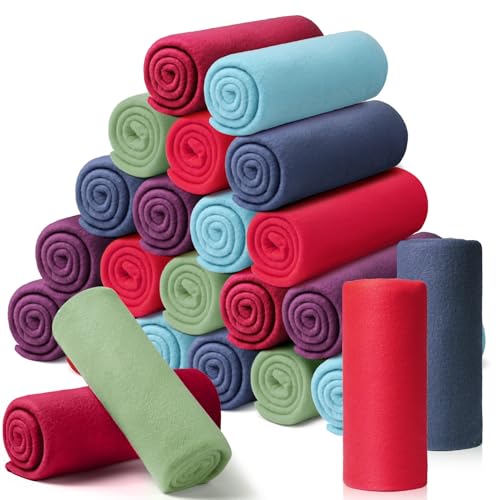
Some bulk packs are general products that happen to suit donation; this one names the purpose in its own description, speaking directly to homeless shelters and donation use, and that focus shows in the specification. Twenty-four throws at the standard 50 by 60 inches, soft lightweight fleece, in what the maker calls novel colours — a brighter assortment than the usual bulk palette. For an organiser buying specifically for a shelter rather than for mixed event use, there is a plain comfort in choosing the pack that was assembled with that destination in mind.
The lightweight character cuts the same way it does throughout this guide: easy to carry in quantity, quick through the laundry, compact in the shelter’s storage bins, and warm enough for indoor shelter sleeping and layered outdoor use rather than as a sole barrier against severe cold. Most shelter distribution is exactly that indoor case — a bed, a hall, a person who needs a blanket of their own — and for it, this weight of fleece is the rational standard rather than a compromise.
Colour, again, is not trivial. A brighter assortment on the distribution table changes the emotional temperature of the transaction; it looks like a gift rather than surplus. Organisers who have watched someone deliberate happily between a teal and a coral blanket understand that this is not decoration. It is the restoration, in miniature, of the ordinary pleasure of choosing your own things.
As with every pack here, order with inspection time in hand and wash a sample blanket hard before the rest go out. The Shimeyao’s shelter framing earns it the benefit of the doubt, not an exemption from the ritual.
- Pack count: 24 blankets
- Size: 50 x 60 inches each
- Material: fleece, lightweight
- Colours: assorted bright shades
- Care: machine washable
Strengths
- Assembled and described specifically for shelter donation
- Standard size in a light, storage-friendly fleece
- Bright colour assortment lifts the distribution experience
Trade-offs
- Lightweight warmth suits indoor shelter use more than severe cold
- Less established name than the bulk incumbents in this guide
- Same 24-count ceiling as the other mid-size packs
Best for: organisers buying expressly for shelter distribution. Not suited for: deep-winter outdoor distribution as the only layer.

Buryeah 48 Pack Bulk Fleece Throw Blankets — Best Large-Drive Quantity
Scale changes the buying problem, and this pack is for the organisations living at that scale: forty-eight fleece throws, 50 by 60 inches, double-sided, in eight bright colours, at a 150 GSM weight. A drive expecting a hundred people does not want to assemble its supply from five separate product listings with five delivery dates; it wants a quantity that arrives as one decision. The 48-pack is that decision, and its per-blanket economics improve on the smaller packs in the way bulk buying always rewards the organised.
Double-sided fleece is a small specification with real service implications: no wrong side means faster bed-making by volunteers, a slightly plusher hand feel for the recipient, and edges that present finished from either direction. Across a season of shelter use, those small efficiencies compound into hours of volunteer time returned to other work.
The cautions scale up too. Forty-eight blankets are a storage commitment before the event and a distribution commitment on the day — buy this count against confirmed numbers from the receiving organisation, not against hope, because a surplus of blankets in a volunteer’s garage helps nobody and quietly expires as goodwill. Freight and delivery timing also matter more at this size; split the order across two purchase dates if the supplier allows, so a single delayed shipment cannot strand the whole drive.
For the established annual drive, the school district collection, the company-wide effort — the buyers who already know their numbers — this is the pack that respects their competence and their budget in equal measure.
- Pack count: 48 blankets
- Size: 50 x 60 inches each
- Material: double-sided fleece, 150 GSM polyester
- Colours: eight bright colours
- Care: machine washable
Strengths
- Largest count here, with bulk economics to match
- Double-sided fleece speeds volunteer handling and bed-making
- Eight colours preserve recipient choice even at scale
Trade-offs
- A serious storage and distribution commitment — buy against confirmed numbers
- Single large shipment concentrates delivery risk
- Lightweight fleece, as throughout, is not a severe-cold solution
Best for: large, established drives with confirmed distribution numbers. Not suited for: first-time or small efforts unsure of their turnout.

Hahafelt 12 Fleece Throw Blankets Bulk — Best Small-Drive Pack
Not every act of giving is an organisation. This twelve-pack exists for the person, family or small circle whose scale is a dozen: the nursing-home visit at Christmas, the classroom that adopted a shelter family, the individual who keeps a few blankets in the car through winter for the people they pass. Twelve throws at 50 by 60 inches, a light 140 GSM fleece, and — the detail that defines the pack — inspirational cards included with the blankets.
The cards will divide organisers, and we will be honest about both readings. In a personal, relational context — a care home, a gift bag assembled by hand — a kind written message is part of the gift, and recipients in those settings often keep such cards long after the blanket has worn out. In a large, anonymous shelter distribution, cards can feel like the giver’s signature on someone else’s necessity, and many experienced organisations quietly remove them. The pack lets you decide; the blankets themselves are the same either way, and the right choice depends on the relationship between giver and receiver, which only the giver can judge.
At 140 GSM this is the lightest fleece in the guide, warm enough for indoor use and layering, and priced and sized for the personal scale it serves. It is not the pack for a shelter’s winter intake, and it does not claim to be. Its virtue is that it makes a complete, respectable unit of giving available to someone whose budget and car boot are both modest — because twelve people kept warmer is not a small thing merely because forty-eight is a bigger one.
- Pack count: 12 blankets
- Size: 50 x 60 inches each
- Material: fleece, 140 GSM
- Extras: inspirational cards included
- Care: machine washable
Strengths
- Right-sized for personal and small-group giving
- Cards suit relational settings like care homes and gift bags
- Full standard blanket size despite the small pack count
Trade-offs
- Lightest fleece here — indoor and layering warmth only
- Cards may not suit anonymous large-scale distribution
- Per-blanket value cannot match the larger packs
Best for: individuals, families and small groups giving at a dozen scale. Not suited for: shelter winter intake or large organised drives.
At a Glance: How Do the Six Packs Compare?
| Pack | Count | Size | Fabric | Best role |
|---|---|---|---|---|
| 24 Pack Bulk Fleece Throw Blankets 50 x 60 | 24 | 50 x 60 in | Fleece | All-round first drive |
| Trail Maker 24 Pack Microfiber Fleece Blankets 30 x 40 | 24 | 30 x 40 in | Microfiber fleece | Outreach kits and car boots |
| Trail Maker 24 Pack Plaid Sherpa Fleece Blankets | 24 | 50 x 60 in | Sherpa-backed fleece | Cold-climate warmth |
| Shimeyao 24 Pack Fleece Throw Blankets | 24 | 50 x 60 in | Fleece | Shelter-focused donation |
| Buryeah 48 Pack Bulk Fleece Throw Blankets | 48 | 50 x 60 in | Double-sided fleece | Large established drives |
| Hahafelt 12 Fleece Throw Blankets Bulk | 12 | 50 x 60 in | Fleece | Personal-scale giving |
What Do Shelters Actually Ask For When You Call?
Every experienced organiser gives the same first piece of advice, and it is not about blankets at all: call before you buy. Shelters’ needs are specific in ways no guide can guess. One has a new laundry contract and wants only blankets under a certain size for its machines. Another is full to the ceiling with throws but desperate for larger blankets for its family rooms. A third runs a no-storage facility where donations must arrive on the distribution day itself, counted and boxed. A five-minute call converts your purchase from a guess into a fulfilment, and it is the single highest-value step in this entire process.
Ask about size, quantity and timing in that order. Ask whether they prefer new-in-packaging — most do, for hygiene and dignity reasons, and all the packs in this guide arrive in a presentable state. Ask about colour only if you enjoy hearing a tired coordinator laugh gently; shelters care about warmth, washability and count, and the colours are for the recipients, not the institution. And ask what else is needed, because the honest answer is sometimes socks, and the best donation is the one that matches the list rather than the donor’s original plan.
If you are donating as an individual without an organisation in mind, the same principle applies at smaller scale: local shelters, outreach teams and mutual-aid groups publish needs lists, and a dozen blankets delivered against a stated need are worth more than fifty delivered against an assumption. Generosity aimed is generosity multiplied.
How Many Blankets Should a Drive Actually Buy?
The arithmetic of a drive has three numbers, and confusing them is how blankets end up in garages. The first is the receiving organisation’s confirmed capacity — how many blankets they can distribute and store in the relevant window. The second is your realistic fundraising or budget reach, which is a fact about your group, not about the weather. The third is the pack arithmetic: the counts in which blankets are actually sold, which this guide maps from twelve to forty-eight. The purchase should be the smallest of the first two numbers, rounded to the packs that serve it — with one deliberate exception. A modest overage, held by the organisation itself as replacement stock for the blankets that will inevitably be lost, damaged or given to latecomers, is not waste; shelters expect attrition and plan for it when donors let them.
What organisers consistently advise against is the speculative surplus: buying beyond the confirmed number because the per-blanket price was tempting. Blankets are bulky, goodwill is perishable, and a group’s second drive is harder to fund when the first one’s leftovers are still visible in a corner. Buy the confirmed number well — good blankets, inspected, delivered on the agreed day — and let a clean success recruit the next drive’s donors.
Timing belongs in the arithmetic too. Winter drives should be purchasing in autumn, when stock is deep and delivery is calm, rather than in the first cold week of December when every group in the country has the same idea at once. The blankets are identical; the experience of acquiring them is not.
How Do You Run a Blanket Drive That Ends Well?
Start with the receiving organisation and the date, and work backwards. Fix the distribution day with the shelter, set your purchase deadline two weeks before it, and your fundraising deadline two weeks before that. The two-week inspection buffer is the step amateur drives skip and regret: it is when the sample blanket gets washed, when a short shipment gets corrected, when the count gets reconciled against the promise while there is still time to fix every one of those problems quietly.
On the practical side, plan the unglamorous logistics with the same care as the purchase. Blankets in these pack sizes arrive in large boxes; someone needs a vehicle, a dry storage corner and a plan for distribution day that covers who carries, who counts and who photographs — with the recipients’ privacy treated as absolute. No one’s worst month should become a group’s publicity material without their clear, unpressured consent, and the drives that understand this are the ones shelters welcome back.
Close the loop afterwards. Report to your donors what was bought, what it cost in total, when it was delivered and what the organisation said it needed next. That report is not administration; it is the seed of the second drive. Groups that close the loop find that giving, like warmth, is a renewable resource when it is handled with a little structure.
How Well Do Bulk Fleece Blankets Survive Institutional Washing?
This is the technical heart of donation buying, because a shelter blanket’s life is measured in laundry cycles. Institutional machines wash hotter, spin harder and run more often than domestic ones, and fabrics reveal their character quickly under that regime. Fleece’s virtues here are structural: it is a knitted synthetic that does not shrink, does not felt, holds its edges without fraying, and dries in a fraction of the time a cotton or wool blanket needs — which, across hundreds of cycles, is also an energy and availability argument that facility managers understand instinctively.
The failure modes to inspect for are pilling, thinning at the fold lines, and edging that separates from the body of the blanket. A sample wash — genuinely hard, the way the shelter will do it — exposes all three tendencies early enough to change a purchase. GSM, the fabric weight figures quoted in several listings here, is a rough guide to starting substance: the 140-to-160 GSM range of these packs is the light-to-mid territory appropriate for throws, with the understanding that construction quality matters as much as the number.
Sherpa asks for one adjustment: its pile mats gradually under very hot, hard regimes, trading loft for a flatter warmth over a season. It remains the warmest start, and for a single winter’s distribution that trade is usually right — but a shelter buying for multi-year service may rationally prefer flat fleece’s slower decline. As always in this guide, the correct answer belongs to the specific building, machines and season in front of you.
How Do Disaster-Relief Blankets Differ From Ongoing Shelter Supply?
It is worth separating two kinds of giving that are often confused, because they buy differently. Ongoing shelter supply — the subject of most of this guide — is a relationship: a known organisation, a known laundry, a replenishment rhythm, and blankets chosen for durability across a season of service. Disaster relief is an event: a flood, a fire, a sudden cold snap, hundreds of people in a hall tonight, and blankets whose first job is to exist, in quantity, immediately. In relief buying, the largest count at the standard size wins almost every argument, because the binding constraint is coverage per hour, and the 48-pack’s arithmetic is built for exactly that arithmetic of urgency.
Relief blankets also travel differently. They are palletised, forklifted, thrown into trucks and handed out in car parks, so packaging that keeps blankets clean and countable through rough handling matters more than any refinement of hand feel. The fleece packs here, arriving compressed and boxed by count, suit that world well. What relief buying should not do is improvise specification under pressure — the time to learn that a compact blanket cannot cover an adult is before the emergency, in a calm read of a guide like this one, not in a hall at midnight.
If your group exists for readiness — a community emergency team, a congregation that serves as a warming centre — the rational pattern is a stored base stock of standard throws, rotated annually into ordinary shelter donation so the stock is always fresh, always counted, and always known to the people who will deploy it. Readiness and generosity, organised that way, stop competing and start maintaining each other.
How Do You Build an Outreach Kit Around a Blanket?
The kit is the unit of street outreach: a bag a volunteer can carry several of, containing the things a person sleeping outside consistently asks for. The blanket’s role in it is warmth and ground insulation, and the compact Trail Maker size exists because a full throw crowds everything else out of the bag. Around it, experienced teams pack by a discipline of usefulness — socks above almost everything, toiletries, water, shelf-stable food, and seasonal items that rotate with the weather. The blanket is the largest and heaviest component, which is why its size decision drives the whole kit’s design.
Assembly is a social technology as much as a packing one. Kit-building sessions are how congregations, classrooms and offices turn a Saturday morning into a hundred finished units, and the work divides naturally: folders, packers, counters, and the person whose only job is quality — checking that every bag is complete and identical, because a kit missing its blanket is a promise with a hole in it. Standardised contents also protect the distribution itself: every recipient gets the same kit, which is its own quiet fairness.
Two cautions from experienced teams are worth engraving. First, distribute kits through or alongside organisations that already know the people and the territory, rather than improvising encounters; the kit is a tool of an existing relationship with the street, not a substitute for one. Second, let the kit be a floor, not a ceiling — the conversation it starts, the information about services it carries, and the regularity of the team returning next week are worth more than any single item in the bag, the blanket included.
Why Does Fleece Dominate Donation Blankets Instead of Wool or Cotton?
New donors often arrive with a reasonable question: wool is warmer, cotton is natural, so why does every shelter list seem to want fleece? The answer is a system, not a fabric preference. Wool is genuinely excellent — warm when damp, durable, dignified — but it costs several times more per blanket, washes unforgivingly in institutional machines, dries slowly, and can be ruined by one hot cycle, which in a busy laundry is not a risk but a schedule. The army surplus tradition covered in our related guides shows where wool still earns its place: organisational buyers with controlled laundries and a taste for decades-long service.
Cotton’s case fails on weight and water. A cotton blanket is heavy dry and far heavier wet, dries slowly enough to bottleneck an institutional laundry, and offers modest warmth for that burden. In a home, none of this matters much. In a facility washing a hundred blankets a week, it is the difference between a system that flows and one that clogs.
Fleece wins the system argument on every operational axis at once — purchase cost per blanket, weight in transport, wash tolerance, drying speed, storage density — while remaining warm and soft enough to be a genuinely kind object to receive. That last clause matters and should not be rushed past: the operational winner is also, by the testimony of the people who hand them out, a blanket recipients are pleased to get. Efficiency and dignity, in this one category, point the same way.
How Should Blankets Be Handed Over on the Day?
The last ten feet of a donation are the part the recipient experiences, and they deserve the same care as the purchase. Wherever the setting allows, blankets should be offered, not issued: laid out by colour so a person can choose, handed over with the ordinary courtesies of any transaction between equals, and accompanied by no ceremony that makes the recipient perform gratitude for an audience. The assorted-colour packs in this guide exist partly for this moment — a table with colours on it is a table where someone gets to have a preference, and preference is a form of respect that costs the giver nothing.
Practical details carry the same message. Blankets should be clean, complete and, where the organisation’s practice allows, still in their packaging or freshly laundered — the state of the object tells the recipient how they were thought of during the weeks before the meeting. Volunteers should know the basics of what they are handing out: the size, the washing instructions, whether a warmer option exists for someone in visibly greater need. Competence is a courtesy.
And the drive’s own people should be looked after in the planning — fed, rotated, thanked privately rather than publicly at the recipients’ expense. The groups that return year after year are the ones whose members remember the day as orderly and warm in every sense. Shelters notice this too, and a group that runs a calm distribution becomes a group that gets called when the need is urgent, which is the deepest form the work can take.
Which Blanket Suits Which Setting: Shelters, Care Homes, Families and Cars?
Settings refine the choice one last time. The general shelter, with its beds, bins and central laundry, is the standard case: standard-size fleece, mid counts, the leading packs of this guide. Family shelters add a wrinkle — children — and with them a premium on colour, softness and blankets that can become a child’s own possession rather than institutional stock; the brighter assortments earn their place there, and organisers sometimes add a few compact blankets specifically for small children, for whom the 30-by-40 is a full blanket rather than a lap layer.
Care homes and nursing facilities invert the priorities gently. Warmth matters, but so do lightness — a blanket an elderly person can lift and arrange themselves — and a certain presentational kindness, which is where the twelve-pack with its cards found its natural home. Weight in the hand, for a frail recipient, is not a specification; it is the difference between a blanket that empowers and one that pins. Choose the lighter fleeces there, and let the sherpa stay with the robust sleepers of the winter shelter.
The last setting is the private one: the car boot, the hallway cupboard, the bag by the door. Individuals who keep two or three blankets ready for the encounters of ordinary life — the stranded motorist, the rough sleeper near the station, the neighbour whose heating failed — are doing a small, old kind of neighbourliness that no organisation can schedule. The compact pack serves the car; the standard throws serve the cupboard. Either way, the blanket that exists, in the place it is needed, beats the perfect blanket that was never bought, and that sentence is as good a summary of this entire guide as we can write.
How Should Purchased Blankets Be Stored Before Distribution Day?
Between the delivery van and the distribution table there is an interval — days or weeks — that organisers rarely plan for, and blankets are bulky enough to punish the omission. Keep the packs in their shipping boxes, stacked in a dry room, off a garage floor that can wick damp into cardboard after one rainy week. Count the boxes on arrival against the order, photograph the count for the group’s records, and resist opening more than the one inspection pack: sealed boxes stack better, travel better, and keep the blankets in the clean, presentable state that the handover section of this guide asks for.
If the interval stretches long — an autumn purchase for a December drive — rotate the stock once, checking for any mustiness from storage, and keep the sample-washed blanket separate and labelled so it is not accidentally distributed as new. Groups storing in shared spaces should label boxes with the organisation’s name and the distribution date in large, unmissable writing; more than one drive has lost its blankets to a well-meaning clear-out by people who assumed the boxes were abandoned stock.
Transport on the day deserves the same thirty seconds of thought. Blankets are light but voluminous; the vehicle that organisers imagine is usually one size too small, and a second car on standby is the cheapest insurance a drive can arrange. Load in distribution order — the blankets for the first site at the doors, not under everything else — and the day begins calmly, which, as this guide has argued at every stage, is a form of respect that travels all the way to the person at the end of the line.
What Are the Most Common Mistakes When Buying Blankets to Donate?
The first is buying without calling — covered above, and repeated here because it causes more wasted generosity than every other mistake combined. The second is donating used blankets where new ones were needed: most shelters cannot accept used bedding for hygiene reasons, and the donor who arrives with a car full of clean-but-used blankets creates work and disappointment on both sides. Give the used blankets to an animal shelter instead, where they are genuinely wanted, and buy new for people. The same sorting instinct applies to everything else a household clears out in a generous mood: each object has a recipient who can truly use it, and the donor’s real work is the routing, not merely the giving.
Third is under-sizing: choosing the compact or novelty size because the per-blanket price looked efficient, and delivering blankets that cannot cover the people they were meant for. Fourth is the December ambush — purchasing at the last moment in peak season, paying rush prices for whatever stock remains, and arriving after the organisation’s distribution day has passed. Fifth is forgetting distribution itself: blankets without a delivery plan, a count, or a contact name are a burden dressed as a gift. Each of these mistakes is made by kind people every winter; the purpose of listing them is that your drive does not have to be.
Final Recommendation
Call the shelter first. Then, for the classic drive, buy the 24-pack of standard fleece throws that leads this guide, or the Shimeyao pack if you want the purchase aimed expressly at shelter work; choose the sherpa pack when winter is the real adversary, the compact Trail Maker size when the blankets must travel in kits, the 48-pack when your numbers are confirmed and large, and the 12-pack when the giving is personal. Inspect one blanket, wash it hard, and deliver on the day you promised. The measure of a donation is not the size of the order but whether, on a cold night some weeks from now, a stranger is warmer because a group of people did a modest thing carefully — and that is entirely within your power to arrange.
Frequently Asked Questions
Do shelters prefer blankets or money?
Most shelters are honest that money lets them buy exactly what is needed, in bulk, at their own trade terms — and many donors find that answer deflating. A workable middle path exists: several organisations will happily give a group their exact blanket specification and let the group do the purchasing and delivery as its project, which keeps the human act of giving intact while surrendering the guesswork that makes donated goods miss their mark. If your group’s purpose includes the act of giving blankets itself, ask the shelter for its current specification and buy precisely to it; that respects both the organisation’s efficiency and your group’s intent.
What size blanket is best for donation?
The 50-by-60-inch throw is the working standard: it covers an adult’s shoulders and lap, fits a shelter bed, folds compactly and launders easily. Larger blankets suit family shelters; the compact 30-by-40 size belongs in kits and outreach bags rather than as a primary blanket.
Can I donate used blankets from home?
Most shelters for people cannot accept used bedding. Animal shelters and rescue organisations, by contrast, actively need old blankets and towels for bedding. Route each kind of blanket to the recipient who can actually use it, and both donations become the right ones.
Is fleece warm enough for someone sleeping outside?
A single fleece throw is a layer, not a survival system, and organisers serving people sleeping rough usually pair blankets with other provisions and advice from experienced outreach groups. The sherpa pack is the warmest option here; for severe conditions, ask the outreach organisation what combination they actually distribute before buying.
How far ahead should a winter drive order?
Purchase in autumn if you can, and in all cases allow at least two weeks between delivery and distribution for inspection, a sample wash and correcting any shortfall. Groups that build that buffer into their calendar stop experiencing emergencies that were, in truth, only ever scheduling decisions made too late in the year. Peak-season ordering compresses every one of those safeguards at once.
Should our group put notes or cards in with the blankets?
It depends on the setting. In relational contexts — care homes, hand-assembled gift bags — a kind note is often treasured, and staff in those homes can tell you about cards kept in bedside drawers for years, reread on the flat days, which suggests the gesture lands more deeply than its simplicity promises. In large anonymous distributions, many organisations prefer the blanket to speak for itself. Ask the receiving organisation; they know their residents and clients better than any guide does.
How should we confirm a shelter’s blanket requirements before placing a bulk order?
Start by asking one named contact to send the current needs in writing, then compare that note against your shortlist before any payment is made. Check four practical points: whether their laundry handles standard throws or only smaller sizes, which fibres they turn away, how much storage they have on delivery day, and what hours they can receive boxes. If answers differ between a website list and the person coordinating intake, trust the coordinator and keep their message with the order paperwork. A short confirmation call the week before delivery catches changed bed counts, full storerooms, or a pause on donations, and lets you redirect part of the order to another group while redirecting is still simple.
Related Guides
The smallest recipients have their own version of this guide in Best Blankets for Foster Kittens, where rescue fosters face the same questions at a smaller scale. For the heavy-duty end of donated warmth, Best Army Surplus Wool Blankets covers the traditional alternative to fleece, while groups furnishing a community space can look at Best Bouncy Chairs for Fourth Graders and Best Captain’s Chairs for Exercise for the seating side of the hall.


