What's inside
- Key Takeaways
- Quick Picks
- How Did We Choose These Beach Chairs with Canopy and Cup Holders?
- Why Does an Attached Canopy Beat a Separate Umbrella?
- What Should You Look for in the Canopy Itself?
- Our Six Picks in Detail: Shade, Seat and Somewhere for Your Drink
- How Do the Six Options Compare at a Glance?
- How Should You Set Up and Care for a Canopy Chair?
- What About the Cup Holder — Why Does Its Design Matter So Much?
- Does Seat Height Matter More Than You Think?
- How Does a Canopy Chair Change the Shape of a Beach Day?
- How Should You Read a Canopy Chair Listing Without Being Fooled?
- How Do Canopy Chairs Travel and Store the Other 350 Days?
- Which Extras Are Worth Having Beside a Canopy Chair?
- What Mistakes Do Buyers Make with Canopy Chairs?
- Final Recommendation
- Frequently Asked Questions
- Related Guides
As an Amazon Associate I earn from qualifying purchases. This post may contain affiliate links at no extra cost to you.
cottageverdict.com is reader-supported. When you buy through links on our site, we may earn an affiliate commission.
Where to buy: the best beach chairs with canopy and cup holders in this guide mostly link straight to their Amazon listings, where you can check the current price and confirm colours and pack counts. One entry near the end — the old umbrella-and-any-chair workaround — is discussed without a link, because it is an approach rather than a product.
Every beach day has the same two failures. The first arrives around eleven, when the sun climbs over the umbrella you planted at nine and your chair, your book and your shoulders are suddenly in full glare. The second arrives ten minutes later, when your drink, set down in the sand because the chair has nowhere to put it, tips into a gritty puddle. A canopy chair answers both failures with one piece of engineering: shade that travels with the seat instead of standing apart from it, and a cup holder built into the arm you are already resting on.
The category sounds simple and is not. Canopies differ in how far they tilt, how much of you they actually cover at two in the afternoon, and whether they survive the sea breeze that turns lesser shades into kites. Frames differ in how they fold, how they carry, and how honestly their stated weight capacities were arrived at. Cup holders differ most of all in the detail nobody photographs: whether the well is deep enough to keep a tall bottle upright when you stand up and the chair shifts in soft sand. This guide reads all six entries against those unglamorous tests, because a beach chair earns its keep at the shoreline, not in the product studio.
A word about the numbers you will meet below. Weight capacities quoted here come from the listings themselves, and they should be read the way you would read a weather forecast — as the maker’s statement, useful for comparison between chairs, not as a laboratory guarantee. Comfort, shade coverage and carry weight are described from the designs and specifications rather than from any promise that a chair can change the weather. What we can say plainly is which designs solve which problems, and that turns out to be most of what a buyer actually needs.
Key Takeaways
- Attached shade beats a separate umbrella for one simple reason: it moves when the chair moves.
- Canopy adjustability matters more than canopy size, because the sun spends most of the day at an angle.
- Check the stated weight capacity on the listing and treat it as a comparison figure between models.
- A deep, well-placed cup holder prevents the most common beach spill; shallow trays do not.
- Carry format decides how often the chair gets used — backpack straps beat good intentions.
- Salt and sand punish zips, hinges and fabric coatings, so rinsing is part of ownership.
- Seat height is a posture decision: camp-height chairs with armrests are kinder to older knees than low loungers.
- Buy one chair per regular adult; rotating a single shaded seat through a group breeds quiet resentment.
Quick Picks
| Pick | Badge | Why it made the list |
|---|---|---|
| Homcosan Folding Chair with Shade Canopy | Best All-Rounder | The straightforward answer for most beachgoers: a proper canopy, thick 600D fabric and a frame with a stated 330-pound capacity. |
| Docusvect Beach Chair with Canopy Shade | Smartest Carry | Its canopy doubles as the backpack, so the shade you sit under is also how the chair travels to the sand. |
| Suteck Camping Chair with Canopy Shade | Heaviest Duty | The listing claims support up to 500 pounds, and it adds a cooler bag beside the cup holder and pockets. |
| Northroad Folding Chairs with Canopy 2 Pack | Best for Two | A matched pair with phone holders and a carry bag, solving the couple-or-friends problem in a single purchase. |
| Camping Chair with Canopy UPF 50+ | Sun-First Design | The listing leads with a UPF 50+ shade rating and a stated 400-pound capacity in a portable folding frame. |
| Separate Umbrella Plus Any Chair (generic approach) | The Workaround | Included without a link as the flexible alternative, with an honest account of where it beats a canopy chair and where it loses. |
How Did We Choose These Beach Chairs with Canopy and Cup Holders?
The entry ticket was strict: a chair had to offer both features in the title of this guide, shade and a drink holder, as designed parts of the product rather than accessories sold separately. Ordinary camp chairs with a cup holder but no canopy went back on the shelf, as did canopy chairs whose arms were bare. That single filter removes most of the folding-chair market, and what survives is a small, specialised family of designs that this guide could compare properly against each other.
Verification came next. Each linked chair was confirmed against its live listing through the site’s product-checking tools, and the figures quoted in the spec boxes — fabric, stated capacity, extras such as cooler bags and phone holders — are drawn from those listings. When a maker states a capacity, we report it as the maker’s figure and say so, because capacities in this category are marketing-adjacent numbers that vary in how they were derived. Colours and pack configurations change through the season, so the listing remains the final authority at the moment of purchase.
We also kept a sceptical eye on the difference between a canopy and a gesture. A few designs on the market wear a strip of fabric above the headrest and call it shade; in side view it covers the sitter’s hair and nothing else. Every canopy admitted here projects meaningfully over the seat, judged from the listing imagery, so that at the hours when shade matters the sitter’s face, shoulders and lap are inside it. A guide about shade should begin by insisting that shade be present.
Finally, we spread the six across the ways people actually use them. One chair had to be the uncomplicated default. One had to solve the walk from a distant car park. One had to serve a larger sitter without apology, one had to outfit two people at once, and one had to put sun protection at the front of its design brief. The sixth slot went to the umbrella workaround deliberately, because some readers will be better served by it and a guide that hides that fact is selling rather than advising.
Why Does an Attached Canopy Beat a Separate Umbrella?
Geometry is the whole argument. An umbrella shades a circle fixed to the spot where its pole entered the sand, while you occupy a chair that gets carried to the water’s edge, dragged back as the tide moves, and rotated to face whoever is talking. By midday the circle and the chair have usually parted company. A canopy is bolted to the chair’s own frame, so the shade follows every one of those small migrations without being asked, and the person in the seat stays inside the shadow they paid for.
Wind writes the second chapter. A beach umbrella concentrates a large sail at the top of a single pole, and its failure mode — inverting, then travelling down the beach at speed — is a familiar afternoon spectacle. A canopy presents a smaller surface, held at several points by the chair’s structure and steadied by the sitter’s own weight, so its failure mode is usually a flap and a rattle rather than a launch. Neither design loves a gale, and both should come down in genuinely rough weather, but for the ordinary sea breeze that fills most beach days, the attached shade is the calmer tenant.
The third argument is arithmetic. One canopy chair is one object to carry, one object to set up, and one object to remember at the end of the day when everyone is sun-drowsy and the car park is far. The umbrella system is two objects minimum, plus whatever anchor or sand screw keeps the pole honest. Families already hauling coolers, boards and children feel that difference in their shoulders, which is why so many umbrella owners quietly convert after watching a neighbour unfold shade and seat in a single motion.
What Should You Look for in the Canopy Itself?
Tilt range is the first specification worth your attention, because the sun is only overhead for a sliver of the day. A canopy that adjusts forward and back lets you keep your face and book shaded at ten in the morning and at four in the afternoon, when light arrives at a raking angle and a fixed shade becomes a decorative hat. Look for language about adjustable or multi-position shades in the listing, and be sceptical of designs whose canopy appears locked perpendicular to the seat in every photograph.
Coverage is the second test, and it is best judged by imagining your own outline at two o’clock. A generous canopy shadows head, shoulders and lap together; a skimpy one protects your scalp while your knees roast, which is a poor trade for anyone reading, nursing a baby in their arms, or simply trying to keep a phone screen readable. Photographs taken from the side are more informative than the heroic front view, because they show how far the shade projects beyond the sitter.
Attachment deserves a mention alongside the fabric. A canopy joins its chair either as part of the folding frame or as a clamped addition, and the integrated designs in this guide fold as one object, which keeps the shade aligned year after year. Clamp-on shades can twist in their mounts until the shadow lands beside you rather than on you. When a listing shows the canopy’s mounting, look for brackets with some substance; the joint is small, but the whole feature hangs from it, in every sense.
Fabric ratings form the third test. One pick below carries a stated UPF 50+ rating on its shade, which is a claim about how much ultraviolet the cloth blocks; other canopies make no rated claim and should be understood as shade in the ordinary sense — they cut glare and heat, and they reduce exposure, without a tested number attached. Either way, a canopy is a supplement to sunscreen rather than a substitute for it, especially for children and for anyone the doctor has already lectured. Shade plus sunscreen plus common sense is the complete system; any single leg of that tripod, leaned on alone, eventually wobbles.
Our Six Picks in Detail: Shade, Seat and Somewhere for Your Drink
Five verified chairs and one honest workaround follow. They are ordered by breadth of appeal rather than by any single specification, because beach days differ more than beaches do — the right chair for a solo reader and the right chair for a grandfather supervising four grandchildren are cousins, not twins.
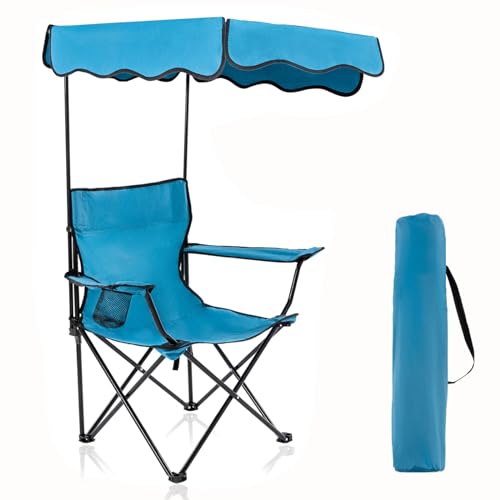
Homcosan Folding Chair with Shade Canopy — Best All-Rounder
If the brief is simply a good canopy chair at a sensible tier, the Homcosan is where the search starts and often ends. Its fabric is a thickened 600D Oxford, the heavier cloth grade in this category, which matters less for how it feels on day one than for how it looks in season three, when thinner fabrics have begun to sag and shine at the stress points. The canopy is a proper overhead shade rather than a token visor, and the listing states a heavy-duty frame supporting 330 pounds — a figure in the honest middle of this market.
Posture is upright camp-chair rather than low beach lounger, and that choice suits more people than it disappoints. Sitting higher makes standing up easier on knees, keeps the seat clear of blown sand, and puts the cup holder at a natural arm’s height instead of down by your ankle. Readers who want to sprawl at the waterline with their toes in the wash should look at the lower-slung designs in the umbrella section instead; readers who want to sit, read, supervise and sip in one posture will recognise this chair as the default done properly.
There is a temperament this chair suits particularly well: the reader. An upright seat, a shaded page, a drink at the elbow and feet planted clear of the sand is the complete reading posture, and the Homcosan’s canopy is sized for a lap and a book rather than for a whole reclining body. Chapter-length sessions are where its steadiness shows — no creeping shadow loss as the sun moves, no periodic relocation of the whole encampment, just the small tilt adjustments that any adjustable shade invites. If your beach day is measured in chapters rather than swims, weight this pick accordingly.
- Shade: attached canopy
- Fabric: thickened 600D Oxford per listing
- Stated capacity: 330 lbs per listing
- Drink storage: cup holder in arm
- Format: folding, portable
Strengths
- Heavier fabric grade promises a longer service life
- Upright seat height suits mixed-age groups
- Uncomplicated design with nothing gimmicky to break
Trade-offs
- Upright posture is not a lounger’s recline
- No cooler bag, unlike the Suteck below
- Single chair, so pairs buy twice
Best for: the general beachgoer who wants one dependable shaded seat. Not suited for: sprawlers who prefer to sit at sand level.

Docusvect Beach Chair with Canopy Shade — Smartest Carry
The Docusvect has the cleverest single idea in this guide: the canopy is the backpack. Fold the chair and its shade becomes the carrying system, with straps that put the load on your shoulders and leave both hands free for the cooler, the toddler or the gate at the top of the dune path. Anyone who has made the walk from a full car park to a distant patch of sand, arms loaded and chair banging against a shin, understands immediately why this design exists.
Under the party trick sits a serious chair. The listing states a 330-pound capacity, describes full sun protection from the canopy, and includes both a cup holder and a side pocket — the pocket being the quiet hero, since phones, keys and sunscreen tubes are exactly the items that otherwise migrate into the sand. The shade’s coverage reads generous in the listing imagery, wrapping the sitter rather than perching above them. For walkers, train-takers and anyone whose beach begins with a journey, this is the pick that respects the whole trip rather than only the destination.
- Shade: canopy that converts to the backpack carry
- Stated capacity: 330 lbs per listing
- Drink storage: cup holder
- Extras: side pocket
- Format: folding, backpack straps
Strengths
- Hands-free carry transforms long approaches
- Side pocket keeps small valuables out of the sand
- Full-coverage shade shape
Trade-offs
- Dual-purpose canopy hardware is more complex than a plain shade
- Backpack format carries one chair per person, no stacking
- Walkers who drive to the sand gain less from its best trick
Best for: beachgoers who walk, ride or hike any real distance to their spot. Not suited for: a family wanting to carry four chairs in one trip.

Suteck Camping Chair with Canopy Shade — Heaviest Duty
The Suteck’s listing makes the boldest capacity claim in this guide — support up to 500 pounds — and pairs it with the same thickened 600D Oxford fabric as the Homcosan, so the chair’s ambitions are at least dressed consistently. Treat the figure as the maker’s own statement, as with every capacity on this page, but the direction of travel is clear: this is the chair aimed at larger sitters who are tired of furniture that treats them as an edge case, and at anyone who simply wants the most overbuilt frame on the blanket.
Its storage game is also the strongest here. Beside the cup holder and side pockets sits a cooler bag, which changes the rhythm of a beach day more than any other single feature — cold drinks within arm’s reach, no expedition to the family cooler every forty minutes, and no warm bottle rolling in the sand. The shade is described as adjustable, answering the tilt test from the buying section above. The colour shown is green, a campground-friendly shade that will not show dust the way pale fabrics do. For big-and-tall readers, and for basecamp-style beach days generally, this is the heavyweight champion of the six.
A word about who else benefits from an overbuilt chair: the person supervising. Beach days with children involve a seated headquarters — towels, snacks, spare clothes, the lost-and-found of buckets — and that headquarters is usually one adult in one chair for hours. A frame that feels planted rather than perched, with cold drinks in its own cooler and shade that can be re-aimed as the sun swings, turns that duty from an endurance event into a post. Headquarters duty is the hidden use case of this entire category, and the Suteck is built for it.
- Shade: adjustable canopy per listing
- Fabric: thickened 600D Oxford per listing
- Stated capacity: supports 500 lbs per listing
- Drink storage: cup holder plus cooler bag
- Extras: side pockets
Strengths
- Highest stated capacity in this guide
- Cooler bag keeps drinks cold at the chair
- Adjustable shade follows the sun’s angle
Trade-offs
- Heaviest spec usually means the heaviest carry
- Capacity is a maker claim, as throughout this category
- More features mean more parts to rinse and maintain
Best for: larger sitters and long, settled beach basecamps. Not suited for: minimalists walking a mile of boardwalk with a towel and nothing else.

Northroad Folding Chairs with Canopy 2 Pack — Best for Two
Couples, fishing partners and beach friends face a small recurring absurdity: buying two chairs separately, in two transactions, often in colours that almost match. The Northroad pack simply sells the pair — two folding canopy chairs, in purple and green as listed, with cup holders, phone holders, armrests and a carry bag to move them together. The phone holder deserves its mention; a phone in a dedicated slot is a phone that is not cooking in direct sun on a towel or filling its charging port with sand.
As chairs, they follow the camp pattern rather than the lounger pattern: upright, armrested, shaded, built for sitting and watching the water rather than lying in it. The listing pitches them at travel, sports and fishing as much as at the beach, which is honest — a canopy chair is really a portable shaded seat, and the same design that serves a shoreline serves a sideline. Buyers should note the two colours are fixed by the pack; households with strong colour opinions should confirm they can live with purple and green before the pair becomes a point of domestic negotiation.
The pair format also solves a subtler problem: mismatched comfort. When two people buy chairs separately across different seasons, one inevitably ends up in the good chair and the other in the folding apology, and beach harmony suffers in ways nobody admits to a survey. A matched pack puts both sitters at the same height, in the same shade, with the same drink facilities — a small democracy of comfort. For households that host, the pair doubles as the guest set, sparing visitors the wobbly spares that garages accumulate.
- Shade: canopy on each chair
- Pack: two chairs, purple and green per listing
- Drink storage: cup holders
- Extras: phone holders, armrests, carry bag
- Format: folding
Strengths
- One purchase outfits two people completely
- Phone holders protect the most-dropped beach object
- Shared carry bag simplifies transport and storage
Trade-offs
- Colours are chosen for you
- A pair is wasted on the committed solo beachgoer
- Two chairs in one bag is a heavier single load
Best for: couples and pairs who always attend the beach together. Not suited for: solo readers or colour perfectionists.
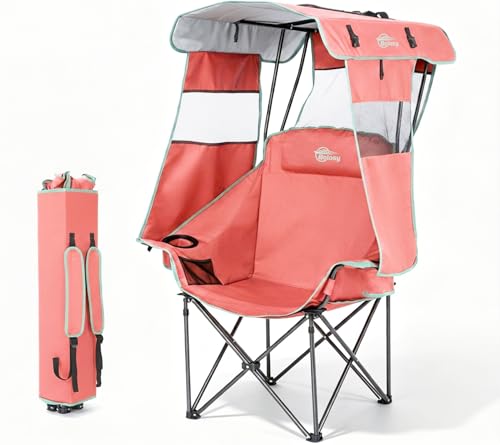
Camping Chair with Canopy UPF 50+ — Sun-First Design
Most canopy chairs treat shade as a shape; this one treats it as a rating. The listing leads with UPF 50+ on the canopy fabric, a tested-style claim about ultraviolet blocking that the other picks here do not make, and for buyers whose primary motive is sun management — fair skin, a dermatologist’s warning, children rotating through the seat — that specificity is the reason to choose it. The stated capacity is 400 pounds, second only to the Suteck, and the colour shown is an unapologetic pink that has the side benefit of being findable: your chair is visible from the water, which anyone who has scanned a crowded shoreline for their own towel will appreciate.
The rest of the package follows the modern camp-chair pattern: cup holder, side pocket, portable folding frame, pitched at fishing and outdoor sports as readily as at the beach. A note of proportion belongs here. A rated canopy is a genuinely useful layer of sun protection for the hours you spend seated, and it is still one layer; hats, sunscreen and shade breaks for children remain part of the day. Within that honest framing, this is the chair that takes the sun most seriously, and for many families that is the whole decision.
Parents should read this pick with a particular scenario in mind: the child who will not keep a hat on but will sit, for surprising stretches, in a grown-up’s chair with a book or a bucket of shells. A rated canopy over that seat is not a medical device and this guide makes no health claims for it; it is simply the most deliberate shade in the group, placed exactly where a small person has chosen to be still. Combined with the sunscreen and hat negotiations you were already conducting, it stacks the afternoon in your favour.
- Shade: canopy with UPF 50+ rating per listing
- Stated capacity: 400 lbs per listing
- Drink storage: cup holder
- Extras: side pocket
- Colour shown: pink
Strengths
- Only pick here with a stated UPF rating on the shade
- Strong stated capacity in a mid-weight format
- Bright colour is easy to spot on a crowded beach
Trade-offs
- Pink will not be every household’s choice
- No cooler bag for all-day drink storage
- Rated shade still supplements rather than replaces sunscreen
Best for: sun-conscious families and fair-skinned readers. Not suited for: buyers who want a muted, campground-blending colourway.
Separate Umbrella Plus Any Chair (generic approach) — The Workaround
Before canopy chairs existed, the beach solved shade the modular way: any chair you liked, plus an umbrella planted beside it. The approach survives because it has real virtues. It shades a group rather than a person, so two or three chairs can share one shadow; it lets you choose a low lounger, a recliner or a beloved old camp chair on its own merits; and when the umbrella eventually dies, as umbrellas do, the chair is not buried with it. Households that already own good chairs and gather in groups may rationally stop here.
The costs were laid out in the canopy section above and they are structural, not incidental. The shade stays where the pole is while the chair wanders; the sail area is larger and its failure in a gust is livelier; and the carry count grows by an object and an anchor. This class sits at every tier from disposable to heirloom, and quality varies wildly, which is precisely why we discuss it without pointing at a listing. If you take this route, spend on the umbrella’s hinge and anchor before its colour, and accept the midday ritual of moving either the shade or yourself.
There is one more scenario where the workaround quietly wins: the mixed group. Grandparents in camp chairs, teenagers on towels, a lounger addict at the waterline — no single product shades that scatter, while one large umbrella at least offers a communal pool of shadow that people can rotate through. Canopy chairs personalise shade; umbrellas socialise it. Knowing which your group actually needs is worth more than any fabric specification in this guide.
- Shade: separate umbrella, group-sized
- Seat: any chair you already own
- Drink storage: depends entirely on the chair
- Format: two or more objects to carry
- Replacement logic: shade and seat age independently
Strengths
- One shadow can cover several sitters
- Freedom to choose any chair style, including low loungers
- Components replace separately when they wear out
Trade-offs
- Shade and sitter drift apart as the day moves
- Most wind-vulnerable arrangement on this page
- Heaviest total carry of the six options
Best for: groups with chairs they already love and a short carry. Not suited for: solo beachgoers, long walks, or anyone tired of chasing shade.
How Do the Six Options Compare at a Glance?
| Option | Shade | Stated capacity | Drink storage | Defining trait |
|---|---|---|---|---|
| Homcosan Folding Chair | Attached canopy | 330 lbs per listing | Cup holder | 600D all-round default |
| Docusvect Beach Chair | Canopy becomes backpack | 330 lbs per listing | Cup holder | Hands-free carry |
| Suteck Camping Chair | Adjustable canopy | 500 lbs per listing | Cup holder + cooler bag | Heaviest-duty build |
| Northroad 2 Pack | Canopy on both chairs | See listing | Cup holders | Matched pair with phone holders |
| UPF 50+ Camping Chair | Rated UPF 50+ canopy | 400 lbs per listing | Cup holder | Sun protection first |
| Umbrella + any chair | Separate umbrella | Depends on chair | Depends on chair | Group shade, modular parts |
How Should You Set Up and Care for a Canopy Chair?
Setup begins with the ground. On soft sand, work each foot of the frame down until the chair stops rocking, because a canopy chair that shifts every time you move will wear its hinges and your patience simultaneously. Angle the seat so the canopy’s shadow falls across your lap at the hour you most care about — for most readers that is the long early afternoon — rather than square to the water by default. Then test the cup holder with the actual bottle you brought before you settle; tall, top-heavy bottles sit differently from cans, and discovering that at leisure beats discovering it in a lapful of lemonade.
Care is a freshwater habit. Salt spray and sand work into canopy hinges, folding joints and zips, and the five-minute rinse with a hose or a beach shower at day’s end is what separates a chair that lasts five summers from one that lasts two. Let the fabric dry fully before folding it into a car boot or a garage corner, because mildew finds damp Oxford cloth in the dark with unerring accuracy. Store the chair somewhere the canopy is not crushed flat under heavier gear, and its fabric and frame will both keep their shape.
Through the season, give the moving parts a minute of attention monthly. A grain of sand in a tilt mechanism announces itself as stiffness long before it becomes a breakage, and a rinse plus a gentle working of the joint usually evicts it. Check the cup holder’s mesh or well for the small tears that beach debris causes, and check canopy attachment points for loosening, since those are the spots where wind loads concentrate. None of this is workshop work; it is the same glance-over you would give a bicycle before a ride, applied to furniture.
What About the Cup Holder — Why Does Its Design Matter So Much?
It matters because the cup holder is the feature you will use most often and notice only when it fails. Depth is the first quality: a deep well cradles a bottle past its centre of gravity, so the small earthquakes of beach life — standing up, a child leaning on the arm, a gust — rock the drink instead of ejecting it. A shallow tray, by contrast, is a launching pad with good intentions. Diameter is the second quality, since modern insulated bottles are wider than the cans these holders were originally drawn around; a holder that fits your actual bottle is worth more than two that fit a hypothetical one.
Placement is the third quality, and the subtlest. A holder set into the armrest keeps the drink in your peripheral vision and within the natural arc of your hand, which sounds trivial until you compare it with designs that hang the holder low on the frame, where every retrieval is a small expedition and every kick from a passing toddler is a direct hit. Drainage completes the picture: mesh bottoms and open wells shed the meltwater and sand that inevitably join the drink, while sealed cups become small gritty aquariums by three o’clock. Judge holders by these four tests and you will never be surprised by one again.
Does Seat Height Matter More Than You Think?
Beach seating divides into two civilisations that rarely understand each other. The low loungers sit inches above the sand, legs stretched toward the water, built for people who want to be in the beach rather than on it. The camp-style chairs in this guide sit at roughly chair height, knees bent, feet flat, built for people who want to read, eat, supervise and converse. Neither is superior in the abstract; each is miserable when forced on the other’s devotee, which is why the first question in this category should be about posture rather than shade.
Age and joints cast deciding votes. A grandparent who lowers gracefully into a lounger at twenty-five may need a hand and a strategy to leave it at seventy-five, and a chair that cannot be exited with dignity will quietly stop being invited. Camp-height seats with armrests — armrests being, functionally, exit handles — keep older beachgoers independent all day. The same logic serves anyone recovering from a knee or hip complaint, and parents who will stand up forty times before lunch to answer the demands of small children in the surf.
Children complicate the picture in the opposite direction: they do not care. A child will sit in the sand itself, in your chair, on the cooler, and briefly upside down, all within the hour. What children need from your chair is the shade and the drink discipline, not the seat. Buy for the adults’ bodies, let the children colonise as they please, and choose the height that keeps the oldest sitter in your group comfortable — that person is the true design brief.
How Does a Canopy Chair Change the Shape of a Beach Day?
Follow the hours. At arrival, the canopy owner walks to a chosen spot with hands free or nearly so, unfolds one object, and is seated in shade inside two minutes, while the umbrella household is still negotiating with a sand anchor. Through the morning, small migrations — toward the water as the tide drops, sideways as a neighbour’s game expands — cost the canopy owner a lift and a shrug. The shadow is not a location; it is an attribute of the chair, and the freedom compounds quietly all day.
Midday is where the design earns its price. The sun is highest, the heat is worst, and tempers in unshaded groups begin their annual short season. A seated row of canopy chairs becomes a small shaded village: conversation happens at conversational distance, drinks stay cold and upright, books stay readable, and nobody has to choose between the group and the shadow. The umbrella household, by contrast, begins its slow afternoon shuffle, rotating chairs around a pole like planets that have lost their orbit.
Departure reverses the morning’s arithmetic. One fold, one carry, one object in the boot — and no umbrella discovered in the garage next spring with a bent rib and no memory of how it happened. None of this makes the canopy chair glamorous. It makes it frictionless, and on a day whose entire purpose is ease, frictionless is the luxury that matters. The workaround pick in this guide survives because groups and loungers are real; but for the seated hours that dominate most adults’ beach days, the attached shade is simply the more civilised machine.
How Should You Read a Canopy Chair Listing Without Being Fooled?
Photographs in this category are taken at the chair’s most flattering hour, so read the words first. The honest specifications are fabric weight, stated capacity, folded format and the list of included extras; the soft specifications are adjectives. A listing that tells you its cloth is 600D Oxford and its frame’s stated limit is a number has given you something to compare. A listing that tells you the chair is luxurious, premium and perfect for everyone has given you a mood. Both kinds of chair exist at every tier, but only one kind of listing lets you shop.
Look hard at the canopy in side-profile images, because coverage lives there. Measure with your eye how far the shade extends beyond where a sitter’s head would be, and whether the mechanism visibly tilts or merely folds for storage — folding and tilting are different talents, and listings occasionally blur them. Check whether the cup holder appears in the arm you would actually use, and whether the chair’s folded shape is shown at all; a maker proud of its carry usually photographs it, which is how the Docusvect’s backpack design announces itself.
Finally, read the pack contents like a contract. A two-pack that includes a carry bag, as the Northroad does, is a different total purchase from two single chairs plus a bag bought separately. A cooler bag included with the Suteck changes its value against a bare chair at a similar tier. None of this requires cynicism — the picks in this guide were verified against their listings precisely so the extras named here are the extras the listings claim — but it does require reading the whole page before the price line, in that order.
How Do Canopy Chairs Travel and Store the Other 350 Days?
A beach chair spends most of its life not on a beach, and its manners in cars and cupboards decide whether it survives to a second summer. Folded format is the first test: the backpack design disappears onto a hook, the Northroad pair rides in their shared bag, and the camp-style frames generally stack flat against a garage wall. Measure your storage honestly before buying the largest chair in the guide; a heavyweight frame that lives permanently in the car’s boot will be resented by whoever does the weekly shopping.
Car interiors argue for bags and straps more than owners expect. Loose folding chairs shed sand for months, rattle on every journey, and occasionally deploy a leg into the shopping. Keeping each chair in its bag or strapped bundle contains the beach to the beach. Sand management at the source helps too — a shake and a brush-down at the shoreline, before the chair meets the car, is worth a month of vacuuming later.
Off-season, the enemies are damp and compression. Store chairs dry, in air that moves, with nothing heavy parked on top of the folded canopy; a shade that spends winter crushed under a toolbox emerges with creases that become cracks. If space forces a choice, store the chair you love best in the house and the spare in the shed, and rotate them next season. Furniture that is stored kindly is furniture that does not need replacing, which is the least glamorous and most reliable saving in this entire category.
Which Extras Are Worth Having Beside a Canopy Chair?
The chairs above already carry the two features that define the category, so extras should be judged by whether they remove a recurring annoyance rather than by novelty. A side pocket earns its place daily, as the Docusvect shows, because phones and keys otherwise live in the sand. A cooler bag, the Suteck’s contribution, earns its place hourly on long days. A phone holder, as on the Northroad pair, sounds like garnish until the first time a phone overheats on a sunlit towel and shuts itself down mid-photograph.
Beyond the chair itself, the honest companion list is short. A sand-free blanket defines the territory the chairs stand in and stops the slow migration of grit into every holder and hinge. A simple brush — the kind sold for car dashboards — lives in the beach bag and evicts sand from mechanisms before the rinse. And a spare strap or bungee in the car boot tames whichever chair refuses to fold flat on the one day you are in a hurry. Everything else marketed at beachgoers should have to argue its way into the bag against these incumbents.
What is notably absent from that list is more shade. Owners sometimes add clip-on visors, side screens and secondary mini-umbrellas to a canopy chair, building a small fortress against a sun that the original canopy was already managing. Each addition is another hinge, another sail, another thing to rinse. The better investment, when the midday sun defeats a single canopy, is scheduling: swim at noon, read at three. The chair is a tool for comfort, not a bunker, and the day is allowed to have a rhythm.
What Mistakes Do Buyers Make with Canopy Chairs?
- Choosing shade size over shade adjustment. A huge fixed canopy still misses the low afternoon sun; a tilting one follows it.
- Ignoring the carry until the car park. The best chair is the one that actually gets brought, and carry format decides that.
- Reading capacity as a promise. Stated figures are the maker’s own; compare chairs by them, but seat yourself gently in any new frame first.
- Forgetting the rinse. Salt and sand left in hinges overnight are the leading cause of chairs dying young.
- Buying one chair for a two-person habit. Pairs who always go together should price the two-pack before buying singles twice.
- Treating shade as sunscreen. A canopy cuts exposure at the seat; exposed legs, water reflection and snack walks still count.
Final Recommendation
Most readers should start with the Homcosan: it is the balanced, durable, no-drama version of the idea, and it will suit the majority of beach days in the majority of households. Walkers should take the Docusvect and its backpack canopy, larger sitters and basecamp builders the Suteck, couples the Northroad pair, and the sun-avoidant the UPF-rated chair — each of those is a genuine specialist rather than a trim level. The umbrella workaround remains respectable for groups with chairs they love, provided they accept its wandering shadow with good humour.
One last piece of arithmetic for households deciding how many to buy: chairs multiply awkwardly. One canopy chair per regular adult is the clean solution; sharing a shaded seat in rotation sounds frugal in April and feels like a scheduling dispute by July. Children, as established, will sit anywhere including the sand, so the adult count is the number that matters, and the Northroad pair exists precisely because that number is so often two.
Decide by picturing your own shoreline routine — the walk, the hours, the people, the bottles — and buy the chair that fits that film rather than the brochure, because the seat you unfold without thinking, in the spot you always choose, is the one quietly doing its job while the tide comes in.
Frequently Asked Questions
Can a canopy chair replace a beach umbrella for a family?
For seating shade, largely yes: each person gets a shadow that follows them, which an umbrella cannot promise. For a shared play area, a picnic spread or a sleeping baby in a pram beside the chairs, an umbrella still covers ground that personal canopies do not. Many families end up with canopy chairs for the adults and one umbrella over the communal patch, which is less a compromise than a division of labour.
How much wind can a canopy handle?
Ordinary sea breezes are fine; the designs here hold their shade at several attachment points and sit low compared with an umbrella. In gusts strong enough to sandblast your ankles or empty neighbouring towels, fold the canopy down regardless of brand — no maker rates these shades for storm work, and a damaged canopy hinge is an avoidable expense. Comfort is the guide: if you are fighting the weather, the weather has already won the afternoon.
Do these chairs work away from the beach?
Yes, and several listings say so outright, pitching the same chairs at camping, fishing and sports sidelines. Garden readers, allotment holders and anyone who supervises outdoor events for hours will find the shade-and-drink combination just as relevant on grass as on sand, with the bonus that grass is far kinder to hinges. Anywhere a person sits outdoors for hours — a lakeside, a garden, a youth football touchline — a portable shaded seat with a drink holder earns its space. The beach-specific demands are really just sand and salt tolerance, which the rinse habit covers.
What size person do the stated capacities suit?
Capacities on these listings run from 330 pounds to a claimed 500, and they should be used comparatively: a chair stating a higher figure is generally built with a heavier frame and fabric. They are maker statements rather than independently certified limits, so a sitter near a chair’s stated ceiling should choose the next chair up the scale. Seat width and height, described in each listing, matter as much to comfort as the headline number.
How do I stop my drink tipping in soft sand?
Start with the chair itself: settle all four feet firmly so the frame is not rocking, and use the deepest holder your bottle fits. Keep the bottle more than half full when you can — a low centre of gravity forgives bumps — and put the chair, not the drink, on the downhill side of any slope. If your bottle is a tall insulated one, test its fit in the holder at home; the time to discover a mismatch is in the kitchen, not at the shoreline.
Is a canopy chair worth it for occasional beachgoers?
If occasional means three or four beach days a year, the arithmetic still favours owning one decent chair over renting or borrowing dubious ones, because the same chair serves gardens, campsites, sidelines and festivals between beach trips. The category’s entry tier is modest, and the chair’s usefulness is not beach-locked. What occasional users should skip is the top of the range: buy the all-rounder, keep it dry, and let it amortise itself across a decade of odd sunny obligations.
Are replacement canopies or parts available?
Availability varies by maker and changes over time, so check the listing and the maker’s storefront at the moment you need a part. The practical defence is the care routine above: rinsed hinges, dry storage and gentle handling postpone most failures past the point where a replacement matters. For the umbrella approach, parts are easier to source precisely because umbrellas are generic — one of that option’s genuine advantages.
Related Guides
Shade handled, the rest of the household’s seating deserves the same scrutiny: our Best Black Leather Chairs for a TV Room covers the indoor end of the comfort spectrum, Best Camp Chairs for 500 Pounds takes heavy-duty outdoor seating further, Best Carpet Mats for Office Chairs protects the floors under the chairs you work in, and Best Sand-Free Beach Blankets completes the shoreline kit by dealing with the sand itself.



[…] the whole yard’s kit, and our neighbouring guides approach neighbouring problems: start with Best Beach Chairs with Canopy and Cup Holders for a complete change of scenery, then Best Cafeteria Chairs and Tables and Best Car Booster Chairs […]