What's inside
- Key Takeaways
- Quick Picks
- How We Chose These Picks
- The Lineup Compared: Bases, Backs and Adjustment
- How Do You Know Whether a Kneeling Chair Will Fit a Shorter Leg?
- How Should You Build Up Kneeling Time Safely?
- What Floor and Desk Pairings Suit a Kneeling Chair?
- Which Mistakes Do Shorter Buyers Make With Kneeling Chairs?
- What Does the Angled Seat Actually Do All Day?
- How Do You Set Up a Kneeling Chair at Your Desk, Step by Step?
- Which Work Suits Kneeling, and Which Does Not?
- How Should You Care for Cushions That Carry Your Shins?
- What Role Can a Kneeling Chair Play in a Two-Chair Rotation?
- How Do Rocking, Rolling and Locking Bases Feel Different by Hour Three?
- What Should You Ask Before Ordering Any Kneeling Chair?
- Why Does Fitting a Small Body Teach You to Fit a Whole House?
- How Does Clothing, Flooring and Habit Change the Kneeling Experience?
- What Do the First Two Weeks Teach That No Review Can?
- How Should a Shorter Sitter Choose Between the Two Back-Supported Models?
- Can a Kneeling Chair Share a Home With a Conventional Desk Chair?
- Final Recommendation
- Frequently Asked Questions
- What Is a Fair Price of Patience for This Category?
- How Do You Enter and Leave a Kneeling Chair Gracefully?
- What Separates a Good Knee Pad From a Merely Thick One?
- Related Guides
As an Amazon Associate I earn from qualifying purchases. This post may contain affiliate links at no extra cost to you.
cottageverdict.com is reader-supported. When you buy through links on our site, we may earn an affiliate commission.
Where to buy: every kneeling chair below links to its Amazon listing, where you can check price on Amazon and confirm the adjustment style, cushion thickness and whether a backrest or footrest is included before you order.
The best kneeling chairs for short people solve a problem that standard kneeling chairs quietly create. A kneeling chair replaces the usual seat pan with an angled cushion for your seat and a second pad for your knees and shins, opening the hip angle and letting the spine stack in a way many sitters find naturally upright. But that geometry is built from distances — seat height, the gap between seat and knee pad, the angle between them — and when those distances are cut for a longer leg, a shorter sitter ends up perched, stretched or sliding. For a petite frame, the adjustment range is not a feature on the list; it is the entire product.
So this guide reads all six listings through one lens: how far can each chair come down and close in to meet a shorter leg? Every pick here is a genuine kneeling chair with an angled seat and knee pads — the cross-legged floor chairs that crowd search results in this category were excluded on purpose, because they answer a different question for a different room. Within the six, the designs split into rollers and rockers, backless stools and back-supported chairs, wooden frames and wheeled bases, and one model that adds a footrest to the formula. Capacities and cushion details appear only where the listings print them.
Language honesty matters in this category more than most. Listings speak freely about posture and comfort, and one or two use pain language in their titles. This guide borrows none of that as a promise: a kneeling chair offers a different sitting geometry that many people find easier to hold upright, full stop. Anyone managing an actual knee, hip or back condition should take medical advice before spending long days on their shins, and everyone should build up kneeling time gradually, whatever the brochure implies.
Key Takeaways
- For shorter sitters, the seat-to-knee-pad distance and lowest seat setting matter more than any other detail.
- All six picks are true kneeling chairs with angled seats; cross-legged floor chairs were excluded deliberately.
- Two DRAGONN by VIVO models anchor the field — one backless with brake casters, one with back support.
- The NYPOT states a 250 lb support figure and an adjustable, rocking format in its listing.
- Back support appears on two picks, a footrest on one, and lockable wheels on two.
- Thick moulded foam knee cushions recur across the field — kneeling comfort lives in that pad.
Quick Picks
| Pick | Badge | Why it earns its place |
|---|---|---|
| NYPOT Ergonomic Kneeling Chair, Adjustable | The rocking adjuster | Adjustable seats with a rocking kneel format and a stated 250 lb support figure. |
| DRAGONN by VIVO Kneeling Chair DN-CH-K01B | The classic stool | Angled seat, thick moulded foam cushions and brake casters in the category’s reference design. |
| DRAGONN by VIVO Kneeling Chair with Back Support DN-CH-K02B | Back-supported kneel | The same angled geometry with a backrest for sitters who want somewhere to lean between tasks. |
| VEVOR Wooden Ergonomic Kneeling Chair | The wooden rocker | A solid wood frame with adjustable height and thick foam cushions in a calm grey finish. |
| Ergonomic Kneeling Chair with Footrest and Back Support | Footrest plus back | A 4-inch thick cushion, back support, footrest and two locking wheels for a settled kneel. |
| GIANTEX Ergonomic Kneeling Chair | Angle and height control | Adjustable height and seat angle with lockable universal wheels and thick padded cushions. |
How We Chose These Picks
Adjustability for shorter legs came first, and it was judged on mechanism rather than adjectives. A kneeling chair serves a petite sitter only if its seat can lower and its knee pad can sit close enough that the shin rests along the pad instead of reaching for it. Each pick here describes adjustment in its listing — of seat height, of seat position, of angle — and the reviews below keep returning to that question, because it is the question this keyword actually asks.
Category purity came second. The kneeling-chair shelves are crowded with cross-legged meditation chairs, floor cushions with backrests and other pleasant objects that share no geometry with a kneeling chair at all. They were all excluded, however comfortable they may be, because a reader searching for a kneeling chair for a short frame needs the angled seat and the knee pad, fitted closely. Shoppers at the opposite end of the tape measure face mirror-image problems, which our guide to Best Chairs for Tall Men takes up from the tall side; this guide stays at the shorter end, where chairs are usually too big rather than too small.
Cushion honesty came third. Kneeling transfers a share of your weight to your shins, so the knee pad is not upholstery — it is a load-bearing surface. Listings that state cushion thickness or describe moulded foam earned their places here, and the reviews treat pad quality as a headline rather than a footnote. Where a listing prints a support figure, like the NYPOT’s 250 lb, the review repeats it; where it does not, no number is invented.

NYPOT Ergonomic Kneeling Chair, Adjustable — The rocking adjuster
The NYPOT builds its case on two words in its listing: adjustable and rocking. Adjustable seats are the headline for this guide’s readers, because a seat that travels lets a shorter sitter pull the whole geometry inward — lower seat, closer knee position — until the shin lands along the pad the way the design intends. The rocking format adds the second half of kneeling comfort: a gentle rock lets you shift weight between seat and knees through the day instead of holding one static load on the shins until they file a complaint.
The listing states support for 250 pounds, which earns it the guide’s only printed capacity figure and a measure of trust — a maker willing to publish a limit is a maker who has thought about load paths. Its title also carries the category’s usual posture and comfort language, which this review translates plainly: the angled, rocking sit encourages an upright stack and lets you move. Nothing stronger is claimed here, and nothing stronger should be claimed anywhere for a stool.
For a first kneeling chair, the NYPOT’s combination is persuasive: real adjustment for a shorter frame, motion built into the base, and an honest number on the listing. Petite sitters who have tried a fixed kneeling chair and found themselves sliding toward the knee pad — the classic symptom of geometry cut for longer legs — will understand immediately why the adjustable seat leads this guide.
The rocking base also forgives a new user’s imperfect fit during the learning fortnight. While you are still discovering your preferred seat position, the rock lets you redistribute pressure experimentally, minute by minute, instead of enduring a setting that is nearly right. Experienced sitters keep using that freedom long after the fit is solved, which is why rocking designs inspire a loyalty that fixed stools rarely match.
- Format: kneeling rocking stool for desk use
- Adjustment: adjustable seats to close the geometry
- Stated support: 250 pounds, per the listing title
- Use setting: home and office desks
- Where to buy: the NYPOT Ergonomic Kneeling Chair, Adjustable listing on Amazon — check price on Amazon
Strengths
- Adjustable seat directly serves shorter leg lengths
- Rocking base spreads load between seat and knees
- Published support figure aids confident buying
Trade-offs
- No backrest for lean-back pauses
- Rocking motion will not suit every work style
- Kneeling still demands a gradual build-up period
Best for: petite sitters buying their first kneeling chair who want adjustment and movement in one design. Not suited for: anyone who knows they need back support during long sessions.
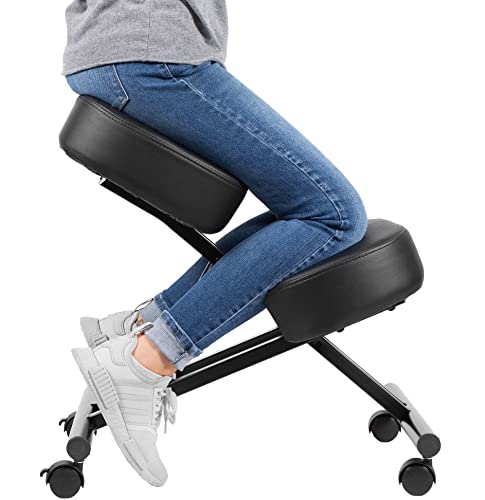
DRAGONN by VIVO Kneeling Chair DN-CH-K01B — The classic stool
If the kneeling chair has a reference design, this is close to it: an adjustable stool with an angled seat, thick moulded foam cushions and brake casters, in black. The moulded foam is the detail to underline — knee pads shaped as moulded cushions cradle the shin rather than presenting it with a flat slab, and across a working day that shaping is the difference between a pad you forget and a pad you negotiate with hourly.
Brake casters are the second thoughtful touch. A kneeling chair on free-rolling wheels can creep as you shift, and creeping is doubly annoying for a shorter sitter whose feet may not anchor the chair as firmly. Brakes let you park the chair at the desk and trust it during focused work, then release and roll it aside when the desk returns to household duty. For shared rooms, that parkability is a genuine daily convenience.
The backless format is a deliberate trade. Without a backrest, the chair asks your own posture to do the work, which is the kneeling concept in its purest form — many sitters find the angled seat makes that work surprisingly natural, in shorter sessions especially. Treat this model as the guide’s purist option: the classic geometry, good foam, sensible wheels, and nothing between you and the sitting position itself.
Its simplicity also makes it the easiest chair here to lend, store or move between rooms — a stool that behaves like a stool when it is not being a posture instrument. In a small flat where every object must justify its footprint twice, that ordinariness off duty is a genuine virtue.
- Format: adjustable kneeling stool, model DN-CH-K01B
- Cushions: thick moulded foam on seat and knee pad
- Wheels: brake casters for a parked, trusted position
- Back: none — pure kneeling geometry
- Where to buy: the DRAGONN by VIVO Kneeling Chair DN-CH-K01B listing on Amazon — check price on Amazon
Strengths
- Moulded foam knee cushions suit long shin contact
- Brake casters stop desk creep during focused work
- Reference design with a long category history
Trade-offs
- Backless sitting limits comfortable session length
- Casters need hard floors or a mat to roll well
- Adjustment range should be checked against your leg length
Best for: kneeling purists and shorter sitters who work in focused sessions with breaks between. A poor fit for: anyone who leans back to read for long stretches at the same desk.

DRAGONN by VIVO Kneeling Chair with Back Support DN-CH-K02B — Back-supported kneel
The K02B takes the same DRAGONN geometry — angled seat, thick moulded foam cushions — and adds the feature half of all kneeling shoppers eventually ask about: a backrest. The back changes the chair’s rhythm. Pure kneeling stools are session furniture; a back-supported kneeling chair can host a whole morning, because the sitter can alternate between the active kneel and a genuine lean without leaving the chair or fetching a second one from another room.
For shorter sitters there is a fitting subtlety to check on arrival: the backrest only helps if it meets your back when your knees are correctly placed on the pad. Set the seat first, settle the shins, and only then judge the back — a backrest adjusted before the kneel is set will meet the wrong spine entirely. The moulded cushions carry over from its sibling, so the shin comfort story is the same, and the pairing of the two models in one guide is deliberate: same pads, same family geometry, one decision about the back.
Choose this one if your work mixes typing with reading, calls or thinking pauses, and you suspect a backless stool would exile you to the sofa by eleven. The kneeling position still does its quiet work in the active hours; the back simply forgives the inactive ones.
There is a social benefit as well: on video calls the backrest reads as an ordinary office chair from the front, sparing you the kneeling-chair explanation that backless models tend to provoke. For professionals who want the geometry without the conversation, that camouflage has real value.
- Format: adjustable kneeling chair, model DN-CH-K02B
- Cushions: thick moulded foam seat and knee pads
- Back: integrated back support for lean-back pauses
- Setting: home and office desks
- Where to buy: the DRAGONN by VIVO Kneeling Chair with Back Support DN-CH-K02B listing on Amazon — check price on Amazon
Strengths
- Backrest extends comfortable session length greatly
- Shares the moulded-foam comfort of its sibling
- One chair covers active work and reading pauses
Trade-offs
- Larger footprint than the backless stool
- Backrest fit must be set after the kneel position
- Less minimal to store in a small room
Best for: shorter sitters who want kneeling geometry with an escape route for their back. Not the right match for: purists who prefer the discipline of a backless stool.

VEVOR Wooden Ergonomic Kneeling Chair — The wooden rocker
The VEVOR changes the material story: a solid wood frame in a grey finish, with adjustable height, adjustable thick foam cushions and a format the listing aims at both office work and meditation. Wooden kneeling chairs rock rather than roll, and the rock is the point — a curved base that lets the whole chair breathe with your shifts of attention, in a material that looks like furniture instead of office equipment. In a living-room desk corner, that appearance is not vanity; it is permission for the chair to exist in the room.
Adjustable height on a wooden rocker matters doubly for this guide’s readers. A fixed wooden frame cut for average legs would be a beautiful mistake for a petite sitter, so the height adjustment is what earns this chair its place here rather than in a style roundup. The thick foam cushions handle the shin load, and the solid frame gives the rock a calm, creak-resistant feel that wheeled bases sometimes lack on soft floors.
The listing mentions meditation alongside office use, and the dual citizenship is honest: a rocking kneeling chair is equally at home in a morning practice corner and at a writing desk. Buyers whose kneeling chair will live a double life — desk by day, quiet corner by evening — will find this the most natural fit in the guide, provided the floor beneath it is one a rocker can enjoy.
Wood also ages with a grace that office materials rarely attempt: small scuffs read as character rather than damage, and the frame will still look intentional in a room long after a wheeled stool has started to read as equipment. Buyers furnishing for the long term, in rooms that are lived in rather than logged into, will weigh that heavily.
- Frame: solid wood, grey finish
- Adjustment: adjustable height for shorter frames
- Cushions: adjustable thick foam seat and knee pads
- Base: rocking, wheel-free
- Where to buy: the VEVOR Wooden Ergonomic Kneeling Chair listing on Amazon — check price on Amazon
Strengths
- Solid wood build suits living-space desks
- Rocking base encourages gentle position shifts
- Height adjustment keeps petite sitters in scope
Trade-offs
- Rocker base needs suitable flooring to move well
- No wheels means lifting rather than rolling aside
- No backrest for extended leaning
Best for: shorter sitters who want a kneeling chair that doubles as a calm, furniture-like meditation seat. Poorly suited to: carpeted offices where a rocking base cannot travel.

Ergonomic Kneeling Chair with Footrest and Back Support — Footrest plus back
This model adds the two comforts kneeling chairs usually omit: a backrest and a footrest, wrapped around a 4-inch thick cushion and two locking wheels. The cushion figure is printed in the listing, and at four inches it is the most explicit padding claim in the guide — relevant because the knee pad on a kneeling chair is a working surface, and thickness is the simplest honest proxy for how forgiving that surface will feel at hour two.
The footrest solves a specifically petite problem. Shorter sitters on kneeling chairs sometimes find their feet dangling behind the knee pad with nowhere meaningful to rest, which quietly fatigues the whole arrangement. A footrest gives the feet a station, stabilising the kneel and making the position feel chosen rather than endured. Combined with the back support, this is the guide’s most accommodating design: kneel actively, lean back when thinking, rest your feet throughout.
Two locking wheels keep the generosity honest at the desk — the chair can be positioned, locked and trusted, rather than drifting as you shift between its modes. If your instinct is that kneeling sounds austere, this is the model engineered to talk you out of that assumption.
It is also the kindest design here for a hesitant first purchase shared between two people of different heights, because its back and footrest give the second, taller user somewhere to compromise gracefully while the primary, shorter user keeps the close fit that justified the purchase.
- Cushion: 4-inch thick, as stated in the listing
- Support: back support plus a footrest
- Wheels: two locking wheels for a settled position
- Adjustment: adjustable kneeling office format
- Where to buy: the Ergonomic Kneeling Chair with Footrest and Back Support listing on Amazon — check price on Amazon
Strengths
- Footrest answers the dangling-feet problem directly
- Thickest stated cushion in this guide
- Back support extends sessions like its DRAGONN rival
Trade-offs
- Most components to assemble and adjust of the six
- Only two wheels, so repositioning is a partial lift
- Feature-rich format is the least minimal here
Best for: petite sitters who want kneeling geometry with every comfort concession included. A poor fit for: anyone seeking the simplest possible stool.

GIANTEX Ergonomic Kneeling Chair — Angle and height control
The GIANTEX closes the guide with the two adjustments that matter most, named separately in its listing: height and seat angle. Angle is the connoisseur’s control. Two sitters of identical height can prefer different seat tilts — one thriving on a steep, active kneel, the other on a gentler slope that asks less of the shins — and a chair that adjusts angle lets a shorter sitter fine-tune the position instead of accepting the designer’s guess at their anatomy.
Lockable universal wheels and thick padded cushions complete a practical spec: roll the chair in, lock it down, kneel on real padding. The listing’s language about comfort and posture is, as throughout this guide, treated as a description of the geometry rather than a promise — an adjustable angled seat that lets you hold an upright position with less conscious effort than a flat stool demands.
Against the NYPOT, which leads the guide, the GIANTEX trades rocking motion for angle control and locking wheels; against the DRAGONN stool it adds that same angle dial. Buyers who enjoy tuning equipment to themselves — and shorter sitters usually must, since default settings were not drawn around them — will find this the most instrument-like chair of the six.
Keep a note of the angle and height pairing that finally suits you, because a two-dial chair refitted by guesswork after every cleaning day will slowly drift away from its best self. Tuners who record their settings own a repeatable chair; everyone else owns a daily approximation of one.
- Adjustment: height and seat angle, separately controlled
- Cushions: thick padded seat and knee cushions
- Wheels: lockable universal wheels
- Format: kneeling stool chair for office desks
- Where to buy: the GIANTEX Ergonomic Kneeling Chair listing on Amazon — check price on Amazon
Strengths
- Seat angle adjustment fine-tunes the kneel precisely
- Lockable wheels combine mobility with stability
- Thick padding supports the shin load properly
Trade-offs
- No backrest or footrest among listed features
- Two dials mean a longer fitting process at first
- Stool format suits sessions rather than whole days
Best for: shorter sitters who like precise, tunable equipment and work in focused sessions. Not suited for: anyone who wants back support built into the same chair.
The Lineup Compared: Bases, Backs and Adjustment
| Chair | Base style | Back or foot support | Key adjustment |
|---|---|---|---|
| NYPOT Ergonomic Kneeling Chair, Adjustable | Rocking | None | Adjustable seats |
| DRAGONN by VIVO Kneeling Chair DN-CH-K01B | Brake casters | None | Adjustable stool |
| DRAGONN by VIVO Kneeling Chair with Back Support DN-CH-K02B | Wheeled | Back support | Adjustable geometry |
| VEVOR Wooden Ergonomic Kneeling Chair | Wooden rocker | None | Adjustable height |
| Ergonomic Kneeling Chair with Footrest and Back Support | Two locking wheels | Back support and footrest | Adjustable format |
| GIANTEX Ergonomic Kneeling Chair | Lockable wheels | None | Height and seat angle |
How Do You Know Whether a Kneeling Chair Will Fit a Shorter Leg?
Measure your lower leg before you measure the chair. Sit on the edge of a table with your legs hanging, and note the distance from the back of your knee down to the floor — then kneel on a cushion and feel where your shin wants to rest. A kneeling chair fits when, at its lower settings, the seat meets your seat and the pad meets your shin at the same moment, without you sliding forward to find either one. Sliding is the diagnostic: a chair that makes a short sitter slide is a chair whose seat-to-pad distance exceeds their leg, whatever its brochure says about adjustability.
Desk height joins the fitting too. Kneeling sits you differently than a standard chair — often a touch higher at the eye, with the desk edge meeting you at a new angle — so expect to revisit your screen position after the chair arrives. Give the new geometry a fortnight of graduated use before judging the whole experiment; the first three days measure your novelty tolerance more than the chair.
How Should You Build Up Kneeling Time Safely?
Gradually, and without heroics. Begin with twenty or thirty minutes at the desk, return to your ordinary chair, and let your shins and knees report back by evening. Add time across a week or two as the reports stay friendly. The rocking and angle-adjustable models in this guide help because they let you vary the load mid-session, but no mechanism replaces the simple discipline of standing, walking and alternating chairs during the learning period.
Clothing and padding are legitimate variables: a softer knee pad, trousers without a seam at the shin, a rug under a rocker base. And keep the honest boundary in view — kneeling is a sitting option with devoted fans, not a therapy. Discomfort that sharpens rather than fades as you adapt is information, and it should be taken to a professional rather than argued with.
What Floor and Desk Pairings Suit a Kneeling Chair?
Wheeled models want a hard floor or a chair mat; deep carpet swallows small casters and turns every adjustment into a tug. Rockers want the opposite consideration — a surface they can travel across without chewing, which usually means a rug or mat between wood and floorboards. Desks with a low apron or a modesty panel can collide with raised knees, so measure the underside clearance with the same care you gave the chair itself.
Room context matters in the other direction too: a kneeling chair is compact, social furniture that guests will ask about. If your taste runs to calm, furniture-like pieces in shared rooms — the sensibility behind our look at Best Reclining Stadium Chairs is different, but the VEVOR’s wooden frame in this guide speaks the same domestic language — the wooden rocker will integrate where a wheeled stool reads as equipment. Choose the base for your floor and the frame for your room, in that order.
Which Mistakes Do Shorter Buyers Make With Kneeling Chairs?
The first is buying a fixed-geometry chair because it photographed beautifully, then discovering its distances belong to a longer leg. The second is judging kneeling by a single afternoon; almost everyone’s first session ends early, and the format’s fans are simply the people who built up gradually. The third is ignoring the knee pad’s quality — in this category the pad is a structural component, and thin foam over hard board will end the experiment faster than any question of posture.
The fourth mistake is expecting the chair to be a whole-day, every-day answer from week one. Most long-term kneeling fans alternate — kneeling chair for focused morning work, conventional chair or standing for the afternoon. Buy the chair as a powerful option in a rotation, fit it patiently at its lowest, closest settings, and it will earn its place in that rotation honestly.
What Does the Angled Seat Actually Do All Day?
On a conventional chair the thigh and torso meet at roughly a right angle, and holding that angle upright for hours is work your back must supervise constantly. The kneeling chair tilts the seat forward and lets the knees drop, opening that angle so the pelvis rolls toward a more neutral tilt and the spine’s natural curves stack with less muscular nagging. That is the entire mechanism — no electronics, no therapy, just geometry — and it explains both the devotion of kneeling fans and the format’s one honest cost: some of the load a seat pan used to carry now travels through the shins.
For a shorter sitter the geometry has a second chapter. Opening the hip angle only helps if the knee pad arrives where the shin actually is; a pad placed for a longer leg leaves the short sitter’s knees hovering short of support, the seat edge doing all the work while the body slides in search of the missing contact. This is why the adjustment ranges in this guide were read before any other feature, and why a chair that fits will feel dramatically different from an identical-looking chair that almost fits.
How Do You Set Up a Kneeling Chair at Your Desk, Step by Step?
Begin with the chair at its lowest and closest settings — a shorter sitter should start from the small end of every range and travel outward only as needed. Settle onto the angled seat first, then let your shins find the pad; if you must slide forward to reach it, the distance is still too long. Once seat and shin make contact together, check your feet: resting on the floor, on a footrest where fitted, or hooked calmly behind you without strain.
Then arrange the desk around the position you have actually achieved, not the one the chair’s photograph promised. Your eye level will sit differently than it did in your old chair, so raise or lower the screen until your head balances without touring forward. Bring the keyboard close enough that your elbows stay near your sides. Work for twenty minutes, stand, walk, and only then make the second round of adjustments — first impressions in a new sitting geometry are enthusiastic liars in both directions.
Which Work Suits Kneeling, and Which Does Not?
Focused desk work is kneeling’s home turf: writing, reading on screen, drawing, coding, anything where the body can settle into the position and the mind leaves it alone. The gentle upright stack rewards exactly the tasks where a conventional chair slowly folds its owner into a question mark by mid-afternoon. Shorter sitters often report that the format’s enforced variety — kneel, shift, rock, stand — suits pomodoro-style work rhythms particularly well.
Tasks that demand constant swivelling between stations, frequent rising, or perching sideways suit it less. A kneeling chair is entered and exited with a small ceremony, and jobs built on forty interruptions an hour will make that ceremony tiresome. Video calls deserve a mention too: you will sit visibly higher and straighter, which most people count as a benefit, though the first call from a new kneeling chair tends to include explaining the chair.
How Should You Care for Cushions That Carry Your Shins?
Knee pads age like the working surfaces they are. Foam compresses where the shin lands, so rotate your exact position slightly across the week where the design allows, and give the pads a visual check each season for a developing hollow. Moulded cushions hold their shape longest, which is part of their appeal in this guide, but even they appreciate a day of rest in a rotation household where a second chair can take the occasional shift.
Fabric pads collect dust at the weave and can be vacuumed with an upholstery brush; wooden rocker bases want their runners checked for grit that would scar a floor, and wheeled bases want their casters cleared of the hair they inevitably harvest. Keep the adjustment bolts snug — a kneeling chair’s geometry is its comfort, and a loose joint quietly edits that geometry while you work.
What Role Can a Kneeling Chair Play in a Two-Chair Rotation?
The most sustainable pattern among long-term users is not conversion but rotation: the kneeling chair hosts the focused morning, a conventional chair or a standing desk hosts the afternoon, and each position rests the tissues the other one loads. For shorter sitters this rotation has a fitting bonus — the conventional chair in the pair can be a standard model with a footrest, since it no longer has to be perfect for eight hours, only pleasant for three.
Rotation also solves the guest problem and the resale problem at once. A kneeling chair that shares duty ages more slowly, and a household that treats it as one instrument among several stops asking it to be a miracle. Buy it as the strongest voice in a small choir, fit it closely, and its particular geometry will still feel like a discovery a year from now instead of a novelty that wore off by spring.
How Do Rocking, Rolling and Locking Bases Feel Different by Hour Three?
Base behaviour is invisible in a product photograph and decisive by the third hour. A rocking base — the NYPOT and the wooden VEVOR in this guide — turns stillness into a dial: tiny shifts of weight travel through the whole chair, so no single patch of shin or seat carries an unbroken load. Sitters who think with their bodies, rocking while they read, tend to describe these chairs as the ones they forget they are sitting on, which is the highest praise seating can earn.
A rolling base trades that motion for travel and must then solve the problem travel creates: drift. This is why the guide keeps noting brakes and locks — the DRAGONN stool’s brake casters, the GIANTEX’s lockable wheels, the footrest model’s two locking wheels. A kneeling chair that creeps backward as you lean into work will be abandoned for reasons its owner may misreport as posture. Judge any wheeled pick by its parked behaviour first and its rolling behaviour second.
What Should You Ask Before Ordering Any Kneeling Chair?
Ask what its lowest settings truly are, in numbers where the listing offers them, and picture your own measured leg against them. Ask whether the knee pad is moulded or flat, thick or thin, replaceable or permanent. Ask how the chair behaves on your floor — rocker on boards, casters on carpet — and whether a mat belongs in the same order. Ask, finally, how a return would travel, because a chair bought for an unusual geometry deserves a painless exit if your body votes no during the trial fortnight.
Then ask the question that organises all the others: which hours of your day is this chair for? A kneeling chair bought for focused morning sessions can be the purist backless stool; one bought to host an entire working day should probably carry a backrest. The six designs here were chosen to answer those different briefs without overlap, so let your calendar, rather than a photograph, make the final selection.
Why Does Fitting a Small Body Teach You to Fit a Whole House?
Anyone who has measured a shin before buying a chair has learned the transferable skill: dimensions are promises, and promises should be checked against the space and the body they must serve. The same reader, furnishing a kitchen, will measure a range slot twice and distrust a photograph once — the discipline behind our guide to Best 48-Inch Dual-Fuel Ranges, where the objects are larger and the cost of a fitting error grows accordingly. Small chairs and large ranges reward the identical virtue, which is measuring the real thing before falling for the rendered one.
How Does Clothing, Flooring and Habit Change the Kneeling Experience?
Small variables steer this format more than most. A trouser seam landing exactly at the shin can undo a fine knee pad, which is why experienced users develop quiet preferences for smooth fabrics on kneeling days. Bare floors make rockers eloquent and casters noisy; rugs reverse both judgments. Even the time of day matters — legs that kneel happily at nine can feel the position sooner at four, one more reason the rotation pattern in this guide outperforms any single-chair promise.
None of these variables appears on a listing, and all of them will appear in your first fortnight. Treat that fortnight as fieldwork rather than a verdict: change one variable, keep the chair constant, and let the accumulated notes choose your final setup. The sitters who love kneeling chairs are rarely the ones who lucked into a perfect first day; they are the ones who ran the small experiments.
What Do the First Two Weeks Teach That No Review Can?
They teach your personal ratio. Every kneeling convert eventually discovers the proportion of the day the position serves — two golden hours for one person, a full working day for another — and that ratio is written in your shins, your knees and your concentration, not in any guide. They also teach which supporting habits matter to you: the footrest you thought was decoration, the rocking you thought was a gimmick, the backrest you swore you would never use and now lean on through every long call.
Keep the second chair nearby during those weeks without embarrassment. Alternating is not failure; it is the format’s intended use for most bodies, and the sitters who grant themselves that freedom early are the ones still kneeling happily a year later. By the end of the fortnight you will know your ratio, your settings and your floor’s opinion — the three facts that turn a purchased chair into a fitted one.
How Should a Shorter Sitter Choose Between the Two Back-Supported Models?
The DRAGONN K02B and the footrest model answer the same wish with different emphases. The DRAGONN keeps the family’s moulded cushions and a cleaner, stool-first silhouette, adding the back as a graceful extension of a proven design. The footrest model surrounds the kneel with more equipment — the thickest stated cushion here, a station for your feet, locking wheels — and suits the sitter whose hesitation is about comfort rather than concept. Choose the DRAGONN if your shins already trust moulded foam; choose the footrest design if your feet have been the restless party in every chair you have tried.
Can a Kneeling Chair Share a Home With a Conventional Desk Chair?
Comfortably, if the room is arranged for the partnership. Park the kneeling chair where its entry ceremony — kneel in, settle, begin — is unobstructed, and let the conventional chair take the desk’s social duties: guests, quick emails, the household’s passing admin. Many owners find the kneeling chair becomes the focus chair by association, a small ritual object that signals deep work the way a reading lamp signals the evening chapter. That psychological zoning is an unlisted feature, and for distractible workers it may be the most valuable one in this entire guide.
Practically, the pair asks only for a parking plan: a rocker against the wall, a wheeled stool rolled beneath a side table, the back-supported model taking the corner. Measure those parking spots with the same care as the desk position, because a chair with nowhere to live will live in the doorway, and no geometry survives being tripped over daily.
Final Recommendation
For most shorter sitters, start with the NYPOT: its adjustable seats and rocking base attack the fit problem from both ends, and its printed support figure is a small lesson in listing honesty. Choose the classic DRAGONN stool for moulded-foam purity with brake casters, or its back-supported sibling when your sessions run long and mixed. The VEVOR is the pick for a living-space desk that also hosts a meditation habit, the footrest model is the most forgiving design here for sensitive shins and dangling feet, and the GIANTEX rewards the tuner with separate height and angle control. Fit whichever you choose at its closest settings first, build your kneeling time across a fortnight, and let your own shins — the best kneeling chairs for short people are simply the ones whose distances finally match a shorter leg.
Frequently Asked Questions
Are kneeling chairs actually comfortable for short people?
They can be, when the geometry closes down far enough. The comfort comes from the angled seat opening the hip and the knee pad sharing the load; the discomfort stories usually trace back to fixed chairs whose seat-to-pad distance was cut for longer legs. That is why every pick in this guide adjusts, and why fitting at the lowest settings comes first.
Will a kneeling chair hurt my knees?
Your weight rests partly on your shins, just below the knee, rather than on the kneecap itself when the chair is fitted correctly. Thick, moulded pads — a recurring feature here — exist to spread that contact. Build up time gradually, and stop and seek advice if you have a knee condition or if discomfort sharpens instead of fading as you adapt.
Can I use a kneeling chair all day?
Most experienced users alternate rather than kneel exclusively, especially in the first month. Back-supported models extend sessions considerably, and rocking or angle-adjustable designs let you vary the load, but a rotation between kneeling, a conventional chair and standing remains the pattern that long-term fans describe.
Do kneeling chairs work at a standard desk?
Generally yes, with two checks: the underside clearance for your raised knees, and your screen height, since kneeling changes your eye level and desk angle. Wheeled models also want a mat on carpet. Measure the desk bay before ordering, as with any chair in this batch of guides.
How long does it take to get used to kneeling while working?
Most sitters find their rhythm inside two weeks of graduated use, starting from short sessions and alternating with a familiar chair. The position feels deliberate for the first few days, then quietly ordinary. Give the adaptation a calm fortnight rather than a deadline week, and judge the chair by your second Friday instead of your first Monday.
What is the difference between a rocking and a wheeled kneeling chair?
A rocker moves with you in place, shifting load gently between seat and knees, and suits calm rooms and meditation corners. A wheeled chair stays geometrically still but travels — to the desk, away from it, between rooms — and locking or brake casters keep it planted while you work. Floors often decide: rockers like a protected surface, wheels like a hard one.
What Is a Fair Price of Patience for This Category?
Kneeling chairs ask for the one currency other chairs do not: a fortnight of adaptation before the verdict. Budget that patience as deliberately as the money. If your work calendar holds a brutal deadline this week, let the chair wait in its box until the following Monday rather than forming a lifelong opinion during a crisis. Started in a calm week, fitted from the small end of its range and alternated honestly with your old chair, a kneeling chair gets the fair hearing its geometry deserves — and returns the favour for years.
How Do You Enter and Leave a Kneeling Chair Gracefully?
Nobody mentions the choreography, and everybody learns it. Approach from the side or front, place one knee on the pad, let the seat take your weight as the second shin settles, and only then reach for the desk. Leaving reverses the order: hands on the desk or the seat, one knee off, stand through your legs rather than hauling with your arms. The first day feels ceremonial; by the end of the first week it is as unremarkable as sitting down has always been, and the rocking models let you add a small settling sway that most owners find oddly satisfying.
Skirts, long coats and trailing cables deserve a thought in the arrangement — clear the floor arc around the chair the way you would around a rocker, and route the laptop cable so it never crosses the knee pad’s territory. Grace, in this category, is mostly tidiness practised in advance.
What Separates a Good Knee Pad From a Merely Thick One?
Thickness is the beginning, not the verdict. A good pad is shaped — the moulded cushions on the DRAGONN models are the guide’s clearest example — so the shin rests along a contour rather than balancing on a slab’s high spots. It is dense enough to keep the board beneath it a rumour rather than a fact at hour two, and its cover grips clothing gently instead of letting the leg skate. Judge pads at the end of your longest session, not the start; every pad in this guide feels generous at minute ten, and the honest ones are still generous when the meeting finally ends.
Related Guides
And when the fortnight ends, keep the habit of noticing. A fitted kneeling chair rewards attention the way a tuned instrument does: small adjustments after a growth spurt of new work, a pad checked before it thins, a base kept clean so its motion stays honest. The chair will repay that light stewardship every working morning, quietly, in the currency of hours that never once felt long.
Shorter readers should also remember that a chair is only half of a fitted desk; the screen, the keyboard tray and the foot position complete the geometry, and each deserves the same unsentimental measuring you gave the chair itself before any of them is declared the problem.
One last encouragement for the hesitant: a kneeling chair is among the easiest furniture experiments to reverse. It folds into a household’s life or out of it without ceremony, it asks nothing of the room’s wiring or walls, and its trial costs a fortnight of curiosity rather than a renovation. Few posture decisions offer so much information for so little commitment.
Fit problems at a desk come in several sizes, and readers working through them may also want Best Chairs for Petite People, which approaches small-frame seating across conventional chair styles rather than the kneeling geometry explored here. And because a well-fitted home rarely stops at one room, the measure-first habit this guide teaches — distances before photographs — is the same habit that will serve you in every other furnishing decision in this series.


