What's inside
- Key Takeaways
- Quick Picks
- How Did We Choose These Play Room Chairs?
- How Do These Play Room Picks Compare?
- What Size Bean Bag Does Your Child Actually Need?
- How Do You Keep Play Room Soft Seating Clean and Safe?
- What Mistakes Do Families Make Buying Play Room Seating?
- How Should a Play Room Seat Grow with Your Child?
- How Do You Arrange Soft Seating So the Play Room Still Works?
- What Colours and Fabrics Survive Play Room Life Best?
- How Much Should a Family Spend on Play Room Seating?
- When Is a Play Room Seat Ready to Be Replaced?
- How Do Play Room Seats Handle Guests, Grandparents, and Grown-Ups?
- What Role Does Soft Seating Play in Quiet Time?
- A Short Word on Bean Bags and Household Pets
- Final Recommendation
- Frequently Asked Questions
- Related Guides
As an Amazon Associate I earn from qualifying purchases. This post may contain affiliate links at no extra cost to you.
cottageverdict.com is reader-supported. When you buy through links on our site, we may earn an affiliate commission.
Where to buy: each linked bean bag and kids’ sofa below leads to its Amazon listing, where you can check price on Amazon and confirm the exact size, colour, and cover details for the variant you want before ordering. One pick is discussed in prose only, because simple foam floor cushions are made by countless small sellers in endless sizes, and choosing them by touch in a shop beats choosing them from a photograph.
The best chairs for a kids’ play room are not really chairs in the dining-room sense. They are landing pads. A play room seat gets jumped on, dragged into forts, curled into for stories, used as a boat, a mountain, and a reading nest within a single afternoon, and it has to survive all of that while still being soft enough for a tired four-year-old to fall asleep on at the end of it. The five linked picks here are bean bags and convertible kids’ sofas, because that is the furniture family that matches how play actually happens: low, soft, movable, and forgiving.
Safety and washing run through every judgement in this guide, ahead of colour and cuteness. Play room seating lives close to the floor and closer to snacks. Covers that come off and go in the wash are worth more than any decorative trim. Seams and zips deserve a parent’s hands-on check on arrival — look for zips that are covered, tucked, or fitted with child-resistant pulls where the listing describes them, and follow each maker’s own guidance about the age a seat suits. Sizes matter just as much: a bean bag that swallows a toddler is a different object from the same style sized for a ten-year-old, so we flag who each pick fits as honestly as the listings allow.
Three of the picks come from MAXYOYO, which might look like favouritism until you notice they are three genuinely different objects: a classic stuffed bean bag sofa in beige, a three-in-one design that unfolds from bean bag to lounger, and a sofa bed that pulls out flat for naps and sleepovers. Treat them as three separate answers to three separate questions, not as one pick repeated. Around them sit a rainbow faux-fur bean bag filled with memory foam and a smaller blue bean bag with a carry handle, plus our prose-only floor cushion for families who want the simplest possible soft seat.
Key Takeaways
- Play room seating is soft furniture first: low, light, and safe to fall onto beats structured and upright every time.
- Washable or removable covers matter enormously, because play room seats live within range of every snack and drink in the house.
- Check zips and seams on arrival and follow each maker’s age guidance; soft seats for the youngest children deserve the closest look.
- The three MAXYOYO picks are distinct designs — a stuffed bean bag, a folding three-in-one, and a pull-out sofa bed — not repeats.
- Size by the child, not the room: an oversized bean bag can overwhelm a toddler, while a small one disappears under a tall nine-year-old.
- Memory foam filling holds its shape differently from loose bead filling, so read each listing’s filling description before choosing.
Quick Picks
| Pick | Badge | Why it earns its place |
|---|---|---|
| Fluffy Bean Bag Chair for Kids 2.5FT | Best Overall | A rainbow faux-fur bean bag with memory foam filling that works as seat, nest, and reading corner in one. |
| MAXYOYO Kids Bean Bag Chair Beige | Best Calm-Coloured Classic | A stuffed bean bag sofa in a quiet beige, with a side pocket, for rooms that host both play and guests. |
| MAXYOYO 3 in 1 Kids Bean Bag Chair | Best Convertible | Folds from bean bag to lounger to floor couch, with a removable cover for washing days. |
| MAXYOYO Kids Sofa Bed Convertible | Best for Naps and Sleepovers | A navy kids’ sofa that pulls out into a bed, doubling as guest sleeping space in a play room. |
| MaxiBean Bean Bag Chair for Kids Blue | Best Lightweight Mover | A smaller blue bean bag with a carry handle that children can drag between rooms themselves. |
| A Low Foam Floor Cushion Set | Best Simple Prose-Only Pick | Plain stackable foam cushions for families who want soft seating with nothing to unzip, refill, or convert. |
Every linked pick below leads to its Amazon listing, where the current price sits; the prose-only cushions sit at a budget-to-mid tier in most home shops depending on foam thickness.
How Did We Choose These Play Room Chairs?
We started on the floor, literally, because that is where play room seating works. Every pick sits low enough for a child to climb on and tumble off without drama, and soft enough that the tumbling is the point rather than a hazard. Structured chairs with legs were left out deliberately: in a play room they become climbing frames and fort scaffolding, roles they are not built for, whereas a bean bag simply absorbs whatever the afternoon invents. If you need upright seating for crafts at a table, that is a different purchase, and the desk chair guide in this batch covers the homework side of a child’s room.
Cover practicality came next. We favoured picks whose listings describe removable covers or wipeable, washable fabrics, and we read the filling descriptions closely, because filling decides how a bean bag behaves over months. Memory foam chunks hold a moulded shape and spring back; traditional bead fills slump and need topping up; high-density foam in the convertible designs keeps a lounger’s shape when it is unfolded flat. None of these is automatically best — they suit different children and different tolerances for maintenance — so each detailed section names what its pick uses and what that means for you.
Safety checks formed the third pass, and they are checks you should repeat at home. Seams on soft seating take the strain of dragging and jumping; zips control access to filling, which no child should be able to reach. Where a listing mentions child-safe zip design or specific age suitability, we note it; where it does not, we say the parent should inspect on arrival and supervise accordingly, particularly with the youngest children. Soft seating is for sitting, lounging, and supervised play — babies and sleeping toddlers belong in their proper sleep spaces, not on bean bags, and no pick here is presented otherwise.
Finally we weighed the room’s second life. Play rooms double as guest overflow, movie dens, and the place visiting cousins land. A sofa bed that hosts a sleepover, a beige bean bag that does not shout during an adult film night, and cushions that stack into a corner all earned credit for serving the household beyond the play date. Versatility is not a bonus in a play room; it is the room’s whole job description.

Fluffy Bean Bag Chair for Kids 2.5FT — Best Overall
The rainbow faux-fur finish makes this the pick children will vote for, and the memory foam filling is what makes parents right to agree. At the 2.5-foot size given in its name, it is a substantial personal seat — big enough for a child to sink into with a book or a tablet, small enough to tuck into a reading corner or beside a bed. The faux fur surface is unapologetically cosy, the sort of texture that turns a seat into a nest, and in a play room that cosiness is functional: it is where a child goes to calm down, not just to sit down.
Memory foam filling behaves differently from the polystyrene beads many parents remember from their own childhoods. It moulds around the sitter and recovers its loft when vacated, rather than migrating to the edges and leaving a crater. It also makes the chair quieter — no rustling bead soundtrack during a film — and heavier to drag, which cuts both ways: it stays where it is put during play, and a small child will need help moving it between rooms. For a seat intended to live in one corner as a reading and resting place, that settled weight is a virtue.
Judge the rainbow honestly against your household. It is joyful in a play room and conspicuous anywhere else, and the long faux-fur pile will show crumbs and craft debris more readily than a smooth fabric, so keep a lint roller or a handheld vacuum nearby and check the listing’s care instructions for how the cover should be cleaned. The size suits the younger and middle years best; a tall ten-year-old will find it more cushion than chair. Within its intended span, though, it is the warmest welcome in this guide.
- Form: round bean bag chair, 2.5 ft size
- Filling: memory foam per listing
- Cover: faux fur fabric, rainbow colourway
- Suggested homes in listing: playroom, living room, bedroom
- Movement: heavier fill — stays put, harder for small children to drag
Strengths
- Memory foam moulds to the sitter and recovers its shape afterwards.
- Faux-fur softness makes it a genuine calming-down nest.
- Settled weight keeps it in place during energetic play.
Trade-offs
- Rainbow pile shows crumbs and glitter readily.
- Too small to serve as a main seat for older, taller children.
- Heavier than bead-filled rivals when a child wants to move it.
Best for: a dedicated reading and resting corner for younger and middle-years children. Not suited for: households wanting one seat to travel constantly between rooms.

MAXYOYO Kids Bean Bag Chair Beige — Best Calm-Coloured Classic
Beige is a deliberate choice in a children’s product, and it tells you who this bean bag is for: the play room that is also the spare room, the family room, or the corner of a living room where adults sit in the evening. The MAXYOYO beige model is a stuffed bean bag sofa — shaped a little more like a small armchair than a formless sack — and the listing mentions a side pocket, a small feature with outsized daily value. Books, a remote, a favourite small toy: the pocket gives the seat a memory, so the reading corner reassembles itself instead of scattering across the floor.
The stuffed construction gives a child a defined place to sit rather than a surface to negotiate, which younger children often prefer; there is a back to lean against and a seat that reads as theirs. In the standard size, it suits one child comfortably as a personal chair for gaming, reading, and watching, and the neutral colour lets it sit alongside ordinary furniture without turning the room into a primary-coloured zone. Parents furnishing a shared family space will feel the benefit every single evening.
The cautions are the mirror of its virtues. A calm colour shows some marks more honestly than a busy rainbow pattern does, so check the listing for cover removal and washing guidance before the first juice incident rather than after. The shaped, stuffed form is less squashable for fort-building than a loose bean bag, and children who want a seat they can completely reshape should look at the fluffy pick above. And one seat means one sitter — siblings will negotiate, as siblings do, so many families end up buying soft seating in pairs eventually.
- Form: stuffed bean bag sofa, standard size
- Colour: beige
- Detail: side pocket for books and small items
- Suggested uses in listing: gaming, reading, floor seating
- Profile: shaped seat with a back, armchair-like
Strengths
- Neutral colour lets a play seat live in adult rooms gracefully.
- Side pocket keeps the current book beside the reader.
- Shaped stuffing gives younger children a defined, supportive seat.
Trade-offs
- Pale fabric shows marks and needs its care routine checked.
- Less mouldable than loose-filled bean bags for fort play.
- Seats one child; sibling households may need two.
Best for: shared family rooms and play corners where the furniture must calm down by evening. Not suited for: children who want a completely squashable, reshapeable play sack.

MAXYOYO 3 in 1 Kids Bean Bag Chair — Best Convertible
Three shapes live inside this one purchase: a bean bag chair for sitting up, a lounger for stretching out, and a flat floor couch for lying down with a film or a comic. The listing describes high-density foam filling, which is what makes the transformations work — foam holds the lounger’s long shape and the couch’s flat plane in a way loose filling never could. For a play room short on floor space, one object that covers sitting, lounging, and lying is a genuinely economical use of the room.
The removable cover is the detail parents will bless monthly. Play room soft furniture absorbs spills as a condition of employment, and a cover that comes off for washing turns a disaster into a laundry load. The folding mechanism also changes how the room resets at night: lounger during the film, folded back to a chair for the morning, floor space reclaimed in under a minute. Children old enough to manage the fold themselves treat it as part of the furniture’s fun, and a seat that participates in play gets used more than one that merely witnesses it.
Convertibility has costs worth stating. A folding foam piece has seams and fold lines where a plain bean bag has none, and those lines are where wear will show first, so inspect them occasionally. The foam that holds shapes so well also makes this a firmer sit than the memory foam nest earlier in the guide; children seeking sink-in softness may prefer the fluffy pick. And a three-in-one is a compromise in each mode — a dedicated lounger is longer, a dedicated bean bag squashier — so buy it for the versatility, eyes open, rather than expecting three best-in-class objects.
- Form: convertible bean bag, lounger, and floor couch
- Filling: high-density foam per listing
- Cover: removable for washing
- Footprint: folds back to chair size for storage
- Suggested uses in listing: gaming, lounging, floor seating
Strengths
- Three usable shapes replace three separate pieces of furniture.
- Removable cover makes spill recovery a laundry task.
- Foam filling holds the lounger and couch shapes properly.
Trade-offs
- Fold seams are the long-term wear points to watch.
- Firmer sit than memory foam or bead-filled rivals.
- Each mode is a compromise against a dedicated piece.
Best for: smaller play rooms where one piece must sit, lounge, and lie flat across the week. Not suited for: children who want maximum sink-in softness above all else.

MAXYOYO Kids Sofa Bed Convertible — Best for Naps and Sleepovers
This navy MAXYOYO begins the day as a small sofa — a proper little two-part shape with a back, sized for children — and ends it, when required, pulled out into a bed. That second identity is the reason to buy it. Play rooms host sleepovers, cousins, and the occasional grandparent-adjacent overflow, and a kids’ sofa bed turns those nights from an air-mattress expedition into a thirty-second pull-out. It is also, the listing notes, a bean bag style chair in its sofa form, so daytime sitting keeps the softness children expect from this category.
As a sofa it gives a play room something bean bags cannot: a shared seat with a back, where two small children can sit side by side for a story or a cartoon without slowly subsiding into one heap. The navy colour is a practical adult decision — dark enough to forgive the evidence of play, handsome enough for a room that guests see. For birthdays and children’s days, which the listing itself mentions, it makes an impressive gift that is also genuinely useful furniture rather than another toy competing for the same floor.
Be clear-eyed about scale and duty. This is a children’s sofa bed: the pull-out bed suits children, for naps and sleepovers, and is not a substitute for an adult guest bed. The folding mechanism and its joins deserve the same occasional inspection as the three-in-one’s seams, and the sofa form takes more floor than a bean bag even before it unfolds, so measure both footprints — sofa and bed — against your room. Families who never host young overnight guests may find the beige bean bag’s simplicity serves them better.
- Form: kids’ sofa converting to a pull-out bed
- Colour: navy
- Daytime use: shared sofa seat with a back
- Night use: child-sized sleeping surface for guests and naps
- Profile: larger footprint than a bean bag in both modes
Strengths
- Pull-out bed solves sleepovers without extra equipment.
- Sofa shape seats two small children side by side properly.
- Dark navy colour forgives the marks of daily play.
Trade-offs
- Bed suits children, not adult overnight guests.
- Takes the most floor space of any pick here.
- Folding parts need occasional checks for wear.
Best for: play rooms that regularly host naps, cousins, and sleepovers. Not suited for: tiny rooms where every square foot is already spoken for.
MaxiBean Bean Bag Chair for Kids Blue — Best Lightweight Mover
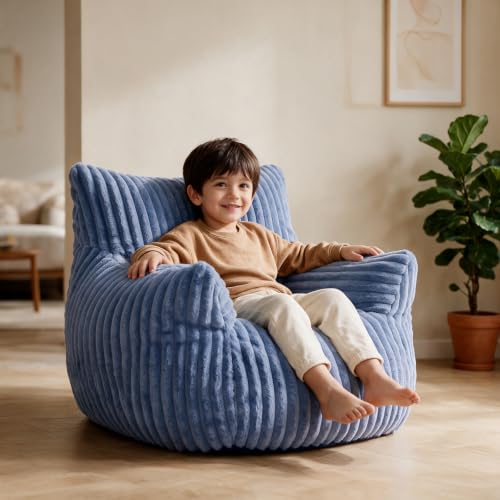
The MaxiBean’s defining feature is a handle, and a handle changes who owns a piece of furniture. This smaller blue bean bag is light enough — the listing emphasises its lightweight build — for a child to carry or drag it from play room to bedroom to living room unaided, and children use furniture they can move far more than furniture arranged for them by adults. It becomes the seat that follows the activity: reading nook in the morning, gaming spot after school, extra place by the sofa when the whole family watches something together.
The filling is memory foam, per the listing, in a faux fur fabric, so the small size does not mean a thin experience; it moulds and supports like its larger fluffy cousin earlier in the guide, in a footprint aimed at children roughly from toddler age into the early teens, as the listing frames it — though, as ever, the tall end of that span will find it a cushion rather than a chair. The blue faux fur splits the difference between the rainbow’s exuberance and the beige’s restraint, playful but placeable in most rooms.
Its limits follow from its virtues. Lightweight means it migrates, and it will be found in doorways, on stairs’ landings, and once, memorably, in most houses, in the bath. Set a house rule about where it may travel if that matters to you. Small also means outgrown: this is a childhood-years purchase, not a decade piece, and its price tier should be judged on that basis. Finally, a handle invites carrying by the handle alone, so check its stitching now and then — it is the hardest-worked seam on the chair.
- Form: small bean bag chair with carry handle
- Filling: memory foam per listing
- Cover: faux fur fabric, blue
- Movement: lightweight — child-portable between rooms
- Suggested homes in listing: bedrooms, playrooms, reading nooks
Strengths
- Carry handle lets children move their own seat independently.
- Memory foam comfort in a compact, tuck-away size.
- Blue colour balances playfulness with placeability.
Trade-offs
- Small size is outgrown by taller, older children.
- Portability means it turns up in unexpected places.
- Handle stitching takes strain and needs occasional checks.
Best for: children who move between rooms and want their seat to come with them. Not suited for: a fixed, stay-in-place main seat for an older child.
A Low Foam Floor Cushion Set — Best Simple Prose-Only Pick
Sometimes the right play room seating is not a product category at all, just thick foam cushions on the floor. We discuss the type without a link because every craft shop, market stall, and home store sells some version, quality is entirely about foam density and cover stitching, and both are things your hands can judge in seconds in person. Expect a budget-to-mid tier for a set thick enough to matter; very cheap thin cushions are place mats pretending to be furniture.
Cushions do jobs the shaped picks cannot. They stack into a corner and vanish. They spread into a circle for a board game or a story with friends. They pad the floor under a climbing frame’s landing zone, line a den, become stepping stones, walls, and cargo in games that bean bags are too shaped to join. For families with several children, a set of cushions seats everyone at once for the price of one statement bean bag, and when one cushion’s cover finally gives up, the set survives its loss without ceremony.
Their weaknesses are the absence of everything the other picks provide. No back support, so long reading sessions migrate elsewhere. No defined personal seat, so the territorial comfort some children love is missing. And loose cushions scatter — the play room tidy-up includes re-stacking them nightly, a small tax some households happily pay and others resent. Judge foam by squeezing: it should resist, then recover, without staying dented. Choose covers you can unzip or wipe, in colours bought for the room you have rather than the one in a catalogue photograph.
- Form: stackable low foam cushions, bought as a set
- Support: floor padding only, no backrest
- Storage: stacks into a corner
- Tier: budget to mid depending on foam thickness
- Buying route: judge foam density by hand in a shop
Strengths
- Seats several children at once for group play and stories.
- Stacks away completely when floor space is needed.
- Joins games as props in ways shaped seats cannot.
Trade-offs
- No back support for longer sitting or reading.
- Scatters across the room and needs nightly re-stacking.
- Thin, cheap versions compress to uselessness quickly.
Best for: group play, dens, and families seating several children on a budget. Not suited for: a child wanting one defined, supportive personal seat.
How Do These Play Room Picks Compare?
One pattern is worth naming before the table: the softer and simpler a pick is, the more households it tends to survive, while the convertible designs repay the families who genuinely use their second and third shapes every single week.
| Pick | Form | Filling or build | Standout trait | Watch out for |
|---|---|---|---|---|
| Fluffy Bean Bag Chair for Kids 2.5FT | Bean bag | Memory foam | Rainbow faux-fur nest | Pile shows crumbs |
| MAXYOYO Kids Bean Bag Chair Beige | Bean bag sofa | Stuffed, shaped | Side pocket, calm colour | Pale fabric marks |
| MAXYOYO 3 in 1 Kids Bean Bag Chair | Convertible | High-density foam | Chair, lounger, floor couch | Fold seams wear first |
| MAXYOYO Kids Sofa Bed Convertible | Sofa bed | Foam, pull-out bed | Sleepover-ready | Largest footprint |
| MaxiBean Bean Bag Chair for Kids Blue | Small bean bag | Memory foam | Carry handle, portable | Outgrown sooner |
| A Low Foam Floor Cushion Set | Cushions | Foam slabs | Stacks and seats a crowd | No back support |
What Size Bean Bag Does Your Child Actually Need?
Bean bag sizing confuses parents because the numbers describe the bag, not the child. A useful rule: seated, your child should sink in enough to feel held, with hips supported and feet able to touch the floor or rest on the bag’s front slope without dangling into space. A bag that is too large swallows a small child into a hollow they must climb out of, which is fun as a game and useless as a seat; a bag that is too small becomes a perch that tips. Where a listing gives an age span, treat its younger end as the comfortable fit and its older end as the squeezable limit, and favour the next size up when your child sits between sizes and the room can take it.
Room size disciplines the choice from the other side. Play rooms accumulate furniture the way pockets accumulate coins, and a giant bean bag in a small room becomes the room. Measure the corner you intend, allow the bag its settled spread rather than its packaged dimensions — soft seating relaxes outward once filled and used — and leave a path around it that does not require climbing over it, however tempting children find that route. The convertible picks help here precisely because their stored shape is their smallest shape.
How Do You Keep Play Room Soft Seating Clean and Safe?
Set the cleaning rhythm before the first spill sets the terms for you. Removable covers should come off on a schedule — monthly in a busy play room — rather than only after incidents, because ground-in crumbs and dust are what make soft seating smell like a play room in the bad sense. Between washes, vacuum the seams and folds, where debris collects, and shake smaller pieces outside when the weather allows. Follow each maker’s washing instructions; faux fur and foam-filled inners each have their own rules, and a hot wash can ruin a cover that a cool one would have saved.
Safety upkeep is mostly inspection. Run your hands over seams and zips every few weeks: a zip that has worked open, a seam beginning to gape, a handle stitch loosening — each is a small fix now and a filling spill, or a child’s access to filling, later. Keep soft seating for babies and sleeping children out of the equation entirely; these are seats for awake, playing children, used with the ordinary supervision play rooms always need. Check each listing’s stated age guidance when it arrives and keep the tags or a photo of them, because six months from now nobody in the house will remember which seat was rated for whom.
What Mistakes Do Families Make Buying Play Room Seating?
The commonest is buying for the photograph — the enormous statement bean bag that fills a catalogue play room and, in a real one, fills the actual room. The second is ignoring the cover: a beautiful non-removable cover on a seat destined for juice, glue, and felt-tip is a countdown, not a furnishing. Third, families buy one seat for several children and are surprised by the politics; soft seating is personal territory in a way a sofa is not, and two modest seats often produce more peace than one magnificent one.
Fourth, do not overlook the floor beneath. Bean bags on hard floors drift and bunch rugs; on deep carpet they sit lower and firmer than expected. Fifth, resist matching the seat to a theme the child will abandon within the year — colours and shapes they can grow within, like the beige and navy picks here, outlast the cartoon phase gracefully. Finally, check the filling before purchase day: a household that hates maintenance should choose foam that holds its shape over beads that need topping up, and a household that loves a mouldable nest should accept the fluffing ritual that comes with it.
How Should a Play Room Seat Grow with Your Child?
The seat that suits a three-year-old’s story time will be asked, within a few years, to host chapter books, handheld games, homework spillover, and eventually a teenager’s friends pretending not to enjoy sitting on the floor. Planning for that arc does not mean buying huge; it means buying honest quality in shapes that age well. The convertible picks stretch furthest along the arc, because a lounger and floor couch remain useful long after a small bean bag becomes a footrest. The sofa bed’s second life as guest sleeping also extends its service well past the play years.
When a seat is finally outgrown, soft furniture has kind afterlives: the smaller bean bag becomes a pet’s bed or a reading cushion in a sibling’s room, cushions migrate to dens and gardens, and a good cover, washed, passes the whole piece to another family. Buying with that chain in mind — sturdy seams, washable covers, colours the next family might also want — is both thrift and courtesy. Play rooms turn over faster than any other room in the house; furniture that can leave gracefully is furniture bought well.
How Do You Arrange Soft Seating So the Play Room Still Works?
A play room needs two kinds of space that fight each other: open floor for building, dancing, and the sprawling games that are childhood’s main industry, and settled corners where a child can withdraw with a book or a puzzle. Soft seating should defend the corners and surrender the middle. Place bean bags and the kids’ sofa along walls and in alcoves, keep the centre clear, and let the portable pieces — the handled MaxiBean, the cushions — be the ones that travel into the open floor for a particular game and travel back again at tidy-up time. Rooms arranged this way reset in minutes, and a room that resets easily gets reset often.
Light and company shape the corners too. A reading seat belongs near the room’s best natural light or a lamp, not in the gloom behind the door. A gaming seat belongs within cable reach of the screen and console, facing them squarely, because a bean bag at an angle to a television produces a cricked neck and an abandoned seat. The sofa bed earns the wall where its pull-out has room to unfold without moving three other things first; discover that geometry on a calm afternoon, not at a sleepover’s bedtime with four excited children watching you rearrange furniture.
Finally, think in zones by age when the room serves a wide span. Younger children’s soft seating near the door keeps them in the traffic of supervision; older children’s corner further in gives them the small sovereignty they crave. The picks in this guide scale across that span — cushions and the small MaxiBean at the younger end, the lounger and sofa bed at the older — so a room can graduate its furniture corner by corner rather than all at once, which is kinder to both the budget and the children’s sense that the room is still theirs.
What Colours and Fabrics Survive Play Room Life Best?
Play rooms are where colour goes to be tested by reality. Mid-tones forgive the most: they hide the grey dust of floor life better than white or beige, and they shrug off the small marks that make black look dusty and tired. Busy patterns hide the most of all, which is the rainbow pick’s secret practical virtue beneath its exuberance — a patterned pile conceals a multitude of crumbs between vacuums. Where a room is shared with adults, the navy and beige picks show the compromise working in both directions: calm enough for the evening, dark or textured enough for the afternoon.
Fabric texture matters as much as shade. Smooth, tightly woven covers wipe clean and release crumbs with a shake; long piles and faux fur trap debris and need the vacuum’s attention, though they repay it with a cosiness no smooth fabric matches. Velvet-soft short piles sit between the two. Whatever you choose, hold the care instructions up against your household’s honesty: a cover that needs gentle specialist cleaning will, in a real play room, simply not get cleaned, and a washable cover washed monthly beats a delicate one admired and avoided. Buy the fabric your laundry habits can keep up with.
There is also the question of the child’s own taste, which in a play room deserves more weight than anywhere else in the house. This room is their territory; a seat in a colour they chose will be used, defended, and loved, while a tasteful seat imposed on them becomes the thing they sit on only when theirs is taken. The shortlist method from the desk chair guide applies here too — adults vet safety, size, and washability, children choose among the survivors. The rainbow bean bag exists in this guide precisely because some children will choose it with their whole hearts, and a play room should contain at least one object chosen exactly that way.
How Much Should a Family Spend on Play Room Seating?
Think in terms of cost per year of service rather than the number at the till. A well-made foam seat that serves from age four to ten, then passes to a sibling, costs very little per year even at a mid tier. A bargain seat whose seams open in the second year costs more, in money and in landfill, however small its price was. The picks here sit mostly at accessible tiers; the sofa bed and the three-in-one ask more because they do more, replacing guest bedding and extra furniture respectively, and they should be judged against the cost of the things they replace rather than against a plain bean bag.
Budget honestly for the second seat as well. Most families who buy one beloved bean bag buy its companion within the year, once sibling arithmetic asserts itself. Planning for two modest seats from the start is often cheaper than one premium seat followed by one resentful duplicate at whatever price the shop happens to charge that month. Cushions remain the great leveller: a stack of them seats the whole play date for the price of a single shaped chair, and no child at a party has ever mourned the absence of a designer bean bag when the floor was soft and the games were good.
When Is a Play Room Seat Ready to Be Replaced?
Soft seating rarely breaks dramatically; it fades. The signs are a filling that no longer recovers after a shake and a rest, seams that have begun to grin at the stress points, a zip that will not stay closed, and a cover that stays tired-looking after a proper wash. Any one of these is a prompt to inspect; a zip or seam failure is a prompt to act the same week, because filling accessible to children is the one genuine hazard this furniture category carries. Retire a seat whose structure has gone, however beloved — children attach to these objects, and a small farewell ceremony beats a midnight filling spill.
Outgrowing is the happier ending and the commoner one. A seat that has become too small is not worn out, and the hand-me-down chain for play furniture is long: younger siblings, cousins, the reading corner of a classroom a parent teaches in, a pet who has been waiting years for exactly this inheritance. Wash the cover, check the seams, and pass it on with its story. The play room will refill with the next size up soon enough — it always does — and the room’s furniture history becomes part of the family’s, one soft landing at a time.
How Do Play Room Seats Handle Guests, Grandparents, and Grown-Ups?
Play rooms host adults more often than their name suggests: a grandparent reading aloud, a parent joining a board game on the floor, a friend staying for coffee while the children rampage. Most picks in this guide are child-sized and child-weighted, and an adult lowering into a small bean bag should do so expecting a floor-level experience and a undignified rise afterwards. That is fine for a story, less fine for a grandparent with a replaced knee. Households that regularly seat adults in the play room should keep one adult-capable option in the room — a sturdy cushion stack at a sensible height, or the family sofa’s end — rather than expecting children’s furniture to stretch beyond its design.
There is kindness in planning this before it is needed. A grandparent who knows there is a proper seat for them visits the play room instead of summoning children to the living room, and the room fulfils its promise as the house’s shared ground. Check any listing’s stated weight guidance before assuming a seat suits an adult, respect it where given, and where it is not given, assume the seat is a child’s and treat adult use as brief and careful. The furniture is not being precious; it is being honest about what it was built to hold.
What Role Does Soft Seating Play in Quiet Time?
Every play room needs a way to lower its own volume, and soft seating is the mechanism. A defined cosy corner — one bean bag, one lamp, one small shelf of books, perhaps the beige pick’s pocket holding the current story — gives a child somewhere to go when the room’s energy exceeds them, without leaving the room or being sent away. Teachers call this a calm corner; at home it needs no name, just a seat soft enough and a spot sheltered enough that sitting there feels like a choice rather than an exile. Children use such corners more wisely than adults expect, often taking themselves there before a meltdown rather than after one.
Building the corner is mostly a matter of what you leave out: no screens stored there, no toy boxes, no through-traffic. The fluffy rainbow pick and the MaxiBean both suit the role — one as the fixed nest, one as the seat a child fetches to make a quiet spot wherever the house is calmest. A blanket folded over the seat’s back completes it. In a guide full of buying advice, this may be the most valuable paragraph: the seat matters less than the permission it represents, and the cheapest pick here, arranged with intent, will do the job beautifully.
A Short Word on Bean Bags and Household Pets
In many homes the play room seat’s second user has four legs. Cats claim faux fur with a speed that suggests prior arrangement, and dogs regard a floor-level foam bed as a gift addressed to them. None of the picks here is sold as pet furniture, and claws are hard on every cover in this guide, faux fur especially. If your animals will share the seat — and they will — choose the smoothest cover your children will accept, keep a washable throw over the favourite spot, and accept the vacuum as a permanent resident of the room. A seat that survives both children and pets with its seams intact has earned every penny of its tier, and the hand-me-down chain at the end of its life may well end, fittingly, as the pet’s own bed.
Final Recommendation
Start with the seat your play room will use daily. For most families that is the Fluffy Bean Bag Chair for Kids 2.5FT: memory foam comfort, a defined corner of one’s own, and a texture children seek out when they need to settle. Choose the beige MAXYOYO where the room is shared with adults, the three-in-one where floor space must multitask, the sofa bed where sleepovers are a standing feature of your calendar, and the little blue MaxiBean for the child who carries their comfort from room to room. Keep plain cushions in mind when the crowd is the point. Whatever you choose, check its zips, wash its cover, size it to the child in front of you — and then let the play room do what it exists to do, with somewhere soft for everyone to land when the game finally runs out of breath.
Frequently Asked Questions
Are bean bag chairs suitable for toddlers?
Only with care and supervision, and always according to the individual listing’s age guidance, which you should read before ordering and keep after delivery. Soft seating is for awake, seated play; babies and toddlers should never sleep on bean bags, and the youngest children need an adult nearby, as they do throughout a play room. When in doubt, the floor cushions with an adult present are the conservative choice.
Which filling is better, memory foam or high-density foam?
They do different jobs. Memory foam moulds around a child and suits nests and reading corners; it is what the fluffy rainbow pick and the MaxiBean use. High-density foam holds deliberate shapes, which is why the convertible picks use it to become loungers and couches. Choose by the job you need done, not by an abstract ranking.
How do I stop a bean bag from going flat?
Foam-filled designs recover their loft with a shake and a few minutes of air; work the filling back toward the centre when you tidy the room. Keep covers washed and fully dry before refitting, since damp filling clumps. If a listing offers replacement filling or a refill route, note it at purchase time rather than hunting for it in two years.
Can play room bean bags be used outdoors?
These picks are indoor furniture. A dry afternoon on a patio will not ruin most fabrics, but damp grass, rain, and strong sun will age covers and fillings quickly, and indoor faux fur is nobody’s idea of garden upholstery. Keep them inside, and let the prose-only cushions be the ones that travel to the garden if any must.
Where should soft seating go in a small play room?
Corners first, walls second, middle never — at least not permanently, and never in the swing of the door, where a soft seat becomes a soft barricade that every entering adult trips over in the dark. In a small room the convertible picks earn their premium because their stored footprint is their smallest, and the cushions earn theirs by stacking into a tower a child can climb to tidy. Leave one clear route from door to window that crosses no furniture; fire drills aside, that path is how the room breathes, how adults cross it with laundry baskets, and how a sleeping child gets carried out of it at the end of a film without an obstacle course. Small rooms furnished kindly feel bigger than large rooms furnished greedily, and soft seating, being movable, is where that kindness starts.
How long does delivery-day fluffing take for foam bean bags?
Foam-filled seats often arrive compressed for shipping, and the listing usually says how long the filling needs to expand — commonly a day or two in a warm room, helped by breaking up clumps with your hands as it loosens and by turning the piece over halfway through so the far side gets its share of air and encouragement. Do not judge the seat’s final size or firmness in its first hour out of the packaging; a bean bag assessed too early gets returned by families who would have loved it on day three. Plan the purchase a few days ahead of the birthday or the sleepover, not the night before, and let the foam finish its slow magic in a corner where small helpers cannot assist it prematurely.
One big seat or two smaller ones for siblings?
Two smaller ones, in most houses. A personal seat ends more arguments than a shared throne starts, and smaller seats are easier to move, wash, and eventually pass on. The exception is the sofa bed, whose shared daytime seat and sleepover bed justify its single, larger footprint.
Related Guides
A play room rarely gets furnished in isolation. The study corner usually follows, and Best Living Room Chairs shows how the accent-chair thinking in the family room connects to the way children claim their own seats. For the practical side of chairs on hard floors, Best Chair Risers for Chairs That Sit Too Low covers the fittings that protect floors and fix heights elsewhere in the house. Grown-up seating gets its own treatment in Best Barber Chairs, a useful read if a home salon is also on your list. And when the play room doubles as a guest space for the smallest visitors, Best Blankets for 2-Year-Olds completes the sleepover kit.


