What's inside
- Key Takeaways
- Quick Picks
- How Did We Choose These Classroom Chairs?
- How Do You Match Seat Height to Students and Desks?
- Why Do Stacking and Glides Matter More Than Looks?
- How Do the Six Classroom Options Compare?
- How Should a School Plan a Chair Purchase?
- How Do You Keep a Classroom Chair Fleet Alive?
- What Mistakes Do Schools Make When Buying Classroom Chairs?
- What Do Examination Rooms and Halls Ask of a Chair?
- How Should Chairs Serve Students Who Need Something Different?
- How Do Chairs Shape the Sound and Movement of a Lesson?
- How Should a School Trial Chairs Before a Big Order?
- What Does the Per-Chair Arithmetic Really Look Like?
- How Do Classroom Chairs Interact With Desks, Tables and Storage?
- What Should Happen to Chairs at the End of the School Year?
- How Do You Choose Between the Three 18-Inch Options?
- Final Recommendation
- Frequently Asked Questions
- Related Guides
As an Amazon Associate I earn from qualifying purchases. This post may contain affiliate links at no extra cost to you.
cottageverdict.com is reader-supported. When you buy through links on our site, we may earn an affiliate commission.
Where to buy: each linked chair set below leads to its Amazon listing, where you can check price on Amazon and confirm the seat height, pack size, glide type and stated capacity before ordering. One traditional design is discussed in prose only, as the guide’s reference for what stackable plastic chairs replaced.
The best chairs for a classroom are bought by arithmetic before they are bought by taste. Seat height must match the age of the student and the height of the desk, in three distinct sizes across a school career. Chairs must stack, because classrooms are cleaned, rearranged and borrowed from. Surfaces must survive daily wiping, glue, paint, and the particular chemistry of a water bottle left leaking in June and found in September. And they are bought in packs, at a per-chair cost a budget committee can defend, in quantities that assume a few will be lost to the mysterious attrition that every school knows and no inventory has ever explained. This guide is organised around that arithmetic: three seat heights, five linked pack options, and one prose-only elder statesman for contrast.
The heights come first, because they are the specification that cannot be fudged. A 10-inch seat serves preschool and early years children, roughly the 3-to-6 band the listing states, whose feet must reach the floor for the sitting to be stable and the standing-up to be safe. A 14-inch seat serves elementary children, listed at 6 to 9 years. An 18-inch seat is the adult-proportioned chair of middle school, high school and beyond, listed for ages 12 and up in one pick and built to an 880 lb stated capacity in another. Buy the height for the children you have, measured against your desks, and resist the temptation to buy one size for the whole school and let the small children dangle.
The two glide families in this pool deserve an introduction too. Ball glides — the colourful ball feet on the FDP elementary and preschool chairs — roll and pivot gently, forgive uneven floors, and are kind to hard surfaces while giving young children a chair that moves a little rather than scraping. Swivel glides, on the FDP 18-inch, self-level on imperfect floors and suit the heavier, older end of the school. Both exist because classroom floors are rarely the showroom’s plane, and a chair that rocks on three legs teaches fidgeting better than any lesson plan.
Key Takeaways
- Buy by seat height: 10 inches for preschool (listed ages 3–6), 14 inches for elementary (6–9), 18 inches for middle school and up (12+).
- All five linked picks are stackable shell chairs sold in packs of four, five or six — classroom furniture is bought in multiples.
- Ball glides on the younger chairs forgive uneven floors and protect hard surfaces; swivel glides on the 18-inch FDP self-level for older students.
- The Flash Furniture Hercules carries the pool’s highest stated capacity at 880 lbs, in a five-pack.
- Match chair height to your existing desks before ordering; a correct chair at the wrong desk is still the wrong height.
- The prose-only wooden school chair shows what the stackable shell replaced: repairable and handsome, but heavy, unstackable and bought one at a time.
Quick Picks
| Pick | Seat height | Badge | Why it is here |
|---|---|---|---|
| Learniture Structure Stackable School Chairs 18 Inch | 18 in | Best Classic 18-Inch Four-Pack | The straightforward stackable standard for older students, in black, four to a pack. |
| FDP 18 Inch School Stack Chairs 4-Pack | 18 in | Best 18-Inch with Swivel Glides | Self-levelling swivel feet for ages 12 and up, in navy, for classrooms with imperfect floors. |
| Flash Furniture Hercules Stack Chairs 5-Pack | 18 in class | Best Heavy-Duty Stack Chair | An ergonomic shell on a black frame with an 880 lb stated capacity, five to a pack. |
| FDP 10 Inch School Stack Chairs 6-Pack | 10 in | Best for Preschool | Ball-glide feet and a sand finish for ages 3 to 6, six to a pack for early years rooms. |
| FDP 14 Inch School Stack Chairs 4-Pack | 14 in | Best for Elementary | The middle height for ages 6 to 9, with ball glides, in navy, four to a pack. |
| Traditional Wooden-Frame School Chair | varies | Prose-Only Reference | The repairable wooden classic, included to mark what modern stackable shells traded away and what they gained. |
How Did We Choose These Classroom Chairs?
We chose a ladder, not a winner. A classroom guide that crowned one chair would fail every school whose children are the wrong age for it, so the picks were selected to cover the three standard heights with at least one strong option each, and three options at the 18-inch height where schools buy most heavily and argue most. Within each height we weighted the unglamorous virtues: a shell that stacks without a wrestling technique, glides matched to school floors, a frame that will not develop the wobble by half-term, and pack sizes that map onto real classroom counts.
Stated figures are reported as listed — the Hercules’ 880 lb capacity, the FDP age bands of 3–6, 6–9 and 12+, the pack counts of four, five and six. Where the pool’s material does not state a figure, this guide does not invent one. We also kept the prose-only wooden chair in the line-up deliberately: schools still own thousands of them, mixed fleets are the reality in most buildings, and a buying guide that pretends the past away cannot advise on the commonest real decision, which is whether to keep repairing the wooden stock or replace it in stages with shells.
How Do You Match Seat Height to Students and Desks?
The test is the seated child, and it has three checkpoints. Feet flat on the floor, not dangling and not perched on the chair’s rung unless the rung is genuinely at foot height. Knees at roughly a right angle, with the seat’s front edge not pressing into the back of the leg. And the desk’s surface arriving at the child’s mid-torso, so forearms rest on it without shoulders climbing. A chair that passes all three lets a student sit through a lesson without the slow migration — sideways, kneeling, one leg tucked — that teachers read as restlessness and is usually furniture.
Use the listed bands as the starting map: 10-inch chairs for the 3-to-6 rooms, 14-inch for 6-to-9, 18-inch from 12 upward, and treat the 9-to-12 gap as the judgement call it is — taller elementary children often graduate early to the 18-inch at higher desks, and many schools run a mixed fleet in those years precisely because children refuse to grow in step with procurement categories. Measure your desks as part of the same exercise: the chair and the desk are one system, and replacing one without measuring the other is how a school ends up with beautiful chairs at the wrong altitude.
Why Do Stacking and Glides Matter More Than Looks?
Because a classroom chair’s hardest work happens when no child is in it. It is stacked at cleaning time, unstacked at rearrangement time, carried to the hall for assemblies, lent to the classroom whose chairs have gone on an excursion, and stood on — against every rule — by someone reaching a high shelf. A chair that stacks cleanly, in a stable tower of a sensible height, with a shell that does not marry its neighbour, saves staff time every single week. A chair that stacks badly gets dragged instead, and dragging is what kills glides, floors and tempers in that order.
Glides are the chair’s diplomacy with the floor. Ball glides roll a little and pivot, which suits young children who shuffle their chairs constantly and floors that would rather be rolled on than scraped. Swivel glides tilt to meet an uneven surface, keeping four points of contact on the floors of older buildings where level is an aspiration. Bare or worn glides are the maintenance item to watch: a stack chair whose glides have worn through becomes a floor-scratching, rocking nuisance, and replacing glides is the cheapest fleet-wide refresh a school can buy.

Learniture Structure Stackable School Chairs 18 Inch — Best Classic 18-Inch Four-Pack
The Learniture Structure is the guide’s baseline 18-inch chair: a stackable shell seat in black, sold four to a pack, from a maker whose name is a fixture in school procurement. Nothing about it is experimental, and that is the recommendation. An 18-inch seat serves the oldest students and adult-sized sitters, and a school buying for a secondary classroom, a staffroom overflow or a sixth-form common room wants exactly this: a known shape, a stackable frame, a colour that hides a term’s evidence, and a pack size that divides neatly into classroom rows.
Its plainness is also its fleet virtue. Black shell chairs from the mainstream makers interoperate visually with the chairs a school already owns, so a staged replacement programme does not produce a patchwork room. Buy these to begin a fleet, to extend a fleet, or to hold the line in the rooms where the chairs take the hardest daily use and nobody is asking them to be beautiful. The FDP below adds self-levelling glides for difficult floors and the Hercules adds stated capacity; the Learniture’s claim is the centre ground, held competently.
- Seat height: 18 inches
- Pack: 4 chairs
- Form: stackable shell seat, black
- Students: older students and adult-sized sitters
- Fleet role: the standard replacement and extension chair
Strengths
- A mainstream standard that blends with existing school fleets.
- Stackable shell keeps cleaning and storage simple.
- Four-packs divide neatly into rows and classrooms.
Trade-offs
- No specialist glide story for very uneven floors.
- Black shows dust and pale scuffs readily between cleans.
- One height only; younger rooms need the smaller picks below.
Best for: secondary classrooms and staged fleet replacement. Not suited for: primary-age children, whose feet will not reach the floor.

FDP 18 Inch School Stack Chairs 4-Pack — Best 18-Inch with Swivel Glides
FDP’s 18-inch chair distinguishes itself at the feet: swivel glides that self-level, on a stack chair listed for middle and high school students aged 12 and up, in navy, four to a pack. The self-levelling foot is a small mechanism with an outsized classroom effect. On the uneven floors of real school buildings — the Victorian block, the portable classroom, the hall that doubles as a gym — a fixed-glide chair finds its three-legged rocking point and keeps it all year, while a swivel glide tilts to meet the floor and gives the student a stable seat without the folded-paper-under-one-leg folk remedy.
Choose this pick where the building is old, the floors are honest about it, and the students are old enough to notice a rocking chair and weaponise it rhythmically during examinations. The navy finish is the traditional alternative to black, marginally kinder to dust, and the four-pack sizing suits classroom-by-classroom rollouts. For homeschool settings — the listing names them too — a single pack equips a family learning space with chairs the children will not outgrow until they leave.
- Seat height: 18 inches
- Pack: 4 chairs, navy
- Glides: swivel, self-levelling
- Listed students: ages 12 and up, classroom and homeschool
- Form: stackable shell seat
Strengths
- Swivel glides end the rocking-chair problem on uneven floors.
- Age band matches the secondary years precisely.
- Navy finish hides the week’s evidence better than black.
Trade-offs
- Swivel glides are a moving part that wears and wants inspection.
- Four to a pack means more packs for a full school rollout.
- Too tall for elementary children by design.
Best for: older students in older buildings with imperfect floors. Not suited for: primary classrooms or brand-new level floors where the glides earn nothing.
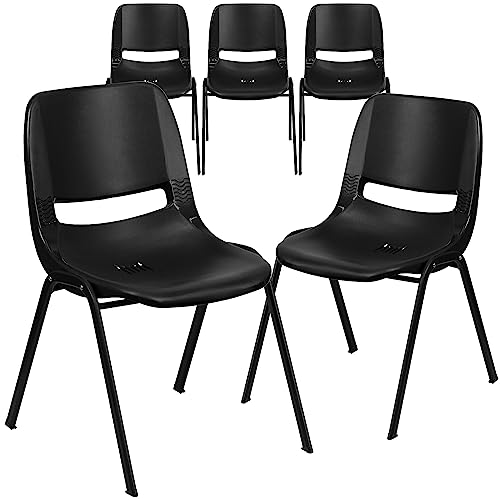
Flash Furniture Hercules Stack Chairs 5-Pack — Best Heavy-Duty Stack Chair
The Hercules makes the heavy-duty case in the 18-inch class: an ergonomic shell seat on a black frame, five to a pack, with a stated weight capacity of 880 lbs — a figure that belongs to the chair’s frame engineering and tells a school, in one number, that this is the chair for the rooms where chairs are treated as climbing equipment with a seating function. Flash Furniture sells heavily into the events and education markets, and the Hercules line is its workhorse: contoured enough to sit in for a lesson, plain enough to stack in a tower and forget.
The five-pack is a small but real convenience, shifting the arithmetic for a thirty-chair classroom from eight packs to six. The ergonomic shell contour matters at this age band more than at any other: older students sit longest, in the examination years, and a shell that supports rather than merely receives them is the difference between furniture that disappears under a lesson and furniture that becomes the lesson’s background ache. For halls, exam rooms and the classrooms of the largest students, this is the 18-inch pick with the strongest shoulders.
- Seat height: 18-inch class
- Pack: 5 chairs
- Stated capacity: 880 lbs
- Form: ergonomic shell on a black frame, stackable
- Students: older students, exam rooms and halls
Strengths
- The highest stated capacity in the guide, by a wide margin.
- Five-packs simplify classroom-count arithmetic.
- A contoured shell suits long examination sittings.
Trade-offs
- The heavy-duty build is heavier to stack and carry.
- Its strength is wasted in gentle early-years settings.
- Black frame and shell is the most utilitarian look here.
Best for: halls, exam rooms and classrooms of older, larger students. Not suited for: preschool or elementary rooms, where its size defeats it.

FDP 10 Inch School Stack Chairs 6-Pack — Best for Preschool
At the other end of the school, the FDP 10-inch chair is built for the smallest students: a stack chair with ball glides, in a sand finish, six to a pack, listed for preschool, daycare and children aged 3 to 6. Ten inches puts a small child’s feet on the floor, and everything about early-years sitting follows from that contact — stability getting in and out, independence at the table, and a chair the child can move a little without an adult’s intervention. The ball glides, colourful little feet, suit the age twice over: they are gentle on floors and they turn the chair’s small movements into rolling rather than screeching.
The six-pack recognises early-years economics, where a room may need twenty small chairs and the budget arrives in one line. Sand is a forgiving colour for a room whose curriculum includes paint. Stackability matters here in a specific way: early-years rooms are rearranged daily between table work, floor play and nap layouts, and chairs that stack into a corner in one trip are chairs that get stacked, rather than chairs that colonise the room’s edges. For a home playroom or a homeschool corner for one small child, a pack is more chairs than you need — share it with another family, or accept the spares as the room’s visiting-chair fleet.
- Seat height: 10 inches
- Pack: 6 chairs, sand
- Glides: ball glides
- Listed students: ages 3 to 6, preschool and daycare
- Form: stackable shell seat
Strengths
- The correct low height for the youngest students’ feet and independence.
- Ball glides are floor-kind and quiet in a busy room.
- Six-packs match early-years room counts and budgets.
Trade-offs
- Children outgrow the height by design; plan the 14-inch succession.
- Ball glides can wander on slopes; keep them on level floors.
- A full pack is oversupply for a single-child home.
Best for: preschool, daycare and kindergarten classrooms. Not suited for: elementary children, who need the 14-inch height.

FDP 14 Inch School Stack Chairs 4-Pack — Best for Elementary
The 14-inch FDP is the middle rung of the ladder, and in many schools the hardest-working: listed for elementary children aged 6 to 9, with ball glides, in navy, four to a pack. Elementary classrooms ask the most of their furniture across a day — table work, group work, reading corners, lunch in some schools, and a constant low-level rearrangement as lessons change shape — and a chair at this height must be light enough for a seven-year-old to carry two-handed and tough enough to be carried that way ten thousand times.
The ball glides continue from the preschool pick, and at this age they earn their keep on the shuffle: elementary students adjust their chairs constantly, and a chair that rolls slightly rather than juddering teaches quieter habits by example. Navy matches the 18-inch FDP above, which lets a school run one colour family across its whole FDP fleet from elementary to secondary — a small aesthetic discipline that makes mixed rooms and borrowed chairs look intentional. Buy these for the elementary block, and keep one pack in reserve: the mid-year arrival and the mysteriously vanished chair are certainties of school life, not contingencies.
- Seat height: 14 inches
- Pack: 4 chairs, navy
- Glides: ball glides
- Listed students: ages 6 to 9, elementary
- Form: stackable shell seat
Strengths
- The correct middle height for the elementary years.
- Light enough for children to move their own chairs safely.
- Colour-matches the FDP 18-inch for a one-family fleet.
Trade-offs
- Tall nine-year-olds will graduate early to the 18-inch.
- Ball glides wear with dragging; teach lifting early.
- Four-packs mean steady reordering for large schools.
Best for: elementary classrooms and mixed-age family learning spaces. Not suited for: preschoolers or secondary students at either extreme.
Traditional Wooden-Frame School Chair — Prose-Only Reference
The wooden school chair is the ancestor in the room: a solid timber frame, a shaped wooden seat, built one at a time, repairable by any competent workshop, and heavy in every sense. It is included in prose, without a link, because it represents the fleet most schools are actually managing alongside their modern shells — and because its virtues are real. A wooden chair can be re-glued, re-screwed, sanded and re-varnished across decades; it carries a school’s history in its initials carved and sanded out again; and for a small classroom, a heritage setting or a home schoolroom, its warmth and permanence are worth money that a shell chair cannot argue with.
Its costs are the mirror of the shells’ virtues. It does not stack, so it stores at full footprint. It is bought singly at a craftsman’s tier rather than in budget packs. Its weight makes the daily rearrangement of an early-years room an adult job. And its sizes are whatever the maker made, rather than a standardised ladder of heights. The sensible fleet strategy for most schools is the one already happening in most schools: wooden chairs retire gradually to the rooms that suit them — the library, the small seminar room, the head’s study — while the high-turnover classrooms convert to the stackable heights above. Honour the ancestor; do not ask it to do the descendants’ shift work.
- Form: solid wooden frame and seat, single chairs
- Tier: premium, described qualitatively
- Stacking: none — stores at full footprint
- Maintenance: repairable and refinishable for decades
- Fleet role: libraries, small rooms and heritage settings
Strengths
- Repairable almost indefinitely; the longest-lived chair here.
- Warm, permanent presence that suits quiet rooms.
- A single chair can be bought to match an existing set.
Trade-offs
- No stacking makes storage and cleaning laborious.
- Heavy for children to move and for staff to rearrange.
- Bought singly at a tier far above the pack chairs’ per-seat cost.
Best for: libraries, small seminar rooms and home schoolrooms with permanence. Not suited for: high-turnover classrooms that rearrange daily.
How Do the Six Classroom Options Compare?
| Pick | Height | Pack | Glides | Listed ages |
|---|---|---|---|---|
| Learniture Structure Stackable School Chairs 18 Inch | 18 in | 4 | Standard | Older students |
| FDP 18 Inch School Stack Chairs 4-Pack | 18 in | 4 | Swivel, self-levelling | 12+ |
| Flash Furniture Hercules Stack Chairs 5-Pack | 18 in class | 5 | Standard | Older students; 880 lb stated capacity |
| FDP 10 Inch School Stack Chairs 6-Pack | 10 in | 6 | Ball glides | 3–6 |
| FDP 14 Inch School Stack Chairs 4-Pack | 14 in | 4 | Ball glides | 6–9 |
| Traditional Wooden-Frame School Chair | Varies | Single | Fixed feet | All, by size |
Read the table by the age column first and the height column second; they are the same decision stated twice. The pack and glide columns then tune the purchase to your building: its floors, its storage, its cleaning routine and its headcount. A school that buys its heights correctly and its glides honestly has solved classroom seating; everything after that is colour.
How Should a School Plan a Chair Purchase?
Count three things before opening a catalogue: students, desks and spares. Students by room and by age band, because the heights follow the children. Desks by height, because the chair serves the desk as much as the child, and a school replacing desks next year should sequence the chairs after them. Spares by experience — every school loses chairs to breakage, borrowing that becomes annexation, and the hall that never gives them back — and a reserve of one pack per height, kept in the store rather than deployed, is the difference between a mid-year problem and a mid-year shrug.
Then buy in the order the building feels it. The rooms with the oldest, wobbling stock first; the exam hall before the examination season, not during it; the early-years rooms at the summer’s start, so small chairs are part of the September room the new children meet. Keep one chair from each new batch unissued for the first fortnight if you can, as the comparison standard and the warranty witness. And record what you bought, in the plain asset-register way: maker, height, colour, pack count, date. The next purchaser — who may be you in four years, with no memory of this term’s decisions — will bless the record.
How Do You Keep a Classroom Chair Fleet Alive?
The maintenance of shell chairs is a rhythm of small attentions. Weekly, chairs are stacked for cleaning anyway, and that is the moment to spot the cracked shell, the missing glide and the frame that has begun to flex. Termly, work through the fleet with a cloth, a screwdriver for the chairs that take one, and a bag of replacement glides; glide replacement is the highest-value maintenance in this entire category, restoring floor manners and stability for pennies per chair. Shells wipe clean with ordinary cleaners; the enemies are solvent abuse, which clouds plastic, and pressure washers, which should be kept for the playground.
Retire chairs on evidence, not age: a shell cracked at a stress point, a frame that no longer stacks true, a chair that rocks after its glides are renewed. A retired stack chair has honourable second careers — the caretaker’s store, the stage’s edge, the garden classroom — before it has no career at all. Schools that run this rhythm find their fleets lasting far beyond the budget line that bought them, which is the quiet arithmetic that makes the pack prices in this guide look better every year.
What Mistakes Do Schools Make When Buying Classroom Chairs?
The first is buying one height for the whole school, usually the 18-inch because it is the easiest to find, and sentencing six years of children to dangling feet. The second is forgetting the desks, ordering chairs against a memory of the furniture rather than a measurement of it. The third is buying to the exact headcount with no spares, guaranteeing that the first breakage becomes a child on a borrowed chair from another height band, sitting at the wrong altitude until the next budget round. The fourth is choosing by the showroom sit — an adult’s thirty seconds — rather than by the specifications that decide a chair’s school life: stacking, glides, cleanability and stated capacity.
Fifth, schools mix colours and makers across years of small orders until every room is a patchwork that no one chose; a fleet standard, written down, prevents it. Sixth, they overlook the staffroom and the hall, where the same chairs serve adults at events and examinations, and where the Hercules’ stated capacity earns its keep in a way a preschool chair never will. A classroom chair purchase is a small piece of institutional planning, and it rewards being treated as one.
What Do Examination Rooms and Halls Ask of a Chair?
Duration and silence. An examination candidate sits longer without moving than any other student in the building, in a room where every scrape is public, so the hall fleet wants the contoured shell and the stated capacity of the Hercules, glides in perfect order, and chairs inspected before the season with the seriousness of a stage manager. A chair that fails mid-examination — a glide lost, a shell cracking under a shifting candidate — becomes part of that student’s story of the day, and schools owe their candidates furniture that stays out of the story entirely. Stack the hall chairs in counted towers after each use, store them under cover, and let the hall fleet be the school’s best-kept chairs rather than its overflow, because no other room tests them in public.
Events ask the same fleet for a different virtue: speed. A chair that stacks fast, carries two to a trip safely, and presents a uniform face to an audience of parents is the chair that makes a school concert feel organised before a note is played. The 18-inch picks all serve here; the discipline is in the storing and the counting, not in the model name.
How Should Chairs Serve Students Who Need Something Different?
Every school contains students whom the standard chair serves imperfectly: the very tall fourteen-year-old whose knees have outgrown the 18-inch’s desk pairing, the larger student for whom the Hercules’ stated capacity is not a statistic but a reassurance, the left-handed writer in a room of tablet-arm chairs — a reason this guide’s picks are all open chairs rather than tablet designs — and the student whose concentration survives better in a chair that is exactly, boringly stable. The fleet answer is variety at the margins: a few chairs of the neighbouring height, a few heavy-duty chairs distributed without ceremony, and teachers empowered to swap a chair for a child without a requisition form. This guide offers furniture guidance in general terms; a student’s individual needs are a conversation between the school and the family, and the right chair is the one that conversation chooses from a fleet broad enough to contain it.
There is a dignity principle worth stating plainly. A different chair should arrive in a classroom as furniture, not as an announcement. Fleets that include the heavy-duty and alternative-height chairs as ordinary stock — present in every room, used by whoever they suit — achieve that dignity by inventory rather than by exception, and it costs nothing beyond planning.
How Do Chairs Shape the Sound and Movement of a Lesson?
Thirty chairs moving at once is a classroom’s weather. Glides in good order make that weather quiet; worn glides make it a daily thunderstorm of scrapes that teachers shout over and students learn to ignore, at the cost of everyone’s nerves. Ball glides at the younger heights genuinely change the acoustic of a room — chairs roll into place for group work and roll back, in a murmur rather than a clatter — and swivel glides keep older students’ chairs from the rhythmic rocking that becomes a percussion section during quiet work. When a school complains that a classroom is unsettled, the chair fleet’s feet are worth inspecting before the children are blamed; furniture noise is a behaviour policy written in plastic.
Movement matters the other way too. Modern lessons rearrange rooms constantly, and chairs light enough for their students to carry — true of the FDP picks at their heights — turn rearrangement into a thirty-second student job instead of a teacher’s furniture removal service. Teach the carry early: two hands, chair lifted not dragged, stacked with care. A class that can reset its own room is a class whose furniture was chosen correctly, and the lesson time saved across a year would buy the fleet twice over.
How Should a School Trial Chairs Before a Big Order?
Buy one pack first and put it in the hardest room you have: the class with the reputation, the floor with the slope, the teacher with the standards. A term in that room is a more honest review than any catalogue, including this guide. Watch the stacking at cleaning time, ask the caretaker — the person whose opinion on school furniture is worth the most and is consulted the least — and sit in the chairs yourself through a whole parents’ evening. Check the shells after the term for the stress whitening that precedes cracks, work every glide, and stack the pack to its full tower and back down. A chair that survives its trial term unmarked and uncomplained-about has earned the fleet order; a chair that has not has saved the school a building’s worth of regret for the price of four chairs.
Run the same trial discipline at each height, because a maker’s 10-inch and 18-inch chairs are different objects sharing a surname. Schools that standardise on one maker for the whole ladder — as the FDP picks here allow across all three heights — gain interchangeable looks and one glide-buying routine, but the standardisation should be the conclusion of three trials, not a substitute for them.
What Does the Per-Chair Arithmetic Really Look Like?
Schools buy chairs the way airlines buy seats: the headline price is the beginning of the story, not the story. Divide honestly — pack price by chairs, then divide again by the years the fleet rhythm in this guide can honestly promise, and the stackable shells’ case makes itself against both the disposable bargain chair that cracks in its second year and the beautiful wooden chair whose per-seat cost belongs to a different budget conversation. Add the caretaker’s time, the glide replacements and the floor repairs a bad fleet causes, and the middle of the market — where every linked pick in this guide lives — is revealed as the economy option wearing a sensible disguise.
The false economy to avoid is the chair bought below that middle: a shell too thin to stack without flexing, glides that are decorative, a capacity figure nobody states. It will be replaced inside the budget cycle that bought it, and the school will have paid twice for the same seat. Committees respond to that argument in those terms — cost per seated year — better than to any plea about quality in the abstract, and it happens to be true.
How Do Classroom Chairs Interact With Desks, Tables and Storage?
A chair is bought into a system. Its height serves the desk, as this guide has insisted, but its width serves the table’s places — how many chairs fit along the standard classroom table without a daily negotiation of elbows — and its stack serves the store cupboard, whose door width and depth decide the tower’s maximum more honestly than the maker’s stacking claim does. Measure the store as part of the purchase: a fleet that stacks twelve high in the brochure and six high in your cupboard has half the storage virtue you paid for. Check also the chair’s behaviour under the table at cleaning time, since many schools park chairs seat-down on desktops for floor washing, and a shell whose back or glides mark the desktop trades one maintenance problem for another.
Colour belongs to the system too. One colour family across a school’s fleet — the FDP navy runs through two heights here, and black covers the rest — lets borrowed chairs disappear into any room, lets a hall set for an event look deliberate, and lets the caretaker’s replacement packs match without a colour archaeology project. Patchwork fleets are not a moral failure, but they are a daily small untidiness that a written standard prevents for free.
What Should Happen to Chairs at the End of the School Year?
The summer is the fleet’s annual service, and schools that use it rarely face September surprises. Every chair stacked, counted and inspected; shells washed properly rather than wiped; glides renewed wholesale where wear is general, since a glide costs less than the floor it protects; frames checked for the flex that announces retirement; and the count reconciled against the register, with losses investigated while memories of the summer term’s borrowings are still warm. Retired chairs leave by the honourable routes described earlier, and the reserve packs are topped back up to strength while suppliers are quiet and delivery is quick.
Do the same, in miniature, at each term’s end, and the fleet’s condition becomes a trend the school manages rather than a crisis it discovers. Classroom chairs are among the most-used objects in public life and the least thanked; a summer hour per classroom is thanks enough, and it pays for itself by October.
How Do You Choose Between the Three 18-Inch Options?
Since the oldest band has three linked candidates, a direct comparison is owed. The Learniture is the fleet standard: buy it when the rooms are ordinary, the floors are decent, and the purchase is part of a long replacement programme where blending matters more than any single feature. The FDP 18-inch is the floor specialist: buy it when the building is old, the portable classrooms rock their furniture, or the caretaker’s report uses the word “wobble” — its swivel glides are the only mechanism in the trio aimed at the floor itself. The Hercules is the endurance specialist: buy it for halls, examination rooms and the classrooms of the oldest and largest students, where its stated 880 lb capacity and contoured shell answer the two demands those rooms make, which are strength and long-sit support. A large school may honestly buy all three, deployed by room, and the fleet will look unified enough in black and navy for the differences to read as planning rather than accident.
Final Recommendation
Buy the ladder. For preschool rooms, the FDP 10-inch six-pack puts the smallest feet on the floor at the friendliest pack arithmetic. For elementary, the FDP 14-inch carries the middle years with the same ball-glide manners and a colour that matches the fleet above it. For secondary and beyond, choose among the 18-inch three by your building: the Learniture for the standard fleet, the FDP with swivel glides where the floors are uneven, and the Hercules where capacity and examination-season endurance rule. Keep the wooden elders in the quiet rooms that suit them, hold a pack of each height in reserve, and renew the glides before you renew the chairs. A school seated that way has solved a problem its students will never know it had — which is the highest achievement furniture in a classroom can reach.
Frequently Asked Questions
What seat height should I buy for a mixed-age classroom?
Buy for the majority, and hold a few chairs of the neighbouring height for the outliers at either end. A room of mostly 7-year-olds wants the 14-inch fleet, with two or three 10-inch chairs for the smallest and, in time, an 18-inch or two for the tallest. Uniformity is tidy; fit is kind, and children remember kind.
How many spare chairs should a school keep?
One pack per height in use is a sound reserve for most schools — enough to absorb breakages, mid-year arrivals and the hall’s permanent borrowings without raiding another classroom’s set. Schools with large event programmes should hold more at the 18-inch height, where adult events draw on the same fleet.
Are ball glides or swivel glides better?
They solve different floors. Ball glides roll gently and suit the younger heights, where chairs shuffle constantly and floors are usually modern and level. Swivel glides self-level and suit older buildings and older students. Match the glide to the floor you have, and inspect both kinds termly; a worn glide of either family is a floor’s enemy.
Can these chairs be used outdoors?
Briefly, for an outdoor lesson on a dry day, shell chairs travel happily. As permanent outdoor furniture they will weather — plastic chalks in sun and frames prefer dry storage — and the school’s fleet money is better protected by bringing them in. The wooden chair, for all its virtues, dislikes rain most of all and should stay a creature of indoors.
How do I stop stacked chairs marking each other?
Stack them as the maker intends, shell to shell in a true tower, without forcing the last chair, and avoid dragging a stack across the floor — lift or use a dolly where the school has one. Most stacking marks come from twisted towers and dragged bases. A sensible tower height also matters: a stack that must be wrestled apart will be, and the chairs will show it.
What should a homeschool family buy?
The height that matches your child and your table, in the smallest pack that covers siblings and the future — for most families that is one FDP pack at the child’s current height, with the next height planned rather than bought. Homeschool rooms rearrange less and store less than schoolrooms, so the pack’s spares become the visiting cousins’ chairs, which is a fine second career.
How high should chairs stack for storage?
As high as the maker intends and the store allows, with the tower’s stability tested empty before it is trusted full height in a cupboard children pass. In practice most schools settle on towers their shortest staff member can add to safely. A stack that needs a tall person’s full reach for its last chair will be left at nine and a half chairs, leaning, which is worse than an honest tower of eight.
Can one chair model serve the staffroom too?
The 18-inch picks serve adults by design, and using the same chair in classrooms, hall and staffroom is fleet sense: one glide type to stock, one look everywhere, and chairs that migrate between rooms without comment. The Hercules’ stated capacity makes it the natural staffroom and events choice of the three; the Learniture is the quieter all-rounder.
What if our desks are height-adjustable?
Then the chairs’ job simplifies and the ladder still applies: set the desks to the children’s band, choose the matching seat height, and let the adjustment absorb the outliers within the room. Adjustable desks rescue the tall and the small at the margins; they do not repeal the relationship between a child’s legs and the floor.
How do we label chairs without defacing them?
A paint pen or engraved mark on the underside of the shell or the frame’s inner leg, with the room or height band coded by colour, survives cleaning and stays invisible in use. Underside labelling is what lets a borrowed fleet find its way home at term’s end and lets the caretaker sort a mixed pile in minutes rather than by sitting in each chair like a suspicious Goldilocks.
Should classroom chairs have arms or tablet arms?
For the general classroom, no — and the picks here are deliberately open chairs. Arms complicate stacking, catch on tables, and fit only the students they fit; tablet arms add a handedness problem to every room change. Lecture halls and dedicated examination setups are the exceptions where tablets earn their footprint. For the flexible, rearranging, multi-purpose classroom, the open shell remains the correct default.
How long should a stackable school chair last?
With the fleet rhythm in this guide — glides renewed, shells inspected, stacking done properly — a mainstream shell chair should serve across many school years, outlasting several cohorts of its students. The chairs that die young almost always die by dragging, by stacking abuse or by a glide left worn until the frame suffered for it. Longevity in this category is a behaviour, purchased once and practised termly.
What colour should a school choose?
The colour that hides the school’s own evidence and matches the fleet it will join. Black is the default and shows pale dust; navy, used by both FDP picks here, is marginally more forgiving and reads slightly warmer in a classroom; the sand of the preschool pick suits a room whose walls and curriculum are already colourful. The mistake is not any colour but several, accumulated by accident across years of unrecorded orders.
Can students help maintain the chairs?
Within reason, and the habit is worth more than the labour. A class that stacks its own chairs carefully, reports a wobble instead of exploiting it, and keeps a glide-check in the end-of-term routine is learning the maintenance culture this guide describes, at an age when cultures are absorbed. The caretaker keeps the tools and the authority; the students can absolutely keep the standard.
What is the first sign a chair should be retired?
A crack at a shell stress point — usually where the back meets the seat or around a frame fixing — because cracks in loaded plastic do not heal, stabilise or forgive. A chair showing one leaves front-line service the day it is spotted, however busy the term is. Flex that survives a glide renewal is the second sign, and a frame that no longer stacks true is the third; any one of the three is enough.
Do these chairs work for adult education and training rooms?
The 18-inch picks do, and training providers buy them for exactly the reasons schools do: they stack between sessions, wipe clean between cohorts, and present a uniform room. The Hercules suits long seminar sittings best of the three. Adult education at elementary heights, mercifully, does not arise, and the smaller picks can stay in the children’s world they were sized for.
How should chairs be arranged for the first day of term?
In the room’s teaching formation, counted, with the spares already in the store rather than stacked hopefully in a corner where they will migrate. Check every glide the day before the children arrive — the first morning’s scrape sets the room’s acoustic standard for the year — and leave the teacher one chair of the neighbouring height in reserve, because the first week’s seating plan never survives contact with the actual class.
Is it worth paying more for a named school-furniture maker?
Usually, in this category, because the name buys the unglamorous continuities: the same model available in five years for the replacement pack, glides that remain a stock item, and a shell whose stacking geometry has been tested by ten thousand classrooms before yours. The picks here lean on makers with exactly those continuities, and the fleet standard your school writes should name them so future orders inherit the benefit automatically.
What about chairs for the teacher?
The teacher’s chair is a different purchase — one chair, sat in across a career’s worth of marking, and worth choosing with the same care as an office chair rather than from the student fleet. This guide’s student picks will serve a teacher perfectly well for a lesson’s perching, but the staffroom and the teacher’s desk deserve their own decision, made by the person who will sit in the result.
Related Guides
The chair-makers’ other crafts appear in Best Chairs for a Masseuse, treatment-room seating is covered by Best Esthetician Chairs for Facials, the homework end of childhood is in Best Kids’ Desk Chairs, and the after-school reward for good behaviour is waiting in Best Bouncy Chairs for Fourth Graders.


