What's inside
- Key Takeaways
- Quick Picks
- How Did We Choose Bath Rugs That Resist Mold and Mildew?
- How Do the Six Dryness Strategies Compare?
- What Bathroom Habits Matter More Than the Rug Itself?
- How Can You Tell Whether a Rug Is Staying Damp Too Long?
- How Do Seasons and Households Change the Damp Equation?
- What Should You Do With a Rug That Has Already Gone Stale?
- Where in the Bathroom Does Each Strategy Belong?
- What Mistakes Keep Bath Rugs Damp?
- Final Recommendation
- Frequently Asked Questions
- Related Guides
As an Amazon Associate I earn from qualifying purchases. This post may contain affiliate links at no extra cost to you.
cottageverdict.com is reader-supported. When you buy through links on our site, we may earn an affiliate commission.
Where to buy: Each option below is sold on Amazon. Follow a linked name to its listing, check price on Amazon there, and read the care notes with unusual care, because in this category the care routine is half the product.
The best bath rugs that resist mold and mildew share one trait above all others: they refuse to stay wet. Mold and mildew are household growths that colonise damp surfaces, and a bath rug is the dampest textile most homes own, soaked daily, pressed against a cool floor, and often left exactly where it fell. A rug resists that colonisation not through magic coatings but through physics: surfaces that release water to the air quickly, constructions with nowhere for moisture to hide, and materials that can be cleaned back to a dry, neutral state without falling apart. This guide compares six answers to the damp problem, from stone that dries itself to bamboo that never absorbs at all to fabrics engineered to give water up fast.
Let the frame be plain from the start. This is a guide about household freshness: rugs that stay dry, smell neutral, and keep a bathroom feeling clean between proper cleans. It makes no medical claims of any kind. A quick-drying rug supports a fresher room and a more pleasant routine, and it removes the persistent damp that makes grout and textiles look tired; that everyday benefit is the whole promise here, and it is a worthwhile one. Readers dealing with extensive growth in walls, ceilings, or ventilation have a building problem, not a rug problem, and should address the building.
The six picks divide into three philosophies. Stone mats made from diatomaceous earth pull water off feet and evaporate it from a hard mineral surface that stores nothing. Bamboo mats decline to absorb in the first place, standing on raised slats while water passes through to evaporate beneath. Quick-dry fabrics, a thin foam-cored mat and a waffle weave, accept water and then surrender it faster than any plush pile can. Each philosophy suits a different bathroom, a different tolerance for laundry, and a different idea of comfort, and the reviews below keep those differences in the foreground.
One warning applies to every pick equally: no rug outruns a bathroom that never dries. Ventilation, an extractor fan that actually runs, and the habit of lifting any rug off the floor regularly do more for freshness than any purchase. Think of these six as the strongest partners for those habits, not substitutes for them, and the category will reward you exactly as promised.
It is also worth saying what this category is not. These are not specialty medical products, and nothing in a rug purchase should be asked to carry that weight. What a well-chosen rug does is keep one household surface reliably dry, clean-smelling, and pleasant to use, inside a room whose ventilation and habits you control. That is a modest, real, and daily benefit, and it is the standard against which every pick below was judged.
Key Takeaways
- Drying speed is the whole game: growth colonises surfaces that stay damp, so the fastest-drying rug is the most resistant rug.
- Stone mats store no water at all, evaporating what they pull from feet across a hard mineral face.
- Bamboo slats never absorb; water passes through and evaporates from the floor gap beneath.
- Thin fabrics and waffle weaves beat plush pile because they hold less water and release it sooner.
- The floor under any rug is the dampest spot in the room; lifting and airing weekly matters as much as the rug itself.
- Hot-washable constructions let you reset a fabric rug completely instead of merely perfuming it.
Quick Picks
| Pick | Badge | Why it made the list |
|---|---|---|
| Foldable Stone Bath Mat Diatomaceous | Self-drying stone, folds away | Diatomaceous earth that drinks footprints dry in minutes and folds for storage or travel. |
| zmnklry Stone Bath Mat Diatomite | Dark stone for busy floors | A fast-drying hard stone slab in dark grey that hides the scuffs of a family bathroom. |
| Domax Bamboo Bath Mat | Raised slats, zero absorption | Natural bamboo on raised feet, so the mat itself never holds a drop. |
| GOBAM Bamboo Bath Mat Small | Compact bamboo platform | A smaller black bamboo mat for tight shower exits and spa-style corners. |
| Homergy Quick Dry Bath Mat 16×24 | Thin foam-core speed | A fraction-thin cushioned mat that fits under doors and gives up its water fast. |
| Upgraded Waffle Bath Mat 17×24 | Waffle weave fabric pick | A soft fabric surface whose pocketed weave dries quicker than any plush rival. |
How Did We Choose Bath Rugs That Resist Mold and Mildew?
We started from the moisture budget of a real bathroom. Every shower deposits water on the rug, in the air, and on the floor beneath, and a rug earns a place here only if its design spends that budget down to dry before the next deposit arrives. That test eliminated most plush textiles immediately: deep pile is a reservoir, and a reservoir that refills daily never empties. What survived were surfaces that store little, evaporate fast, or store nothing at all, and constructions open enough that air can reach every part of them.
Second, we looked for cleanability back to neutral. Resistance is not a permanent property; it is a routine. Stone can be rinsed and occasionally refreshed, bamboo can be wiped and dried in minutes, thin fabrics can be washed hot and dried completely. Each pick below can be returned, by an ordinary household with ordinary equipment, to a state indistinguishable from new in moisture terms. Rugs whose care instructions forbade thorough washing or thorough drying were set aside, however plush their promises, because a rug you cannot fully dry is a rug on a countdown.
Third, we weighed the under-rug question, the one most guides skip. A rug can be bone dry on top while the floor beneath it stays damp for days, and that hidden film is where bathroom floors and grout suffer. Raised, open, and thin constructions scored well here because they let the covered floor breathe or can be lifted in one motion. Every pick in this list either stands off the floor, folds away, or weighs so little that the weekly lift-and-air habit is effortless rather than aspirational.
Finally, we kept comfort in the room, deliberately. The driest imaginable surface, bare tile, is not a bath rug at all, and a mat so austere that the household steps around it has failed differently. Stone feels firm and cool, bamboo feels structured, waffle feels like fabric; each review describes its surface honestly so you can choose the dryness your feet will actually accept every morning, because the most resistant rug is always the one that stays in use.
We also discounted any freshness claim that depended on a coating doing the work invisibly. This guide’s trust sits with structure, thinness, openness, evaporation, and washability, properties you can see, test with a hand, and maintain yourself, rather than with treatments whose strength and lifespan a shopper has no way to verify at home. A rug whose dryness you can explain is a rug whose dryness you can keep.
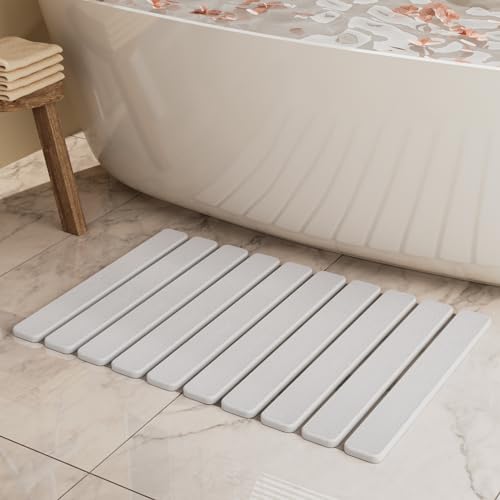
Foldable Stone Bath Mat Diatomaceous — Self-drying stone, folds away
Diatomaceous earth is a mineral material full of microscopic pores, and a mat made from it behaves unlike any textile: step onto it with wet feet and the footprints visibly darken, then lighten again as the surface pulls the water in and evaporates it back into the room. Nothing is stored, nothing stays damp, and there is no pile, backing, or foam in which moisture can settle for days. For a bathroom fighting persistent damp, that is the most direct answer available: remove the reservoir entirely and let physics do the housekeeping.
The foldable design separates this mat from the rigid stone slabs that pioneered the category. It folds for storage in a cupboard, for travel, or for standing it on edge to air both faces after a rinse, and that flexibility quietly solves stone’s two classic objections, bulk and immovability. A mat that can be put away is a mat whose floor gets aired, and a floor that gets aired is the other half of the freshness equation. The white finish keeps a small bathroom feeling bright and shows you exactly where the day’s water went, which some households find reassuring and others find demanding.
Care is refreshingly unlaundrylike. Rinse it, wipe it, let it dry; if absorption ever slows after months of soap and mineral film, the surface can be refreshed according to the maker’s guidance, restoring the pores’ thirst. It also serves double duty beyond the bathroom, since the same listing pitches it as a drying mat for kitchen counters, where dishes benefit from the same evaporative trick. Keep it out of the washing machine entirely, and keep heavy toiletries bottles from being dropped on it, because mineral mats are hard but not forgiving of point impacts.
Underfoot, expect the truth about stone: firm, cool, and dry within moments. In summer that coolness is a pleasure; in a cold house in January it is a brisk awakening, and comfort-first households may prefer it at the shower exit rather than the vanity, where standing time is longer. It grips by texture and weight on the floor and is described as non-slip, and its hard surface gives wet feet a secure, unyielding platform. As the purest expression of the dryness philosophy in this guide, it earns the first place on the list.
There is a small ritual pleasure in watching it work, footprints blooming dark and fading as you brush your teeth, the mat visibly resetting itself for the next person. Children find it quietly fascinating, which has the side effect of making them actually stand on it rather than beside it. A product that recruits its users into correct use has solved a problem most household goods never even attempt.
- Size: 23.5 x 15.4 inches
- Surface: diatomaceous earth stone, foldable
- Absorption: surface evaporation, no stored water
- Care: rinse and air dry; no machine washing
- Colour in listing: white
Strengths
- Dries itself in open air; nothing stays damp between showers.
- Folds away so the floor beneath gets aired as a matter of routine.
- No pile, foam, or backing where moisture can hide for days.
Trade-offs
- Firm, cool surface will not please cushion seekers.
- White shows every scuff and asks for regular wiping.
- Hard mineral can chip if heavy objects are dropped on it.
Best for: damp-prone bathrooms, shower exits, and laundry-free households. Not suited for: anyone wanting a soft, warm landing above all else.
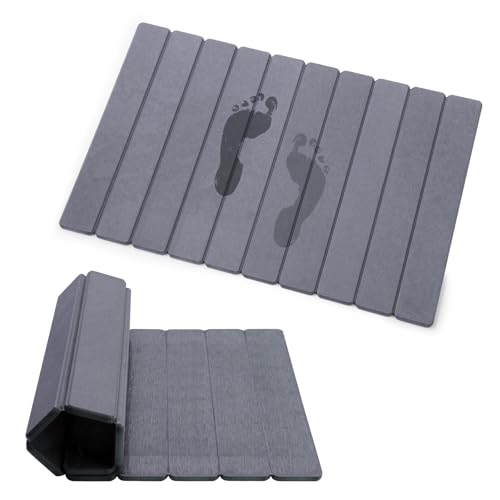
zmnklry Stone Bath Mat Diatomite — Dark stone for busy floors
The zmnklry mat works the same evaporative physics as the foldable pick above, a quick-drying diatomite surface that takes water off feet and returns it to the air, but it dresses the idea for a busier household. The dark grey finish is the headline difference: where white stone announces every wet footprint and scuff until it dries, dark stone absorbs the visual evidence of a family morning, looking composed while it works. In a bathroom shared by children, a dog, and two adults in a hurry, that composure is not vanity; it is the difference between a mat that looks maintained and one that looks accused.
As a hard stone drying mat sized for the shower floor exit, it asks for the same simple contract as all stone: rinse it, stand it to dry fully now and then, and let its pores stay clear of soap film. The fast-drying claim in its listing is the property that matters; a surface that returns to dry between the morning’s showers presents nowhere for damp to linger, and the mat’s solid build means there is no underside textile quietly staying wet against the tile. Lift it during the weekly floor clean and the covered patch of floor gets its airing in the same motion.
Positioning is this mat’s main decision. At a shower exit it is superb, catching the heaviest water of the day at the exact point of exit. At a vanity, where people stand for minutes, its firmness divides opinion, and households that groom at length may prefer stone at the shower and fabric at the sink, a two-zone arrangement this guide endorses happily. The dark tone also coordinates with the grey palettes most modern bathrooms already wear, slipping into the room’s scheme instead of announcing itself.
One honest caution belongs to all stone mats and is worth repeating here: they are floor-level equipment, and they feel like it. Guests unfamiliar with the category sometimes mistake the slab for a tile and step expecting give. A household that hosts often may keep a thin fabric mat to lay over it for visitors, enjoying stone’s dryness on ordinary days and fabric’s familiarity on guest days, which is a perfectly rational way to own both philosophies at once.
The dark surface has one more household virtue: it forgives hard water. In regions where tap water leaves pale mineral traces on everything it touches, a white stone mat slowly maps those traces for all to see, while the dark grey simply incorporates them into its tone between rinses. If your kettle furs and your shower screen clouds, let that local knowledge steer you toward the darker stone without a second thought.
- Size: 23.6 x 15.4 inches
- Surface: diatomite stone, hard and fast-drying
- Absorption: surface evaporation
- Care: rinse, wipe, air dry fully
- Colour in listing: dark grey
Strengths
- Same self-drying mineral physics in a forgiving dark finish.
- Solid build leaves no damp textile underside against the floor.
- Composed appearance through a busy family’s whole morning.
Trade-offs
- Firm underfoot; vanity standing divides opinion.
- Rigid format does not fold for storage like the first pick.
- Guests may find a hard mat surprising at first step.
Best for: family shower exits and grey-toned modern bathrooms. Not suited for: long vanity standing or anyone wanting storage flexibility.

Domax Bamboo Bath Mat — Raised slats, zero absorption
Bamboo answers the damp problem by refusing to participate in it. The Domax mat is a platform of natural bamboo slats raised on feet, so a bather stands on dry wood while water falls between the slats and evaporates from the open gap beneath. The mat itself absorbs essentially nothing, holds no pile, and hides no foam; when the shower ends, the only wet thing in the arrangement is the floor, which the raised design leaves exposed to air on every side. For bathrooms where fabric has failed repeatedly, that structural honesty is deeply appealing.
The listing pitches the mat beyond the bathroom, for sauna, spa, and outdoor use, and that range tells you something about its relationship with water: it is built for environments where getting wet is the normal condition, not an accident to be absorbed. Bamboo’s natural density suits that life. Wipe it down, let it stand in moving air, and it returns to neutral quickly. In a home bathroom it brings a spa visual with it, warm wood tones against tile, and a faintly architectural presence that fabric cannot imitate.
Comfort is structured rather than soft: slats feel firm, warm compared with stone, and pleasantly tactile, with the small give of wood rather than the sink of foam. The non-slip character comes from the platform’s stability and footing rather than from a backing, so place it on a level floor and let its feet do their work. Mind the footprint, a compact rectangle that suits a shower exit or a tub side in a smaller room, and note that water passing through means the floor beneath will get wet by design; that floor needs its own occasional mop, which the airy gap makes easy rather than hidden.
Longevity with bamboo is about drying the wood itself. It resists the daily wetting cycle well, but any wooden platform left permanently in a puddle will eventually show it, so the same weekly lift that serves every pick in this guide serves this one doubly. Stand it on edge after the morning rush in a very steamy room and it will repay you with years of service and a bathroom corner that always looks deliberately finished.
It also changes the acoustics of a tiled bathroom in a way guests remark on: wood does not ring. Bottles set down on it, feet landing on it, a dropped phone bouncing off it all land with a muted knock instead of a ceramic clatter, and a room that sounds calmer tends to feel cleaner. Freshness is partly a fact and partly a perception, and this platform works on both ledgers at once.
- Size: 21.26 x 14.17 inches, raised platform
- Surface: natural bamboo slats
- Absorption: none by design; water passes through
- Care: wipe down, air dry; lift weekly
- Finish in listing: natural bamboo
Strengths
- Absorbs nothing, so there is no reservoir for damp to colonise.
- Raised slats let the floor beneath breathe from every side.
- Spa-grade looks with sauna and outdoor versatility.
Trade-offs
- Floor beneath gets wet by design and needs its own mop.
- Firm slatted feel; no cushioning for long standing.
- Wood still wants a weekly full dry to stay at its best.
Best for: fabric-fatigued bathrooms, spa-style rooms, and shower exits. Not suited for: buyers wanting absorbency or a soft landing.

GOBAM Bamboo Bath Mat Small — Compact bamboo platform
The GOBAM takes the same raised-slat idea as the Domax and shrinks it for the spaces the larger platform cannot serve: the narrow exit of a shower stall, the side of a compact tub, the ensuite where floor area is measured in hand spans. Its black finish gives it a different personality, more modern bath accessory than spa deck, and in a small room that visual lightness matters, because a compact dark platform reads as intentional where a sprawling rug reads as clutter. Smallness here is the feature, and it is honestly sized for one person’s exit rather than pretending to furnish a whole floor.
Everything said about bamboo’s moisture logic applies with extra force at this scale. A mat this size can be lifted with one hand, stood against the wall to dry in minutes, carried to a balcony, or rinsed in the shower itself without ceremony. The freshness routine that larger textiles make aspirational becomes automatic when the object is this manageable, and that is a genuine resistance strategy: the easiest mat to dry completely is the one that always is dry. Households that know their own habits should weigh that heavily.
The listing ranges it across spa, sauna, kitchen, and indoor-outdoor spaces, and the kitchen mention is worth pausing on: a small bamboo platform in front of a sink catches a standing cook’s fatigue and sheds water exactly as it does in the bathroom. Buying one for the shower exit and discovering it moonlights elsewhere is a common story with this format. Just keep its role in the bathroom primary if damp is your enemy, since a mat that migrates rooms takes its drying routine with it only if you carry the habit along.
Its limits are the limits of its size. Two people cannot share its landing, a long tub exit overflows it, and the slatted firmness remains a taste some feet never acquire. But as the compact, black, easily aired representative of the zero-absorption school, it completes the bamboo half of this shortlist with a clear conscience and a clear floor beneath it.
Renters should give it a particular look. It asks nothing of the floor, leaves nothing on the floor, and packs into a suitcase-sized footprint when the lease ends, which cannot be said of the plush rugs it replaces. A bathroom upgrade that requires no permission, no installation, and no apology to a landlord is a rare thing, and this little platform is exactly that.
- Size: 19.7 x 13 inches, raised platform
- Surface: bamboo slats, black finish
- Absorption: none by design
- Care: wipe, rinse, stand to dry
- Finish in listing: black
Strengths
- Compact size makes the full-dry routine effortless and automatic.
- Black finish suits modern small bathrooms and hides scuffs.
- Versatile across shower, sauna, and kitchen standing spots.
Trade-offs
- One-person landing only; too small for long tubs or couples.
- Firm slats offer no cushioning whatsoever.
- Floor beneath still takes the water and needs mopping.
Best for: shower stalls, compact ensuites, and renters who move often. Not suited for: family tub exits or comfort-first buyers.

Homergy Quick Dry Bath Mat 16×24 — Thin foam-core speed
Not every household will accept stone or wood underfoot, and the Homergy exists for them: a fabric-feeling mat engineered around surrendering water quickly. Its construction pairs a super absorbent surface with a cushioned foam core at a total thickness the listing gives as a fraction of an inch, thin enough to fit under doors that defeat every plush rug. Thinness is the freshness strategy here. A mat that holds little water and exposes a wide, flat area to the air dries in the gaps of a normal day, and a mat that dries daily never builds the persistent damp this category exists to prevent.
The non-slip rubber backing keeps the thin profile honest on tile, and the dark grey colour keeps it honest visually, hiding the evidence of a working week. Washable construction completes the reset story: when a fabric mat does pick up the stale note that busy bathrooms eventually give everything, this one can go through a wash and come back neutral, then dry fast enough to be back on the floor the same day. That full cycle, wash, quick dry, return, is the fabric school’s answer to stone’s self-drying, and for households committed to softness it is a perfectly sound one.
Door clearance deserves emphasis because it decides real purchases. Bathrooms in older homes often have doors planed for carpet that no longer exists, or swollen frames that shave millimetres yearly; a mat at this thinness slides under almost any of them and stays flat rather than bunching at the swing. Bunching is not merely ugly in this category, it is a damp trap, folding wet fabric against itself. A mat that lies flat dries flat, and the Homergy’s whole design conspires toward that flatness.
Expect modest cushioning: the foam core takes the edge off hard tile without pretending to be a memory-foam landing. Expect, too, to wash it on a real rhythm, because thin fabrics trade capacity for speed and repay regular laundering. Within those honest terms, it is the pick for the fabric loyalist in a damp bathroom, proof that softness and freshness can coexist when the engineering respects how little water a mat should be allowed to keep.
It is also the natural travel companion of this list, rolling or folding into a weekender for the caravan, the boat, or the relative’s house whose bathroom you know too well. A mat that dries this fast forgives the strange ventilation of temporary homes, and arriving with your own dry footing is a small comfort that frequent travellers quietly swear by.
- Size: 16 x 24 inches, very thin profile
- Surface: super absorbent, fast drying per listing
- Core: cushioned foam with rubber backing
- Care: washable; dries quickly
- Colour in listing: dark grey
Strengths
- Thin build dries between ordinary uses and fits under tight doors.
- Washable reset returns it to neutral the same day.
- Rubber backing keeps the light, flat profile planted on tile.
Trade-offs
- Modest capacity; saturates under heavy multi-shower traffic.
- Cushioning is gentle rather than plush.
- Needs regular washing to deliver its freshness promise.
Best for: fabric loyalists in damp rooms and doors with minimal clearance. Not suited for: large families or buyers wanting deep pile comfort.

Upgraded Waffle Bath Mat 17×24 — Waffle weave fabric pick
The waffle weave is fabric’s cleverest answer to damp, because its texture does the drying work. The recessed pockets of a waffle surface multiply the area exposed to air while holding water in shallow cells rather than deep pile, so evaporation wins the race against the next shower. This mat wraps that weave in a soft, decorative finish, brown and bathroom-pretty, that reads as a chosen textile rather than as equipment, which matters in the room guests see. It is the pick for households that want a rug to look like a rug while behaving like a drying system.
The listing calls it ultra absorbent and quick dry in the same breath, a pairing that sounds contradictory until you watch a waffle mat work: the pockets take water in fast at the surface, then the open weave lets it go. Against a plush chenille of similar size, the waffle finishes the day noticeably drier, and against stone it offers the familiar give of fabric underfoot. Non-slip backing keeps the light structure planted, and washable construction lets you reset it fully whenever the household’s rhythm calls for it.
Its decorative softness also suits the vanity position, where the stone and bamboo picks in this guide can feel austere during a long grooming session. Many households will run a mixed strategy, and this mat is the natural fabric half of it: stone at the shower exit where water is heaviest, waffle at the sink where standing is longest, each playing to its strength, the whole room drying faster than any single-material answer could manage.
Care is the familiar fabric contract, wash, dry completely, return to a dry floor, with one waffle-specific note: the pockets can hold onto hair and lint, so shake it outside before washing and the weave will release its water as freely as ever. Give it that small attention and it will hold its texture and its drying speed through a long service life, ending this shortlist as proof that the oldest textile trick in the bathroom, a weave with air in it, still answers the damp problem beautifully.
Hosts tend to love this one for a reason beyond physics: it photographs and presents like a considered purchase. A guest bathroom fitted with a waffle mat in a warm tone looks styled rather than treated, and nobody’s visit needs to include evidence of the household’s war on damp. Freshness that does not announce its own effort is the most elegant kind.
- Size: 17 x 24 inches
- Surface: waffle weave, soft and decorative
- Backing: non-slip, per listing
- Care: washable; shake out before washing
- Colour in listing: brown
Strengths
- Pocketed weave evaporates faster than any plush fabric.
- Looks and feels like a proper rug, not like equipment.
- Pairs naturally with stone at the shower in a two-zone setup.
Trade-offs
- Pockets collect hair and lint; needs a shake before washing.
- Still a fabric: slower to dry than stone or bamboo.
- Light structure wants its backing kept clean to grip well.
Best for: vanity positions, guest bathrooms, and fabric lovers in humid homes. Not suited for: the wettest shower exits, where stone earns its place.
How Do the Six Dryness Strategies Compare?
| Pick | Strategy | Stores water? | Laundry needed | Underfoot feel |
|---|---|---|---|---|
| Foldable Stone Bath Mat Diatomaceous | Evaporating mineral | No | None, rinse only | Firm and cool |
| zmnklry Stone Bath Mat Diatomite | Evaporating mineral | No | None, rinse only | Firm and cool |
| Domax Bamboo Bath Mat | Raised slats | No | None, wipe down | Structured wood |
| GOBAM Bamboo Bath Mat Small | Raised slats, compact | No | None, wipe down | Structured wood |
| Homergy Quick Dry Bath Mat 16×24 | Thin quick-release fabric | Briefly | Regular wash | Lightly cushioned |
| Upgraded Waffle Bath Mat 17×24 | Waffle evaporation | Briefly | Regular wash | Soft textured fabric |
What Bathroom Habits Matter More Than the Rug Itself?
Ventilation is the first habit and it is not close. A bathroom whose extractor fan runs during every shower and for twenty minutes after will keep almost any sensible rug fresh; a bathroom sealed tight with a fan nobody uses will defeat the best stone in this guide eventually, because the whole room, walls, grout, towels, and all, stays in the damp zone. If your fan is weak, noisy, or absent, a window opened a crack after showering does more for freshness than any purchase in this article, and fixing the fan outranks replacing the rug.
The second habit is the weekly lift. Whatever sits on your bathroom floor, raise it once a week, let the covered patch dry in open air, and give the floor a plain clean while it is exposed. That hidden rectangle is where moisture lingers longest and where freshness is quietly lost. Each pick here was chosen partly for how little friction that lift involves: stone stands on edge, bamboo lifts with one hand, the thin fabrics weigh almost nothing. Choose the rug whose lift you will actually perform.
The third habit is honest laundering for fabric owners: wash on a rhythm rather than on a smell, dry completely rather than mostly, and never fold a damp rug into a cupboard. A fabric rug returned to the floor at ninety percent dry spends its life in the damp zone and slowly perfumes the room with the evidence. Complete drying is the unglamorous hinge on which the whole fabric strategy swings, and it costs nothing but patience.
A fourth habit ties the other three together: keep the bathroom’s textiles as a set on the same rhythm. Towels, the shower curtain’s lower edge, and the rug all share the room’s moisture, and a fresh rug beside a tired, slow-drying towel set will inherit the room’s stale note no matter how well it is engineered. Wash days that move the whole set through together, and drying that finishes the whole set together, keep the room’s baseline neutral, which is the quiet goal underneath every specific recommendation in this guide.
How Can You Tell Whether a Rug Is Staying Damp Too Long?
Use the morning hand test. Two hours after the day’s first shower, press the back of your hand firmly into the rug’s busiest spot and hold it there for five seconds. A rug that feels cool and dry has won its race. A rug that feels cool and damp has not, and the fix begins with routine, longer fan time, a daily drape over the tub edge, before it becomes a replacement. Smell is the second witness: a rug that smells neutral after washing but stale by midweek is telling you its drying never completes, whatever the label promised.
The floor test is the quieter one. When you lift the rug for its weekly airing, run a dry tissue across the covered patch. If it comes away damp in a bathroom that has not been used for hours, moisture is living under there, and either the rug must be lifted more often, the room’s ventilation must improve, or the construction must change toward the open and raised end of this guide’s range. These are household diagnostics, not laboratory science, and they are quite sufficient to steer a purchase.
Add a calendar to the diagnostics and they become decisive. Note the date a freshly washed fabric rug goes down and the date its stale note returns; that interval is your rug’s true freshness lifespan in your room. If the interval is measured in weeks, routine tweaks will stretch it. If it is measured in two or three days, no routine will save the pairing, and the construction itself must change toward the open end of this guide. Data, even bathroom data, ends arguments that opinions prolong.
How Do Seasons and Households Change the Damp Equation?
A bathroom in January and the same bathroom in August are two different climates sharing an address. Winter heating dries indoor air aggressively, and rugs that struggled in summer may behave impeccably for six months; summer humidity reverses the verdict, especially in homes without air conditioning, where night air brings no relief. Households in strongly seasonal climates should judge a rug by its August performance and forgive its January self almost anything, because the hard season is the honest one. If a fabric rug fails only in the humid weeks, a seasonal rotation, stone for summer, fabric for winter, is a rational and economical answer rather than an indulgence.
Household composition shifts the equation just as much. A single occupant showers once and the room rests for twenty-three hours; a family with teenagers runs the shower like a utility, towels multiply, and the door stays shut against the steam for privacy. The family’s rug lives in a different world from the single person’s identical rug, and blaming the product for that difference is a category error this guide has tried to prevent. Buy for your household’s actual water traffic, and size your expectations, and your drying routine, to the busiest week of your year rather than the quietest.
Guests and gatherings deserve a footnote of their own. A weekend of visitors can deposit a week’s worth of moisture in two days, overwhelming a rug that serves the household perfectly well the rest of the year. The graceful response is a spare: a second quick-dry mat, kept clean in a cupboard, rotated in for busy weekends and washed at leisure afterwards. Owning the spare also solves the wash-day gap for fabric households, which is why so many of this guide’s recommendations quietly assume that two modest mats outserve one grand one.
What Should You Do With a Rug That Has Already Gone Stale?
Start with the honest reset before you shop. A fabric rug that smells stale but is structurally sound deserves one thorough attempt: wash it according to its label with a full rinse, then dry it completely in moving air, ideally outdoors or in front of a fan, until it is dry to the bone rather than to the touch. If it returns to the floor and stays neutral for a full week of normal use, the rug was a victim of routine, not of design, and your new drying habits have rescued it. If the stale note returns within days despite a genuine reset and a ventilated room, the textile is holding moisture somewhere you cannot reach, and replacement is the economical answer.
Stone and bamboo that have gone dull with soap film ask for their own resets rather than replacement. Rinse stone thoroughly, let it dry for a full day in air, and follow the maker’s guidance for refreshing a slowed surface; wipe bamboo down, dry it standing on edge, and check that its feet and underside are as clean as its top. In both cases the material itself has not failed; a film has simply been allowed to do the holding that the design was built to avoid. A household that learns the reset for its material rarely needs to replace the mat itself.
What you should not do is mask. Scented sprays on a damp rug perfume the evidence for an afternoon and leave the moisture, which is the actual subject of this guide, entirely untouched. Freshness that has to be reapplied daily is not freshness; it is scheduling. Fix the water, by routine or by replacement, and the room will take care of its own atmosphere without assistance.
Where in the Bathroom Does Each Strategy Belong?
Think of the bathroom as three moisture zones and assign materials like a planner rather than a decorator. The exit zone, at the shower door and the tub side, takes the day’s heaviest water in the shortest time, and it rewards the materials that store nothing: stone first, bamboo second, because both are dry again before the next person arrives. The standing zone, at the vanity and mirror, takes less water but far more time, feet planted for minutes while the tap runs and splashes accumulate; a quick-dry fabric serves it best, softening the stand without building a reservoir. The occasional zone, beside a guest bath or in front of a little-used tub, forgives almost anything, which makes it the right home for the prettiest, least technical rug you own.
Mapping zones this way also explains why single-rug bathrooms so often disappoint. One material asked to be an exit mat and a standing mat and a decorative mat simultaneously will be a compromise in at least two of the roles, and the compromise usually shows up as damp, because the exit role is the most punishing. Splitting the roles between two well-chosen pieces, as several picks in this guide invite, is not upselling; it is how the room’s physics actually distributes its water.
Renters and renovators can use the same map in reverse. If you cannot improve the fan, strengthen the exit zone with stone and shrink the standing zone’s rug to the thinnest fabric that stays comfortable. If you are renovating, spend on extraction first and buy rugs second, in that order, and even modest textiles will perform like premium ones in the dried room you have built for them.
What Mistakes Keep Bath Rugs Damp?
The champion mistake is the plush rug in the steamy room, bought for comfort and left flat forever, drying neither itself nor the floor beneath it. The second is washing without drying: a rug laundered faithfully and returned damp has been given a freshness ritual with the essential step missing. Third, households layer rugs, a mat over a mat, doubling the reservoir and halving the airflow, usually to postpone replacing one tired textile. Fourth, the extractor fan is treated as a light-switch accessory rather than the room’s lungs, clicked off with the light while the air is still saturated.
A fifth mistake is expecting a product to solve a plumbing reality. A slow drip under a vanity, a shower screen that leaks at its hinge, a bath that overflows weekly: each keeps a corner permanently wet, and no rug resists a water supply. Fix the drip, then choose from this list. Finally, shoppers buy the largest, thickest rug for a small, windowless bathroom because it photographs warmly, when the room’s physics were asking for the thinnest, fastest, most open construction on the page. Match the rug to the room’s drying power, not to its photograph.
One more deserves a place on the list because it is so easy to fix: the rug that is never given a holiday. Even the best construction benefits from a full day off the floor now and then, hung in moving air while the bathroom floor gets a proper clean and a proper dry. Households that rotate a spare through that holiday find every rug in the rotation lasting longer and smelling better, which is the closest thing this category has to a free upgrade.
Final Recommendation
If damp has defeated fabric in your bathroom before, go straight to the evaporating school: the foldable stone mat for flexibility and storage, the dark zmnklry stone for a busy family’s composure. If you love the spa look and can mop the floor beneath, the two bamboo platforms keep nothing wet at all, the Domax for standard exits and the GOBAM for compact ones. Fabric loyalists should choose by thinness and weave: the Homergy for doors and speed, the waffle mat for softness that still dries with conviction. Whichever you choose, run the fan, lift the rug weekly, and dry everything completely. Freshness in a bathroom is a system, and the right rug is the part of that system your feet will thank you for every morning, stepping onto dryness instead of yesterday’s shower.
Begin with the zone that frustrates you most, usually the shower exit, and change only that one surface first. A single dry success teaches the household the whole philosophy faster than any lecture, and the second zone tends to follow within the month, voluntarily.
Frequently Asked Questions
Do stone bath mats really dry themselves?
Yes, in the plain physical sense: the porous mineral surface pulls water off your feet and spreads it across a wide area, where room air evaporates it, usually within minutes. The mat stores nothing, which is why it suits damp bathrooms. It still benefits from an occasional rinse and a full airing stood on edge.
How do I keep the floor under my rug from staying damp?
Lift the rug at least weekly and let the covered patch dry in open air, and choose constructions that make that lift easy or unnecessary: raised bamboo, foldable stone, or very thin mats. Running the extractor fan after showers dries the whole room, covered patch included, far faster.
Can I wash a fabric bath rug hot to keep it fresh?
Follow the rug’s care label first, but as a rule, a wash warm enough to feel thorough, followed by complete drying, is the fabric freshness routine that works. The drying half matters more than the temperature half: a rug returned to the floor even slightly damp will smell stale again within days.
Is bamboo a good choice for a family bathroom?
It is, provided the household accepts its terms: water passes through to the floor, so the floor needs mopping, and the surface is firm rather than cushioned. In exchange, the mat itself never stays wet, wipes clean in seconds, and suits households tired of laundry as a freshness strategy.
Why does my bath rug smell fine after washing but stale by midweek?
Because it never fully dried in between. A rug that stays slightly damp accumulates the stale note regardless of how clean the wash left it. Drape it over the tub edge daily, extend the fan’s run after showers, and if the routine cannot fix it, move toward the thinner or non-fabric picks in this guide.
Should I use two different mats in one bathroom?
Often, yes. Stone or bamboo at the shower exit, where water volume is greatest, and a quick-dry fabric at the vanity, where standing comfort matters, is a combination many households settle on permanently. Each material then works where its drying behaviour is strongest.
Does a heated bathroom floor help a rug stay fresh?
It can, since gentle warmth speeds evaporation from both the rug and the floor beneath it, but it rewards thin constructions most; a thick plush rug insulates itself from the warmth and keeps its damp in the middle. If your floor is heated, favour the thin, stone, or raised options and still lift the rug weekly.
How long should a fresh-smelling rug stay fresh?
A well-matched rug in a ventilated room should stay neutral for at least a week of ordinary use, and the non-fabric picks should stay neutral indefinitely with only rinsing. If a fabric rug turns stale within two or three days despite full drying after each wash, the construction is losing to the room, and moving toward stone, bamboo, or a thinner weave is the honest fix.
Related Guides
Dryness is one side of bath-rug ownership; the guides below cover the rest. See Best Plastic and Vinyl Bathroom Rugs for the fully waterproof end of the spectrum, Best Area Rugs That Don’t Shed for low-maintenance thinking elsewhere in the house, and Best Educational Rugs for Baby and Kids for family floors beyond the bathroom. The broader hygiene shortlist behind this guide is Best Bath Mats for Cleanliness.


