What's inside
- Key Takeaways
- Quick Picks
- How We Chose These Picks
- How Do the Six Coolers Compare at a Glance?
- What Does Self-Cleaning Actually Clean — and What Does It Not?
- Bottled or Bottleless: Which Family Fits Your Home?
- Where Should a Cooler Stand in a Home?
- How Do You Swap a Bottom-Load Bottle Without the Flood?
- What Rhythm Do Bottleless Filters Want?
- How Hot and How Cold Should Cooler Water Be?
- What Does a Cooler Cost You Beyond the Purchase?
- How Does a Cooler Change a Household’s Drinking Habits?
- What Should Happen in the First Week With a New Cooler?
- Can a Cooler Serve a Home Office or a Small Workplace Corner?
- How Do You Move House With a Water Cooler?
- What About Noise, Drips and the Night-Time Personality of a Cooler?
- How Long Should a Home Cooler Last, and What Decides It?
- What Water Should Go Into a Bottled Cooler?
- How Should You Clean the Parts Self-Cleaning Does Not Reach?
- What Happens When the Power Goes Out or the House Empties for a Holiday?
- Which Mistakes Do Cooler Buyers Make Most Often?
- Final Recommendation
- Frequently Asked Questions
- Related Guides
As an Amazon Associate I earn from qualifying purchases. This post may contain affiliate links at no extra cost to you.
cottageverdict.com is reader-supported. When you buy through links on our site, we may earn an affiliate commission.
Where to buy: the six best self-cleaning water coolers for home below are sold through Amazon, and their names in the Quick Picks table, the detailed reviews and the comparison table link to the matching listing, where you can check price on Amazon and confirm loading style, temperatures and dimensions before ordering. A water cooler asks for one chore nobody enjoys: cleaning the inside of a machine you cannot see into. Tanks, lines and reservoirs sit in the dark, wet and warm, and the slimy film that eventually flavours the water is the reason neglected coolers end up unplugged in garages. Self-cleaning models exist to retire that chore, running a sanitising cycle — UV light on the models that say so, the maker’s own cleaning cycle on the rest — so the water path stays fresher without a weekend of dismantling and vinegar.
This guide splits the six picks the way a buyer must: three are bottled machines that hide a standard 3- or 5-gallon bottle in a bottom-loading cabinet, and three are bottleless machines that plumb into your water line and filter as they go. The two families solve different problems. Bottled coolers need no plumbing and can stand anywhere with a socket, but they ask you to store and swap heavy bottles. Bottleless coolers end the bottle entirely, but they ask for a water line, a filter schedule, and a permanent position. Neither family is better in the abstract; the right one is the one whose chores your household will actually do.
Everything stated here comes from the listings themselves: temperatures offered, loading style, safety locks, alerts and certifications exactly as printed, with gaps marked where a listing does not specify. Where a maker claims its filtration reduces particular contaminants, we report it as the maker’s claim from the listing, because that is what it is. The rest of the guide — placement, bottle handling, filter rhythms, what self-cleaning does and does not do — is the practical knowledge that decides whether a cooler is still loved in its third year.
Key Takeaways
- Self-cleaning means the machine sanitises its internal water path on a cycle, cutting the deep-clean chore dramatically; it does not mean the drip tray, taps and exterior clean themselves.
- The list splits by family: four bottled bottom loaders (Euhomy, Brio 520, IKT and Brio Moderna) and two bottleless machines (Avalon and Brio 520 UV) that plumb into a water line.
- The Avalon and the Brio 520 UV are bottleless: they connect to a water line and filter on the way, ending bottle storage and lifting entirely.
- Hot water safety is consistent across the bottled picks: child locks appear in the Euhomy, Brio 520 and IKT listings, which matters in any house with small children.
- The Brio Moderna is the only pick whose listing promises adjustable hot and cold temperatures, for households particular about their tea and their chilled water alike.
- Empty bottle alerts on the Euhomy and Brio 520 remove the classic bottled-cooler failure: the tap that coughs air on a Friday evening.
Quick Picks
| Pick | Badge | Why it earns its place |
|---|---|---|
| Euhomy Self-Cleaning Water Dispenser with UV | Best All-Round Bottom Loader | UV self-cleaning named in the listing, three temperatures, an LED display and an empty bottle alert in one tidy package. |
| Brio 520 Series Self Cleaning Water Dispenser | Best Established Bottled Name | The 520 series is Brio’s long-running bottom loader, with self-cleaning, three temperatures and the alerts a family uses daily. |
| Avalon Self Cleaning Bottleless Water Cooler | Best Bottleless Cabinet | No bottles at all: a stainless steel cabinet, an NSF certified filter and three temperatures from your own water line. |
| IKT Self-Cleaning Water Cooler Dispenser | Best Silver Finish | A self-cleaning bottom loader in silver with an LED display light and child safety lock, for kitchens that want the look. |
| Brio 520 UV Self-Cleaning Bottleless Water Cooler | Best Filtration Package | UV self-cleaning, two-stage filtration and two replacement filters in the box, with the maker’s PFAS and microplastics claim. |
| Brio Moderna Water Dispenser | Best Temperature Control | A bottom-loading bottled machine whose listing promises adjustable hot and cold dispensing temperatures. |
How We Chose These Picks
Self-cleaning was the entry ticket, and we read the listings strictly: a model had to present its cleaning cycle as a named feature, not as a hope. Within that gate, we balanced the two families deliberately, because a guide that only lists bottled machines fails the renter with a water line and a hatred of bottle storage, and a guide that only lists bottleless machines fails everyone who cannot plumb. Four bottled machines and two bottleless ones reflects how homes actually divide, with bottled convenience still the majority choice and the plumbed pair serving the households ready to commit.
Safety and friction came next. Hot water from a cooler is genuinely hot, so child locks were scored as first-class features wherever a listing names them. Empty bottle alerts, LED displays and bottom loading itself were all judged as friction-removers: the history of home water coolers is a history of small annoyances accumulating until the machine is unplugged, and every alert and easy swap is a defence against that fate. For the bottleless pair, certifications named in the listings — NSF certified filters, UL listings — carried real weight, because a plumbed appliance earns trust differently from a bottled one.
Finally, we favoured makers with a visible ecosystem. Brio appears three times in this guide not from laziness but because its 520 platform, in bottled, bottleless and UV forms, is the closest thing this category has to a standard, with filters and parts a household can actually source in year three. Avalon plays the same role for bottleless cabinets. A water cooler is a decade-long appliance; the brand’s staying power is a specification, even if no listing prints it.

Euhomy Self-Cleaning Water Dispenser with UV — Best All-Round Bottom Loader
Euhomy’s listing is the most explicit in this guide about how the self-cleaning works: UV. The machine is a bottom-loading cooler for 3- and 5-gallon bottles, dispensing hot, room and cold water, with an LED display, an empty bottle alert and a child lock, and its self-cleaning cycle uses ultraviolet light on the internal water path. That specificity matters because it tells you what the cycle is doing — sanitising the tank and lines where water sits — rather than asking you to trust a trademarked noun.
The rest of the package reads like a list of the bottled family’s traditional irritations, each answered. Bottom loading ends the deadlift of a full bottle onto a top-loading spike, which is the moment most home coolers get scratched, flooded or abandoned. The empty bottle alert ends the dry-tap surprise. The child lock ends the hot-water worry in a house with toddlers. None of these is glamorous; together they are the difference between a cooler that integrates into a kitchen and one that generates a small grievance every week.
Euhomy is better known for ice makers and compact appliances than for premium coolers, and the honest reading of this pick is value engineering done well: the features households use daily, the UV cycle named plainly, and no claim in the listing that reaches beyond them. For a first self-cleaning cooler, it is the easiest recommendation on this page.
- Loading: bottom load, for 3- and 5-gallon bottles
- Self-cleaning: UV cycle, per the listing
- Temperatures: hot, room and cold
- Features named in the listing: LED display, empty bottle alert, child lock
- Plumbing required: none
Strengths
- UV cleaning method stated outright, not hidden behind a brand word
- Bottom loading removes the heaviest chore in bottled cooling
- Alert and child lock answer the family’s two daily frictions
Trade-offs
- Bottles still need storing, swapping and sourcing
- Maker’s cooler ecosystem is smaller than Brio’s or Avalon’s
- No filtration of its own; water quality is the bottle’s quality
Best for: a family buying its first self-cleaning cooler, wanting bottled simplicity with the cleaning chore genuinely retired.
Not suited for: a household determined to end bottled water altogether.

Brio 520 Series Self Cleaning Water Dispenser — Best Established Bottled Name
The Brio 520 series is the bottled cooler’s establishment: a bottom-loading, self-cleaning platform that has been sold in large numbers for years, offering hot, cold and cool water with a child-safety lock and an empty bottle alert. Longevity in this category is not a vanity metric. It means the model’s quirks are documented, its replacement parts exist, and a household buying one in 2026 is joining a long line of owners rather than beta-testing a newcomer’s first attempt.
Brio describes the self-cleaning as a sanitising cycle for the machine’s interior; the listing does not name UV for this bottled model — that distinction belongs to its bottleless sibling below — so we report the cycle as the maker’s own. What matters practically is the rhythm it creates: the machine maintains itself on its cycle, and the owner’s remaining duties shrink to the bottle, the drip tray and an occasional wipe of the taps. That is the honest scope of self-cleaning across this whole guide, and the 520 delivers it in the category’s most proven wrapper.
Temperature language deserves a footnote: this listing says hot, cold and cool, where the Euhomy says hot, room and cold. In practice both describe a middle tap that is unchilled; the difference is vocabulary, not engineering, and neither should be read as a third refrigeration circuit. Buy the 520 for its track record and its bottom-loading ease, and it will bore you reliably for years, which is the highest praise a water cooler can earn.
- Loading: bottom load, easy bottle changes per the listing
- Self-cleaning: maker’s sanitising cycle (UV not named for this model)
- Temperatures: hot, cold and cool
- Features named in the listing: child-safety lock, empty bottle alert
- Plumbing required: none
Strengths
- The most established platform in this guide, with parts and knowledge everywhere
- Bottom loading plus empty alert removes bottled cooling’s two chores
- Child-safety lock suits family kitchens
Trade-offs
- Self-cleaning method is not specified as UV in the listing
- Bottle storage and swapping remain part of ownership
- Design is functional rather than a kitchen statement
Best for: a household that values a proven platform and easy ownership over novelty.
Not suited for: buyers who want the cleaning technology specified to the last detail.
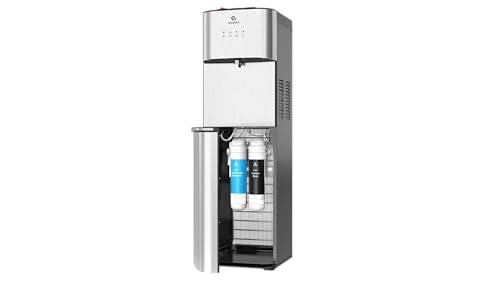
Avalon Self Cleaning Bottleless Water Cooler — Best Bottleless Cabinet
The Avalon changes the subject entirely: no bottles, no storage corner, no delivery schedule. Its listing describes a self-cleaning bottleless cooler with three temperature settings — hot, cold and room — in a durable stainless steel cabinet, with an NSF certified filter and a UL listing. It connects to the home’s water line and filters on the way through, which makes it less an appliance you feed and more a fixture you install, like a tap that happens to chill and heat.
Bottleless ownership trades one set of chores for a smaller, rarer set. The bottle runs disappear forever; in their place arrive a filter change on a schedule measured in months, and the one-time work of installation — a water line connection that the handy can do and the rest of us should happily hand to a plumber. The stainless cabinet is the right material for that permanent role: it wipes clean, shrugs off kitchen splashes, and will not yellow or craze the way plastic cabinets do over a decade beside a cooker.
The certifications are this pick’s quiet argument. An NSF certified filter and a UL listing, both named in the listing, are the vocabulary of an appliance meant to be plumbed into a home’s drinking water and left there — a different trust proposition from a bottled cooler, and Avalon states it plainly. For a household that owns its home, drinks a great deal of water and is done with bottles, this is the destination pick.
- Type: bottleless, connects to a water line
- Self-cleaning: maker’s self-cleaning cycle, per the listing
- Temperatures: hot, cold and room
- Cabinet: durable stainless steel, per the listing
- Certifications named in the listing: NSF certified filter, UL listed
Strengths
- Ends bottles, storage and lifting permanently
- Stainless cabinet suits a permanent kitchen installation
- Named certifications support the plumbed-in role
Trade-offs
- Needs a water line and a real installation, once
- Filters become a scheduled consumable instead of bottles
- Not a renter-friendly or portable proposition
Best for: a homeowner household with heavy water use that wants the bottle era over.
Not suited for: renters, or anyone who may move the cooler between rooms or homes.

IKT Self-Cleaning Water Cooler Dispenser — Best Silver Finish
The IKT is the style-conscious bottled pick: a self-cleaning, bottom-loading dispenser for 3- to 5-gallon bottles, finished in silver, with a child safety lock and an LED display light that its listing pitches squarely at the home. In a kitchen where the cooler stands in open view — and bottom loaders, being full-height cabinets, always stand in open view — the finish is not decoration but diplomacy. A silver cabinet reads as an appliance among appliances, beside a fridge and an oven, where a white plastic tower reads as office equipment on loan.
Under the finish, the specification follows the bottled family’s proven pattern: bottom loading to spare your back, a self-cleaning cycle to spare your weekends, a lock to keep small hands off the hot tap. The listing is briefer than Brio’s or Euhomy’s — it does not name its temperature set beyond the dispenser’s standard presentation, and it does not specify the cleaning method — so we describe it as it describes itself and no further. What is stated is coherent: a home-oriented, self-cleaning bottom loader that prioritises how the machine looks in the room.
That priority is legitimate, and it is also this pick’s boundary. A buyer who wants the deepest documentation, the named UV cycle or the longest track record has the Euhomy and the two Brios in this same guide. A buyer whose kitchen has suffered enough visual compromises, and who wants the cooler to pull its weight in the room’s appearance while keeping the standard self-cleaning conveniences, is the IKT’s intended customer — and there are more of those than appliance marketing usually admits.
- Loading: bottom load, for 3- to 5-gallon bottles
- Self-cleaning: maker’s cycle, per the listing; method not specified
- Finish: silver, per the listing
- Features named in the listing: child safety lock, LED display light
- Plumbing required: none
Strengths
- Silver finish integrates with stainless kitchen appliances
- Standard self-cleaning, bottom-load pattern in full
- Child safety lock keeps the hot tap a grown-up tool
Trade-offs
- Listing is light on detail compared with Brio and Euhomy
- Cleaning method is not specified as UV
- Smaller brand ecosystem for parts and support
Best for: a design-conscious kitchen that wants bottled self-cleaning convenience without the office look.
Not suited for: a buyer who shops by documentation depth and named technologies.

Brio 520 UV Self-Cleaning Bottleless Water Cooler — Best Filtration Package
If the Avalon is bottleless made simple, the Brio 520 UV is bottleless made thorough. Its listing describes a UL certified dispenser with UV self-cleaning, a built-in two-stage filtration system, two replacement filters included in the box, and three temperatures — and it states the maker’s claim that the filtration reduces PFAS and microplastics. We report that claim exactly as what it is: the manufacturer’s statement in its own listing. A household that chooses this machine is choosing to take that claim seriously, and the inclusion of spare filters suggests a maker that expects the filtration to be maintained rather than admired.
The UV in the name does the self-cleaning work the bottled 520 leaves unspecified: ultraviolet sanitising of the internal water path, in a machine whose water arrives from your own line. Pair that with two filtration stages and the ownership picture becomes clear — this is the cooler for a household that has thought hardest about what is in its water and wants the machine to keep thinking about it, on a filter schedule, with the first replacements already in the cupboard.
Installation is the same one-time conversation as the Avalon’s: a water line, a position the machine will keep for years, and filters changed on rhythm rather than on crisis. Against the Avalon, the trade is simplicity for specification — the Avalon states its certifications and keeps its pitch short, while the Brio itemises its filtration and includes the spares. Neither is wrong; they are answers for households at different points on the same journey away from bottles.
- Type: bottleless, connects to a water line
- Self-cleaning: UV, per the listing
- Filtration: built-in two-stage filtration; two replacement filters included
- Maker’s claim in the listing: filtration reduces PFAS and microplastics
- Certification named in the listing: UL certified
Strengths
- Most complete filtration story in this guide, with spares included
- UV self-cleaning named explicitly, as on the Euhomy
- Three temperatures from a plumbed, bottle-free cabinet
Trade-offs
- Filtration claims are the maker’s own, as stated in the listing
- Filter schedule becomes a permanent household rhythm
- Installation required; not portable, not renter-friendly
Best for: a homeowner household that wants bottleless convenience with the filtration specified, spared and UV-maintained.
Not suited for: anyone who cannot plumb, or who prefers the simplest possible bottleless pitch.

Brio Moderna Water Dispenser — Best Temperature Control
The Moderna’s distinguishing promise is in its listing’s last clause: adjustable hot and cold dispensing temperatures. Every other pick here offers its temperatures as the maker set them; the Moderna lets the household tune them. That sounds minor until you meet the households it serves — the tea drinker who finds standard cooler hot water too aggressive for green tea, the parent who wants the cold tap genuinely cold for summer bottles of water, the office-leaning home that runs the machine like a small catering station. Temperature is the one variable a cooler presents in every single glass, and this is the only machine here that hands it over.
The rest of the design is the bottled family’s modern form: bottom loading for 5-gallon bottles, a tri-temp output, and a self-cleaning cycle, per the listing, to keep the interior maintained. Brio positions the Moderna as its contemporary line, and the adjustability fits that pitch — a cooler for households that have opinions. In daily use, the tuning happens once, in the first week, and then disappears into the background, which is exactly how good adjustability should behave.
Note what the listing does not promise: no UV is named for this model, and no empty bottle alert is called out, so we claim neither. The Moderna’s case rests on its temperatures and its platform. For a household that has returned a cooler before because the hot was not hot enough or the cold not cold enough — a more common story than the industry admits — it is the only pick in this guide that answers the actual complaint.
- Loading: bottom load, for 5-gallon bottles
- Self-cleaning: maker’s cycle, per the listing
- Temperatures: tri-temp, with adjustable hot and cold dispensing temperatures
- UV named in the listing: no
- Plumbing required: none
Strengths
- Only pick with adjustable hot and cold temperatures
- Bottom loading and tri-temp output in Brio’s modern line
- Suits particular drinkers — tea, chilled water — precisely
Trade-offs
- No UV or alert features named in the listing
- Adjustability is wasted on households happy with factory settings
- Bottled chores — storage, swapping — remain
Best for: a household with definite opinions about how hot and how cold its water should be.
Not suited for: buyers who want UV cleaning or an empty bottle alert named in the specification.
How Do the Six Coolers Compare at a Glance?
| Pick | Type | Self-cleaning (per listing) | Standout trait |
|---|---|---|---|
| Euhomy Self-Cleaning Water Dispenser with UV | Bottom-load bottled | UV | Empty bottle alert, LED display, child lock |
| Brio 520 Series Self Cleaning Water Dispenser | Bottom-load bottled | Maker’s cycle | Most established platform here |
| Avalon Self Cleaning Bottleless Water Cooler | Bottleless | Maker’s cycle | Stainless cabinet, NSF certified filter |
| IKT Self-Cleaning Water Cooler Dispenser | Bottom-load bottled | Maker’s cycle | Silver finish for open-view kitchens |
| Brio 520 UV Bottleless Water Cooler | Bottleless | UV | Two-stage filtration, spare filters included |
| Brio Moderna Water Dispenser | Bottom-load bottled | Maker’s cycle | Adjustable hot and cold temperatures |
Read the table by household, not by specification. The bottled four differ in documentation, finish and temperature control; the bottleless two differ in how much filtration detail they offer. The family’s first question — bottles or plumbing — decides more than any feature in the right-hand column, and it should be answered before the features are allowed to argue.
What Does Self-Cleaning Actually Clean — and What Does It Not?
The honest answer protects buyers from the category’s one real disappointment. A self-cleaning cycle sanitises the internal water path: the reservoir, the tanks and the lines where water sits in the dark between drinks. That is where the slimy film and the stale flavour breed, so it is the right target, and a machine that handles it on a cycle genuinely retires the worst chore in cooler ownership — the periodic deep clean with the cabinet open and the manual in a puddle.
What it does not touch is everything you can see. The drip tray still collects its spills and wants a weekly rinse. The taps still meet every glass and mug in the house and deserve a wipe. The exterior still gathers kitchen dust. Self-cleaning should be understood the way a dishwasher’s self-clean filter is understood: the machine maintains its hidden interior, and you maintain its surfaces, and between the two the water stays tasting like water. Owners who grasp that division stay satisfied; owners who expected a machine that never needs a cloth feel misled by a feature that never promised it.
Bottled or Bottleless: Which Family Fits Your Home?
Answer three questions and the family chooses itself. First, can the cooler stand permanently within reach of a water line? If not — renters, room-by-room flexibility, a cooler destined for a garden room or a garage gym — the question is closed: bottled. Second, how much water does the household drink? A couple refilling bottles at the tap barely notices bottled ownership; a family of five with teenagers will feel every bottle swap and every delivery, and the bottleless maths improves with every litre. Third, who maintains things in your house, honestly? Bottled machines need a person willing to swap bottles; bottleless machines need a person willing to keep a filter schedule. Both are small duties. Choose the one your household will actually perform.
There is also the water itself to consider. A bottled cooler serves the water you buy, which some households prefer for taste or because their tap water disappoints them. A bottleless cooler serves your tap water through its filter, which the Avalon’s NSF certified filter and the Brio UV’s two-stage system are designed to improve. Households that already love their tap water gain nothing from bottles; households that buy bottled water for flavour should notice that a bottleless machine changes their water’s source, not just its temperature.
Where Should a Cooler Stand in a Home?
Within a short walk of where water is actually drunk, on a level floor, near a socket, and — for the bottled family — with honest clearance for the cabinet door and the bottle swap. The kitchen corner is the classic position and usually the right one: near the sink for the drip tray’s weekly rinse, near the kettle it partially replaces, and on the route every household member walks a dozen times a day. A cooler exiled to a utility room gets used a third as much, and hydration habits are built on proximity.
Two placement errors recur. The first is the sunbeam: a cooler standing in direct sun works harder to chill, and a bottled machine’s stored bottle fares no better for the warmth. The second is the wobble — a cabinet on uneven flooring or thick carpet that rocks at every tap press, loosening fittings over a season. Bottom loaders are tall; give them a firm, flat, shaded footing and they will feel like fixtures rather than guests. Bottleless machines add one more consideration: their position is permanent, so choose it like a kitchen planner, not like a guest.
How Do You Swap a Bottom-Load Bottle Without the Flood?
Bottom loading removed the lift, but it kept a small ceremony, and doing it calmly is a learnable skill. Wait for the alert or the first cough of air, then open the cabinet and slide the empty out rather than wrenching it — the probe and cap arrangement rewards a straight pull. Wipe the bottle neck area of the new bottle before the probe goes in; the cabinet’s interior is a clean space and deserves to stay one. Seat the new bottle fully, close the door, and give the machine a minute to draw before judging the taps.
Storage is the other half of bottled life. Bottles awaiting their turn want a cool, dark corner out of the kitchen’s traffic — a pantry floor, a utility cupboard — and a household rhythm that orders or refills before the last bottle is on the machine, not after. The empty bottle alert on the Euhomy and Brio 520 exists to start that rhythm earlier; households that heed it at the first warning never meet the dry tap at all.
What Rhythm Do Bottleless Filters Want?
A bottleless machine’s filter is its bottle, arriving on a calendar instead of a doorstep. The Avalon names an NSF certified filter; the Brio 520 UV builds in two stages and includes two replacements, which tells you the maker expects the change to be a normal household event rather than a service visit. The discipline that works is the same one that works for every consumable in a house: write the change date on the filter itself or in the household note, order the next when you fit the current, and never let the schedule depend on someone remembering a season.
Taste is the filter’s own messenger. A bottleless cooler whose water begins to taste like the tap it came from is announcing an exhausted filter more honestly than any indicator. Households should treat that change as the deadline, not as a new normal to adapt to — the whole point of the plumbed machine is water that tastes better than the line delivers, and a filter run far past its life quietly cancels the purchase’s premise.
How Hot and How Cold Should Cooler Water Be?
Hot enough to matter, cold enough to notice — and the specifics are household theology. Cooler hot water is designed for instant drinks: tea, coffee from granules, noodles, the hot water bottle’s first fill. It is deliberately not a kettle replacement for every task, and households that accept it as a fast, always-ready source for cups rather than pans stay happy with it. The child locks across this guide exist because that water is genuinely hot, and they should be treated as essential equipment in any house with small children, not as a feature to disable for convenience.
Cold is where the Moderna’s adjustability earns its paragraph in the picks. Standard cold settings suit most people; households in hot climates, or athletes refilling bottles through the day, often want it colder, and tea drinkers often want the hot side gentler. If your household has never had an opinion, the factory settings of any pick here will serve. If it has returned appliances over temperature before, the Moderna is the only machine in this guide listening.
What Does a Cooler Cost You Beyond the Purchase?
Three quiet costs, all manageable, all worth naming before the box arrives. Electricity: a cooler heats and chills around the clock, and while no listing here states a consumption figure we could quote, the honest expectation is a modest, continuous draw — the price of water that is always ready. Bottled households add the water itself and its delivery or collection. Bottleless households add filters on their schedule. None of these is large; all of them are permanent, and a household that has counted them owns its cooler with open eyes.
The counterweight is what the cooler retires: the kettle boiled a dozen times a day, the fridge door opened for bottled water kept cold in plastic, the single-use bottles for households escaping them. A cooler is one of the few appliances whose running costs argue with its alternatives rather than simply adding to the bill, which is part of why the category survives every kitchen fashion.
How Does a Cooler Change a Household’s Drinking Habits?
The unadvertised effect of a good cooler is behavioural. Water that is cold, instant and standing in the room you live in gets drunk; water that requires a fridge jug, a kettle or a trip to a shop competes with every sweeter alternative in the house and often loses. Households consistently report the same quiet shift after a cooler arrives: glasses refilled without thought, bottles filled before school and work without a morning negotiation, and the kettle demoted to cooking duties. None of this is a health claim — it is an observation about friction, and friction is what appliance design actually controls.
The placement section of this guide matters here more than any specification. A cooler on the household’s natural walking route participates in the day; a cooler in a spare room is a rumour. If your family’s water intake is a quiet household project, spend the thought on the corner, not on an extra feature — the corner is the feature.
What Should Happen in the First Week With a New Cooler?
Flush and settle, in that order. New machines and new filters alike want water run through them before the household judges the taste — the first glasses from any cooler are the machine introducing itself, not its settled character. Bottled owners should seat the first bottle, run each tap, and check the cabinet floor the next morning for the slow drip that announces a bottle not fully seated. Bottleless owners should check every joint of the new installation dry-eyed, twice, because a plumbed appliance earns trust by inspection before it earns it by habit.
Then set the household’s rhythms while they are still new-machine novelties: the filter date written down for the bottleless pair, the bottle storage corner established for the bottled four, the child lock engaged if it is ever going to be. A cooler’s tenth year is decided in its first week more than in any other — the machines that become fixtures are the ones whose small systems were set up while the box was still in the recycling.
Can a Cooler Serve a Home Office or a Small Workplace Corner?
Emphatically, and the self-cleaning feature argues even harder there. An office corner has no owner the way a kitchen does; a cooler that depends on a volunteer for its deep cleans will, in practice, never be deep-cleaned. A machine that sanitises its own water path on a cycle is the only kind that survives communal ownership with its dignity intact. The bottled family suits most small workplaces — no plumbing permissions to negotiate with a landlord — and the empty bottle alert converts the refill from a discovery into a task someone can be assigned.
Temperature discipline matters more at work: the hot tap serves a queue of teas and coffees at ten o’clock, and a machine that recovers slowly will be cursed by the third person in line. Households doubling the cooler as a workplace station should also settle the bottle question socially — whose job the swap is — because a cooler is a small commons, and commons run on explicit arrangements rather than goodwill.
How Do You Move House With a Water Cooler?
Bottled owners hold the advantage and should use it gently. Empty the machine before it travels — a cooler moved full is a cooler flooded — remove the bottle, drain the reservoirs as the manual directs, and let the interior dry with the cabinet door open for a day before the move if time allows. Transport it upright; these cabinets are built to stand, not to lie in a van among boxes. At the new home, let it stand and settle before switching on, and give it a cleaning cycle before the first glass, as a matter of ceremony as much as hygiene.
Bottleless owners face a fixture’s farewell: the machine must be disconnected properly, its line capped, and its new home’s installation arranged as deliberately as the first. This is the bottleless family’s one structural cost, and it is why this guide steers renters to bottles without hesitation. A household that moves every few years and a household settled for a decade are simply buying different appliances that happen to share a name.
What About Noise, Drips and the Night-Time Personality of a Cooler?
A cooler is a small refrigerator with a kettle inside, and it has a refrigerator’s manners: a compressor’s hum that cycles, an occasional gurgle as a bottled machine draws, a click as heating engages. In a kitchen these sounds vanish into the house’s chorus. In a studio flat or a bedroom-adjacent hallway they acquire personalities, and light sleepers should place accordingly — a cooler is best kept out of the room where the household’s lightest sleeper dreams, whatever family it belongs to.
Drips deserve their own sentence because they are the cooler’s most misread signal. A drip tray filling faster than evaporation explains is usually a glass habit, not a leak — drips from filling, splashes from the tap’s height. A genuinely wet cabinet floor under a bottled machine is different: check the bottle’s seating first, since a bottle not fully home on its probe weeps slowly and silently. Both diagnoses are five-minute jobs, and both beat the household that towels the floor for a month while resenting a machine that needed one firm push on a bottle.
How Long Should a Home Cooler Last, and What Decides It?
The cabinet and the refrigeration of a decent cooler are decade-scale equipment; what decides the actual lifespan is almost never the compressor. It is the accumulation of neglected small things — a filter run two years past its life until the household decides the water tastes wrong and blames the machine, a self-cleaning cycle never once run, a drip ignored until it reaches the floorboards. The machines in this guide are built to be maintained lightly and indefinitely; their enemies are not time but inattention.
The brands’ ecosystems are the other half of longevity. A cooler whose filters, taps and trays remain orderable in year six — the practical argument for Brio’s and Avalon’s presence throughout this guide — can be kept at full health indefinitely, while an orphaned model dies of the first broken tap. When you choose among near-equal machines, choose the one whose spare parts you can picture ordering, because one day you will.
What Water Should Go Into a Bottled Cooler?
The bottled machine is only ever as good as its bottle, which makes the bottle’s source a real decision rather than a errand. Households divide into refill families, who exchange or refill large bottles at a store or a refill station, and delivery families, who pay for the bottles to arrive. Both work; the refill family’s water costs less and demands a car journey with a heavy passenger, while the delivery family trades money for the absence of that journey. What does not work, over time, is informality — the bottle refilled from a questionable source, stored in a hot garage for a month, and expected to taste like spring water.
Storage discipline is the quiet half of bottled water quality. Full bottles want shade, cool and a floor that is not the kitchen’s busiest thoroughfare; a bottle that has spent August in a sunlit conservatory will tell you about it in September. The self-cleaning machine maintains its own interior impeccably, but it cannot improve what arrives inside the bottle — a truth worth one honest sentence in any guide to this category.
How Should You Clean the Parts Self-Cleaning Does Not Reach?
Five minutes, monthly, with the machine’s own logic. The drip tray lifts out on every design here: empty it, wash it in the sink with the ordinary washing-up, and dry it before it goes back, because a tray returned wet is a tray halfway to its next film. The taps and the dispensing area want a wipe with a clean cloth — this is the surface every glass in the house visits — and the cabinet’s exterior wants the same dusting the fridge gets. None of this needs products beyond the kitchen’s ordinary ones, and none of it should involve opening the machine’s sealed interior, which is the self-cleaning cycle’s jurisdiction, not yours.
The one habit that multiplies all the others is timing: attach the tray-and-taps routine to an existing monthly event — the filter check on a bottleless machine, the first bottle swap of the month on a bottled one — and it stops being a resolution and becomes a rhythm. Coolers do not fail from dramatic neglect; they fade from a hundred small postponements, and a rhythm is the only known cure.
What Happens When the Power Goes Out or the House Empties for a Holiday?
A cooler in a power cut becomes a cupboard of slowly warming water, and the sensible response is patience: keep the cabinet shut, let the insulation do its work, and run a cleaning cycle and a few discarded glasses through the machine when power returns if the outage ran long. The water in a sealed, self-cleaned system tolerates a few hours gracefully; a day or more of warm stillness is the machine’s cue for the full ceremony of cycle and flush before the household drinks again.
Holidays pose the quieter version of the same question. A bottled machine left for a fortnight is best left running — its self-cleaning cycle is precisely the guardian of an unattended water path — or, if the house is shutting down entirely, emptied and left open to dry. A bottleless machine on holiday simply waits, its filter resting. What neither family wants is the middle state: powered, stagnant and forgotten for a month, then used without a thought on the first evening home. One cycle and one discarded glass is a small toll for certainty.
Which Mistakes Do Cooler Buyers Make Most Often?
Expecting self-cleaning to mean no cleaning is the first, and it curdles more purchases than any defect: the drip tray still wants its rinse, and the taps their wipe. Second is buying the wrong family — the renter who plumbs, the heavy-drinking family that bottles — because the features argued louder than the household’s reality. Third is placement by leftover space rather than by use, exiling the machine to a room nobody drinks in.
Two more follow from optimism. Households disable the child lock because it slows them down, in the one house where it mattered. And bottleless owners treat the filter schedule as a suggestion, drinking quietly worsening water for a year before concluding the machine was oversold — when it was, in truth, under-maintained. Every machine in this guide will serve a household that performs its small duties; none can serve one that performs none.
Final Recommendation
Answer the family question first and the rest resolves. Bottled households should start with the Euhomy Self-Cleaning Water Dispenser with UV, whose named UV cycle, alert and lock make it the most complete first cooler here, with the Brio 520 Series Self Cleaning Water Dispenser as the proven-platform alternative and the Moderna waiting for temperature particularists. Homeowners done with bottles should choose between the Avalon’s clean simplicity and the Brio 520 UV Self-Cleaning Bottleless Water Cooler and its itemised filtration. Whichever you choose, give it a level corner, keep its small duties, and it will hand your household cold water at midnight and hot water at dawn for years without ever asking for a weekend of vinegar and dismantling.
Frequently Asked Questions
Does self-cleaning mean I never clean the cooler?
No. The cycle maintains the internal water path — the tanks and lines you cannot reach — which is the hard, important part. You still rinse the drip tray, wipe the taps and dust the cabinet. Think of it as the machine doing the dismantling chore so that your share shrinks to surfaces, which is a genuinely good trade.
Which is cheaper to run, bottled or bottleless?
It depends on your water use, and no listing here prints running costs we could quote. Bottled households pay for water and its delivery indefinitely; bottleless households pay for filters on a schedule and a one-time installation. Light drinkers usually find bottled simpler; heavy-drinking households usually find bottleless cheaper over the years, as well as less physical work.
Can I install a bottleless cooler myself?
The connection is a standard water-line job that a confident home plumber can manage with the kit and instructions, and a plumber can do quickly if you would rather not. What matters is doing it once, properly, with the machine in its permanent position — a bottleless cooler is a fixture, and its installation should be treated with a fixture’s seriousness.
Is the hot water safe around children?
The water is genuinely hot, which is why the child locks named in the Euhomy, Brio 520 and IKT listings matter. Keep the lock engaged in any house with small children, position the cooler so the hot tap is not a toddler’s first reach, and treat the lock as part of the appliance rather than an inconvenience to defeat.
What does the Brio 520 UV claim about its filtration?
Its listing states that the built-in two-stage filtration reduces PFAS and microplastics, and we report that as the manufacturer’s claim, in the manufacturer’s words. The machine also includes two replacement filters and UL certification, per the same listing. Households choosing it are choosing that stated filtration package and the schedule that maintains it.
How will I know a bottled machine needs a new bottle?
The Euhomy and Brio 520 listings name an empty bottle alert, which exists to warn you before the tap runs dry. Heed it at the first warning and start the swap or the refill then. Households without an alert learn the pre-symptoms — a slowing flow, a cough of air — but the alert is the civilised version of the same information.
Related Guides
From the cooler to the rest of the kitchen and beyond: Best Water Coolers Without Plastic Taste takes the flavour question head-on, Best Outdoor Kitchen Faucets covers water where the garden cooking happens, and Best Egyptian Cotton Bath Sheets looks after the other end of the house’s water story.



[…] the rest of the stove-heated house: Best Self-Cleaning Water Coolers for Home covers the kitchen corner that keeps a wood-heated household hydrated, Best Traditional Kitchen […]