What's inside
- Key Takeaways
- Quick Picks
- How We Chose These Picks
- How Do the Six Dispensers Compare Side by Side?
- Bottom Load, Top Load or Bottleless: Which Loading Style Fits Your Home?
- How Cold Is Cold, and How Hot Is Hot Enough?
- What Does Owning a Jug-Fed Dispenser Actually Cost Over a Year?
- Where Should a Water Cooler Stand in a Real House?
- How Do You Keep a Dispenser Tasting Clean?
- Can a Dispenser Replace Your Kettle and Fridge Jug?
- What Should You Check Before the Box Arrives?
- How Do You Swap a Bottom-Load Bottle Without the Flood?
- How Much Electricity Does a Dispenser Use While Nobody Is Drinking?
- Why Does the Hot Tap Deserve More Respect Than the Kettle?
- Delivery, Refill Station or Exchange Cage: How Should Bottles Reach Your House?
- What Does a Sensible Cleaning Calendar Look Like Month by Month?
- Does a Home Office Deserve Its Own Dispenser?
- Why Does the Same Water Taste Different From Two Machines?
- What Should You Do When a Tap Sputters, Slows or Stops?
- How Long Should a Dispenser Last, and What Wears Out First?
- How Do You Choose Between a Three-Gallon and a Five-Gallon Routine?
- Can a Dispenser Keep Up With a Party, a Heatwave or a Houseful of Guests?
- What Should Renters and Frequent Movers Notice Before Choosing?
- How Do Pets, Plants and Other Quiet Customers Change the Calculation?
- When Is a Countertop or Fridge Solution Honestly the Better Answer?
- What Mistakes Do New Water Cooler Owners Make Most Often?
- How Should a First-Time Buyer Read the Listings Without Getting Lost?
- Final Recommendation
- Frequently Asked Questions
- Related Guides
As an Amazon Associate I earn from qualifying purchases. This post may contain affiliate links at no extra cost to you.
cottageverdict.com is reader-supported. When you buy through links on our site, we may earn an affiliate commission.
Where to buy: every dispenser reviewed here is sold through Amazon, and the model names in the Quick Picks table, the detailed sections and the comparison table all link to the matching listing, where you can check price on Amazon and confirm the current cabinet colour, bottle compatibility and warranty terms before ordering.
The search for the best home water coolers and dispensers usually starts with a sore back or a lukewarm glass. Maybe you have been hoisting five-gallon jugs onto an old top loader and your shoulder has filed a formal complaint. Maybe the kettle takes forever when three people want tea, or the fridge jug runs dry by mid-morning because teenagers treat hydration like a competitive sport. A floor-standing dispenser solves the daily friction rather than the occasional thirst: cold water on demand, hot water at near-kettle speed, and a reservoir that does not need refilling every few hours.
Six machines made this guide, and they divide into three honest families. Four load their bottles at the bottom, hiding the jug inside the cabinet and sparing you the lift-and-flip manoeuvre entirely. One classic top loader keeps the bottle visible, which turns out to have real advantages of its own. One bottleless model abandons jugs altogether and plumbs into your water line, trading bottle deliveries for filter changes. Which family suits your kitchen depends on your strength, your plumbing access and how your household actually drinks, so the reviews below treat the families separately before ranking anything.
Key Takeaways
- Bottom loading is the single biggest quality-of-life upgrade in this category, because a full five-gallon bottle slides in at floor level instead of being lifted, inverted and dropped onto a spike.
- All six picks dispense hot, cold and room-temperature water, yet the hot tap matters most for households that brew tea, coffee or instant noodles several times a day.
- The bottleless Avalon removes deliveries forever but asks for a nearby water line, a filter routine and a little installation patience on day one.
- Child safety locks on the hot spout are standard across this line-up, and they are worth using even in homes where children only visit occasionally.
- An empty-bottle alert sounds trivial until a pump has run dry at midnight; two picks here announce the empty bottle so you never have to guess.
Quick Picks
| Pick | Badge | Why it earns its place |
|---|---|---|
| Brio Bottom Loading Water Cooler Dispenser | Best All-Round Bottom Loader | A stainless cabinet, three temperatures and an LED empty-bottle alert wrapped into the most complete jug-fed package here. |
| Avalon A4 Bottom Loading Water Cooler | Best Certified Classic | The long-running A4 pairs bottom loading with UL listing and Energy Star approval for buyers who value paperwork. |
| Manastin Bottom Loading Water Cooler Dispenser | Best Matte Black Finish | A newer bottom loader in matte black with an empty-bottle indicator for kitchens that have moved past stainless everything. |
| Igloo Top Loading Water Cooler | Best Top-Loading Traditionalist | You can see the water level at a glance, swap bottles in seconds and skip the pump entirely with this tower design. |
| Avalon Self Cleaning Bottleless Water Cooler | Best Bottleless Plumbed Pick | It connects to your water line, filters as it dispenses and cleans itself, so bottles leave your life completely. |
| Tehanld Bottom Loading Water Cooler Dispenser | Best Noir Black Alternative | Another floor-level loading cabinet in deep black, with stainless steel in the build and a child lock on the hot tap. |
How We Chose These Picks
We began with the loading question, because it decides how the machine feels on the worst day of ownership rather than the best. A five-gallon bottle weighs roughly forty pounds when full. Top loading asks you to raise that weight to chest height, flip it and land the neck on the reservoir opening, ideally without flooding the floor. Bottom loading replaces the whole performance with a pump and a door: roll the bottle in, push the suction cap on, close the cabinet. For older owners, smaller owners and anyone with a bad back, that difference is the product.
Temperature delivery came next. Every pick here offers hot, cold and room-temperature water, but the details diverge: how the hot tap is guarded, whether the cold side chills properly or merely cools, and how the machine behaves when four people draw glasses in a row. We also weighed the signals a dispenser gives its owner. An empty-bottle indicator or LED alert prevents the pump from sucking air and saves you the shake-the-cabinet test. Certifications mattered too; UL listing and Energy Star approval on the Avalon A4, and an NSF certified filter on the bottleless Avalon, are verifiable claims rather than marketing adjectives.
Finally, we considered what each design asks of your home. Bottom loaders need an outlet and floor space but nothing else. The top loader needs headroom above the bottle and an owner willing to lift. The bottleless model needs a water line within reach, a filter replacement habit and a household that drinks enough to justify permanent installation. Renters, take note: four of these six picks can move house with you in an afternoon, and one absolutely cannot.

Brio Bottom Loading Water Cooler Dispenser — Best All-Round Bottom Loader
The Brio is the dispenser we would hand to a household that has never owned one, because it removes the two classic annoyances in a single design. The bottle lives downstairs behind a door, loaded by sliding rather than lifting, and an LED display warns you when that bottle is empty, so the pump never grinds away at air while somebody stands there holding a glass and wondering. Three spouts cover hot, room and cold water, which sounds like a spec-sheet line until a winter evening produces tea, a lukewarm glass for medication and a cold refill for a gym bottle within ten minutes.
Stainless steel on the cabinet gives the Brio a kitchen-appliance look rather than an office-furniture look, and that matters when the machine stands in an open-plan room all day. The child safety lock on the hot water spout is the two-hand style that frustrates small fingers without slowing an adult down much. In daily use the machine fades into the background, which is the highest praise a water cooler can earn: glasses get filled, bottles get swapped at floor level, and nobody in the house thinks about the device until the alert light says the jug is done.
- Loading style: bottom loading, bottle hidden inside the cabinet
- Bottle size: 5 gallon jugs
- Temperatures: hot, room and cold from separate spouts
- Cabinet: stainless steel finish
- Extras: LED display with empty bottle alert, child safety lock
Strengths
- Floor-level bottle changes protect backs and shoulders completely
- Empty-bottle alert ends the guessing game around refills
- Three true temperatures cover brewing, drinking and refilling
Trade-offs
- The pump makes a short hum while drawing water up
- Stainless shows fingerprints in bright kitchen light
- You still depend on bottle deliveries or refill trips
Best for: families upgrading from a top loader or a fridge jug. Not suited for: anyone determined to escape bottled water entirely.
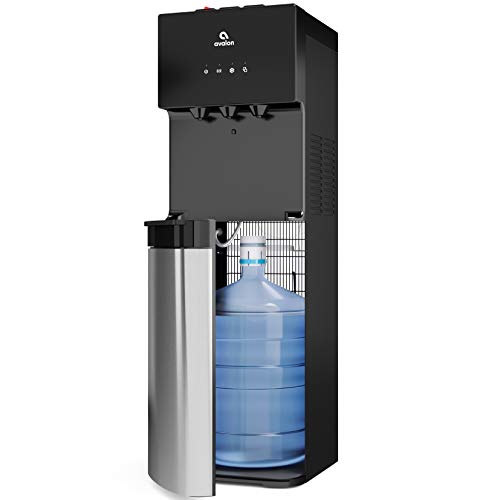
Avalon A4 Bottom Loading Water Cooler — Best Certified Classic
Avalon has sold the A4 for years, and longevity is itself a feature in a category full of anonymous newcomers. The formula mirrors the Brio closely: the bottle hides in the base, a pump does the lifting, and hot, cold and room-temperature water arrive from three settings. What separates the A4 is the paperwork behind it. The listing carries UL approval and Energy Star certification, which tells you the electrical safety and the standby consumption have both been examined by somebody other than the manufacturer.
The durable stainless steel cabinet suits it to busy placements, from a family kitchen corner to a small office kitchenette that sees thirty glasses a day. Owners tend to describe the A4 the way people describe a reliable hatchback: unglamorous, consistent, easy to live with. Bottle changes follow the same floor-level routine as every bottom loader here, and the hot tap carries the expected child safety lock. If the Brio wins on its alert display, the A4 answers with a track record, and for many buyers a track record is the more persuasive argument.
- Loading style: bottom loading with pump assist
- Temperatures: hot, cold and room settings
- Cabinet: durable stainless steel
- Certifications named on the listing: UL and Energy Star approved
- Safety: child lock on the hot water dispenser
Strengths
- Third-party safety and energy approvals are documented
- Long production history suggests parts and support stability
- Bottom loading keeps bottle swaps at ankle height
Trade-offs
- No empty-bottle alert mentioned on the listing
- The design looks more office than designer kitchen
- Cold output still depends on compressor recovery time
Best for: cautious buyers who read certification lines before feature lists. Not suited for: shoppers wanting the newest display or finish options.

Manastin Bottom Loading Water Cooler Dispenser — Best Matte Black Finish
Matte black has quietly taken over the modern kitchen, appearing on fridges, range hoods and coffee machines, and the Manastin is the bottom loader that matches that memo. Behind the finish sits the familiar, sensible layout: a five-gallon bottle concealed in the base, three temperature settings, an empty bottle indicator and a child safety lock guarding the hot side. Nothing about the formula is experimental, and that is precisely the appeal for a newer brand asking for your trust.
Where the Manastin earns attention is the combination of the indicator and the styling at this end of the range. The empty bottle light solves the one recurring bottom-loader complaint, namely that a hidden bottle also hides its own emptiness, and the matte surface shrugs off the fingerprints that glossy black and stainless both collect. The listing positions it for home, office and living room use, and the footprint follows the standard tower proportions, so it tucks beside a fridge or at the end of a counter run without drama.
- Loading style: bottom loading, concealed bottle compartment
- Finish: matte black cabinet
- Temperatures: hot, cold and room settings
- Signals: empty bottle indicator light
- Safety: child safety lock on the hot tap
Strengths
- Matte finish hides smudges better than gloss or steel
- Empty-bottle warning covers the hidden-jug blind spot
- Three temperatures match the established brands here
Trade-offs
- A newer name without the A4’s long sales history
- Matte black can clash with older white appliance suites
- Bottle supply remains your ongoing errand or delivery
Best for: design-led kitchens that still want floor-level loading. Not suited for: buyers who only trust brands with decade-long records.

Igloo Top Loading Water Cooler — Best Top-Loading Traditionalist
Every other jug-fed pick in this guide hides its bottle, so the Igloo deserves a defence of the visible alternative. With a top-loading tower, the water level is always on display; you know on Tuesday that Friday needs a fresh jug, no indicator light required. There is no pump to wear out, because gravity does the delivery work, and the bottle swap, while heavier, takes under a minute once your technique settles. The removable drip tray and energy-saving features on this model tidy up the two everyday annoyances of the format, spills and standby waste.
The honest cost is the lift. A full five-gallon jug must rise, tip and settle onto the top of the tower, and that job belongs to the strongest person in the house. Households with one able lifter who does not mind the ritual will find the Igloo refreshingly simple, with hot and cold settings, a child safety lock and stainless in the build. Households where the lifter travels for work, or where a grandparent handles refills, should read the bottom-loading reviews above twice and choose accordingly.
- Loading style: top loading, bottle visible on the tower
- Bottle sizes: fits 3 and 5-gallon jugs
- Temperatures: hot and cold settings
- Extras: removable drip tray, energy-saving features
- Safety: child safety lock included
Strengths
- Water level is visible without opening anything
- Gravity feed means no pump noise or pump failure
- Accepts both three and five-gallon bottles
Trade-offs
- Bottle changes demand a confident forty-pound lift
- No room-temperature third tap on this model
- The exposed jug dominates the look of the corner
Best for: traditionalists with a willing lifter and good headroom. Not suited for: bad backs, low ceilings or solo small-statured owners.
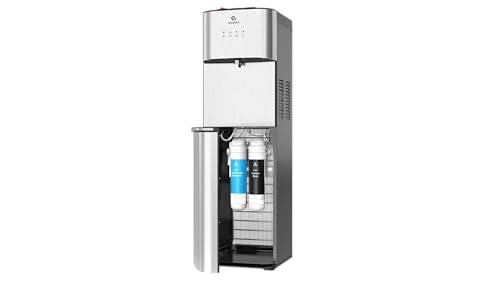
Avalon Self Cleaning Bottleless Water Cooler — Best Bottleless Plumbed Pick
This Avalon deletes the bottle from the equation. It connects to your cold water line, passes the flow through an NSF certified filter, and dispenses hot, cold or room-temperature water for as long as the mains supply lasts. The self-cleaning function periodically sanitises the internal tanks, which addresses the hygiene question that hangs over every dispenser: the water path you cannot see. For a household burning through three jugs a week, the arithmetic of skipped deliveries, skipped deposits and skipped storage quickly becomes persuasive.
Now the part bottleless brochures whisper. Filtration is not optional decoration on a plumbed cooler; it is the whole point, because the machine serves your tap water, so the filter defines the taste and needs replacing on schedule, typically a couple of times a year depending on use. Installation asks for a water line within reach, a shut-off you can access, and either modest DIY confidence or a plumber’s short visit. Renters need landlord permission for a plumbed appliance. None of this is hidden cost so much as a different cost shape: money and effort move from weekly bottles to occasional filters and one proper setup afternoon.
- Supply style: bottleless, connects to a household water line
- Filtration: NSF certified filter fitted as standard
- Temperatures: hot, cold and room settings
- Cabinet: durable stainless steel
- Extras: self-cleaning cycle for the internal tanks, UL listed
Strengths
- No bottles to store, lift, deposit or run out of
- Built-in filtration improves ordinary tap water taste
- Self-cleaning tackles the invisible hygiene problem
Trade-offs
- Needs a nearby water line and a real installation step
- Filters become a recurring replacement commitment
- Moving house means uninstalling, not just unplugging
Best for: heavy-drinking households in homes they own. Not suited for: renters, minimalists about maintenance or the plumbing-shy.
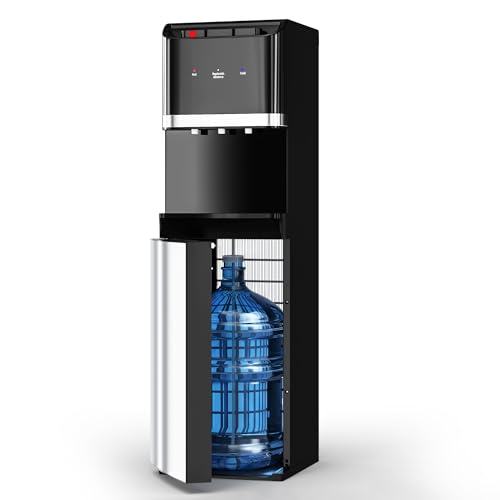
Tehanld Bottom Loading Water Cooler Dispenser — Best Noir Black Alternative
The Tehanld gives the Manastin a direct rival: another bottom loader in deep black, this time described as noir, with stainless steel in the construction and the standard trio of hot, cold and room temperatures. Five-gallon bottles disappear into the base, the pump handles the vertical work, and a child safety lock watches the hot tap. For a kitchen already committed to black appliances, having two credible dark options at different listings is genuinely useful, because stock and offers shift week to week.
Choosing between the two black cabinets comes down to details rather than drama. The Manastin advertises its empty bottle indicator in plain terms; the Tehanld listing leans on finish and core temperatures. If the alert matters to you, that tilts the decision. If you prefer this cabinet’s look and you are disciplined about keeping a spare bottle in the pantry, the Tehanld covers the fundamentals without fuss. Either way, the daily experience converges: quiet standing, quick glasses, and bottle swaps your spine will never hear about.
- Loading style: bottom loading with internal pump
- Finish: noir black with stainless steel in the build
- Bottle size: 5 gallon jugs
- Temperatures: hot, cold and room settings
- Safety: child safety lock on the hot water tap
Strengths
- Deep black finish suits modern appliance line-ups
- Floor-level loading like the other concealed models
- Full three-temperature coverage for drinks and cooking
Trade-offs
- No empty-bottle alert highlighted on the listing
- Brand history is shorter than Avalon’s or Brio’s
- Black cabinets show dust in sunny rooms
Best for: black-appliance kitchens wanting a second dark option. Not suited for: buyers who rank the empty-bottle alert above finish.
How Do the Six Dispensers Compare Side by Side?
| Pick | Loading | Temperatures | Standout detail |
|---|---|---|---|
| Brio Bottom Loading Water Cooler Dispenser | Bottom | Hot, room, cold | LED empty-bottle alert |
| Avalon A4 Bottom Loading Water Cooler | Bottom | Hot, cold, room | UL and Energy Star approvals |
| Manastin Bottom Loading Water Cooler Dispenser | Bottom | Hot, cold, room | Matte black, empty indicator |
| Igloo Top Loading Water Cooler | Top | Hot, cold | Visible level, 3 or 5 gallon |
| Avalon Self Cleaning Bottleless Water Cooler | Bottleless | Hot, cold, room | NSF filter, self-cleaning |
| Tehanld Bottom Loading Water Cooler Dispenser | Bottom | Hot, cold, room | Noir black cabinet |
Bottom Load, Top Load or Bottleless: Which Loading Style Fits Your Home?
Start with the human who changes the bottle. Bottom loading asks that person to kneel, slide and connect a cap, a job almost any adult can manage on a tired evening. Top loading asks for strength and confidence at chest height. Bottleless asks nobody anything weekly, but demands a competent adult with a wrench exactly once, plus a filter diary forever after. Rank the three by your household’s real abilities rather than your aspirations, because the dispenser you dread servicing becomes the dispenser gathering dust.
Space tells the second half of the story. A top loader needs clearance above the bottle for the swap, which rules out spots under low cabinets. Bottom loaders fit under shelves because the jug travels horizontally. The bottleless Avalon needs proximity to a water line, usually under a nearby sink, and a route for the supply tube that does not cross a walkway. Measure your intended corner for height, depth and outlet access before falling for any finish, and remember the machine also wants a few inches of breathing room behind it for the condenser.
How Cold Is Cold, and How Hot Is Hot Enough?
Compressor-cooled dispensers like these chill water to the kind of cold that makes a summer glass sweat, noticeably colder than a fridge jug that has been opened twenty times. Recovery matters more than the minimum temperature: after three tall glasses, a small tank needs minutes to chill the next round, which is why big households should favour proven models with sensible tank sizes. On the hot side, dispenser water arrives hot enough for tea, instant coffee, oatmeal and noodles straight from the tap, sparing the kettle entirely for most morning routines.
The room-temperature spout, fitted to five of the six picks, earns its keep in quieter ways. Medication, baby formula mixing under guidance, pet bowls and houseplant watering all prefer water that is neither chilled nor heated. The Igloo skips the third tap, so owners there mix hot and cold or keep a counter jug. Decide how often your household reaches for unheated water before treating the missing spout as trivial or fatal.
What Does Owning a Jug-Fed Dispenser Actually Cost Over a Year?
The machine’s purchase is the smallest cheque in this story. Jug-fed ownership means a rolling supply of filled bottles, whether that is a delivery subscription, a refill station at the supermarket or an exchange cage at the hardware store. Add the deposit on each bottle in rotation and the electricity of a compressor and a hot tank running around the clock. None of these costs is alarming alone; together they explain why heavy-use households eventually eye the bottleless route.
Bottleless ownership flips the ledger. The water itself is nearly free at household volumes, but filters arrive on a schedule and cost real money, and the installation, whether DIY time or a plumber’s visit, lands in the first month. Spread over three years, a thirsty family usually spends less plumbed than bottled, while a couple who drinks two glasses a day may never recoup the setup. Your consumption, honestly estimated from a week of watching the fridge jug, decides which ledger wins.
Where Should a Water Cooler Stand in a Real House?
Kitchens are the default answer, yet the best spot is wherever thirst actually happens. A hallway nook near bedrooms serves night-time glasses without a dark kitchen expedition. A home office corner keeps a worker hydrated and away from the snack cupboard. A utility room beside the back door catches gardeners, dog walkers and gym bags. Each candidate spot needs three things: a level floor, an outlet that is not already hosting the microwave, and enough clearance for the bottle door or the top-load lift.
Avoid placing any dispenser in direct afternoon sun, which warms the cabinet and makes the compressor work for its living. Keep the hot tap out of toddler reach even with the safety lock engaged, because locks are a second line of defence, not the first. If the machine stands on carpet, a shallow tray underneath catches the one drip-tray overflow that eventually happens to everyone, usually during a party.
How Do You Keep a Dispenser Tasting Clean?
Stale taste in dispenser water almost always traces back to the bottle or the reservoir, not the machine’s cooling. Store spare jugs away from sunlight and cleaning chemicals, because plastic picks up neighbouring smells and algae loves a sunlit bottle. When a bottle empties, wipe the cabinet compartment and the suction cap before the fresh jug goes in. Every few months, run the manufacturer’s cleaning routine, which on the bottleless Avalon is partly automated by its self-cleaning cycle.
The drip tray deserves weekly attention; it collects a surprising soup of splashes that will announce itself by smell if ignored. The Igloo’s removable tray makes this a ten-second job, and the fixed trays on the bottom loaders still lift out or wipe clean easily. Finally, respect filter dates on the plumbed model. An exhausted filter does not merely stop improving taste; it can harbour the very growth it was installed to prevent, so the calendar reminder is a health habit, not a sales trick.
Can a Dispenser Replace Your Kettle and Fridge Jug?
For most households, mostly yes. The hot tap covers the daily tea, coffee and instant meals that keep a kettle employed, and it does so instantly, which changes breakfast choreography more than any other single feature here. The cold tap retires the fridge jug and frees a door shelf. What a dispenser does not replace is the kettle’s rolling boil for tasks that genuinely need one, such as sterilising or certain pour-over rituals, and it does not chill anything else, so the fridge keeps its day job regardless.
Think of the dispenser as plumbing for your drinking habits rather than as another gadget. Once water at three temperatures stands in the corner, people drink more of it; that is the consistent, unglamorous finding of every household that installs one. Children fill their own bottles. Guests help themselves without opening your fridge. The machine pays its way in behaviour long before it pays in arithmetic.
What Should You Check Before the Box Arrives?
Confirm the bottle format your local supply actually stocks. Five-gallon jugs are the common currency for the bottom loaders here, while the Igloo also accepts three-gallon bottles for lighter lifts. Check the doorway and the path from it; these towers are slim but tall, and a tight stair turn has embarrassed more than one delivery day. Photograph your intended corner with the outlet visible, then compare it against the machine’s listed footprint when the listing gives one.
For the bottleless Avalon, the pre-order homework is plumbing homework. Identify the cold line you will tap, confirm the shut-off valve turns, and plan the tube route. Decide now where the filter will live and how you will remember its birthday; a note in the family calendar beats a guess eighteen months later. Owners who do this homework report boring installations, and boring is exactly what you want from anything involving pressurised water.
How Do You Swap a Bottom-Load Bottle Without the Flood?
Wait until the indicator or the sputtering tap confirms the jug is truly empty, then open the cabinet door and slide the bottle out. Pull the suction cap assembly from the empty jug’s neck, keeping the probe over the old bottle so the last drips land inside it. Roll or carry the fresh bottle to the machine, remove its sealed cap, press the suction assembly firmly home, and slide the jug into the compartment. Close the door, give the pump a moment, and draw a small glass from the cold tap to confirm the line is primed.
Two habits keep the ritual dry. First, never tip a bottom-load bottle to drain the dregs into a glass over the kitchen floor; the dregs are a sink job. Second, wipe the probe before it meets the fresh bottle, because the probe touches every drop the household will drink from that jug. The whole swap takes perhaps three minutes, needs no lifting beyond a short carry, and can be done by whoever notices the alert first, which quietly redistributes a chore that top loaders reserve for the strongest back in the house.
How Much Electricity Does a Dispenser Use While Nobody Is Drinking?
A water cooler never truly sleeps. The compressor cycles to hold the cold tank at temperature, and the heating element keeps the hot tank ready for a kettle’s worth of instant demand at any hour. That readiness is the convenience you bought, and it carries a modest, continuous appetite for power. Models with energy-saving features, like the Igloo in this line-up, trim the waste by letting temperatures drift when the house is quiet, and the Avalon A4’s Energy Star approval certifies that its standby behaviour has been measured rather than guessed.
You can help without giving up convenience. If your household keeps regular hours, a timer plug that rests the machine overnight returns the hot tank to duty before the first alarm, though you should confirm the model tolerates external switching. Holidays deserve the off switch entirely. What you should not do is unplug and replug the machine several times a day in the name of savings; compressor restarts are the hardest work the unit does, and the pennies saved buy wear you will pay for later.
Why Does the Hot Tap Deserve More Respect Than the Kettle?
Kettle water announces itself with steam, noise and a whistling build-up that warns everyone nearby. Dispenser hot water arrives silently, instantly and at a temperature that can scald a child’s hand or mouth before an adult registers what happened. That is why every pick in this guide guards the hot spout with a child safety lock, usually a squeeze-or-slide-and-press action that small hands cannot coordinate. Treat the lock as a seatbelt: it works only when engaged, and engaging it must become a reflex for the whole household, including teenagers who find it annoying.
Adults burn themselves too, most often in the first week, by filling a mug one-handed while reading a phone. The stream is thinner than a kettle’s and easy to misjudge against a cup’s rim. Slow down for the first dozen cups. Position the mug, use both the lock and the lever deliberately, and keep the dispensing area clear of the clutter that migrates across every kitchen surface, because a knocked mug of near-boiling water finds feet with terrible reliability.
Delivery, Refill Station or Exchange Cage: How Should Bottles Reach Your House?
Jug-fed owners choose between three supply chains, and the right one depends on your car, your street and your tolerance for subscriptions. Delivery services drop full bottles and collect empties on a route, which is effortless and usually the priciest per gallon. Refill stations at supermarkets and water stores charge the least and ask you to haul the empties yourself, a trip that pairs naturally with the weekly shop. Exchange cages at hardware and grocery stores sit between the two: swap an empty for a sealed full bottle, no membership, moderate price.
Whichever chain you pick, keep the rotation at three bottles minimum for a family: one in the machine, one full in reserve, one empty awaiting its trip. That buffer absorbs a missed delivery or a busy fortnight without a hydration emergency. Store the reserve upright, indoors and away from the garage’s chemical shelf, and rinse the neck area before the bottle meets the machine. Small disciplines like these are why some households describe bottled water as flawless while others swear it tastes of the boot of their car.
What Does a Sensible Cleaning Calendar Look Like Month by Month?
Weekly, empty and wash the drip tray, and wipe the taps and the cabinet front, because those surfaces meet every glass and every hand in the house. Monthly, clean the bottle compartment of a bottom loader and inspect the suction probe for the slimy film that water equipment grows when nobody looks at it. On the top-loading Igloo, lift the bottle off monthly and wipe the reservoir rim and the spike area where dust settles between swaps.
Every three to six months, run the deeper clean the manual describes, typically a flush with a food-safe sanitising solution through the tanks and taps. The bottleless Avalon shortens this ritual with its self-cleaning cycle, but even there the external taps, tray and cabinet still want hands and a cloth. Put the deep clean on the same calendar rhythm as something you never forget, like changing a toothbrush head or paying a quarterly bill, and the machine will taste as clean in year three as it did in week one.
Does a Home Office Deserve Its Own Dispenser?
Remote workers underestimate how often they abandon a desk for the kitchen and lose a thread of concentration to a kettle’s boil. A dispenser within arm’s reach of the study door collapses that trip to twenty seconds, and the hot tap quietly replaces the desk kettle that was always a small spill risk near laptops and paperwork. For a single worker, the Igloo’s simplicity or a bottom loader’s quiet pump both serve; the deciding factor is usually who else in the house will use the machine, because an office dispenser inevitably becomes a household one.
Placement in a work room raises two cautions. Compressor hum that vanishes in a kitchen can register in a silent study during calls, so give the machine a corner away from your microphone side. And a dispenser in the office invites the rest of the family through your workspace all day, which some people love and others experience as a slow leak in their door policy. Decide which household you are before the bottle goes in.
Why Does the Same Water Taste Different From Two Machines?
Temperature is the first illusionist. Very cold water tastes cleaner than the same water at room temperature because cold dulls the tongue’s sensitivity to chlorine and mineral notes. A dispenser with strong chilling can make ordinary tap or bottled water seem a grade better than it is, while a weak chiller exposes every flaw. This is why the room-temperature tap is the honest taste test of any machine: it serves the water unmasked.
Freshness is the second factor. Water sitting in a tank for a week picks up the character of its container and its air exposure, which is why low-use households sometimes report a flat taste that heavy-use neighbours never meet. The cure is turnover: draw and discard a glass or two after holidays. On the plumbed Avalon, the filter does the real flavour work, stripping the chlorine note that dominates most municipal supplies, and a tired filter hands that note straight back, which is your palate’s reminder that the change date has arrived.
What Should You Do When a Tap Sputters, Slows or Stops?
Sputtering on a jug-fed machine almost always means air in the line, which means the bottle is empty or the suction cap has lost its seal. Check the jug first, reseat the cap second, and draw a full glass to purge the bubbles third. A slow cold tap after a party usually means the tank is recovering rather than broken; give the compressor twenty minutes before diagnosing anything. A slow hot tap in a hard-water area can signal scale building at the outlet, which the manual’s cleaning routine addresses.
Silence from a bottom loader’s pump with a full bottle fitted points at the cap connection or a kinked internal line, both fixable by reopening the cabinet and tracing the tube with your fingers. The bottleless machine that stops dispensing has most likely reached a filter or safety condition and wants its manual consulted rather than its cabinet opened. None of these faults needs panic; dispensers are simple machines, and nearly every symptom maps to water supply, air, temperature recovery or cleaning, in that order.
How Long Should a Dispenser Last, and What Wears Out First?
A compressor dispenser from an established maker should serve five to ten years of household use. The components that age first are the ones that move or heat: pump motors on bottom loaders, hot tank elements, tap levers and the seals around them. The established names in this guide, Avalon, Brio and Igloo, have the advantage of parts and documentation existing at all, which is a genuine argument against the very cheapest anonymous towers whose makers vanish before the first seal perishes.
You extend the machine’s life with boring kindness. Keep the rear condenser coils dusted so the compressor breathes. Do not let the hot tank run dry, because heating an empty tank is the fastest way to kill the element. Rest the machine during long holidays rather than letting it hold temperatures for an empty house. And when a tap begins to drip, fix the drip; a leaking hot tap wastes heated water all day and scales everything downstream of it. Treated this way, the dispenser becomes one of those appliances you replace out of boredom with its finish rather than failure of its function.
How Do You Choose Between a Three-Gallon and a Five-Gallon Routine?
Bottle size sounds like a storage detail and behaves like a lifestyle one. Five-gallon jugs minimise trips and cost less per gallon, but each one is a forty-pound commitment at swap time, which is why bottom loading pairs so naturally with the big format: the machine, not your spine, does the vertical work. Three-gallon bottles halve the carry and suit top loading far better, and the Igloo’s willingness to accept both sizes lets a household start light and change its mind later without changing machines.
Households with one strong adult and several light drinkers often settle happily on three-gallon top loading. Households with teenagers, athletes or a home-working parent usually find the small bottles emptying at an irritating rhythm and migrate upward. Watch your first month honestly. If the jug empties faster than your supply routine comfortably refills it, the format is wrong, not the machine, and adjusting bottle size is cheaper than resenting a good dispenser.
Can a Dispenser Keep Up With a Party, a Heatwave or a Houseful of Guests?
Peak demand is where tank size stops being a spec and becomes an experience. A dispenser chills and heats a finite reservoir; draw past that reservoir in a short burst and the next glasses arrive merely cool or warm while the machine recovers. For an ordinary family evening, every pick here copes without comment. For a barbecue with fifteen guests filling bottles and jugs, even the best tower will fall behind unless you plan around it, filling a large pitcher in advance and letting the machine work on refills between rounds.
Heatwaves expose the same limit at household scale, as everyone drinks double for a week. The practical responses are simple: keep a couple of bottles of water in the fridge as a relief valve, stagger the big refills, and resist the urge to judge a machine by its worst afternoon of the year. Bought for the ninety-five percent of days, with a pitcher strategy for the rest, any of these six will feel generously sized.
What Should Renters and Frequent Movers Notice Before Choosing?
Portability divides this line-up sharply. The five jug-fed models unplug, drain and travel in a car boot, asking nothing of the building they leave behind. The bottleless Avalon is a semi-permanent installation: it can certainly move with you, but moving means disconnecting a water line, capping it cleanly and repeating the setup at the next address, ideally with the landlord’s blessing recorded somewhere more durable than a handshake.
Renters should also think about deposits and marks. A tower on a hard floor leaves no trace; on carpet, years of tiny splashes can leave a ring that a tray prevents for pennies. If your tenancy is short or your landlord is particular, choose a bottom loader, stand it on a tray, keep the bottle routine inside your own four walls, and the machine will be the least controversial appliance you own.
How Do Pets, Plants and Other Quiet Customers Change the Calculation?
Not every glass drawn from a dispenser goes into a person. Dog bowls empty twice a day, cats develop strong opinions about freshly drawn cold water, and a shelf of houseplants drinks steadily through winter heating season. The room-temperature tap serves all of them without shocking roots or wasting chilled water on a spaniel. Households that tally these quiet customers usually discover their true consumption is a third higher than the human-only estimate, which pushes borderline families toward the five-gallon or bottleless formats.
Pet hair, predictably, finds the drip tray. If animals drink near the machine, wipe the tray and taps more often than the standard calendar suggests, and position bowls a step away from the cabinet so splashes land on the floor rather than against the bottle door. Small adjustments like these keep a shared water station hygienic for every species using it.
When Is a Countertop or Fridge Solution Honestly the Better Answer?
A floor dispenser is the wrong purchase for a studio flat where the tower would stand in the only walkway, or for a household that drinks two glasses a day and would watch a five-gallon jug age for a month. Freshness follows turnover, and low-turnover homes are better served by a filter jug they refill daily. Equally, if nobody in the house drinks hot drinks, a third of the machine’s talent stands idle, and a simpler cold-only arrangement may suit the budget better.
We say this because the six machines above deserve owners who will use them fully. A dispenser thrives in a busy, thirsty household with floor space and a corner outlet. If that description fits, choose with confidence; if it does not, the honest recommendation is to spend the money where your household’s real habits live.
What Mistakes Do New Water Cooler Owners Make Most Often?
The classic error is placement by enthusiasm: the machine lands wherever it fits on day one, far from an outlet, and lives on an extension lead it should never have met. Plug a compressor appliance directly into a wall socket. The second error is forgetting the hot tank has an off switch or a long memory; leaving hot water heating through a two-week holiday wastes energy for nobody’s benefit, and several of these models include energy-saving behaviour precisely for those gaps.
Third, owners ignore the first strange taste. A new dispenser should be flushed according to its manual before the household drinks from it, and a plumbed filter should be run in as directed. Fourth, bottle households let the spare run out, converting a convenience appliance into an emergency supermarket trip. Keep one full jug in reserve, always. Finally, people skip the child lock because their own children are older, then host a curious four-year-old. Engage the lock; it costs you half a second per cup of tea.
How Should a First-Time Buyer Read the Listings Without Getting Lost?
Listings for dispensers repeat the same half-dozen phrases until they blur, so read for the three facts that actually separate models: how the bottle loads, whether an empty-bottle alert exists, and what certification or filtration stands behind the water path. Finish, colour names and lifestyle photography are decoration around those facts. When two listings look identical, the alert and the paperwork usually mark the better buy, and when a listing stays silent about loading style, it is almost certainly a top loader wearing flattering angles.
Final Recommendation
For most homes, the Brio Bottom Loading Water Cooler Dispenser is where we would start: floor-level loading, three temperatures and that useful empty-bottle alert cover the category’s real needs in one cabinet. Buyers who put certifications first should take the Avalon A4 Bottom Loading Water Cooler and its documented approvals. Households ready to leave bottles behind altogether, with a water line in reach, belong with the Avalon Self Cleaning Bottleless Water Cooler, filters and all. Choose by loading style first and finish second, and the machine will disappear into your routine within a week, leaving only the drinking behind.
Frequently Asked Questions
Do bottom-loading dispensers need a special kind of bottle?
No. The bottom loaders here drink from ordinary five-gallon jugs, the same format sold by delivery services and refill stations. The suction cap adapts to the standard neck, so you are not locked into one water brand.
How much noise does the pump in a bottom loader make?
Expect a brief, low hum for a few seconds after you draw water, while the pump refills the internal tanks. It is closer to a fridge compressor starting than to any appliance you would move out of a bedroom for.
Is bottleless worth it for a small household?
Only if you dislike bottle logistics more than you dislike filter schedules. A two-person household drinking modestly will take years to offset installation and filter costs, though the convenience argument can still win on its own merits.
Can children serve themselves cold water safely?
Yes, and most do within a day of installation. The hot tap is the guarded one, with a child safety lock on every pick here; teach children that the lock exists because the water behind it can scald.
What happens during a power cut?
The tanks hold their temperature for a while, so a short outage means gradually warming cold water rather than none at all. Dispensing itself still works on jug-fed models for the water already in the tanks, though the pump needs power to refill them.
How often should the bottleless filter be changed?
Follow the interval printed for the Avalon’s filter and mark the date somewhere you will actually see it. Usage and local water quality shift the timing, so treat the manufacturer’s schedule as the ceiling, not a suggestion to stretch.
Related Guides
Kitchen water is one corner of a well-run home drinks station. If mixing and baking are next on your upgrade list, our guide to Best Stand Mixers for Your Kitchen covers the counter’s other workhorse. For the bathroom side of household water habits, Best Bathroom Towels That Do Not Shed looks at linens that survive the wash without snowing lint. And when the cooking itself levels up, Best Cookware Sets Surgical Stainless Steel explains what those steel grades really mean before you spend on a set.



[…] companion guides continue the household tour from here: Best Home Water Coolers and Dispensers leaves textiles for the kitchen’s hardest-working appliance, Best Alarm Clocks for Peaceful […]