What's inside
- Key Takeaways
- Quick Picks
- How We Chose These Picks
- How Do the Six Car Washers Compare at a Glance?
- How Does a Foam Cannon Actually Clean a Car?
- What Is the Safest Washing Sequence, Panel by Panel?
- Why Must the Pinpoint Tip Never Touch a Car?
- How Do You Wash in Winter Without Inviting Damage?
- What Else Around the Car Benefits From a Gentle Washer?
- Which Mistakes Do Car Owners Make With a New Washer?
- How Should You Set Up the Driveway Before the First Wash?
- What Does the Two-Bucket Method Add to a Pressure Wash?
- How Do You Care for the Machine Between Washes?
- When Should a Car Owner Skip the Washer and Hand Wash Only?
- How Does Water Quality Change the Result?
- What Should Motorcyclists and Cyclists Borrow From This Guide?
- Why Does This Class Belong in a Garage Rather Than a Rental Yard?
- Final Recommendation
- Frequently Asked Questions
- Related Guides
As an Amazon Associate I earn from qualifying purchases. This post may contain affiliate links at no extra cost to you.
cottageverdict.com is reader-supported. When you buy through links on our site, we may earn an affiliate commission.
Where to buy: every machine in this guide is sold through Amazon, and the linked names in the Quick Picks table, the review headings, and the comparison chart open each model’s own listing, where you can check price on Amazon and confirm which tips and foam accessories ride in the box. Drivers searching for the best car pressure washers for home use need a very different machine from the driveway-stripping kind: paint, clear coat, badges, and rubber seals all reward gentleness, and the useful pressure window for a car sits far below what concrete demands.
That window runs from roughly 1,600 to 2,100 PSI, and all six picks live inside it deliberately. Within the band, flow stays modest — around 1.2 gallons per minute for most, rising to 1.76 on the step-up Westinghouse — because a car wash is a rinsing exercise punctuated by foam, not a blasting contest. The other half of the method is the foam cannon, which lays a thick blanket of shampoo over the paint so chemistry lifts grit before anything touches the surface. Pressure’s job in car care is mostly to rinse and to make foam; the wash mitt does the persuading.
One warning belongs at the top rather than buried in a safety section. Never use a 0-degree pinpoint tip on a vehicle. That jet concentrates the machine’s full force into a pencil that can cut clear coat, lift paint at stone chips, drive water past window seals, and injure skin on contact. Every pick below ships with the wide fans a car actually needs — 25 and 40 degrees — and several add a turbo nozzle that belongs on wheels and undercarriages only, kept well away from painted panels.
Greenworks dominates this gentle class with three entries at 1,600, 1,700, and 1,900 PSI, Ryobi fields its compact 1,800, an unbranded 1,800 offers the plainest route in, and Westinghouse’s ePX3100s closes the set as the step-up for owners who also want a foam cannon in the box and enough headroom for light patio duty. The reviews that follow treat each machine as a car tool first and judge it by that standard.
Key Takeaways
- Stay inside the gentle band: roughly 1,600 to 2,100 PSI with a wide fan is the safe working range for paint.
- Foam first, rinse second — a foam cannon’s dwell time does more cleaning than extra pressure ever will.
- Never aim a 0-degree pinpoint tip at a vehicle; it can cut clear coat and lift paint at chips.
- Turbo nozzles belong on wheels, tyres, and underbody grime, not on doors, bonnets, or bumpers.
- Four of these six picks are Greenworks or Ryobi electrics with 1.2 GPM flow tuned for rinsing, not stripping.
- The Westinghouse ePX3100s is the step-up: 2,100 max PSI, 1.76 max GPM, and a foam cannon included.
Quick Picks
| Pick | Badge | Why it earns its place |
|---|---|---|
| Greenworks 1600 PSI Electric Pressure Washer | Best Gentle Starter | The mildest pressure here, with 25 and 40-degree tips and a soap applicator for a safe first car-wash setup. |
| Greenworks 1700 PSI Electric Pressure Washer | Best Light Upgrade | A touch more pressure, a turbo nozzle for wheels, and soap delivery in a compact Greenworks frame. |
| RYOBI 1800 PSI Electric Pressure Washer | Best Compact All-Rounder | Ryobi’s tidy 1,800 PSI, 1.2 GPM machine for owners who wash the car and the patio chairs alike. |
| 1800 PSI Electric Pressure Washer | Best Simple Value | An unbranded, no-ceremony 1,800 PSI electric for buyers who want the gentlest route in. |
| Greenworks 1900 PSI Electric Pressure Washer | Best Near-Top of the Gentle Band | 1,900 PSI with turbo nozzles and soap gear for drivers who also face winter road film. |
| Westinghouse ePX3100s Electric Pressure Washer 2100 Max PSI | Best Step-Up With Foam Cannon | 2,100 max PSI, 1.76 max GPM, a bundled foam cannon, and a turbo nozzle for the keen home detailer. |
How We Chose These Picks
The ceiling came before the floor. Any machine whose headline pressure sailed past the gentle band was excluded, however good its driveway reputation, because a car guide that recommends concrete muscle teaches exactly the wrong instinct. Within the band, we required electric drive across the set: instant starting, no exhaust near a freshly washed car, and quiet operation that suits a Sunday morning on a residential street.
Accessory kits were read as evidence of intent. A car washer should arrive with a 25-degree tip for general rinsing and a 40-degree for delicate passes, plus some honest route to soap — an applicator, a tank, or ideally a foam cannon. Machines offering only aggressive tips were cut. We also noted which bundles add a turbo nozzle, and our reviews confine that accessory to wheels and underbody work where its rotating jet earns its keep without endangering paint.
Finally, we spread the six across the ownership ladder: a mild starter for the nervous first-timer, two mid-band all-rounders from the big cordless-era brands, a value entry with no badge tax, a near-ceiling Greenworks for winter grime, and one genuine step-up whose foam cannon and flow suit owners graduating toward home detailing. Every reader should find their current rung described, and the next rung visible.

Greenworks 1600 PSI Electric Pressure Washer — Best Gentle Starter
Sixteen hundred PSI is the mildest headline in this guide, and for a first car washer that mildness is the entire recommendation. A beginner’s mistakes — standing too close, lingering on a badge, angling into a panel gap — are forgiven by a machine whose ceiling sits low, while its 1.2 GPM flow still rinses shampoo and loosened road film at a perfectly civilised pace. Greenworks bundles the two tips a car actually uses, 25 degrees for the general rinse and 40 for the gentlest passes over fresh wax or delicate trim.
The soap applicator handles the detergent stage without extra purchases, foaming modestly rather than laying the thick blanket a cannon produces, yet entirely adequately for a weekly wash rhythm. Technique matters more than foam density at this level: pre-rinse the grit downward, apply soap from the bottom up so it dwells longest on the dirtiest panels, wash with a mitt in straight lines, then rinse from the roof down. This machine supports every step of that liturgy without ever threatening the paint it serves.
New drivers in a household deserve a paragraph of their own, because a first car and a first pressure washer often arrive in the same year. This Greenworks is the machine to teach with: its ceiling limits the tuition of every mistake, its controls explain themselves, and the wash sequence it supports — rinse, soap, mitt, rinse — builds the exact habits that protect a finish for decades. A teenager who learns car care on a forgiving machine becomes an adult whose cars always look cared for, which is a inheritance no accessory can buy.
Garage practicality seals the case. The unit is light enough to carry one-handed to the driveway, stores in the footprint of a bucket, and starts with the uncomplaining click that makes a twenty-minute wash feel spontaneous rather than scheduled. Owners whose ambitions grow toward foam cannons and winter salt will eventually step up within this guide; owners whose ambition is a clean car every fortnight may never need to.
- Output: 1,600 PSI max with 1.2 GPM max flow
- Tips: 25-degree and 40-degree fans for painted surfaces
- Soap: applicator included for the detergent stage
- Hose: 20-foot class reach for driveway working room
- Role: mildest, most forgiving starter in the set
Strengths
- Gentlest ceiling makes beginner errors survivable.
- Both car-safe fan tips included from the start.
- Light, compact body stores almost anywhere.
Trade-offs
- Foam from the applicator is thinner than a cannon’s blanket.
- Modest flow slows rinsing on large SUVs and trucks.
- Little headroom for patio or deck side jobs.
Best for: first-time owners washing cars and little else. Not suited for: drivers wanting thick foam or multi-surface duty.

Greenworks 1700 PSI Electric Pressure Washer — Best Light Upgrade
One hundred PSI is a small step on a spec sheet and a surprisingly useful one at the wand, because the extra authority shows up exactly where car washing struggles: the lower panels. Road tar mist, brake dust baked onto front wheels, and the grey film that colonises sills all surrender a little faster at 1,700 PSI through a 25-degree fan, while the paint above the waistline never learns the difference. Greenworks keeps the flow at the same car-friendly 1.2 GPM, so rinsing manners stay gentle even as loosening power grows.
The bundle widens in the right places. Alongside the 25 and 40-degree tips and the soap route, a turbo nozzle joins the kit — a rotating jet that scours wheel faces, tyre sidewalls, and underbody splash zones with an enthusiasm you must never point at a door skin. Used with that discipline, the turbo turns the worst ten minutes of a winter wash into the most satisfying, watching a season of brown dissolve off the alloys in spirals.
There is a subtler pleasure in this size class worth naming: the whole wash stays quiet enough to hold a conversation across the car. Neighbours wave instead of wincing, a podcast survives in one ear, and the machine’s modest voice makes the early weekend slot — the best light, the coolest panels — socially available. Power tools rarely offer discretion as a feature, yet for a chore performed on a shared street, discretion may be the feature owners use most.
Consider this the connoisseur’s version of the starter above: same compact philosophy, same quiet electric manners, a broader toolkit. Owners washing one car on a driveway will feel the difference in the wheels alone, and households whose car doubles as a muddy dog transport will appreciate the extra resolve on the lower half without paying for pressure the upper half cannot use.
- Output: 1,700 PSI max with 1.2 GPM max flow
- Tips: 25-degree, 40-degree, and a turbo nozzle
- Soap: applicator route for shampoo application
- Role: starter-plus for wheels and winter lower panels
- Caution: turbo nozzle for wheels and underbody only
Strengths
- Extra pressure lands where cars get dirtiest.
- Turbo nozzle transforms wheel cleaning sessions.
- Compact electric manners suit residential driveways.
Trade-offs
- Turbo tip demands discipline near painted surfaces.
- Foam still applicator-grade rather than cannon-grade.
- Flow unchanged, so big vehicles rinse no faster.
Best for: owners whose wheels and sills carry the worst of the road. Not suited for: foam-cannon devotees or large-vehicle households.

RYOBI 1800 PSI Electric Pressure Washer — Best Compact All-Rounder
Ryobi has built a loyal following by packaging honest performance in designs a person can carry with one hand and store on a shelf, and this 1,800 PSI machine is that philosophy with a wand. Its 1.2 GPM flow matches the gentle class standard, the pressure sits mid-band where cars are safe and patio furniture is fair game, and the whole unit feels engineered for apartments, townhouses, and garages where floor space is negotiated rather than assumed.
Mid-band pressure buys versatility that the milder Greenworks pair cannot quite claim. The same Saturday can hold a two-bucket car wash, a rinse of the balcony railing, and a pass over the outdoor chairs, all within the machine’s comfort and all without approaching the thresholds where surfaces complain. For a household buying exactly one small washer to cover car plus odd jobs, that breadth is the argument, and Ryobi’s wide retail and parts presence backs it with easy accessory hunting later.
Car discipline still applies in full. Keep to the wide fans on paint, hold a respectful distance from badges and sensors, and let shampoo dwell rather than escalating force when a panel looks stubborn. The machine’s ceiling is forgiving but not imaginary, and a turbo accessory, if you add one, inherits the wheels-only rule from the Greenworks review above. Treated as a car tool with sidelines, it will serve for years; treated as a tiny driveway machine, it will age in a season.
- Output: 1,800 PSI with 1.2 GPM flow, mid-band balance
- Design: compact corded electric, shelf-friendly storage
- Role: car-first all-rounder with patio sidelines
- Support: broad Ryobi accessory and parts availability
- Method note: wide fans and distance on all painted panels
Strengths
- Mid-band power covers cars plus light household jobs.
- Compact frame suits small garages and balconies.
- Brand network makes tips and spares easy to source.
Trade-offs
- No foam cannon bundled for detailing enthusiasts.
- Flow stays modest for rinsing larger vehicles.
- Versatility tempts owners toward harsher surfaces.
Best for: small households wanting one compact washer for car and patio. Not suited for: dedicated detailers chasing thick foam and speed.

1800 PSI Electric Pressure Washer — Best Simple Value
Not every useful tool arrives with a famous name moulded into its housing. This unbranded 1,800 PSI electric occupies the same mid-band pressure as the Ryobi, promises the same plug-in simplicity, and asks the buyer to trade brand infrastructure for a leaner proposition. For a second car, a holiday home, or a first experiment in pressure washing a vehicle, that trade can be entirely rational.
The buying method matters more than the badge here. Read the listing’s stated tip set carefully and confirm the wide fans a car needs are actually in the box, because value bundles vary between production runs. Then use Amazon’s returns window as your inspection period: run the machine through two full washes, check fittings for weeping, and verify the stream stays steady. A value tool that survives honest scrutiny in week one usually settles into years of unremarkable service.
Holiday-home owners make a quiet constituency for machines like this one. A car that sits near the coast accumulates salt air film and seagull commentary between visits, and a washer that lives in the garage there — cheap enough to leave behind, simple enough for any family member to run — turns arrival day into a quick rinse rather than a detailing appointment. The unbranded premium you are not paying is, in that setting, precisely the feature.
Judge its car manners by the same physics as everything else in this guide. At 1,800 PSI with a 40-degree fan and a sensible standoff, paint is safe; at close range with a narrow tip, no logo on earth would make it safe. The machine does not change the method — foam or soap first, mitt second, rinse last, pinpoint tips never — and owners who bring that discipline will find its output perfectly adequate for keeping a daily driver presentable.
- Output: 1,800 PSI electric, mid-band car-safe ceiling
- Design: unbranded value build, corded operation
- Role: plainest route into home car pressure washing
- Buying note: confirm the included tip set on the listing
- Method note: verify performance inside the returns window
Strengths
- Mid-band pressure without a brand premium attached.
- Simple electric operation for occasional washers.
- Adequate output for routine car and light home use.
Trade-offs
- Parts and support trail Ryobi and Greenworks networks.
- Bundle contents can shift between production batches.
- Long-term durability is unproven beside established names.
Best for: value-first buyers and second-location car washing. Not suited for: owners who want a guaranteed decade of parts support.

Greenworks 1900 PSI Electric Pressure Washer — Best Near-Top of the Gentle Band
Nineteen hundred PSI is where this guide’s gentle band starts clearing its throat. The extra pressure over the 1,700 model is not for the paint — the paint neither needs nor wants it — but for everything the road glues beneath the paint’s sightline: salt crust in the arches, mud packed into tread blocks, and the brown lacquer that winter applies to rocker panels. Greenworks pairs the pressure with the familiar 1.2 GPM and a kit that includes turbo nozzles alongside the 25 and 40-degree fans and a soap route.
Plural turbos in the bundle is a telling detail. Wheel work consumes time, and a spare turbo or a second angle of attack keeps the session moving when one clogs with the very grit it is removing. Used strictly on wheels, tyres, and underbody metal, the rotating jet at 1,900 PSI is the closest this guide comes to a detailing shortcut, cutting through brake dust films that a fan merely persuades.
The discipline tax rises with the pressure, so let us collect it explicitly. Widen your standoff on painted panels compared with the milder machines, keep the fan moving in overlapping sweeps, and never test whether the turbo can remove a tar spot from a door — it can, along with a margin of clear coat. In careful hands this is the sweet spot for drivers in salted-winter regions; in casual hands the 1,700 is the wiser Greenworks.
- Output: 1,900 PSI max with 1.2 GPM max flow
- Tips: 25-degree, 40-degree, and turbo nozzles included
- Soap: applicator route for shampoo application
- Role: winter-grime specialist at the band’s upper edge
- Caution: widen standoff on paint at this pressure
Strengths
- Strongest loosening power still inside the car-safe band.
- Turbo nozzles excel on wheels and salted underbodies.
- Full Greenworks support behind the purchase.
Trade-offs
- Less forgiving of close-range beginner technique.
- Flow remains 1.2 GPM despite the pressure rise.
- Foam quality still depends on an applicator.
Best for: winter-region drivers battling salt, mud, and brake dust. Not suited for: nervous beginners who should start at 1,600 or 1,700 PSI.
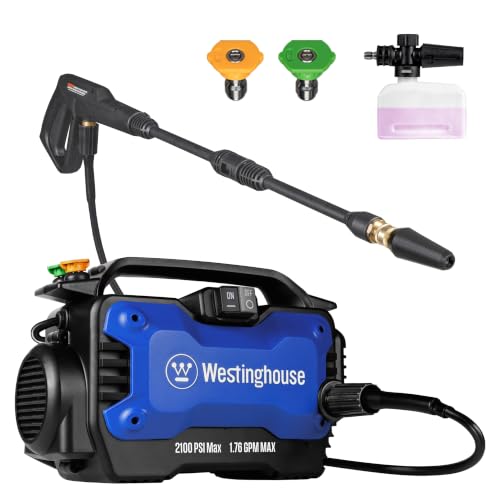
Westinghouse ePX3100s Electric Pressure Washer 2100 Max PSI — Best Step-Up With Foam Cannon
The ePX3100s is the machine this guide’s other five are a rehearsal for. Its 2,100 max PSI tops the gentle band without leaving it, its 1.76 max GPM finally gives rinsing some sweep, and — the headline — a foam cannon rides in the box, ready to lay the thick, clinging blanket that turns a wash into a detail. For the owner who has watched foam videos with intent, this is the complete starter kit in a single purchase.
Westinghouse’s electric line has been circling the car niche for several seasons, and the s-suffix model shows the homework: the flow figure climbs where rinsing large panels actually benefits, the accessory kit assumes foam from the first wash, and the frame stays compact enough for a garage corner rather than demanding a bay. It reads less like a driveway machine tolerating cars and more like a car machine that tolerates driveways, which is the correct priority order for this guide.
Foam changes the physics of the wash in your favour. A cannon’s blanket clings for minutes, softening bug remains, traffic film, and dust cement, so the mitt that follows glides over lubricated paint instead of grinding dry grit across it. Swirl marks are born in that grinding; the cannon is how home detailers avoid authoring them. Paired with the two-bucket mitt method and a 40-degree rinse, the Westinghouse supports a genuinely careful wash at driveway scale.
The turbo nozzle in its kit inherits the standing rule — wheels, tyres, underbody, never paint — and the extra flow gives the machine a second life on patio slabs and outdoor furniture between washes. That versatility explains the step-up label: it is the only pick here that a growing hobby will not outgrow in a year, and the only one whose ceiling deserves a final repetition of the guide’s core warning. Even at 2,100 PSI, distance and fan width are what make it safe; the cannon, not the pressure, is the star.
- Output: 2,100 max PSI with 1.76 max GPM flow
- Foam: cannon included for thick shampoo blankets
- Tips: turbo nozzle included for wheels and underbody
- Role: step-up for owners moving toward home detailing
- Caution: top of the gentle band — respect standoff distances
Strengths
- Foam cannon included, no separate accessory hunt.
- Highest flow here makes rinsing large panels swift.
- Versatile enough for light patio duty between washes.
Trade-offs
- Strongest ceiling here demands the most discipline.
- More kit to rinse, dry, and store after each wash.
- Over-specified for owners who only rinse dust monthly.
Best for: aspiring home detailers wanting foam and headroom in one box. Not suited for: casual owners who will never use the cannon.
How Do the Six Car Washers Compare at a Glance?
| Washer | Output | Foam route | Defining trait |
|---|---|---|---|
| Greenworks 1600 PSI Electric Pressure Washer | 1,600 PSI, 1.2 GPM | Soap applicator | Gentlest starter ceiling |
| Greenworks 1700 PSI Electric Pressure Washer | 1,700 PSI, 1.2 GPM | Soap applicator | Turbo nozzle for wheels |
| RYOBI 1800 PSI Electric Pressure Washer | 1,800 PSI, 1.2 GPM | Soap route per listing | Compact all-rounder |
| 1800 PSI Electric Pressure Washer | 1,800 PSI electric | Per listing bundle | Unbranded simple value |
| Greenworks 1900 PSI Electric Pressure Washer | 1,900 PSI, 1.2 GPM | Soap applicator | Winter-grime resolve |
| Westinghouse ePX3100s Electric Pressure Washer 2100 Max PSI | 2,100 max PSI, 1.76 max GPM | Foam cannon included | Detailing step-up |
How Does a Foam Cannon Actually Clean a Car?
A foam cannon is a small venturi mixer that whips shampoo solution and air into shaving-cream foam as it leaves the wand, and the foam’s thickness is functional rather than theatrical. Thick foam clings to vertical panels instead of sheeting off, which buys the shampoo minutes of contact with the film of road grit, pollen, and oily dust that dulls paint between washes. During those minutes, surfactants loosen the bond between grit and clear coat, so contamination floats in the foam layer rather than sitting on the surface waiting for a mitt to drag it.
The wash that follows explains the detailer’s loyalty. You rinse the foam — and the loosened grit suspended in it — away before any cloth touches the car, then wash with a mitt and fresh shampoo for the residue that remains. Two stages of chemistry have now done the abrasive work that a single hurried sponge pass used to do against the paint itself. Swirl marks decline not because the owner became gentler, but because the process removed the grit before contact began.
Only the Westinghouse in this guide bundles a cannon, yet the principle upgrades every machine here: the applicators on the Greenworks models lay thinner foam that still dwells usefully on horizontal surfaces, and any of these washers can host an aftermarket cannon matched to its fittings. Judge foam by cling time on a door panel, adjust the cannon’s dilution knob until the blanket holds for several minutes, and remember that foam is the opening act — the mitt and the rinse still close the show.
What Is the Safest Washing Sequence, Panel by Panel?
Begin with the wheels, counterintuitive as that feels, because they hold the harshest contamination and the strongest cleaners, and splashing wheel chemicals onto a freshly washed door is a self-inflicted wound. Turbo or fan at a distance, dedicated wheel cleaner, agitation with a brush — then rinse the arches and move upward to the body with fresh solution and a clean mitt, leaving the dirtiest work behind you.
The body sequence runs top-down for gravity’s sake. Pre-rinse from the roof to knock loose grit downward, foam the whole car, and let the blanket dwell in shade — a hot panel in direct sun dries foam into spots faster than chemistry can work. Wash with the mitt in straight, overlapping lines, rinsing the mitt between panels in a second bucket, then rinse the car clean from the roof down with the 40-degree fan at a comfortable distance.
Details finish the job: door jambs wiped rather than blasted, badges and sensors given distance, glass rinsed last so water spots land where they are easiest to polish away. Dry with a plush towel or a blower rather than letting mineral-rich water evaporate into a map of your driveway’s water supply. The sequence sounds ceremonial written out; practised twice, it becomes a twenty-minute rhythm that protects paint better than any product upgrade.
Why Must the Pinpoint Tip Never Touch a Car?
Because concentration is the whole story of pressure damage. Spread 1,800 PSI across a 40-degree fan and each square inch of paint receives a manageable share; collapse the same output into a 0-degree pencil and the impact multiplies at the point of contact until it behaves less like water and more like a blade. Clear coat chips at stone strikes become lifting points, edges of trim become entry wounds, and a moment’s inattention writes a line the car’s finish will carry permanently.
The risks extend past paint. A pinpoint jet can drive water past window and sunroof seals into headliners, force moisture into headlamp housings that then fog from inside, and strip the protective coating from exposed wiring connectors in an engine bay. On skin, the same jet can cause injection injuries that look trivial and are not, which is why the safety warning appears in every manual this class of machine ships with.
None of the six picks needs the pinpoint to do its job, and several wisely omit it. If a tip set you own includes one, treat it as a concrete-and-metal tool that lives in a separate pouch, clearly exiled from car day. The turbo nozzle is the aggressive end of legitimate car work, and even it stays on wheels and underbody metal, where rotating force cleans without threatening a finish anyone polishes.
How Do You Wash in Winter Without Inviting Damage?
Salt changes the mission from cosmetic to protective. The corrosive film colonises underbody seams, arch lips, and sill cavities, so a winter wash prioritises the underside and the lower third of the body, using the fan at moderate distance to flush deposits rather than blast them deeper into seams. Lukewarm water where available helps dissolve salt without the thermal shock that very hot water can deliver to cold glass and paint.
Timing becomes a safety discipline of its own. Wash on a day above freezing where the car can dry, or dry it deliberately with towels and a short drive, because water parked in locks, seals, and mirror housings will freeze into small sabotages overnight. Door seals benefit from a wipe and, across the season, a silicone-safe dressing that keeps rubber from freezing to the frame — a detail no pressure washer provides but every winter owner learns.
The near-top machines in this guide earn their winter keep here. The Greenworks 1,900’s turbo work on salted wheels and the Westinghouse’s flow for underbody rinsing are precisely the tools this season asks for, while the milder starters remain perfectly adequate for the visible panels. Match the machine to your climate honestly: a coastal driver and a mountain driver both wash cars, but they are not washing the same enemy.
What Else Around the Car Benefits From a Gentle Washer?
The driveway cast of supporting objects, mostly. Bicycles shed chain-area grit under a careful fan — kept away from bearings and seals — while patio furniture, outdoor cushions in their covers, and children’s ride-on toys all tolerate the gentle band beautifully. Garage floors rinse clean after the car’s drips are swept, and a home’s front steps lose their algae slick at the 25-degree setting that cars taught you to respect.
Restraint is the transferable skill. Engine bays tempt owners and punish them, because modern bays are forests of connectors and sensors that prefer a gentle rinse and a brush to any directed jet; if you wash one at all, use the widest fan, the longest distance, and a cold engine. Convertible tops, motorcycle chrome, and boat covers each carry their own cautions, and the habit this guide teaches — start far, widen the fan, let chemistry work — travels safely to all of them.
Draw the line where the gentle class itself draws it. Decks needing stripping, fences gone silver, and long driveways belong to the stronger machines in our companion guide, and forcing a 1,600 PSI car washer through those jobs teaches it an early grave. Tools kept inside their brief stay sharp; the six here were chosen to be excellent at one brief and honest about its borders.
Which Mistakes Do Car Owners Make With a New Washer?
Chasing dirt with distance is the classic error: a stubborn spot tempts the wand closer and closer until the fan’s full force lands on one patch of clear coat. The correct response to a stubborn spot is chemistry and a mitt, never proximity. Bug remains and tar yield to dwell time and dedicated removers; paint yields to nothing once it is gone, and it leaves in the direction the wand was pointing.
Washing in blazing sun ranks next, because panels dry faster than you can rinse them, spotting the finish with mineral ghosts of your own water. Work in shade or in the cool of morning and evening, keep the whole car wet while you wash it section by section, and treat drying as part of the wash rather than an optional epilogue. Owners who blame their machine for spots are usually describing their weather.
The third mistake is skipping the pre-rinse to save time, which converts the wash mitt into sandpaper loaded with the grit the rinse existed to remove. Every shortcut in car washing is paid for in clear coat, at compound interest. The machines in this guide are quick enough; let the sequence be slow where the sequence protects the finish, and the car will look newer at year five than a hurried neighbour’s looks at year two.
How Should You Set Up the Driveway Before the First Wash?
Position is half the craft. Park on a slight slope if your drive offers one, nose toward the fall, so rinse water carries grit away from the car instead of pooling around your shoes. Work in shade whenever the day allows, or schedule the wash for the hours when your house shadows the drive, because every minute of sun on a wet panel is a race against spotting that chemistry keeps losing on hot paint.
Lay the equipment out in the order of use: machine near the tap and outlet with its cord routed behind you, hose in loose loops that will not kink as you circle the car, buckets filled before the machine starts, cannon or applicator loaded, mitts and towels staged on a clean surface rather than the ground. A wash improvised around tangled hoses teaches bad habits, including the worst one — dragging a gritty hose across a fender to reach the far side.
Walk the circle once empty-handed. Note the mirror housings that trap water, the fuel flap and charge port that deserve distance, the stone chips you already know about, and any trim that lifts a fingernail’s width at its edge. That reconnaissance converts the wash from a general rinse into a series of informed decisions, and it takes less time than repairing one moment of inattention with a fan held too close to a chip.
What Does the Two-Bucket Method Add to a Pressure Wash?
Pressure handles the car’s exterior dirt in bulk, but the mitt still touches every panel, and the two-bucket method protects that contact. One bucket holds shampoo solution; the other holds clean rinse water, ideally with a grit guard at its base. After each panel, the mitt is agitated in the rinse bucket, shedding the grit it collected, before it reloads with shampoo. The paint never meets the previous panel’s dirt again, which is the entire point.
Sceptics call it ceremony until they empty the rinse bucket and see the sediment that would otherwise have toured the car’s clear coat. The method costs one extra bucket and ninety seconds, and it multiplies the benefit of everything the pressure washer did before it, because foam and pre-rinse remove the loose majority while the buckets manage the stubborn remainder without recycling it across the finish.
Pair the method with the machine sequence this guide teaches — wheels first, foam dwell, mitt in straight lines, rinse top-down — and a home wash reaches a standard that automated tunnels cannot approach, since tunnels recycle water and brushes across hundreds of cars. Your driveway, your buckets, your mitt: the chain of custody for grit stays unbroken, and the finish keeps the receipt in its shine.
How Do You Care for the Machine Between Washes?
Electric car washers ask for little and repay it fully. After each session, run clean water through the soap path until the stream runs clear, because dried shampoo residue is the clog behind most applicator and cannon complaints. Relieve the line pressure before coiling, wipe the fittings, and store the lance where its tip cannot be knocked against concrete — a bent tip distorts the fan in ways owners misdiagnose as pump failure.
Cold weather adds one commandment: no water may sleep inside the pump. Drain the machine per its manual, work the trigger to expel what the passages hold, and store it where frost cannot reach, or use the maker-approved pump protection fluid if a cold garage is unavoidable. Freeze damage announces itself in spring as leaks and lost pressure, and it is entirely a storage failure rather than a manufacturing one.
Inspect the high-pressure hose along its length each season, looking for the pale scuffs and soft spots that precede a burst, and check the inlet screen for the grit that starves flow. These five-minute rituals, performed while the car dries, are why some owners report a decade from a modest electric while others shop yearly. The machine’s lifespan is written less in its factory than in your garage habits.
When Should a Car Owner Skip the Washer and Hand Wash Only?
Fresh paint and fresh repairs set the clearest boundary. Newly painted panels need the curing period the body shop specifies before any pressurised water approaches them, and stone-chip touch-ups deserve the same patience on a smaller scale. During that window, a bucket, a mitt, and a garden hose at gentle flow keep the car clean without gambling the repair’s adhesion on your enthusiasm.
Delicate classics and ageing finishes argue similarly. Thin, oxidised paint on an older car can lift under a fan that a modern clear coat would shrug off, and irreplaceable trim does not forgive experiments. For such cars, the pressure washer’s role shrinks to wheels, arches, and the driveway itself, while the body receives hand washing only — a division of labour that respects what cannot be repainted back into originality.
Finally, honour the weather’s veto. A wash in freezing air ices the driveway beneath you, a wash in a thunderstorm needs no explanation, and a wash in high wind paints your neighbour’s car with your foam. The machines in this guide will wait patiently in their corners for the right morning; part of owning one well is knowing that the right morning is a real specification.
How Does Water Quality Change the Result?
Every rinse leaves behind whatever the water carried, and hard water carries plenty. Mineral content dries into spots that mimic dirt, convincing owners their wash failed when their water succeeded too well at evaporating. Working in shade, keeping panels wet until the final rinse, and drying promptly with a plush towel defeats most spotting without any equipment, because the minerals never get their still, sunny minute on the paint.
Owners in very hard water districts sometimes add a final deionised rinse from a small filter canister, a detailing habit that lets the last water sheet off spot-free even in imperfect drying conditions. None of the six machines requires it, and all of them benefit from it equally, since the filter treats the water rather than the washer. Judge the upgrade by your towel time: if drying feels like a second wash, filtration earns its shelf space.
Temperature plays a quieter role. Cold water stiffens some shampoos’ foam and slows salt’s dissolution in winter, while very hot water risks the paint and glass stresses discussed earlier. The comfortable middle — cool to lukewarm supply, shaded panels, unhurried drying — is where home car washing produces its best results, and it costs nothing but scheduling.
What Should Motorcyclists and Cyclists Borrow From This Guide?
Riders face the same physics on a smaller canvas. A motorcycle’s painted tank and plastics sit comfortably inside this guide’s gentle band, while its chain, bearings, and exposed electrics demand the distance discipline doubled. Keep the fan wide, the standoff generous, and the stream off bearing seals and intake openings, and a small electric from this set cleans road film from a bike in minutes that hand washing would spend on the wheels alone.
Bicycles ask for even more restraint around their drivetrains, because a directed jet strips lubricant from chains and pivots while driving grit into places fingers cannot reach. The mildest machine here, at its widest fan and longest reasonable distance, rinses a muddy frame safely; anything stronger is a parts washer with ambitions. In both sports, the lesson of this guide scales down intact: chemistry and patience clean, pressure merely assists.
Storage completes the crossover. A compact Ryobi or Greenworks that lives on a garage shelf serves the car on Saturday and the bikes on Sunday without new purchases, which is precisely the household economy that makes the gentle class worth owning rather than renting. One mild machine, several vehicles, a single rule about distance — the arithmetic is friendly.
Why Does This Class Belong in a Garage Rather Than a Rental Yard?
Because car washing is a rhythm, not an event. Rental logic suits the annual driveway restoration, where a big machine arrives, performs, and leaves; a car’s finish, by contrast, is maintained by frequent gentle attention that no rental schedule can supply. Owning a mild electric converts the wash from a planned expedition into a twenty-minute habit, and habits, accumulated across seasons, are what separate cars that gleam at five years from cars that merely survive to them.
The economics follow the rhythm. A modest electric in this class costs a household roughly what a season of commercial wash visits would, yet it returns control over chemistry, contact, and timing that no tunnel sells at any tier. Add the sidelines — bicycles, furniture, steps, the occasional patio — and the machine’s cost per use falls to pocket change within its second year, while the paint it protected quietly holds the car’s value in a way no receipt records.
There is a final, less measurable return: competence. An owner who has washed a car properly fifty times reads every surface differently afterward — paint, decking, siding, stone — because the discipline of matching force to material generalises. The gentle washer in the garage corner is, in that sense, the first tool of a household that maintains things rather than replacing them, and its lessons outlast its pump.
Final Recommendation
Choose by ambition. The nervous beginner is safest with the Greenworks 1600 PSI Electric Pressure Washer, whose ceiling forgives learning; the driver ready to graduate to real foam and faster rinsing should jump straight to the Westinghouse ePX3100s Electric Pressure Washer 2100 Max PSI and its bundled cannon; and the household wanting one compact machine for the car plus the patio will be happiest with the RYOBI 1800 PSI Electric Pressure Washer in the middle of the band.
Whichever box arrives at your door, tape one rule inside the garage where the hose hangs: wide fan, honest distance, foam before friction, and the pinpoint tip never, ever on paint. A car washed by that rule every fortnight ages like a garaged classic, its clear coat deep and unmarked, while the machine that washed it asks for nothing more exotic than a rinse, a coil of hose, and a dry corner to sleep in.
Frequently Asked Questions
How far should the nozzle stay from the paint?
A practical working distance is roughly a foot to two feet with a 25 or 40-degree fan, adjusted by what the surface tells you: if the fan’s edge feels sharp against your palm at that range, the paint deserves more room. Start farther away on an unfamiliar machine and walk closer only until rinsing becomes effective, never until it becomes dramatic.
Can I use a pressure washer on a wrapped or ceramic-coated car?
Yes, with extra respect for edges. Coatings tolerate gentle pressure washing well and often shed dirt faster for it, while vinyl wrap lifts at seams and edges if a fan catches them at close range or an angle. Keep the stream angled away from edges, widen the fan, and let the foam stage do more of the work than usual.
Is a foam cannon really better than a soap applicator?
For dwell time and grit suspension, yes: a cannon’s thick blanket clings to vertical panels for minutes, while applicator foam runs thinner and shorter-lived, especially on doors. For a quick maintenance wash on a lightly dusty car, the applicator is honestly sufficient. The gap matters most on genuinely dirty vehicles and to owners who wash for pleasure.
What shampoo should go in the cannon or applicator?
Use a dedicated car shampoo at the dilution the cannon or applicator maker suggests, never household detergents, which strip wax and dry rubber trim. Foam-specific shampoos are blended to cling, while ordinary wash shampoo works acceptably at slightly richer dilution. Rinse the cannon’s bottle and pickup tube with clean water after each session so residue cannot clog the mesh.
How often should a daily driver be pressure washed?
Every two to four weeks suits most climates, tightening to weekly rinses during salted winter months when the underbody matters more than the shine. Between washes, a gentle rinse after a muddy trip prevents grit from bonding. The machines here start instantly and store small, which is what makes that rhythm realistic rather than aspirational.
Can these machines clean an SUV or pickup as well as a sedan?
Yes, with time as the only tax. The gentle band’s pressure is identical whatever it touches, but a tall SUV presents more panel area, a higher roofline that stretches your rinse angle, and wheels that carry more brake dust. The Westinghouse’s extra flow shortens the rinse noticeably on large vehicles, while the 1.2 GPM machines simply ask for a few more passes and a step stool for the roof.
Should I wax more or less often if I pressure wash?
Roughly the same, provided the wash itself stays gentle. Proper foam-and-mitt washing is kinder to wax than a gritty sponge ever was, so a pressure routine often extends the life of a coat rather than shortening it. Harsh detergents and close-range rinsing are what strip protection, and both are choices, not consequences of owning the machine.
Related Guides
Car day connects to the rest of the home’s calendar in ways our link map enjoys. When sale season approaches, the hunting strategy in Best Black Friday Sale on Pressure Washers applies to this class too, the cleaned driveway can host the party gear from Best Bubble Machines, and serious hosts finish the picture with Best Clear Ice Maker Machines for drinks worthy of a freshly detailed car.



[…] stops on it deserve their own reading. Drivers whose main job is gentler paintwork will prefer Best Car Pressure Washers for Home Use, entertainers planning the cleaned patio’s first party might browse Best At Home Karaoke […]